Expert comparison

Updated October 7, 2026

Best Drip Coffee Makers 2026: 6 Tested Picks

The best drip coffee maker for most people is the Technivorm Moccamaster KBGV Select. Six machines compared on brew temperature, bloom, thermal vs glass carafes, programming and price, with picks from under $100 up. See every write-up in the coffee maker reviews hub .

Affiliate disclosure: this page contains Amazon affiliate links. We may earn a commission if you buy through them, at no extra cost to you, and it never affects our rankings. Learn more

Quick answer: which drip coffee maker should I buy?

The best drip coffee maker for most households is the Technivorm Moccamaster KBGV Select, which held the most consistent brew temperature of the six machines we compared. If you want an SCA-certified machine for less, the OXO Brew 9-Cup is the best value, the Breville Precision Brewer is the best programmable drip coffee maker, and the Bonavita BV1900TS is the best budget pick at around $100.

Start with brew temperature and carafe type. Features come after. If you are choosing between a thermal carafe and a glass carafe, a thermal model keeps coffee drinkable far longer, and that single choice affects daily use more than most spec-sheet extras. The picks below are grouped by the situation they suit: best overall, best value, best programmable, best for pour-over fans and best budget.

Which drip coffee maker is right for my situation?

Find your situation, then jump to the matching machine.

How do the best drip coffee makers compare side by side?

Ratings come from our testing. Prices are ranges that change, so check the listing.

ProductBest forCarafe, bloom, timerPriceRatingLink

Best overall

Technivorm Moccamaster KBGV

Best overall

Best forConsistent brew temperature, no app or timerCarafe, bloom, timerGlass, manual bloom, no timerPrice$349–$369Rating4.7/5Check current price

Best value

OXO Brew 9-Cup

Best value

Best forSCA-certified brewing at a mid price, larger batchesCarafe, bloom, timerThermal, automatic bloom, timerPrice$200–$250Rating4.5/5Check current price

Best programmable

Breville Precision Brewer Thermal

Best programmable

Best forScheduled brewing with bloom and temperature controlCarafe, bloom, timerThermal, adjustable bloom, full timerPrice$199–$230Rating4.5/5Check current price

Best for enthusiasts

Fellow Aiden

Best for enthusiasts

Best forClosest automatic match to hand pour-overCarafe, bloom, timerThermal, adjustable bloom, Wi-Fi appPrice$379–$399Rating4.3/5Check current price

Best budget

Bonavita BV1900TS

Best budget

Best forSimple SCA-certified coffee at around $100Carafe, bloom, timerThermal, no bloom, no timerPrice$89–$110Rating4.2/5Check current price

Cheapest programmable

Cuisinart DCC-3200

Cheapest programmable

Best forOffices and big households who accept an everyday cupCarafe, bloom, timerGlass, no bloom, full timer, not SCA-certifiedPrice$79–$99Rating3.8/5Check current price

Which are the best thermal, programmable and budget drip coffee makers?

Each pick lists who it suits, who should skip it and the trade-offs.

1. Best overall

Technivorm Moccamaster KBGV Select

$349–$369★ 4.7/5

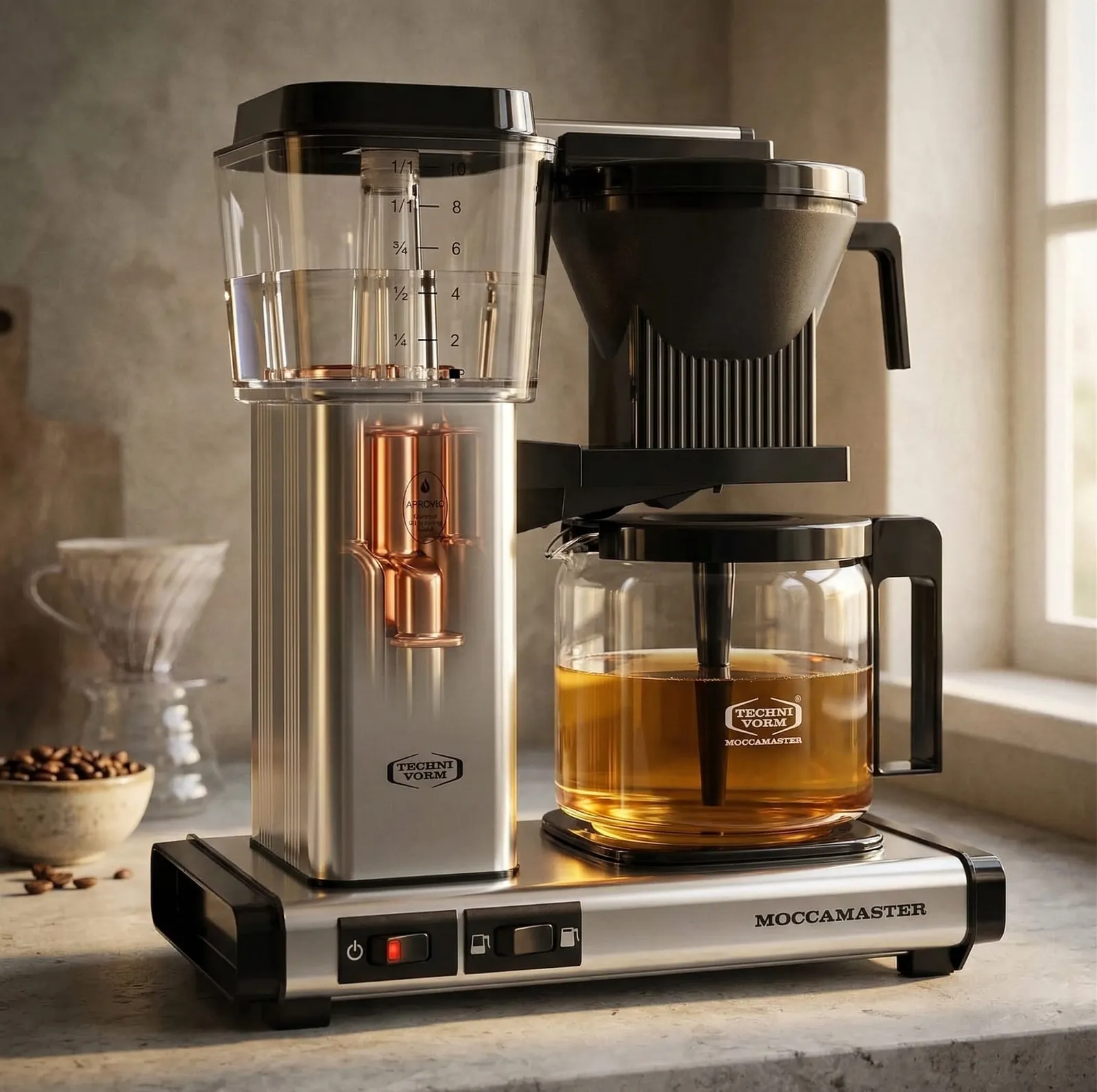
Temperature consistency is its strength. The copper boiling element kept water in a narrow window while cheaper machines swung widely, and the flow-rate switch gives a hands-on way to bloom fresh grounds. The cost is a high price and a machine with no timer, Wi-Fi or programming.

Best for
Households that want the most consistent brew temperature of any machine tested and prefer one durable machine with no app or programming.
Skip if
You want a brew that starts itself before you wake up, or you drink coffee only occasionally and the price is hard to justify. The Breville Precision Brewer below offers delay-brew scheduling.
  • Measured 196–205°F across 80+ brews
  • Spiral copper showerhead left no dry grounds
  • Hand-assembled in the Netherlands, 5-year warranty
  • Flow-rate switch allows a manual bloom
  • No programmable scheduling
  • Glass carafe and warming plate; flavour degrades after about 45 minutes (a thermal KB version exists)
  • Bloom needs the flow switch set by hand each time
  • Premium price

2. Best value

OXO Brew 9-Cup

$200–$250★ 4.5/5

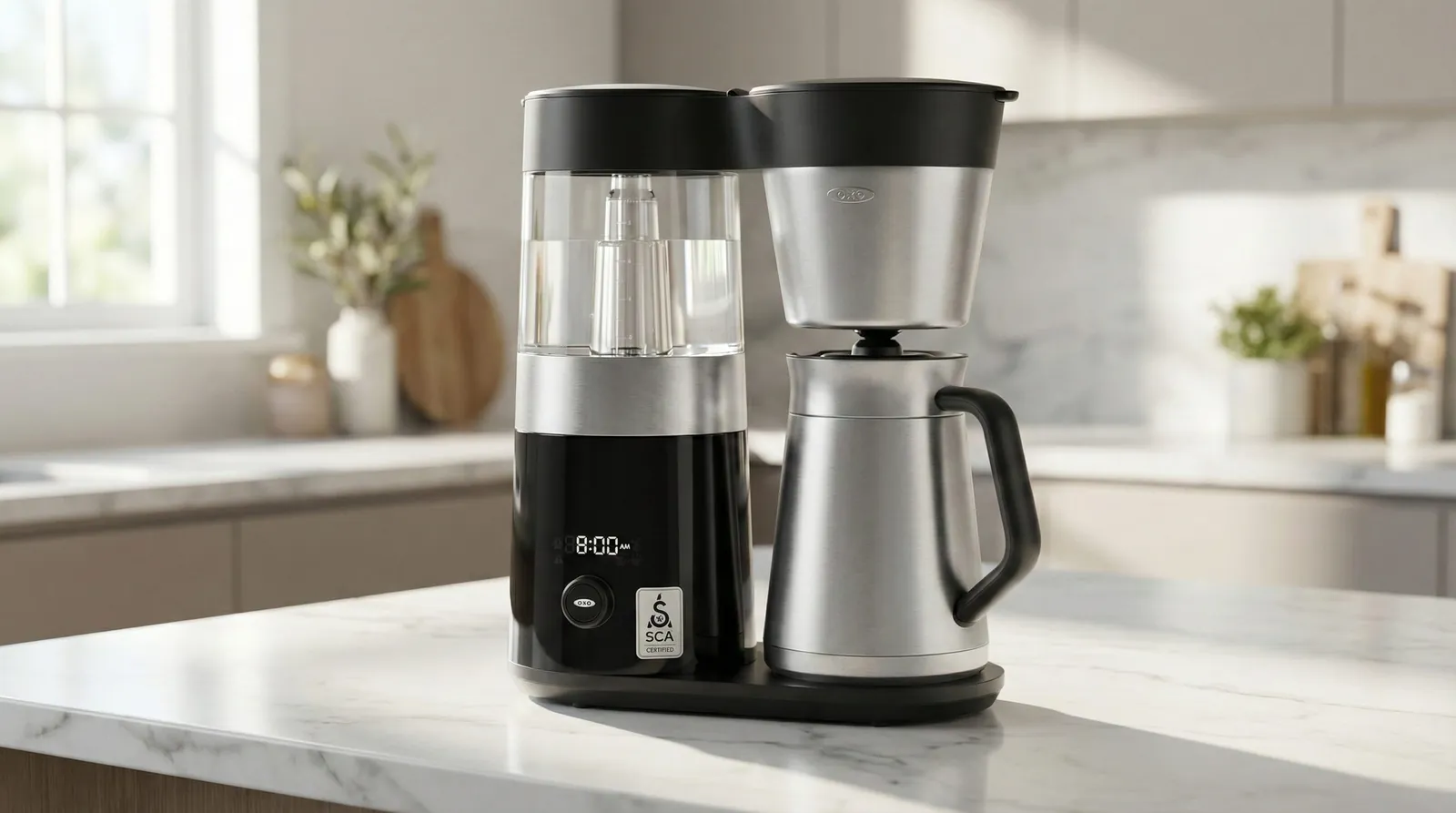
Certified brewing at around $200 is rare, and the automatic bloom plus rainmaker showerhead soak the grounds evenly. Extraction evenness matched machines costing twice as much. The trade-offs are no built-in grinder, no strength or temperature settings, and a 9-cup capacity that works out to about 4–5 mugs.

Best for
Buyers who want SCA Gold Cup brewing without a premium price, and households that value easy cleaning and a carafe that holds heat for about two hours.
Skip if
You regularly brew for more than 4–5 mugs, want to see the coffee level through a glass carafe, or want strength and temperature settings. The Fellow Aiden offers far more control.
  • SCA certified at around $200, with automatic bloom
  • Rainmaker showerhead gives even saturation
  • Easiest filter basket and water tank access of any machine tested
  • Thermal carafe held 168°F about two hours after brewing, with no burnt taste
  • Opaque thermal carafe makes it hard to see the coffee level
  • No strength or temperature settings, and no built-in grinder

It pairs scheduled brewing with real control over bloom and temperature at a modest price. In pour-over mode, two of three tasters preferred it to a Chemex on the same coffee. The trade-off is a lighter build and a filter basket that needs care to seat.

Best for
Anyone who wants fresh coffee on a schedule while keeping bloom and temperature control.
Skip if
Build quality and long-term durability matter more than programmability. The filter basket needs careful seating, and the overall feel is a step below the Moccamaster at a similar price.
  • Adjustable bloom time and temperature offset
  • Pour-over mode slows flow to mimic hand brewing
  • 24-hour scheduling
  • Consistent timing across 30 brews
  • Filter basket is fiddly to seat, with 2 misalignment spills in testing
  • Thermal carafe lid needs two hands until broken in
  • Build feels lighter than the Moccamaster

4. Best for enthusiasts

Fellow Aiden

$379–$399★ 4.3/5

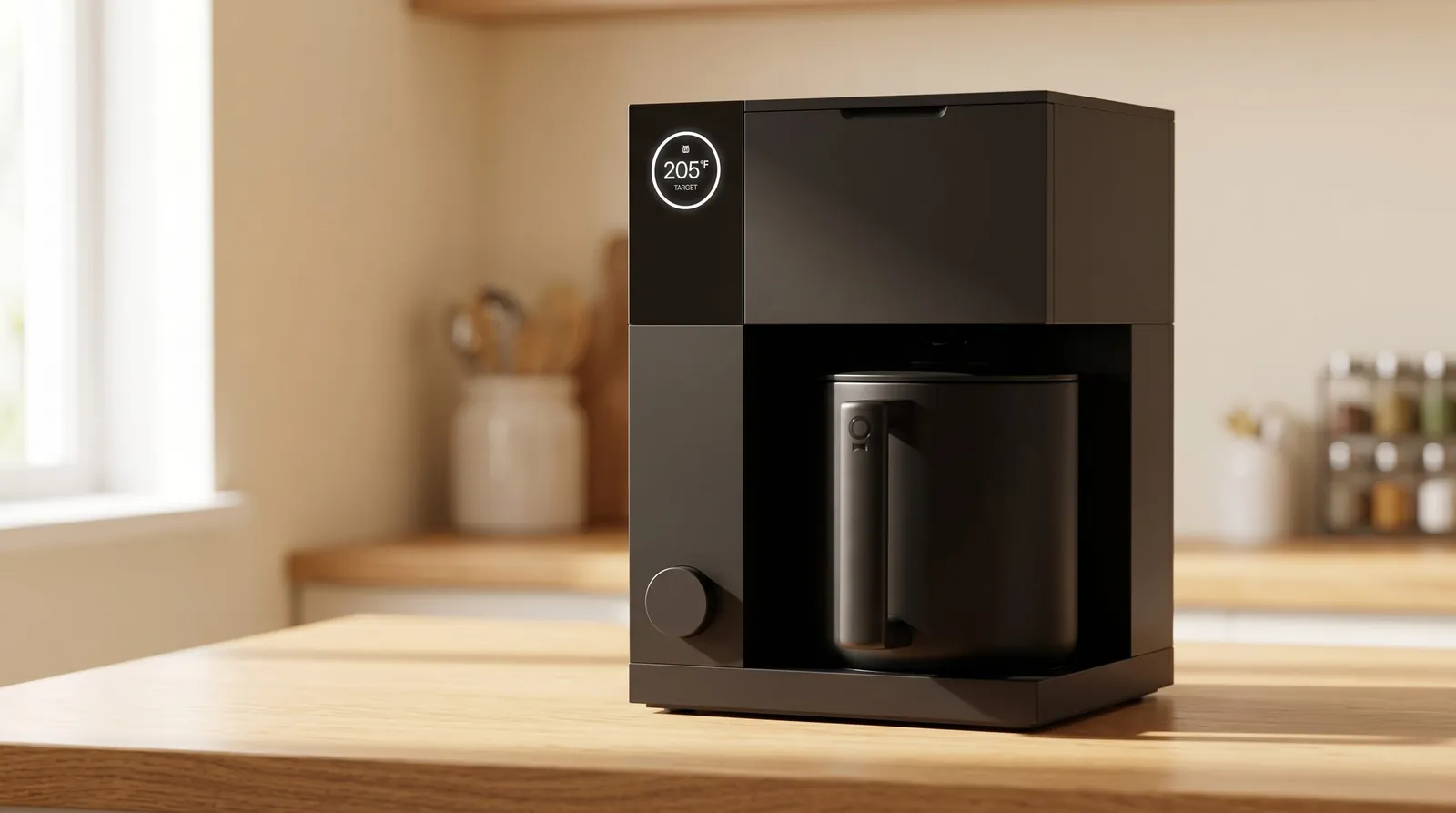
Slowing the flow on a light roast changed the cup more than any other setting tested, and the app stores a recipe for each coffee. It comes closer to hand brewing than any other machine here. The catch is the highest price in the group and settings you must tune yourself.

Best for
Specialty coffee enthusiasts who understand pour-over technique and want a dialled-in recipe repeated automatically.
Skip if
You want to buy a machine and never touch a setting. The best results come from tuning flow rate and bloom per coffee, and you pay for that control. The Moccamaster or Bonavita suit set-and-forget buyers.
  • Variable flow rate made the biggest quality difference of any setting tested
  • App profiles and Wi-Fi scheduling
  • Closest automatic match to manual pour-over here
  • Temperature held 199.1–200.8°F across 70+ brews
  • Most expensive machine in this comparison
  • Best results require dialling in flow and bloom yourself

One switch, 200°F water and a thermal carafe make this a simple SCA-certified machine at around $100, and it beat every machine tested in the $50 to $80 bracket. The trade-off is a showerhead that spreads water less evenly than the Moccamaster's, so the cup is less refined.

Best for
A dorm, a first apartment, or anyone who wants decent SCA-certified coffee without thinking about settings.
Skip if
You are chasing the best possible cup. The showerhead and faster brew speed give a thinner result than the Moccamaster or OXO.
  • Hit 200°F consistently in testing
  • Thermal carafe at a budget price
  • Single-switch operation
  • Less even showerhead distribution, giving a thinner cup
  • Faster brew speed reduces contact time
  • No bloom pre-infusion

It offers 24-hour programming at the lowest price here, which suits offices and big households happy with an everyday cup. Water reached the grounds well under the 195°F SCA minimum, so light roasts taste flat and slightly sour, and the strength setting only changes brew time.

Best for
Offices, large households, or anyone who wants 24-hour programming at the lowest price and accepts an everyday cup.
Skip if
Extraction quality matters to you at all. It brewed well below the SCA temperature minimum, and the Bonavita costs about the same.
  • Most affordable programmable machine in this comparison
  • 24-hour scheduling and self-clean
  • Widely available, with easy-to-find replacement parts
  • Peaked at 187°F and averaged 181°F at the grounds
  • Flatter, sometimes sour cups on light roasts
  • "Brew strength" adjusts brew time only

How do I choose a drip coffee maker? Buying guide

If this is your situation, then this is the trade-off to make.

Carafe, temperature and bloom

If: you sip coffee over an hour or more

Choose thermal. A glass carafe keeps coffee hot by heating it continuously, so coffee left on the plate for a long time tends to go flatter and more bitter as heat drives off aromatics. A thermal carafe holds temperature passively. If you drink the full pot within 20 minutes, glass is fine, and you can see the fill level. The OXO, Breville, Aiden and Bonavita are thermal; the Moccamaster KBGV Select and Cuisinart are glass (Moccamaster sells a thermal KB version at the same price).

If: flavour is the priority

Buy a machine that reaches 195–205°F (90–96°C). That is the SCA brewing range, and most budget machines run at 175–185°F, which under-extracts and gives a thin, slightly sour cup. In testing, every recommendation here reached the range except the Cuisinart. SCA certification shows a machine can hit the target; it does not guarantee every cup tastes better, because beans, grind and water still matter.

If: you buy beans within two weeks of roast

Bloom is worth having. It adds about 0.08–0.16% TDS on fresh beans in our results (see the bloom results below). If you mostly brew older or pre-ground coffee, it matters less and the Bonavita's lack of bloom is not a problem. Read our coffee bloom guide for the science.

Programming and fit

If: you want coffee waiting in the morning

Choose the Breville (full 24-hour scheduling) or the Fellow Aiden (Wi-Fi scheduling). The OXO has a programmable timer. If you brew by hand each morning anyway, skip it: the Moccamaster and Bonavita have no timer and make better coffee per dollar than the cheapest programmable machine.

If: your counter sits under cabinets

Measure the height before you buy. Machines with a tall water reservoir and carafe need clearance to fill and to remove the carafe. Capacity also changes the size: the OXO is a 9-cup machine and the Cuisinart a 14-cup. Dimensions are not listed here, so check the manufacturer's specifications. If you only brew one or two cups, a small machine such as the aarke below can make more sense.

Budget, ownership and what to skip

If: you want the best drip coffee maker under $100

The Bonavita BV1900TS is the pick here, at roughly $89–$110. It is SCA-certified, has a thermal carafe and reached 196–200°F in testing, which is the part that matters most at this price. The Cuisinart DCC-3200 costs about the same or less and adds a timer, but it brewed well below the SCA range, so you are trading cup quality for convenience. If you need a timer, consider saving toward the OXO or Breville instead. Our best programmable coffee makers comparison goes deeper on that choice.

If: you are weighing price against longevity

Think about cost per year of ownership, not just the sticker. The Moccamaster carries a 5-year warranty and is built to be repaired, which spreads its $349–$369 price over many years of daily use. Cheaper machines usually have simpler heating parts and shorter warranties, so plan on replacing a budget machine sooner. Warranty terms vary by seller and region, so confirm them on the manufacturer's page before you buy.

If: a machine advertises a very large capacity or lots of presets

Be sceptical of features that do not touch brew temperature, saturation or contact time. A 12 to 14-cup capacity is useful only if you actually brew that much, because most machines extract poorly when you run them far below their rated batch size. Extras such as a built-in clock display, a strength dial that only changes brew time, or a pause-and-serve function rarely improve flavour. Spend on temperature accuracy and showerhead design first.

If: you are deciding between drip and a manual method

A good automatic machine saves time and repeats the same recipe daily, while pour-over gives you more control and costs less up front. If you brew one cup at a time and enjoy the ritual, a manual dripper may suit you better. If you brew for two or more people or want it hands-off, drip wins. Our drip vs pour-over comparison walks through the differences, and the coffee ratio calculator helps you set the right dose for any batch size.

Before you upgrade

If: you use pre-ground or stale beans

Upgrade the grinder first. A $200 OXO paired with a burr grinder such as the Baratza Encore will outperform a $400 drip machine paired with pre-ground supermarket coffee. Use a medium grind and beans within 2 weeks of roast. Our best coffee grinders comparison covers every budget, and the descaling guide helps keep any machine brewing at full temperature.

Want a bigger budget view? See our best coffee makers under $500.

What are the best alternatives to these drip coffee makers?

Strong options that fit narrower needs than the picks above.

aarke Coffee Maker

$395–$425. Reviewed by our Q Grader Sarah Chen, it measured 197–203°F across 45 brew cycles, with an automatic 30-second bloom and a brushed stainless thermal carafe. There is no timer, and it shows up weak grinders, so pair it with a burr grinder.

BALMUDA The Brew

$679–$699. A Japanese-designed 600ml machine with a swing-arm mechanism that mimics hand-pouring. It competes on design and craft rather than extraction performance per dollar.

Miele CM 5310 Silence

A bean-to-cup machine, so a different category. Our Q Grader Sarah Chen measured 58–62 dB during grinding, 10–12 dB quieter than comparable bean-to-cup machines. Not a drip replacement.

Outin Mino (travel or no power)

Every machine here needs a mains outlet. For the road or a campsite, the Outin Mino is the most convenient battery coffee maker we have tested. It is a portable espresso maker, not a drip replacement.

Takeya Tritan Cold Brew maker (cold brew)

Drip machines cannot do cold brew, because it needs an immersion pitcher. We tested this one over 30+ batches.

VINCI Express Cold Brew maker (cold brew)

Tested over 25+ batches, with concentrate in 5 minutes.

KitchenAid 38 oz Cold Brew carafe (cold brew)

Tested over 28 batches, borosilicate glass.

How were these drip coffee makers tested and ranked?

Every machine went through a structured 60-cycle protocol (10 brew cycles per machine).

  • Brew temperature: measured at the grounds, not in the reservoir, with a calibrated digital thermometer in the filter basket during brewing. A machine that misses the SCA range of 195–205°F (90–96°C) consistently cannot earn a top recommendation, whatever its features.
  • Bloom: the same Ethiopian Yirgacheffe (3–5 days off roast, high CO2) was used for every bloom test, comparing TDS with and without bloom.
  • Taste and extraction: a consistent medium grind (Baratza Encore, setting 18), a 60 g/L ratio and filtered water of known hardness. Cups were blind-tasted by three people, including two trained baristas.
  • Cleaning: each machine was deliberately neglected for two weeks, then assessed for ease of descaling and part cleaning. Removable showerheads, accessible baskets and self-clean modes counted toward the score.

Brew temperature at the grounds

Technivorm Moccamaster KBGV196–205°F (Most consistent)
Fellow Aiden199–201°F (Variable by profile)
OXO Brew 9-Cup197–204°F (SCA compliant)
Breville Precision Brewer195–201°F (Offset adjustable)
Bonavita BV1900TS196–200°F (Simple but accurate)
Cuisinart DCC-3200179–187°F (Below SCA range)

SCA standard: 195–205°F (90–96°C) at the grounds.

Bloom and extraction (TDS)

Bloom raised TDS on fresh beans: the OXO's automatic 45-second bloom took it from 1.32% to 1.48%, while the Fellow Aiden's 45-second bloom and the Moccamaster's half-open flow switch each added about 0.08–0.12%.

MachineBloom typeTDS, no bloomTDS, bloomDifference
Technivorm KBGVManual switch——+0.08–0.12%
Fellow AidenAdjustable auto——+0.08–0.12%
OXO Brew 9-CupAuto 45s1.32%1.48%+0.16%
Breville Precision0–60s adjustable1.21%1.39%+0.18%
Bonavita BV1900TSNone1.19%——

Frequently Asked Questions

Quick answers before you buy.

Bloom is the 30–45 second pre-infusion phase where a small amount of hot water saturates the grounds before full brewing begins. Freshly roasted coffee releases CO2 when hot water hits it.

Without a bloom, that gas creates a barrier that water flows around, leaving dry spots in the grounds. The OXO Brew 9-Cup, Fellow Aiden and Breville Precision Brewer include bloom cycles, and the Moccamaster KBGV Select has a flow-rate switch for a manual bloom.

Bloom matters most with beans roasted within the last few weeks, since older coffee has already released most of its CO2.

Not automatically. The SCA specifies 195–205°F (90–96°C) as the brewing target, and certification tells you a machine can reach it.

That is a useful shortcut, because many budget machines are not certified and can run cooler. It does not guarantee every cup will taste better: beans, grind and water still matter, so check brew temperature before you buy and do not treat certification as the whole story.

Closer than most people expect, with the right machine. The Fellow Aiden comes closest: its adjustable flow rate (10–20 mL per second), programmable bloom and temperature control cover the same variables you would control by hand.

The Chemex Ottomatic takes a different route, automating the Chemex pour-over with the same bonded paper filter and borosilicate carafe. The Moccamaster with its flow switch and fresh beans is another strong option, since its spiral showerhead spreads water evenly.

What separates mediocre drip from pour-over-quality drip is even water distribution, accurate temperature, a proper bloom and a medium grind from a decent burr grinder.

Daily, rinse the carafe, filter basket and lid with warm water, because coffee oils go rancid within 24 hours. Weekly, wash all removable parts with mild soap and wipe the showerhead, where scale builds fastest.

Descale on a schedule: every 3–4 weeks in hard water areas and every 6–8 weeks in soft water areas. Use a descaling solution such as Urnex Dezcal, or check your manual, since some manufacturers advise against vinegar.

You are overdue if brewing slows, coffee tastes bitter or flat, or a white mineral ring forms inside the carafe. The OXO Brew and Breville have self-cleaning modes, which are worth running but do not replace descaling.

For most buyers, the OXO Brew 9-Cup at roughly $200–$250 is the best value, because it is SCA-certified, blooms automatically and has basic programming.

If your budget is closer to $100, the Bonavita BV1900TS is the better buy.

Spending more on the Moccamaster mainly buys temperature consistency and long-term durability rather than a dramatic jump in everyday flavour.

For most people, yes, if you do not drink the whole pot within about 20 minutes.

A thermal carafe keeps coffee hot without a heating plate, so flavour holds longer.

A glass carafe is fine for quick drinkers and lets you see the level, but coffee left on the plate gets flatter and more bitter over time.

The usual causes are water that is too cool, a grind that is too coarse, or too little coffee per litre. A machine that brews well under 195°F, as the Cuisinart DCC-3200 did in our testing, will tend to under-extract regardless of settings.

Try a finer grind and a stronger ratio first, then consider descaling. Bitter coffee has a different set of causes.

Why does coffee taste bitter? →

Budget machines commonly last a few years with daily use, while better-built models are designed to last much longer, with the Moccamaster backed by a 5-year warranty.

Regular descaling is the biggest factor in lifespan, because scale damages heating elements and slows brewing.

Expect results to vary with water hardness and how often you brew.