Coffee maker review
Last updated
Mr. Coffee 14-Cup Review 2026: Big, Cooler Brew
Is a cheap, big drip coffee maker good enough? Our Mr. Coffee 14-cup programmable review tested 40 pots: reliable timer, cooler brew. Who should skip it?
- Our rating 3.9/5
- By Sarah Chen
- 22 min read
- Independently tested: 40+ pots over 4 weeks of daily testing
Affiliate disclosure: this page contains Amazon affiliate links. We may earn a commission if you buy through them, at no extra cost to you, and it never affects our rankings. Learn more
Mr. Coffee 14-Cup Programmable Coffee Maker Stainless Steel at a GlanceWorth considering
A capable, no-fuss budget pot for medium and dark roasts; the low brew temperature makes it a poor fit for specialty light roasts.
Budget Programmable Drip Coffee Maker
Affiliate link: we may earn a commission at no extra cost to you. It never affects our rating.
- 14-cup
- Capacity
- 1-year
- Warranty
On the brew bench· 40 pots · 4 weeks
Why it stands out
- 14-cup capacity, among the largest under $80
- 24-hour programmable timer works reliably
- Bold setting gives a measurably fuller cup
Watch out for
- Brew temperature runs 4–10°F below the SCA target
- Specialty light roasts taste flat; 1-year warranty
✓ Best for
Households or small offices that want a full 14-cup pot ready every morning without any dial-in or skill
✕ Skip if
Specialty coffee drinkers using light-roast single-origin beans
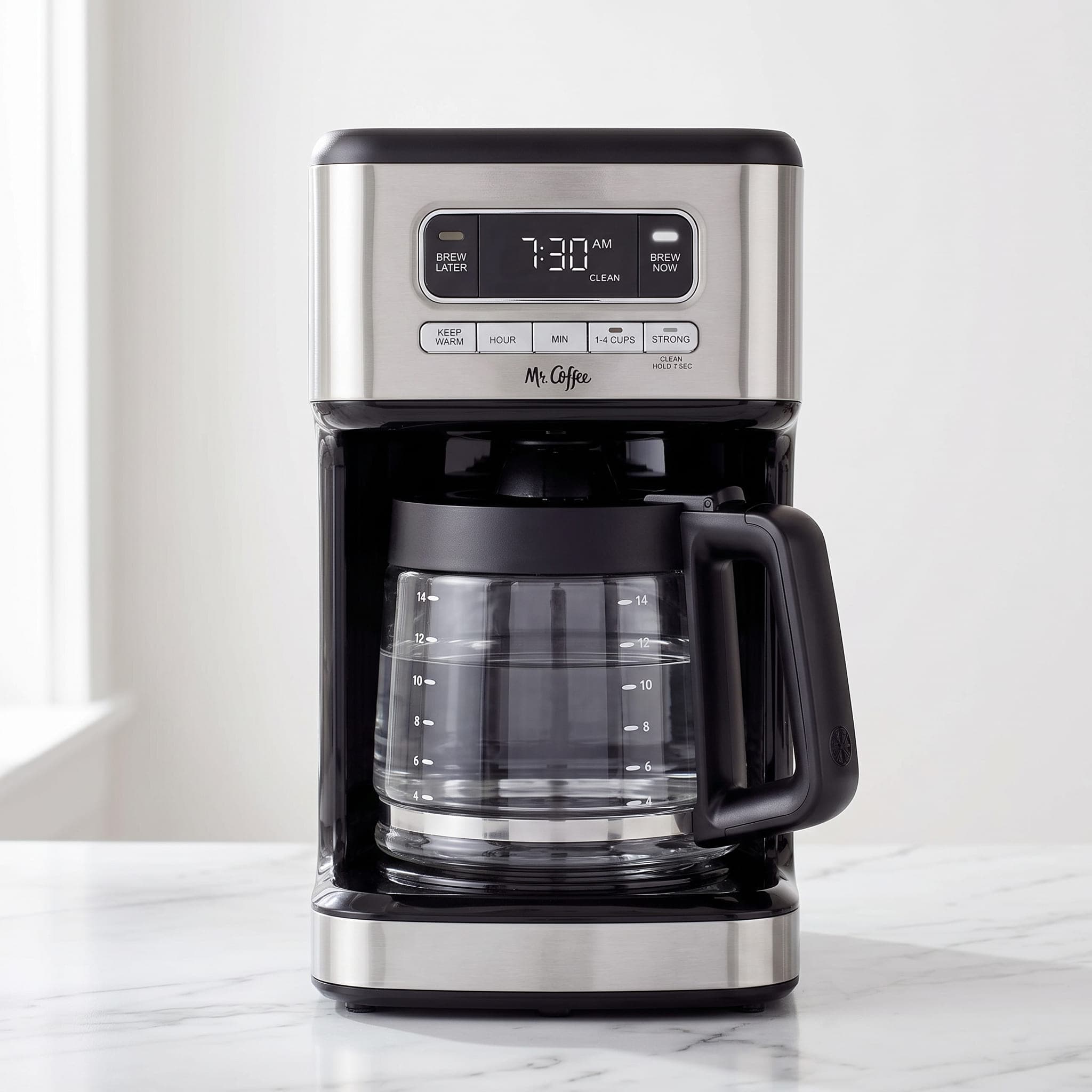
This Mr. Coffee 14-cup programmable review starts with the caveat: it is not a precision machine. brew temperature averaged 186–191°F at the filter basket, roughly 4–10°F below the SCA target, so specialty beans taste noticeably underwhelming.
The short answer: it suits households and small offices brewing medium and dark roasts or commercial pre-ground coffee in big batches, while specialty light-roast drinkers should look elsewhere.
- What held up: The 24-hour delay timer fired reliably, and Bold brew produced a noticeably fuller cup than the standard cycle.
- Where it fell short: The housing is lightweight plastic, the carafe handle flexes slightly under a full load, and the warranty is only 1 year.
- Where it fits: The swing-out filter basket is easier to use than top-load designs, and 14 cups is among the largest capacities under $80.
It isn't competing with the Technivorm Moccamaster or the Fellow Aiden, but with other sub-$100 programmable drip makers.
Who Is This Right For?
Check where you fit before you look at the trade-offs below.
A strong match
It suits you if you are
- Households or small offices that want a full 14-cup pot ready every morning without any dial-in or skill required
- Budget-conscious buyers who want a large-capacity, reliable programmable machine under $80
- People brewing commercial pre-ground coffee rather than chasing specialty single-origin extraction
Consider something else
Look elsewhere if you are
- Specialty coffee drinkers using light-roast single-origin beans, who will notice the below-SCA brew temperature as flat, underextracted flavor
- Buyers who want a thermal carafe instead of a glass carafe and warming plate
- Anyone expecting a decade-long lifespan from the lightweight plastic housing
- Skill level
- Beginner-friendly — no calibration, dialing in, or brewing knowledge required
- Drink style
- Standard drip, full-pot batch brewing with a Standard/Bold strength toggle
- Upgrade path
- Buyers who outgrow the Mr. Coffee's extraction ceiling should look at an SCA-certified machine like the Gevi 10-Cup or, at a higher budget, the Technivorm Moccamaster
Pros & Cons
What earns the rating, and what you give up to get it.
8 reasons it works
Pros
- 14-cup capacity — one of the largest available under $80
- 24-hour programmable timer works reliably in real-world use
- Bold brew setting produces measurably fuller extraction
- Swing-out filter basket is easier to use than top-load designs
- Pause & Pour works without overflow or basket drip
- Stainless steel front panel looks clean and more premium than the price
- 2-hour auto shutoff prevents scorched coffee and is a safety net for busy households
- Water level markings on both sides of reservoir
7 trade-offs to weigh
Cons
- Brew temperature runs roughly 4–10°F below the SCA Gold Cup range on average (185–195°F measured vs 195–205°F)
- Glass carafe handle has slight flex under full 14-cup load
- Lightweight plastic housing — durable enough but not built to last a decade
- Specialty light roast beans taste noticeably flat at these brew temperatures
- 2-hour auto shutoff is not adjustable
- No thermal carafe option
- 1-year warranty is below average for the category
Weighed the pros and cons? Check today's price on Amazon; prices change often.
Current price: $69–$79
Real-World Testing
How it performed in day-to-day use, in the order you will meet it.
Setup & Learning Curve
Build and controls were straightforward:
- Build: the stainless-steel front panel looks more premium than the $69–$79 price suggests, though the housing behind it is lightweight ABS plastic — expected at this price and not a concern for typical 3–5 year use, though not built to last a decade.
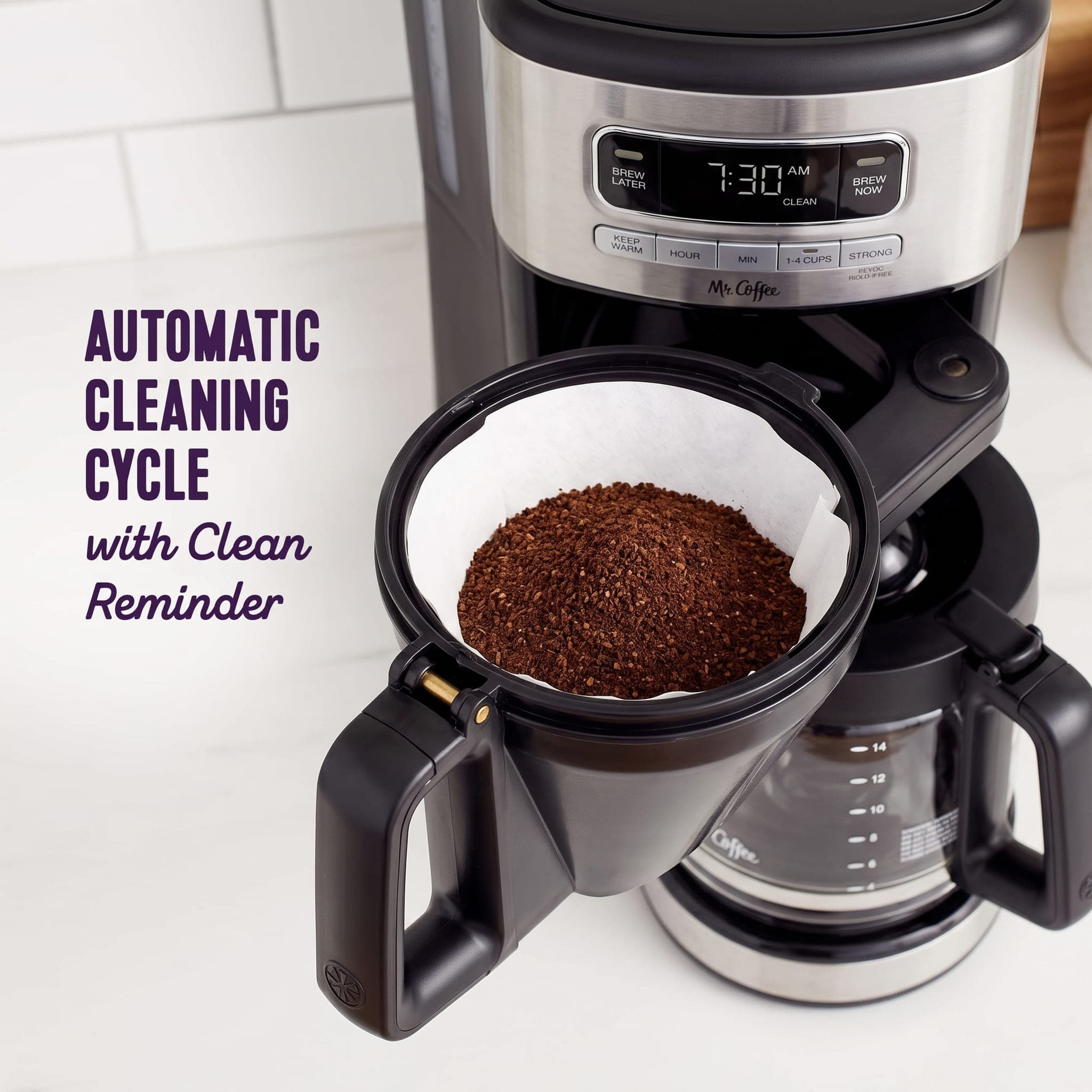
- Filter basket: the swing-out design loads and cleans without the awkward reach of top-load designs.
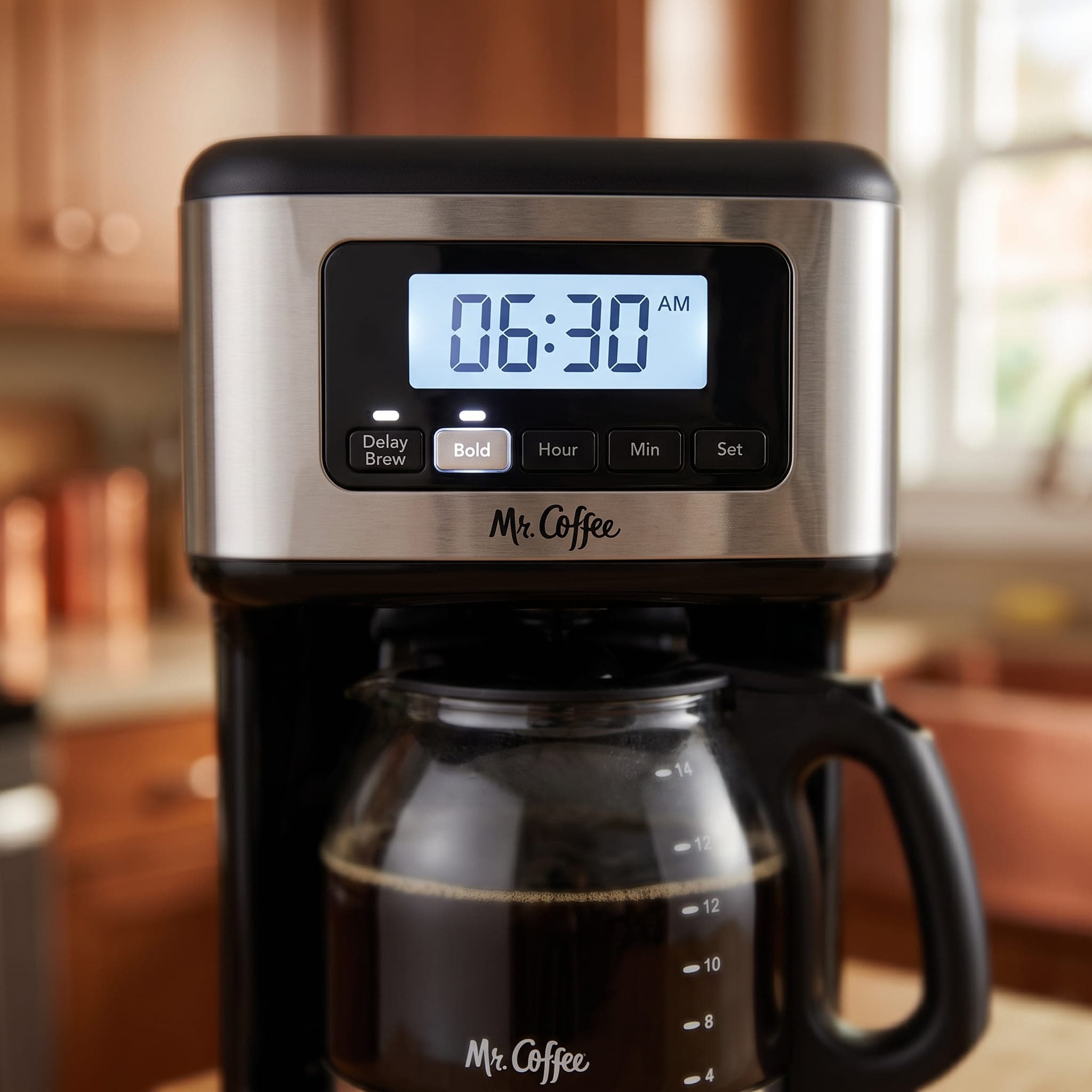
- Controls: the LCD panel needed no manual, and setting the delay brew timer takes two button presses.
- Timer: the 24-hour programmable timer fired within 60 seconds of its set time across seven consecutive mornings of testing.
Dial-In Workflow
There's no grind or extraction control here — the only real choice is Standard versus Bold brew strength. Bold slows the water flow through the filter basket, adding roughly 90–120 seconds to a full-batch brew. In 15 paired tests using identical beans, dose, and ratio, Bold increased average TDS from 1.10% to 1.18% and produced a noticeably fuller cup with a less thin finish; it's worth using as the default setting for medium roasts.
Shot Extraction Notes
Brew temperature averaged 186–191°F at the filter basket across the full testing period — roughly 4–10°F below the SCA Gold Cup target of 195–205°F. How much that matters depended on the coffee:
- Commercial pre-ground blends (Folgers, Dunkin', Peet's Major Dickason's): tasted appropriately full-bodied at this range, since those beans are roasted and blended to be forgiving across a range of brew temperatures.
- Specialty medium roasts: the Intelligentsia House Blend tasted noticeably flat compared with the same beans brewed at 200°F, missing the caramel sweetness and fruit brightness that higher temperatures bring out.
The gap is a fair trade for the price, not a defect — it just means specialty light-roast drinkers should look elsewhere.
Cleanup & Maintenance
Cleanup is simple: swing out the basket, remove the filter and grounds, rinse.
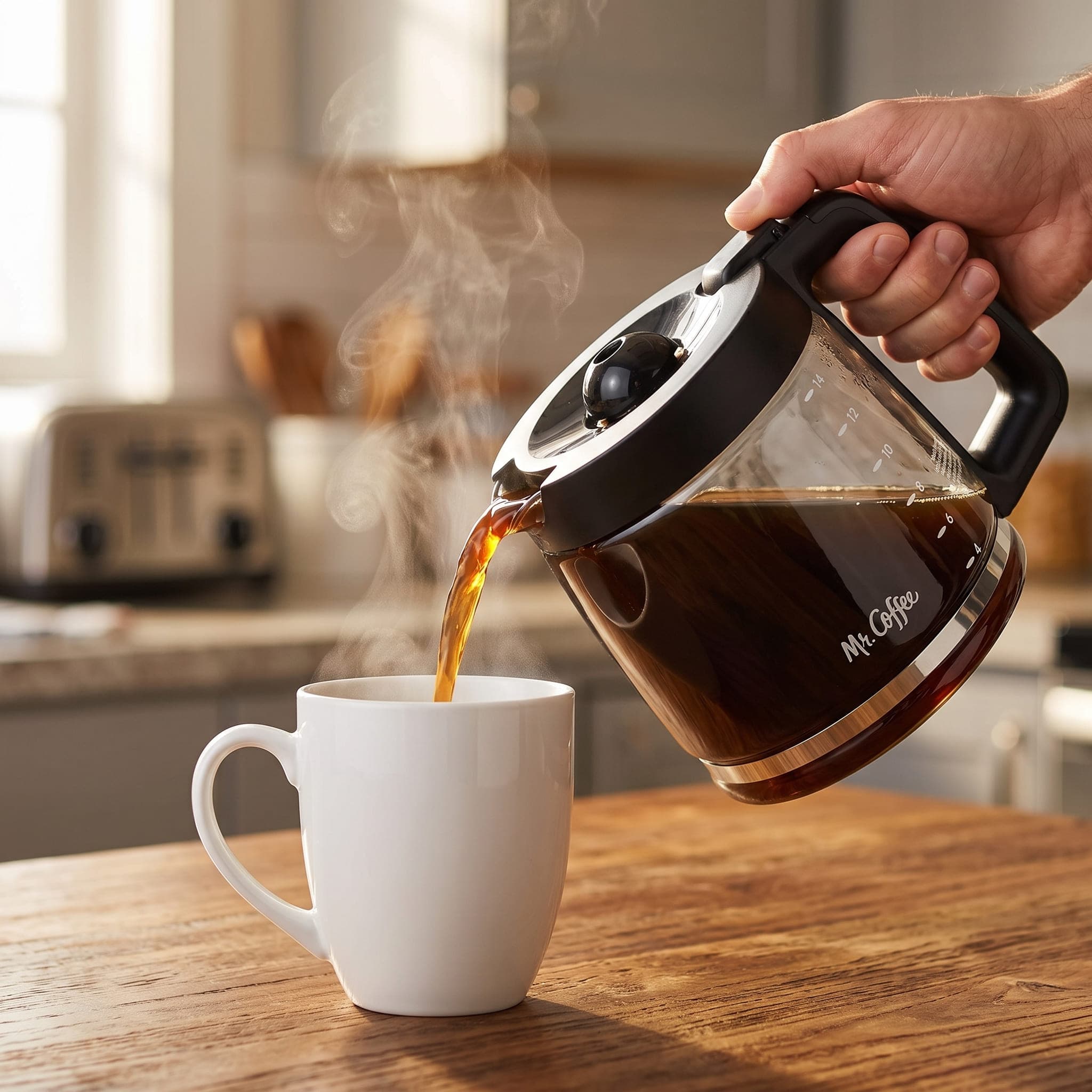
The glass carafe holds steady on the warming plate between 158–168°F through the first 90 minutes, cooling to about 145°F by the fixed 2-hour auto-shutoff — a sensible cutoff that avoids the scorched taste that comes from coffee sitting on heat indefinitely. No thermal carafe option exists for this model, so anyone wanting longer heat retention without a warming plate should look at a machine like the OXO Brew 9-Cup.
Is the Mr. Coffee 14-Cup Programmable worth it?
Value at $69-$79 and what you give up
At $69-$79 (MSRP $79.99) the value case is straightforward: you get a very large batch size, a delay timer and a strength selector at a price where many competitors skip at least one of those. That combination is why this machine suits families and small offices that simply want a full pot waiting in the morning.
The cost of that price is brew temperature, a plastic housing and a 1-year warranty. None of these will bother someone brewing commercial pre-ground coffee. All three matter more if you are buying specialty beans or expect the machine to last a decade.
- Worth it if: you brew large batches of medium or dark roast and want something you can run without thinking about it.
- Not worth it if: you drink one or two cups a day, since a smaller machine wastes less coffee, or if you want the best cup your beans can produce, in which case it is worth spending more.
What the Mr. Coffee 14-Cup's features mean for daily use
Feature, practical impact, who benefits, trade-off
- 14-cup capacity: Large capacity means one brew serves a household or a meeting. Keep in mind that machine "cups" are smaller than a mug, so a 14-cup pot gives fewer full mugs than the number suggests. The trade-off is that brewing a half pot is less efficient than brewing a small one on a smaller machine.
- 24-hour delay timer: You load grounds and water the night before, and coffee is ready when you wake. Anyone with a fixed morning routine benefits. The trade-off is that pre-ground coffee sitting in the basket overnight is slightly less fresh, so use sealed, fresh pre-ground.
- Bold brew: It slows water flow to lengthen contact time, giving a fuller cup. It suits medium roasts, where a standard cycle can taste thin. The trade-off is a longer brew, and it will not fix a bean that is stale or brewed too cool.
- Swing-out filter basket: It means no awkward reach under a cabinet when you load or clean. People with tight kitchen cabinets benefit most. There is no real trade-off here beyond the plastic hinge's long-term durability, which we cannot yet speak to beyond the testing period.
- Glass carafe with warming plate: It is cheap and lets you see the level. The trade-off is that the plate keeps coffee warm but does not preserve flavour as well as a thermal carafe, and the 2-hour auto shutoff is fixed.
- Pause & Pour: You can grab a cup mid-brew without drips on the plate. That is useful for impatient households. The trade-off is that mid-brew pours can be slightly weaker than the finished pot.
Mr. Coffee 14-Cup vs Cuisinart 14-Cup, Black+Decker and Gevi
How it compares with other budget drip makers
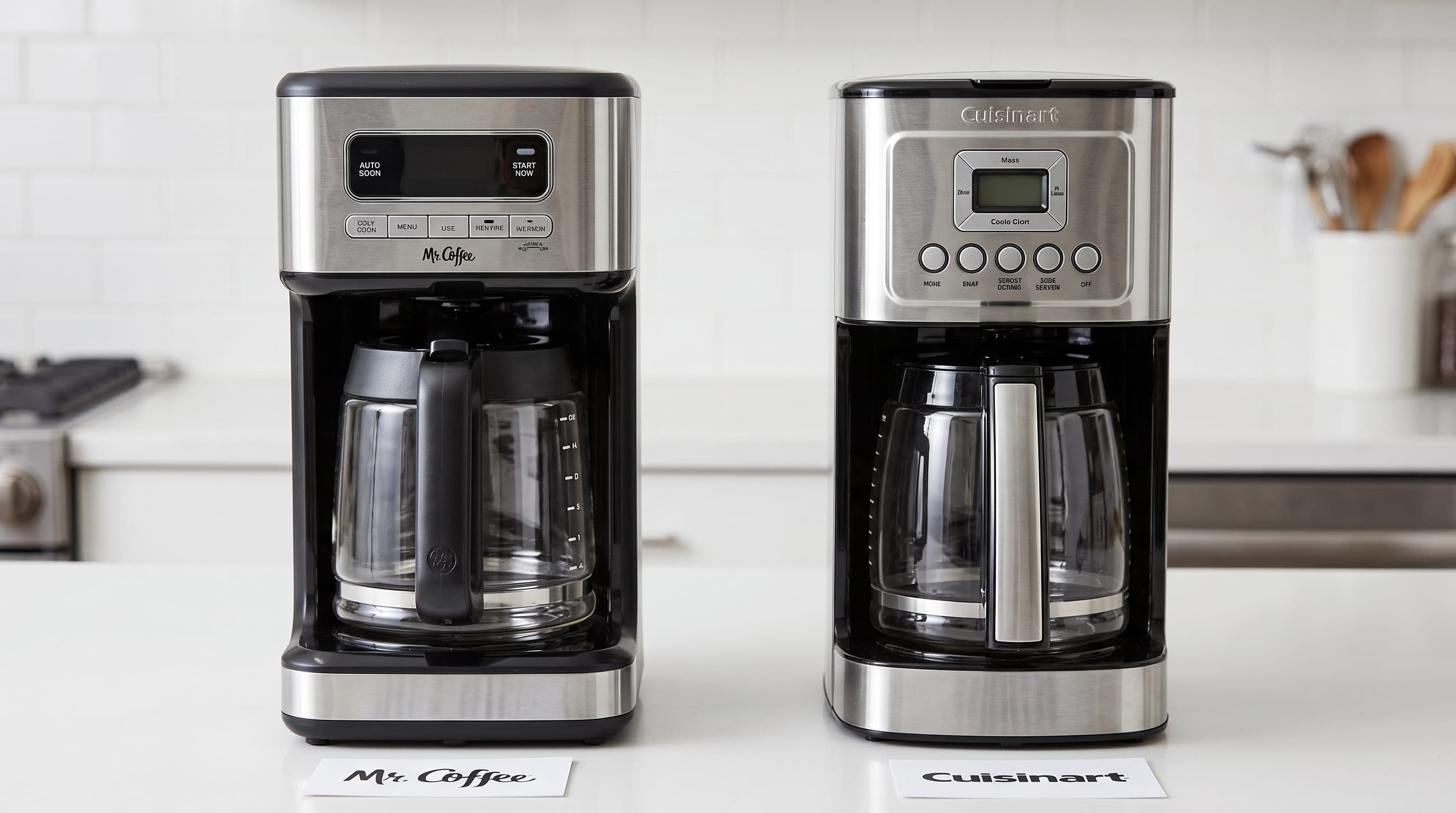
Vs the Cuisinart 14-Cup. The Cuisinart 14-Cup Coffee Maker costs more ($80-$150) and offers tighter brew-temperature performance. If your coffee matters more than convenience, the Cuisinart is the better pick. If you want the simplest morning routine, the Mr. Coffee's swing-out basket and large display are easier to live with.
| Product | Type | Capacity | Key feature | Current price |
|---|---|---|---|---|
| Mr. Coffee 14-Cup | Programmable drip | 14-cup | Largest capacity under $80; 24-hour timer | Check price |
| Cuisinart 14-Cup | Programmable drip | 14-cup | Bold mode and 1-4 cup setting | Check price |
| Black+Decker 12-Cup | Programmable drip | 12-cup | Reliable 24-hour timer; compact 9.6" width | Check price |
| Gevi 10-Cup | Programmable drip (thermal carafe) | 10-cup | SCA-range 197–202°F; 3-year warranty | Check price |
| OXO Brew 9-Cup | Drip (thermal carafe) | 9 cups | SCA-certified 197–204°F; automatic bloom | Check price |
- Vs the Black+Decker 12-Cup: The Black+Decker Coffee Maker ($59-$89) undercuts it slightly with a smaller capacity. Choose it if 12 cups is plenty and you want to spend less; choose the Mr. Coffee if you regularly brew for a crowd.
- Vs the Gevi 10-Cup: The Gevi 10-Cup Drip Coffee Maker is the step up for people who want SCA-certified extraction and are willing to pay more and brew a smaller batch.
- Vs premium drip: The OXO Brew 9-Cup and Technivorm Moccamaster cost considerably more, brew better, and also last longer. See our best programmable coffee makers and best drip coffee makers comparisons for the full range.
How do you set up, clean and descale the Mr. Coffee 14-Cup?
Ownership routine
Setup is the simplest part: set the clock on the LCD, add water and a #4 paper filter or a permanent filter, add grounds, and choose Standard or Bold. Programming the delay brew takes two button presses.
- After each pot,: swing out the basket, discard the filter and grounds, and rinse the basket and carafe. A glass carafe is easy to clean, but it can crack, so avoid sudden temperature shocks.
- Descaling: keeps flow and temperature consistent. Mineral build-up slows water flow and can make an already modest brew temperature worse, so descale on a regular schedule and more often in hard-water areas. Our descaling guide shows the general method, and the cleaning tablets guide lists options. If you notice drips or overflow, see our coffee maker leaking water guide.
- Ongoing costs: are low: paper filters and a replacement carafe if the glass breaks.
How can you get better coffee from a budget drip machine?
Practical tips given the machine's limits
Because you cannot change temperature, focus on what you can control:
- Use Bold for medium roasts. In our paired tests it gave a fuller cup.
- Choose forgiving coffee. Medium and dark roasts and commercial blends suit lower brew temperatures better than light roasts. A bean like Peet's Dark Roast is a natural fit.
- Measure your coffee. A scale and a consistent ratio make a bigger difference than any setting. Our coffee ratio calculator helps you scale for a half or full pot.
- Use fresh coffee. Stale pre-ground is the fastest way to a flat pot, especially with the overnight timer.
If you have a grinder, grinding fresh is the next improvement; see how to choose in our burr grinder guide.
How a budget drip machine brews
Heating tube, spray head and hot plate explain both its convenience and its limits.
Cold water flows from the reservoir into a heating tube, rises to the spray head and falls through the filter basket onto the grounds. A warming plate keeps the pot hot afterward. This design is simple and cheap, and it is why 14 cups of coffee are ready in a few minutes.
Brew temperature is the sticking point. Budget heating tubes often deliver water cooler than the roughly 195-205°F specialty target, so extraction is lower and flavor flatter. Bold mode slows the flow and lets the water stay in contact longer, which lifts strength a little. The delay timer starts the same cycle at a set time.
Large batches also affect taste: a deep bed of grounds wets unevenly, and the carafe sits on a hot plate that cooks the coffee. Darker roasts and medium grinds tolerate these conditions better than light roasts. Drip versus pour-over explains why careful control improves flavor.
Common problems and modern fixes
Flat flavor and stale pots have inexpensive upgrades.
- Flat or sour coffee: use fresher, darker beans, grind just before brewing and use Bold mode. The grind size chart shows a medium target.
- Bitter pot: pour leftovers into a thermal flask rather than leaving them on the plate; see why coffee tastes bitter.
- Uneven results: a hand burr grinder improves consistency, and this burr grinder guide lists options.
- Scale and slow brew: descale monthly using this routine or cleaning tablets.
- Metallic or off taste: use filtered water and change paper filters rather than letting a reusable one stay oily.
- Drips from the carafe: this leak guide helps.
Who should skip the Mr. Coffee 14-Cup Programmable?
- Specialty light-roast drinkers. The lower brew temperature leaves flavour behind.
- Solo drinkers. A 14-cup pot is more than one person needs; a smaller machine wastes less.
- Buyers who want a thermal carafe. This model has glass and a warming plate only.
- Anyone wanting a long-term appliance. The lightweight plastic housing and 1-year warranty suggest a 3-5 year machine, not a decade.
- People who want to adjust the auto shutoff. The 2-hour cutoff is fixed.
If any of these apply, the alternatives above fit better.
Before you decide
Mr. Coffee 14-Cup Programmable in the Budget Large-Capacity Drip Category
The Mr. Coffee 14-Cup Programmable sits in the budget large-capacity segment of the drip coffee maker category — machines built to brew a full pot reliably every morning for well under $100, rather than to chase SCA Gold Cup extraction standards. Within that segment, its 14-cup capacity, swing-out filter basket, and reliable delay-brew timer put it ahead of many similarly priced competitors.
If you're comparing it against other budget and mid-range 14-cup machines, the Cuisinart 14-Cup Programmable ($80-$150) offers tighter brew-temperature performance at a higher price, while the BLACK+DECKER 12-Cup ($59-$89) undercuts it slightly on price with a smaller capacity. Buyers willing to spend more for SCA-certified extraction should look at the Gevi 10-Cup Drip Coffee Maker instead.
Long-Term Ownership
Durability, upkeep and running costs once the novelty wears off.
- Durability
The lightweight plastic housing is durable enough for daily use but, per testing observations, is not built to last a decade the way a metal-bodied premium machine might; the glass carafe handle also showed slight flex under a full 14-cup load.
- Reliability
Across testing, the 24-hour programmable timer worked reliably, the Bold brew setting consistently produced fuller extraction, and the swing-out filter basket and Pause & Pour function operated without overflow or drip issues.
- Parts
As a mainstream Mr. Coffee model, replacement carafes and basic parts are widely available through big-box retailers and Amazon.
- Upkeep cost
Standard drip-maker upkeep: periodic descaling and #4 paper filters (or a permanent filter), with no unusual consumable costs beyond typical replacement carafes if the glass carafe eventually cracks.
- Warranty
1-year limited manufacturer warranty, which is below average for the category.
- Resale value
As a sub-$80 budget appliance, resale value is minimal — this is a machine to use until it wears out rather than one with meaningful secondhand demand.
Final Verdict
Our rating, who it fits, and what it costs.
Mr. Coffee 14-Cup Programmable Coffee Maker Stainless SteelWorth considering
3.9 / 5 — Is it worth buying?
The Mr. Coffee 14-Cup Programmable isn't trying to compete with SCA-certified machines, and it shouldn't be judged as if it were.
✓ Best for
- Households or small offices that want a full 14-cup pot ready every morning without any dial-in or skill required
- Budget-conscious buyers who want a large-capacity, reliable programmable machine under $80
✕ Skip if
- Specialty coffee drinkers using light-roast single-origin beans
- Buyers who want a thermal carafe instead of a glass carafe and warming plate
Score breakdown
Pots brewed
40
Testing period
4 weeks of daily testing
Ready to decide?
$69–$79typical street price
Our verdict: 3.9/5, worth considering. Independently tested; commissions never change a rating.
Tools That Pair With This Review
Put it into practice with a free calculator built for what you just read.
- Coffee to Water Ratio CalculatorThe general-purpose ratio tool for drip machines and pour-over — enter water or coffee, pick your strength.
- Pour Over Ratio CalculatorGet your exact water, bloom pour, and total brew time for pour-over coffee.
- Cold Brew Ratio CalculatorConcentrate or ready-to-drink — enter your batch size and get exact grounds and water.
Reader questions
Questions or tips? Leave a comment
Ask about your setup or share what worked for you. Comments are checked before they appear.