Buying Guides

Espresso Machine Types Explained: 2026 Buyer's Guide

Which espresso machine actually fits how you make coffee — not what the spec sheet promises. Manual, semi-automatic, automatic, super-automatic, and pod machines compared honestly, by skill level, budget, and daily routine.

Last Updated: September 22, 2026
25 min read

Here's the question I get asked most behind the counter: “Which espresso machine should I buy?” The honest answer is always another question — how involved do you actually want to be?

Espresso machines split into five genuinely different categories: manual lever, semi-automatic, automatic, super-automatic, and pod. That's not marketing language. Each one hands you a different amount of control over the shot, a different learning curve, and a different daily chore list. Get the type wrong, and no feature list will save you. I've watched people buy a semi-automatic wanting push-button convenience, and buy a super-automatic wanting to learn the craft. Both walked away disappointed.

This guide breaks down what each type actually does — the mechanics, the real learning curve, who it suits — so you can match the machine to how you want to make coffee, not to a spec sheet. At its core, espresso is simple: pressurized water at roughly 9 bars forced through finely ground coffee in under 30 seconds. What changes between machine types is how much of that process you control, and how much the machine takes off your hands.

Quick Answer

There are five espresso machine types — manual lever, semi-automatic, automatic, super-automatic, and pod — and the real difference between them is how much control you keep over the shot versus how much the machine takes off your hands.

Our pick for this: Gaggia Classic Pro (~$449–$499) — a commercial-style 9-bar pump and PID-friendly boiler that make it easy to dial in consistent shots

Espresso Machine Types at a Glance

Espresso Machine Types at a Glance

Machine Type Skill Required Price Range Milk Capability Best For
Manual Lever Expert $300–$2,500 Limited (small boiler) Purists, pressure profiling enthusiasts
Semi-Automatic Beginner–Intermediate $200–$3,000+ Excellent (steam wand) Home enthusiasts, skill builders
Automatic Beginner–Intermediate $400–$2,500 Excellent (steam wand) Consistency-focused home baristas
Super-Automatic None $700–$5,000+ Good (auto frother) Convenience-first users, offices
Pod / Capsule None $100–$700 Limited (basic frother) Casual drinkers, tight budgets

What Is an Espresso Machine?

An espresso machine forces hot water — about 9 bars of pressure, roughly 130 PSI — through finely ground, tamped coffee. The result is a concentrated 1-2 ounce shot in 25-30 seconds, topped with that signature golden crema. It's a fundamentally different process from gravity-fed methods like pour over coffee or immersion brewing like French press, and that difference is exactly why espresso tastes and behaves the way it does.

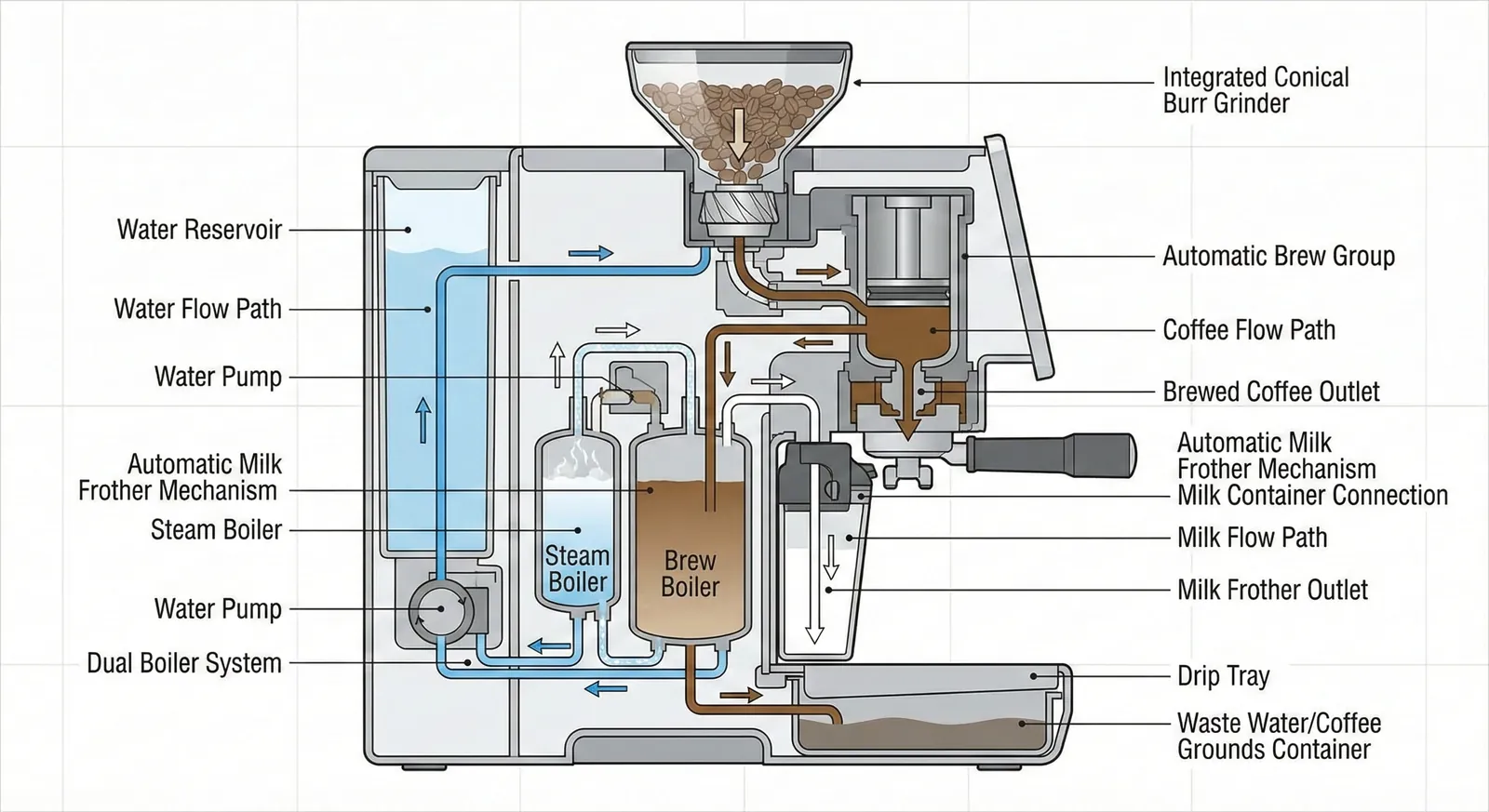
Every espresso machine shares the same core parts: a water reservoir or plumbed line, a heating element or boiler holding water at 195-205°F, a pump generating consistent pressure (vibratory or rotary), a group head that spreads pressurized water evenly across the coffee puck, a portafilter basket, and — on most machines — a steam wand for milk.

What separates one type from another is how those parts work together and how much of the process gets automated. That's what actually drives shot consistency, learning curve, and price — not the logo on the front.

Why type matters more than brand or feature lists: A manual lever machine demands real technique and patience, but rewards you with total control over the shot. A super-automatic asks nothing of you and hands you a solid cup in under two minutes. Neither is objectively “better” — they're built for different people with different goals.

Most buyers get this backwards. They shop by price or brand first, then discover months later the automation level never matched how they actually wanted to make coffee. Sort that out first, and everything downstream — features, price, brand — gets a lot easier to judge.

Cross-section diagram comparing single boiler, dual boiler, and heat exchanger espresso machine configurations, showing water flow and heating elements

Manual Lever Espresso Machines

Manual lever machines are the original espresso method — hands-on in a way nothing else on this list comes close to. They trace back to Achille Gaggia's 1948 invention, the first machine to pull true crema from mechanical pressure instead of steam.

How Manual Lever Machines Work

There are two designs. Spring-lever machines (La Pavoni Europiccola, Elektra Micro Casa) compress a spring when you pull the lever, then let it push water through the coffee as it relaxes — a declining pressure curve you don't have to think about. Direct-lever machines put you in charge of that pressure the entire time; your arm is the pump.

Spring-lever models create a natural pressure profile on their own — high at the start to saturate the grounds, then tapering off — essentially replicating what modern pressure-profiling machines do automatically, with zero electronics.

Either way, you're doing it all: heating (electric or stovetop), grinding, dosing, distribution, tamping, and timing. Nothing is automated here.

Advantages and Disadvantages

Advantages

  • ✓ Total pressure control: you can shape the pressure profile mid-shot in a way fixed-pump machines simply can't match
  • ✓ Built to outlast you: fewer electronics means fewer failure points — 30-50+ years isn't unusual, and repairs are straightforward
  • ✓ Genuinely well-built: brass boilers, chrome-plated brass groups, stainless components — commercial-grade materials throughout
  • ✓ Dead silent: no pump noise, ever — good news if you're pulling shots at 6am next to a sleeping household
  • ✓ You'll actually learn something: nothing teaches extraction variables faster than feeling them under your own hand
  • ✓ They're beautiful: classic Italian designs that earn their spot as a kitchen centerpiece

Disadvantages

  • ✗ The learning curve is real: expect months of practice before your lever technique is consistent
  • ✗ It's physical work: pulling levers takes strength and stamina, especially shot after shot
  • ✗ Temperature surfing: single boilers mean timing your shot carefully around the heating cycle
  • ✗ Slow, start to finish: 5-8 minutes per shot once you count heating, pulling, and steaming milk
  • ✗ Weak steam power: small boilers and manual heating cap how much and how fast you can froth
  • ✗ Not built for guests: inconsistent results and a slow process don't mix well with a crowd wanting drinks

Expert Recommendation:

Manual lever machines are for the dedicated purist — someone who finds the ritual of hands-on preparation genuinely meditative, wants to build real technical skill, and cares more about shot customization than saving five minutes each morning.

Manual lever espresso machine with brass boiler and chrome accents, spring-lever mechanism pulling a shot with visible pressure profiling

Semi-Automatic Espresso Machines

If you asked me to pick one category for someone serious about home espresso, this is it. Semi-automatic machines are the standard behind most café counters and in most enthusiast kitchens — for good reason.

How Semi-Automatic Machines Work

An electric pump — vibratory on budget models, rotary on premium ones — holds 9 bars of pressure, while a thermostat or PID controller keeps water at 198-204°F. That's all handled for you.

You handle everything else: grind, dose, distribute, tamp, and start and stop the shot yourself. Give it 2-4 weeks of daily practice and shot-to-shot consistency clicks into place.

Advantages and Disadvantages

Advantages

  • ✓The right balance of control and convenience: the machine handles pressure and temperature, you still shape the shot
  • ✓Real café-quality shots: pair one with a good grinder and you're matching commercial results
  • ✓You actually learn the craft: teaches real barista fundamentals without the complexity of a manual lever
  • ✓A price point for every budget: quality options exist from $200 up past $2,000
  • ✓Real steam wands: commercial-style wands mean proper microfoam and latte art, not a guess
  • ✓A deep upgrade path: accessories, mods, and community support make these machines grow with you
  • ✓They last: quality models run 10-15+ years with basic maintenance and the occasional part swap

Disadvantages

  • ✗You have to learn it: grinding, dosing, distribution, and tamping all take practice to get consistent
  • ✗It takes time: 3-5 minutes per drink once you count grinding, prep, extraction, and cleanup
  • ✗Cleanup is on you: knock out the puck, backflush the group, purge the wand — every session
  • ✗Single-boiler models make you wait: 30-60 seconds switching between brew and steam temperatures
  • ✗You need a real grinder too: budget $300-800 separately — shot quality depends on it just as much as the machine
  • ✗Expect rough first weeks: results will be inconsistent while your technique catches up

Expert Recommendation:

If you enjoy the craft of making espresso and want café-quality results without going full manual, this is your category. Want a grinder built in and no 3-minute warm-up wait? The Breville Barista Pro ($849-$899) is one of the most workflow-efficient all-in-one semi-automatics we've tested — its ThermoJet heating gets you from cold to ready in seconds, not minutes.

Semi-automatic espresso machine with PID temperature display, pulling a double shot into a bottomless portafilter with clean extraction channels and golden crema

Automatic Espresso Machines

Automatic machines are semi-automatics with one extra piece of help: they stop the shot for you, cutting water flow once a pre-set volume dispenses — typically 1 ounce for a single, 2 for a double.

How Automatic Machines Work

A flow meter or timer tracks how much water passes through the puck and cuts it off at the volume you set.

Everything before that is identical to a semi-automatic: grind, dose, distribute, tamp, lock in, press start.

Advantages and Disadvantages

Advantages

  • ✓More consistent pours: a programmed volume removes manual timing mistakes from the equation
  • ✓Frees up your hands: steam milk or grab a cup while the shot finishes itself
  • ✓Easier while you're learning: one fewer thing to watch and time yourself
  • ✓Built for busy counters: keeps multiple baristas pulling identical shots without thinking about it
  • ✓Same shot quality: dialed in properly, it tastes identical to a semi-automatic

Disadvantages

  • ✗Less on-the-fly flexibility: changing your shot volume means reprogramming, not just stopping early
  • ✗Costs a bit more: volumetric controls typically add $100-300 over a comparable semi-automatic
  • ✗New beans, new settings: a grind change shifts shot timing, so you may need to reprogram volume
  • ✗Same learning curve underneath: you still have to master grinding, dosing, distribution, and tamping

Expert Recommendation:

Good fit for households where more than one person makes espresso at different skill levels, or anyone who just wants one less thing to think about on a rushed morning.

Super-Automatic Espresso Machines

Super-automatics take the whole process off your hands — bean to cup, one button. Built-in burr grinder, automatic dosing, self-tamping, programmed extraction, and on most models, automatic milk frothing too.

How Super-Automatic Machines Work

A built-in burr grinder — usually ceramic — grinds on demand, doses and tamps automatically, then extracts. On models with an automatic frother, it steams and pours the milk too.

Premium versions add grind, dose, and temperature adjustment, saved profiles for different household members, and app connectivity.

Advantages and Disadvantages

Advantages

  • ✓Genuinely one-button: whole beans to finished drink in under 2 minutes
  • ✓Zero learning curve: good results on day one, no barista skills required
  • ✓Remarkably consistent: automated dosing, tamping, and extraction take human error out of the equation
  • ✓No separate grinder to buy: the built-in burr grinder saves counter space and another purchase
  • ✓One machine, many drinks: espresso, Americano, cappuccino, latte, macchiato — all pre-programmed
  • ✓Saved profiles: everyone in the house gets their own settings
  • ✓Barely any cleanup: automatic puck disposal and rinse cycles handle daily maintenance
  • ✓Anyone can use it: guests included, no supervision needed

Disadvantages

  • ✗Not cheap: quality models start around $800-1,200, and premium units run $2,000-5,000+
  • ✗Little control over the shot: minimal ability to adjust pressure profile, pre-infusion, or flow rate
  • ✗The grinder is the weak link: built-in grinders rarely match a dedicated espresso grinder
  • ✗More parts, more that can break: complexity means more potential failure points and pricier repairs
  • ✗The milk system needs daily attention: rinse it every day or risk bacterial buildup and clogging
  • ✗No latte art: automated frothers make decent microfoam, but not wand-precision microfoam
  • ✗They're big: integrated systems typically need 12-18 inches of counter space
  • ✗Repairs aren't DIY: service usually needs a specialized technician and proprietary parts

Expert Recommendation:

This is the category for convenience-first users who drink multiple espresso drinks daily, households with different tastes to juggle, offices, and anyone who wants better quality than a pod machine without ever learning a technique. Popular models include the De’Longhi Dinamica ($799-899, with LatteCrema one-touch milk system), De’Longhi Magnifica Evo ($699-749, best-value entry), Jura E8 ($2,600-2,800), Philips 3200 LatteGo ($699-799, best-value LatteGo entry), Philips 5500 Series ($799-849, with LatteGo and 12 drink programs), Bosch Fully Automatic ($599-649, ceramic grinder and Bosch appliance-grade reliability), Terra Kaffe TK-02 ($995, app-controlled bean-to-cup with saved brew profiles), and Miele CM6 ($1,800-2,200).

Super-automatic bean-to-cup espresso machine with touchscreen display making a cappuccino, showing its integrated burr grinder and automatic milk frother

Pod and Capsule Espresso Machines

Pod and capsule machines use pre-packaged, single-serve coffee — no grinding, dosing, or tamping at all.

How Pod Machines Work and Pod Type Differences

The machine pierces a sealed pod and forces hot water through at a moderate pressure that varies by system — 19 bars for Nespresso, 8-15 bars for most others — dispensing brewed coffee straight into your cup.

Nespresso capsules: the market leader, with aluminum or plastic capsules across 20-30 varieties. Deciding between the two Nespresso platforms? our Nespresso Vertuo vs Original comparison covers the brewing technology difference, capsule lock-in, and which system fits different drinking habits.

E.S.E. pods: pre-portioned paper pods that fit standard 44mm portafilter baskets on many machines, running $0.60-1.00 each — a middle ground between whole-bean freedom and full capsule lock-in.

Keurig and compatible K-Cup systems: built for drip-style coffee, not true espresso. Some claim “espresso-style” shots, but they don't generate the pressure real espresso extraction needs.

Advantages and Disadvantages

Advantages

  • ✓About as easy as it gets: insert pod, press button, drink coffee — no grinding, dosing, or cleanup
  • ✓Every cup is identical: zero technique required, zero variables to manage
  • ✓Cheap to get into: machines start around $100-200
  • ✓Small footprint: fits tight counters, offices, dorms, RVs
  • ✓Easy to explore roasts: try different origins and blends without committing to a full bag
  • ✓No learning curve: anyone can use it immediately, no instruction needed
  • ✓Stays fresher longer: sealed pods hold up better over time than an open bag of beans

Disadvantages

  • ✗Expensive per cup: $0.60-1.40 a shot versus $0.20-0.40 with whole beans — that's $400-800+ a year in the difference
  • ✗Real waste: aluminum and plastic pods pile up fast unless you recycle every single one
  • ✗Limited to the manufacturer's catalog: no access to specialty roasters
  • ✗Shot quality takes a hit: pre-ground coffee isn't fresh, and it shows in the cup
  • ✗No customization: can't touch grind size, dose, or extraction parameters
  • ✗Locked to one brand: the machine only accepts its own pods, so there's no price competition working in your favor
  • ✗Call it “espresso-style” at best: many systems make concentrated coffee, not true espresso

Expert Recommendation:

Pod machines make sense for casual drinkers having 1-2 cups a day who value convenience over ultimate quality, budget-conscious buyers who don't want to invest in a grinder, offices with varying tastes to serve, or as a backup for guests and rushed mornings.

Key Features to Consider

Boiler Type: Single, Dual, and Heat Exchanger Systems

Boiler configuration is the single biggest factor in your daily workflow, especially if milk drinks are in the mix. Single boiler machines use one boiler for both brewing (200°F) and steaming (270°F), so you're waiting 30-60 seconds to switch between the two.

Heat exchanger (HX) machines keep a large steam boiler with a water tube running through it. Fresh brewing water passes through that tube and picks up espresso temperature via heat transfer as it goes.

Dual boiler systems are the premium standard — two separate boilers, each holding its own ideal temperature for brewing and steaming at the same time. No waiting, no temperature surfing. Just a consistent shot and milk ready whenever you are.

Boiler Type Comparison
Boiler Type Brew + Steam Simultaneously? Warm-Up Time Ideal User
Single Boiler No (30–60 sec switch) 10–20 min Solo espresso drinkers, beginners
Heat Exchanger Yes (temperature surfing needed) 15–25 min Milk drink enthusiasts, intermediate users
Dual Boiler Yes (seamless) 15–30 min Serious home baristas, high-volume households

Pressure System: The 9-Bar Standard

Real espresso extraction happens at 9 bars of pressure at the puck. Rotary pumps, found on commercial and premium machines, deliver that pressure smoothly and quietly, and simply last longer than the alternative.

Watch out for machines advertising pressure under 15 bars or with no OPV regulation — they physically can't produce authentic espresso, no matter what the box says.

Portafilter Type: Commercial vs. Pressurized Baskets

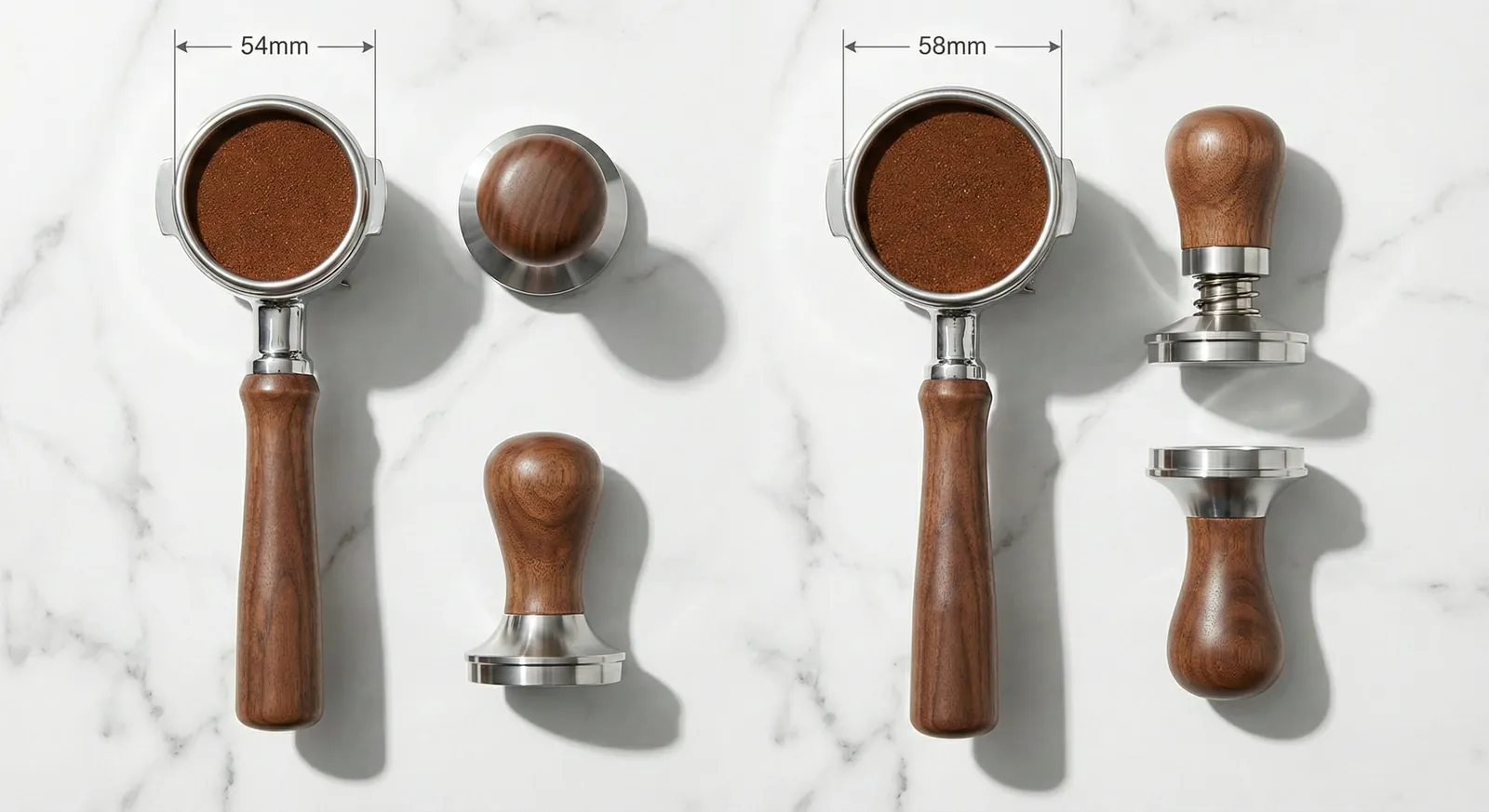
Commercial portafilters (bottomless or spouted) use standard baskets that demand proper grinding, dosing, distribution, and tamping. They ask more of your grinder, but they reward you with authentic espresso and let you actually build technique.

Pressurized baskets are a fine training wheel while you're learning or working with a weaker grinder, but if you're serious about this, look for a machine that takes standard commercial baskets.

Side-by-side comparison of a 58mm precision portafilter basket versus a pressurized double-wall basket, showing the difference in extraction flow

PID Temperature Control: Consistency Through Precision

A PID (Proportional-Integral-Derivative) controller holds brewing temperature within ±1°F by constantly monitoring and adjusting the heating element.

Entry-level machines typically get by with a simple thermostat. Casual users often won't notice the gap, especially with darker roasts, which forgive temperature swings far better than light roasts do.

Steam Wand: Commercial vs. Panarello Frothers

Commercial-style steam wands (single or multi-hole tips) put out powerful, dry steam and let you shape microfoam precisely enough for latte art. It takes practice, but you get complete control over milk texture.

If milk drinks matter to you, prioritize a commercial steam wand with adequate steam pressure — that means paying attention to boiler size too.

Espresso Machine Price Ranges

Understanding how espresso machines are priced saves you from two mistakes: expecting too much from a budget machine, and paying for hype instead of substance. The market breaks into clear tiers, each with its own build quality, feature set, and honest performance ceiling.

Entry-Level Espresso Machines ($100-$400)

These machines run single boilers with thermostat control, vibratory pumps, plastic housings, pressurized portafilter baskets, and panarello steam wands. They're built to a price, not to last — expect 3-5 years under normal home use.

What to actually expect: Acceptable espresso-style drinks, especially with the pressurized basket doing some of the forgiving for a weaker grinder. Temperature swings of ±5-10°F are normal here, so shot-to-shot you'll be adjusting as you go.

Popular models: De’Longhi EC155 ($249-349, dual-function filter holder accepts ESE pods), Mr. Coffee Café Barista ($130-180), Krups XP444C50 ($99-129, 34 oz tank, pressurized basket), Capresso EC100 ($175-230, 15-bar pump, 40 oz tank, twin frother — a solid step up from pod machines), Breville Bambino ($250-300), De’Longhi Dedica ($300-350), Gaggia Carezza ($250-300).

Best For: Budget-conscious beginners, casual drinkers having 1-2 cups a week, and anyone testing whether espresso is worth further investment before committing to real equipment

💡 Explore Top Budget Options: Our best espresso machines under $500 guide rounds up our top-rated entry-level and mid-range picks, so you can find real value without guessing.

Mid-Range Machines ($400-$1,200): Quality Meets Value

Step up here and you get better temperature stability (many include PID controllers), larger brass boilers, commercial-style 58mm portafilters that accept standard baskets, better steam wands, and noticeably better build quality overall. Stainless housing and tighter manufacturing standards mean 8-12 years of life with proper care.

What to actually expect: Café-quality espresso, paired with a decent grinder ($300-800 range). Most run single-boiler or thermoblock systems, so you're still waiting briefly between brewing and steaming.

Category leaders: Gaggia Classic Pro ($449-$499), Breville Bambino Plus ($350-400), Breville Barista Express ($600-700, includes grinder), Rancilio Silvia ($750-850), Breville Infuser ($500-600), Lelit Anna ($450-550), Breville Barista Pro ($750-900).

This is the sweet spot for most home enthusiasts — professional-feeling results without professional-level spending. Jump up from entry-level and the difference is obvious the first time you taste it: cleaner flavor, better crema, and far more control over extraction.

Best For: Serious home baristas making espresso daily, anyone chasing café-quality results, enthusiasts willing to put in the technique, households pulling multiple drinks a day

Premium and Prosumer Machines ($1,200-$3,000+): Café-Grade Performance

Here you get dual boilers or a sophisticated heat exchanger, PID control on every boiler, quiet rotary pumps with plumbed-in capability, commercial E61 group heads with thermosyphon circulation, programmable pre-infusion, and steam systems that mean business. Construction uses genuine commercial components — stainless steel, brass boilers, chrome-plated brass groups — built for café duty cycles.

What to actually expect: Shot quality on par with high-end commercial machines, and build quality that supports 15-20+ years of daily use — some of these run in cafés for decades.

You'll also find smartphone connectivity, custom pressure profiling, flow rate control, shot timers with live pressure and temperature readouts, and deep programmability. Many support plumbed-in water, so you never refill a reservoir again.

Premium model examples: Profitec Pro 500 ($1,600-1,800), ECM Classika ($1,400-1,600), Rocket Appartamento ($1,500-1,700), Lelit Bianca ($2,400-2,800), Profitec Pro 700 ($2,200-2,500), ECM Synchronika ($2,800-3,200), Decent Espresso DE1+ ($3,500-4,000).

Best For: Espresso perfectionists chasing the last few percent of shot quality, high-volume home users, experienced baristas building out a home setup, small café operations, anyone who wants commercial-grade equipment that'll outlast a mortgage

Commercial Machines ($3,000-$15,000+): Professional Equipment

Built for café duty cycles: multi-group heads (2-4 groups pulling shots simultaneously), massive boiler capacity (5-20+ liters), commercial-grade rotary pumps, volumetric dosing, automatic backflushing, and construction that shrugs off hundreds of shots a day. These need dedicated 220V-240V circuits and usually a plumbed water connection with proper filtration.

Popular commercial brands: La Marzocco Linea ($8,000-15,000+), Slayer Steam ($15,000-20,000), Victoria Arduino Black Eagle ($15,000-25,000), Nuova Simonelli Aurelia ($7,000-12,000), Synesso MVP Hydra ($15,000-20,000).

Some enthusiasts do install commercial single-group machines at home (La Marzocco GS3 $7,500-9,000, Slayer Single Group $9,000-12,000), but these need professional installation, a dedicated circuit, and a genuine willingness to spend at that level for residential use.

Best For: Café owners, commercial operations, mobile coffee carts, and extreme enthusiasts with an unlimited budget and a dedicated coffee space

Budget Allocation Strategy:

A rule I give every customer: budget a 1:1 or 2:1 machine-to-grinder ratio. A great machine on a weak grinder is money left on the table. See our best coffee grinders guide for expert-tested picks at every budget.

Espresso machines at different price tiers, from $200 entry-level to $3,000+ prosumer models, showing the jump in build quality and features

Already know your budget? Explore our top-tested espresso machines by price range:

Choosing the Right Type for You

Skill Level and Learning Commitment

Complete beginners: a semi-automatic with PID control and both pressurized and commercial baskets gives you the smoothest on-ramp (Breville Bambino Plus $350-400, Gaggia Classic Pro $449-$499).

Want convenience over craft: a super-automatic skips the learning curve entirely and gives you consistent results from day one (De’Longhi Magnifica $800-1,200, Jura E8 $2,600-2,800). Ideal if you want café-style drinks without ever picking up a tamper.

Already experienced: a prosumer dual boiler machine gives you room to play with pressure profiling, flow control, and shot experimentation (Lelit Bianca $2,400-2,800, Decent DE1+ $3,500+).

Daily Consumption Volume

1-2 cups daily (solo users): a single boiler semi-automatic is excellent value here. The wait between brewing and steaming barely matters when you're only making one drink (Rancilio Silvia $750-850, Lelit Anna $450-550).

3-5 cups daily (couples, small households): a heat exchanger or dual boiler machine removes the waiting between shots and lets you brew and steam at the same time (Profitec Pro 500 $1,600-1,800, ECM Classika $1,400-1,600).

6+ cups daily (large households, offices): a super-automatic with a large boiler and waste container handles the volume without complaint (Jura Z10 $3,000-3,500), or step up to a commercial-grade machine built for continuous use.

Counter Space and Kitchen Layout

Tight counter space (apartments, small kitchens): compact machines under 10 inches wide fit where bigger units won't (Breville Bambino $250-300, De’Longhi Dedica $300-350).

Dedicated coffee station: larger prosumer machines (12-16 inches wide) need a permanent spot, but reward you with better performance and better looks (Rocket Appartamento, ECM Synchronika).

Don't forget height clearance for refilling the water tank — many machines need 12-16 inches of overhead room — and enough access for maintenance. Heat exchanger and dual boiler machines also need good ventilation to shed heat.

Milk Drink Preferences

Mostly straight espresso: a single boiler works just fine — steam power matters a lot less here (Gaggia Classic Pro $449-$499, Rancilio Silvia $750-850).

50/50 espresso and milk drinks: a heat exchanger machine is good value, giving you real steam power without paying for a second boiler you don't fully need (Profitec Pro 400 $1,200-1,400).

Mostly cappuccinos and lattes: a dual boiler machine keeps your workflow smooth, especially for multiple drinks back to back (Profitec Pro 500 $1,600-1,800). Or let a super-automatic's auto frother take milk steaming off your plate entirely.

Chasing latte art: you need a commercial-style steam wand with real steam pressure, full stop. Skip panarello frothers and automatic milk systems — neither can produce microfoam fine enough for detailed art.

Morning Workflow and Time Constraints

Rushed mornings (5-10 minutes to spare): a super-automatic or pod system gets you a drink fastest — 45-90 seconds from button press to cup in hand.

Unhurried routine (15-20 minutes): a semi-automatic fits right into a relaxed morning, with grinding, prep, and cleanup becoming part of the ritual instead of a chore.

Don't forget warm-up: most machines need 10-25 minutes to reach thermal stability before that first shot — plan around it.

Home barista working with a semi-automatic espresso machine in a kitchen, showing a typical morning workflow with grinder, tamper, and milk pitcher

Maintenance and Long-Term Costs

Daily Maintenance Requirements

After each use (2-3 minutes): knock out the puck, purge the group head, backflush with plain water using a blind basket (no detergent), and wipe down the steam wand and portafilter.

Weekly (10-15 minutes): soak the baskets and group screen in a cleaner like Cafiza or Puly Caff, and scrub the steam wand tip. For the full daily/weekly/monthly routine, see our dedicated espresso machine cleaning guide.

Descaling and Water Quality

Water hardness drives how often you'll need to descale, and how long your machine lasts. Hard water leaves mineral scale in the boiler and water lines, choking flow and heating efficiency over time.

Stick to manufacturer-approved descaling solutions — never vinegar, it damages seals and leaves an odor behind.

Water filtration is worth it: a water softener or filtered water extends your machine's life dramatically. Third Wave Water packets or a Brita filtration pitcher are cheap, easy fixes.

Long-Term Parts Replacement

Group head gaskets: replace every 6-12 months ($5-15 in parts, a 15-minute DIY job). Watch for leaking around the portafilter, trouble locking it in, or hissing during extraction.

Shower screens: replace every 1-2 years, or sooner if flow feels restricted ($10-20 in parts).

Pump replacement: vibratory pumps last 5-10 years ($40-80 in parts, best left to a professional). Rotary pumps last 15-20+ years.

Boiler and heating element: a quality machine rarely needs a new boiler. Heating elements last 10-15 years with proper descaling ($50-150 in parts, professional install recommended).

Annual Cost of Ownership

Budget machines ($100-400): expect $20-40 a year in descaler, cleaning products, and the occasional gasket. Realistic lifespan: 3-5 years.

Mid-range machines ($400-1,200): budget $40-80 a year for supplies, gaskets, and the occasional service. Realistic lifespan: 8-12 years with proper care.

Premium machines ($1,200+): plan on $60-150 a year for quality cleaning products and scheduled professional maintenance. These often run 15-20+ years, sometimes past 25 with excellent care.

Espresso machine maintenance supplies: descaling solution, backflush cleaning tablets, group gasket replacements, portafilter brush, and steam wand cleaner

Common Mistakes to Avoid

Buying Based on Features Instead of Machine Type

Don't let a flashy feature sell you the wrong category of machine. Pick the type first, based on how you actually want to make coffee — then compare features within that category.

Ignoring Grinder Investment

A $1,000 espresso machine paired with a $50 blade grinder makes terrible espresso. Every time. Don't skimp here.

Essential reading: Complete burr grinder buying guide →

Overlooking Physical Space Requirements

Measure your counter before you fall in love with a machine. Check that it fits your space AND leaves room to actually work comfortably.

Underestimating Learning Commitment

Semi-automatic and manual machines genuinely require practice — 2-4 weeks of daily use before you're consistent. Don't buy one expecting café-quality shots on day one without putting in the reps.

Focusing Solely on Initial Purchase Price

Add up the whole picture: the grinder, accessories (tamper, distribution tool, milk pitcher, scale), ongoing maintenance, and consumables. A $150 pod machine looks cheap until you notice it costs $600-1,200 a year in pods.

Choosing Single Boiler for Milk Drink Lovers

If cappuccinos and lattes are your daily drink, a single boiler's 30-60 second wait between brewing and steaming gets old fast. That workflow interruption becomes genuinely annoying within weeks.

Neglecting Water Quality Impact

Hard water quietly destroys espresso machines through mineral scale, cutting lifespan by 50-70%. Get water filtration sorted from day one — a filtered pitcher, bottled water, or a softening system all work.

Buying Machines Without PID for Temperature-Sensitive Beans

Light-roasted specialty coffee needs tight temperature control (±1-2°F) to extract properly. A simple thermostat swings ±8-10°F, which makes consistency nearly impossible with delicate beans.

Making Your Final Decision

Step-by-Step Decision Framework

  1. 1. Decide how hands-on you want to be: full manual involvement (manual lever/semi-automatic), partial automation (automatic), or hands-off entirely (super-automatic/pod). Get this right and you've already cut your options by about 70%.
  2. 2. Set a total budget, grinder included: machine ($X), grinder (40-100% of the machine's cost), and accessories ($100-200 for scale, tamper, pitcher, distribution tool). Don't forget cleaning supplies and water filtration.
  3. 3. Be honest about milk drink consumption: if 70%+ of your drinks involve milk, prioritize a dual boiler or heat exchanger machine. Straight espresso drinkers can save real money with a single boiler.
  4. 4. Measure your space: width, depth, and — critically — height clearance for tank refills. Check ventilation, and think about workflow ergonomics while you're at it.
  5. 5. Research specific models in your category: read professional reviews from specialty coffee publications, watch video reviews of machines in action, and check user reviews for reliability — weight the ones from owners past 6 months more heavily.
  6. 6. Check parts and service support: confirm the warranty terms (1-2 years standard, 3-5 years premium), look into local service options, verify replacement parts are actually available, and check for an online community for troubleshooting help.
  7. 7. See it in person if you can: specialty coffee retailers and high-end appliance stores often have machines on display. Seeing the build quality, hearing the noise level, and feeling the controls in your hand tells you things a spec sheet never will.

Testing and Trial Periods:

Most retailers give you a 30-day return window — actually use it. Pull 20-30 shots in the first week instead of waiting until day 29 to discover a problem.

Research Resources and Expert Reviews

Lean on established specialty coffee sources: James Hoffmann (YouTube), Lance Hedrick (YouTube), Whole Latte Love, Seattle Coffee Gear, Clive Coffee, and the Home-Barista forums.

Be a little skeptical of generic Amazon reviews for espresso machines — a lot of reviewers are comparing against blade grinders and drip coffee, not against café-quality espresso, which skews the picture.

Ready to Find Your Perfect Espresso Machine?

Explore our expert-reviewed espresso machines across all types and price ranges

Read Recommended Espresso Machine Reviews

Reviewed Espresso Machines by Type

Machines we've tested across the main categories covered in this guide:

SEMI-AUTO · REVIEWED

Gaggia Classic Pro

~$449–$499

The benchmark semi-automatic. Commercial 58mm group head, 9-bar OPV, manual steam wand. Best for users who want to learn real espresso technique.
SEMI-AUTO · REVIEWED

Breville Bambino Plus

~$300–$350

Compact semi-automatic with ThermoJet heating, pre-infusion, and auto steam wand. Ideal entry point before stepping up to a full semi-auto.
SUPER-AUTO · REVIEWED

De'Longhi Magnifica

~$599–$699

Built-in grinder, one-touch operation, automatic milk frother. The fully hands-off super-automatic option for convenience-first users.

Your Espresso Machine Decision, Simplified

Conclusion: Your Espresso Journey Begins Here

Picking the right espresso machine type is the single most important decision in this whole process — more than brand, more than any feature list, more than price.

Remember, great espresso comes from three things working together: a machine matched to your needs, a grinder capable of consistent particle distribution, and your own developing technique. Skimp on any one of the three and the other two can't save you.

Whatever tier you land in, choose it deliberately — weigh your actual daily routine, how much you genuinely want to learn, your counter space, and where you want this hobby to go.

Double espresso shot with a thick golden crema layer in a white porcelain cup, alongside a 58mm portafilter and semi-automatic espresso machine

Frequently Asked Questions

Semi-automatic machines are the best starting point.

They handle water pressure and temperature for you, but you still control shot timing — easier than a manual machine while still teaching you real espresso fundamentals.