

If your grinder steps are too coarse
Baratza Encore ESP
Fine micro-stepped adjustment makes it easier to land on the exact espresso grind instead of sitting between two steps.
Espresso Guides
Last updated
Espresso pulling too fast (under 20 sec) or too slow (past 40)? Fix shot time by checking grind, dose, tamp, bean age and machine in order.
Affiliate disclosure: this page contains Amazon affiliate links. We may earn a commission if you buy through them, at no extra cost to you, and it never affects our rankings. Read our full affiliate disclosure
If your espresso shot is too fast or too slow, the grind is the most likely culprit: go finer if the shot ran fast, coarser if it dragged, one or two settings at a time. Weigh your dose first so you are not chasing a grind problem that is really a dose problem.
Match what you see at the portafilter to the most likely cause.
A balanced shot usually lands around 25–30 seconds. A few seconds outside that is fine if it tastes good.
Under 20 seconds, thin and sour
Fast, sprays or looks patchy
Past 40 seconds, harsh and bitter
Drifted over days or weeks
Flow rate depends on resistance, and resistance comes from the puck.
Espresso flows through a bed of coffee under pressure. The more resistance, the slower the shot. Finer grind, higher dose, stronger tamp and fresher beans all increase resistance; coarser grind, lower dose and stale beans reduce it.
A fast shot under-extracts and tastes sour and thin; a slow shot over-extracts and tastes bitter and harsh. Time is a guide, not a goal: what matters is the ratio of dose to yield (the espresso ratio calculator does the arithmetic) and how the shot tastes.
A repeatable way to correct timing.
Weigh the dose in and the liquid out, and use a recipe ratio as the starting point. Change only grind size by small steps, then adjust dose if needed. Distribute with WDT so flow is even, and use a level tamp. For a starting point, use the coffee grind size calculator.
Pre-infusion, flow control and consistent water temperature stabilise results. Check bean age, since fresh beans release CO2 and can flow differently. See the full dial-in guide and channeling fixes if timing is erratic.
The most common cause in both directions, and the quickest to test.
A steady, honey-coloured stream that moves toward the target window. The dialing-in guide covers the full routine.
If your grinder steps are too coarse
Fine micro-stepped adjustment makes it easier to land on the exact espresso grind instead of sitting between two steps.
Affiliate links: we may earn a commission at no extra cost to you.
An under- or overfilled basket shifts resistance before you touch the grind.
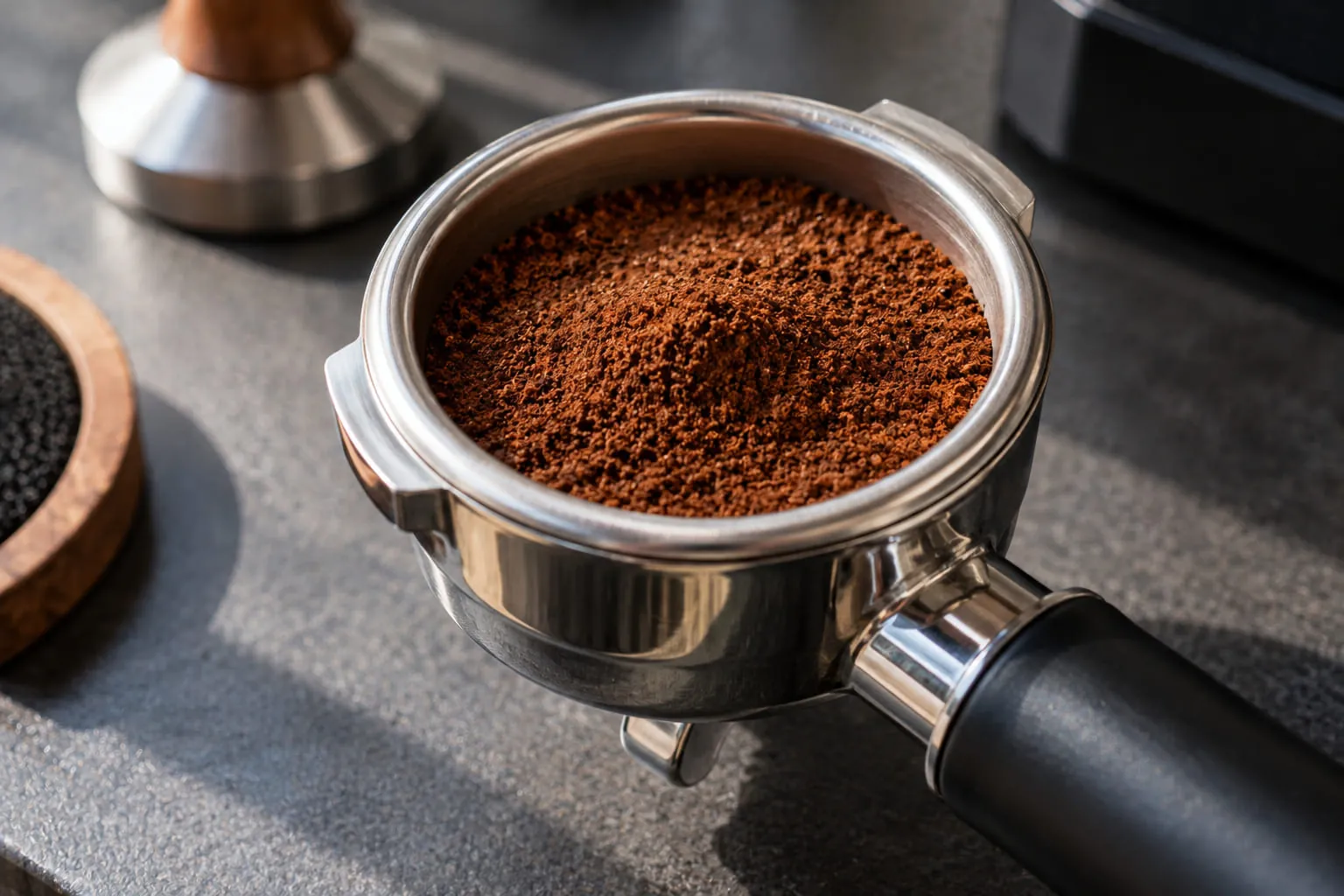
A shallow bed and a fast shot suggest too little coffee. A puck pressed into the shower screen and a slow shot suggest too much.
A puck that sits just below the shower screen with a clean, even surface.
Loose or dense spots make water take the easy route.
The stream sprays to one side or runs patchy rather than steady. That points to channeling, not a simple grind fix. A fast shot with a soupy puck is covered in why your puck is wet.
Past a certain point, extra force adds little, so consistency matters more than strength. See how to tamp espresso and how much pressure matters.
Gas in fresh beans slows flow, and stale beans let it speed up.
The same grind setting that worked last week now runs faster or slower.
Shot time returning to your window after a small grind move.
Rule this out only after grind, dose, tamp and beans check out.
Shots slow down gradually over weeks, especially in hard-water areas, or run fast even with a correct puck.
See how to descale a coffee machine for the steps.
Before blaming the machine, rule out the simple things: a basket that is not the one you dialed in with, a shower screen clogged with old coffee, or a water tank that is nearly empty. Each changes the flow.
Use time as a guide, and let taste make the final call.
| Shot style | Typical ratio (coffee : espresso) | Typical time |
|---|---|---|
| Ristretto | 1:1 to 1:1.5 | About 20–30 seconds |
| Standard espresso | 1:2 | About 25–30 seconds |
| Lungo | 1:3 or longer | About 30–40 seconds |
| Light-roast, longer ratio | 1:2.5 to 1:3 | Often 25–35 seconds |
Ristretto
Standard espresso
Lungo
Light-roast, longer ratio
These ranges are starting points, not rules. Time is useful because it tells you whether the grind is in the right area, but taste decides whether the shot is right. A shot that runs a little fast but tastes sweet and balanced is a good shot; a perfectly timed shot that tastes sour still needs a change. Most people find it quickest to fix the dose and ratio first, then adjust only the grind until the time lands in range, and only then fine-tune by taste.
Start timing from when you press the button, not from the first drip, and keep that habit consistent so your numbers mean the same thing day to day. If your machine has pre-infusion, that low-pressure soak adds a few seconds before the main flow, so allow for it rather than grinding coarser to hit a number. Our espresso dial-in calculator works out target yields from your dose, and what is a ristretto and what is a lungo explain the shorter and longer styles.
Beans, humidity and the grinder all drift a little.
Even with the same beans and grinder setting, shot time drifts. Beans lose gas as they age, which makes them flow faster over a week or two, so a setting that was perfect on day five may run fast by day fifteen. Humidity changes how grounds clump; a warm grinder after several doses grinds slightly differently from a cold one; and the first shot of the morning can run differently while the machine and portafilter finish heating.
The fix is small, frequent adjustments rather than big jumps. Pull a quick test shot each morning or when you open a new bag, adjust the grind one small step, and note the result. Keeping the portafilter locked in the group while the machine warms up, and running a short flush before the first shot, removes most of the early-morning variation.
Where to go next if the clock and the cup still disagree.
Quick decision guide
The shot is balanced but nowhere near the time window
Trust the taste and adjust gently, using the espresso dial-in calculator.
Your grinder cannot hold a fine, consistent setting
Compare options in our best espresso grinders under $300.
The cup is thin and sour after a correct time
Read why espresso tastes sour.
Quick answers before you buy.
Only slightly.
Temperature changes extraction and flavor far more than flow rate, so grind and dose are better places to look first.
Occasionally, if an unusually fine grind and high dose offset the quick flow.
A shot well under 20 seconds is far more often under-extracted, so check it anyway.
Bean age and gradual scale buildup both shift flow over time.
Check the roast date and your last descale.
Roughly 25–30 seconds is a common starting point, but taste matters more than the clock.
Adjust gently with the espresso dial-in calculator.
A very fast shot usually means the grind is far too coarse, the dose is too low, or the puck is channeling.
Grind finer and weigh your dose; see espresso channeling if flow looks uneven.
The grind is usually too fine or the basket overfilled.
Go coarser a step or two and check your dose; severe slowdowns can also point to scale, so see descaling.
Keep reading: more guides on the same topic.
 Fix a problem
Espresso5 min read
Learn how to spot and fix espresso channeling: uneven flow, sour-and-bitter shots, a holey puck. Ordered fixes from distribution to grinder.
 Fix a problem
Espresso5 min read
Why does coffee taste bitter? Find your cause (grind, water temperature, stale beans, dirty gear) and fix bitter coffee one change at a time.
 Fix a problem
Espresso4 min read
Why is my espresso puck wet? Check dose, grind, shower screen, 3-way valve and gasket in order, with one-change-at-a-time fixes.
 Fix a problem
Espresso4 min read
Learn how to fix bitter espresso fast: check grind, temperature, yield, channeling, dirty gear and stale beans, one change at a time.
Reader questions
Questions or tips? Leave a comment
Ask about your setup or share what worked for you. Comments are checked before they appear.