

Best for hands-off milk texturing
Breville Bambino Plus
Pick it if you'd rather not spend mornings on manual steaming: Choose an automatic-texturing machine, such as the Bambino Plus below.
Espresso Guides
Last updated
Steam wand not frothing milk? Run the plain-water test, then fix clogs, technique, low heat, scale or worn seals in likelihood order.
Affiliate disclosure: this page contains Amazon affiliate links. We may earn a commission if you buy through them, at no extra cost to you, and it never affects our rankings. Read our full affiliate disclosure
The most likely cause is dried milk in the tip, followed by pitcher technique. Soak and clear the tip, then hold it just under the milk surface, off-center, once the machine is fully heated.
Run the plain-water test, then match your symptom to a fix.
Point the wand into a cup of plain water and engage steam. Even, forceful spray from every hole means the hardware is fine and the problem is technique. Weak, uneven or partial spray means a clog, scale or a worn seal.
| Symptom | Likely cause | Jump to |
|---|---|---|
| Hisses, spits or sprays unevenly | Clogged tip | Clogged tip |
| Strong steam, milk stays flat | Technique | Technique |
| Weak steam, watery output | Low water or not heated | Heat-up |
| Steam weakened over weeks | Limescale | Limescale |
| Steam escapes at the wand's base | Worn gasket or o-ring | Worn seal |
Hisses, spits or sprays unevenly
Strong steam, milk stays flat
Weak steam, watery output
Steam weakened over weeks
Steam escapes at the wand's base
Most likely if the wand spits or sprays unevenly in the water test.
Dried milk in the holes is the most common cause. The wand hisses but delivers flat, hot milk.
You should see an even spray from every hole. Wipe the wand with a damp cloth after each use, and see the espresso machine cleaning guide for the full routine.
Most likely if steam is strong but the milk never gains volume.
Submerged too deep or centered, the tip heats milk without aerating it.
You should see the milk gain volume and spin in a whirlpool. The same method applies to a cappuccino or latte.
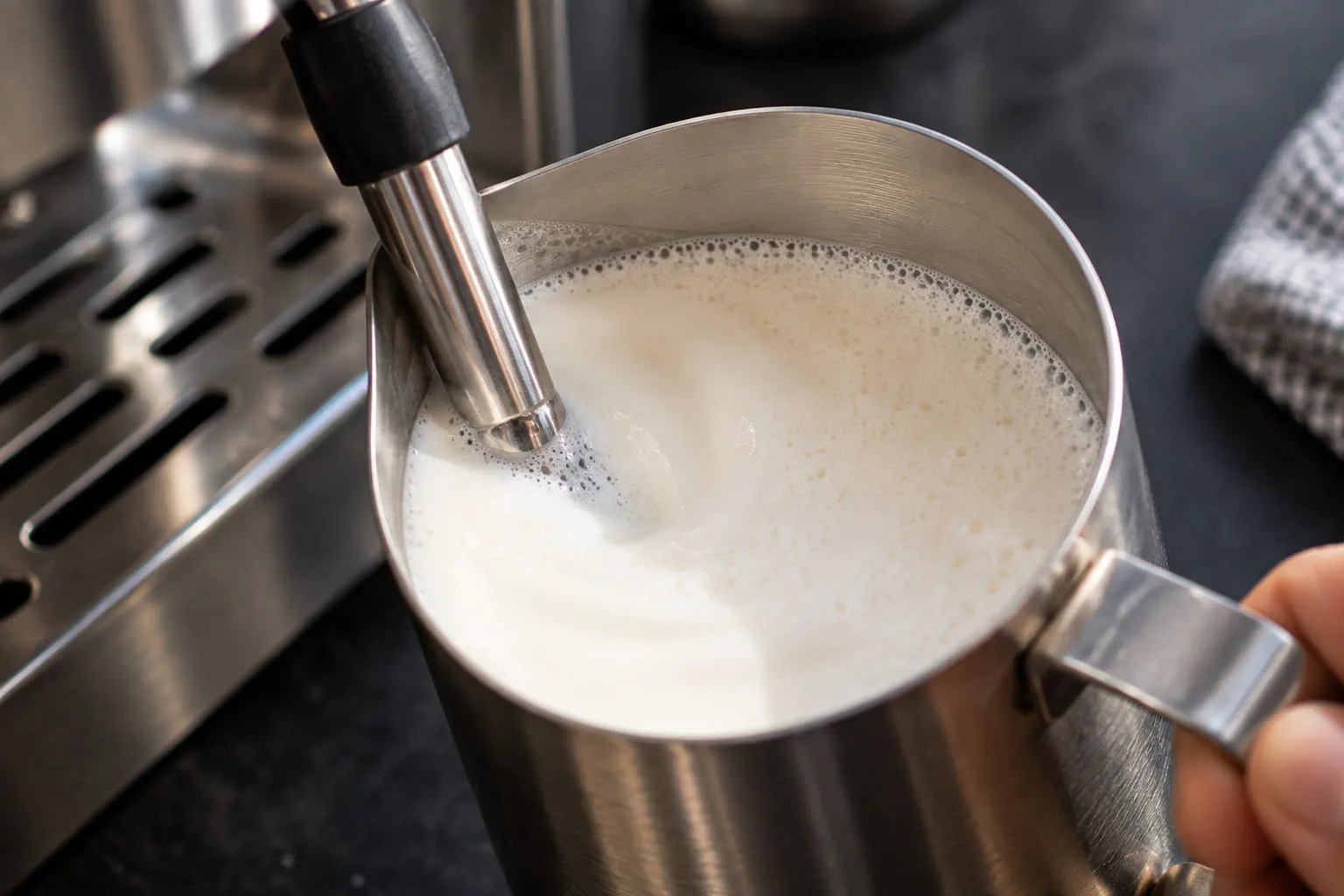
Likely if steam is weak and watery, even with a clean tip.
A low reservoir makes it harder to sustain steam pressure, and starting early gives watery steam.
You should see dry, forceful steam within a few seconds. If it stays weak, see the maintenance guide.
On single-boiler machines, switching from brewing to steam takes a short wait while the boiler heats further. Start steaming before the light says it is ready and the steam will be wet and weak. Purge the wand for a second or two to clear condensed water, then start.
Likely if output faded gradually over weeks rather than overnight.
Hard water leaves mineral deposits in the boiler and steam path even when the tip is clean.
Steam strength should return to normal.
The least common cause: steam escapes at the wand's base, not just the tip.
On older or heavily used machines, a worn rubber seal where the wand meets the boiler lets steam out before it reaches the tip.
Steam should now exit only at the tip.
Air, heat and the whirlpool create microfoam.
A steam wand injects pressurised steam into milk. Early on, the tip sits just below the surface and draws air in, which stretches the milk and adds foam. Then the tip goes deeper to create a whirlpool that breaks bubbles into fine microfoam and heats the milk to about 55-65 C.
Frothing fails when steam pressure is low, the tip is blocked, or too little air reaches the milk. Fat and protein are what hold the foam, so very cold, fresh whole milk works best; old or ultra-filtered milk performs worse. Thermoblock machines can run out of steam on larger volumes, unlike boiler machines.
Two phases make good milk. First, stretching: with the tip just under the surface, the wand draws in air and you hear a gentle tearing sound, which builds volume. Second, texturing: you raise the pitcher so the tip sits a little deeper and the milk spins into a whirlpool, which breaks big bubbles into tiny ones and mixes the foam through the milk. A latte needs only a short stretch; a cappuccino needs a longer one. Most frothing problems come from skipping the stretch, burying the tip too deep, or letting the milk get too hot before the whirlpool has done its work.
Habits and tools that prevent most steam wand problems.
Yes: freshness, temperature and type all matter.
| Milk | How it froths | Tips |
|---|---|---|
| Whole dairy milk | Easiest; glossy, stable microfoam | Start very cold from the fridge |
| Semi-skimmed / 2% | Froths well, slightly lighter body | Stretch a little less for latte art |
| Skimmed | Lots of stiff, dry foam, less silky | Good for dry cappuccinos, harder for art |
| Oat (barista edition) | Froths well; close to whole milk | Choose barista versions, which are made to foam |
| Almond, soy, other plant milks | Varies by brand; can split or stay thin | Use barista versions and heat less |
Whole dairy milk
Semi-skimmed / 2%
Skimmed
Oat (barista edition)
Almond, soy, other plant milks
Old milk froths poorly, even before it tastes off, because its proteins break down. Warm milk does too, since you lose the time you need to add air before it gets hot. Always start with cold milk in a cold pitcher, and stop at around 60–65°C (140–150°F); past that the foam collapses and the milk tastes cooked. If your plant milk refuses to foam, try a barista edition before blaming the machine.
Pitcher size matters more than people expect. Fill the pitcher to just below the base of the spout so there is room for the milk to expand; too little milk heats before you can stretch it, and too much leaves no room for the whirlpool. A 350 ml (12 oz) pitcher suits one drink and a 600 ml (20 oz) pitcher two. Our how to make a latte and how to make a cappuccino guides show the full technique for each drink.
Pick the next step based on what you want from the machine.
Best for hands-off milk texturing
Pick it if you'd rather not spend mornings on manual steaming: Choose an automatic-texturing machine, such as the Bambino Plus below.
Affiliate links: we may earn a commission at no extra cost to you.
Quick decision guide
You want to keep a manual wand and learn the skill
Machines with strong, consistent steam, like the Gaggia Classic Pro or Rancilio Silvia, make technique easier to learn.
The wand passes the water test but the machine is failing elsewhere
Compare options in the sub-$500 espresso machines.
Quick answers before you buy.
Usually repair.
Real hardware faults are typically a low-cost gasket or o-ring.
Replacement only makes sense if the boiler itself has failed, which is uncommon.
Within reason, no. Whole and 2% both foam well, and fridge-cold milk froths better than room-temperature milk.
Technique and wand condition matter far more.
Usually too much air for too long, or the tip sitting too high at the surface.
Aerate briefly, then submerge the tip and spin the milk.
Swirl and tap the pitcher to pop leftover bubbles.
Check the reservoir, that the machine has finished heating, and that steam mode is selected.
If it still stays silent, the tip or steam path may be blocked; see the maintenance guide.
Wipe it with a damp cloth and purge it after every use.
Soak the tip periodically in cleaning solution to stop milk drying inside the holes.
Yes.
A handheld frother or a jar of warmed milk can make foam, though it is usually coarser than steamed microfoam.
For a latte, see how to make a latte.
Keep reading: more guides on the same topic.
 Fix a problem
Maintenance4 min read
Coffee maker leaking water from the bottom, filter basket or carafe? Match the leak to its cause, fix it step by step, or know when to replace.
 Fix a problem
Espresso4 min read
Learn how to increase espresso crema: fix bean freshness, grind, dose, pressure and temperature in order of impact.
 Fix a problem
Espresso4 min read
Sour, thin espresso is usually under-extraction. Work through grind, dose, water temperature, bean age and ratio, one change at a time.
 Fix a problem
Espresso4 min read
Why is my espresso puck wet? Check dose, grind, shower screen, 3-way valve and gasket in order, with one-change-at-a-time fixes.
Reader questions
Questions or tips? Leave a comment
Ask about your setup or share what worked for you. Comments are checked before they appear.