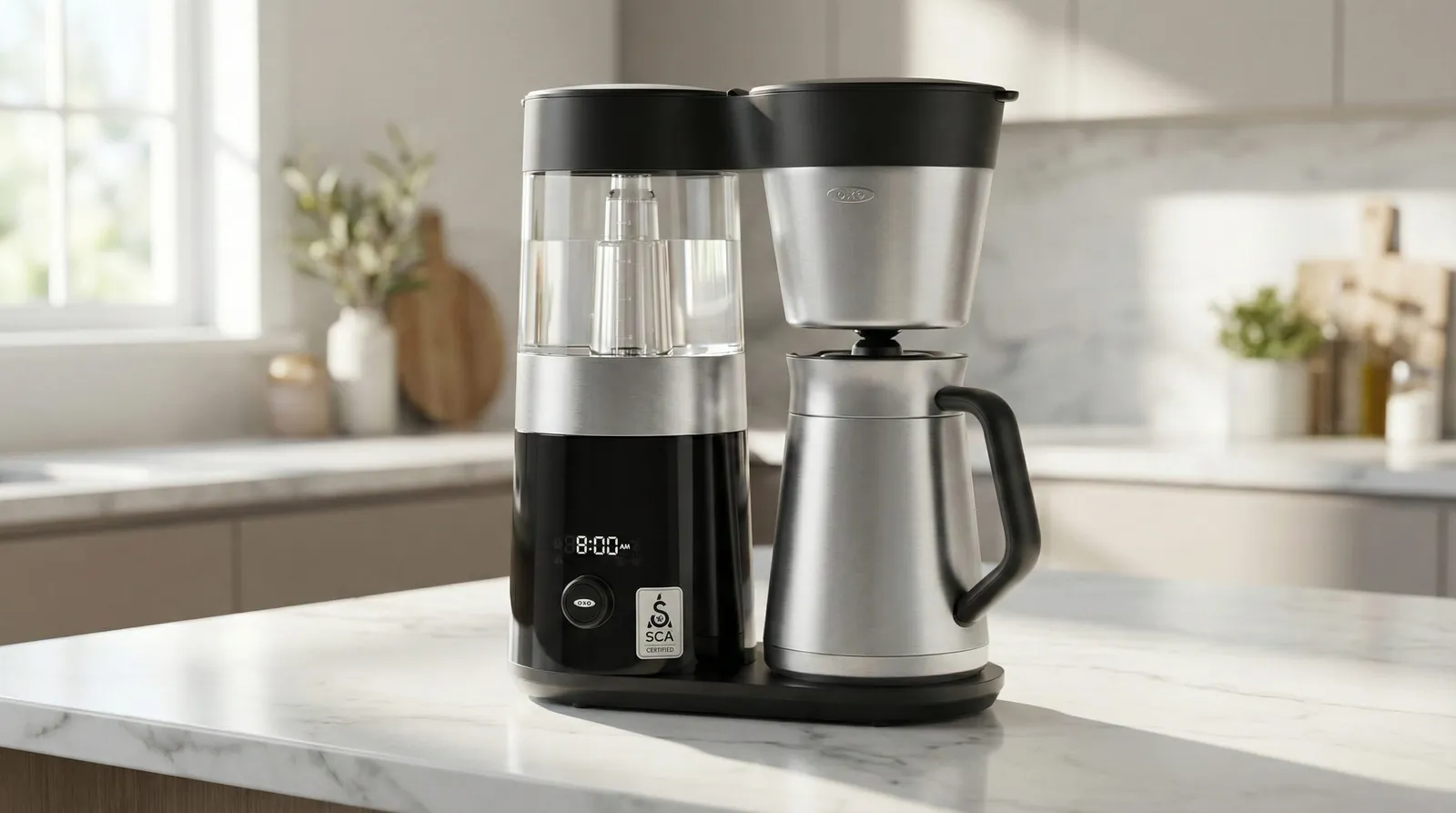
Coffee maker review
Last updated
OXO Brew 9-Cup Review 2026: Hidden Grinder Cost
Is the OXO Brew 9-Cup drip coffee maker worth the splurge? We tested 80+ brews at 197-204°F, plus the hidden grinder cost. See who should skip it.
- Our rating 4.5/5
- By Michael Anderson
- 22 min read
- Independently tested: 80+ brews over 6 weeks
Affiliate disclosure: this page contains Amazon affiliate links. We may earn a commission if you buy through them, at no extra cost to you, and it never affects our rankings. Read our full affiliate disclosure
OXO Brew 9-Cup Coffee Maker at a GlanceHighly recommended
A confident buy if you already own a burr grinder; it won't customize, brew single cups or serve a crowd.
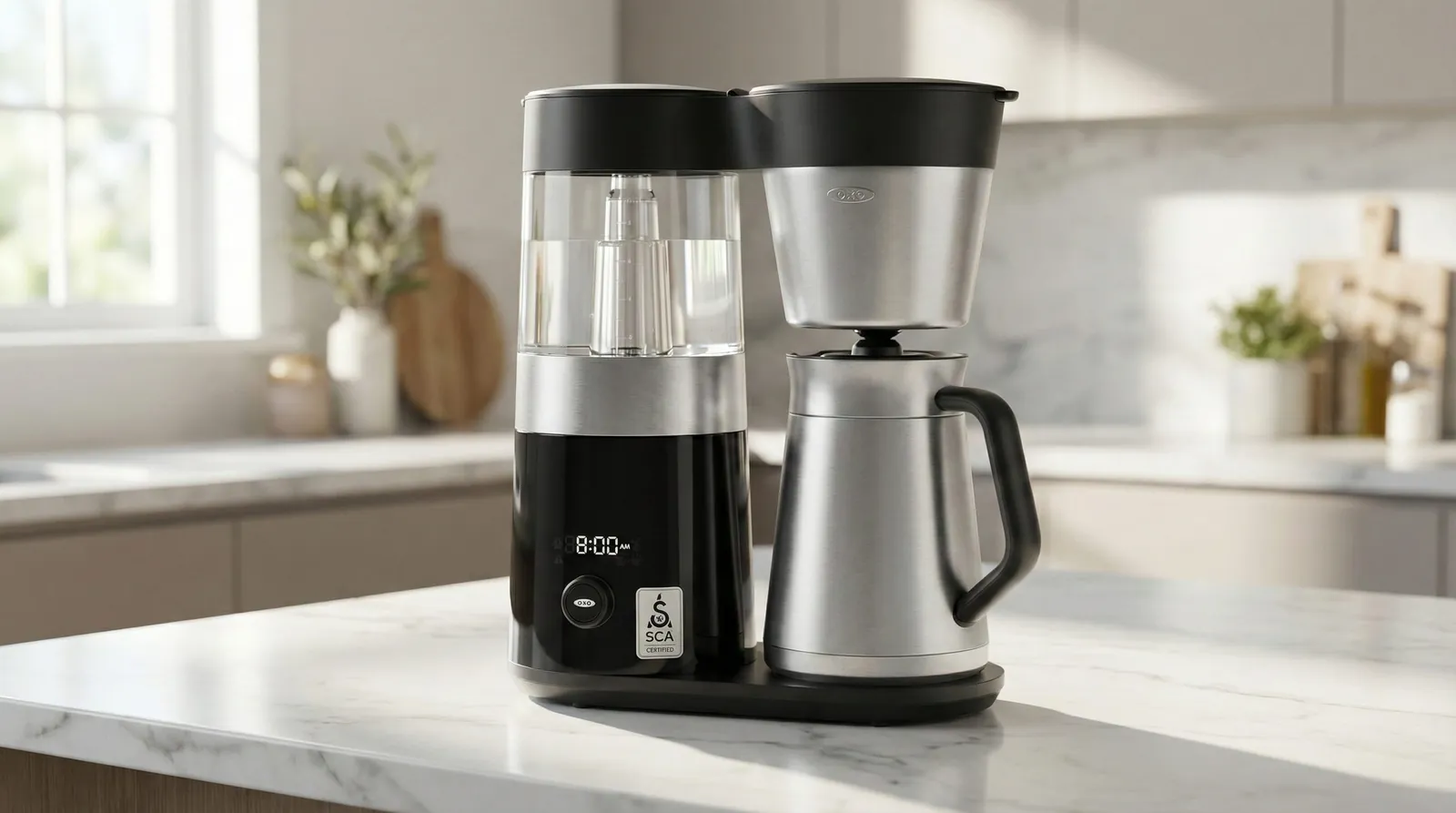
SCA-Certified Drip Coffee Maker
Affiliate link: we may earn a commission at no extra cost to you. It never affects our rating.
- 15.25-inch-wide
- Footprint
- 9 cups
- Capacity
On the brew bench· 80+ brews · 6 weeks
Why it stands out
- Thermocouple-verified 197–204°F brew temperature
- Automatic 45-second bloom improves extraction
- Thermal carafe holds heat for about two hours
Watch out for
- No built-in grinder, strength or temperature settings
- 9 cups is roughly 4–5 mugs; no single-cup brewing
✓ Best for
Coffee geeks who already own a decent burr grinder and want their morning drip to taste like pour-over
✕ Skip if
Buyers who want a built-in grinder
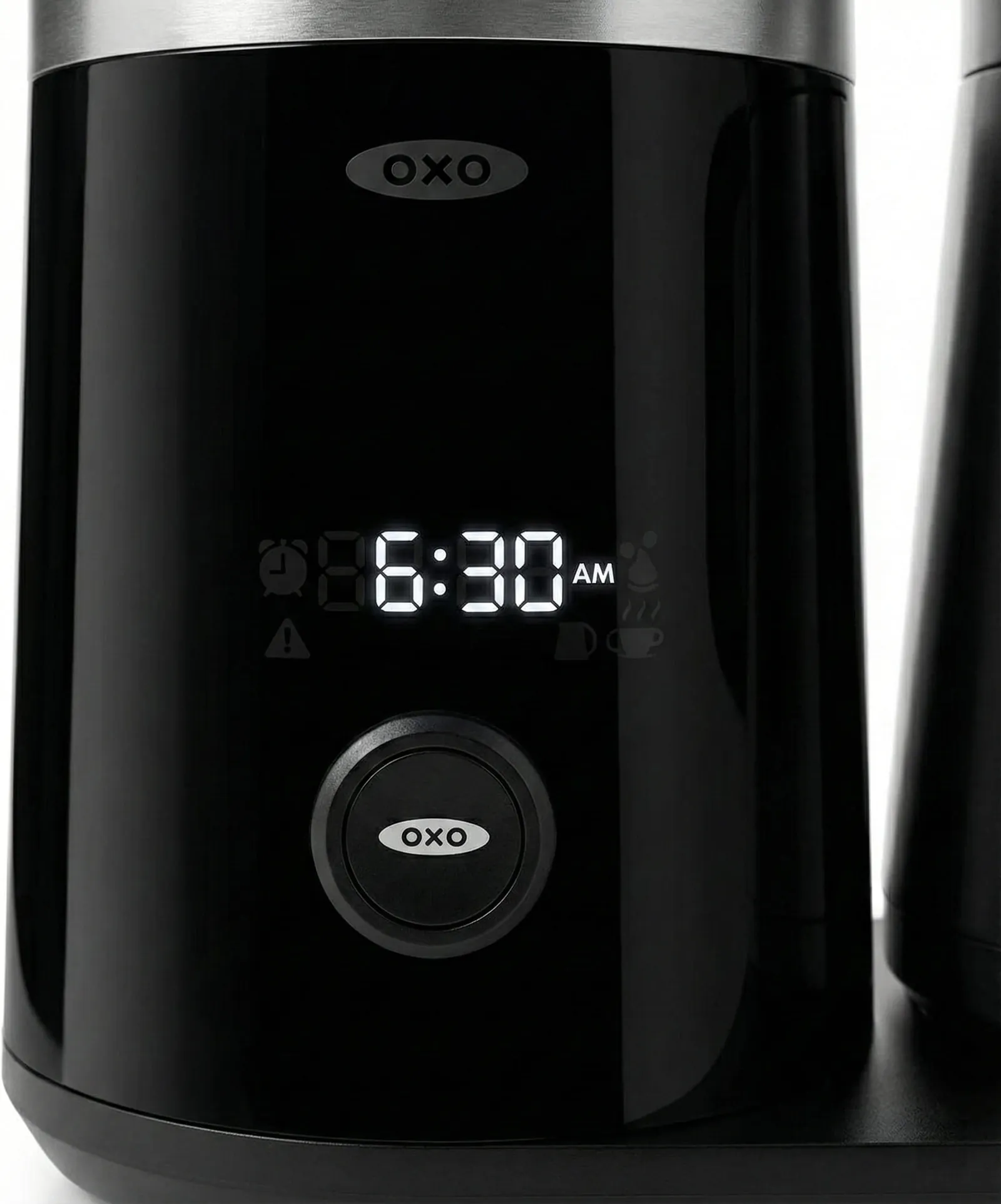
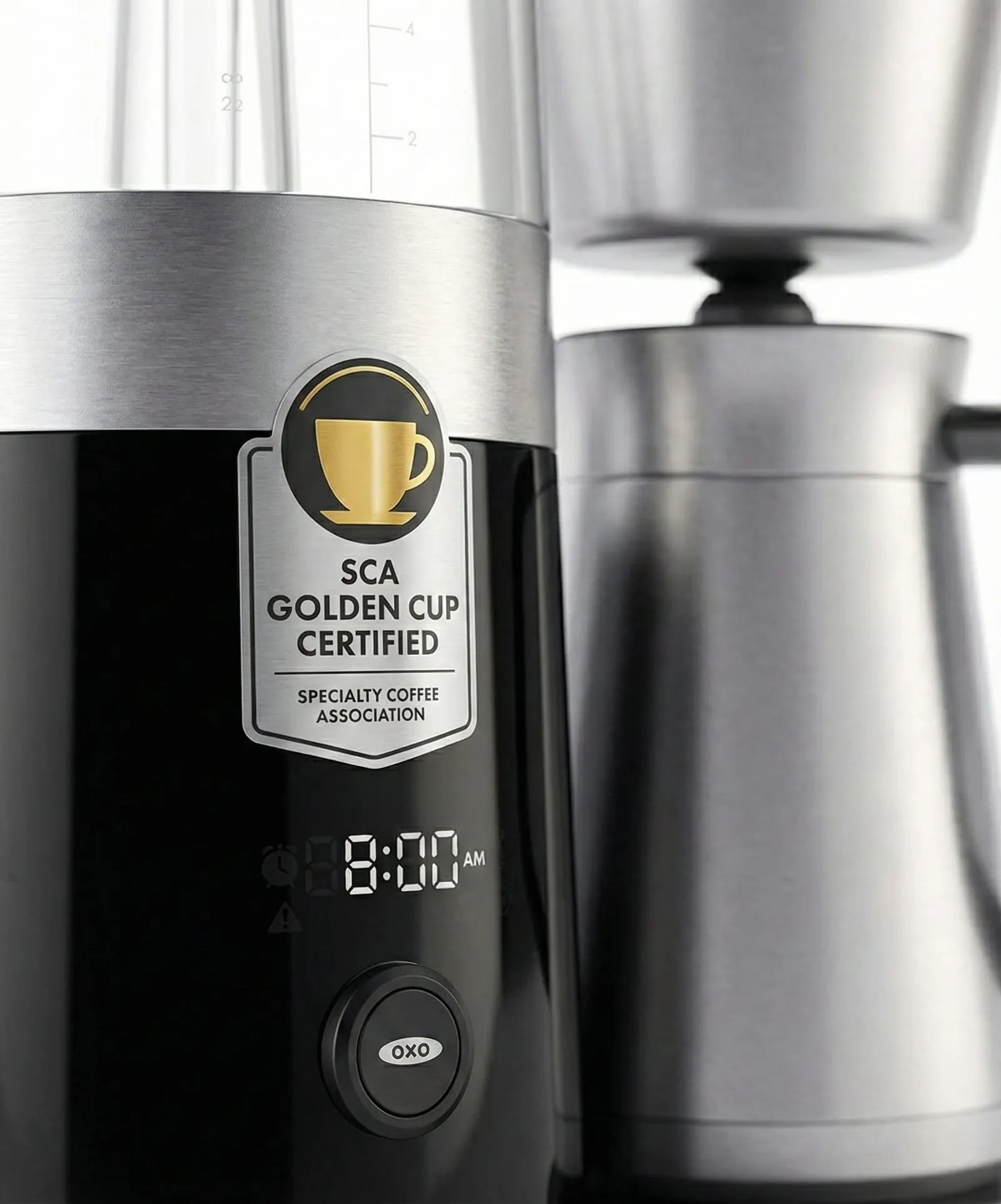
This OXO Brew 9-Cup review starts with a verdict: it is a strong buy for anyone with a burr grinder. Most drip machines that advertise optimal extraction barely reach 190°F, so we doubted the SCA Gold Cup claim on a $200 OXO, until a thermocouple measured 197–204°F consistently.
The short answer: if you already own a good burr grinder and want pour-over-level extraction without the manual ritual, this is the one; look elsewhere for a built-in grinder or a crowd of more than 4–5.
- What held up: The automatic 45-second bloom lifted TDS on fresh-roasted beans from 1.32% to 1.48%.
- Also strong: The thermal carafe kept coffee hot for about two hours without the burnt taste of a glass hot plate.
- Where it fell short: No built-in grinder, no strength or temperature settings, and it works best at 2–3 cups or more.
Who Is This Right For?
Check where you fit before you look at the trade-offs below.
A strong match
It suits you if you are
- Coffee geeks who already own a decent burr grinder and want their morning drip to taste like pour-over without the manual pour
- Buyers who want a good full-pot brewer without premium pricing
Consider something else
Look elsewhere if you are
- Buyers who want a built-in grinder
- Anyone who needs to brew just one cup at a time
- Anyone who wants to see coffee levels through a glass carafe, or who regularly brews for more than 9 cups
- Skill level
- Beginner-friendly to use, but performs best when paired with a quality burr grinder and fresh whole beans.
- Drink style
- Full-pot drip coffee with pour-over-like clarity, aimed at coffee enthusiasts who want quality without a manual routine.
- Upgrade path
- Buyers who want app-based per-recipe control should look at the Fellow Aiden; those who want proven hand-built durability should consider the Technivorm Moccamaster.
Pros & Cons
What earns the rating, and what you give up to get it.
10 reasons it works
Pros
- SCA-certified brew temperature of 197–204°F verified with a thermocouple across testing
- The 45-second automatic bloom cycle measurably improves extraction with fresh-roasted beans
- Rainmaker showerhead saturates the coffee bed more evenly than machines costing significantly more
- Thermal carafe held coffee at 168°F roughly two hours after brewing with no burnt flavor
- Strong value at $200 relative to comparable SCA-certified machines like the Technivorm Moccamaster
- One-button operation with no learning curve
- Compact 15.25-inch-wide footprint, smaller than several grind-and-brew competitors
- Daily cleanup takes about 3 minutes
- Programmable timer ran reliably through daily testing with no missed brews
- Extraction quality comparable to manual pour-over technique
8 trade-offs to weigh
Cons
- No built-in grinder — requires a separate burr grinder, adding $100–$200 to the total cost
- 9-cup capacity works out to roughly 4–5 standard mugs — larger households will need multiple brew cycles
- The thermal carafe's opacity makes it hard to see remaining coffee level
- No strength settings or temperature adjustment — extraction parameters are fixed
- Not designed for single-cup brewing — performs best at 2–3 cups minimum
- Hard-water areas need monthly descaling, as with most drip machines
- Water reservoir fill-line markings are small and can be hard to read
- Grinding too fine can cause the bloom cycle to overflow the filter basket
Real-World Testing
How it performed in day-to-day use, in the order you will meet it.
Setup & Learning Curve
Setup took about 12 minutes from unboxing to first pot: rinse the components, fill the reservoir, and run an initial flush cycle. Operation is single-button — no menus, no settings to configure — so the learning curve is effectively zero for anyone who has used a drip coffee maker before.
One early lesson from testing: a too-fine grind (Baratza Encore setting 12) causes the bloom cycle to overflow the filter basket; a medium grind (setting 18–20) is the sweet spot for this machine's flow rate.
Dial-In Workflow
Grind-size testing across six settings on a Baratza Encore identified setting 18–20 (medium) as the sweet spot, producing a consistent 7–9 minute brew and TDS in the 1.42–1.51% range.
- Grind: Finer settings (12–15) restricted flow, caused bloom overflow, or over-extracted into bitterness; coarser settings (26) under-extracted into thin, sour coffee (1.18% TDS).
- Dose: The included scoop (about 7g, roughly a 1:34 ratio) produced weak coffee at 1.28% TDS, while 15g per cup (1:16) brought TDS up to 1.44–1.50%. That is above the typical SCA Gold Cup TDS band (about 1.15–1.35%) and gave a fuller, stronger cup.
- Daily routine: Grind, fill, press brew takes about 90 seconds hands-on, with coffee ready roughly 7–9 minutes later.
Shot Extraction Notes
A K-type thermocouple placed in the brew basket measured 197–204°F throughout testing, never dropping below 197°F or spiking above 204°F — the SCA Gold Cup certification held up under repeated testing.
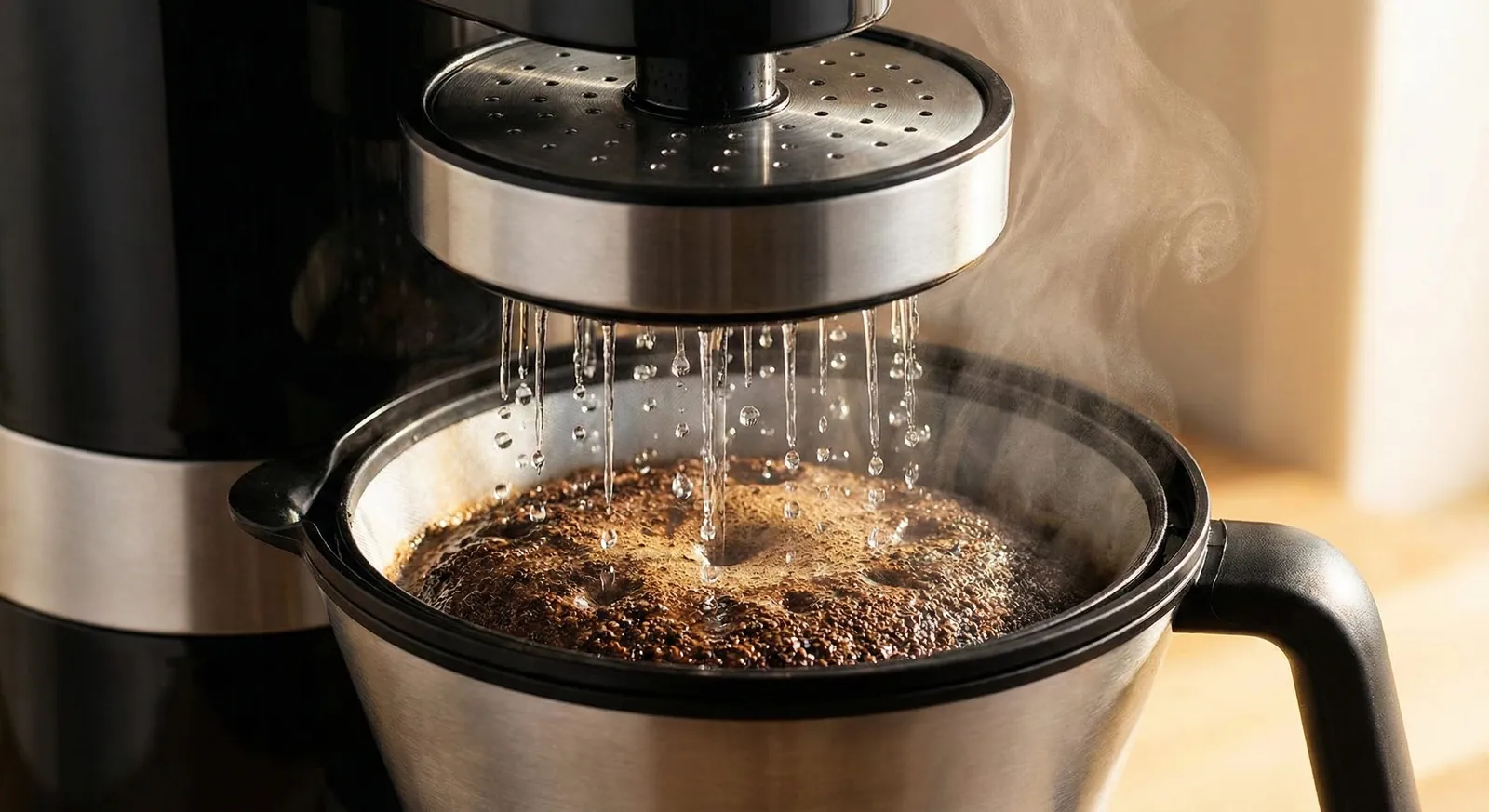
- Bloom: The 45-second automatic bloom cycle made a measurable difference with fresh-roasted beans: TDS rose from 1.32% without a proper bloom to 1.48% with one, translating to noticeably more developed flavor.
- Showerhead: The rainmaker showerhead — a perforated disc with more coverage than the 5–7 holes on typical drip machines — saturated the entire coffee bed rather than concentrating water in the center, which showed up as more even extraction and fewer hollow spots in spent grounds.
- Temperature consistency: Also strong from first pour to last: a variance of about 4°F across a full carafe, versus a much wider spread on a basic drip machine.
Cleanup & Maintenance
Daily cleanup takes about 3 minutes: discard the filter and grounds, rinse the carafe and brew basket, and wipe down the exterior. The brew basket is dishwasher-safe but rinses just as fast by hand.
- Descaling: A monthly descale with a 50/50 white vinegar and water solution, run through the brew cycle followed by two rinse cycles, takes about 30 minutes total, mostly unattended.
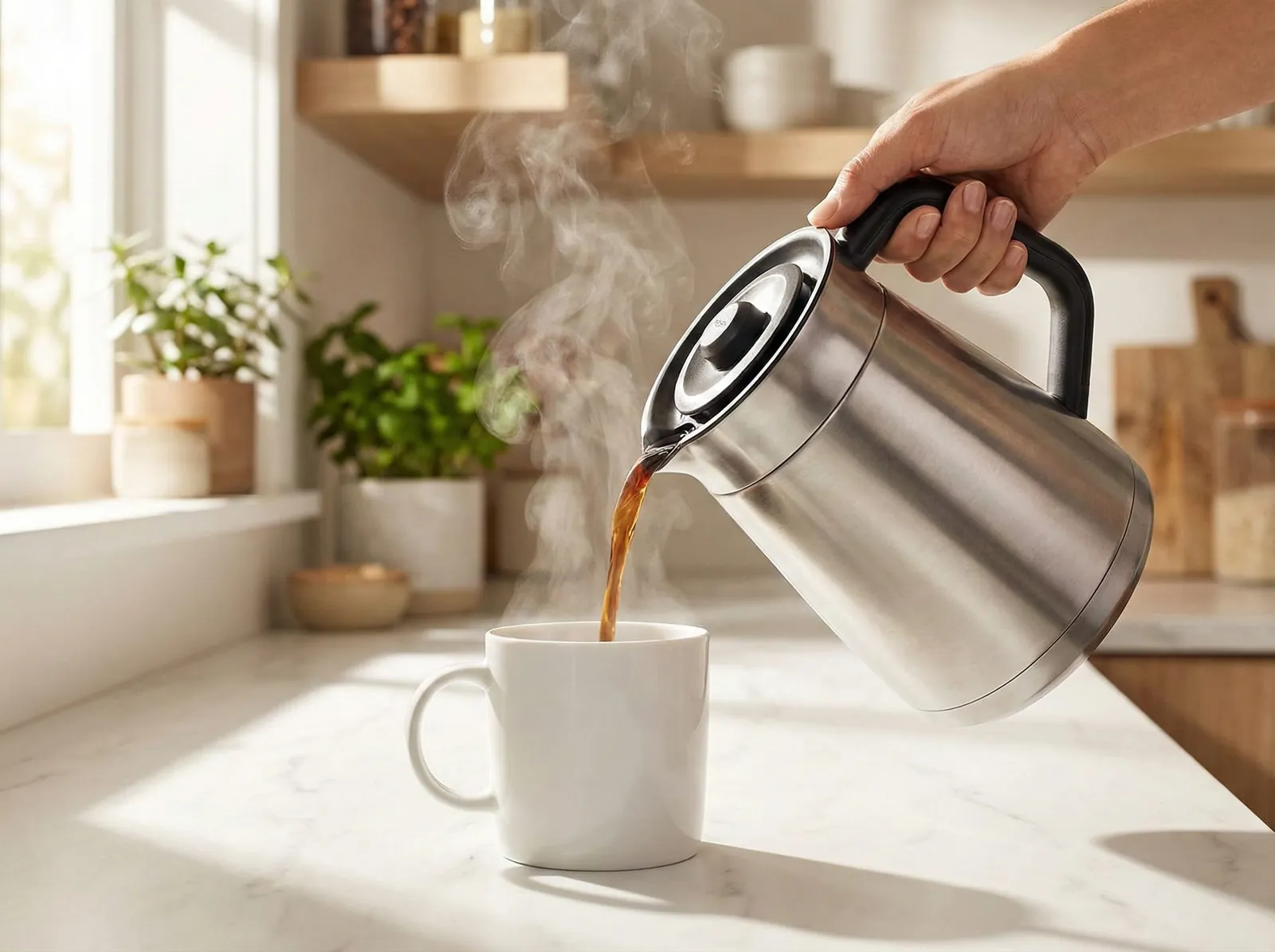
- Carafe: The double-wall vacuum-insulated thermal carafe kept coffee at 168°F roughly two hours after brewing without developing the burnt, hot-plate flavor common on glass-carafe machines. A cup poured one hour after brewing measured 172°F.
- Main tradeoff: The water reservoir's fill-line markings are small enough to require close attention before coffee.
Is the OXO Brew 9-Cup worth it?
What the $200-$250 buys, and what it does not
The OXO Brew 9-Cup is worth it if you value extraction quality over features. You are paying for a controlled brew temperature, an automatic bloom and an even showerhead, not for a screen, an app or a grinder. That focus is why it tends to be recommended to people who would otherwise spend more on a hand-built machine. Our brew timer walks through each pour with scale targets.
The real cost is the system, not the machine. Because there is no built-in grinder, you need a decent burr grinder, and the file puts the combined cost with a Baratza Encore at roughly $350-$400. Judge it at that price, not at $200.
If you already own a burr grinder, the value case is strong. If you buy pre-ground coffee, a lot of the machine's advantage is lost, because even water distribution and a proper bloom cannot fix uneven grounds.
OXO Brew 9-Cup vs Technivorm Moccamaster and other alternatives
Where it sits among drip brewers
The closest rival is the Technivorm Moccamaster. The Moccamaster is the proven, repairable, long-warranty choice. The OXO is the cheaper route to similar brew-temperature performance, with a thermal carafe and a bloom step built in. Our brew yield calculator accounts for the water the grounds keep.
| Product | Type | Capacity | Key feature | Current price |
|---|---|---|---|---|
| OXO Brew 9-Cup | Drip (thermal carafe) | 9 cups | SCA-certified 197–204°F; automatic bloom | Check current price |
| Technivorm Moccamaster | SCA-certified drip | 40oz | 5-year warranty; thermocouple-verified temperature | Check current price |
| Fellow Aiden | App-controlled drip | 8 cups (40 oz) | ±1°F PID control; per-recipe app settings | Check current price |
| aarke Coffee Maker | Design-led drip (thermal carafe) | 8-cup (40oz) | Automatic 30-second bloom; no timer | Check current price |
| Breville Grind Control | Grind-and-brew | 70 oz water tank | Conical burr grinder; adjustable bloom | Check current price |
If you want control the OXO deliberately omits, the Fellow Aiden offers per-recipe adjustment through an app. If you want a design-led alternative, the aarke coffee maker trades a programmable timer for looks at a higher price. If you want grinding included, the Breville Grind Control is the bean-to-cup option, at the cost of noise and size.
The simple rule: choose the OXO when you want one-button reliability and already have a grinder. Choose something else when you need single cups, strength settings or a built-in grinder. See the wider best drip coffee makers guide for more options.
Who should skip the OXO Brew 9-Cup?
Situations where another machine fits better
Skip it if you only ever brew one mug. The machine works best at a couple of cups or more, and a single-cup brewer or manual method suits that routine better.
Skip it if you regularly serve more than a small group. Nine cups in this machine's measure is fewer standard mugs than the label suggests, so larger households will brew twice.
Skip it if you want to see how much coffee is left. The thermal carafe is opaque, which keeps heat in but hides the level.
Skip it if you like to experiment with temperature or strength. Extraction settings are fixed, so your only levers are the beans, the grind and the dose. That is a feature for people who want simplicity and a limitation for tinkerers.
Also be ready to descale in hard-water areas, and keep your grind medium so the bloom does not overflow the basket.
How it works and why it matters
Showerhead, bloom and temperature in plain English
- Why a drip coffee maker can taste flat: Cheap brewers often dump hot water on one spot, so some grounds over-extract while others stay dry. A wide showerhead spreads water across the bed so more of the coffee is used evenly. That is the biggest single difference between a basic machine and a good one.
- Bloom releases gas first: Fresh coffee holds carbon dioxide, which repels water and causes uneven wetting. A short pause after the first pour lets the gas escape, so the main brew extracts more evenly. Our coffee bloom guide explains the science.
- Temperature stability: Water that is too cool tastes sour and thin; water that is too hot tastes bitter. A heater that holds the target range gives a rounder cup.
- What this means for you: You get most of the flavour of manual pour-over without the kettle, though the grinder and beans you pair with it still decide how good the cup is. See our drip vs pour-over comparison if you are choosing between the two methods.
Common problems and modern fixes
Common drip-brewer issues and modern fixes
- Overflowing basket: A grind that is too fine during the bloom can clog the filter and spill. Use a medium grind, and make sure the paper filter is seated flat.
- Weak or sour coffee: Measure coffee by weight rather than scoops, and use a consistent ratio. A burr grinder gives a far more even grind than a blade; see burr vs blade grinders and our burr grinder buying guide.
- Slow brew or scale: Mineral buildup clogs the heating path. Use filtered water if your tap is hard, and follow the descaling guide.
- Dripping or leaking: Check that the carafe lid is seated and the basket is aligned. Our leaking coffee maker guide covers the usual causes.
- Stale-tasting coffee: Store beans in an airtight container away from light and buy smaller bags more often. Rinse the thermal carafe and lid regularly, as old oils taint the next pot.
Before you decide
What Actually Matters in a Drip Coffee Maker
Most drip coffee makers fail at the fundamentals: brew temperature that drops to 185–190°F (too cool for full extraction), water that dumps in the center of the bed and leaves the edges under-extracted, and bloom cycles that are either missing or too brief to matter. The OXO Brew addresses all three, at $200 for precision brewing technology that typically costs $350 or more.
- Temperature: SCA-certified temperatures held between 197–204°F across testing.
- Water distribution: The rainmaker showerhead saturates the entire coffee bed rather than just the center.
- Bloom: The 45-second cycle lets fresh beans degas properly before full extraction.
It isn't for everyone: there's no built-in grinder, capacity tops out at 9 cups, and there's no customization beyond bean choice and dose. For buyers who care about extraction quality and want simplicity, it's a strong fit.
For how it ranks against the other timer-equipped brewers we have tested, see our best programmable coffee makers roundup.
How It Measures Up on Key Brewing Criteria
- Brew temperature
- SCA-certified, meeting its water temperature (about 197.6–204.8°F) and brew-time standards, so drip coffee extracts properly without adjustment.
- Timing and workflow
- A Rainmaker-style showerhead wets the grounds evenly, brewing can start automatically, and the double-walled thermal carafe keeps coffee hot without a hot plate.
Long-Term Ownership
Durability, upkeep and running costs once the novelty wears off.
- Durability
Solid stainless steel and BPA-free plastic build.
More detail
Expect roughly 3-4 years with regular use and proper maintenance. That thermal carafe is probably the weak point—the vacuum seal can degrade after 2-3 years of daily use (opening, closing, washing). This is a common wear point on thermal carafes generally. The heating element and electronics should outlast the carafe though.
- Reliability
The heating element and timer are the main failure points, typically after 3-4 years, based on typical failure points for drip brewers with similar components.
More detail
Monthly descaling is crucial—mineral buildup will kill the heating element faster than anything else. No user-serviceable parts, so if something breaks, you're contacting OXO support. You're not fixing this yourself.
- Parts
OXO keeps parts available for 5+ years after discontinuation, which is better than most brands.
More detail
Replacement thermal carafe runs $40-50 (a real cost, but far less than the $200–$250 for a new machine). Water reservoir and brew basket available separately. Ships in 3-5 business days usually. Replacement parts are listed for separate purchase.
- Upkeep cost
Annual costs: $15-25 for descaling solution and paper filters (using white vinegar brings the cost to about $10/year).
More detail
Over 5 years: $75-125 total. You'll probably need a replacement thermal carafe around year 3-4 ($45). So total 5-year ownership cost: roughly $120-170 beyond the initial $200–$250. A reasonable cost of ownership.
- Warranty
2-year limited warranty covering manufacturing defects.
More detail
Doesn't cover normal wear (thermal carafe vacuum seal degradation), user damage (dropping it, using wrong descaling solutions), or basically anything that's your fault. No extended warranty option, which is a drawback. Claims go through OXO customer service; resolution times can vary.
- Resale value
These hold value okay—seen them resell for 50-60% of original price after 2 years, 30-40% after 4 years.
More detail
Not a collector's item like Technivorm (those actually appreciate sometimes), but decent secondary market demand. List it on Facebook Marketplace or eBay and it'll move eventually. Better resale than most drip makers in this price range.
This machine was purchased independently and was not provided by OXO.
Final Verdict
Our rating, who it fits, and what it costs.
OXO Brew 9-Cup Coffee MakerHighly recommended
4.5 / 5 — Is it worth buying?
After extended daily testing, the OXO Brew 9-Cup delivers SCA Gold Cup-certified brewing at $200. It has no grinder, no strength settings, and no customization — it focuses on precision drip extraction and executes that well and consistently.
✓ Best for
- Coffee geeks who already own a decent burr grinder and want their morning drip to taste like pour-over without the manual pour
- Buyers who want a good full-pot brewer without premium pricing
✕ Skip if
- Buyers who want a built-in grinder
- Anyone who needs to brew just one cup at a time
Score breakdown
Brews tested
80+
Testing period
6 weeks
Ready to decide?
Our verdict: 4.5/5, highly recommended. Independently tested; commissions never change a rating.
Where It Ranks in Our Buying Guides
See how the OXO Brew 9-Cup Coffee Maker compares with the other picks in each tested roundup.
Tools That Pair With This Review
Put it into practice with a free calculator built for what you just read.
- Coffee to Water Ratio CalculatorThe general-purpose ratio tool for drip machines and pour-over — enter water or coffee, pick your strength.
- Brew Yield CalculatorGrounds keep water: work out what to pour to end up with the amount of coffee you want.
- Pour Over Ratio CalculatorGet your exact water, bloom pour, and total brew time for pour-over coffee.
Reader questions
Questions or tips? Leave a comment
Ask about your setup or share what worked for you. Comments are checked before they appear.