
REVIEWED
Fellow Aiden
$379–$399
Handles the bloom step automatically, with app-controlled bloom profiles.
Coffee Education
What is coffee bloom? Why CO2 degassing matters, how to bloom coffee properly, and how bean freshness changes it.
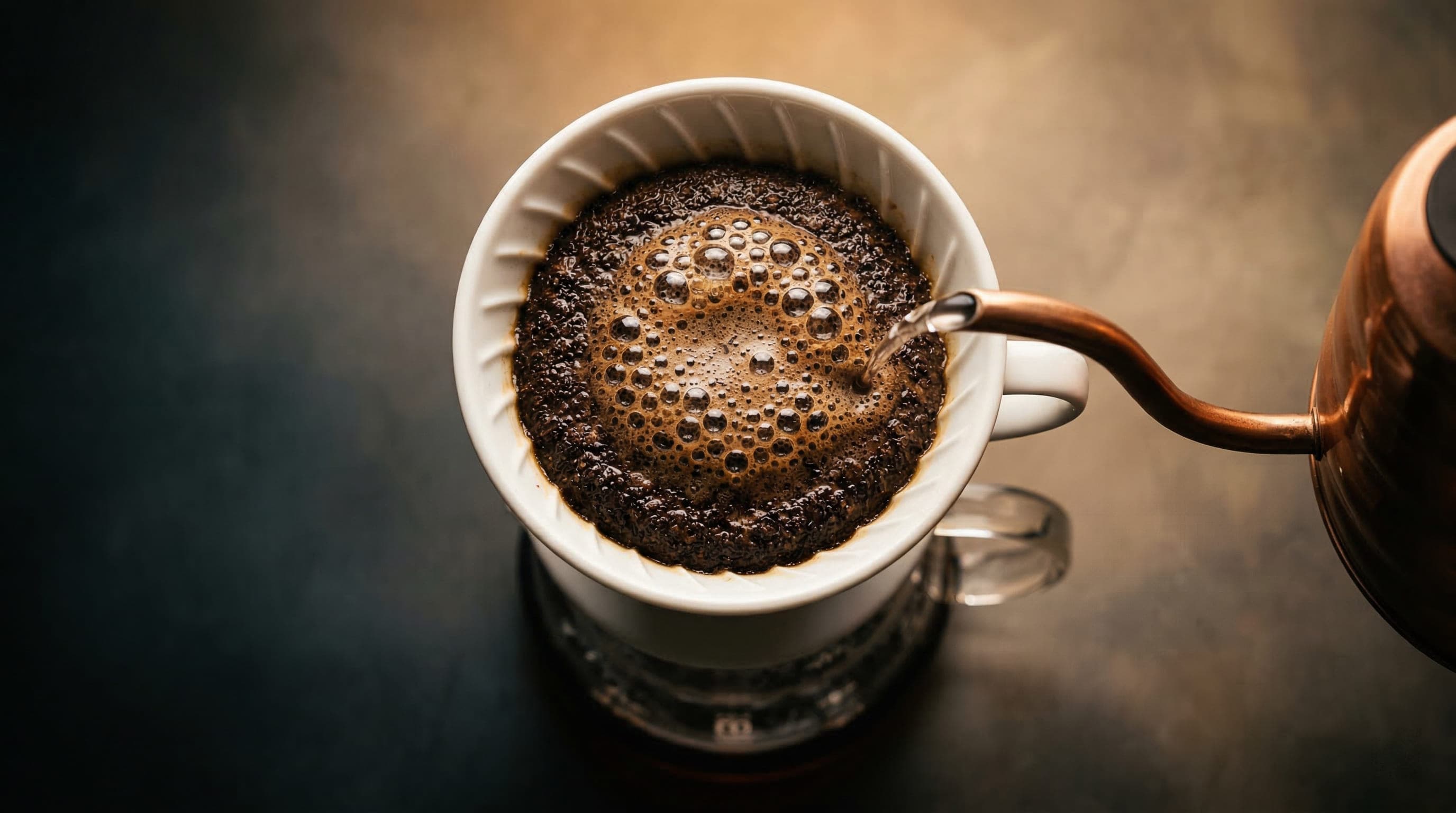
Coffee bloom is the first 30-45 seconds of a brew: a small pour of hot water (about twice the coffee's weight) lets trapped CO2 escape from fresh grounds, so the main pour extracts evenly. It matters most for pour over with beans under about 3 weeks past roast.
Ready to put it into practice? See our best drip coffee makers, or browse how to choose fresh beans for fresh beans to bloom.
A short pre-wetting lets trapped CO2 escape before the main pour.
Roasting traps CO2 in the bean. Hot water releases it fast, and the escaping gas pushes water away from some grounds. The result is a flat, slightly sour cup that grind and ratio cannot explain.
| Without bloom | With bloom |
|---|---|
| Gas repels water unevenly | Gas escapes first |
| Patchy extraction | Even extraction across the bed |
| Flat or sour cup | Sweeter, more developed cup |
Gas repels water unevenly
Patchy extraction
Flat or sour cup
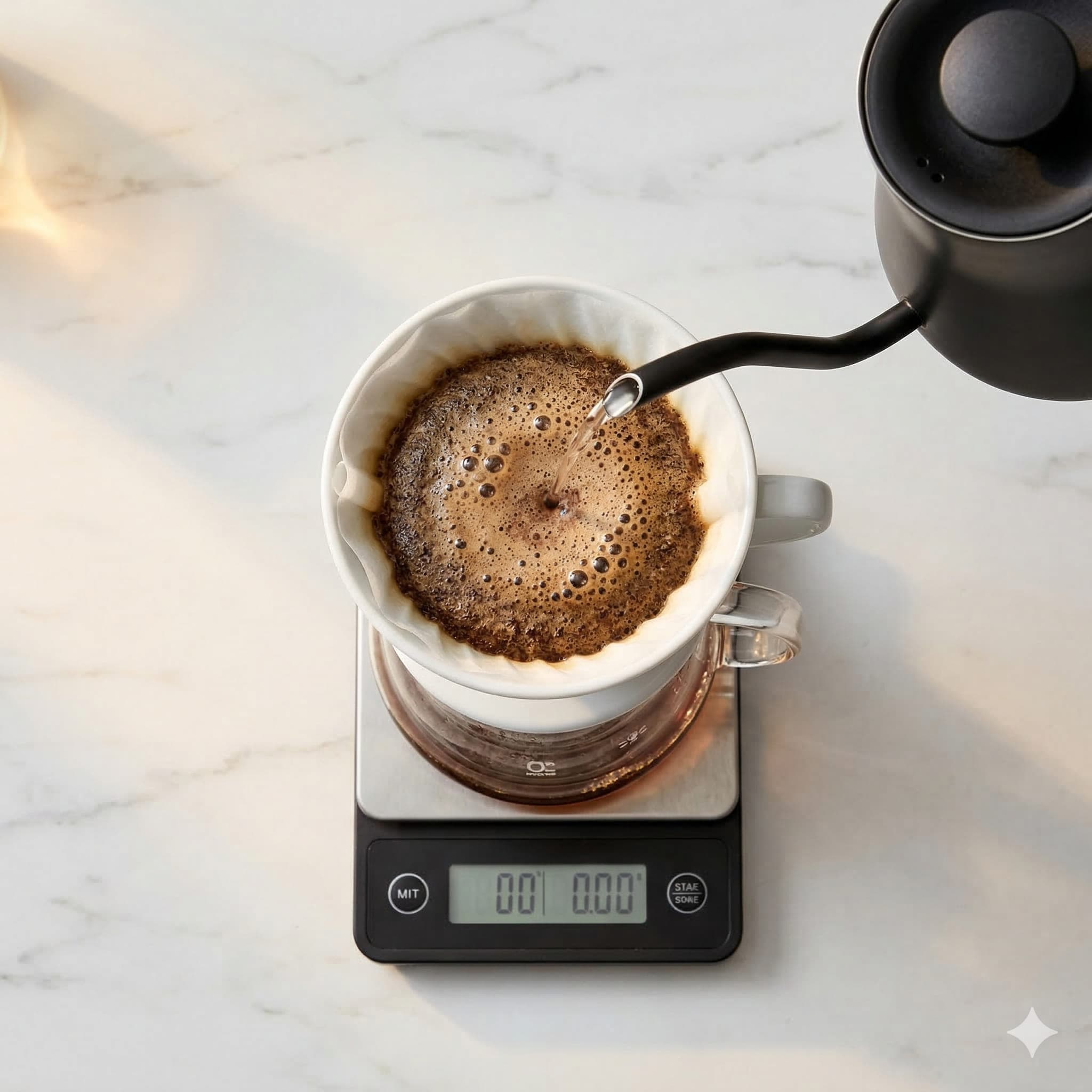
Weigh the water, wet every ground, wait.
Weigh bloom water at 2:1. 15 g coffee gets 30 g water. Very fresh beans can take about 2.5:1.
Pour in a slow spiral,. Centre to edge, with no dry patches.
Wait 30–45 seconds. Until the bed has risen and bubbling slows.30–45 seconds
Start the main pours. Total brew time is about 3–4 minutes.3–4 minutes
Full recipe in what pour over coffee is; the pour over ratio calculator sets bloom water for any dose.
Roasting traps gas inside the bean, and hot water pushes it out.
Roasting creates carbon dioxide inside the bean. Over the following days and weeks it slowly escapes, a process called degassing. When hot water hits fresh grounds, the remaining gas is released in a rush, so the bed swells and bubbles.
Those bubbles repel water. If you skip the bloom, escaping gas pushes the water away from the grounds, which can cause uneven wetting, sour spots and a weaker cup. A short pause lets the gas escape so the main pour reaches every particle.
Darker roasts and older beans bloom less, since they hold less trapped gas. A flat bloom does not always mean something is wrong, but it often signals stale coffee.
More CO2 means a bigger bloom, so it doubles as a freshness check.
| Days since roast | Bloom | What to do |
|---|---|---|
| 0–3 | Very aggressive | Wait 45–60 sec; rest beans if you can |
| 4–14 | Vigorous | Standard 30–45 sec; biggest benefit |
| 15–30 | Moderate | 30 sec is enough |
| 31–45 | Minimal | Mostly cosmetic |
| 46+ | Almost none | Buy fresher beans |
0–3
4–14
15–30
31–45
46+
Bloom amplifies fresh beans but cannot rescue stale ones.
Filter methods, especially pour over.
Too little water, too little time, too much force.
Scales, kettles, pre-infusion and agitation for a consistent start.
Water quality counts too. Very soft or very hard water changes how the grounds extract after the bloom, so a balanced filtered water gives steadier results. For a hands-off alternative, some drip coffee makers include a pre-wet stage.
Brewers with a built-in bloom step, and consistent grinders.
REVIEWED
Handles the bloom step automatically, with app-controlled bloom profiles.
REVIEWED
A drip brewer with an automatic bloom step.
Affiliate links: we may earn a commission at no extra cost to you.
Quick decision guide
You want hands-off bloom control
Choose a brewer from the best drip coffee makers.
You brew pour over by hand
Invest in a consistent grinder: Fellow Ode Gen 2 for precision or Timemore Chestnut C3 for a compact hand grinder.
Quick answers before you buy.
Related, not identical.
Bloom is CO2 degassing when hot water meets fresh grounds; pre-infusion is an espresso function that wets the puck at low pressure.
Little or no bloom usually means the beans are stale, were roasted a long time ago, or are pre-ground and have already released their gas.
Fresher beans bloom more; see how to pick espresso beans for freshness cues.
Barely.
Grinding releases much of the CO2 within minutes, so pre-ground coffee shows a weak bloom even if the bag is fresh.
Grinding just before brewing is the easy fix.
A gentle swirl or quick stir is fine, since the goal is to wet every ground evenly.
Avoid aggressive stirring that pushes fines into the filter.
Yes.
The bloom is the first part of your recipe, so a 15g dose with 30g of bloom water and a 250g total simply adds the remaining water afterward.
Use the pour over ratio calculator to plan it.
Yes.
Add a little hot water, wait 30–45 seconds, then pour in the rest and steep as usual.
It helps fresh grounds saturate evenly.
Keep reading: more guides on the same topic.
What pour over coffee is and how the method works, plus grind size, water temperature and a recipe to dial in your best cup
Read the guideDrip vs pour over coffee compared on taste, temperature, effort and cost, with a simple rule for which brewer fits your routine.
Read the guideHow to pick espresso beans that suit your taste and brewing style
Read the guideHow espresso extraction works and how to fix sour or bitter shots.
Read the guide


