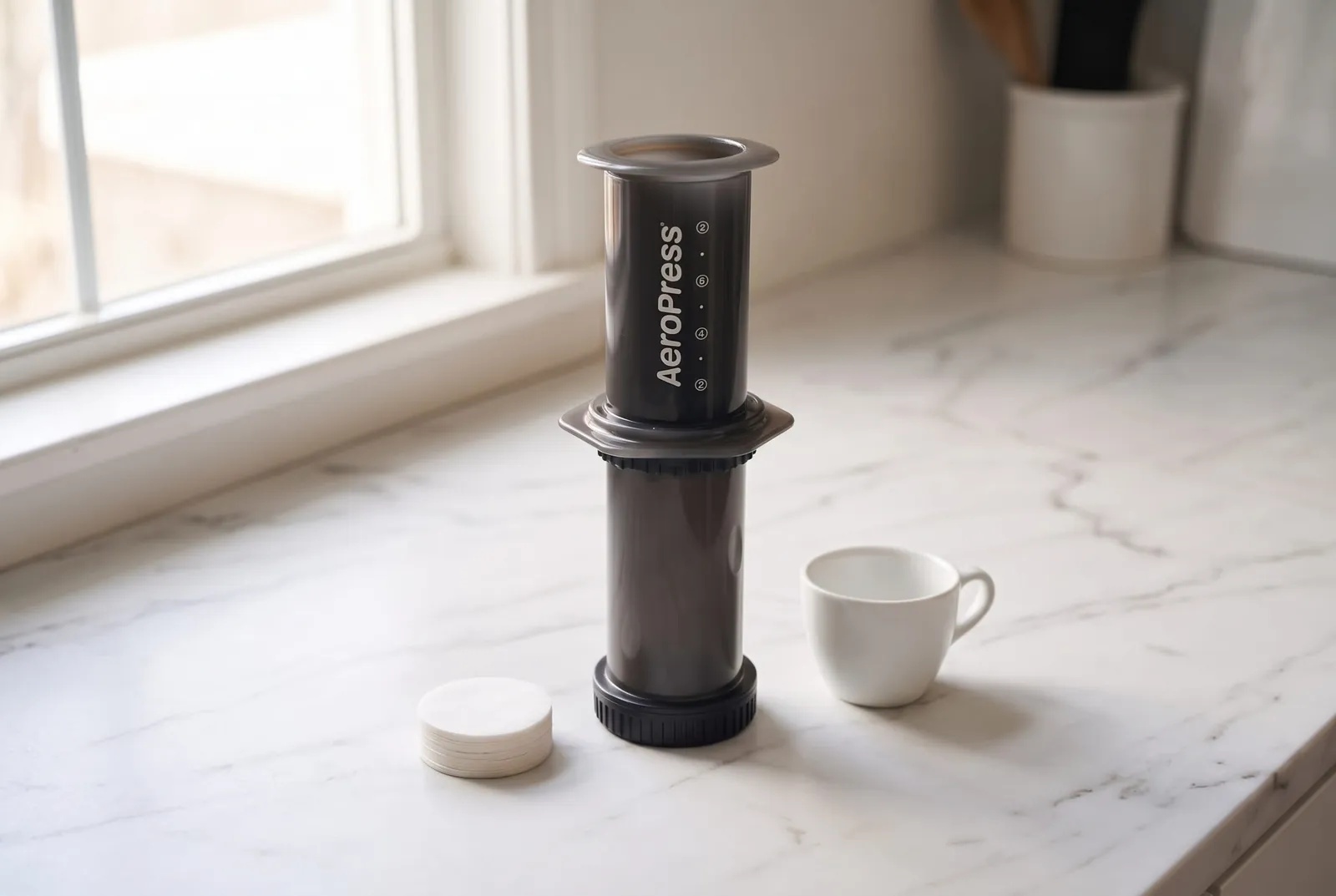
Coffee maker review
Last updated
AeroPress Original Review 2026: Quick Single Cups
AeroPress Original review: want better coffee with 30-second cleanup? We ran 80+ brews over 6 weeks. See what it does well and where one press falls short.
- Our rating 4.8/5
- By Michael Anderson
- 22 min read
- Independently tested: 80+ shots over 6 weeks
Affiliate disclosure: this page contains Amazon affiliate links. We may earn a commission if you buy through them, at no extra cost to you, and it never affects our rankings. Learn more
AeroPress Original Coffee Maker at a GlanceHighly recommended
The best manual brewer for most people at any price; its limits are small batches and no true espresso.
Manual Total Immersion Coffee Maker
Affiliate link: we may earn a commission at no extra cost to you. It never affects our rating.
- 1–2 minutes
- Brew time
- 1–3 cups per press
- Cups per press
- 145g
- Weight
On the brew bench· 80+ brew · 6 weeks
Why it stands out
- Cleanup in 30–45 seconds, no scrubbing
- Smooth, low-acid cup that beat V60 in 4 of 6 blind tastings
- Forgiving of water temperature and grind size
Watch out for
- Only 1–3 cups per press, so groups need repeat brews
- Concentrate mode isn't true 9-bar espresso
✓ Best for
Coffee drinkers who want a fast, forgiving, and endlessly versatile manual brewer
✕ Skip if
Buyers who want full automation with no hands-on steps
This AeroPress Original review starts with a surprise: Alan Adler, the Stanford professor who invented the Aerobie flying disc, also invented the AeroPress, and it scored higher than a Hario V60 in 4 of 6 blind tasting sessions.
The short answer: For most drinkers it is the best manual coffee maker at any price: fast, forgiving and easy to clean, with volume and true espresso pressure as its limits.
- What held up: Smooth, low-acid cups, with cleanup in 30–45 seconds and no scrubbing.
- Forgiving range: It works across a wide range of water temperatures and grind sizes, so it's hard to make undrinkable coffee.
- Where it fell short: Capacity is small for groups of four or more, and concentrate mode isn't true 9-bar espresso.
- Who it's for: Home, travel and camping brewers who don't mind a manual process.
Who Is This Right For?
Check where you fit before you look at the trade-offs below.
A strong match
It suits you if you are
- Coffee drinkers who want a fast, forgiving, and endlessly versatile manual brewer
- Anyone who wants smooth, low-acid coffee at a fraction of the price of any machine
- Travelers, campers, and office or hotel-room brewers who need something compact and durable
- Coffee enthusiasts who want real control over extraction through grind size, water temperature, steep time, and press speed
Consider something else
Look elsewhere if you are
- Buyers who want full automation with no hands-on steps
- Households that regularly brew for four or more people without doing multiple press cycles
- Anyone who needs true 9-bar espresso for milk-based drinks — the AeroPress makes a concentrated brew, not pump-pressure espresso
- Skill level
- Beginner-friendly and forgiving, but rewards experimentation — grind size, water temperature, steep time, and press speed are all easy to adjust and learn from.
- Drink style
- A concentrated, smooth, low-acid manual brew in 1-2 minutes — closer to a strong filter coffee or Americano base than to espresso.
- Upgrade path
- Buyers who want hands-off, higher-volume brewing should move to a programmable drip machine like the Breville Grind Control or OXO Brew 9-Cup; those who want true espresso should look at a semi-automatic machine.
Pros & Cons
What earns the rating, and what you give up to get it.
9 reasons it works
Pros
- Fastest cleanup of any brewer tested — eject puck, rinse, done in 30–45 seconds flat
- Produces smooth, low-acid coffee that consistently scored higher than V60 in 4 of 6 blind tasting sessions
- Versatile enough to brew filter coffee, espresso-style concentrate, Americano, and cold brew concentrate — one brewer, infinite recipes
- Works with any water temperature (175–205°F) and any grind size — hard to make undrinkable coffee
- Travel-ready at 145g — no electricity needed, works on camping trips, hotel rooms, and every country in the world
- Exceptional value at $32–$62 — produces cup quality that rivals $200–$400 pour-over setups when dialled in
- Fastest brew of any manual brewer: 1–2 minutes from grind to cup
- Massive recipe community — World AeroPress Championship recipes freely available online, thousands of tested recipes
- BPA-free, made in USA, fully replaceable parts including seal and filter cap
6 trade-offs to weigh
Cons
- Maximum 1–3 cups per press — not practical for groups of four or more without multiple brew cycles
- Requires manual effort — not suitable if you want push-button automation
- Does not produce true 9-bar espresso — concentrate mode is espresso-style but lacks crema of pump machines
- Metal filter (for heavier-bodied cup) sold separately (~$12); paper filters are an ongoing small cost (~$7 per 350)
- Inverted method requires careful handling when flipping a chamber full of hot water — minor burn risk if rushed
- No keep-warm function — brew directly into the mug you plan to drink from or pre-warm a thermal cup
Real-World Testing
How it performed in day-to-day use, in the order you will meet it.
Setup & Learning Curve
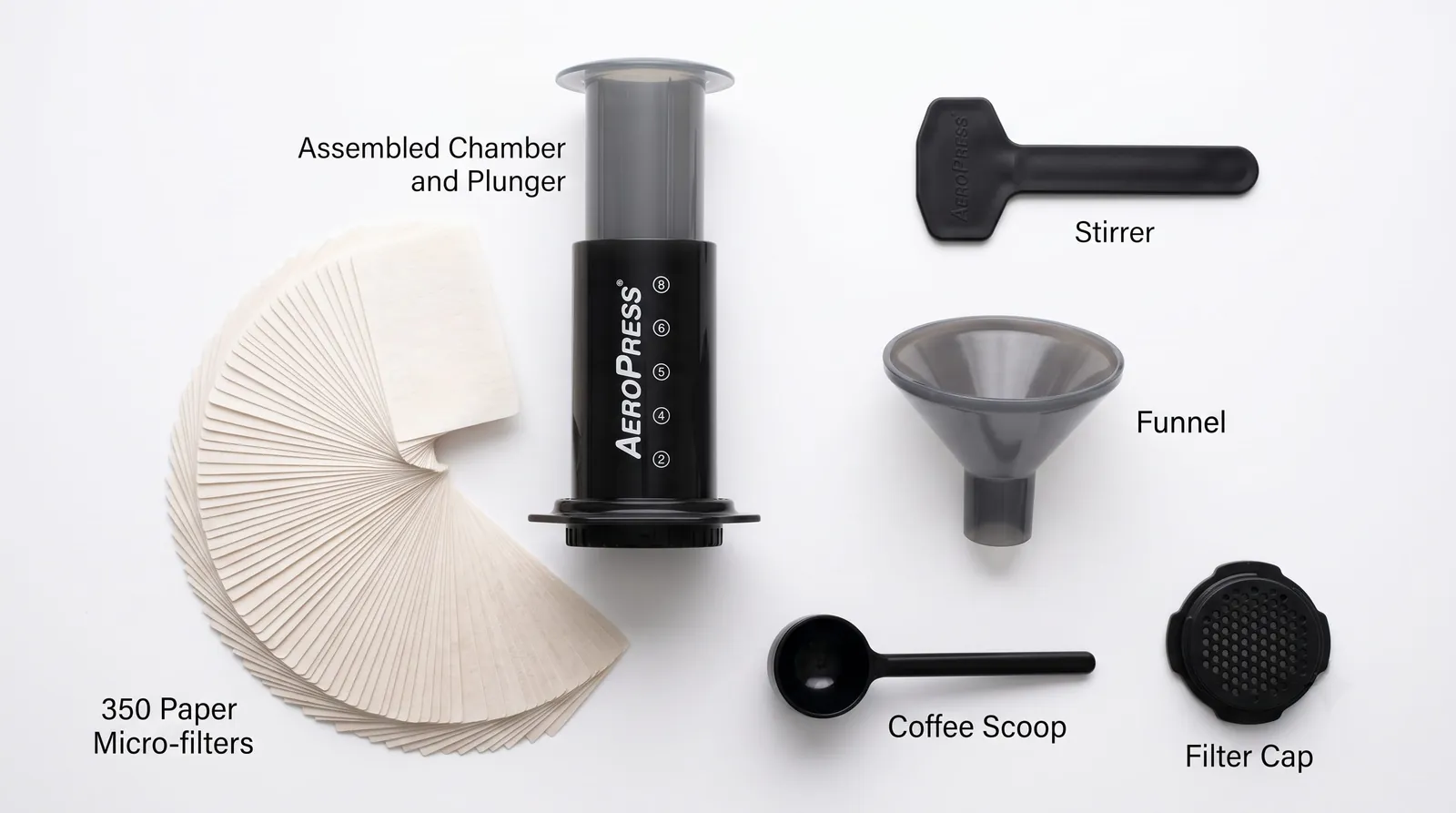
There's no unboxing curve to speak of. Assemble the chamber and plunger, choose the standard or inverted method, and brew.
The inverted method takes a session or two to feel natural (flipping the assembled unit onto the mug without spilling), but most people produce a decent cup on their first attempt.
Dial-In Workflow
Daily use is fast and repeatable:
- Filter-style brewing: steep times of 75–90 seconds.
- Espresso-style concentrate: roughly 90 seconds.
- What matters: results depend mainly on grind size, ratio and water temperature rather than any machine variable.
Shot Extraction Notes
- Filter mode: TDS averaged 1.38% (1.25–1.55% range) at a 1:12–1:15 ratio across all tracked brews, within or just above the SCA Golden Cup range.
- Inverted espresso-style concentrate: TDS averaged 2.4%, well above filter coffee but far below true pump espresso. It works best as an Americano base or a small, intense cup on its own.
Cleanup & Maintenance
Cleanup is the AeroPress's standout advantage. Unscrew the filter cap, eject the compressed grounds puck in one piece, and rinse for 10–15 seconds, a 30–45 second total routine with no scrubbing.
The rubber plunger seal eventually softens after 3–5 years of daily use and is user-replaceable for about $6.
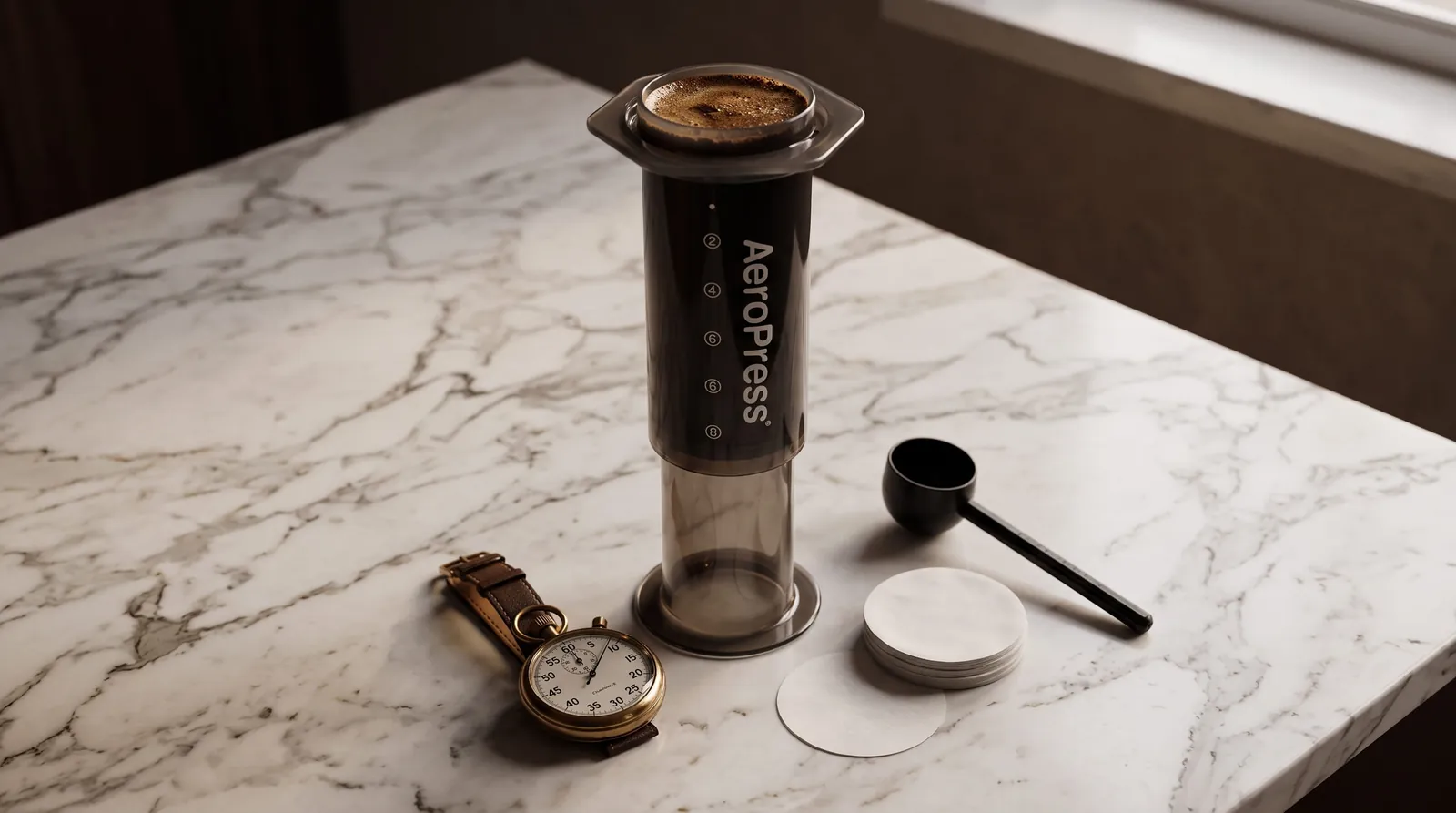
Is the AeroPress Original worth it?
Value, ownership cost and who gets the most from it
Yes, for most solo and two-person households. At $32–$62 it is the cheapest route in this review set to a cup that consistently beat a V60 in 4 of 6 blind tastings. Its five-year ownership cost works out to about $72 including filters and one seal replacement, with no electricity, descaling or replacement carafes. The V60 ratio calculator gives the bloom and every pour as a scale reading.
Where it is not worth it: if you brew for four or more people at once, or you dislike any hands-on step. In those cases a programmable drip maker saves effort, and the manual work will feel like a chore rather than a ritual.
Buy a grinder before you buy accessories. The AeroPress forgives inconsistent grinding, but a burr grinder improves the cup more than any accessory. Our burr grinder guide helps you choose.
AeroPress standard vs inverted method: which should you use?
- Standard method: place the chamber on the mug and press. It is the simplest and has no spill risk, so it suits beginners and travelers. Filter-style steeps run 75–90 seconds.
- Inverted method: flip the assembled unit so you can steep longer without dripping, then flip it onto the mug. It takes a session or two to master, and the main risk is a minor burn if you rush the flip with a chamber full of hot water. It suits espresso-style concentrate, which steeps for roughly 90 seconds, and extended steeps of 2–4 minutes.
Pick standard first. Move to inverted only when you want longer steep control or you are making concentrate.
For ratios, try the AeroPress calculator or the coffee ratio calculator.
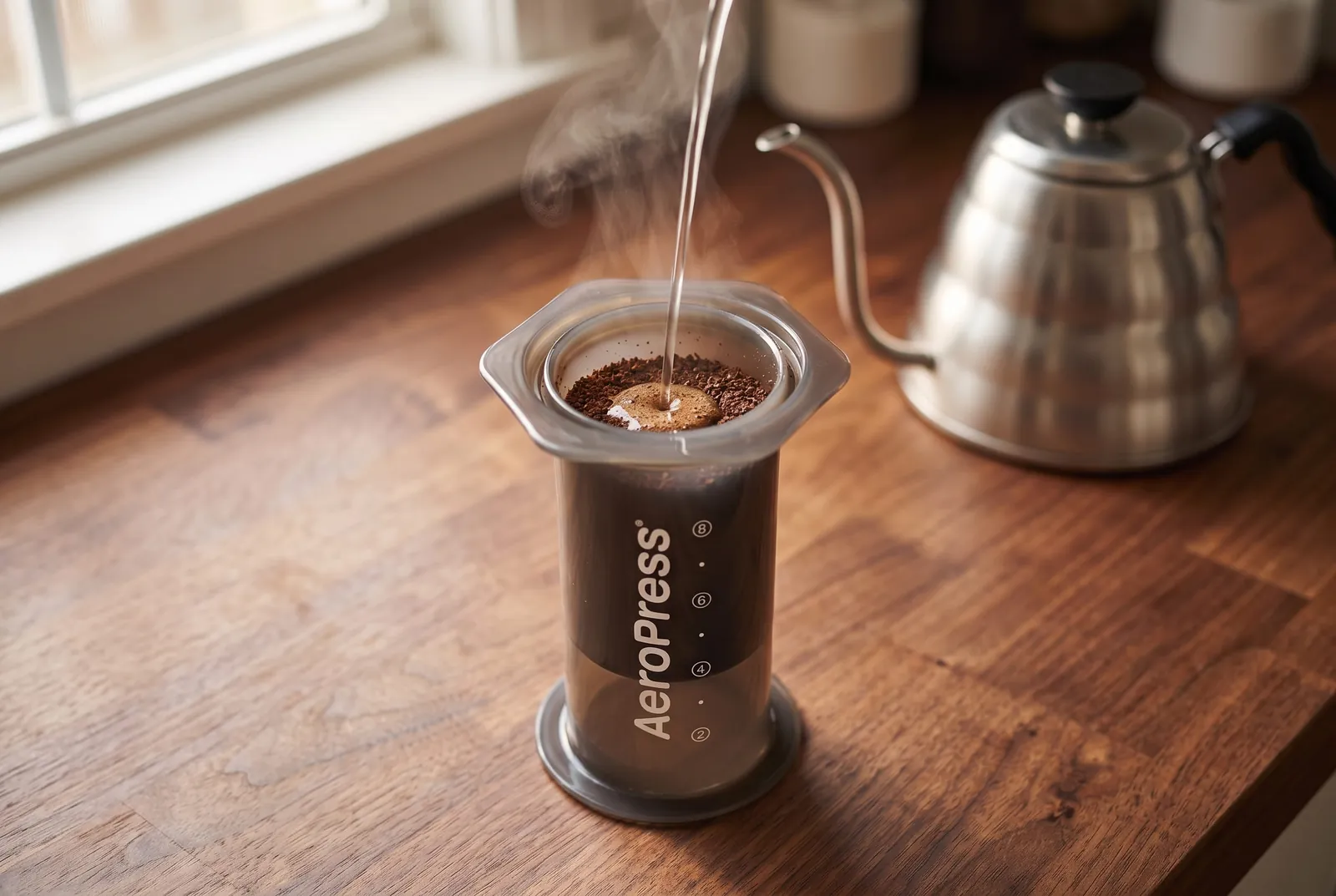
Paper vs metal AeroPress filters: what changes in the cup?
The paper micro-filters included in the box give a clean, low-sediment cup, and a replacement pack of 350 costs about $7 (roughly $0.02 per brew). A metal filter, sold separately for about $12, lets more oils through for a heavier-bodied cup and removes the ongoing filter cost.
The trade-off is clarity versus body. If you like a bright, tea-like cup, stay with paper. If you want something closer to a French press with less sediment, try metal. The review's core results were measured on paper-filter brews, so expect some change in taste and TDS with metal. The French press ratio calculator gives the dose for your press size.
There is no keep-warm function, so brew into a pre-warmed mug or a thermal cup.
AeroPress vs French press, V60, moka pot and espresso machines
Vs French press: the micro-filter removes sediment and most oils for a cleaner cup, and cleanup is quicker. Choose a French press for a heavier body or larger volume.
| Product | Type | Capacity | Key feature | Current price |
|---|---|---|---|---|
| AeroPress Original | Manual coffee maker | 1–3 cups per press | Fast cleanup, 145g and no electricity needed | Check price |
| French press | French press | not listed | Heavier body, larger volume than the AeroPress | — |
| V60 | Pour-over brewer | not listed | Light-roast clarity for experienced brewers | — |
| Bialetti Moka Express | Stovetop coffee maker | 3-cup and 6-cup sizes | Stovetop brewing with no pods or paper filters | Check price |
| Breville Barista Express BES870XL | Semi-automatic espresso machine with integrated grinder | not listed | Integrated 40mm conical grinder and steam wand | Check price |
- Vs V60: the AeroPress won 4 of 6 blind tastings in this review and is more forgiving of technique. A V60 suits experienced brewers focused on light-roast clarity. Our drip vs pour-over guide covers the wider comparison.
- Vs moka pot: the AeroPress needs no heat source, only hot water. See the Bialetti Moka Express review and our moka pot guide if you prefer stovetop strength.
- Vs an espresso machine: concentrate mode averaged 2.4% TDS and gets nowhere near 9-bar pump pressure. If milk drinks with crema matter, read the Breville Barista Express review.
- Vs AeroPress Go: the Go is the more compact travel option, and the Outin Mino is a battery-powered portable espresso-style alternative; the Original is the better home choice.
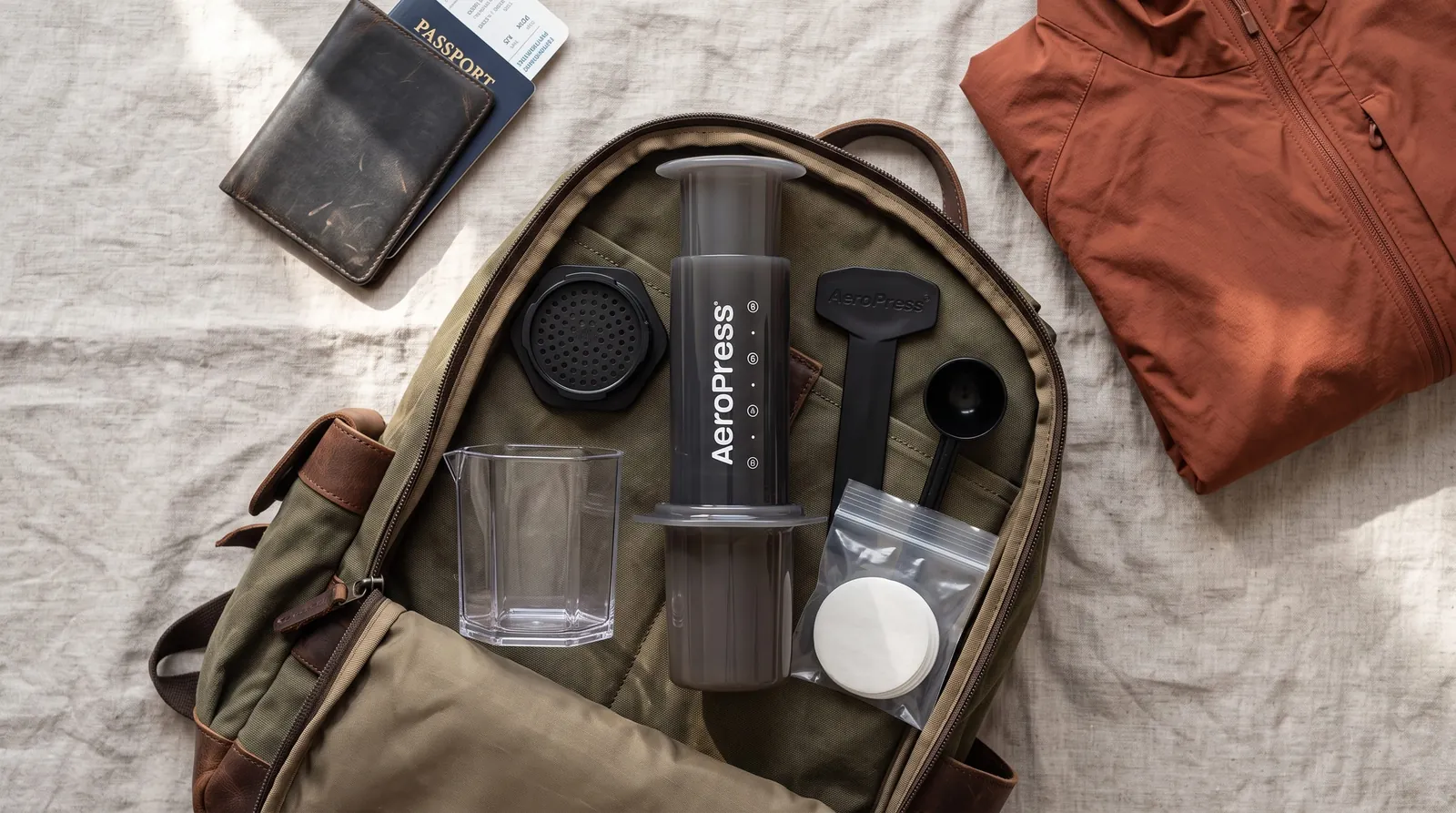
Who should skip the AeroPress Original?
Skip it if you want push-button automation, regularly serve four or more cups, or need true espresso with crema for lattes. You will also be unhappy if you expect it to hold coffee warm, since it has no keep-warm function.
If you do buy it, a manual hand grinder pairs naturally with its travel-friendly design; see our Comandante C40 review and our grind size chart for starting points.
How it works and why it matters
The mechanism behind the AeroPress cup and why it is so forgiving
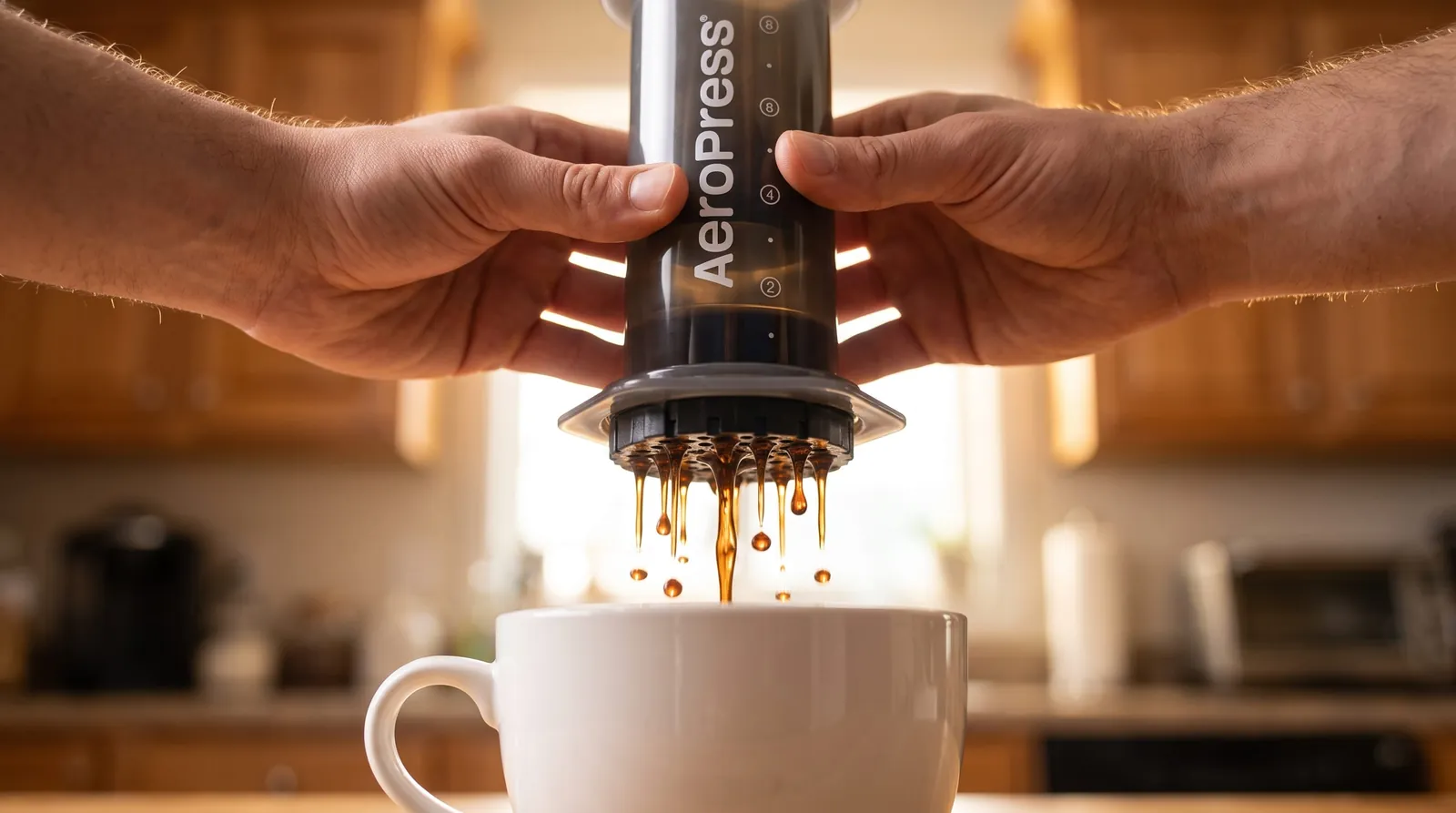
The AeroPress steeps coffee in hot water, then pushes it through a paper microfilter with a plunger. It is a hybrid: immersion builds flavor and body, and light pressure speeds the drain and filters out most oils and fines.
That pressure is far below an espresso machine's roughly 9 bar, so the result is concentrated filter coffee rather than espresso. The Americano versus espresso guide clarifies the difference.
Immersion is forgiving because the grounds sit in water of a fixed temperature for a set time. Small mistakes in pouring matter much less than in a pour-over, and the paper filter removes sediment that causes harshness. Switching to a metal filter lets oils through, giving a heavier, French-press-like cup.
What it means for you: you can change one variable at a time (grind, time, ratio, temperature) and taste the result. The AeroPress calculator turns that into a repeatable recipe.
Common problems and modern fixes
What goes wrong with an AeroPress and the simple fixes
- Bitter or astringent cup: Over-extraction from water that is too hot or a steep that is too long. Cool the water slightly and shorten the steep, or coarsen the grind. See why coffee tastes bitter.
- Weak, thin cup: Increase the dose or grind finer. Use the grind size chart as a starting reference.
- Papery or dusty taste: Rinse the filter with hot water before brewing and preheat the chamber.
- Dripping through before pressing: Fine grinds drain quickly. Start the timer after stirring, or try the inverted method to hold the water in.
- Stiff or sticking plunger: Rinse the rubber seal and avoid dry presses. Replace it when it stops sealing, which is inexpensive.
- Inconsistent results day to day: A hand burr grinder and a scale cure most of it. Our grinder picks include compact options that travel with the brewer.
Before you decide
How the AeroPress Fits in the Manual Coffee Maker Category
The manual coffee maker category spans stovetop moka pots, French presses, pour-over drippers and immersion brewers, and the AeroPress Original occupies a unique position across all of them.
- Versus pour-over: pour-over brewers rely entirely on gravity, while the AeroPress adds gentle air pressure from the plunger. That shortens brew time and produces a consistently smooth, low-acid cup even at variable water temperatures.
- Versus French press: the micro-filter removes sediment and most oils, producing a cleaner result.
- Versus moka pot: it needs no heat source, just hot water from a kettle or hotel tap.
At $32–$62, it is the most versatile manual brewer available at any price, and the only one with an active global championship community dedicated to developing and publishing recipes. If you're choosing between a Chemex, V60, French press or AeroPress as your first or only manual brewer, the AeroPress wins on versatility, speed and cleanup ease.
How It Measures Up on Key Brewing Criteria
- Brew temperature
- No heater: brew temperature is whatever your kettle delivers. That gives full control, and a variable-temperature kettle helps.
- Timing and workflow
- One to two minutes per mug once the water is hot. Cleanup is quick: the plunger pops the used puck and paper filter straight into the bin.
Long-Term Ownership
Durability, upkeep and running costs once the novelty wears off.
- Durability
The AeroPress Original has been in continuous production since 2005 with the same fundamental design.
More detail
The BPA-free polypropylene chamber and filter cap show no significant wear under normal brewing conditions. The most common failure point is the rubber plunger seal, which softens after 3–5 years of daily use — an inexpensive replacement.
- Lifespan
10–20+ years with normal use.
More detail
The chamber and filter cap have no structural wear mechanism. The plunger seal requires replacement every 3–5 years of daily brewing. Full replacement sets (all parts) are available from AeroPress Inc.
- Upkeep
Daily: 30–45 second rinse.
More detail
Weekly: soap wash of small parts. Monthly: optional citric acid soak. Annual: inspect plunger seal for softening; replace if the press feels loose. Filter replacement: approximately 350 paper micro-filters included; replacement packs of 350 cost approximately $7.
- Running cost
The lowest ongoing cost of any brewer in our review database.
More detail
Paper filters cost $0.02 per brew. Metal filter eliminates filter costs entirely. No electricity, no descaling solutions, no replacement carafes or parts beyond the occasional plunger seal.
- Five-year cost
Purchase: $38 average.
More detail
Paper filters (350 brews per pack, 1 brew per day; the first pack is included in the box, so 4 more packs over 5 years): $28. Plunger seal replacement (once): $6. Total 5-year ownership: approximately $72. This is by far the lowest 5-year ownership cost of any coffee maker we have reviewed.
- Warranty
1-year limited manufacturer warranty.
More detail
AeroPress customer service is consistently rated excellent for responsiveness and resolution. The company sells all replacement parts individually at low cost.
Final Verdict
Our rating, who it fits, and what it costs.
AeroPress Original Coffee MakerHighly recommended
4.8 / 5 — Is it worth buying?
Across the test period — and fifteen years of daily AeroPress use in testing — the conclusion has not changed: the AeroPress Original is the best manual coffee maker available at any price for most drinkers.
✓ Best for
- Coffee drinkers who want a fast, forgiving, and endlessly versatile manual brewer
- Anyone who wants smooth, low-acid coffee at a fraction of the price of any machine
✕ Skip if
- Buyers who want full automation with no hands-on steps
- Households that regularly brew for four or more people without doing multiple press cycles
Score breakdown
Brews tested
80+
Testing period
6 weeks
Ready to decide?
$32-$62typical street price
Our verdict: 4.8/5, highly recommended. Independently tested; commissions never change a rating.
Tools That Pair With This Review
Put it into practice with a free calculator built for what you just read.
- Coffee Ratio CalculatorThe general-purpose ratio tool for drip machines and pour-over — enter water or coffee, pick your strength.
- Brew Yield CalculatorGrounds keep water: work out what to pour to end up with the amount of coffee you want.
- Pour Over Ratio CalculatorGet your exact water, bloom pour, and total brew time for pour-over coffee.
Reader questions
Questions or tips? Leave a comment
Ask about your setup or share what worked for you. Comments are checked before they appear.