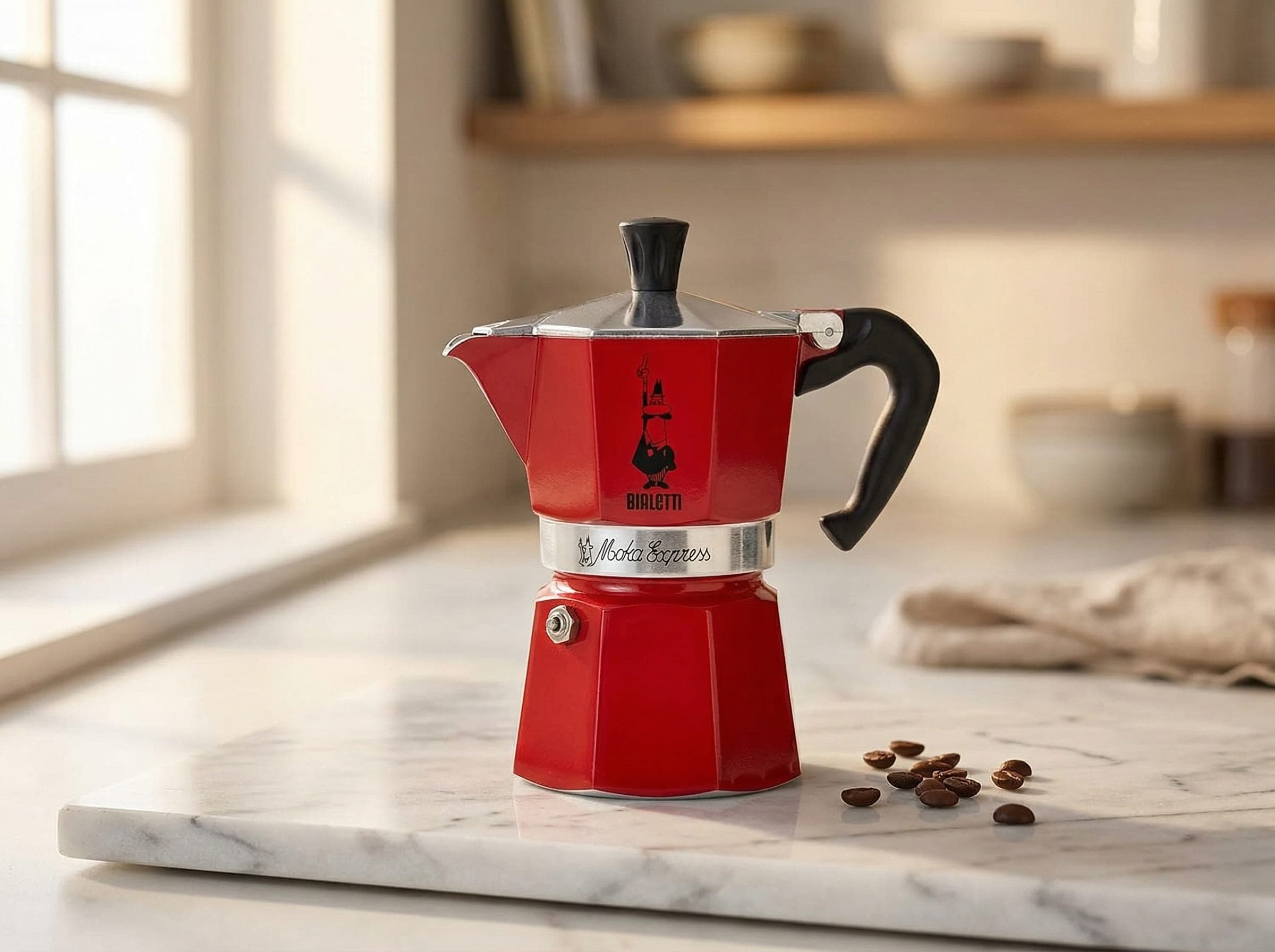
Coffee maker review
Last updated
Bialetti Moka Express Review 2026: Not Espresso
Bialetti Moka Express review: 160+ stovetop brews show what it tastes like, the grind and heat that matter, and why it is not true espresso.
- Our rating 4.6/5
- By Michael Anderson
- 19 min read
- Independently tested: 160+ pots over 8 weeks of daily testing
Affiliate disclosure: this page contains Amazon affiliate links. We may earn a commission if you buy through them, at no extra cost to you, and it never affects our rankings. Learn more
Bialetti Moka Express at a GlanceHighly recommended
A confident recommendation for the money, with one caveat: it rewards technique and is not an espresso machine.
Stovetop Moka Pot
Affiliate link: we may earn a commission at no extra cost to you. It never affects our rating.
- 1–2 bars
- Brew pressure
- 3-cup and 6-cup
- Sizes tested
- Cast aluminium
- Construction
On the brew bench· 160+ brews · 8 weeks
Why it stands out
- One of the best cost-per-cup ratios
- Durable, repairable cast aluminium build
- Zero running costs, no pods or paper filters
Watch out for
- 1–2 bars means no true espresso and no crema
- Real learning curve, and not induction-compatible
✓ Best for
Single-origin black coffee drinkers who want concentrated, espresso-adjacent intensity
✕ Skip if
Induction cooktop users
This Bialetti Moka Express review covers a pot in production since 1933, and testing showed the reputation holds, provided you handle technique the "just fill and heat" instructions skip.
The short answer: it is one of the best value-per-cup purchases in coffee equipment, but it does not make true espresso and it takes a short learning curve.
- What held up: The cast aluminium build is durable; only the rubber gasket really wears.
- Where it fell short: At 1–2 bars it cannot match 9-bar pump extraction, and it makes no crema.
- What to expect: Medium-low heat is required; high heat consistently produced scorched, bitter coffee.
- Who it's for: Anyone who wants bold, concentrated coffee at almost no running cost.
See our complete moka pot guide and moka pot brewing guide.
Who Is This Right For?
Check where you fit before you look at the trade-offs below.
A strong match
It suits you if you are
- Single-origin black coffee drinkers who want concentrated, espresso-adjacent intensity
- Budget-conscious buyers who want to reduce or eliminate pod machine running costs
- Travellers and outdoor brewers — works on any flame source including camping stoves
- Anyone with a gas or standard electric hob who wants a no-electricity brewing option
- Coffee enthusiasts who already understand grind size and want to experiment with stovetop extraction
Consider something else
Look elsewhere if you are
- Induction cooktop users — the aluminium body needs the Moka Induction variant instead
- Buyers who specifically need true espresso crema for latte art and milk drinks
- People who want zero-intervention, push-button consistent results without calibration
- Those who need programmable or timed brewing routines
- Skill level
- Beginner-friendly with a short calibration curve (5–10 brews)
- Drink style
- Strong black coffee, moka-style espresso, diluted Americano-style drinks
- Upgrade path
- Bialetti Brikka (more pressure, small foam layer) or DeLonghi EC155 for true pump espresso
Pros & Cons
What earns the rating, and what you give up to get it.
7 reasons it works
Pros
- Exceptional value — one of the best cost-per-cup ratios in any concentrated coffee brewer
- Zero running costs: no pods, no paper filters, no proprietary accessories
- Durable, repairable construction — gaskets and filters are cheap and easy to replace
- Compact size that stores easily in any kitchen
- Made in Italy — same factory, same design, proven over 90 years of production
- Works on gas, electric coil, and ceramic glass without any adapter
- Environmentally low-impact: no single-use waste
7 trade-offs to weigh
Cons
- Requires technique — grind size and heat management have a real learning curve
- Does not produce true espresso: 1–2 bars cannot replicate 9-bar pump extraction
- No crema — not suitable if you specifically need espresso foam for latte art or milk drinks
- Not induction-compatible (aluminium model) — requires separate Moka Induction purchase
- Cannot brew less than rated capacity — a 6-cup pot cannot make a single small serve
- Early metallic taste in first 10–15 brews requires seasoning before optimal use
- Hand-wash only — dishwasher use degrades the aluminium and strips seasoning
Convinced by the pros? Check today's Amazon price — it regularly goes on sale.
Current price: $50-$99
Real-World Testing
How it performed in day-to-day use, in the order you will meet it.
Setup & Learning Curve
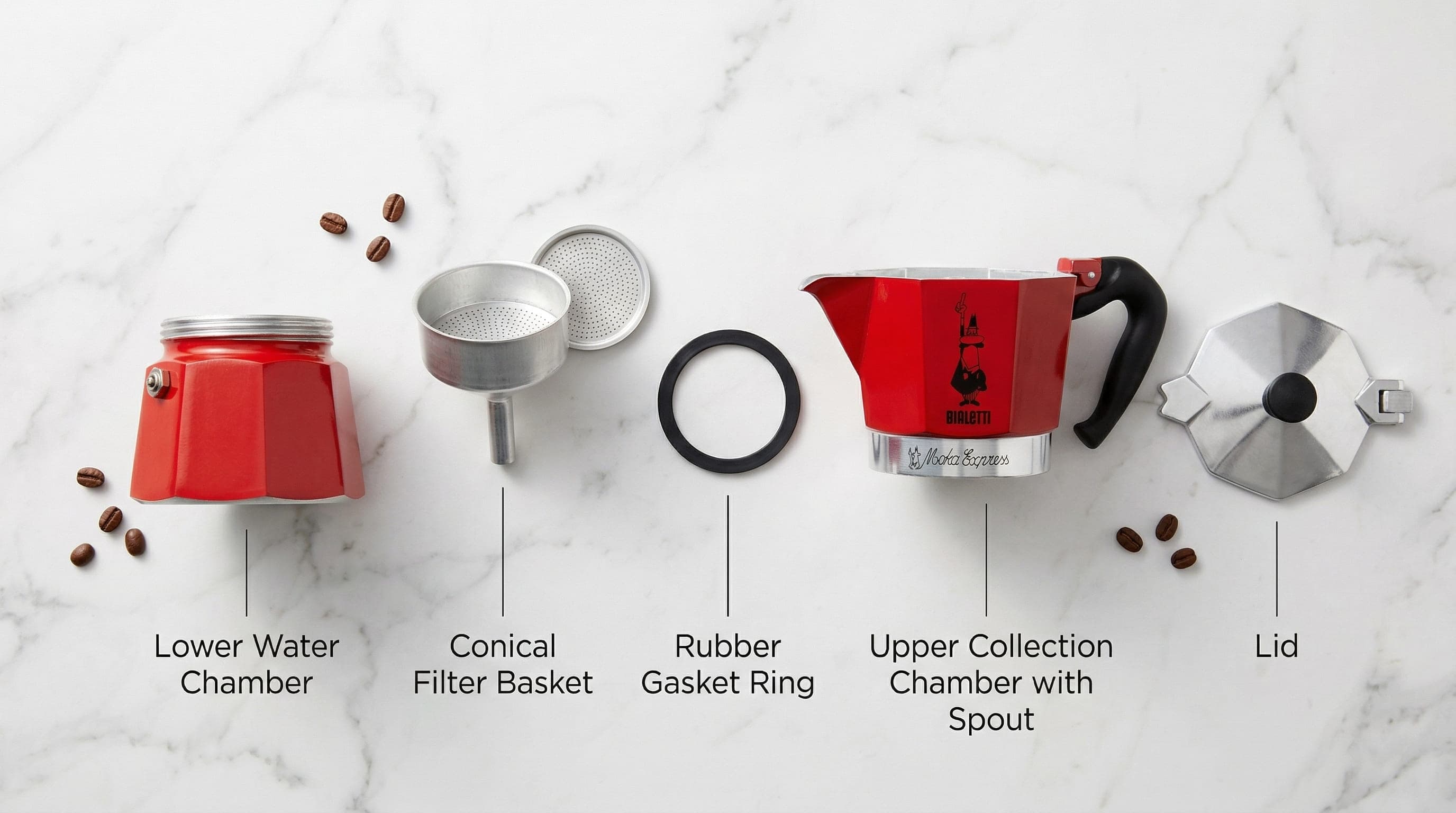
Assembly takes about ten seconds across four components: lower chamber, filter basket, rubber gasket, upper collector. The mechanics are simple, but grind size and heat management both take practice, so budget five to ten brews to reach consistent results, and more for a complete beginner.
- Grind: too fine and the low steam pressure can't push through; too coarse and the result is watery.
- Heat: too high produces scorched, bitter coffee in under three minutes; too low stalls the brew.
- Safety valve: the valve on the lower chamber is an engineered feature rather than decoration — deliberately testing it with an espresso-fine grind confirmed it releases pressure correctly before over-pressure can build.
Dial-In Workflow
Grind size is the primary variable. Testing across four settings on a Baratza Encore ESP (grinder set 12–20) gave clear differences:
- Setting 12 (fine-medium): a harsh, over-extracted cup with obvious astringency.
- Setting 14 (medium-fine): consistent 18–19% extraction with balanced bitterness and good body — the reference setting.
- Setting 17 (medium): thinner and slightly under-extracted.
- Setting 20 (medium-coarse): weak and sour.
The practical guidance: aim two to three clicks coarser than an espresso grind.
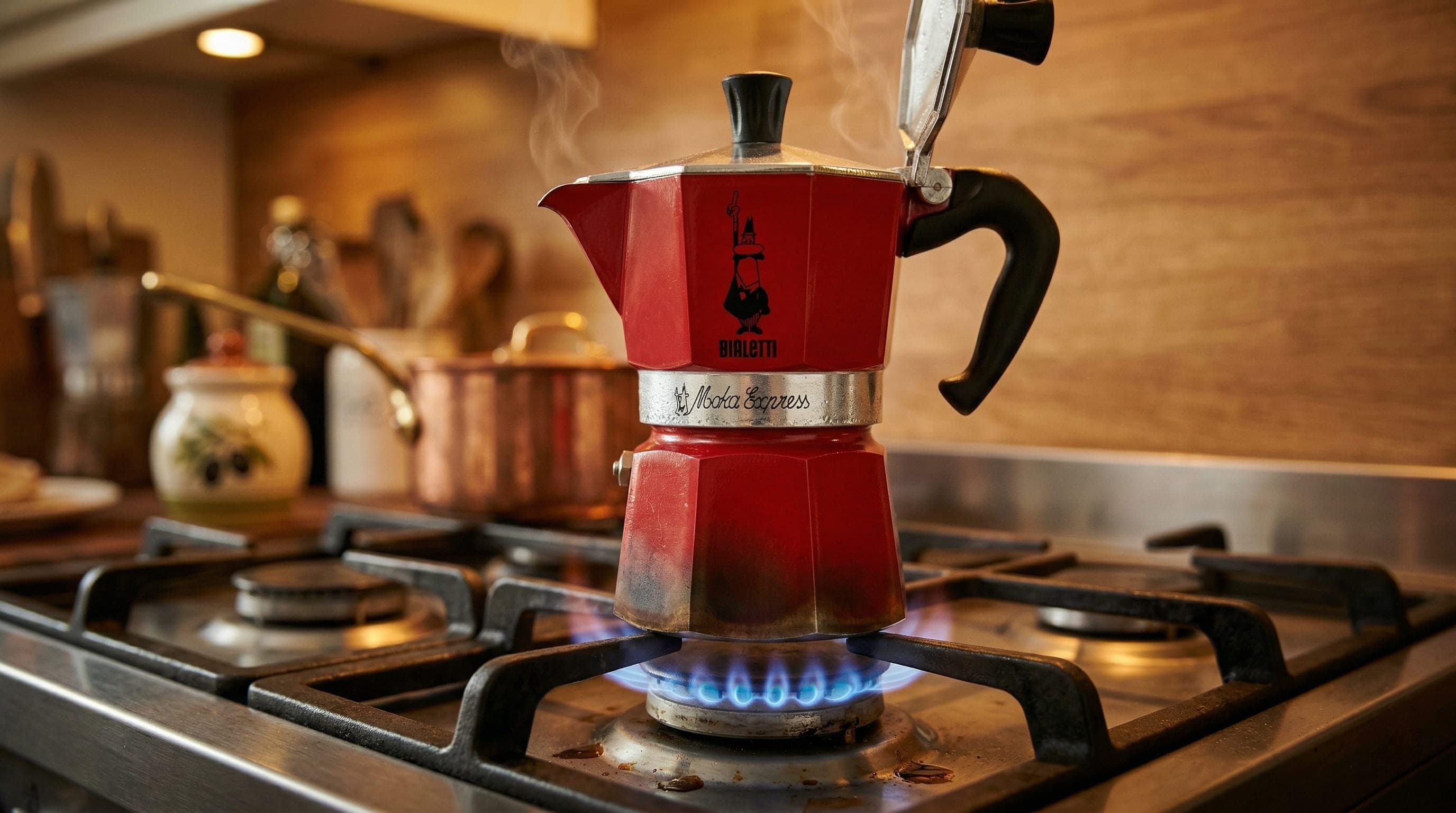
Heat matters just as much. Comparative brews on gas at low, medium, and high settings showed high heat finishing in 2–3 minutes with harsh, scorched top notes, while medium-low heat took 5–7 minutes and produced a structured, clean-finishing cup. Stovetop surface also affects consistency: gas offers the most controllable heat, electric coil is workable but slower to adjust, and ceramic glass is steady but slow to respond.
Shot Extraction Notes
TDS measurements via a VST refractometer across 60+ brew sessions, split between the 3-cup and 6-cup models, averaged 2.0–2.5% at 18–19% extraction yield when properly dialed in — well above specialty drip coffee's 1.2–1.5% TDS, though still short of true espresso's 7–12% TDS at 22–24% extraction.
- Against a pump machine: in a head-to-head against a DeLonghi EC155, the EC155 measured 9.1% TDS at 22% extraction against the Moka Express's 2.3% TDS at 18.5% extraction — a real chemistry difference, though the Moka Express's flavor holds up well for black coffee even without matching those numbers.
- Across coffees: washed Ethiopian Yirgacheffe, Colombian medium roast, and dark Italian espresso blend all produced a bold, structured cup lacking the crema and syrupy body of pump espresso. The Ethiopian light roast was most revealing of the grinder's impact on delicate floral notes.
- 3-cup vs 6-cup: the two models produced equivalent quality per serving, with TDS readings within 0.15% of each other at matched grind settings.
Cleanup & Maintenance
Routine care is simple: after each use, let the pot cool, disassemble, rinse all parts under warm water, dry, and reassemble loosely for storage.
- No soap or dishwasher: the aluminium interior develops a seasoning layer that improves flavor and protects the metal, and both soap and dishwasher detergent strip it.
- New units: a faint metallic note lasts for the first 8–10 brews and clears entirely by brew 12–15, consistent with Bialetti's recommendation to run 5–10 seasoning brews before relying on the pot.
- Gasket: the rubber gasket is the only wear component, typically needing replacement every 12–24 months at $5–$8 per set; swapping it took about 90 seconds per unit with no tools required during testing.
Is the Bialetti Moka Express worth it?
Value, running costs and what you give up
For most people who drink black coffee and own a gas, electric coil or ceramic glass hob, yes. The pot has no electronics, no pods and no paper filters, so the purchase price is nearly the whole cost of ownership. The one wear part is the rubber gasket, covered in the ownership notes above.
What you give up is automation and espresso-style texture. You stand at the stove, manage heat, and accept a bold, concentrated cup rather than a crema-topped shot. If that trade sounds fine, the pot is hard to beat on cost per cup. If it sounds irritating, a drip machine from our best drip coffee makers list will suit you better.
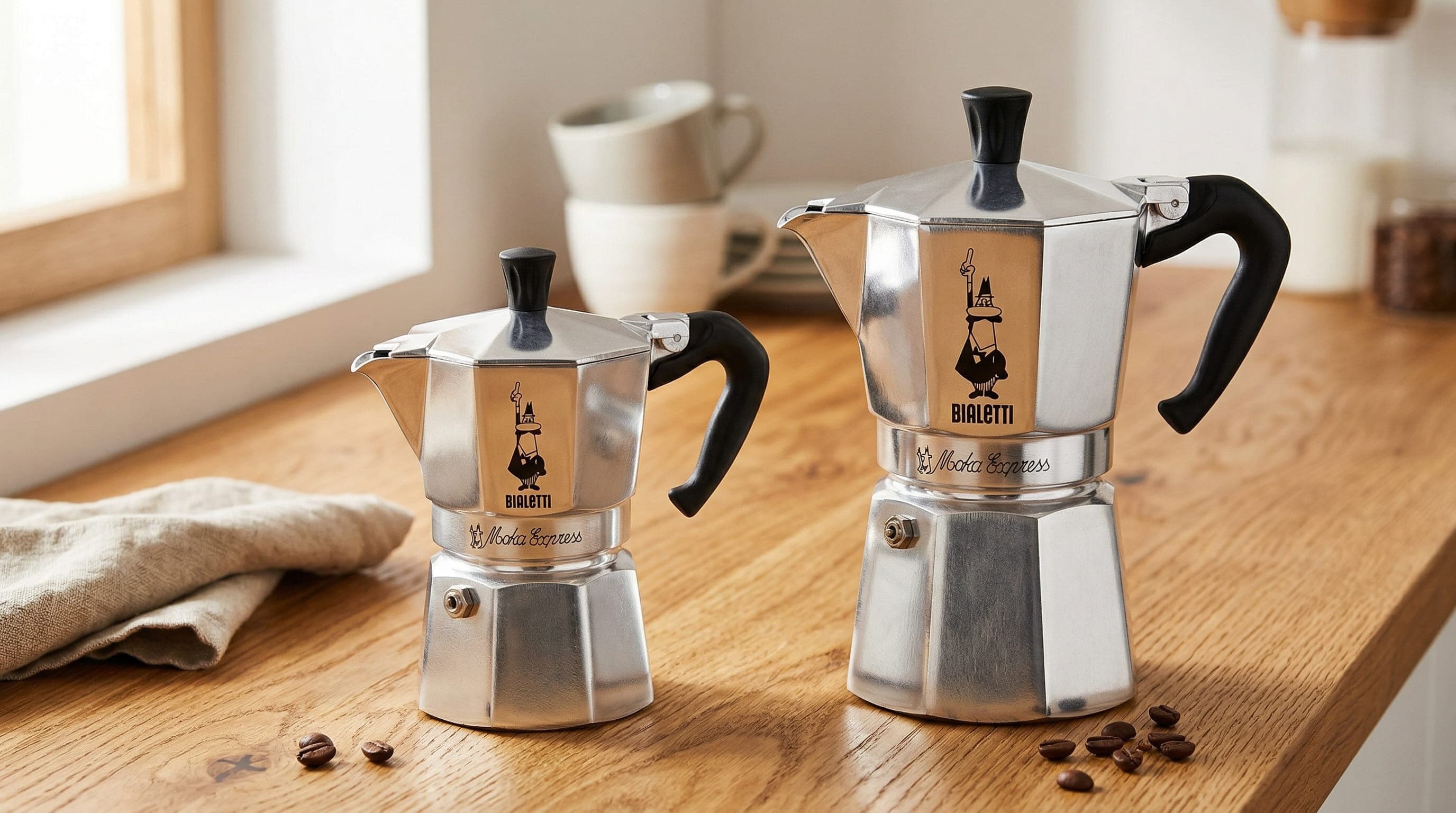
Moka Express 3-cup vs 6-cup: which size should you buy?
Match the pot to your daily routine
A moka pot works best when you fill the basket and the water chamber to their intended levels, so buying the wrong size is the most common regret. A small pot used for two people means two brews; a large pot used for one person means leftover coffee that tastes worse as it cools.
Pick the 3-cup if you drink one small, strong serving, or if you plan to dilute it into an Americano-style drink. Pick the 6-cup if two people share a pot or you like a full mug. Because the two sizes brewed at equivalent quality per serving, the choice is purely about how much you drink.
Note that "cup" here means a small Italian serving, not a standard mug. Check the volume on the product page before comparing it with your mug.
Moka pot vs espresso machine vs AeroPress: how does the Moka Express compare?
Three ways to get concentrated coffee at home
Versus an espresso machine. A pump machine delivers true espresso with crema and can steam milk; the moka pot cannot. The trade-off is price, counter space and a grinder requirement. Read our moka pot vs espresso machine guide for the full comparison, or browse best espresso machines under $500 if you want to step up.
| Product | Type | Capacity | Key feature | Current price |
|---|---|---|---|---|
| Bialetti Moka Express | Stovetop coffee maker | 3-cup and 6-cup sizes | Stovetop brewing with no pods or paper filters | Check current price |
| Breville Barista Express BES870XL | Semi-automatic espresso machine with integrated grinder | not listed | Integrated 40mm conical grinder and steam wand | Check current price |
| AeroPress Original | Manual coffee maker | 1–3 cups per press | Fast cleanup, 145g and no electricity needed | Check current price |
- Versus the AeroPress: The AeroPress Original review covers a portable, forgiving brewer that works without a stove and is easier to get consistent results from on day one. The moka pot gives a stronger, heavier-bodied cup in a stovetop format, and the AeroPress is more flexible across recipes.
- Versus a drip machine: Drip is hands-off and makes larger volumes. The moka pot is smaller, cheaper to run and more concentrated, but it needs your attention.
Bialetti Moka Express problems and how to fix them
The issues that trip up new users
- Bitter or burnt taste: Usually too much heat or too fine a grind. Use medium-low heat and a medium-fine grind, as covered in the grind testing above, and remove the pot from the heat once it begins to gurgle.
- Weak or sour coffee: A grind that is too coarse or a basket that is under-filled. Level the grounds and do not tamp them.
- Metallic taste in a new pot: Normal in the first brews, and it fades with seasoning. Follow the manufacturer's break-in guidance.
- Leaks around the join: Usually a worn or misaligned gasket, or grounds on the threads. Wipe the rim before tightening and replace the gasket when it hardens.
- Stuck or sluggish brew: Too fine a grind clogs the filter. Coarsen the grind slightly.
If you want a step-by-step routine, our moka pot brewing guide walks through each stage, and the moka pot calculator helps with dose and water.
Who should skip the Bialetti Moka Express?
Honest reasons to choose something else
Skip the aluminium Moka Express if you cook on induction, since it needs a different induction-specific model. Skip it if you want milk drinks with foam, or if you expect push-button consistency every morning.
Also skip it if you brew a single small serve in a large pot, or if you want programmable timing. In those cases a drip machine or a pump espresso machine is a better fit, and our what is a moka pot explainer is worth reading before you commit.
How it works and why it matters
How a Moka pot pushes water through the grounds, and why heat control matters
A Moka pot has a base for water, a funnel basket for grounds and an upper chamber. Heating the base builds steam pressure that forces water up through the coffee and into the top. The Moka pot explainer covers the history.
Pressure is low, around one to two bar, so extraction is gentler and less oily than an espresso machine's. That is why the cup is strong and rich but lacks real crema. Compare the two directly in moka pot versus espresso machine.
Heat control sets the flavor. High heat scorches the grounds and drives water through fast, which gives a sour-then-burnt cup. Gentle heat lengthens the extraction and keeps the coffee sweet.
What it means for you: the pot is simple, but it rewards patience. Medium-fine grind, no tamping and low-to-medium heat produce the best result.
Common problems and modern fixes
The Moka Express complaints that come up most, and what current accessories solve
- Burnt or metallic taste: New aluminum can taste metallic until seasoned; brew a few batches and discard them. Remove from heat when the stream turns pale and run the base under cold water to stop extraction.
- Sputtering and bitterness: Too much heat. Start with pre-heated water in the base, as the Moka pot guide advises, to cut the time the grounds sit above a hot base.
- Leaks around the join: Worn gaskets are the usual cause. Replace the rubber seal and filter plate about once a year, and do not overtighten.
- Hard to wash: Rinse by hand, dry fully and avoid dishwashers, which can dull aluminum.
- Induction hob: The aluminum Express does not work on induction. A stainless adapter plate lets it work, or choose an induction-compatible stainless model.
- Dose confusion: Fill the basket level, not packed. The Moka pot calculator sizes brewing water and coffee.
Before you decide
Moka Pot vs. Drip vs. Pod: Choosing the Right Brewing Method
The Bialetti Moka Express sits in a unique position between fully automatic drip machines and entry-level espresso makers. It produces concentrated, espresso-strength coffee at near-zero running cost — but requires technique that pod machines and drip makers don't. Two cases where it isn't the right fit:
- No-fuss automated coffee: a programmable drip machine like the Cuisinart 14-Cup ($80) or a single-serve pod machine makes more sense.
- True 9-bar pump espresso with crema and a steam wand for milk drinks: that requires a pump machine — see our espresso machine reviews.
The moka pot wins on one metric nothing else can match at this price: zero per-cup cost at concentrated-coffee quality. Browse all tested options in our coffee maker reviews hub.
Long-Term Ownership
Durability, upkeep and running costs once the novelty wears off.
- Durability
Cast aluminium construction has proven durability over decades of real-world use.
More detail
Bialetti pots commonly stay in service for decades with only gasket replacements. The only meaningful wear point is the rubber gasket.
- Reliability
Extremely reliable — there are no electrical components, heating elements, or pump mechanisms to fail.
More detail
The only thing that can go wrong is a worn gasket (easy replacement) or a bent valve (rare, caused by impact).
- Parts
Excellent.
More detail
Bialetti sells replacement gasket and filter plate sets for all standard sizes, widely available through Amazon, Williams Sonoma, and kitchen specialty stores. Typically $5–$8 for a set.
- Upkeep cost
Near-zero.
More detail
A gasket replacement every 1–2 years at $5–$8 is the total expected maintenance cost for daily use.
- Warranty
2-year limited manufacturer warranty covering manufacturing defects.
- Resale value
High relative to purchase price.
More detail
Used Moka Express units sell readily at 40–60% of new price because the product is well-understood and the quality is consistent.
Final Verdict
Our rating, who it fits, and what it costs.
Bialetti Moka ExpressHighly recommended
4.6 / 5 — Is it worth buying?
Across testing of both the 3-cup and 6-cup models, the Bialetti Moka Express holds up as one of the best-value concentrated coffee brewers on the market. The trade-off is technique: it demands more from the user than a pod machine or drip maker, but it rewards that effort with cup quality that exceeds its price point.
✓ Best for
- Single-origin black coffee drinkers who want concentrated, espresso-adjacent intensity
- Budget-conscious buyers who want to reduce or eliminate pod machine running costs
✕ Skip if
- Induction cooktop users
- Buyers who specifically need true espresso crema for latte art and milk drinks
Score breakdown
Pots brewed
160
Testing period
8 weeks of daily testing
Ready to decide?
$50-$99typical street price
Our verdict: 4.6/5, highly recommended. Independently tested; commissions never change a rating.
Tools That Pair With This Review
Put it into practice with a free calculator built for what you just read.
- Coffee to Water Ratio CalculatorThe general-purpose ratio tool for drip machines and pour-over — enter water or coffee, pick your strength.
- Pour Over Ratio CalculatorGet your exact water, bloom pour, and total brew time for pour-over coffee.
- Cold Brew Ratio CalculatorConcentrate or ready-to-drink — enter your batch size and get exact grounds and water.