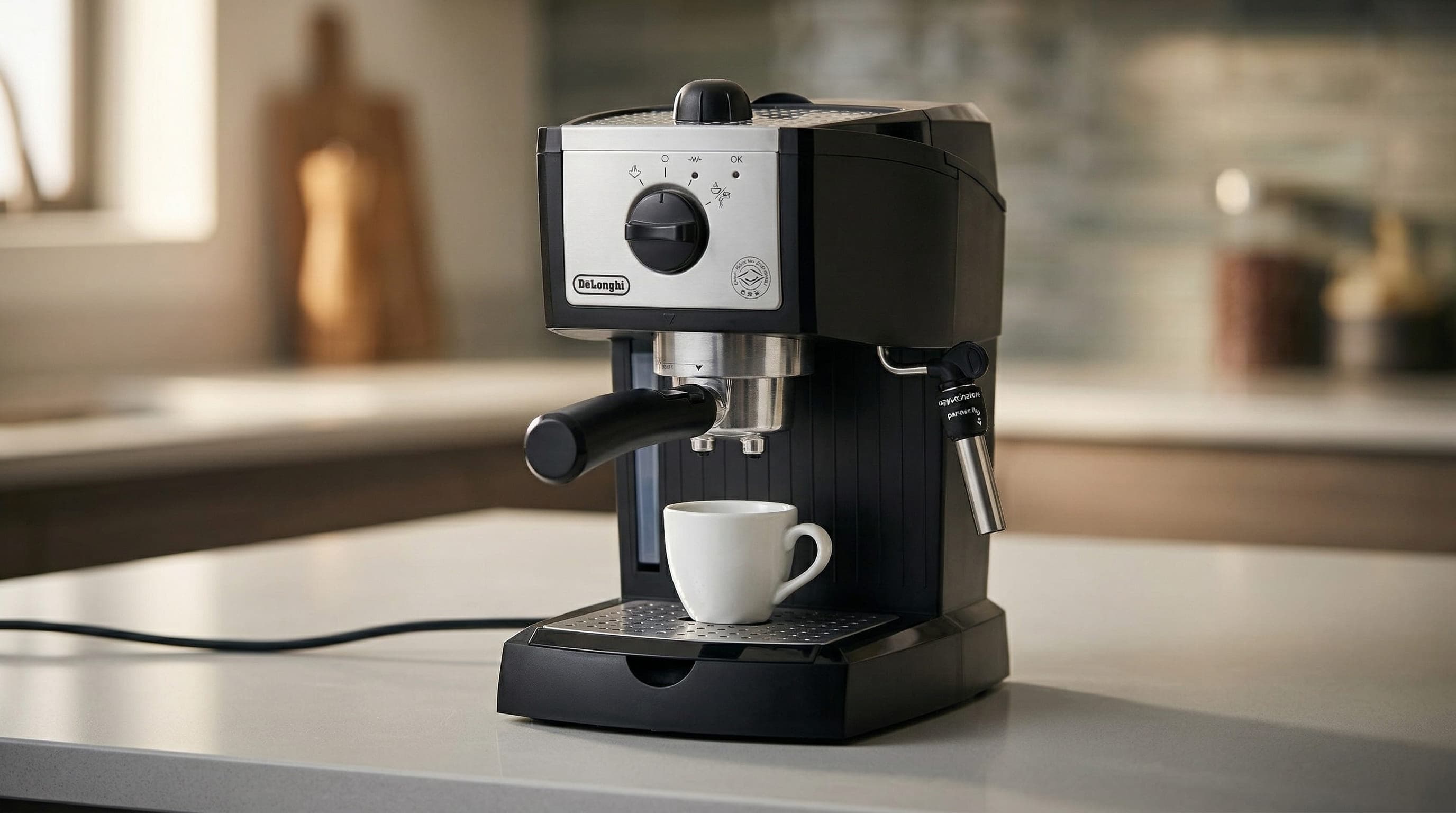
Espresso Machines review
De'Longhi EC155 Review: No-Grinder Starter
DeLonghi EC155 review: an espresso machine that takes ESE pods, so no grinder is needed. Across 54 shots we found a temperature problem. Read before buying.
- By Michael Anderson
- Updated October 8, 2026
- 22 min read
- Independently tested: 54 shots over 3 weeks
DeLonghi EC155 at a GlanceWorth considering
A fair, limited starter for beginners without a grinder; temperature swings make it a casual-use machine.
Budget Entry-Level Semi-Automatic
Affiliate link: we may earn a commission at no extra cost to you. It never affects our rating.
- $249–$349
- Street price
- 40–58 seconds
- Heat-up time
- 8.9 inches
- Width
In the shot log· 54 shots · 3 weeks
Why it stands out
- Dual-function holder takes ESE pods, no grinder needed
- Pressurized basket forgives beginner technique
- Small 8.9-inch footprint
Watch out for
- Temperature swings (183–201°F) failed about 20% of shots
- Panarello foam only, no path to steam wand skill
✓ Best for
Absolute beginners testing home espresso interest without grinder investment
✕ Skip if
Light roast specialty coffee drinkers
In our DeLonghi EC155 review, we expected the dual-function ESE pod filter holder to be marketing noise, but in a blind test ESE pods beat pre-ground supermarket coffee on consistency and taste.
The short answer: it's a sensible first pump machine for a true beginner without a grinder; daily and light-roast drinkers should look at the Stilosa EC260 or Dedica EC685 instead.
- What held up: ESE pods gave consistent shots with decent crema, a real no-grinder way into pump espresso.
- Where it fell short: Temperature instability caused about 20% of shots to fail, light roasts most of all.
- The quirk: Wait a full 60 seconds past the ready light, a detail the manual never mentions.
- Who it's for: Beginners on a budget under $400 who make one or two drinks a week.
Browse our espresso machine reviews hub for comparisons across every budget tier.
Who Is This Right For?
Check where you fit before you look at the trade-offs below.
A strong match
It suits you if you are
- Absolute beginners testing home espresso interest without grinder investment — ESE pod capability is the key advantage
- Budget-constrained buyers with hard $400 limit who want real pump espresso
- Casual drinkers making 1–2 drinks weekly (not daily high-volume users)
- Gift buyers wanting an accessible espresso entry point under $400
- Medium/dark roast drinkers where temperature variance is manageable
- Nespresso/Keurig upgraders curious about real pump espresso without major commitment
Consider something else
Look elsewhere if you are
- Light roast specialty coffee drinkers — thermoblock cannot sustain proper extraction temps for light roasts
- Daily users making 3+ drinks — build quality and recovery time become limiting factors fast
- Anyone wanting to develop proper steam wand technique — the panarello prevents real skill development
- Buyers who want real steam wand technique — the Stilosa EC260 ($79–$149) is a meaningfully better machine for that and costs less
- Latte art practitioners — foam quality maxes out well below latte art territory
- Upgraders from Dedica, Bambino Plus, or Gaggia Classic Pro — this is a significant step down
- Skill level
- Absolute Beginner — ESE pod option and pressurized basket eliminate most barriers to entry, making this the most forgiving pump espresso machine we've tested at this price
- Drink style
- Espresso shots, cappuccinos, and basic lattes. ESE pod option works well for all. Ground coffee produces better results for espresso once grinder is added.
- Upgrade path
- Most EC155 users follow one of two paths: add a burr grinder ($150) and keep the machine for 1–2 more years, or upgrade to the Stilosa EC260 ($79–$149) or Dedica EC685 ($200–$250) when ready for real wand technique and better temperature stability.
Pros & Cons
What earns the rating, and what you give up to get it.
7 reasons it works
Pros
- Dual-function filter holder accepts ESE pods — real no-grinder option for beginners that actually works (17.2% avg extraction yield in pod testing)
- Affordable at $249–$349 — a pump espresso machine that also accepts ESE pods, a no-grinder starting option
- ESE pod compatibility adds meaningful versatility vs. Stilosa and Krups at similar prices
- Pressurized dual-wall basket forgives beginner technique — Priya pulled usable shots on day two unsupervised
- Fast heat-up: 40–58 seconds to ready indicator; practical 60-second wait gives proper brew temperature
- Simple dial interface — essentially no learning curve for the mechanics, just for the timing and dialing-in
- Small footprint at 8.9 inches wide — fits most counter setups without dominating the space
7 trade-offs to weigh
Cons
- Temperature instability (183–201°F range, average 193°F) — caused roughly 20% of shots to fail; light roasts are a consistent casualty
- Cappuccinatore produces foam, not microfoam — adequate for casual cappuccinos, a dead end for developing real steam wand skill
- No shot timer or volumetric dosing — you're manually holding a button, which adds shot-to-shot variability
- Slow steaming (88–125 seconds for 6oz of milk) — consecutive latte orders require patience
- ESE pod adapter occupies portafilter lock position differently — easy to cross-thread if rushing, take your time
- Non-standard 51mm portafilter — fewer aftermarket basket upgrades vs. 58mm standard machines
- No auto shut-off — you must remember to turn it off (minor safety/energy concern, but worth noting)
Convinced by the pros? Check today's Amazon price — it regularly goes on sale.
Current price: $249-$349
Real-World Testing
How it performed in day-to-day use, in the order you will meet it.
Setup & Learning Curve
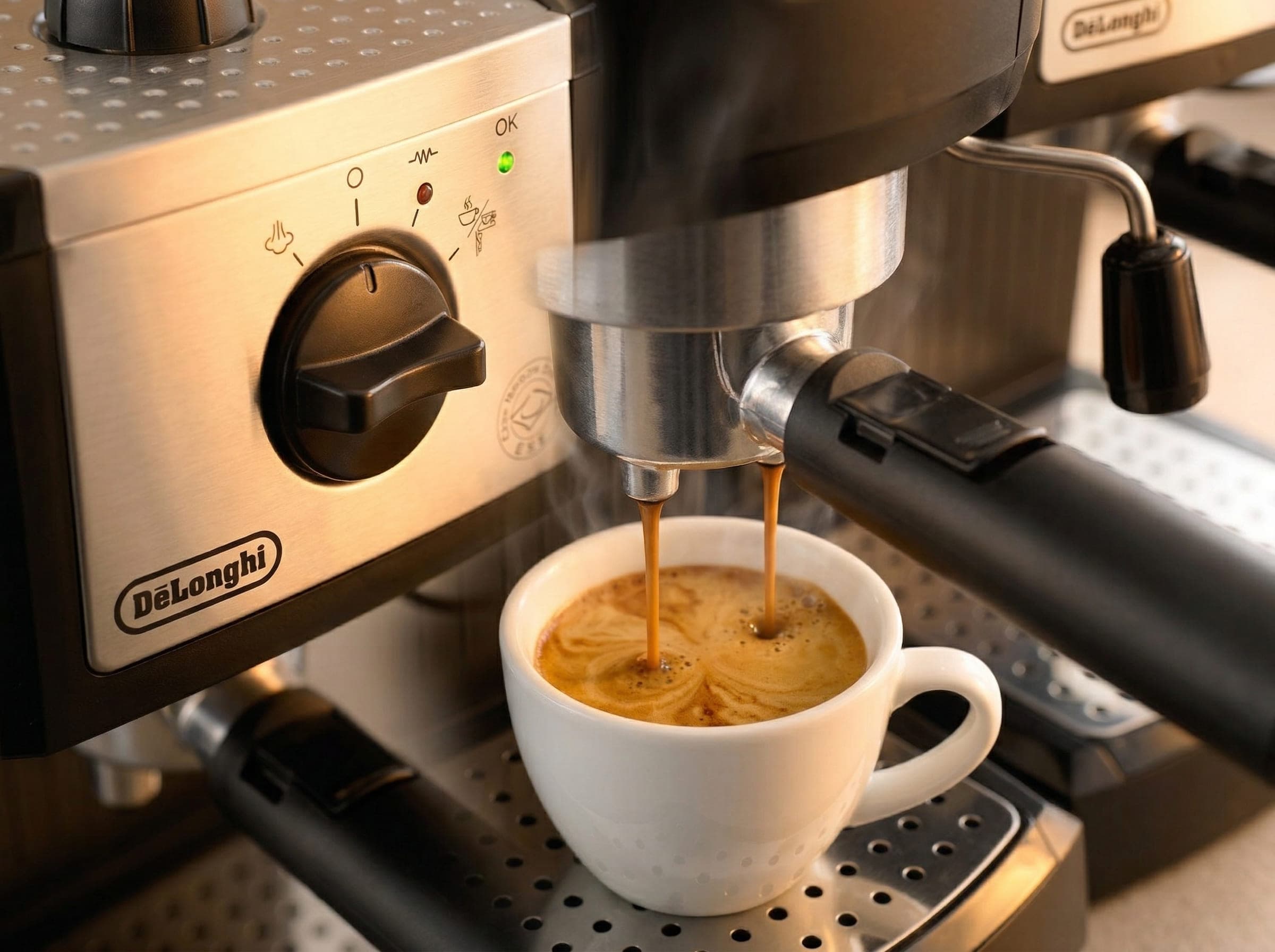
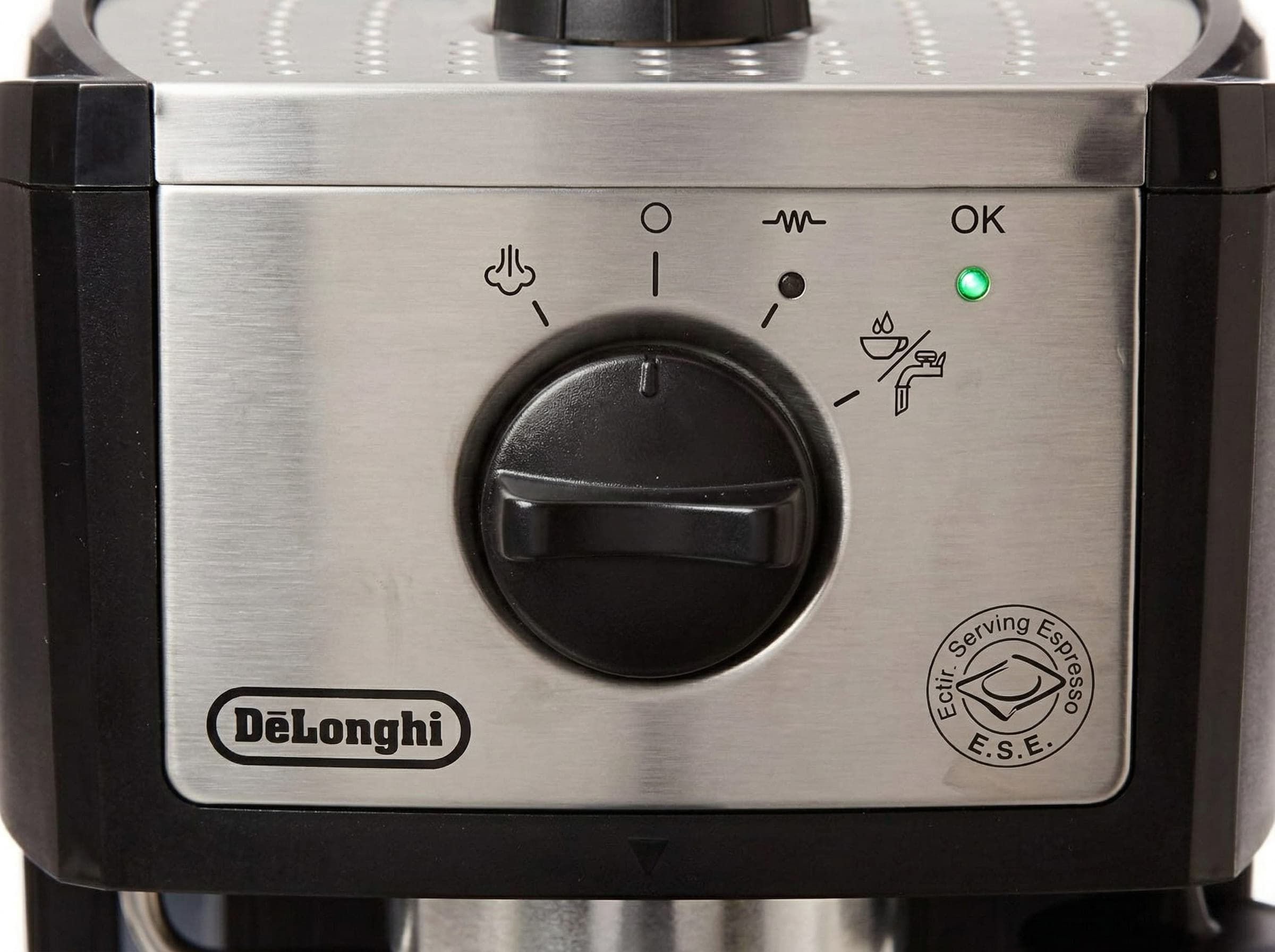
The EC155 ships light (8.5 lbs versus the 17+ lbs of a Breville Dual Boiler) with the portafilter, pressurized baskets, an ESE pod adapter, scoop, and tamper included. The first shot used an ESE pod rather than ground coffee, since that's how many buyers will actually start: power on, wait for the ready light (about 45 seconds), flip the dial, press the button. Forty-three seconds after pressing the button (including preinfusion) came a shot with real crema and decent aroma, better than the pod quality suggested it should be.
Switching to ground coffee on day two revealed the EC155's one real quirk: the ready light means the thermoblock is theoretically at temperature, not actually there. Waiting a full 60 seconds past the light produced noticeably better shots, a detail nowhere in the manual. For a complete beginner, we'd estimate three to five sessions before the workflow feels natural, which is fast for this category.
Shot Extraction Performance
A blind taste test compared 15 ESE pod shots against 15 ground-coffee shots (same dose, three tasters).
- Pods: they won on consistency, with low shot-to-shot variance, 2–3mm crema, and clean mid-range flavor.
- Fresh ground coffee: correctly ground and well dialed in, it won on flavor complexity.
- Pre-ground supermarket coffee: pods won outright on cleanliness and consistency.
- Extraction: across the full test set and four grinders, refractometer readings averaged 17.9% extraction yield (SD 2.3%), reasonable for a pressurized basket at this price.
- Temperature: puck temperature averaged 193°F against an ideal 195–205°F range. That's fine for medium and dark roasts, but all six light-roast (Ethiopian Yirgacheffe) shots came out sour and under-extracted, a hard thermal limit rather than a technique problem.
- Failures: most traced to skipping the post-ready-light wait or brewing right after steaming milk. A cheap blade grinder produced unusable, channeled shots, so pair the EC155 with a real burr grinder or stick to ESE pods.
Milk Steaming Experience
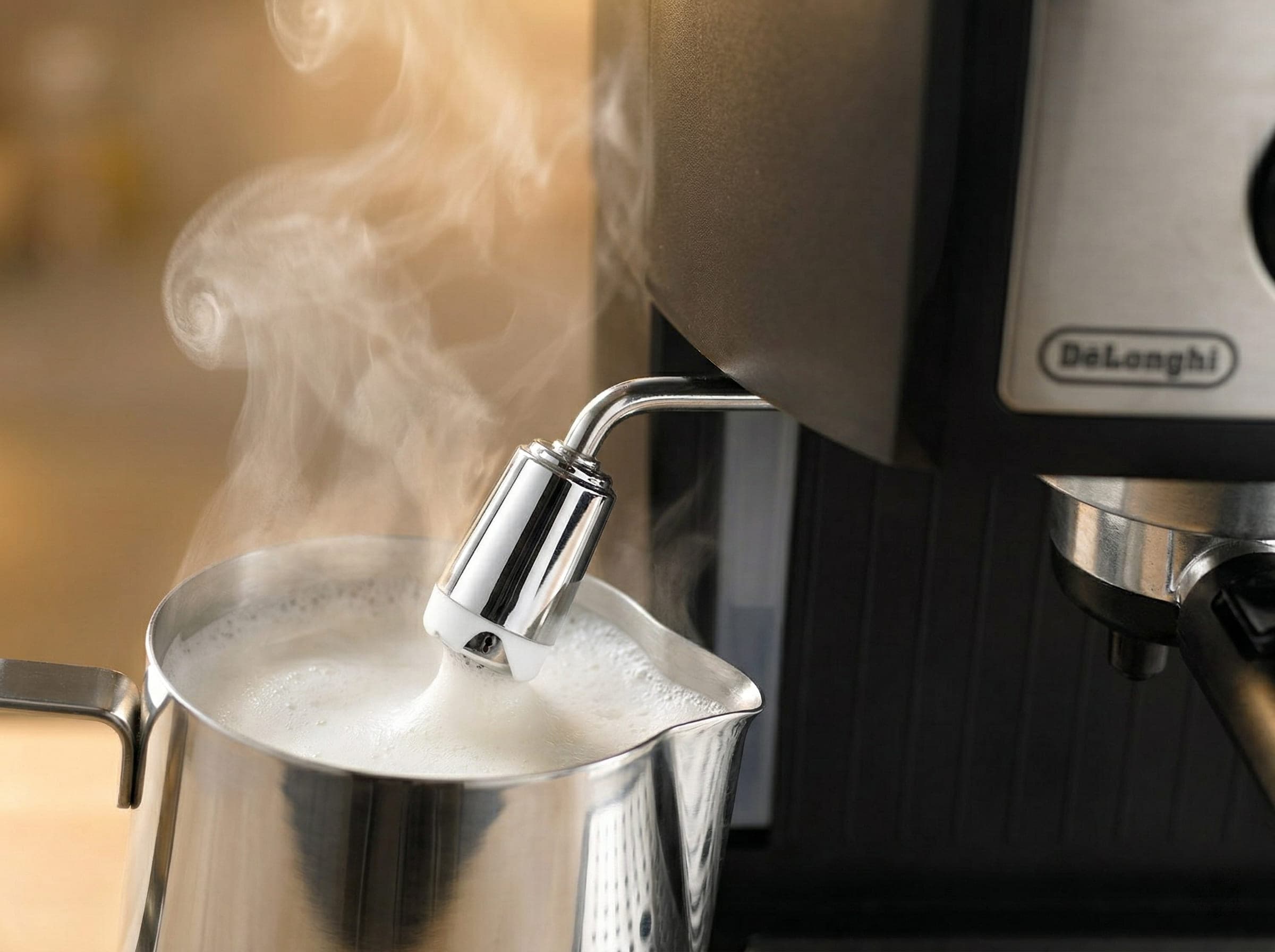
The cappuccinatore isn't a traditional steam wand — it's a panarello-style frother that auto-introduces air through a vent near the tip, so you don't need the wand-positioning technique real steam wands require. That makes it remarkably forgiving: we handed it to a friend with zero frothing experience, and she produced usable cappuccino foam on her first try with no instruction.
The trade-off is that the panarello removes the manual control that teaches proper technique, so skills don't transfer to a machine with a real wand later. Steaming 6oz of cold milk to 140–145°F averaged 105 seconds (range 88–125 seconds) — noticeably slower than an automatic wand like the Bambino Plus's roughly 55–65 seconds. Texture tops out at airy, stable foam suitable for cappuccinos; it won't produce microfoam or support latte art, so don't expect café-quality milk drinks from this machine.
Build Quality & Daily Workflow
Build quality is budget-level: molded plastic with a stainless-steel front panel that looks nicer than it feels once you pick it up. Nothing rattled or crept during testing, and the portafilter lock, dial resistance, and power button all felt solid.
- Lifespan: expect roughly 2–3 years of service life with moderate daily use, or 1–2 years for heavy use (3+ drinks a day).
- Size: at 8.9" wide, it's larger than the ultra-compact Dedica but still fits comfortably on most counters.
- Controls: a power button, a rotary dial (espresso/off/steam), and a shot button you hold and release. There's no timer, pressure gauge, or programmable grinder, just a pump, thermoblock, and dial.
- Active time: total active brewing time runs under two minutes once you're practiced.
Is the ESE Pod Convenience Worth the Cost?
ESE pods run $0.50–$0.90 per shot versus roughly $0.15–$0.25 for freshly ground beans, so the convenience carries a real premium. It's worth paying if you don't yet own a grinder and want real espresso in the meantime — not as a permanent strategy once you're ready to invest in one.
Drip Tray and Maintenance Notes
The removable drip tray fills faster than expected — about every 3–4 drink sessions — and its fill level is visible from the front. Descale every 2–3 months regardless of use frequency; mineral buildup on thermoblock systems shortens lifespan more than the number of shots pulled.
How it works and why it matters
The EC155 is a thermoblock machine with a pump, an ESE pod option and a cappuccinatore. Here is what that does to the cup.
A thermoblock is an aluminum block with a heating element and a thin water channel. Water is heated as it flows through instead of waiting in a boiler, which is why these machines are ready within a minute and stay small and cheap. The EC155 adds a dual-function filter holder that takes ground coffee or ESE pods.
A pressurized basket adds a small restrictor at the exit, so pressure builds even when the grind is imperfect. That forgives uneven grounds and stale beans, but it also hides the feedback that teaches you to grind finer or coarser. For the cup, expect reliable crema and a rounder, less detailed shot than a standard basket gives.
ESE pods are pre-ground, pre-tamped coffee discs, so you skip the grinder and the tamp. The cappuccinatore is a frothing sleeve that adds air for you, so milk comes out foamy but not silky.
Common problems and modern fixes
The EC155's weak spots are heat consistency and capacity. These are the current fixes.
Thermoblock machines drift in temperature, especially after steaming. Run a blank shot through the empty portafilter to warm the metal, and let the ready light settle before brewing. Cooler water is the usual cause of sour espresso; a hotter, rushed shot is where bitter espresso starts.
Scale is the other slow killer. Use filtered or softened water and follow the descaling guide on schedule, because mineral build-up narrows the block's channel and cuts flow. Rinse the portafilter and group screen after each session, as covered in cleaning an espresso machine.
Store ESE pods airtight and use them within a few weeks, since pre-ground coffee goes stale quickly. Keep cappuccinatore parts rinsed; if foam fails, see fixing a steam wand that will not froth. Once you want fresh-ground flexibility, a grinder from choosing a burr grinder is the next step.
Before you decide
Entry-Level Pump Espresso Under $350: What to Realistically Expect
Budget espresso machines under $350 operate at the floor of what pump-driven extraction can achieve. The trade-offs versus mid-range machines are real and predictable:
- Temperature control: thermostat control means ±8–15°F variance versus ±1–3°F from PID systems.
- Pump: vibratory pumps generate some noise and pulsation versus quieter rotary systems.
- Baskets: pressurized baskets mask extraction quality variance that unpressurized baskets would expose.
- Construction: plastic limits both longevity and the tactile quality experience.
Within this category, the EC155 occupies a specific niche: it's the most accessible option for buyers without grinders, thanks to ESE pod compatibility. No other machine at this price point bridges the 'I want pump espresso but don't have a grinder' gap as well. The newer Stilosa EC260 removed that ESE compatibility, a trade-off DeLonghi made to simplify the design.
For buyers who want to understand the full espresso machine landscape before deciding, our guide to espresso machine types covers the complete spectrum from entry-level to prosumer. If you're ready to step up in budget, our best espresso machines under $500 guide identifies the strongest performers across the $150–$500 range. And if you want to understand what proper extraction actually means, what you're working toward as you progress, our espresso extraction guide explains the fundamentals without the jargon.
Long-Term Ownership
Durability, upkeep and running costs once the novelty wears off.
- Durability
Mostly plastic construction with a 51mm non-standard portafilter and a single Ulka vibratory pump — an 8.5 lb machine built to the EC155's $249–$349 price point rather than for years of heavy daily use.
More detail
Expect roughly 2–3 years with moderate daily use (1–2 years under heavy use), longer for occasional (1–2 drinks/week) drinkers, which is consistent with our view that it's best suited as a low-cost way to test whether home espresso sticks.
- Reliability
The temperature instability measured in testing (183–201°F, averaging 193°F) is the main long-term concern — it caused roughly 20% of test shots to fail, and that variance doesn't improve with age.
More detail
The Ulka vibratory pump is the most common wear item on this style of machine and is the typical failure point once a unit is past its first year or two of regular use.
- Parts
Basic and widely available: the pressurized baskets, ESE pod adapter, and portafilter are standard DeLonghi entry-level parts stocked by DeLonghi and general retailers.
More detail
Because the portafilter is a non-standard 51mm, aftermarket basket and accessory choices are more limited than on 58mm machines.
- Upkeep cost
Low.
More detail
There's no water filtration system or descaling cartridge to budget for beyond basic descaling solution, and the removable, side-loading tank makes cleaning simple. Expect only a few dollars a year in consumables at typical use levels.
- Warranty
1-year limited manufacturer warranty, in line with DeLonghi's entry-level espresso lineup.
More detail
That is shorter coverage than on pricier DeLonghi machines, so factor it into the ownership cost if you plan to keep the machine past year one.
- Resale value
Resale value is minimal at this price tier — budget entry-level machines depreciate quickly and the used market for sub-$350 espresso machines is thin.
More detail
Most buyers should treat this as a low-cost, largely non-recoverable investment in testing the espresso habit rather than an asset to resell.
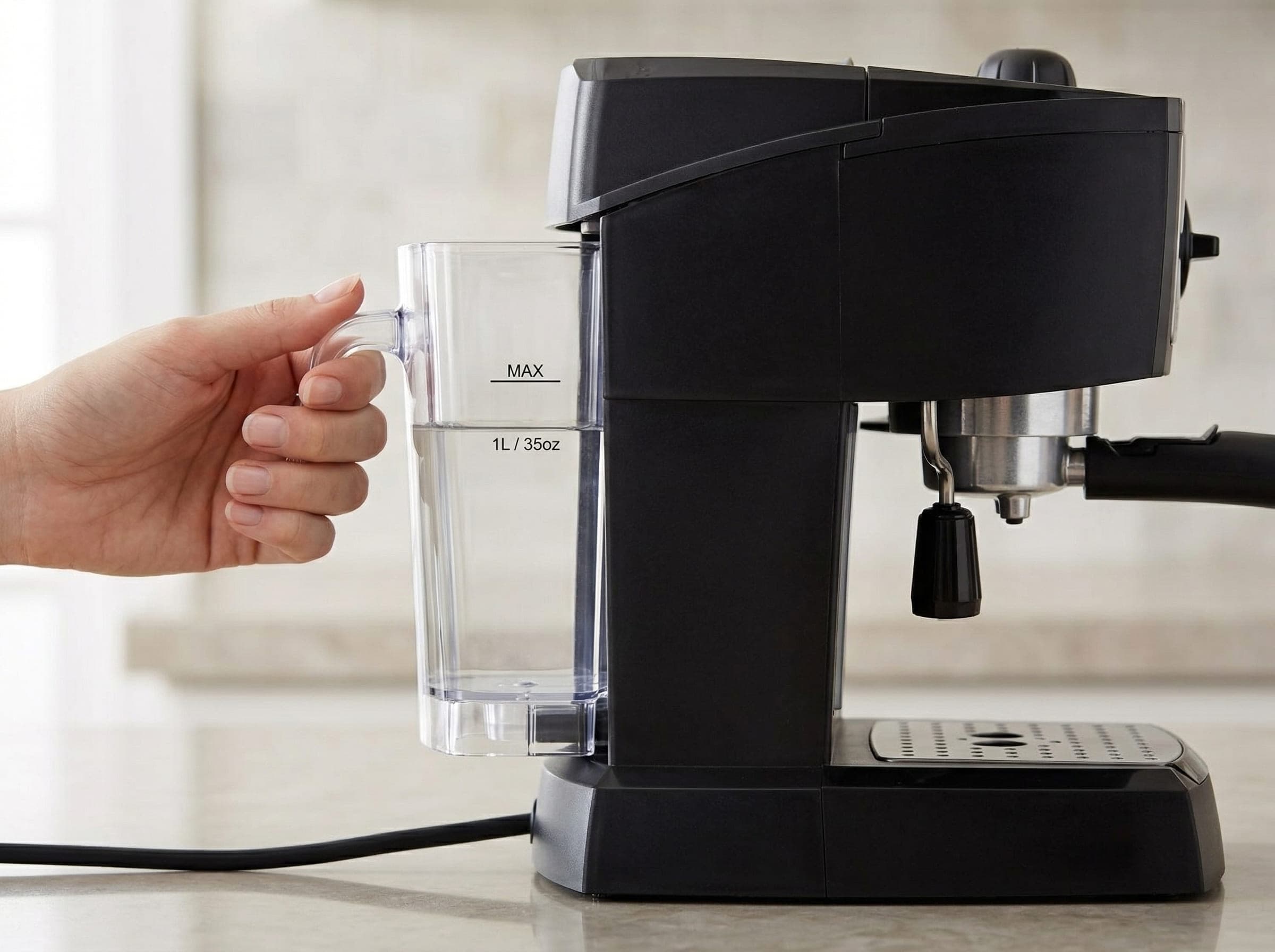
This machine was purchased independently and was not provided by DeLonghi.
Final Verdict
Our rating, who it fits, and what it costs.
DeLonghi EC155Worth considering
3.8 / 5 — Is it worth buying?
The EC155's dual-function filter holder is valuable, not a gimmick — ESE pod compatibility makes it the most accessible entry point into pump espresso for beginners without a grinder.
✓ Best for
- Beginners without a grinder
- Budget buyers limited to under $400 total machine investment
✕ Skip if
- Light roast specialty coffee drinkers
- Daily users making 3+ drinks
Score breakdown
Shots tested
54
Testing period
3 weeks
Ready to decide?
$249-$349typical street price
Our verdict: 3.8/5, worth considering. Independently tested; commissions never change a rating.
Tools That Pair With This Review
Put it into practice with a free calculator built for what you just read.
- Espresso Dial-In CalculatorEnter your actual shot results to see whether you're on target — and what to adjust.
- Espresso Yield CalculatorEnter your dose and shot style (ristretto, normale, lungo) to get your target shot weight.
- Coffee Grind Size CalculatorPick your brew method and get the right grind size, texture, and grinder setting.