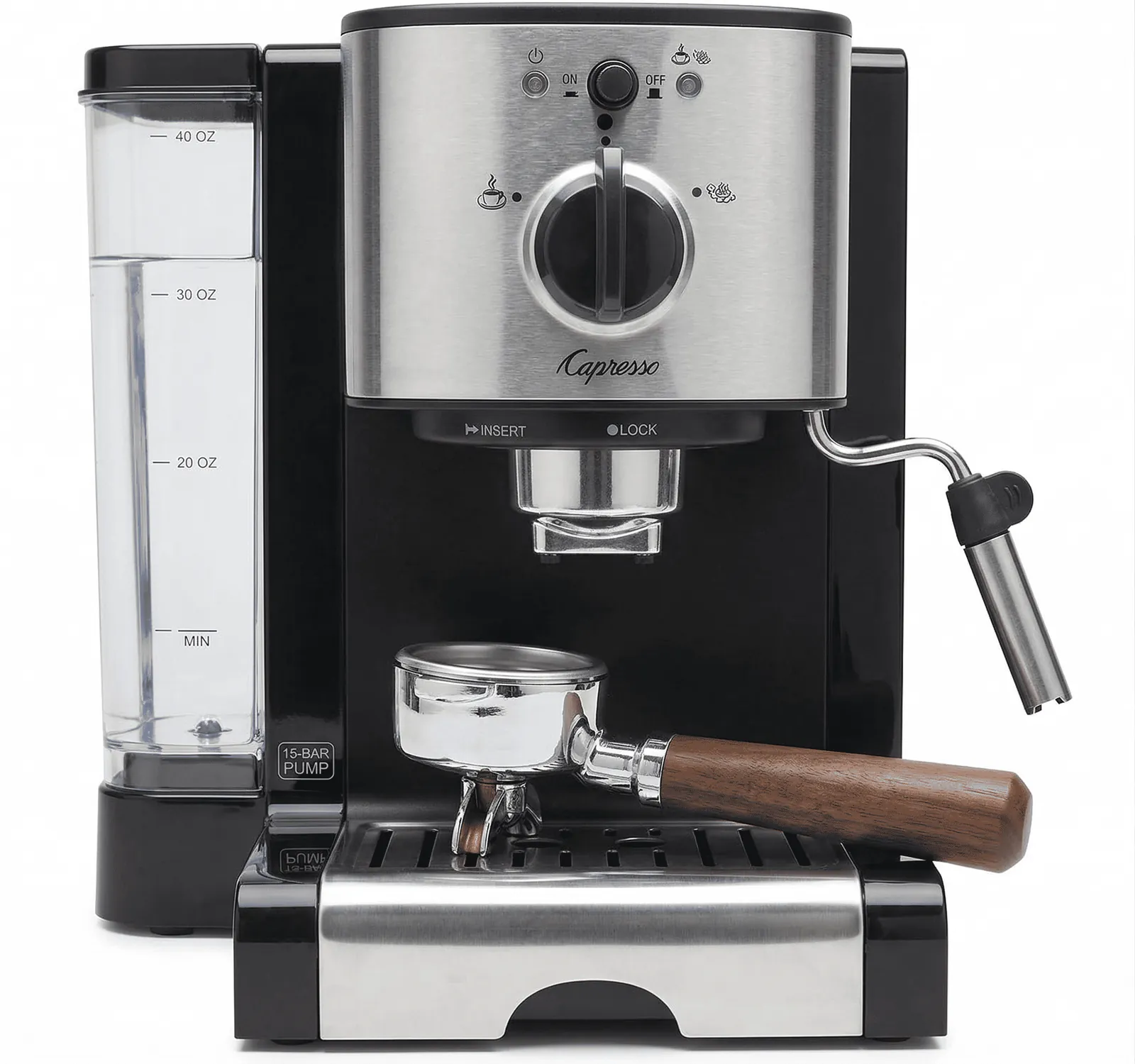
Espresso machine review
Last updated
Capresso EC100 Review 2026: Better at Milk
Capresso EC100 espresso machine review: a twin frother that froths with zero technique, but shaky thermoblock temps over 55+ shots. Who should skip it.
- Our rating 4.0/5
- By Michael Anderson
- 19 min read
- Independently tested: 55+ shots over 3 weeks
Affiliate disclosure: this page contains Amazon affiliate links. We may earn a commission if you buy through them, at no extra cost to you, and it never affects our rankings. Learn more
Capresso EC100 at a GlanceRecommended
A forgiving first pump machine for pod-switchers; fine at what it does, but it has a clear ceiling.
Entry-Level / Lower Mid-Range Manual Pump Espresso Machine
Affiliate link: we may earn a commission at no extra cost to you. It never affects our rating.
- 45 seconds
- Heat-up time
- 40 oz
- Water tank
- 15-bar
- Pump
In the shot log· 55+ shots · 3 weeks
Why it stands out
- Fast heat-up from a cold start
- Pressurized basket forgives grind and technique
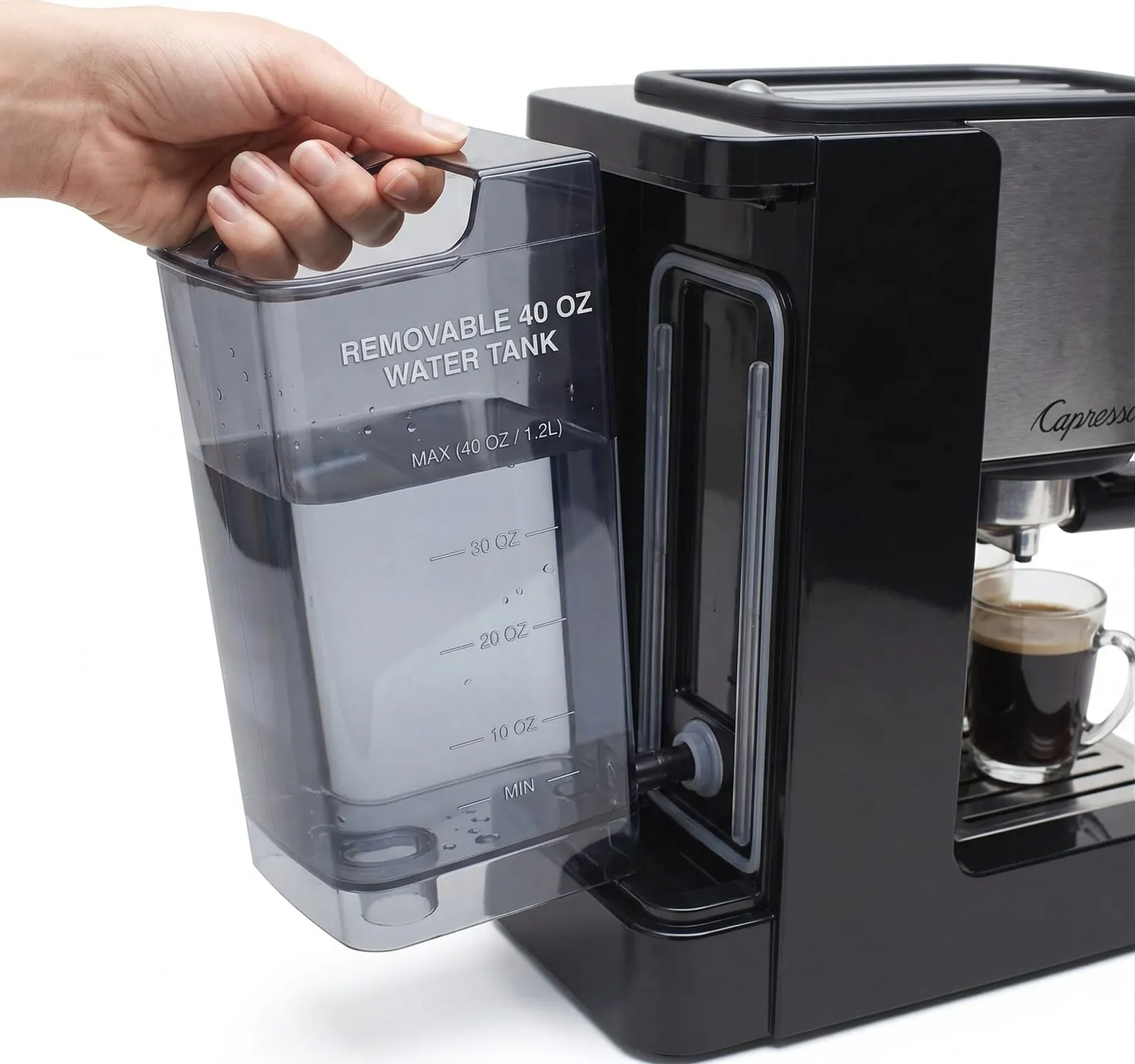
- 40 oz front-access tank means fewer refills
Watch out for
- Twin frother can't make true microfoam
- Wide thermoblock temperature swing hurts light roasts
✓ Best for
Nespresso or Keurig users ready for their first pump espresso machine
✕ Skip if
Espresso enthusiasts requiring a commercial 58mm portafilter
Shot #38 said everything about this machine: wrong grind, wrong dose, mediocre tamp, and it still pulled something a non-espresso drinker would call good coffee. The failures were just as instructive, including an Ethiopian natural that came out muddy no matter how we dialed it.
The short answer: this Capresso EC100 review lands on a good first pump machine for anyone done with pods who wants enjoyable espresso and milk drinks without a steep learning curve, though serious hobbyists will outgrow it.
- What held up: Quick heat-up, a practical 40 oz tank, and zero-technique frothing for cappuccino-style drinks.
- Where it fell short: The twin frother can't make true microfoam, and the thermoblock's temperature swing rules out serious single-origin work.
- Build: The plastic chassis limits durability expectations to 4-6 years.
- Who it's for: First-time pump buyers; anyone sure they'll get serious should look at the Bambino Plus or Gaggia Classic Pro.
Who Is This Right For?
Check where you fit before you look at the trade-offs below.
A strong match
It suits you if you are
- Nespresso or Keurig users ready for their first pump espresso machine
- Households needing 3-4 drinks daily from a large, easy-to-fill 40 oz tank
- Budget buyers who want commercial-looking aesthetics under $150
- People intimidated by manual steam wand technique who want auto-aeration convenience
- Office breakrooms or shared kitchens needing simple, low-maintenance espresso
- Beginners who want espresso fundamentals before investing in a premium machine
Consider something else
Look elsewhere if you are
- Espresso enthusiasts requiring a commercial 58mm portafilter
- Specialty coffee lovers using single-origin light roasts
- Users making 6+ espresso drinks daily (thermoblock recovery will frustrate)
- Anyone wanting to progress to competition-level latte art
- Upgrade seekers — limited modding or upgrade potential
- Households with minimal counter space — footprint is larger than compact alternatives
- Skill level
- Beginner — pressurized basket, auto-frother, and simple dial controls keep the learning curve minimal
- Drink style
- Traditional espresso, cappuccinos, and lattes with auto-frothed foam; not optimised for specialty single-origin work
- Upgrade path
- Most users graduate to Breville Bambino Plus or Gaggia Classic Pro after 18-24 months once they catch the espresso bug
Pros & Cons
What earns the rating, and what you give up to get it.
7 reasons it works
Pros
- Fast 45-second heat-up from cold start — one of the quicker thermoblocks at this price point
- 40 oz front-access water tank is practical for multi-drink households — 3-4 days between refills at 2 drinks daily
- Twin frother produces cappuccino-suitable foam with zero technique — beginner-proof
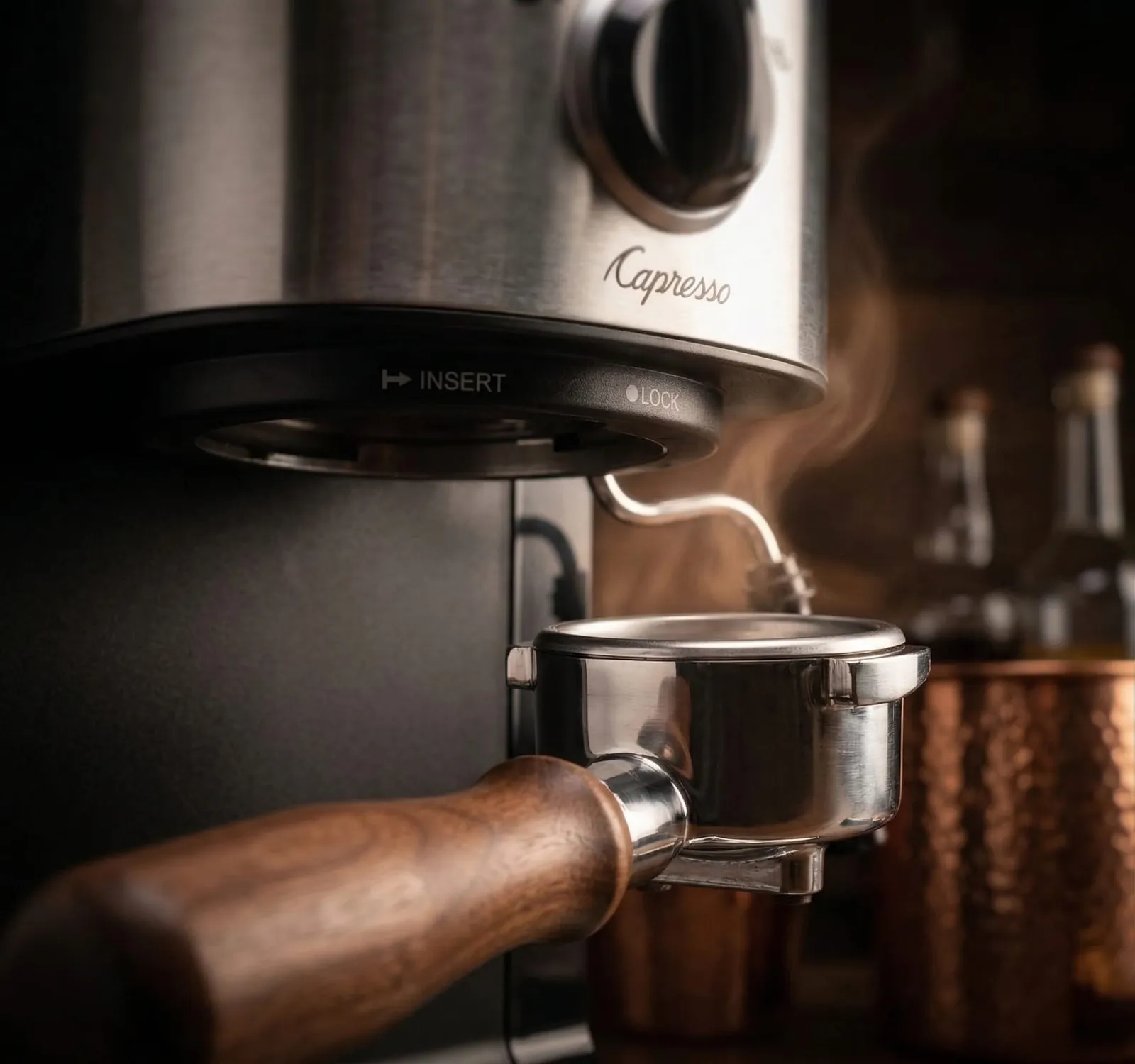
- Commercial-style portafilter looks and handles like a more expensive machine
- Simple two-dial interface has essentially no learning curve for operation
- Pressurized basket extends the margin of error on grind and technique — forgiving for beginners
- Large 40 oz tank means fewer refills
7 trade-offs to weigh
Cons
- Twin frother cannot produce true microfoam — no latte art, foam sits on top rather than integrating
- Thermoblock temperature variance (estimated ±4-5°F) is wider than better-specified competitors, especially noticeable on light roasts
- Plastic chassis limits durability expectations to 4-6 years versus 10+ years with regular maintenance for metal-boiler machines like the Gaggia Classic Pro
- Pressurized basket masks extraction feedback, slowing the development of real grind and technique instincts
- Single-boiler recovery (40-50 seconds brew-to-steam) gets tedious for back-to-back drinks beyond two
- Low resale value and limited upgrade path — this is a starter machine with a clear ceiling
- Water level window is small and awkwardly placed, easy to misjudge
Real-World Testing
How it performed in day-to-day use, in the order you will meet it.
Setup & Learning Curve
Out of the box to first drinkable shot: under 12 minutes. The portafilter arrived with the pressurized basket pre-installed, plus a plastic tamper and measuring spoon. Heat-up averaged 45 seconds to the ready light, occasionally stretching to 55 seconds depending on ambient temperature.
The twin frother needs zero technique — submerge the tip about half an inch into the milk, open the steam valve, and the panarello mechanism auto-aerates for you. No angling, no repositioning. Usable, cappuccino-suitable foam appears in roughly a minute.
Controls are just two rotary dials (brew/steam/off, and water volume), so the real learning curve for a newcomer sits in grind selection and dosing, not machine operation. By day three, a first-time espresso user was making acceptable cappuccinos unsupervised.
Shot Extraction Performance
Dialing in fresh beans took 4-6 shots per new origin — a bit more than expected given the pressurized basket, which should forgive more variance than it did. Dark and medium-dark roasts are this machine's comfort zone. By bean:
- Lavazza: pulled easily and forgivingly.
- Brazilian Santos: the most consistent result of testing — balanced sweetness, no astringency, consistent across seven consecutive shots.
- Ethiopian natural: the clear weak point. The thermoblock's estimated 193-200°F brew temperature doesn't fully open up light, natural-process coffee, and even a coarser, faster pull only got it to drinkable, not good.
Other observations:
- Crema: thick and long-lasting from the pressurized basket, but mechanically generated by the OPV valve rather than a true indicator of extraction quality.
- Temperature: variance estimated at roughly ±4-5°F by taste, a touch wider than the Breville Cafe Roma's more mature thermoblock.
- Best shot: a 28-second Colombian pull with milk chocolate sweetness and a clean finish.
- Worst shot: the Ethiopian natural, muddy and indistinct — a reminder this machine simply isn't built for high-acid specialty coffee.
Milk Steaming Experience
The twin frother is the EC100's clearest trade-off. It's beginner-proof for basic cappuccino foam — no technique, foam in about a minute for 6-8 oz of milk — but the panarello mechanism injects larger bubbles by design, so you don't get true microfoam or latte-art capability.
The foam sits on top of the drink rather than integrating into it. For a standard cappuccino, that's fine; for a textured latte, it falls short.
Milk results:
- Whole milk: frothed most reliably and produced the sweetest results at 150-155°F.
- Oatly Barista: worked but needed longer and occasionally a gentle swirl.
- 2%: produced thinner, less satisfying foam.
- Steam recovery: 40-50 seconds between brewing and frothing — reasonable for a single-boiler thermoblock at this price.
Build Quality & Daily Workflow
Build is mixed: stainless accents over a largely plastic chassis. It feels solid in daily handling, but it's not in the same class as metal-boiler machines like the Gaggia Classic Pro, and that shows up mainly in expected lifespan rather than day-to-day feel. The commercial-style portafilter and passive warming tray add a touch of café aesthetic that most budget machines skip.
Daily workflow is simple and fast: knock the puck, rinse the basket and portafilter, wipe the steam wand immediately, and empty the drip tray as needed — about two minutes total. The two-dial interface (brew/steam/off plus water volume) means there's nothing to relearn between sessions. Footprint is reasonable given the 40 oz tank, though the water level window is small and easy to misjudge at a glance.
Testing Setup
Beans covered a Colombian medium, an Ethiopian natural, a Lavazza dark blend, and a Brazilian Santos medium-dark, ground on a Baratza Encore ESP ($199-$299). Milk testing used whole milk, 2%, and Oatly Barista to check how the twin frother handled different fat and protein levels.
Swapping the Pressurized Basket
Swapping in a third-party non-pressurized 53mm basket thinned the crema noticeably and gave more direct flavor feedback than the stock pressurized basket, which tends to mask under-extraction behind mechanically generated crema. Worth doing once you're comfortable dialing in grind and dose, since it turns the EC100 into a more transparent (if less forgiving) training tool.
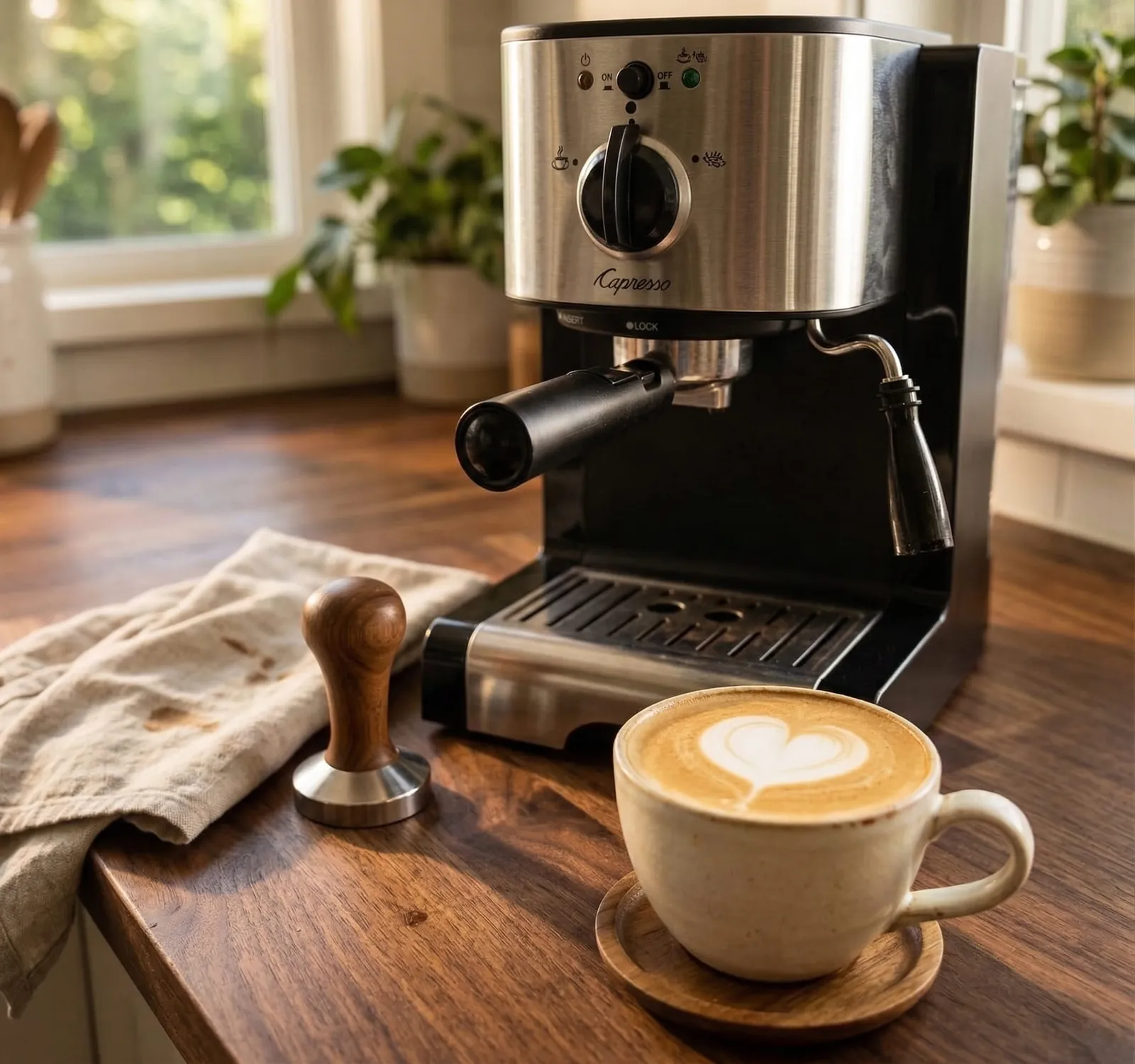
Is the Capresso EC100 worth it, or should you save for more?
The EC100 makes sense when your real alternative is a pod machine and your budget is firm. You get a pump, a portafilter and a steam wand for roughly the cost of a good grinder alone, which lowers the barrier to finding out whether you enjoy espresso at all.
It makes less sense if you already know you want to grow into the hobby. The pressurized basket and thermoblock set a ceiling, and the plastic chassis means you should plan around a shorter service life than a metal-boiler machine. Stretching to the Breville Bambino Plus costs more up front, but it removes several limits at once rather than one.
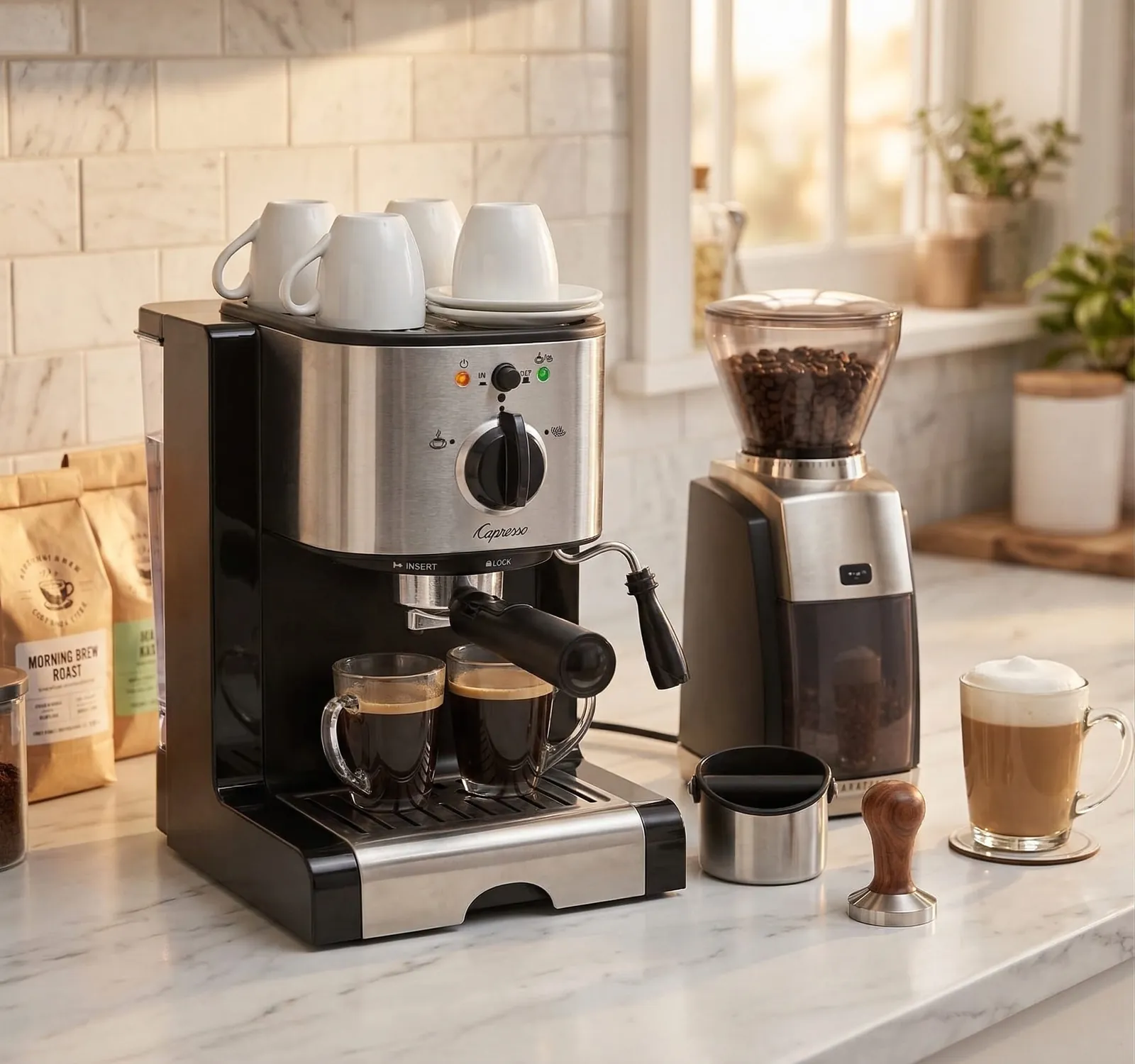
Who should skip the Capresso EC100?
Skip it if you want latte art, because the twin frother adds foam on top rather than texturing milk. Skip it if you drink light-roast single origins and care about temperature precision, since the thermoblock is the weaker point for that style. And skip it if you plan to buy a quality grinder and learn extraction properly, because the pressurized basket hides the feedback you would be learning from.
Buyers in that group are usually happier with the Gaggia Classic Pro, or with the more compact De'Longhi Dedica if counter space is the main constraint. For a wider comparison, our best espresso machines guide lays out each tier.
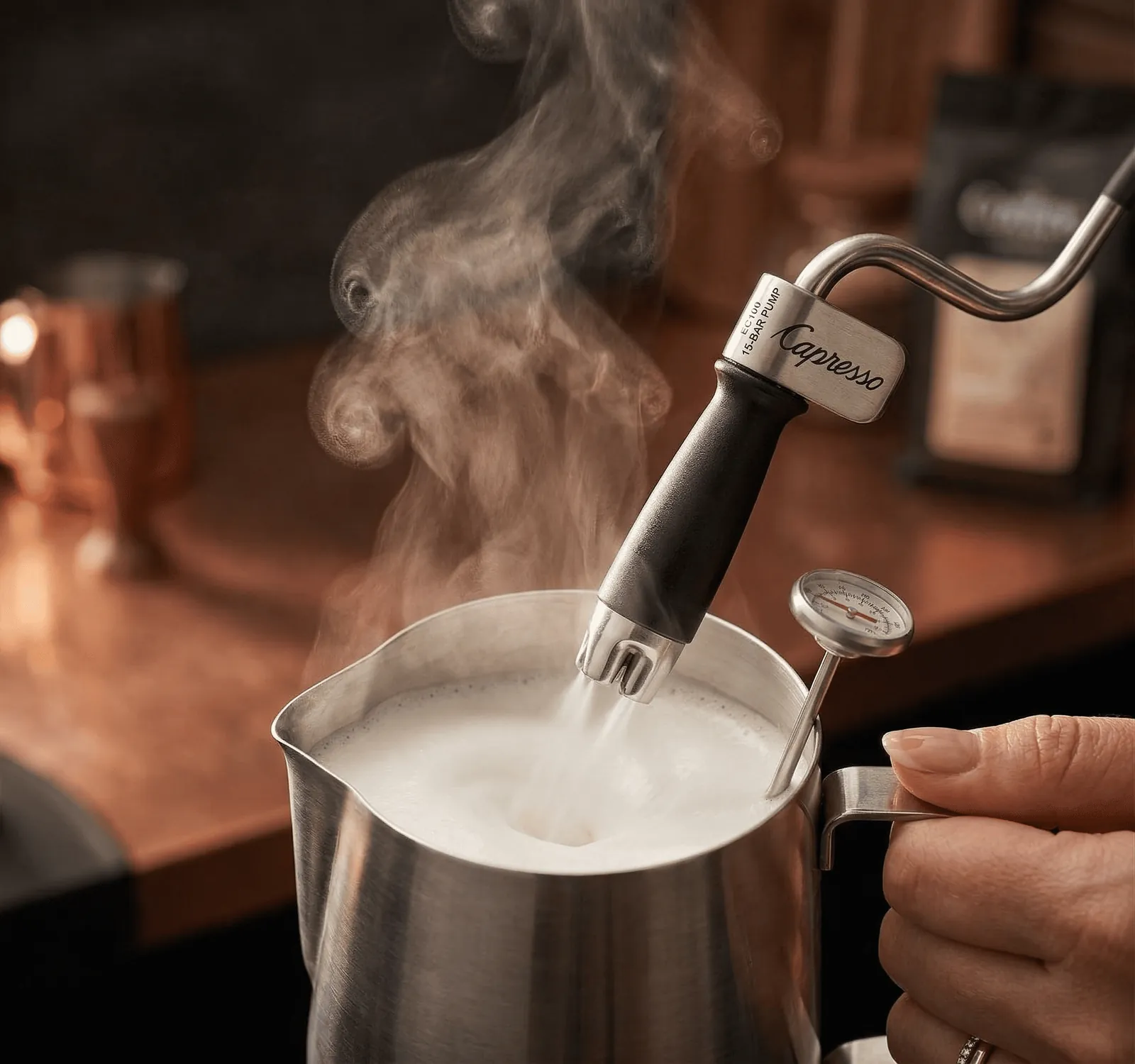
How it works and why it matters
The EC100 uses a thermoblock, a vibratory pump and a twin frother. Here is what each part changes in the cup.
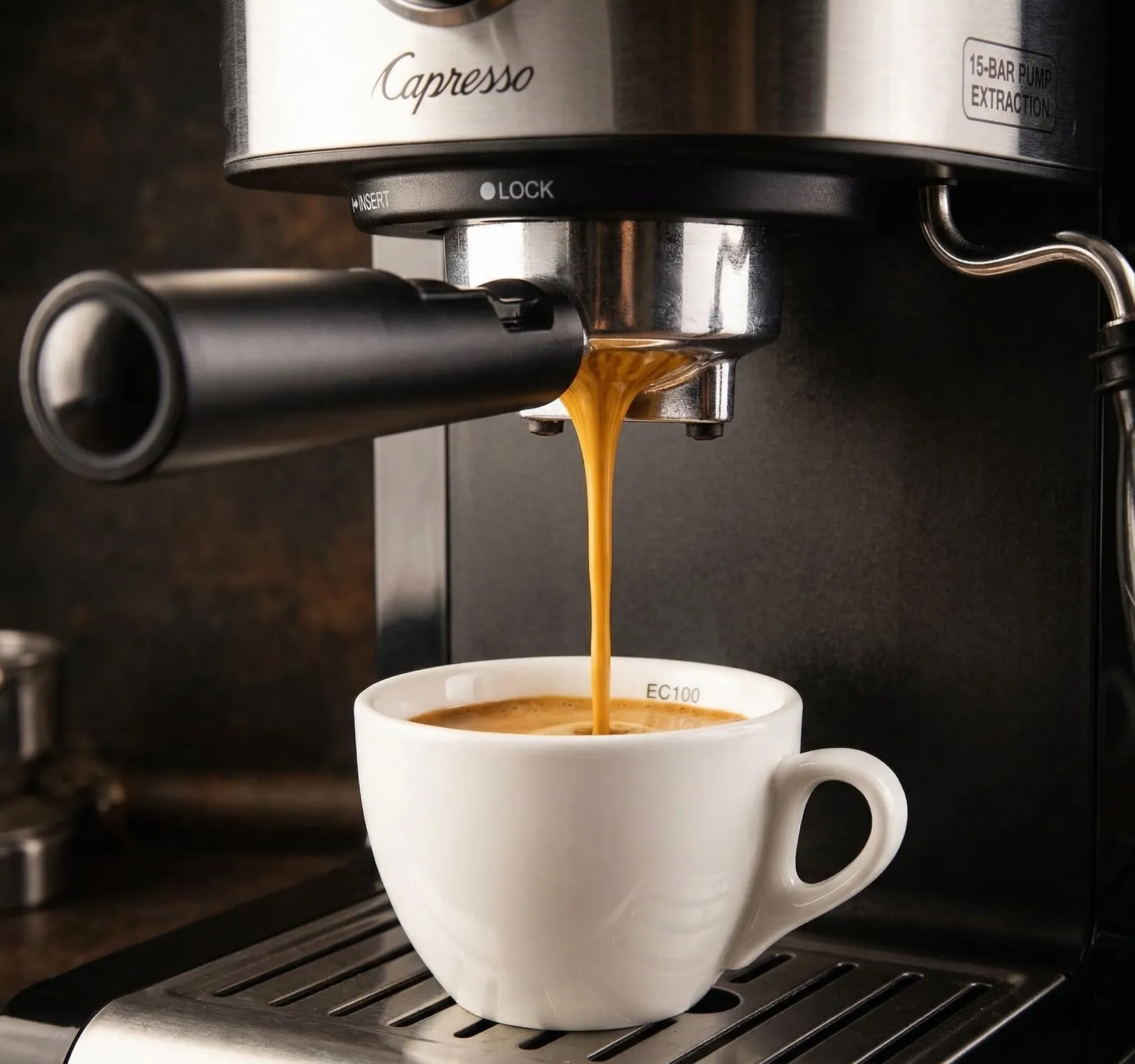
A thermoblock is an aluminum block with a heating element and a thin water channel. Water is heated as it flows through instead of waiting in a boiler, which is why these machines are ready within a minute and stay small and cheap. The EC100 adds a large front-fill tank and a pump that forces that heated water through coffee.
A pressurized basket adds a small restrictor at the exit, so pressure builds even when the grind is imperfect. That forgives uneven grounds and stale beans, but it also hides the feedback that teaches you to grind finer or coarser. For the cup, expect reliable crema and a rounder, less detailed shot than a standard basket gives.
The twin frother is an air-assist wand: a sleeve mixes steam and air into milk automatically. It gives you thick foam without technique, which suits cappuccinos, but it cannot make the glossy microfoam that latte art needs.
Common problems and modern fixes
Budget thermoblock machines share predictable problems. These are the current fixes.
Thermoblock machines drift in temperature, especially after steaming. Run a blank shot through the empty portafilter to warm the metal, and let the ready light settle before brewing. Cooler water is the usual cause of sour espresso; a hotter, rushed shot is where bitter espresso starts.
Scale is the other slow killer. Use filtered or softened water and follow the descaling guide on schedule, because mineral build-up narrows the block's channel and cuts flow. Rinse the portafilter and group screen after each session, as covered in cleaning an espresso machine.
If milk foam turns flat, the frother sleeve is usually blocked with dried milk, so soak and rinse it daily. Weak flow after a few months is typically scale rather than a pump failure; see fixing a steam wand that will not froth for related checks.
Before you decide
Where the Capresso EC100 Fits in the Entry-Level Pump Espresso Market
The entry-level pump espresso market is crowded, and the EC100 occupies a specific, understandable niche: more than a pod machine, but not the financial or technique commitment of a $350+ machine. At $100-$150, its closest rivals are the De'Longhi Stilosa EC260 ($79-$149, cheaper but more plasticky) and the Mr. Coffee Café Barista ($150-$200, adds an automatic frother but feels less substantial), while the Neretva espresso machine goes lower on price still. The EC100's 40 oz tank and commercial-style portafilter give it a real practical edge for multi-drink households.
One tier up, the Breville Bambino Plus ($399-$449) delivers meaningfully better espresso quality and PID temperature control — worth stretching for if your budget allows. If it doesn't, the EC100 is a reasonable choice in its tier.
See our espresso machine reviews hub for the full lineup, our best espresso machines under $500 guide for the next tier, and our espresso machine types guide for the technical differences that matter day to day.
How It Measures Up on Key Espresso Criteria
- Temperature stability
- Stainless-lined thermoblock with separate thermostats for brewing and steaming. No PID, so temperature can drift between back-to-back shots.
- Pressure and pre-infusion
- 15-bar pump rating with no gauge. No pre-infusion feature.
- Shot-to-shot consistency
- Ships with pressurized crema filters, which hide grind and tamp errors but limit fine control.
Long-Term Ownership
Durability, upkeep and running costs once the novelty wears off.
- Durability
Stainless accents over a plastic chassis, with a thermoblock that's proven and standard for this price class.
More detail
Expect 4-6 years with regular descaling — this isn't built to the 10-year standard of metal-boiler machines like the Gaggia Classic Pro.
- Reliability
The usual entry-level issues apply: thermoblock scale buildup (prevented by descaling every 2-3 months), a blocked steam-wand tip from dried milk (prevented by wiping immediately after use), and portafilter gasket wear every 12-18 months.
More detail
Capresso's customer service has generally positive community reviews.
- Parts
Moderate — Capresso maintains parts for 3-5 years, and third-party 53mm basket compatibility broadens your options beyond fully proprietary designs.
- Upkeep
The 40 oz tank stretches refills to every 3-4 days at two drinks daily.
More detail
Descale every 2-3 months (monthly with hard water) using a proper espresso descaler, not vinegar — there's no automatic alert, so track it yourself. Annual upkeep runs roughly $20-$30.
- Warranty
1-year limited warranty, standard for the category.
More detail
Register on Capresso's site to activate.
This machine was purchased independently and was not provided by Capresso.
Final Verdict
Our rating, who it fits, and what it costs.
Capresso EC100Recommended
4.0 / 5 — Is it worth buying?
The Capresso EC100 is competent at exactly what it's designed to do, and that's a narrower brief than its marketing suggests.
✓ Best for
- Nespresso or Keurig users ready for their first pump espresso machine
- Households needing 3-4 drinks daily from a large, easy-to-fill 40 oz tank
✕ Skip if
- Espresso enthusiasts requiring a commercial 58mm portafilter
- Specialty coffee lovers using single-origin light roasts
Score breakdown
Shots tested
55+
Testing period
3 weeks
Ready to decide?
$100-$150typical street price
Our verdict: 4.0/5, recommended. Independently tested; commissions never change a rating.
Tools That Pair With This Review
Put it into practice with a free calculator built for what you just read.
- Espresso Dial-In CalculatorEnter your actual shot results to see whether you're on target — and what to adjust.
- Espresso Yield CalculatorEnter your dose and shot style (ristretto, normale, lungo) to get your target shot weight.
- Coffee Grind Size CalculatorPick your brew method and get the right grind size, texture, and grinder setting.
Reader questions
Questions or tips? Leave a comment
Ask about your setup or share what worked for you. Comments are checked before they appear.