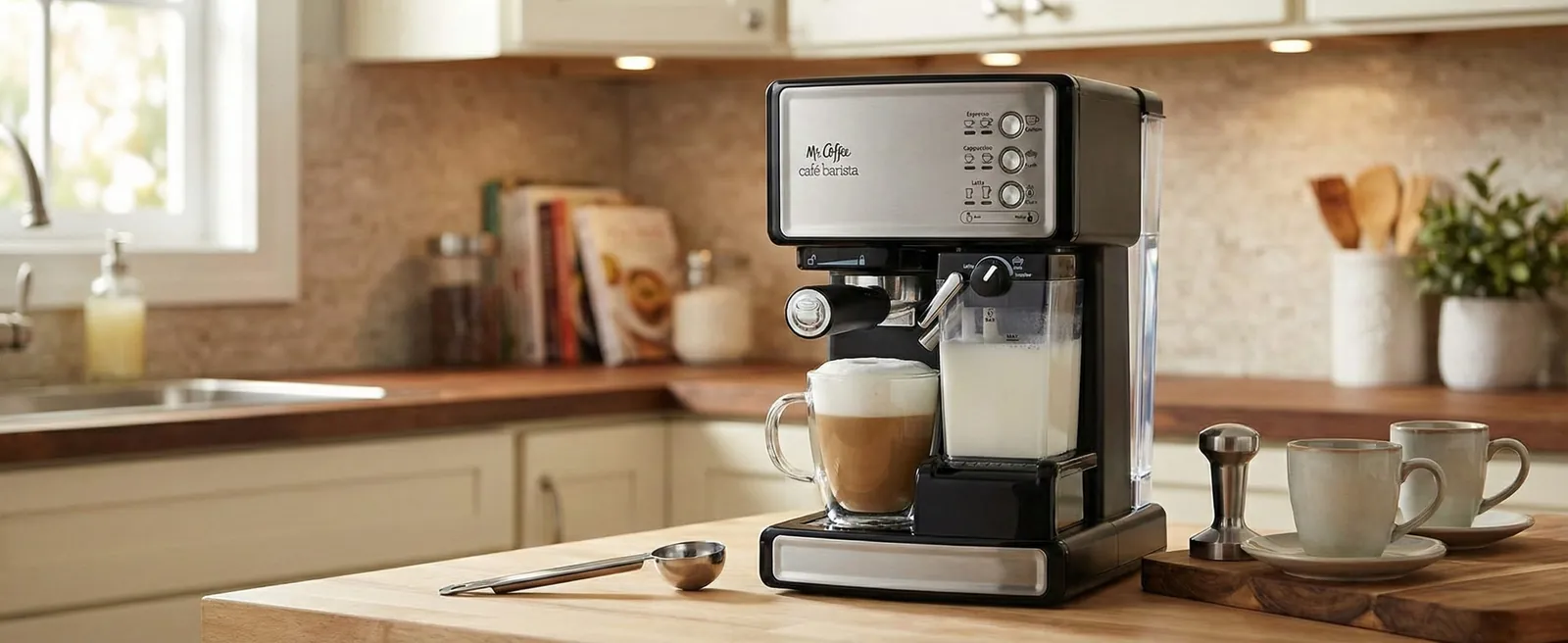
Espresso machine review
Last updated
Mr. Coffee Cafe Barista Review 2026: Inconsistent
Mr. Coffee Cafe Barista review: easy lattes from a budget espresso machine, but 40% of our shots showed flaws. See who should skip it before you buy.
- Our rating 3.8/5
- By Michael Anderson
- 22 min read
- Independently tested: 100+ shots over 30 days
Affiliate disclosure: this page contains Amazon affiliate links. We may earn a commission if you buy through them, at no extra cost to you, and it never affects our rankings. Read our full affiliate disclosure
Mr. Coffee Café Barista at a GlanceWorth considering
A decent budget starter for beginners; if you've tasted good espresso, save up for something better.
Budget Semi-Automatic Espresso Machine
Affiliate link: we may earn a commission at no extra cost to you. It never affects our rating.
- 15-bar
- Pump
- 9 minutes
- Setup time
- 11 x 11 x 13-inch
- Footprint
In the shot log· 100+ shots · 30 days
Why it stands out
- One-touch controls work for complete beginners
- Automatic frother removes the technique learning curve
- Low financial risk at a $150-200 price
Watch out for
- 40% of shots showed flaws from temperature swings
- Plastic build, expected lifespan of 12-24 months
✓ Best for
Budget-conscious coffee enthusiasts exploring home espresso for under $200
✕ Skip if
Serious home baristas requiring consistent extraction and temperature stability
In this Mr. Coffee Cafe Barista review, the headline finding cuts both ways: a friend with zero experience made a drinkable latte on the first try, yet 40% of the shots we pulled showed clear flaws from temperature swings. Both are true of the Café Barista.
The short answer: it's a reasonable $150–$200 starter for the espresso-curious, but it hits its ceiling fast and won't grow with your skills.
- What held up: One-touch controls and an automatic frother mean beginners get a drink on the first attempt.
- Where it fell short: The frother makes coarse macrofoam, not silky microfoam, so latte art is out.
- Build quality: Mostly plastic with a proprietary portafilter, so there's no way to improve it over time.
- Who it's for: Budget-minded beginners dipping a toe in without committing to a $500+ setup.
Browse our espresso machine reviews hub for more options across every budget.
Who Is This Right For?
Check where you fit before you look at the trade-offs below.
A strong match
It suits you if you are
- Budget-conscious coffee enthusiasts exploring home espresso for under $200
- College students and first-apartment dwellers seeking affordable coffee solutions
- Beginners wanting to learn espresso basics without premium investment
- Occasional espresso drinkers making 1-2 drinks daily
- Users prioritizing convenience and one-touch operation over precision
Consider something else
Look elsewhere if you are
- Serious home baristas requiring consistent extraction and temperature stability
- Users seeking commercial-quality espresso with professional-grade features
- High-volume households needing 5+ drinks daily
- Coffee enthusiasts wanting manual control over every brewing parameter
- Those expecting long-term durability beyond 1-2 years of regular use
- Skill level
- Beginner - Minimal espresso knowledge required, one-touch operation
- Drink style
- Entry-level espresso and milk drinks with emphasis on convenience over quality
- Upgrade path
- Most users upgrade within 12-18 months to mid-range machines ($400-$600) after learning basics
Pros & Cons
What earns the rating, and what you give up to get it.
7 reasons it works
Pros
- Accessible $150-200 price point—low financial risk if espresso isn't your thing
- One-touch controls work for beginners—watched a friend make a drinkable latte on the first try, zero experience
- Automatic milk frothing removes all learning curve—consistent coarse foam every time, no technique required
- Compact 11 x 11 x 13-inch footprint fits standard counters without taking over your kitchen
- Quick setup from box to first shot—we timed 9 minutes including system priming
- Works fine with pre-ground grocery store espresso ($8-12 bags)—no expensive grinder needed initially
- Lightweight 10 pounds makes moving it around trivial compared to heavier machines
9 trade-offs to weigh
Cons
- Inconsistent extraction—40% of shots showed clear flaws from temp fluctuations and no PID control
- Plastic construction won't last—expected lifespan 12-24 months versus 3-5+ years for better machines
- Zero temperature or pressure control—you get what it gives you, no customization
- Coarse macrofoam, not microfoam—latte art impossible regardless of technique
- Proprietary portafilter blocks upgrades—no way to improve performance over time
- Short crema duration (8-12 seconds in testing) versus 25-35 seconds from quality machines
- Fast extraction timing (18-22 seconds) prevents proper flavor development versus ideal 25-30 second range
- Louder pump than premium machines—household noticed noise during early morning use
- Limited parts availability and minimal resale value (25-40% of original price typically)
Real-World Testing
How it performed in day-to-day use, in the order you will meet it.
Setup & Learning Curve
Unboxing to first shot took about nine minutes: unpack the unit, slide in the 32-ounce water tank, click the drip tray into place, plug it in, and run two blank shots to prime the system. No technical knowledge required — foolproof for a first machine.
The learning curve is close to nonexistent, which cuts both ways. Three buttons do everything, but the manual gives no guidance on grind size or tamping, so we worked those out through trial and error:
- Grind: medium-fine on a burr grinder (setting 10-12 on a Baratza Encore, noticeably coarser than the 8-9 used on a Gaggia).
- Tamping: moderate, consistent pressure — too light and shots ran sour, too hard and they choked bitter.
- Dose: the included scoop holds about 7-8 grams; two scoops (14-16g) worked for doubles.
Because there's no temperature, pressure, or timing control to adjust, dialing in a new bag of coffee takes only a handful of shots rather than the dozen-plus it can take on a machine with real adjustability — you're optimizing grind and dose, not chasing a moving target. Pre-ground grocery-store espresso (Lavazza, Illy) actually outperformed fresh-ground specialty coffee, since it's formulated for pressurized baskets and compensates for the machine's limitations.
Shot Extraction Performance
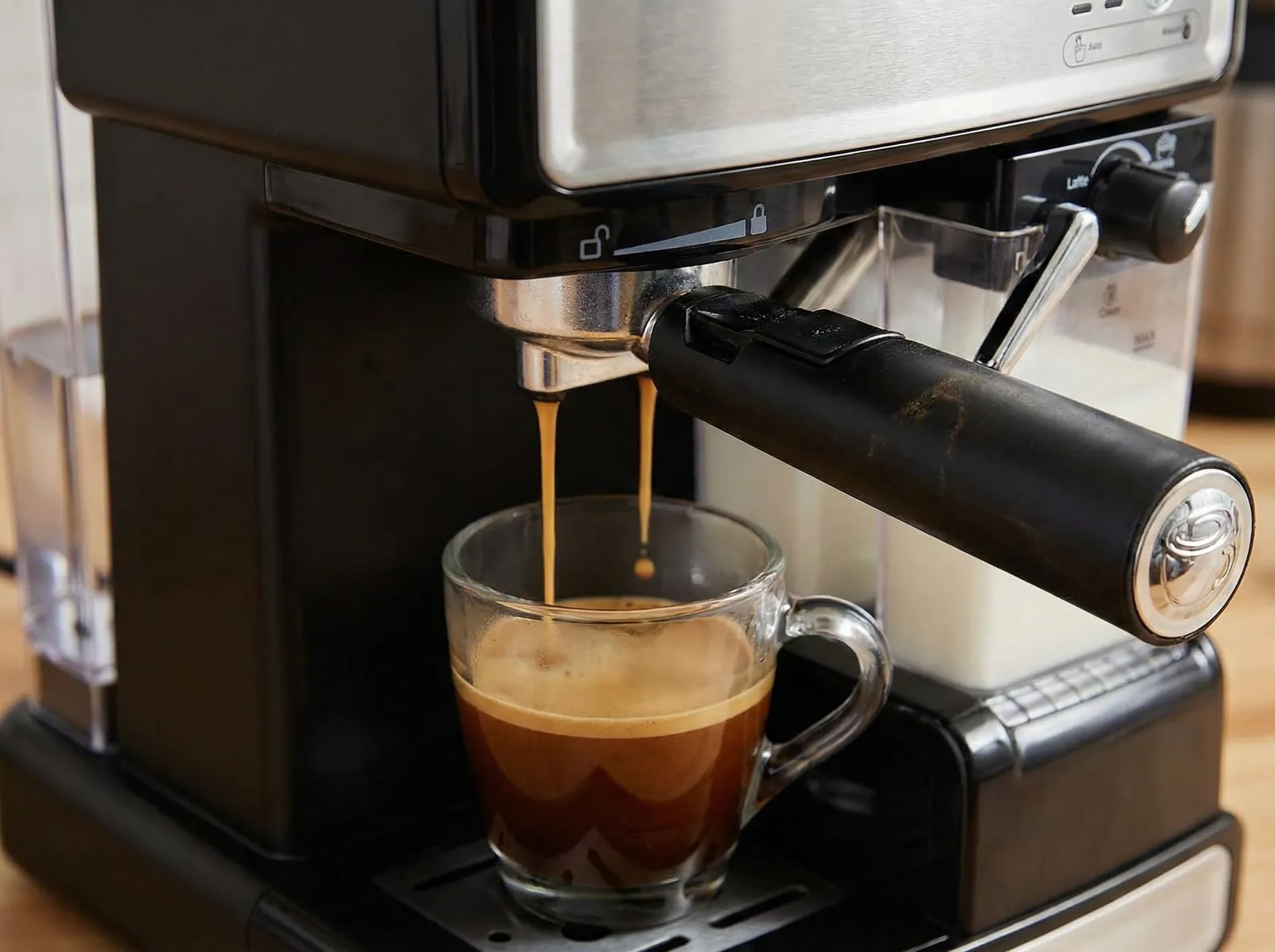
Across a range of coffees — pre-ground Lavazza Super Crema and Illy Dark, fresh Colombian and Brazilian roasts, and a light Ethiopian Yirgacheffe that struggled the most — extraction time measured a consistent 18-22 seconds, short of the 25-30 second range targeted on quality machines. Faster extraction means less contact time for balanced flavor development.
Roughly 60% of shots reached acceptable quality: visible crema lasting 8-12 seconds, reasonable flavor for the roast, adequate body. The rest showed clear problems — either sour and weak or bitter and harsh — traced to the thermoblock's lack of PID temperature control, which we estimate swings extraction temperature by ±8-12°F shot to shot. The first shot of the morning consistently tasted different (usually sour) than one pulled half an hour later once the machine had fully stabilized.
Crema on a good shot stayed thin and light-brown, gone in under 12 seconds — compare that to the thick, golden crema lasting 25-35 seconds from the Gaggia or Bambino Plus. Dark roasts and pre-ground espresso built for pressurized baskets masked these flaws best; light roasts exposed them.
Milk Steaming Experience
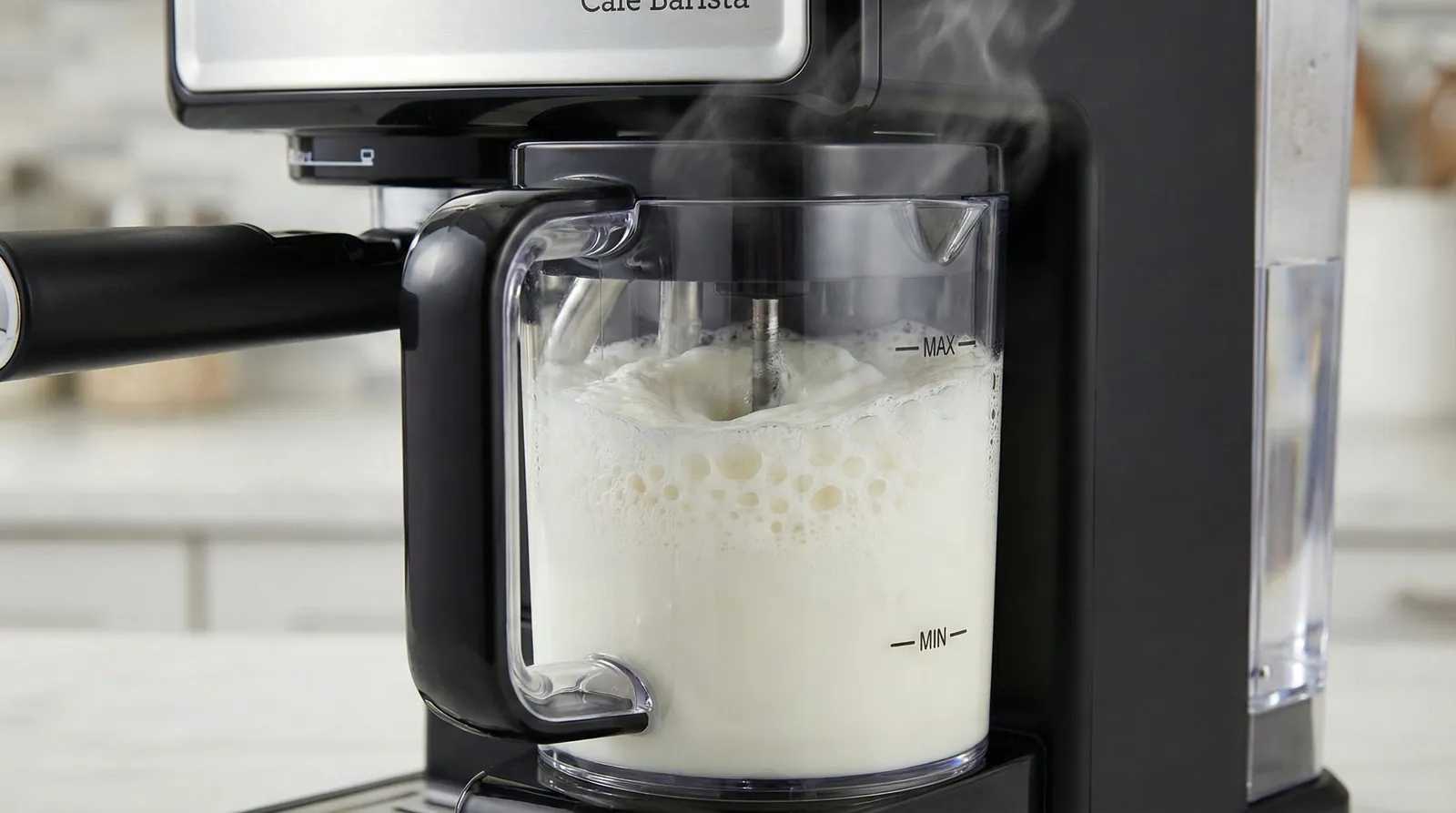
The automatic frother is dead simple: pour cold milk into the included pitcher between the MIN/MAX lines, attach it magnetically, press the cappuccino button, and wait 60-90 seconds for a beep. Compared against milk hand-steamed on a Gaggia's traditional wand, the difference is obvious — this produces foam, not microfoam. Large, visible bubbles separate from the liquid within 30-45 seconds into a distinct two-layer effect, versus the silky, integrated texture a manual wand can hold indefinitely.
That coarse texture rules out latte art entirely; large bubbles break the surface tension needed for controlled pouring. Whole milk gave the best (still coarse) results. Oat milk (Oatly Barista) produced minimal, grainy foam, and almond milk separated during heating — skip this machine if you rely on milk alternatives.
The trade-off is real, though: the automatic system is reliable. It makes the same coarse foam every time regardless of technique, and a complete beginner made a foamy cappuccino on their first try — something that takes weeks to learn on a manual wand.
Build Quality & Daily Workflow
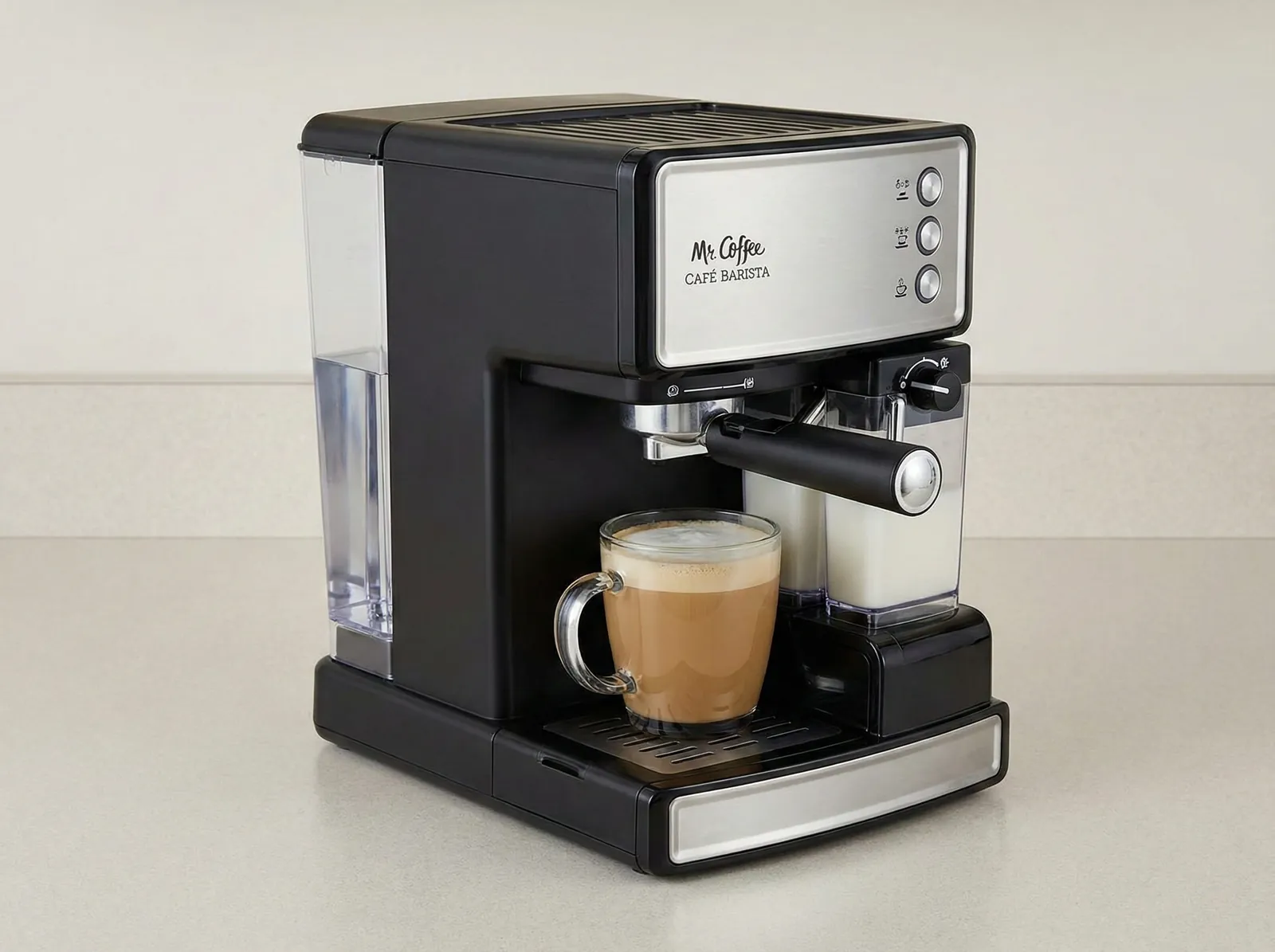
At 10 pounds and 11 x 11 x 13 inches, the Café Barista is mostly black plastic with silver paint standing in for stainless steel. Nobody will mistake it for metal, but the build held up fine through a month of daily use — no cracking around the buttons, no rattling parts, a drip tray that stays seated.
The proprietary pressurized portafilter is the clearest budget tell: it can't be swapped for precision baskets the way a commercial 58mm or semi-commercial 54mm portafilter can.
Controls are three illuminated buttons — single shot, double shot, cappuccino. No temperature adjustment, no programmable volumes, no pressure profiling; press a button and the machine decides everything else. That's easy for a first-time buyer, but frustrating once you know enough to want a longer pull or a hotter shot and can't get one.
Timing and workflow:
- Warm-up: from a cold start, the machine needs the full 3-4 minutes to reach reliable brewing temperature. The ready light turns green much sooner, around 30-45 seconds, but shots pulled that early come out thin and sour.
- One latte: once it's actually warm, a finished latte takes about two more minutes: under a minute to pull the double shot, 60-90 seconds of automatic frothing, plus assembly.
- Noise: the pump runs noticeably louder than premium machines.
- Several drinks: making drinks back-to-back for guests exposes a real limitation. The single thermoblock needs 15-20 seconds to switch between brewing and milk heating, so a round of four drinks takes meaningfully longer than one.
How it works and why it matters
Automatic milk, a pump and a pressurized basket: convenience traded for control
This machine uses a vibratory pump and a pressurized portafilter, so the brew side asks for little skill. Press a button, get a drink. The pressure restrictor in the basket produces foam on top even when the grind is imperfect.
The automatic frother heats milk and whips it with air in a built-in jug, which is why every drink comes out similar. The foam is thicker and airier than café microfoam, so it suits cappuccino-style drinks more than flat whites.
For the cup, think of it as a gateway to espresso-style drinks, not a replacement for a manual machine. See the types guide for what you give up.
Common problems and modern fixes
Thin shots, milk-system residue and plastic wear: what owners hit and what helps
- Weak shots: use fresh, medium-roast coffee and a finer grind rather than pre-ground that is old. The grind chart shows what finer means.
- Cold drinks: preheat the cup and run a blank shot to warm the group.
- Milk residue: the automatic frother needs a rinse after every drink and a deeper clean weekly. See the cleaning guide.
- Scale: plastic lines and small heaters suffer from hard water, so use filtered water and follow the descaling guide.
- Short lifespan: treat it as an entry machine. If you outgrow it, a manual-wand model is the next step; the dial-in guide shows what better equipment allows.
Before you decide
What to Expect from Budget Espresso Machines
Budget espresso machines under $250 make specific compromises to achieve accessible pricing:
- Plastic construction instead of stainless steel or brass.
- Thermoblock heating without PID temperature control.
- Pressurized portafilters that mask grind quality issues.
- Simplified pressure systems that sacrifice extraction precision.
Understanding these trade-offs helps set realistic expectations. Budget machines like the Café Barista produce espresso-style beverages—concentrated coffee drinks stronger than drip coffee—but rarely achieve the balanced extraction, temperature stability, and crema quality of machines costing $400+.
The value proposition centers on accessibility. For users uncertain about committing to home espresso or those with strict budget constraints, these machines provide entry-level experience at minimal financial risk.
Consider budget espresso machines as learning tools rather than long-term solutions. They help beginners understand espresso fundamentals—grind size importance, tamping technique, coffee freshness impact—before investing in higher-quality equipment. Explore our full espresso machine reviews, the best espresso machines overall, or our best espresso machines under $500 guide to find the right step-up machine when you're ready.
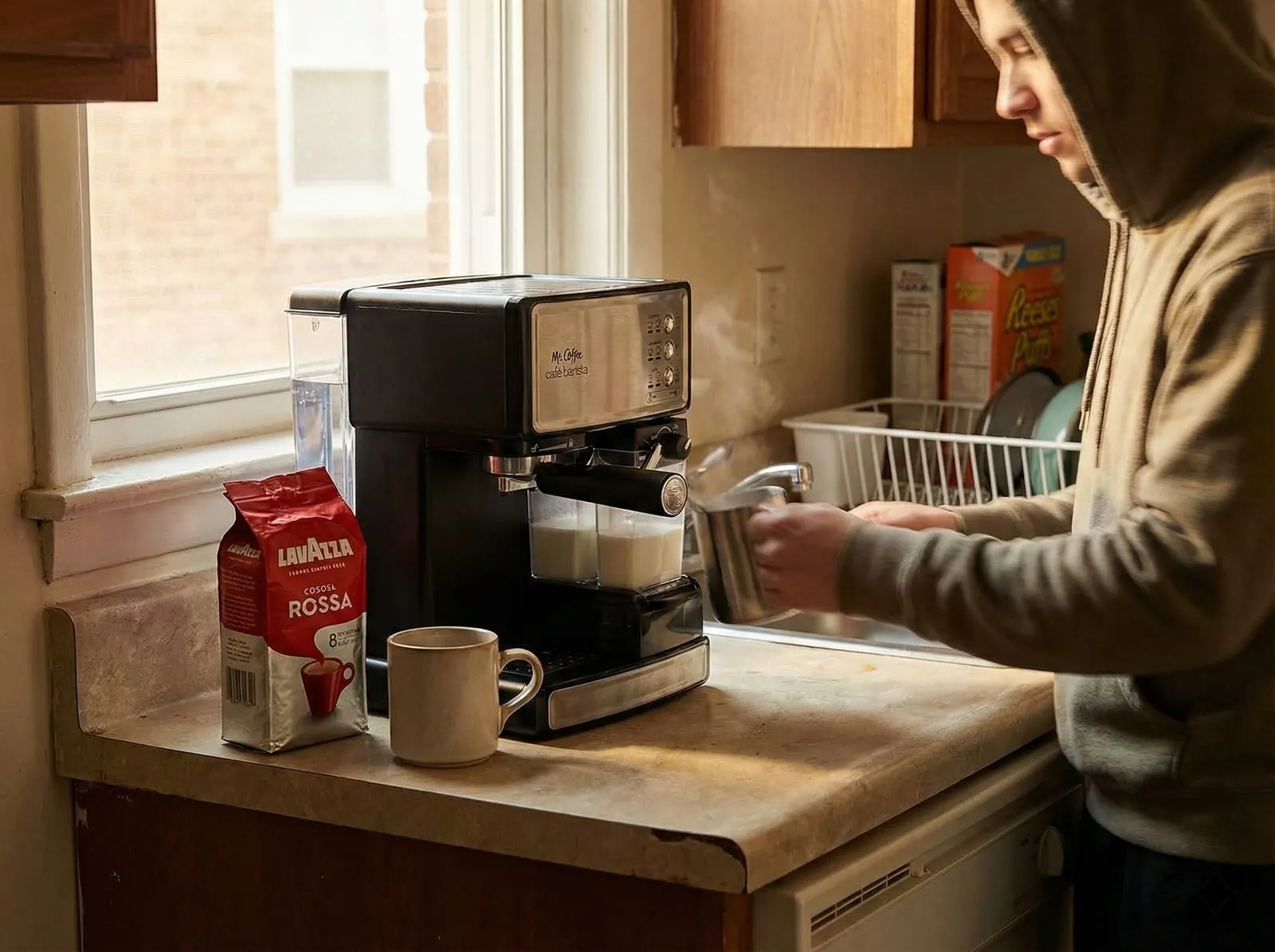
How It Measures Up on Key Espresso Criteria
- Temperature stability
- No adjustable temperature control, so brew temperature follows the machine's presets.
- Pressure and pre-infusion
- 15-bar pump rating. No gauge. No pre-infusion feature.
- Shot-to-shot consistency
- Single and double filters plus automatic milk frothing keep it simple; with no temperature control and basic filters, shots vary more than on PID machines.
Long-Term Ownership
Durability, upkeep and running costs once the novelty wears off.
- Durability
Predominantly plastic with metal accents.
More detail
User reports put average lifespan at 12-24 months with regular use (1-2 drinks daily). Common failure points: pump deterioration, thermoblock heating issues, plastic housing cracks. Not built for commercial or high-volume use.
- Reliability
Mixed.
More detail
A notable share of users report issues in the first year — leaking seals, pressure loss, heating element failure, or frother malfunction — suggesting inconsistent quality control across production batches.
- Parts
Limited replacement parts through Mr. Coffee customer service, and third-party parts are hard to source.
More detail
Most owners replace the whole unit rather than repair it.
- Upkeep cost
About $15-$25 a year for descaling solution and cleaning supplies — though repairs typically cost more than the machine, making them impractical.
- Warranty
1-year limited warranty covering manufacturing defects and mechanical failures; excludes damage from improper cleaning or neglected descaling.
More detail
Some users report slow customer service response.
- Resale value
Minimal secondary market.
More detail
Used units typically fetch $50-$80 (25-40% of original price) even after just 6-12 months, reflecting the saturated budget market and concerns about remaining lifespan.
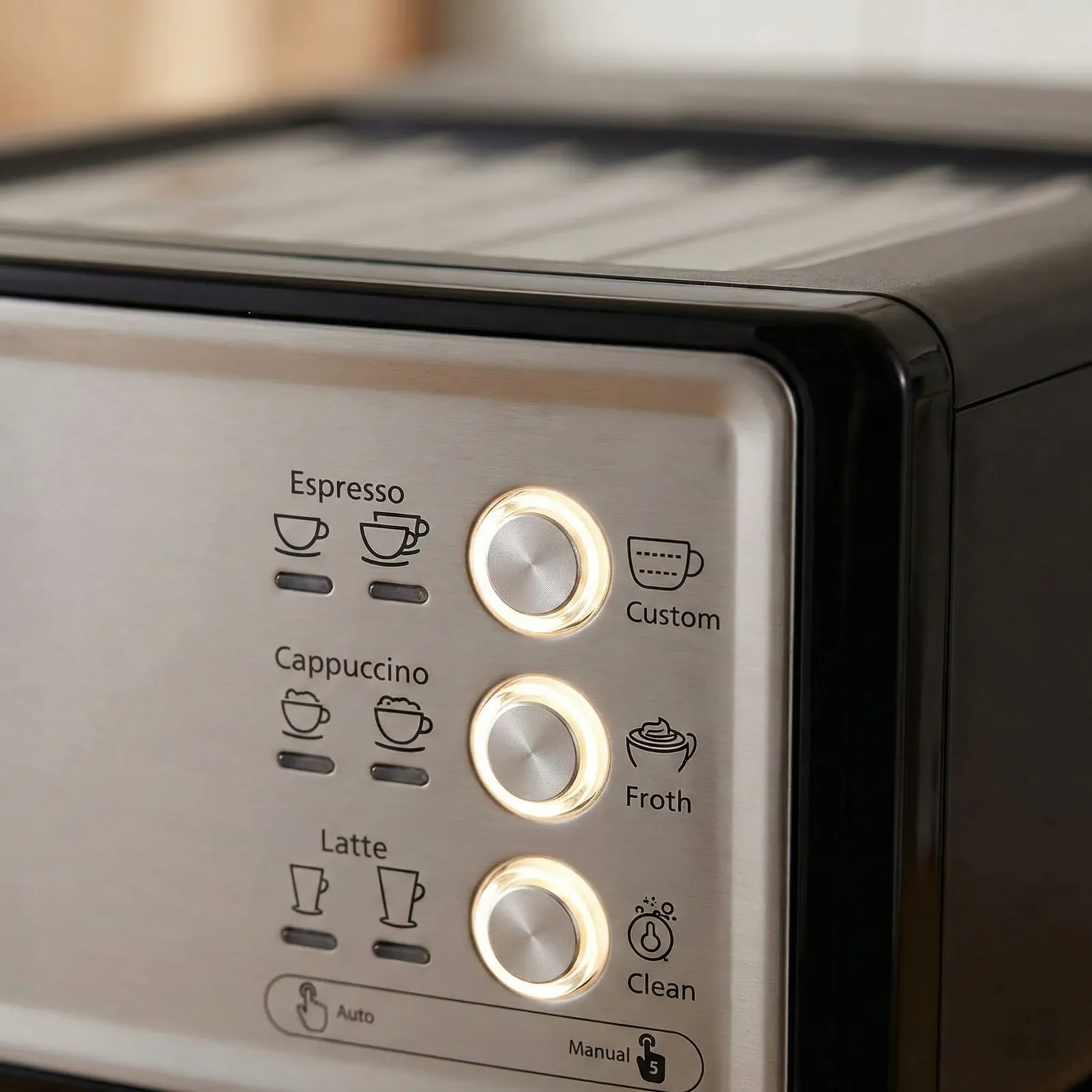
This machine was purchased independently and was not provided by Mr. Coffee.
Final Verdict
Our rating, who it fits, and what it costs.
Mr. Coffee Café BaristaWorth considering
3.8 / 5 — Is it worth buying?
The Café Barista makes its case by removing the two biggest barriers to trying home espresso: cost and complexity. One-touch operation and an automatic frother make it approachable for someone who has never pulled a shot, and the money at risk if espresso doesn't stick is $200, not $500.
✓ Best for
- Budget-conscious beginners exploring home espresso under $200
- College students with limited space and modest consumption
✕ Skip if
- Serious coffee enthusiasts seeking consistent extraction
- High-volume households needing 5+ drinks daily
Score breakdown
Shots tested
100+
Testing period
30 days
Ready to decide?
Our verdict: 3.8/5, worth considering. Independently tested; commissions never change a rating.
Where It Ranks in Our Buying Guides
See how the Mr. Coffee Café Barista compares with the other picks in each tested roundup.
Tools That Pair With This Review
Put it into practice with a free calculator built for what you just read.
- Espresso Dial-In CalculatorEnter your actual shot results to see whether you're on target — and what to adjust.
- Espresso Ratio CalculatorEnter your dose and shot style (ristretto, normale, lungo) to get your target shot weight.
- Coffee Grind Size CalculatorPick your brew method and get the right grind size, texture, and grinder setting.
Reader questions
Questions or tips? Leave a comment
Ask about your setup or share what worked for you. Comments are checked before they appear.