
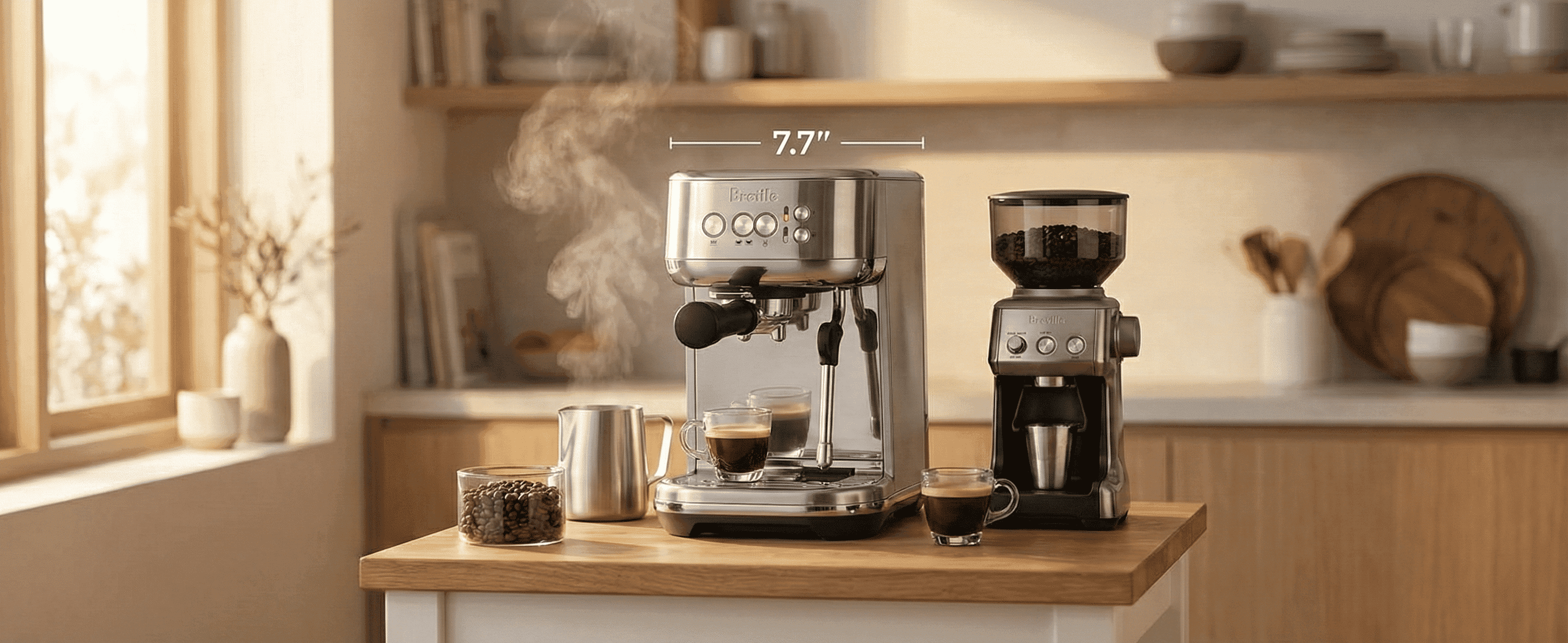
Ships with both basket types
Breville Bambino Plus
Start on dual-wall with pre-ground coffee, then switch to single-wall once you add a grinder.
Espresso Guides
Last updated
Dual-wall baskets forgive a poor grind; single-wall baskets reward a good one. How each works, which to use, and how to switch without a week of sour shots.
Affiliate disclosure: this page contains Amazon affiliate links. We may earn a commission if you buy through them, at no extra cost to you, and it never affects our rankings. Learn more
Pre-ground coffee or a budget grinder: use the pressurized basket. A real espresso grinder and fresh beans: use non-pressurized for fuller flavor and honest feedback. Not sure which you have? Look at the underside: one small hole means pressurized.
How to tell them apart and what each one is for.
| Pressurized (dual-wall) | Non-pressurized (single-wall) | |
|---|---|---|
| How to spot it | One small hole underneath | Many small holes across the base |
| Grind needed | Forgiving: pre-ground often works | Fine, consistent espresso grind |
| Crema | Foamy, often bubbly | Thinner but richer, varies with beans |
| Flavor ceiling | Limited | Much higher |
| Feedback | Hides grind mistakes | Shows mistakes in shot time and taste |
| Best for | Pre-ground coffee, beginners, budget grinders | Fresh beans and an espresso grinder |
How to spot it
Grind needed
Crema
Flavor ceiling
Feedback
Best for
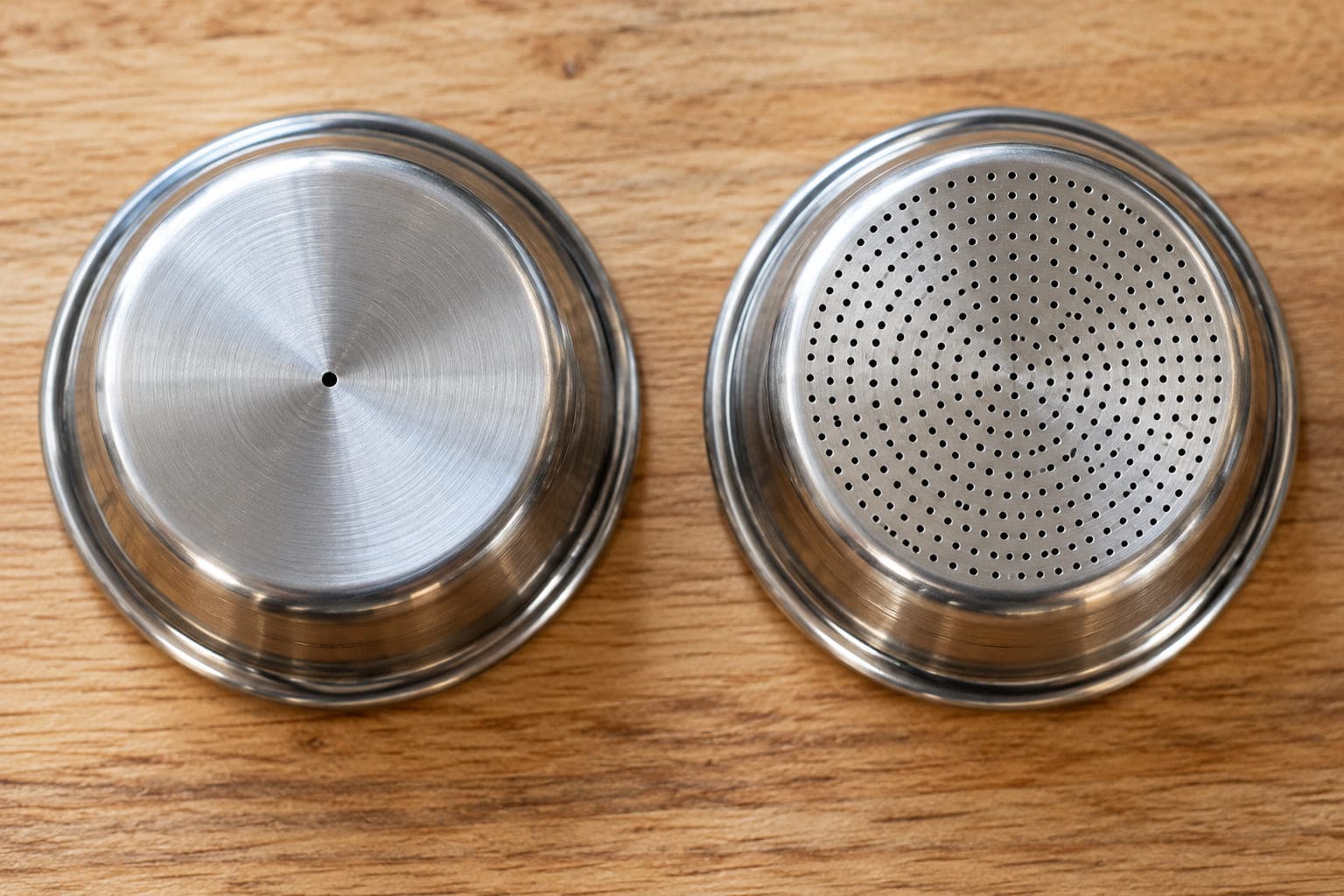
Why a dual-wall basket works with almost any grind, and what that costs you.
In a single-wall basket, the compacted coffee puck is the only thing slowing the water down. Grind finer and the puck resists more; grind coarser and water rushes through. That's why grind size controls the shot.
A dual-wall basket adds a second wall with one small exit hole. Coffee extracts into the gap between the walls, then squeezes out through that hole. The hole creates the resistance, so the puck matters much less. Forcing the coffee through a pinhole also whips air into it, which is the foamy layer that looks like crema.
The trade-off is control. Because the basket sets the pressure, changing your grind changes the shot far less, so you can't fine-tune flavor the way you can with a single-wall basket. Our espresso crema explainer covers why that foam isn't a sign of a great shot.
Shortcuts based on your grinder and your coffee.
Quick decision guide
You use pre-ground supermarket coffee
stick with the pressurized basket; single-wall will run fast and taste sour.
You have a blade grinder or a filter-only burr grinder
pressurized. Neither grinds fine or evenly enough for single-wall espresso; see burr vs blade grinders.
You have an espresso-capable burr grinder and fresh beans
switch to single-wall for more flavor and clearer feedback.
You're not sure your grinder is fine enough
try single-wall at its finest setting. If a double still finishes well under 20 seconds, stay pressurized for now.
If you're choosing a grinder for this upgrade, our burr grinder buying guide explains what an espresso grinder needs.
A short routine that gets you to a good shot without wasting a bag of beans.
Use fresh whole beans, ideally roasted within the last few weeks.
Set your grinder noticeably finer than you used with the pressurized basket.
Dose to the basket size and weigh it; about 18g for a typical double basket is a common start.
Distribute the grounds evenly, then tamp level and firmly.
Pull a double into a cup on a scale and aim for about twice the dose in liquid in 25–30 seconds.25–30 seconds
Fast and sour: grind finer. Slow and bitter: grind coarser. Change one thing per shot.
Expect your first few shots to be off: that's the basket giving you honest feedback. Our dial-in guide and sour espresso fixes cover the next steps, and Barista Express owners can start from our grind settings by roast.
Current puck-prep habits that make non-pressurized baskets more consistent.
What to expect from popular beginner machines, and where upgrades are limited.
Many Breville semi-automatics, including the Bambino Plus and Barista Express, ship with both dual-wall and single-wall baskets, so you can start forgiving and switch later. Our Bambino Plus vs Barista Express comparison covers both.
Several budget De'Longhi machines are built around pressurized baskets. The Dedica EC685 uses a pressurized basket only in our review, so moving to single-wall means buying an aftermarket 51mm basket or bottomless portafilter. The Stilosa EC260 is similar in spirit: forgiving, but with limited room to grow.
Machine contents change between production runs and regions, so check the box list on the listing before buying if basket type matters to you. Still choosing a first machine? Our best espresso machines for beginners notes which basket each pick ships with.
Ships with both basket types
Start on dual-wall with pre-ground coffee, then switch to single-wall once you add a grinder.
Pressurized-first budget machine
Very narrow and forgiving of a budget grinder. Single-wall needs an aftermarket 51mm upgrade.
Affiliate links: we may earn a commission at no extra cost to you.
Problems that make people think their machine is faulty when it isn't.
| Problem | Fix |
|---|---|
| Using a fine espresso grind in a pressurized basket | Grind coarser; dual-wall baskets can choke on very fine coffee |
| Switching to single-wall with pre-ground coffee | Stay pressurized until you can grind fresh and fine |
| Judging shots by foamy crema | Taste and time the shot instead; dual-wall foam isn't a quality signal |
| Not cleaning the pressurized hole | Rinse and check the single exit hole regularly; a clog stops flow |
| Buying baskets in the wrong size | Measure your portafilter: 51mm, 54mm and 58mm aren't interchangeable |
Using a fine espresso grind in a pressurized basket
Switching to single-wall with pre-ground coffee
Judging shots by foamy crema
Not cleaning the pressurized hole
Buying baskets in the wrong size
If shots still channel or run unevenly after switching, see our guide to espresso channeling.
Quick answers before you buy.
They cap the quality.
With pre-ground or coarse coffee they make better shots than a single-wall basket would.
With fresh beans and a good grinder, single-wall baskets taste noticeably fuller and more complex.
Rarely well.
Most pre-ground coffee is too coarse for espresso, so shots run fast and taste sour.
Use the pressurized basket until you have a grinder.
Turn it over.
A pressurized basket has a solid inner floor with one small hole.
A non-pressurized basket has many tiny holes across the whole base.
Partly.
The foam is mostly air forced in through the small exit hole, so it looks thick even on a weak shot.
Crema from a single-wall basket better reflects the beans and extraction.
Tamp lightly and evenly.
The basket creates most of the resistance, so hard tamping adds little and can make a fine grind choke the flow.
Not really.
A bottomless portafilter is there to show how water flows through the puck, and a dual-wall basket releases coffee through one small hole, so there's little to see.
Pair a bottomless portafilter with a single-wall basket.
Keep reading: more guides on the same topic.
 How to
Espresso5 min read
Learn how to dial in espresso: a starting recipe, grind changes by shot time and taste, and fixes for sour or bitter shots.
 Explained
Espresso4 min read
What is espresso crema? What causes it, what good crema looks like and whether it means a better-tasting shot.
 Compare
Grinder3 min read
Burr vs blade grinder: how grind consistency changes taste, who can keep a blade, and what a first burr grinder costs at each budget.
 Explained
Espresso3 min read
What is WDT in espresso? Breaks up clumps before tamping to reduce channeling. What it fixes, whether you need a tool, and how to use it.
