
Sized for 53-54mm baskets
Normcore 53.3mm Puck Screen
Precision-cut stainless steel for Breville-style baskets.
Espresso Guides
Last updated
Are puck screens worth it? They keep your group head cleaner but won't fix channeling. See who should buy one and which size fits.
Affiliate disclosure: this page contains Amazon affiliate links. We may earn a commission if you buy through them, at no extra cost to you, and it never affects our rankings. Read our full affiliate disclosure
Are puck screens worth it? Yes for most 58mm and 54mm setups, but for cleanliness, not better shots. It keeps fines and oils off the shower screen and gasket, and will not fix channeling or a poor grind.
Decide in a few seconds.
Quick decision guide
You backflush regularly and want less gunk on the shower screen
a puck screen cuts how often you need to remove and soak it.
Your shots channel or taste sour and bitter together
skip it and fix grind and distribution first, starting with WDT.
You own a super-automatic or a machine with a small proprietary basket
skip it: no portafilter to fit, or no screen in your size.
It protects the top of the puck from the first blast of water.
When water leaves the shower screen it hits the coffee bed in jets. On a loose or uneven puck, those jets can dig into the surface and start a channel before the bed has wet evenly. A thin metal screen on top spreads that water so the puck saturates more gently.
It also keeps the group head cleaner. Less coffee sticks to the shower screen, and the screen itself is easy to rinse. It does not fix poor distribution or a bad grind; it reduces one source of mess and one source of uneven flow.
There is also a cleanliness benefit that has nothing to do with taste. Without a screen, the top of the puck presses against the shower screen and leaves coffee stuck to it after every shot; over a day of drinks that layer bakes on and needs scrubbing. With a screen in place, most of that residue stays on the screen, which you rinse in seconds. For people who pull several shots a day, that alone is often the reason they keep using one, even when the taste difference is small.
A screen works best as one step in a short, repeatable routine.
Current good practice combines a few cheap steps: dose by weight on a scale, stir the grounds with WDT to break clumps, tamp level (see tamping technique), then add the screen. A paper filter under the puck is another option, and some machines also benefit from pre-infusion, which wets the bed at low pressure.
Check that the screen fits your basket diameter and does not touch the group head, otherwise it can stick. If shots are still uneven, work through the channeling checklist. If you already have a flat puck, even flow and a clean group, the screen is optional.
A good order of upgrades for most home setups is: weigh your dose, add a WDT tool, level the tamp, then consider a precision basket and a puck screen. Each step removes one source of inconsistency, so you can tell which change actually helped. Adding everything at once makes it hard to know what made the difference, and you may end up paying for tools your setup did not need.
Two small effects at the top of the puck.
Match the screen to your basket diameter.
| Size | Machines | Notes |
|---|---|---|
| 58mm | Gaggia Classic Pro, Rancilio Silvia | Widest aftermarket choice |
| 54mm | Breville Barista Pro and Express | Needs a 54mm-specific screen |
| 51mm / proprietary | De'Longhi La Specialista Prestigio | Few or no options; check specs |
58mm
54mm
51mm / proprietary
Sized for 53-54mm baskets
Precision-cut stainless steel for Breville-style baskets.
Standard 58mm portafilter
Accepts the full range of aftermarket screens. More options: best espresso machines under $500.
Affiliate links: we may earn a commission at no extra cost to you.
Six steps, with rinsing the one that matters.
Grind, distribute and tamp. As normal.
Place the screen flat. On the puck, with no gaps at the edges.
Lock in the portafilter. Immediately.
Rinse it after each shot. ; oil buildup adds stale notes.
Dry it fully. To avoid rust spots.
Remove it before backflushing.
Fit first, then thickness and finish.
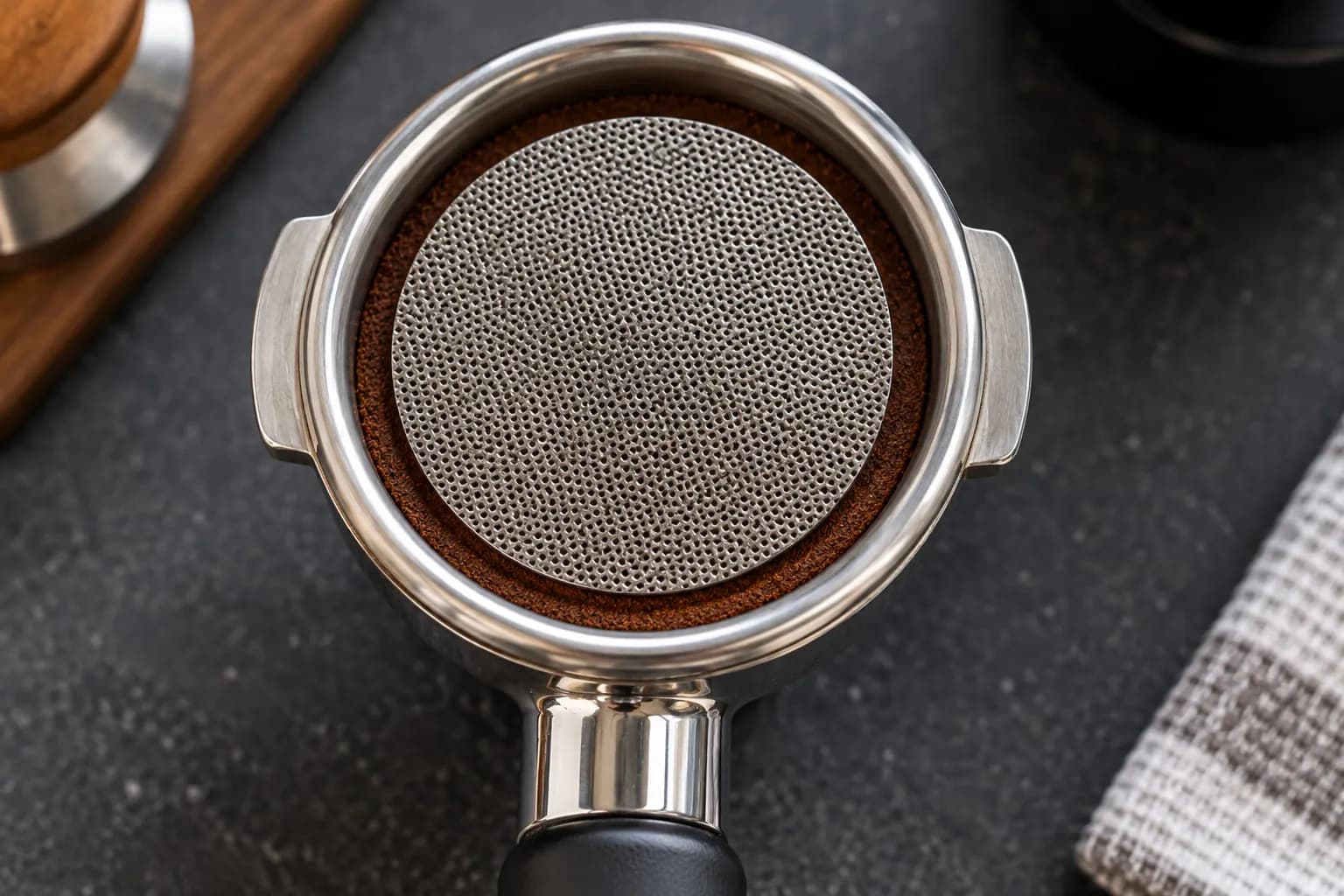
If you already have a precision basket and a clean shower screen, the gains from a puck screen are smaller. It earns its place most on machines with a basic shower screen that sprays unevenly, on machines where coffee tends to stick to the shower screen, and for anyone who wants to cut down on daily group-head cleaning. Our baskets guide covers when a better basket is the bigger upgrade.
No; it helps an evenly prepared puck, it does not fix a bad one.
A puck screen spreads water more evenly across the top of the coffee and keeps the shower screen cleaner, but it cannot fix clumps, an uneven dose or a tilted tamp underneath it. If your shots channel, start with distribution: a WDT tool to break up clumps, a level tamp (see how to tamp espresso), and a consistent dose weighed on a scale. Add the screen once those are in place, and judge it by whether your shots become more consistent, not by a single shot.
Some owners find they need to grind slightly finer or dose slightly less after adding a screen, because the screen takes up some headspace above the coffee. If the puck is wet or the screen leaves a deep imprint, reduce the dose a little; our wet puck guide explains the headspace balance.
A quick rinse daily and a deeper soak every week or two.
After each shot. Lift the screen off the puck (a magnet tool helps) and rinse it under hot water.
Daily. Wipe both sides so coffee oils do not dry onto the mesh.
Weekly or every two weeks. Soak it in hot water with espresso machine cleaning powder, then rinse well.
Replace it. If the mesh warps, the edge separates, or it no longer sits flat in the basket.
A clean screen matters because old oils on the mesh add the same stale, bitter notes as a dirty shower screen. Our espresso machine cleaning guide covers the rest of the routine.
How long a screen lasts depends on care. Rinsed after each shot and soaked regularly, a stainless screen can stay flat and effective for a long time; one left with dried oils and coffee will clog and eventually warp. If the shots start running unevenly again after weeks of good results, clean the screen before changing your grind.
Quick answers before you buy.
No. The shower screen is fixed in the group head; a puck screen is a removable disc on top of the coffee.
Stainless steel holds up to daily rinsing; cheaper plated-metal screens are more prone to rust spots.
Not reliably.
They mainly keep the group head cleaner, and any taste change comes from slightly more even water flow.
Better grinding and puck prep matter far more, as in fixing espresso channeling.
Yes, a puck screen does not replace puck prep.
Stirring the grounds with WDT breaks clumps, which a mesh disc cannot do.
Rinse it after each shot and give it a deeper clean with espresso machine cleaner now and then, since coffee oil builds up on the mesh.
Stained or clogged holes mean it is time to replace it.
It can help keep the surface from sticking, but it will not fix the underlying cause.
See why your espresso puck is wet for the real fixes.
Keep reading: more guides on the same topic.
 Explained
Espresso6 min read
What is WDT in espresso? Breaks up clumps before tamping to reduce channeling. What it fixes, whether you need a tool, and how to use it.
 Explained
Espresso6 min read
What is espresso crema? What causes it, what good crema looks like and whether it means a better-tasting shot.
 How to
Espresso6 min read
How hard to tamp espresso: 15–30 lbs is enough, and a level tamp matters more than force. Calibrate espresso tamping pressure step by step.

Reader questions
Questions or tips? Leave a comment
Ask about your setup or share what worked for you. Comments are checked before they appear.