
 3.9
3.9Bosch
Bosch 300 Series VeroCafe
A reliable automatic machine for one-touch cappuccino and latte macchiato without learning wand technique.
Espresso machine review
Last updated
De'Longhi La Specialista Prestigio espresso machine review: sensor grinding, dual heating and Smart Tamping over 200+ shots, compared with the Opera and Arte.
Affiliate disclosure: this page contains Amazon affiliate links. We may earn a commission if you buy through them, at no extra cost to you, and it never affects our rankings. Read our full affiliate disclosure
DeLonghi La Specialista Prestigio at a GlanceHighly recommended
A serious investment that delivers hands-off café consistency, if you make several milk drinks a day.
Premium Semi-Automatic with Sensor Technology and Integrated Grinder
Affiliate link: we may earn a commission at no extra cost to you. It never affects our rating.
In the shot log· 200+ shots · 6 weeks
Why it stands out
Watch out for
✓ Best for
Experienced coffee enthusiasts upgrading to premium equipment with smart automation
✕ Skip if
Budget-conscious buyers—this premium machine costs roughly double many entry-level alternatives such as the
In this DeLonghi La Specialista Prestigio review: at $800–$900, the machine asks you to trust a sensor over your own hands, and after six weeks and 200+ shots across seven bean origins, we do.
The short answer: for home baristas making several milk drinks a day who want café-level consistency without years of practice, it earns its price; budget buyers and manual-control purists should look elsewhere.
Check where you fit before you look at the trade-offs below.
A strong match
Consider something else
What earns the rating, and what you give up to get it.
9 reasons it works
7 trade-offs to weigh
How it performed in day-to-day use, in the order you will meet it.
The Bean Adapt sensor earned trust the hard way. In the first week we second-guessed it constantly and paid for it with overridden grind settings, a clogged burr chamber from an ignored moisture warning, and a run of sour, channeled shots. Once we stopped interfering, the pattern was clear: the sensor's initial read was right better than nine times out of ten.
The dual thermoblock system is the feature that actually changes your morning, not just the shot in the cup. Because brew and steam water heat independently, you can pull espresso and steam milk at the same time without either one dropping in temperature.
LatteCrema and the My LatteArt manual wand serve different purposes rather than duplicating each other.
In practice, LatteCrema became the default for everyday drinks, with the manual wand reserved for guests or latte-art practice.
Build quality is where the price tag feels justified.
The cold brew setting routes room-temperature water through the puck instead of heated water, producing a bright, fruity, almost tea-like extraction with lighter beans like Ethiopian natural. It's a nice option for iced coffee experiments rather than a reason to buy the machine on its own.
The machine needs roughly 15 x 14 inches of counter space plus clearance above it to refill the bean hopper and water tank. It's manageable on a standard counter but worth measuring first if your kitchen is tight — this isn't a compact machine.
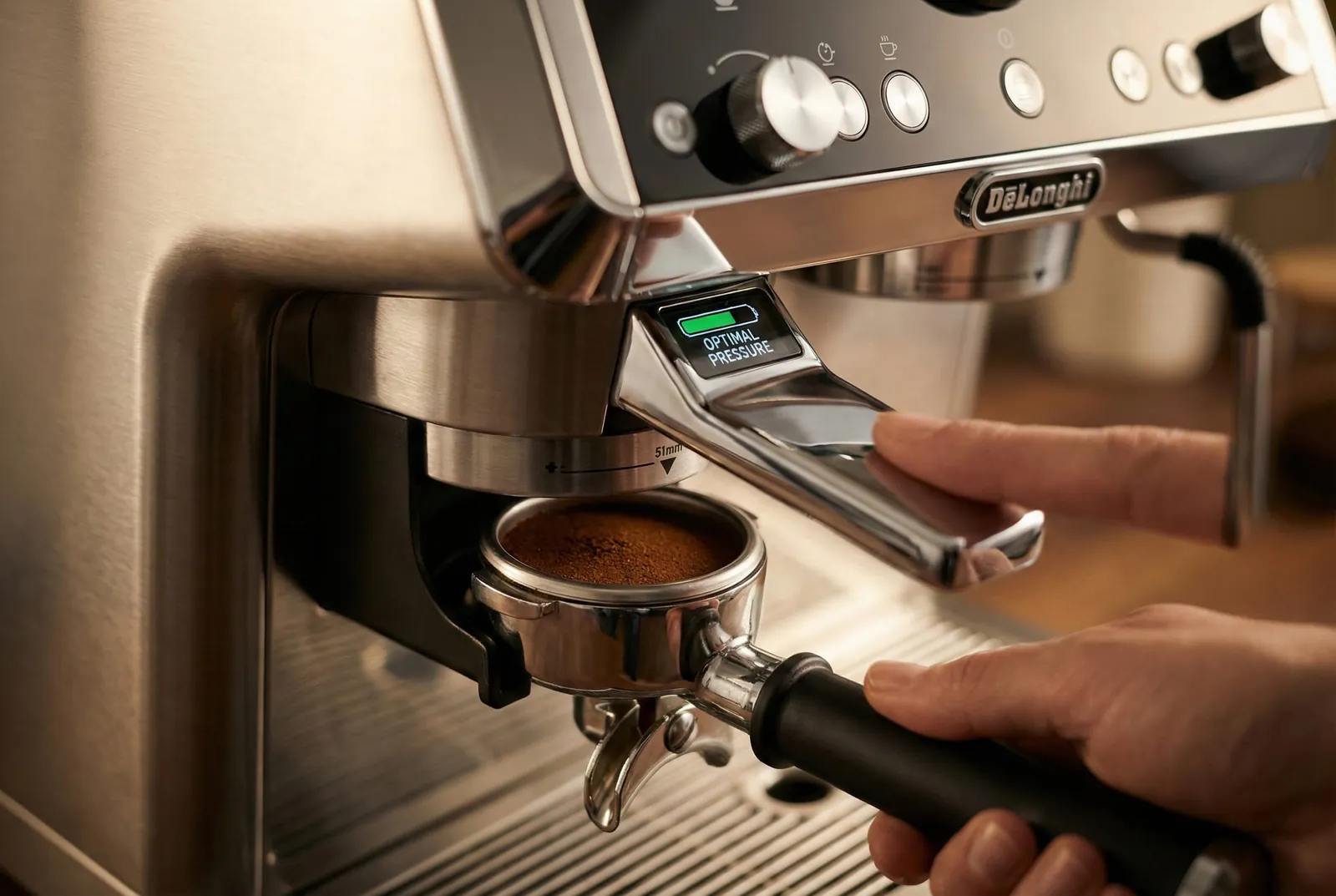
The Prestigio combines sensor grinding, smart tamping, dual thermoblocks and two milk systems. Here is what each does.
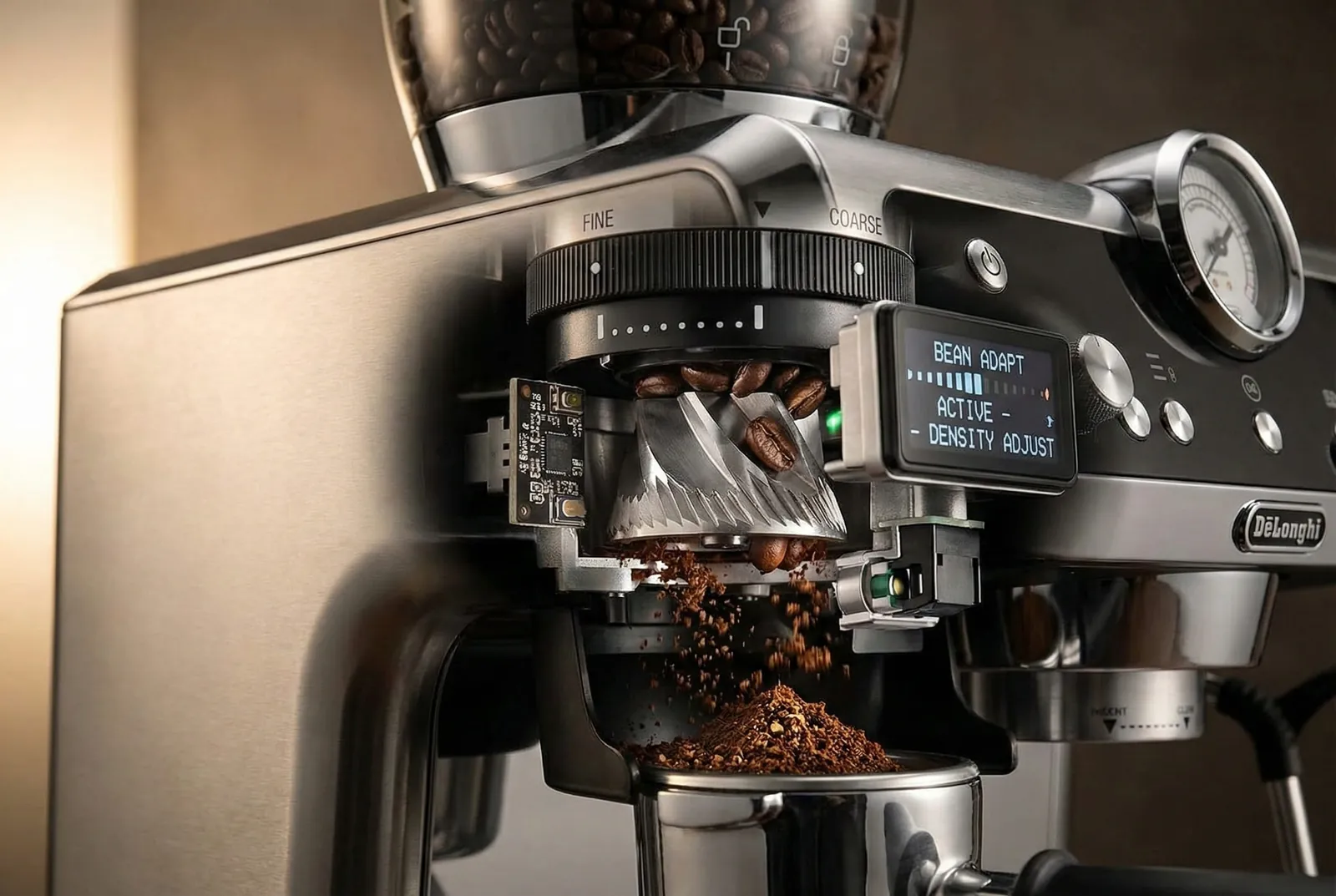
Sensor grinding measures the dose as the grinder runs and corrects as beans change, so you rarely adjust by hand. The tamping station then presses the puck to a set force, which reduces espresso channeling.
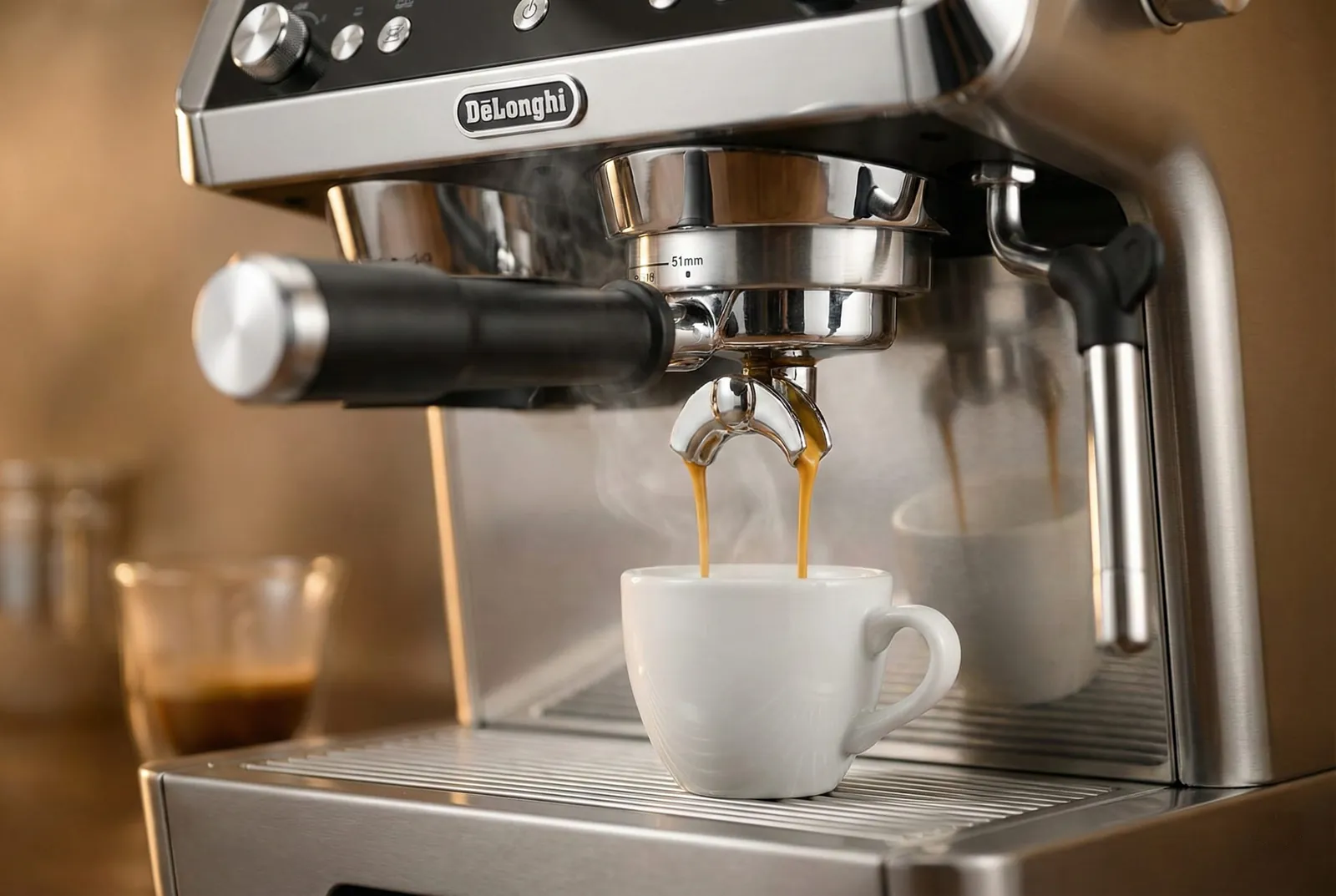
Dual thermoblocks keep brew and steam heat separate, so a cappuccino does not stall while the machine changes modes. PID-style control holds the water temperature steady, which matters because even small swings change how sour or bitter the shot tastes.
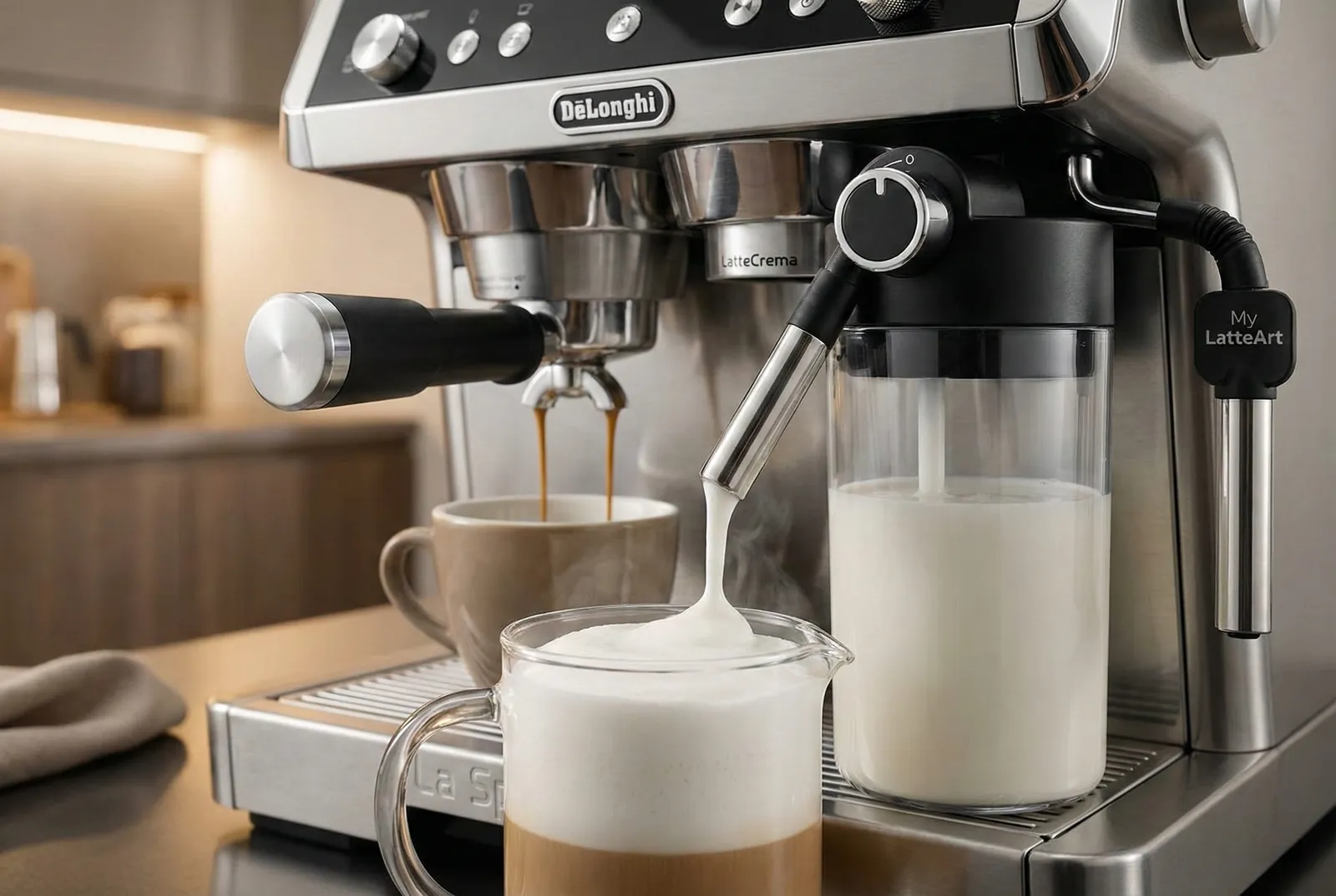
The LatteCrema carafe makes milk automatically, while the manual wand lets you practice latte art. In the cup, expect repeatable medium-bodied shots with solid milk drinks.
A feature-rich machine has more parts to look after. These are the problems and fixes.
The carafe has to stay cold, so return it to the fridge between uses and rinse it after each drink. Run the deeper clean in cleaning an espresso machine every week.
Switching between very dark and very light beans can shift dose, so run a short calibration and adjust one step, as covered in dialing in espresso. Log a shot in the espresso dial-in calculator to see whether to grind finer or coarser.
Descale on the machine's prompt and use filtered water per the descaling guide; dual heaters cost more to repair than a single block.
Replace worn accessories, such as the 51mm basket, with compatible versions, and check the espresso machine maintenance guide for gasket and screen timing.
Before you decide
After testing the entire La Specialista lineup (Opera, Arte, and Prestigio), here is how they rank: the Prestigio sits at the top with its sensor grinding and Smart Tamping automation. It's the most expensive ($900) but delivers the most consistent extraction: a 24-27 second range, tightened from 23-29 seconds with manual tamping.
All three share DeLonghi's solid build quality and 51mm portafilter system. The question isn't "which is best?"—it's "how much automation do you want to pay for?" We tested each for 60+ shots, and the Prestigio's sensor technology saved time and reduced frustration when switching between bean origins. But that convenience costs roughly $150-$200 more than the Opera and $300-$350 more than the Arte.
If you’re still exploring options, our complete guide to the highest-rated home espresso machines covers the top picks across all budgets. If cost is a concern, our espresso machine picks under $500 list has strong alternatives. Our full espresso machine reviews hub includes every machine we’ve tested.
Durability, upkeep and running costs once the novelty wears off.
Premium stainless-steel construction with a 51mm brass portafilter that showed zero flex under firm tamping pressure in testing, plus dual thermoblocks and PID control carried over from DeLonghi's higher-end line.
Build-quality signals here point to a multi-year lifespan with proper descaling, though the dual-thermoblock system's main long-term unknown is scale buildup inside the thermoblocks, which the automated descaling program is designed to manage.
The Sensor Grinding Technology needed zero to one micro-adjustment per bean switch with over 90% first-grind accuracy in testing, and the Smart Tamping Station's fixed 30-pound tamp removes a major source of shot-to-shot variability compared with manual technique.
The main reliability consideration flagged in testing is sensor recalibration when switching between dramatically different roast levels, plus general upkeep of the LatteCrema milk carafe and My LatteArt wand.
As a current-generation flagship DeLonghi model, replacement parts (51mm baskets, brass portafilter components, LatteCrema carafe seals, descaling kits) are supported through DeLonghi's official parts channel and specialty retailers; the 51mm portafilter size does mean upgrading from a 58mm setup requires new accessories, which cost about $65 out of pocket by one estimate.
Higher than an entry-level machine given the dual milk systems and sensor grinder, but manageable: routine costs are descaling solution, occasional water filter cartridges (DeLonghi filter, sold separately), and periodic burr cleaning for the sensor grinder.
Automated descaling reminders and largely dishwasher-safe removable parts help keep upkeep from becoming a chore.
2-year limited manufacturer warranty, matching DeLonghi's premium tier and a full year longer than budget models like the Stilosa or EC155 — appropriate coverage for a $800–$900 investment.
Premium semi-automatics with sensor grinding and dual thermoblocks tend to hold value better than basic pump machines, since the feature set (Bean Adapt sensor, Smart Tamping, dual milk systems) remains distinctive on the used market; buyers upgrading from 58mm setups should factor the non-standard 51mm portafilter into resale expectations, as it narrows the pool of interested buyers slightly.
This machine was purchased independently and was not provided by DeLonghi.
Our rating, who it fits, and what it costs.
DeLonghi La Specialista PrestigioHighly recommended
4.7 / 5 — Is it worth buying?
The Prestigio's sensor grinding, Smart Tamping, and dual thermoblocks remove the variables that trip up manual technique, and the LatteCrema system beats manual steaming on a tired morning.
✓ Best for
✕ Skip if
Score breakdown
Shots tested
200+
Testing period
6 weeks
Ready to decide?
Our verdict: 4.7/5, highly recommended. Independently tested; commissions never change a rating.
Closest alternatives in price and purpose, each tested the same way.
3.9Bosch
A reliable automatic machine for one-touch cappuccino and latte macchiato without learning wand technique.
 4.1
4.1De'Longhi
A bean-to-cup super-automatic that delivers consistently good espresso without any of the semi-automatic learning curve.
 4.2
4.2De'Longhi
A bean-to-cup super-automatic with 16 one-touch drink recipes and saved profiles — real convenience, not a craft project.
 4.6
4.6DeLonghi
A machine built for simultaneous brewing and steaming, aimed at serious home baristas making several drinks a day.
Put it into practice with a free calculator built for what you just read.
Quick answers before you buy.
At $900, this is a serious investment. Here's a blunt cost-benefit analysis, based on daily use:
You're paying for: Sensor grinding technology that saves 5-10 minutes per bean-switching session. Automated milk frothing that produces consistent results without the 50+ hour learning curve of manual steaming. Smart Tamping that eliminates technique variables. Dual heating that cuts morning routine time from 8-12 minutes (single boiler) to 4-5 minutes.
Time savings over the test period: Approximately 2-3 hours of dialing time eliminated. Skips much of the 50+ hours of practice it takes to master manual milk steaming (less relevant if you already know how). Takes several minutes off the daily routine.
Worth it if: You make 3+ specialty drinks daily ($5 café latte × 3 drinks × 30 days = $450/month savings vs buying out). You value time efficiency and consistent results. You're a beginner willing to invest in technology that flattens the learning curve. You frequently rotate between different bean types.
Not worth it if: You're on a tight budget and can accept more variable results from a $500 machine. You already own a quality grinder. You enjoy the manual process and don't want automation.
It's real technology, even if it sounds like marketing. The optical sensors measure bean density, moisture content, and surface oil levels as beans enter the 51mm conical burrs. The system analyzes these parameters in real-time and adjusts burr RPM, grind time, and dose precision automatically.
In our testing across a range of bean origins, from light Ethiopian naturals to dark Italian blends, we observed measurable differences: light roasts triggered noticeably slower burr speeds (the RPM change is audible) to preserve volatile aromatics and prevent overheating. Dark, oily roasts ran faster to prevent clogging. The sensor's initial grind recommendations required zero to one micro-adjustment across all beans we tested—dramatically faster than the manual dial-in process that typically takes 5-8 test shots with traditional machines.
Yes, surprisingly so—IF you can afford the $900 investment. This is arguably one of the best beginner machines at any price point, despite being far from the cheapest.
Why it's beginner-friendly: The sensor grinding eliminates the most frustrating part of learning espresso (dialing in). Smart Tamping removes technique variables. LatteCrema produces café-quality microfoam without the 50+ hours of manual steaming practice. Dual heating means no confusing temperature surfing or boiler switching.
The catch: It's expensive for a first machine. If you're not sure you'll stick with home espresso, a $399-$449 Bambino Plus is less risky. But if you're committed and can afford it, the Prestigio removes most of the learning curve barriers that cause beginners to give up.
Our recommendation: If budget allows, this is an excellent first machine. If $900 feels risky, start with Bambino Plus ($399-$449) or Gaggia Classic Pro ($450-$550), learn the fundamentals, then upgrade later if you stay hooked.
The LatteCrema automatic system and My LatteArt manual wand serve different purposes—and having both options proved valuable during testing, not redundant.
LatteCrema Automatic System:
Uses a sealed carafe with whisk-based frothing mechanism. You fill with cold milk, select texture (five settings), press start. The machine handles everything—heating, aerating, texturing. In our testing, settings 4-5 produced latte-art-quality microfoam with whole milk and oat milk. Well suited to back-to-back drinks or when you want consistency without technique variance. Cleanup: dishwasher-safe jug, takes 15 seconds to rinse.
My LatteArt Manual Wand:
Traditional steam wand for hands-on control. We measured 1.2 bar steam pressure—adequate for proper microfoam. Two-hole tip produces good whirlpool action. Time to steam 8 oz whole milk: 45-60 seconds consistently. Well suited to latte art practice or when you want traditional barista technique. Cleanup: 30-second wipe with damp cloth.
In actual usage: LatteCrema was used for efficiency (making 2-4 drinks for guests), and the manual wand for single cappuccinos where latte art practice was the goal. Both systems performed excellently in their intended roles.
Real-world maintenance based on daily use during testing:
Daily (2-3 minutes):
- Empty/rinse drip tray: 30 seconds
- Wipe portafilter, backflush group head with blind basket: 45 seconds
- Rinse LatteCrema jug (if used) or purge/wipe manual wand: 30 seconds
- Wipe exterior: 30 seconds
- Empty knock box: 15 seconds
Weekly (15 minutes):
- Check the descale indicator; when it prompts, descale with DeLonghi solution ($8/bottle, lasts 8-10 cycles in our testing)
- Clean grinder burrs with brush: 5 minutes
- Deep clean milk systems with cleaning tablets: $12/30 tablets
- Clean shower screen and dispersion plate: 5 minutes
Monthly (30 minutes):
- Burr removal and deep clean
- Replace water filter ($15/3-pack)
Annual cost calculated from our usage: approximately $60-$80 for descaling solution, cleaning tablets, and water filters. This is less than the Breville machines we've tested (which require more frequent descaling).
Time commitment: About 35 hours annually for all maintenance combined. The automatic cleaning prompts are helpful—the machine tracks actual usage cycles, not just elapsed time.
These two machines are the strongest competitors in the $800–$900 semi-automatic category. The Breville Barista Pro integrates a fast-heat ThermoJet system and 54mm portafilter with a clean digital display, while the Prestigio’s defining edge is Bean Adapt sensor grinding and the Smart Tamping Station. In our testing, the Prestigio produced more consistent extraction times (24–27 seconds versus the Barista Pro’s 23–27 second range) because the automated tamping eliminated human variability.
The Barista Pro offers more hands-on control and a better accessory ecosystem (54mm is more common than 51mm). For maximum consistency and automation, the Prestigio wins. For experienced baristas who prefer manual dialing and broader accessory compatibility, the Barista Pro at $849–$899 is the smarter pick.
Both produce excellent espresso; the difference is workflow philosophy.
Choose the Prestigio if you make several milk drinks a day and want sensor grinding plus automated milk.
Our verdict notes you could save $150–$350 with a sibling model if you would rather give up some automation.
Read our La Specialista Opera review and La Specialista Arte review to see which features you would be giving up.
Skip it if you are on a tight budget, since a Bambino Plus plus a separate grinder costs roughly $600–$750.
Skip it too if you own quality 58mm accessories, drink mostly straight espresso, prefer manual dialing, or have limited counter space (footprint roughly 15 x 14 inches).
See our Breville Bambino Plus review for the lower-cost route.
Reader questions
Questions or tips? Leave a comment
Ask about your setup or share what worked for you. Comments are checked before they appear.