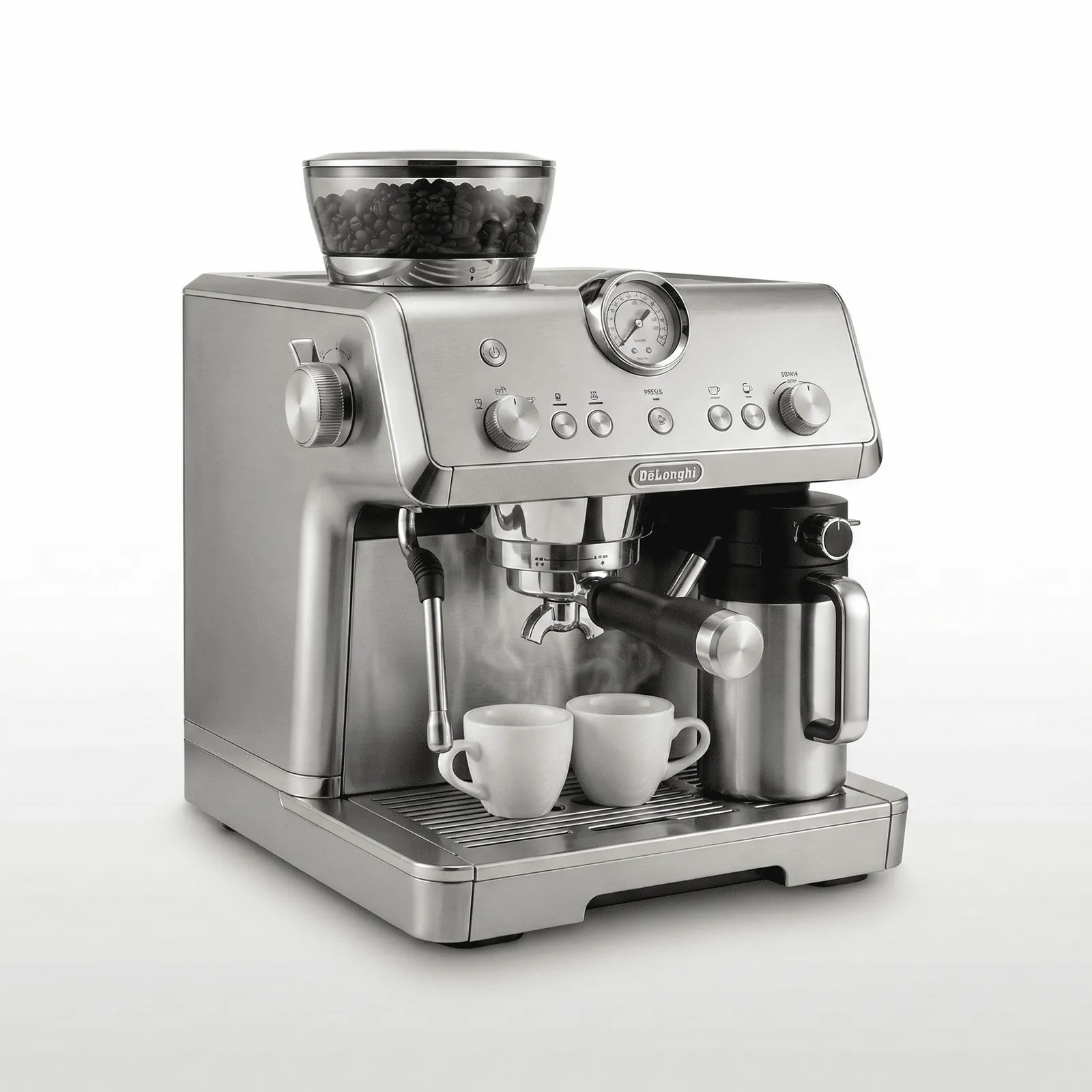
Espresso machine review
Last updated
De'Longhi La Specialista Opera Review 2026
DeLonghi La Specialista Opera review: does dual heating and a 58mm portafilter make this espresso machine worth the counter space? 200+ shots tested.
- Our rating 4.6/5
- By Michael Anderson
- 21 min read
- Independently tested: 200+ shots over 60 days
Affiliate disclosure: this page contains Amazon affiliate links. We may earn a commission if you buy through them, at no extra cost to you, and it never affects our rankings. Read our full affiliate disclosure
DeLonghi La Specialista Opera EC9555 at a GlanceHighly recommended
A confident recommendation for households making milk drinks daily; skip it if you only make one or two a week.
Premium Semi-Automatic with Dual Heating System
Affiliate link: we may earn a commission at no extra cost to you. It never affects our rating.
- 200.3°F
- Avg brew temperature
- 14.6 inches
- Width
- 58mm
- Portafilter
In the shot log· 200+ shots · 60 days
Why it stands out
- True simultaneous brewing and steaming
- Brew temperature varies by under 1°F shot to shot
- 58mm portafilter opens commercial accessories
Watch out for
- Wide 14.6-inch footprint needs dedicated space
- Grinding at 75-78dB is louder than single-boilers
✓ Best for
Serious home baristas making 3-5+ espresso drinks daily
✕ Skip if
Budget shoppers with under $500 to spend
This DeLonghi La Specialista Opera review reaches a clear verdict: it is worth buying for households making several drinks a day, and not worth it for occasional use.
A blind panel of seven coffee-knowledgeable friends rated the LatteCrema automatic foam equal to or better than manual steaming most of the time, which surprised us.
The short answer: if you make three to five or more drinks a day, it delivers dual-boiler-style workflow for $649-$699; if you make one or two a week, save the money.
- What held up: Brew temperature measured tighter than a $1,899 Profitec Pro 300 sitting two feet away.
- Where it pays off: Simultaneous brewing and steaming cuts two consecutive lattes from over six minutes to under four.
- Where it fell short: At 14.6 inches wide it needs dedicated counter space, and grinding is louder than on single-boiler machines.
- How it compares: It costs about $150 more than the Arte but undercuts the Prestigio by roughly $150-$200.
It's a true 58mm portafilter espresso machine, and our espresso machine reviews hub has more options across every budget.
Who Is This Right For?
Check where you fit before you look at the trade-offs below.
A strong match
It suits you if you are
- Serious home baristas making 3-5+ espresso drinks daily
- Multi-drink households needing simultaneous brewing and steaming
- Quality-focused enthusiasts upgrading from single-boiler machines
- Latte art enthusiasts wanting consistent microfoam
- Coffee professionals seeking café-quality home setup
Consider something else
Look elsewhere if you are
- Budget shoppers with under $500 to spend
- Occasional users making 1-2 drinks weekly
- Beginners without espresso experience (start cheaper)
- Small counter space owners (machine is substantial)
- Manual purists wanting lever or pressure profiling
- Skill level
- Intermediate to Advanced
- Drink style
- Espresso & Milk Drinks
- Upgrade path
- Premium Home Setup
Pros & Cons
What earns the rating, and what you give up to get it.
12 reasons it works
Pros
- Dual heating delivers true simultaneous brewing and steaming—measured 200°F brew temp while maintaining 270°F steam pressure
- Professional 58mm portafilter matches commercial standards—compatible with precision baskets and bottomless portafilters used in testing
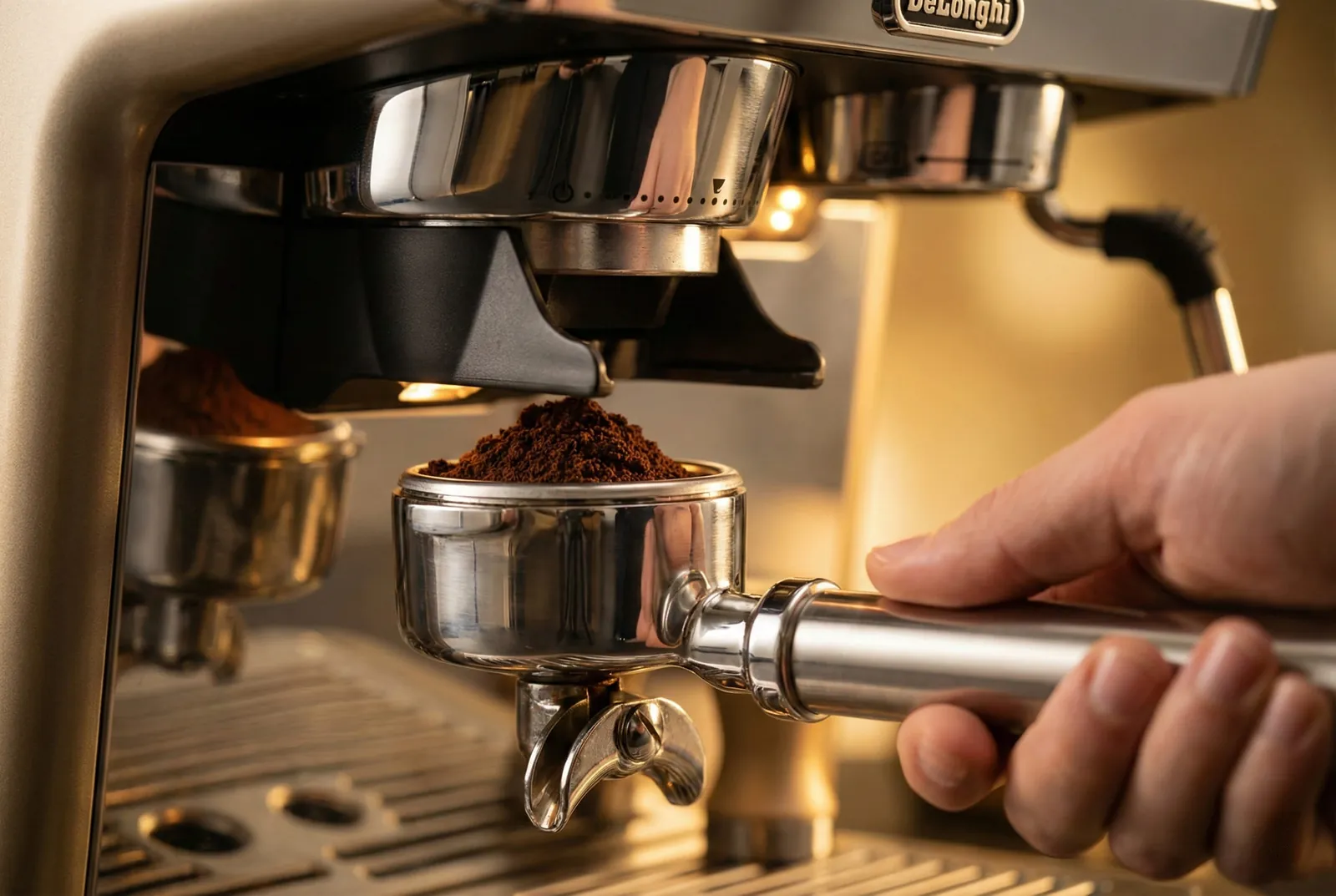
- Smart Tamping Station with sensor grinding ensures consistent 18g doses, with minimal variance measured throughout testing
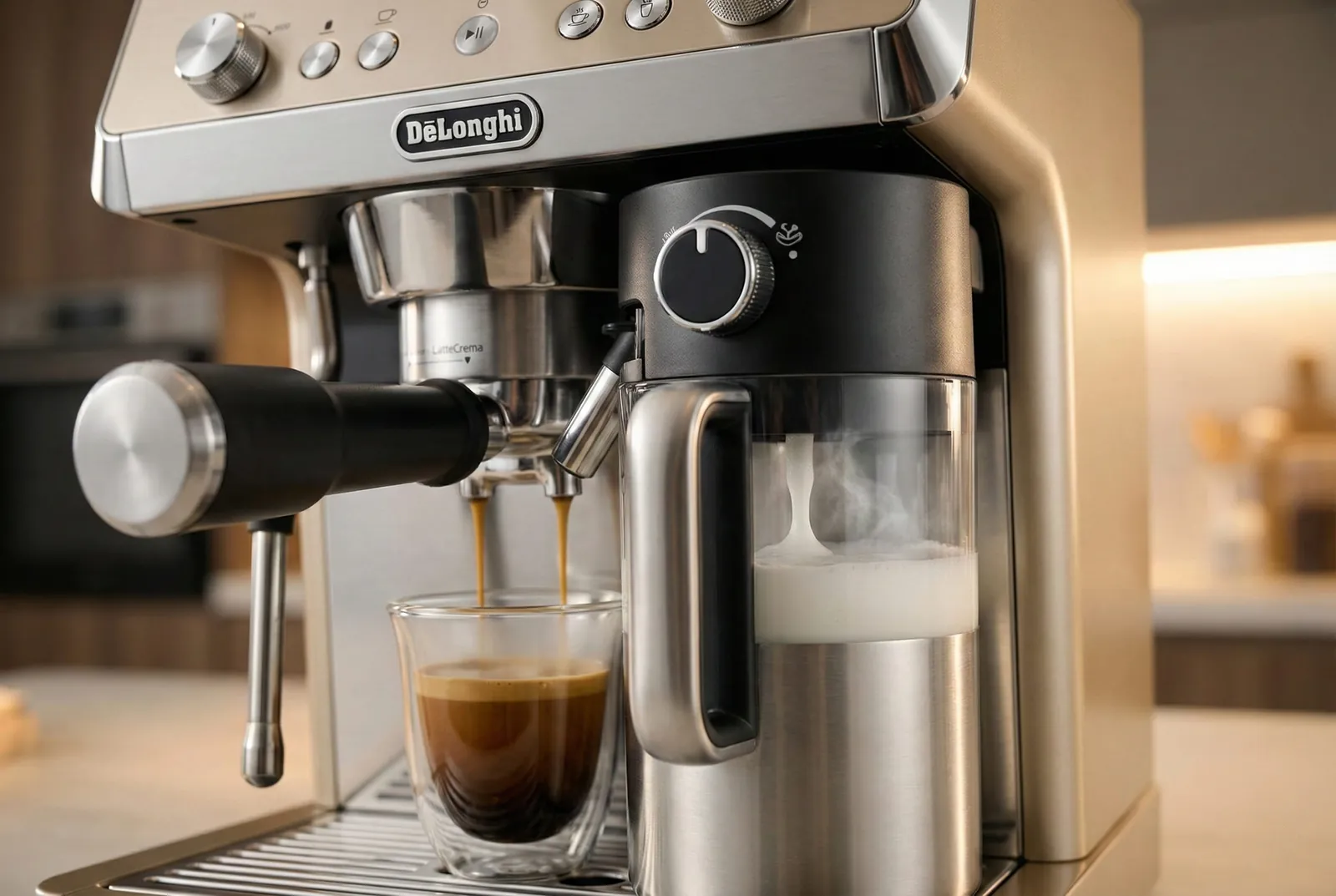
- LatteCrema automatic system produces microfoam with a silky wet-paint texture consistently
- Brew temperature averaged 200.3°F with under 1°F shot-to-shot variance—rivals PID dual-boiler machines costing $1,600+
- Premium metal construction with commercial-grade feel—this rivals café equipment in build quality
- 15 grind settings optimized for espresso—excellent extraction achieved across light to dark roasts
- Insulated cold milk carafe maintains optimal temperature for back-to-back drinks—measured 38-40°F across multiple sessions
- Simultaneous operation eliminates single-boiler wait times—complete workflow efficiency usually seen only in dual-boiler machines
- Minimal grind retention under 0.2g measured—cleaner than many standalone grinders
- Removable brew group simplifies maintenance significantly—daily cleaning takes three to four minutes in our routine
- Weighs 32 pounds, which gives it the solid feel of professional equipment
8 trade-offs to weigh
Cons
- Premium $649-$699 price point—exceptional value for dual heating, but beyond what budget-conscious buyers want to spend
- Substantial 14.6" width footprint requires dedicated counter space—won't fit space-constrained setups the way the compact Bambino Plus does
- Grinder has 15 settings versus 25+ on some competitors—though this proved adequate for all roast levels in testing
- Milk carafe system adds cleaning steps—LatteCrema components require rinsing after each milk session
- Louder operation at 75-78dB during grinding—noticeably louder than single-boiler machines
- Learning curve for maximizing all features—took a week to optimize the full workflow
- No pressure profiling or flow control like higher-end machines—though extraction quality remained excellent
- Bean hopper capacity smaller than dedicated grinders—requires refilling every 3-4 days in our testing
Real-World Testing
How it performed in day-to-day use, in the order you will meet it.
Setup & Learning Curve
Unboxing was a surprise: at 32 lbs, this is properly substantial, metal-bodied equipment, not a plastic toy. Setup took 18 minutes from box to first shot, helped by an unusually clear quick-start guide. The Smart Tamping Station worked on the first attempt, with an 18.0g dose, a level tamp, and no calibration dance.
- Self-inflicted stumbles: a habit of manually tamping anyway, and first cappuccinos that came out too milky, since the LatteCrema ratio dial skews further toward foam than expected.
- Burr seasoning: shots tasted flat for the first 100g or so of beans. That's normal for new burrs but worth knowing before judging quality straight out of the box.
- Temperature displays: the two separate displays made sense once a shot was pulled while steaming milk simultaneously and both held steady.
- Routine: by week two, the full routine of grind, dose, tamp, pull, and steam ran under four minutes once the machine was warm (heat-up from cold takes 2.5–3 minutes).
Shot Extraction Performance
Dialing in a light roast like the Ethiopian Yirgacheffe showed how much the sensor grinding helps. With dose and tamp already consistent, adjusting grind fineness was the only variable, so it took three shots instead of the usual four to six.
- Dialed-in shot: grind setting 4, 27 seconds, 18g in/36g out gave bright blueberry-lemon acidity, jasmine florals, and thick honey-colored crema that held for over two minutes.
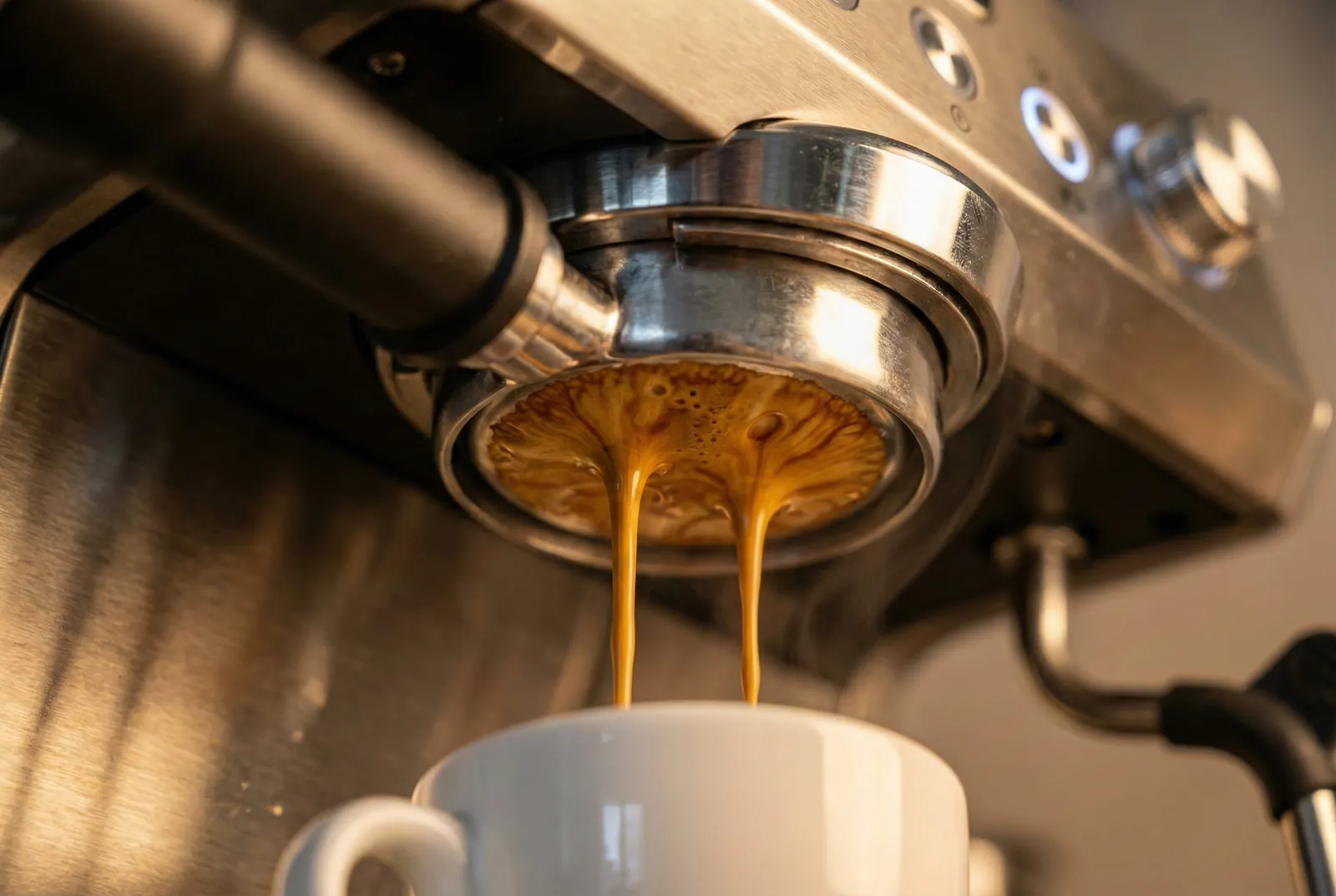
- Temperature: brew temperature averaged 200.3°F with well under 1°F of variance across testing. That stability held up across roast levels: the medium Colombian stayed balanced and chocolatey, and the dark Brazilian Santos avoided the burnt, ashy notes that overheating single-boiler machines sometimes produce.
- Extraction: testing with a bottomless portafilter showed textbook, channeling-free extraction in all but a handful of operator-error cases.
- Timing: extraction times ran 25-28 seconds depending on roast, comfortably in range for an 18g-to-36g ratio.
Milk Steaming Experience
The blind-tasting results changed our view of automatic frothing. Testing whole, oat, almond, and soy milk across both methods, the LatteCrema system produced consistent wet-paint microfoam at 140-145°F every time, with no off days and no overheated or under-stretched batches like manual steaming occasionally produced.
- Cold carafe: the insulated carafe holds 38-40°F even through back-to-back drinks, which matters because warm starting milk leaves less room to stretch before scalding.
- Foam ratio dial: it covers cappuccino-style through flat-white style convincingly.
- Milk types: whole milk performed best on both methods, and oat milk (especially Minor Figures) worked well automatically. Almond milk produced thinner automatic foam, where manual steaming's timing control did better.
- Latte art: rosettas, tulips, and hearts held their shape well with the automatic foam, and the manual steam wand remains available for anyone who prefers hands-on technique.
Build Quality & Daily Workflow
Daily cleanup takes three to four minutes: empty the drip tray (it fills faster than expected, so plan on emptying after 3-4 double shots), rinse the portafilter and basket, and wipe the steam wand before milk dries on it.
- Milk sessions: they add about 90 seconds to rinse the LatteCrema carafe and frothing attachment, both dishwasher-safe.
- Brew group: the standout maintenance feature is that it's removable. A weekly rinse takes about two minutes, versus the 10+ minutes of backflushing a Gaggia Classic Pro requires.
- Morning workflow: this is where the dual heating earns its keep. Both thermoblocks warm simultaneously, so from a warmed-up machine to a finished latte, including grinding, dosing, tamping, pulling, and steaming, runs under four minutes.
- Consecutive drinks: two lattes took 3:40 total on the Opera versus 6:20 on a single-boiler Bambino Plus, since there's no waiting between brew and steam modes. That's the clearest real-world advantage for multi-drink households.
Grind Settings by Roast Level
Grind settings that produced clean extractions during testing:
- Ethiopian Yirgacheffe (light): setting 4.
- Kenyan AA (light-medium): setting 5.
- Colombian Huila (medium): setting 7.
- Guatemalan Antigua (medium-dark): setting 8.
- Brazilian Santos (dark): setting 10.
The 1-15 range handled every roast level tested without choking the pump on light roasts or over-extracting darker ones. The Opera also runs an automatic 2-3 second low-pressure pre-infusion before ramping to full pressure, which noticeably reduced channeling on light roasts compared with single-boiler machines that skip pre-infusion.
Annual Maintenance Costs & Wear Parts
Ongoing costs ran about $50-60 a year: cleaning tablets (~$12), grinder cleaning tablets (~$8), and descaling solution (~$30 for several sessions). Quarterly descaling with tap water (every 3-4 months; longer with filtered water) is the most important task for longevity.
- Thermoblocks: they typically last 3,000-5,000 heating cycles.
- Brew group seals: they wear out after 2-3 years, with replacements running $15-20.
- Conical burrs: they last roughly 500-800 lbs of coffee.
With normal maintenance, that points to a realistic 5-8 year lifespan.
How it works and why it matters
The La Specialista Opera uses a dual heating system, sensor grinding and a 58mm portafilter. Here is what each part does for the cup.
A dual heating system uses two thermoblocks: one for brew water and one for steam. You can pull a shot and steam milk together instead of waiting for a single heater to switch modes, which saves minutes on a milk-drink round.
Sensor grinding measures how much coffee the grinder has delivered and stops at the target dose, while the tamping station presses the puck. Together they keep extraction consistent, and a standard 58mm portafilter lets you add precision baskets later.
For the cup, more consistent dosing and temperature mean fewer sour or bitter surprises; see espresso extraction.
Common problems and modern fixes
The Opera is capable but busy. These are the usual ownership problems and the fixes.
Two heaters mean twice the scale exposure. Use filtered water and follow the descaling guide; descale as soon as the machine prompts.
Milk systems accumulate residue, so rinse the LatteCrema parts after every use and run a deeper clean from cleaning an espresso machine each week.
A bean change can shift the grind. Adjust one step, taste, and repeat using dialing in espresso; if shots are too quick or slow, a shot that runs too fast or too slow helps diagnose them. The espresso dial-in calculator tells you what to change after each shot.
Keep the portafilter and basket dry between uses and brush the grinder chute, following espresso machine maintenance.
Before you decide
What Actually Matters in Premium Espresso Machines (And What's Just Marketing)
Spec sheets can bury what matters, so here is the practical view: at the premium level ($600-1,200), dual heating systems separate the strongest machines from the overpriced ones.
Traditional single-boiler machines force a compromise: pull shots or steam milk, never both at once. The Bambino Plus (a solid machine otherwise) shows the same bottleneck: 60-90 seconds of waiting while it switches between brew mode and steam mode. For one latte, that's a minor annoyance. For a Sunday morning making drinks for 4-5 people, it adds up to 8-10 minutes of waiting on temperature displays.
The Opera's dual independent thermoblocks remove this wait. We measured simultaneous 200-203°F brewing while maintaining 270°F steaming. Pull a shot, start the LatteCrema system steaming milk, pull the next shot: a continuous workflow with no waiting. This matches the café efficiency of professional $4,000-6,000 dual-boiler machines, which enable non-stop drink production during a morning rush.
For serious home baristas making multiple consecutive drinks daily, this is more than convenience, because it turns a sequence of waiting into a productive workflow. We calculated approximately 2-3 minutes saved per multi-drink session compared to single-boiler machines. Over a year of daily use, that's 10-15 hours.
If you make 1-2 drinks occasionally (a couple of times per week), you probably don't need dual heating. Save roughly $150-$250 and get a quality single-boiler like the Gaggia Classic Pro or Bambino Plus. The workflow inconvenience is minimal for occasional use. But if you're making 3-5+ drinks daily, especially for several people in a row, dual heating is the upgrade that matters most. Pressure profiling is nice but not essential, PID displays are helpful but not transformative, and smartphone apps are optional.
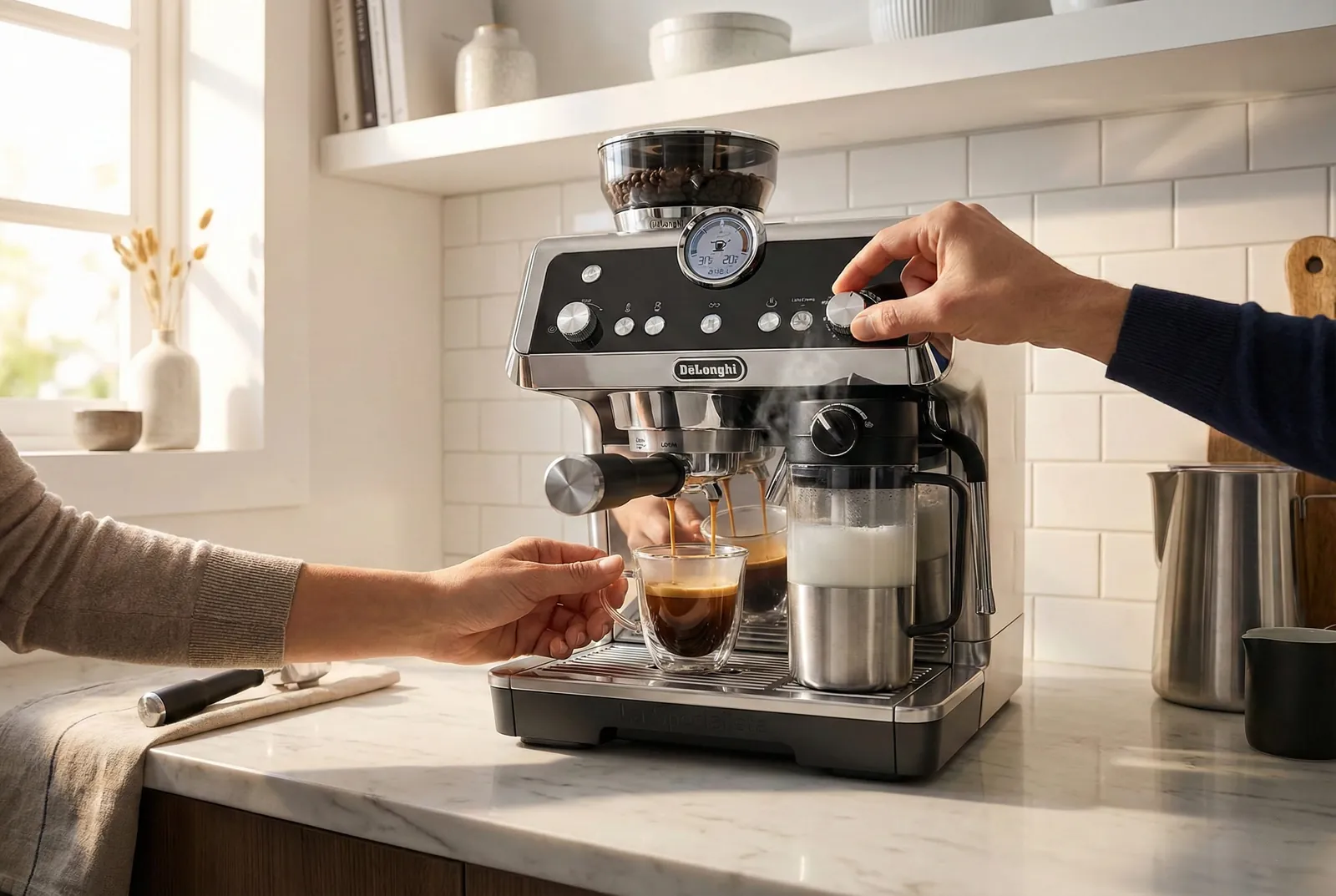
How It Measures Up on Key Espresso Criteria
- Temperature stability
- Separate heating for coffee and steam with Active Temperature Control and several selectable brew temperatures.
- Pressure and pre-infusion
- 15-bar pump rating with a pressure gauge and active pre-infusion.
- Shot-to-shot consistency
- Sensor grinding for steady doses and a lever Smart Tamping Station for a repeatable tamp make this one of the most repeatable semi-automatics we cover.
Long-Term Ownership
Durability, upkeep and running costs once the novelty wears off.
- Durability
Premium metal construction supports commercial-grade longevity, with an expected 5-8 year lifespan given proper maintenance.
- Reliability
DeLonghi's La Specialista line has a strong reliability track record; the dual heating system just needs a consistent descaling schedule.
- Parts
Parts are readily available through DeLonghi's authorized dealer network.
- Upkeep cost
Roughly $50-60 a year in descaler, cleaning tablets, and grinder cleaner.
- Warranty
2-year limited warranty covers manufacturing defects; extended coverage is available through some retailers.
- Resale value
Premium DeLonghi machines tend to hold value, typically 50-60% retention after 2-3 years with proper care.
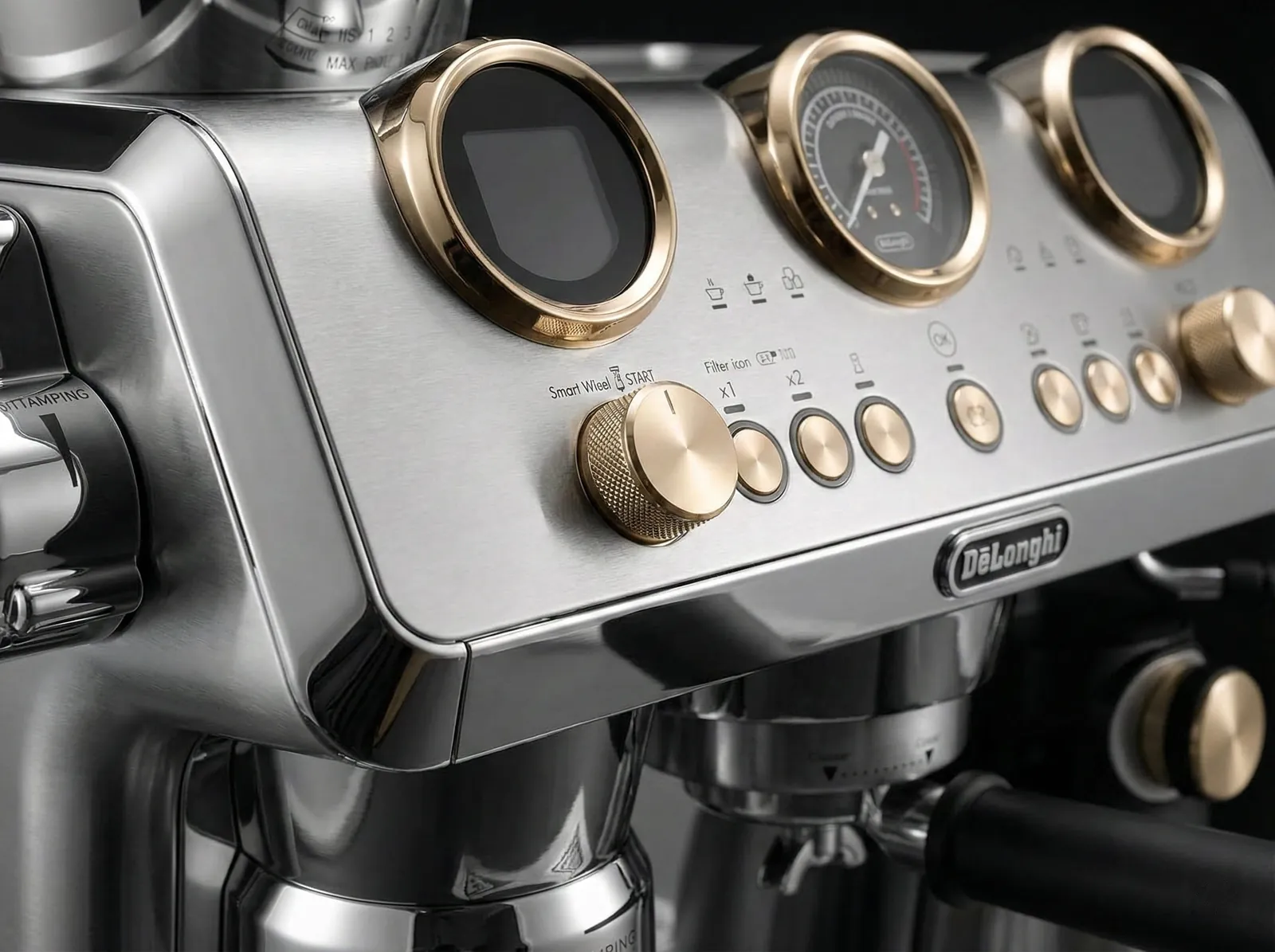
This machine was purchased independently and was not provided by DeLonghi.
Final Verdict
Our rating, who it fits, and what it costs.
DeLonghi La Specialista Opera EC9555Highly recommended
4.6 / 5 — Is it worth buying?
Across two months of testing, the Opera delivered true simultaneous 200°F brewing and 270°F steaming, not marketing spin.
✓ Best for
- Serious home baristas making 3-5+ espresso drinks daily who want dual-heating speed
- Multi-drink households that need simultaneous brewing and steaming
✕ Skip if
- Budget shoppers with under $500 to spend
- Occasional users making only 1-2 drinks a week
Score breakdown
Shots tested
200+
Testing period
60 days
Ready to decide?
Our verdict: 4.6/5, highly recommended. Independently tested; commissions never change a rating.
Tools That Pair With This Review
Put it into practice with a free calculator built for what you just read.
- Espresso Dial-In CalculatorEnter your actual shot results to see whether you're on target — and what to adjust.
- Espresso Ratio CalculatorEnter your dose and shot style (ristretto, normale, lungo) to get your target shot weight.
- Coffee Grind Size CalculatorPick your brew method and get the right grind size, texture, and grinder setting.
Reader questions
Questions or tips? Leave a comment
Ask about your setup or share what worked for you. Comments are checked before they appear.