

Pick this if you are upgrading from a blade grinder
OXO Brew Conical Burr Coffee Grinder
A budget conical burr grinder that gives the even coarse grind a French press needs.
Brewing Guides
Last updated
How to use a French press: the coffee to water ratio, coarse grind, 4-minute steep and how to avoid bitter, muddy coffee.
Affiliate disclosure: this page contains Amazon affiliate links. We may earn a commission if you buy through them, at no extra cost to you, and it never affects our rankings. Read our full affiliate disclosure
Use about 1 g of coarse-ground coffee for every 13.5 g of water (roughly 74 g for a full 34 oz press), pour water just off the boil, stir, steep 4 minutes, then press slowly and pour everything out at once. Most bitter or muddy cups come from a grind that is too fine, not from the ratio.
A press, coarse coffee, hot water and a way to measure.
| Item | Why it matters |
|---|---|
| French press (any size) | Glass, stainless or ceramic all brew the same; insulated presses hold heat better |
| Medium or dark roast beans | Full immersion suits rounder roasts; Peet's Dark Roast is one that shines here, and the light vs dark roast chart explains why |
| Coarse-ground coffee | Coarse, even grounds stay behind the mesh and extract evenly over 4 minutes |
| Burr grinder | Blade grinders make dust that slips through the filter and turns the cup muddy |
| Kitchen scale | Scoops vary a lot by roast and grind; grams make every pot repeatable |
| Kettle and timer | Water just off the boil and a 4-minute steep are the two settings that matter most |
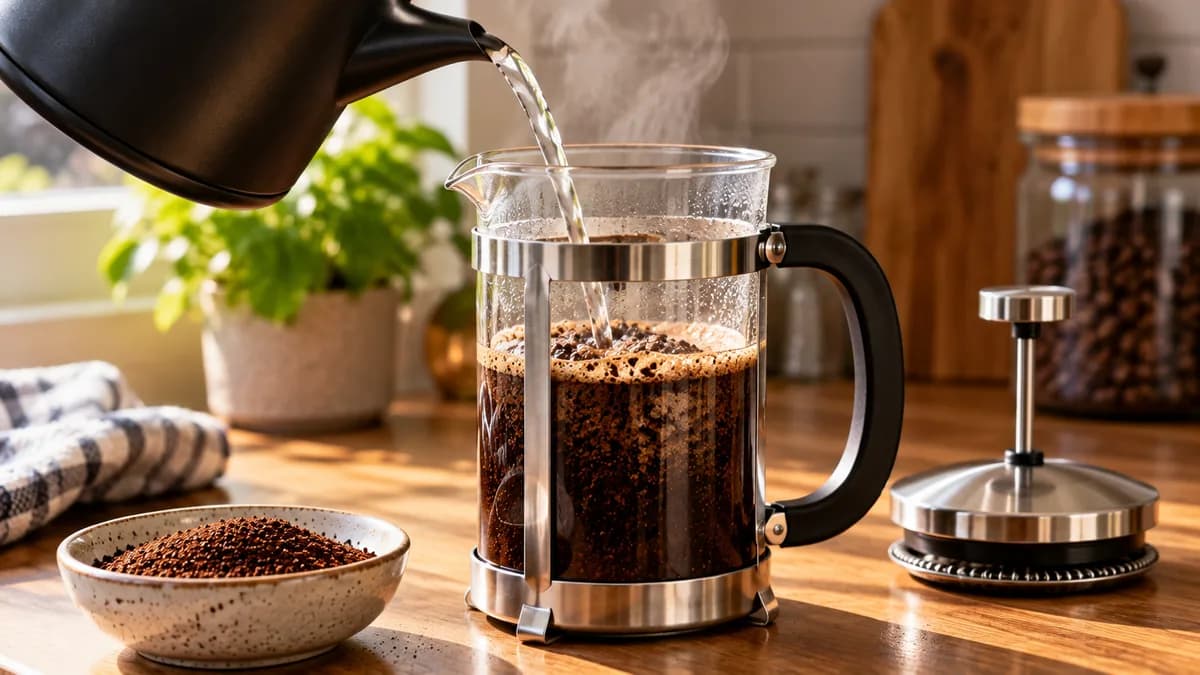
Eight steps from a cold kettle to an empty press.
Heat the water. To just off the boil, about 200°F (93°C). Let boiling water sit 30 seconds if you have no thermometer.30 seconds
Preheat the press. With a splash of hot water, swirl and pour it out. A cold carafe drops the brew temperature fast.
Weigh and grind. The coffee coarse, like sea salt. Use 1 g of coffee per 13.5 g of water as a starting point.
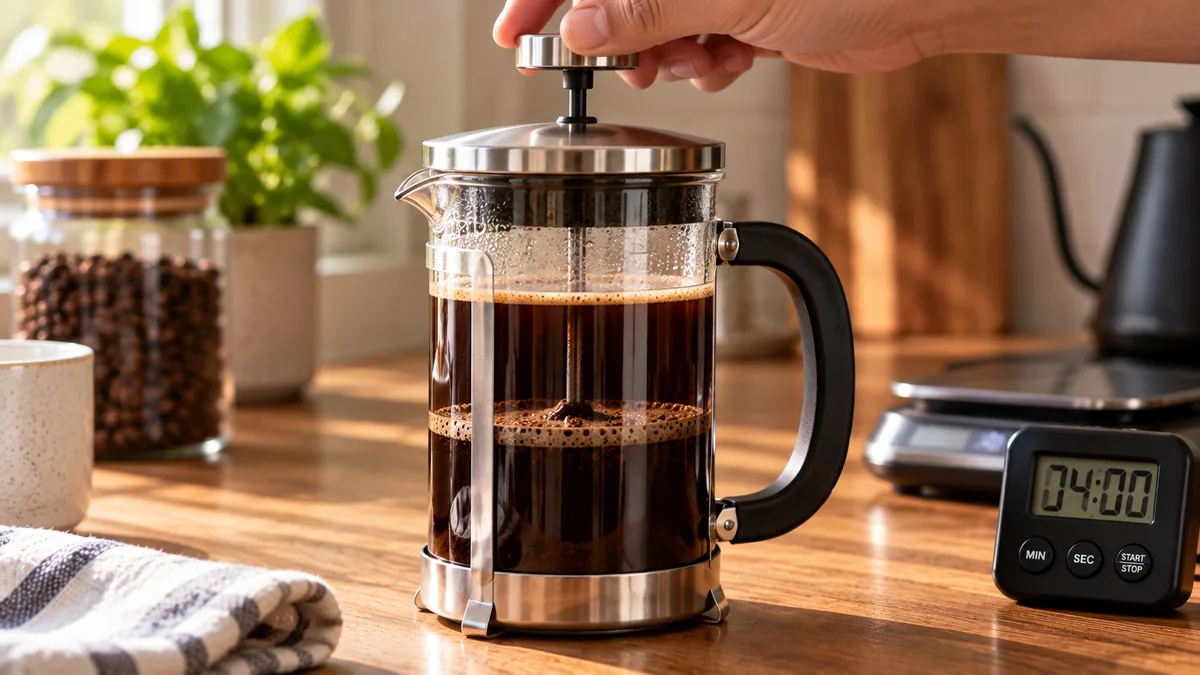
Add the grounds. To the empty press and start a 4-minute timer.
Pour all the water. In steadily, wetting every ground, then give the slurry a gentle stir.
Put the lid on. With the plunger raised and leave it to steep for 4 minutes.4 minutes
Press slowly. , taking about 15 to 20 seconds. If it resists hard, the grind is too fine; stop and ease off.20 seconds
Pour everything out. Straight away into cups or a carafe. Coffee left on the grounds keeps extracting and turns bitter.
Want the exact grams and millilitres for your press? Our French press ratio calculator works it out for every common size and strength.
Coffee and water for common press sizes at a 1:13.5 ratio.
| Press size | Water | Coffee |
|---|---|---|
| 12 oz (single mug) | 350 ml | 26 g |
| 17 oz (2 mugs) | 500 ml | 37 g |
| 34 oz (8-cup) | 1,000 ml | 74 g |
| 51 oz (12-cup) | 1,500 ml | 111 g |
12 oz (single mug)
17 oz (2 mugs)
34 oz (8-cup)
51 oz (12-cup)
Press sizes are sold in “cups” of about 4 oz, so an 8-cup press makes roughly two to three normal mugs, not eight. Fill it to just below the spout and work from the water you actually pour.
A ratio between 1:12 and 1:15 suits most people. Start at 1:13.5, then move toward 1:12 for a bolder cup or 1:15 if it feels heavy. Change the ratio for strength; change the grind for bitterness or sourness.
Full immersion and a metal mesh filter, not a stronger ratio, explain the texture.
A French press is an immersion brewer. All the water sits with all the coffee for the whole steep, so extraction is even and predictable as long as the grind is consistent. Drip and pour over work differently: water passes through the bed once, and a paper filter traps oils and the finest particles.
The metal mesh lets coffee oils and some very fine particles through. That is where the heavy body and rounder mouthfeel come from, and also why a French press cup can taste muddy if the grind produces a lot of dust. If you prefer a cleaner, brighter cup, compare the methods in drip vs pour over.
Because the coffee is fully immersed, time does the work that pouring technique does in pour over. That makes the French press one of the most forgiving brewers: get the grind, ratio and steep time roughly right and it produces the same cup every morning.
A few small changes give a cleaner, sweeter cup without new gear.
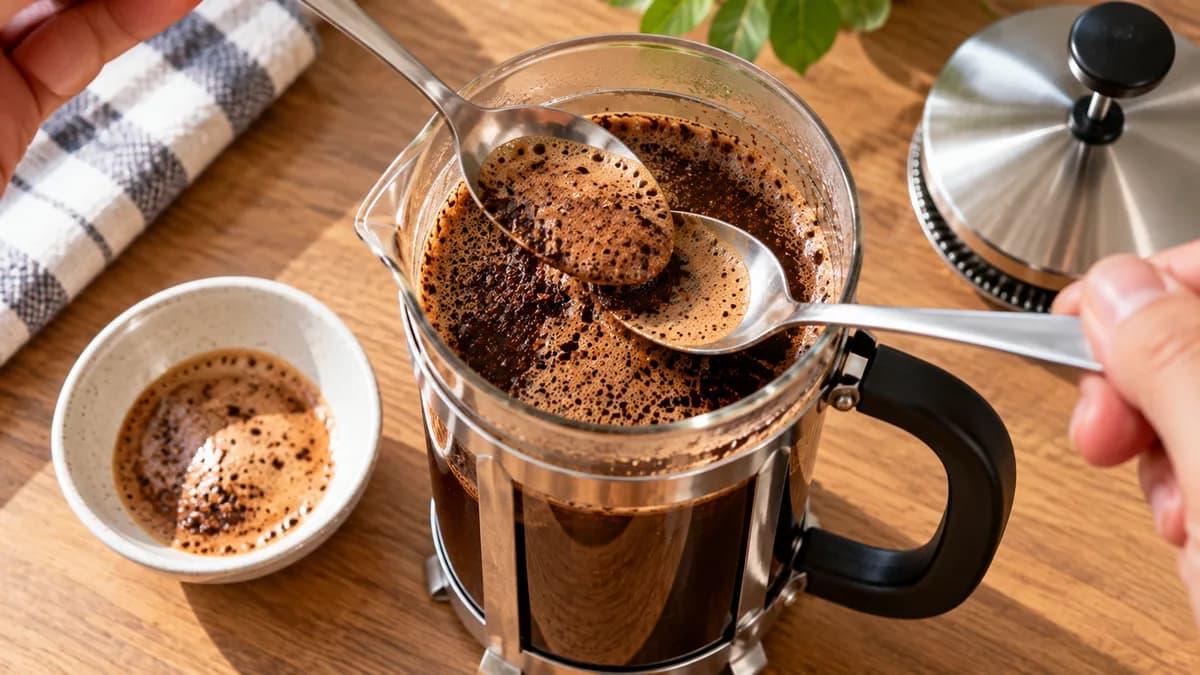
These steps add time, not cost. If you only change one thing, make it the longer settle before pouring.
Coarse and even, with starting settings for popular grinders.
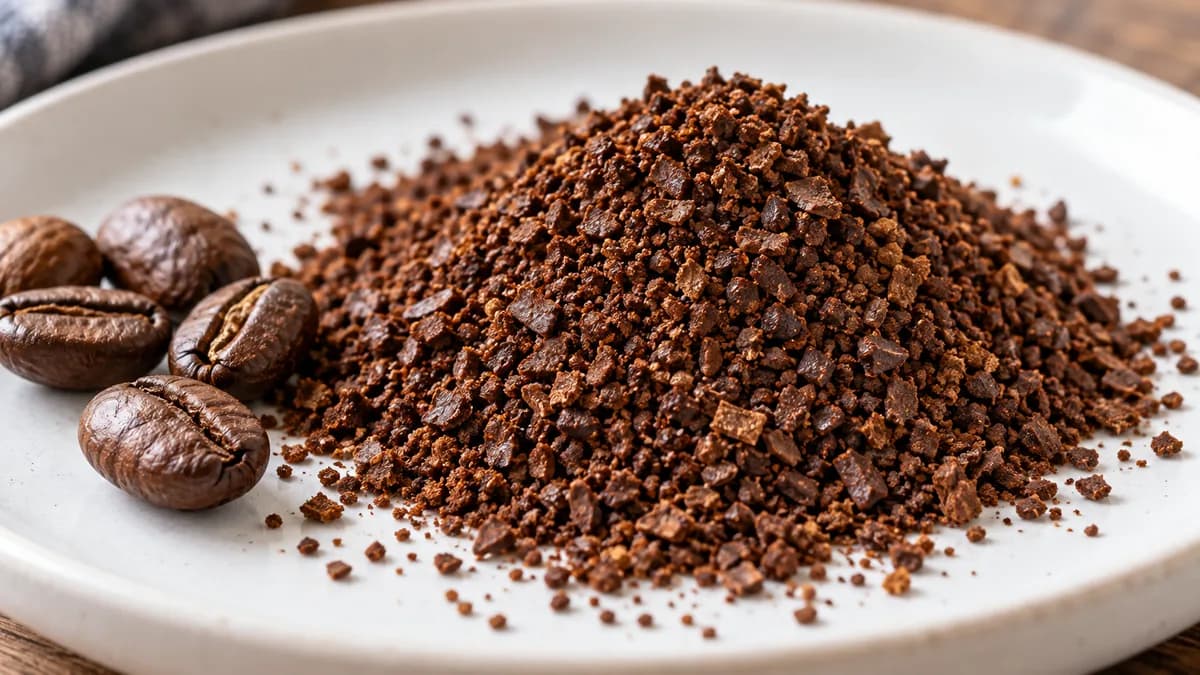
Aim for a coarse grind with pieces about the size of sea salt or breadcrumbs. Too fine and the plunger sticks, the cup turns bitter and sediment fills the bottom. Too coarse and the coffee tastes thin and sour even at a strong ratio. Our coffee grind size chart shows how French press compares with every other method.
| Grinder | Starting point for French press |
|---|---|
| Comandante C40 | About 30 clicks from zero |
| Baratza Virtuoso+ | Upper end of its 20–38 filter range |
| KRUPS Precision | Settings 10–11 |
| Blade grinder | Pulse briefly and shake; expect more sediment |
Owners of hand grinders can find full charts in our Comandante C40 grind settings guide. Adjust one step at a time: coarser if bitter, finer if sour or weak.
Pick this if you are upgrading from a blade grinder
A budget conical burr grinder that gives the even coarse grind a French press needs.
Pick this if you brew filter coffee every day
A filter-first electric grinder with a timer and a large hopper for household batches.
Pick this if you want a premium hand grinder
A precise hand grinder that covers French press through pour over, and travels well.
Affiliate links: we may earn a commission at no extra cost to you.
Read the cup, then change one thing.
| Problem | Fix |
|---|---|
| Bitter, harsh | Grind coarser, pour out straight after pressing, and check the water is not at a rolling boil |
| Sour, thin | Grind a little finer, use hotter water, and make sure the full 4 minutes pass |
| Weak but not sour | Use more coffee: move the ratio toward 1:12 |
| Muddy, gritty cup | Burr grind, skim the crust, wait before pressing and leave the last sip |
| Plunger very hard to push | Grind too fine; lift slightly and press more gently |
| Coffee goes cold fast | Preheat the press and mugs, or decant into a thermal carafe |
Still bitter after these fixes? Work through why coffee tastes bitter. Unsure about temperature for your roast? Use the coffee water temperature calculator.
A daily rinse and an occasional strip-down keep old oils out of the cup.
Tip the grounds into the compost or bin rather than the sink, where they can clog drains. Rinse the carafe and plunger with hot water straight after use, before oils dry on.
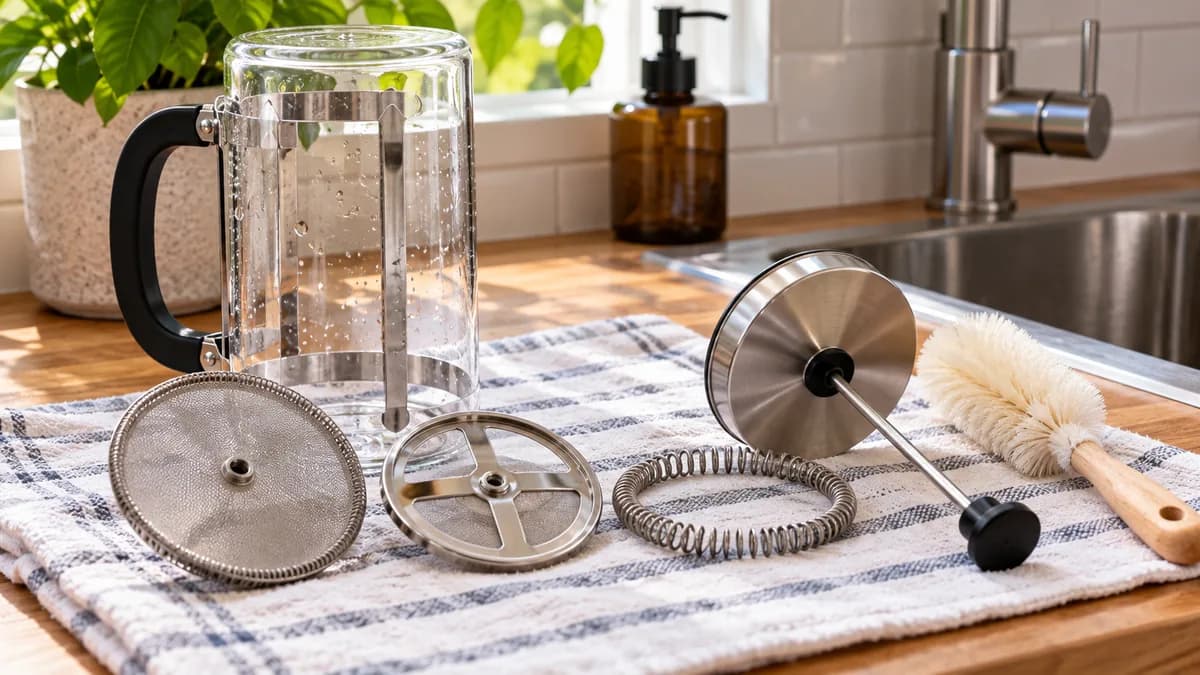
Once a week, unscrew the plunger and separate the mesh, cross plate and spring. Wash them in warm soapy water with a soft brush, rinse well and reassemble with the mesh flat against the edges. A bent or gappy mesh lets grounds through, so replace it if it no longer seals against the glass.
A quick way to decide what to try next.
Quick decision guide
You want a cleaner, brighter cup
Try pour over coffee.
You want hands-off coffee on a timer
See the best drip coffee makers.
You want one quick cup with less sediment
Read our AeroPress Original review.
You want iced coffee in summer
Use your press for cold brew.
Your grounds are uneven or dusty
Compare the best coffee grinders.
Quick answers before you buy.
Yes, once.
A gentle stir after pouring the water wets every ground so the brew extracts evenly.
Stirring again near the end stirs up fines and makes the cup muddier.
No. The grounds keep extracting even after you press, so coffee left in the carafe turns bitter within minutes.
Pour it all into mugs or a thermal carafe straight away.
Usually too little coffee or too coarse a grind.
Weigh the coffee and aim for about 1:13.5, then grind one step finer if it still tastes thin or sour.
Yes, but most pre-ground coffee is ground for drip and is finer than ideal.
Expect more sediment; shorten the steep slightly and leave the last sip in the cup.
About 2 level tablespoons per 8 oz of water, or roughly 15 for a full 34 oz press.
Scoop weight varies with grind and roast, so weigh once to check.
Yes.
Stir coarse coffee into cold water at about 1:8, steep 12 to 18 hours in the fridge, then press and dilute to taste.
See our cold brew guide.
Keep reading: more guides on the same topic.
 Explained
Brewing6 min read
What is pour over coffee? Learn how it works, a starting recipe, grind size and water temperature, and which dripper to buy.
 Compare
Brewing6 min read
Drip vs pour over coffee compared on taste, temperature, effort and cost, with a simple rule for which brewer fits your routine.
 How to
Brewing6 min read
Cold brew recipe: 100 g coarse coffee to 800 ml water, steeped 18 hours, then diluted. Includes fixes for bitter or weak batches.
 Explained
Coffee Education6 min read
What is coffee bloom? CO2 degassing explained, how to bloom with a 2:1 water ratio, and which beans and brew methods benefit most.


Reader questions
Questions or tips? Leave a comment
Ask about your setup or share what worked for you. Comments are checked before they appear.