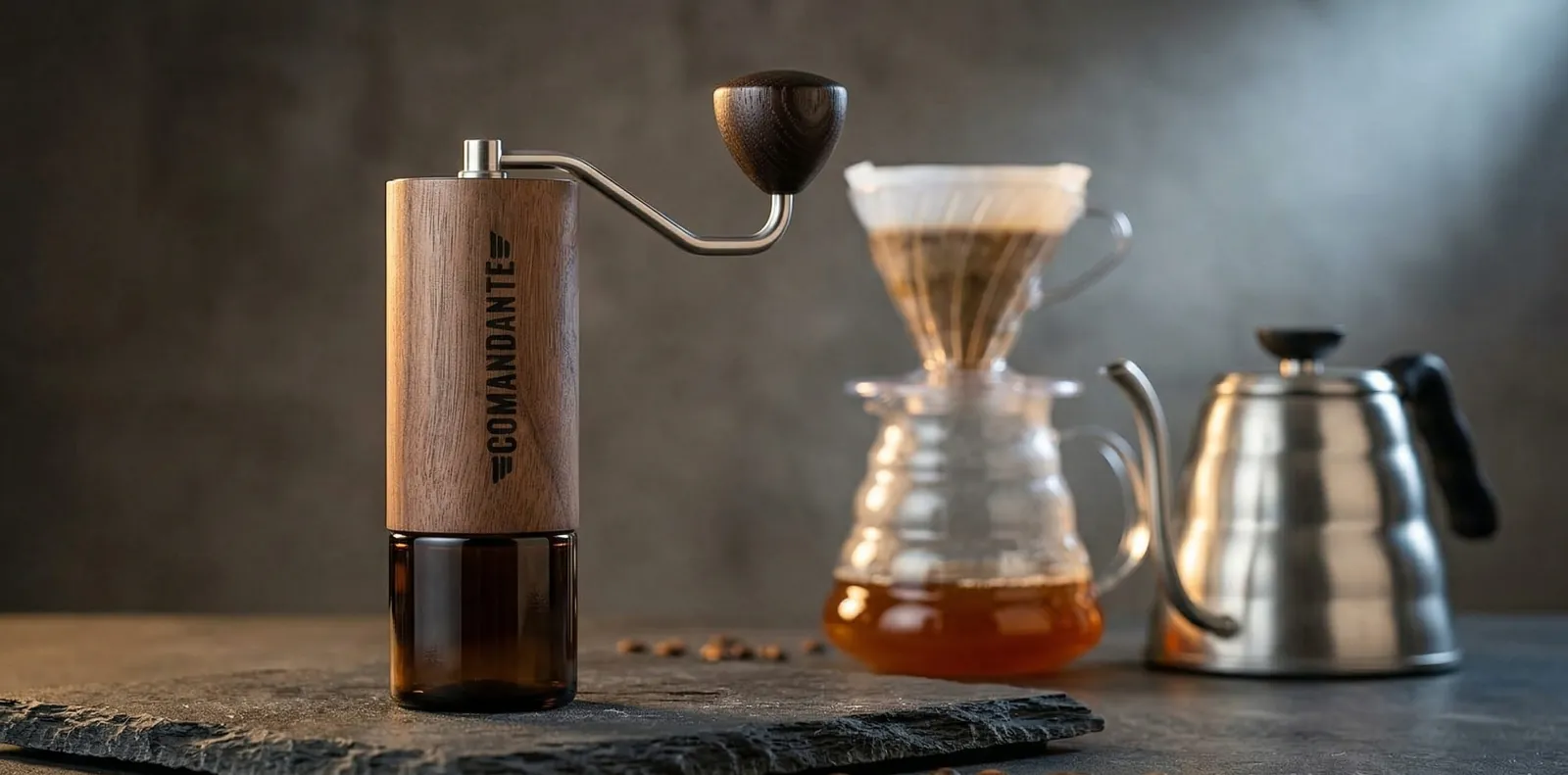
Coffee grinder review
Last updated
Comandante C40 Review 2026: Espresso Workout
Comandante C40 review: a premium hand grinder that excels at filter coffee but makes espresso a workout, tested over 600+ grinds. Is it your best pick?
- Our rating 4.4/5
- By Sarah Chen
- 20 min read
- Independently tested: 600+ grinds over 60 days (daily use)
Affiliate disclosure: this page contains Amazon affiliate links. We may earn a commission if you buy through them, at no extra cost to you, and it never affects our rankings. Learn more
Comandante C40 at a GlanceRecommended
The best hand grinder we've tested for filter clarity, but $299 is hard to justify if espresso is your main drink.
Ultra-Premium Hand Grinder
Affiliate link: we may earn a commission at no extra cost to you. It never affects our rating.
- 39mm conical
- Burr set
- ~30 microns
- Adjustment step
- 75–120 seconds
- 18g espresso grind time
On the grind bench· 600+ grinds · 60 days
Why it stands out
- Nitro Blade burrs showed zero measurable wear
- Pour-over matched a $350–$450 electric flat-burr in blind tests
- Silent, static-free and travel-friendly
Watch out for
- Espresso takes 75–120 seconds of cranking for 18g
- At $299, cheaper grinders deliver most of the performance
✓ Best for
Specialty coffee professionals who travel and refuse to compromise cup quality on the road
✕ Skip if
Daily espresso volume users
This Comandante C40 review starts with a simple verdict: it is a very good hand grinder; the real question is whether it's $299 good, when the Timemore Chestnut C3 costs $99 and handles pour-over brilliantly. After 60 days of testing, the answer turns on how you brew.
The short answer: it's the best hand grinder we've tested for pour-over and filter clarity, and a capable but not ideal choice if espresso is your main drink.
- What held up: The Nitro Blade burrs showed zero detectable drift in grind consistency across the full test period.
- Built for travel: There's no static, no electrical parts, and silent operation suits early mornings and trips.
- Where it fell short: Espresso takes 75–120 seconds of effort for 18g, so it complements an electric grinder.
- Value check: Value-focused buyers get most of the performance from the Timemore C3 or the 1Zpresso JX-Pro.
For broader context, see our manual vs electric grinders guide or our burr grinder buying guide.
Who Is This Right For?
Check where you fit before you look at the trade-offs below.
A strong match
It suits you if you are
- Specialty coffee professionals who travel and refuse to compromise cup quality on the road
- Barista trainers and educators demonstrating premium extraction technique at training events
- Pour-over and filter obsessives where we measured C40 extraction matching electric flat-burr grinders costing $300+
- Long-term investment buyers who want heirloom-quality gear with a 15–20 year service horizon
- Manual grinding practitioners who value the ritual and precision of hand grinding above convenience
Consider something else
Look elsewhere if you are
- Daily espresso volume users — 75–120 sec grind time per 18g dose accumulates quickly; electric grinders are the right tool
- Large household brewing needs — 25–35g capacity limits batch preparation
- Value-focused buyers — the Timemore C3 ($99) or 1Zpresso JX-Pro ($160) offer better performance-per-dollar for most use cases
- Those with arm or wrist mobility limitations — fine espresso settings require sustained cranking effort
- Anyone wanting fastest possible workflow — electric grinders complete the same task in under 15 seconds
- Skill level
- Intermediate to Expert — rewards dialing in the multi-click adjustment for each origin and brew method
- Drink style
- Exceptional for filter and pour-over; capable for espresso but not optimized for espresso-primary workflows
- Upgrade path
- Many serious home baristas pair the C40 with a dedicated electric espresso grinder — best of both worlds for different brew methods
Pros & Cons
What earns the rating, and what you give up to get it.
7 reasons it works
Pros
- Nitro Blade burrs show zero measurable wear across the full test period
- Multi-click system (~30 microns per click) delivers pour-over precision no budget grinder can match
- Filter coffee extraction rivaling $300+ electric flat-burr grinders in blind tests
- German-engineered build quality with projected 15–20 year lifespan
- Zero static, zero electrical components — mechanically bulletproof for travel
- Silent operation — ideal for early mornings, shared spaces, travel
- Heirloom quality; premium materials feel categorically different from grinders under $200
6 trade-offs to weigh
Cons
- $299 price tag — electric alternatives outperform for espresso workflow at this budget
- Espresso grinding requires 75–120 seconds of continuous effort for 18g doses
- No folding handle — slightly less packable than Timemore C3 for travel
- Handle length (shorter than some competitors) reduces leverage for fine espresso settings
- Glass catch jar needs protective wrapping for aggressive travel
- 25–35g capacity limits large batch or multi-cup brewing
Real-World Testing
How it performed in day-to-day use, in the order you will meet it.
Daily Workflow Experience
Daily use throughout the test period included two barista training events. The C40 became the go-to for morning V60 within a week — multi-click precision and zero static made the workflow cleaner than any electric grinder in our kitchen. On rushed mornings we still defaulted to electric for espresso, which tells you who this grinder is really for.
Grind Consistency Notes
Best-in-class for a hand grinder. USB microscope comparisons at weeks 1, 4, and 8 showed no measurable shift in fines percentage or particle clustering across all grinds, including dense light-roast Ethiopians and oily Sumatran dark roasts. Refractometer extraction yields stayed within a 0.8% variance band for identical brew parameters — tighter than any other hand grinder we've tested.
Retention & Static Management
Essentially zero static: grounds fall cleanly into the catch jar with no electrostatic clinging. Retention stayed under 0.2g across all settings and bean types, close to ideal for single-dose workflows.
When pulling espresso rather than filter, a quick WDT stir in the portafilter before tamping still helps distribution, even with grounds this clump-free.
Is the Comandante C40 worth it?
What the premium buys and who gets the benefit
Worth depends on what you value. If your daily coffee is filter or pour-over, you like the ritual of hand grinding, and you want a tool you could still be using in many years, the C40 makes sense. The mechanical design has no motor or electronics to fail, and the burrs are the main wear part.
If you want maximum cup quality per dollar, cheaper hand grinders get you most of the way there. The Timemore Chestnut C3 review is the obvious budget comparison, and our best coffee grinders guide shows where electric options fit at similar money.
What the Comandante C40 specs mean in daily use
Feature, practical impact, who benefits, trade-off
- 39mm conical Nitro Blade burrs: Smaller than some competitors' 48mm sets, but tuned to produce a clean, low-fines filter cup. Pour-over drinkers benefit most. The trade-off is that fine espresso grinding is slower.
- About 30 microns per click: This is coarser than the finest-stepped hand grinders but still very repeatable, so you can write down a number for each brew method. Filter brewers benefit. Espresso users may find the steps coarser than they would like; see the 1Zpresso K-Ultra review for a finer-stepped alternative.
- No motor, no electronics: Silent and static-free, which suits early mornings, shared spaces and travel. The cost is your own effort.
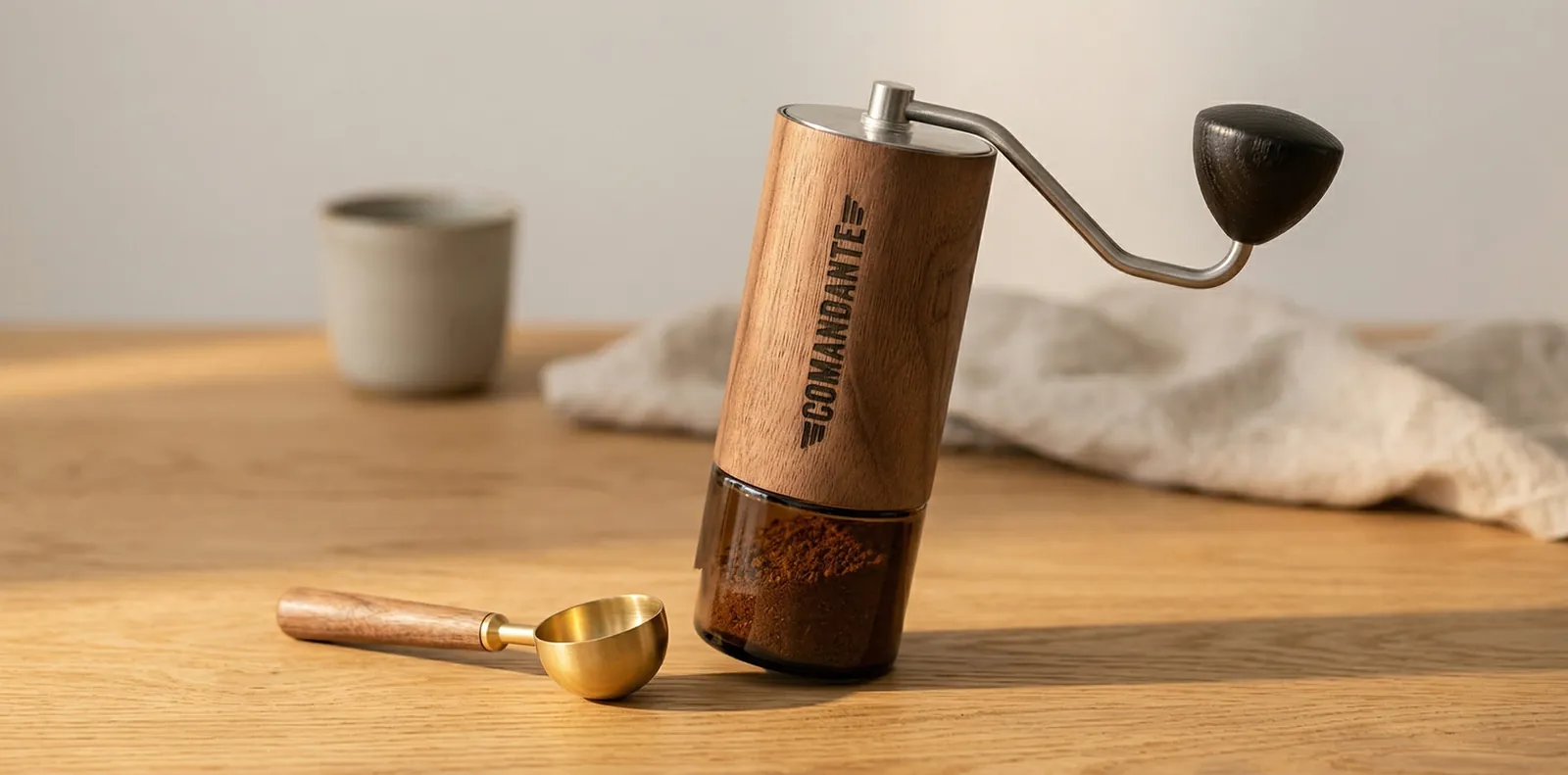
- Glass catch jar and wooden body: Pleasant to use and tough in testing, but the jar needs wrapping for rough travel.
- 25-35g capacity: Enough for one or two cups, not for batches.
Comandante C40 setup, cleaning and care
Keeping the burrs consistent over years
Start by finding your reference click for each brew method and writing it down. Clicks are counted from a fully closed position, so check the manufacturer's instructions on how to set zero before you begin.
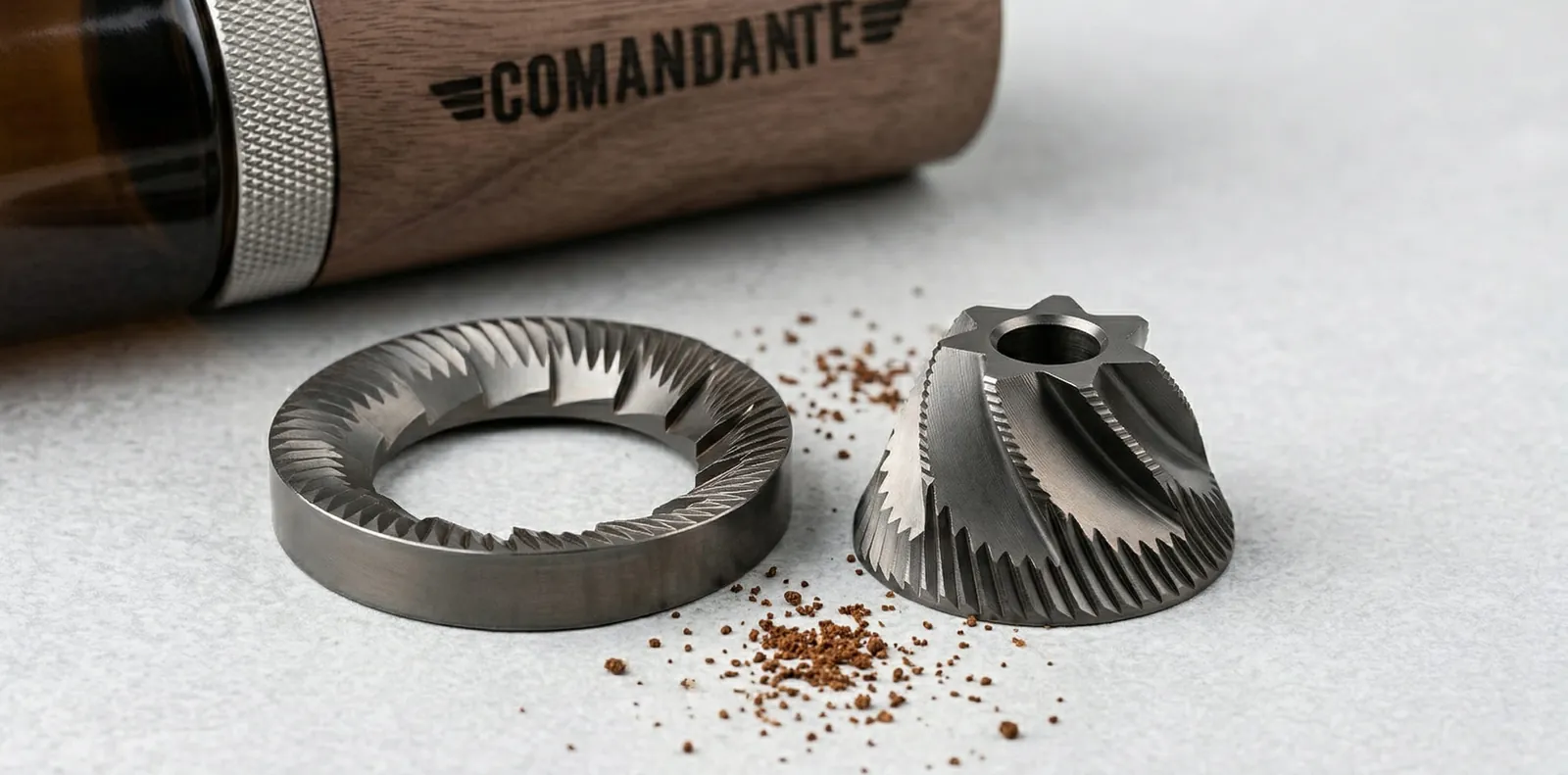
Brush the burr chamber every few weeks and give it a deeper clean every couple of months, as covered in the ownership notes. Avoid water on the burrs, and store the grinder dry.
The glass jar is the part most likely to be damaged by a drop, so a small replacement spare is cheap insurance for frequent travellers.
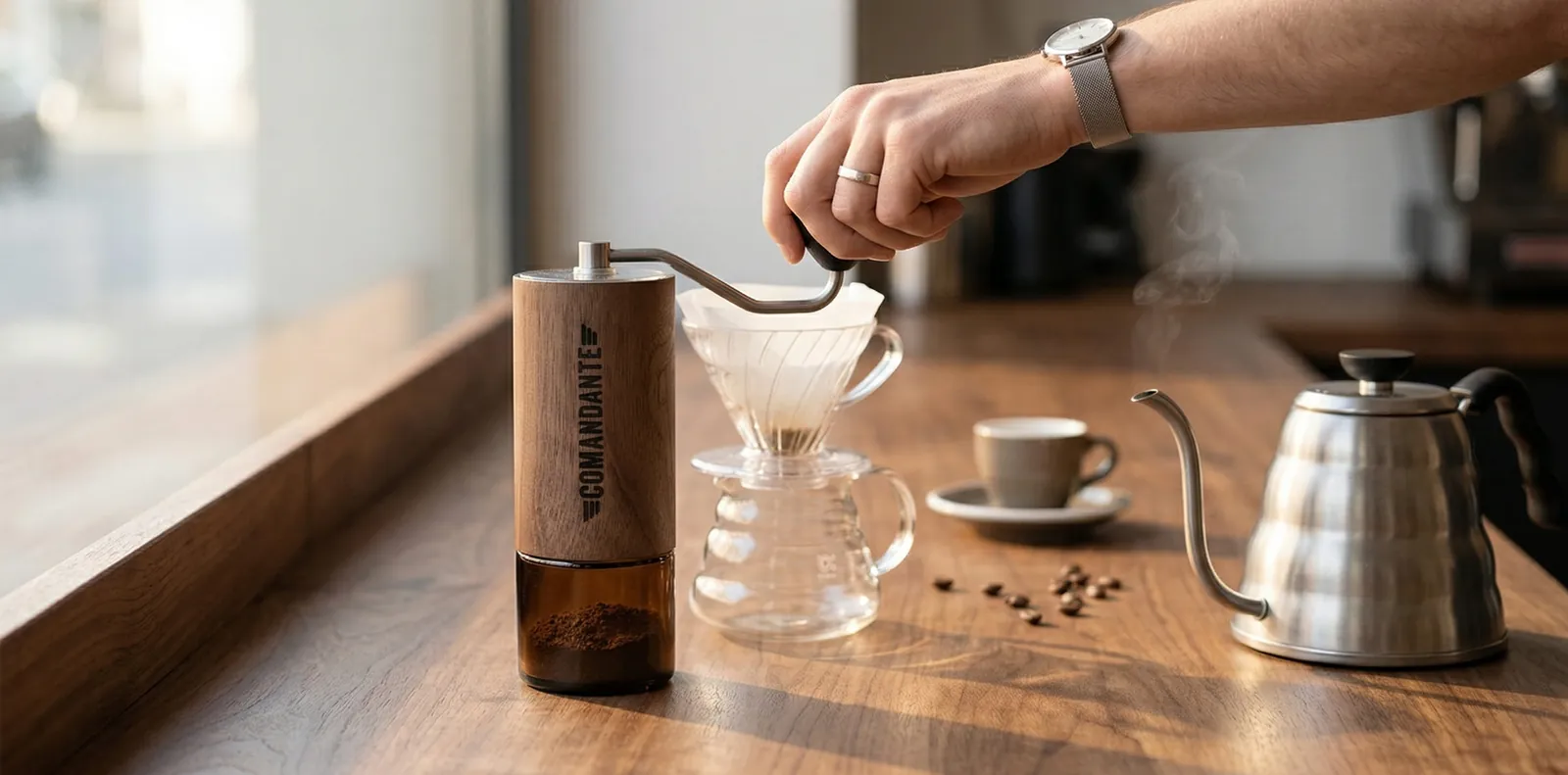
Comandante C40 vs Timemore C3, 1Zpresso K-Ultra and KINGrinder K6
How the premium hand grinders compare
| Grinder | Burr | Capacity | Weight | Current price |
|---|---|---|---|---|
| Comandante C40 | 39mm conical | 25–35g | 510g | Check price |
| Timemore Chestnut C3 | 38mm conical | 20–25g | 420g | Check price |
| 1Zpresso K-Ultra | 48mm conical | 35g | 540g | Check price |
| KINGrinder K6 | 48mm conical | 55g | 620g | Check price |
| Mavo Phantox Pro | 38mm conical | 40g | not listed | Check price |
- Versus the Timemore Chestnut C3: The C3 costs much less and folds for travel, while the C40 produced cleaner cups in this review's blind comparison.
- Versus the 1Zpresso K-Ultra: The K-Ultra's finer steps make espresso easier, and the K-Ultra review covers it in more depth. The C40 suits filter-first buyers who value its reputation and build.
- Versus the KINGrinder K6: The KINGrinder K6 review covers a larger-capacity grinder at a lower price for batch filter brewing.
- Versus the Mavo Phantox Pro: The Mavo Phantox Pro review offers stepless adjustment for filter fans.
How the Comandante C40 works and why it matters
The mechanism behind the grind, in plain English, and what it changes in your cup
The C40 is a hand-cranked conical grinder with Nitro Blade burrs, a stainless steel alloy hardened to resist wear. You turn the handle, the burr cone rotates against the fixed outer burr, and the beans are sheared into fairly even particles.
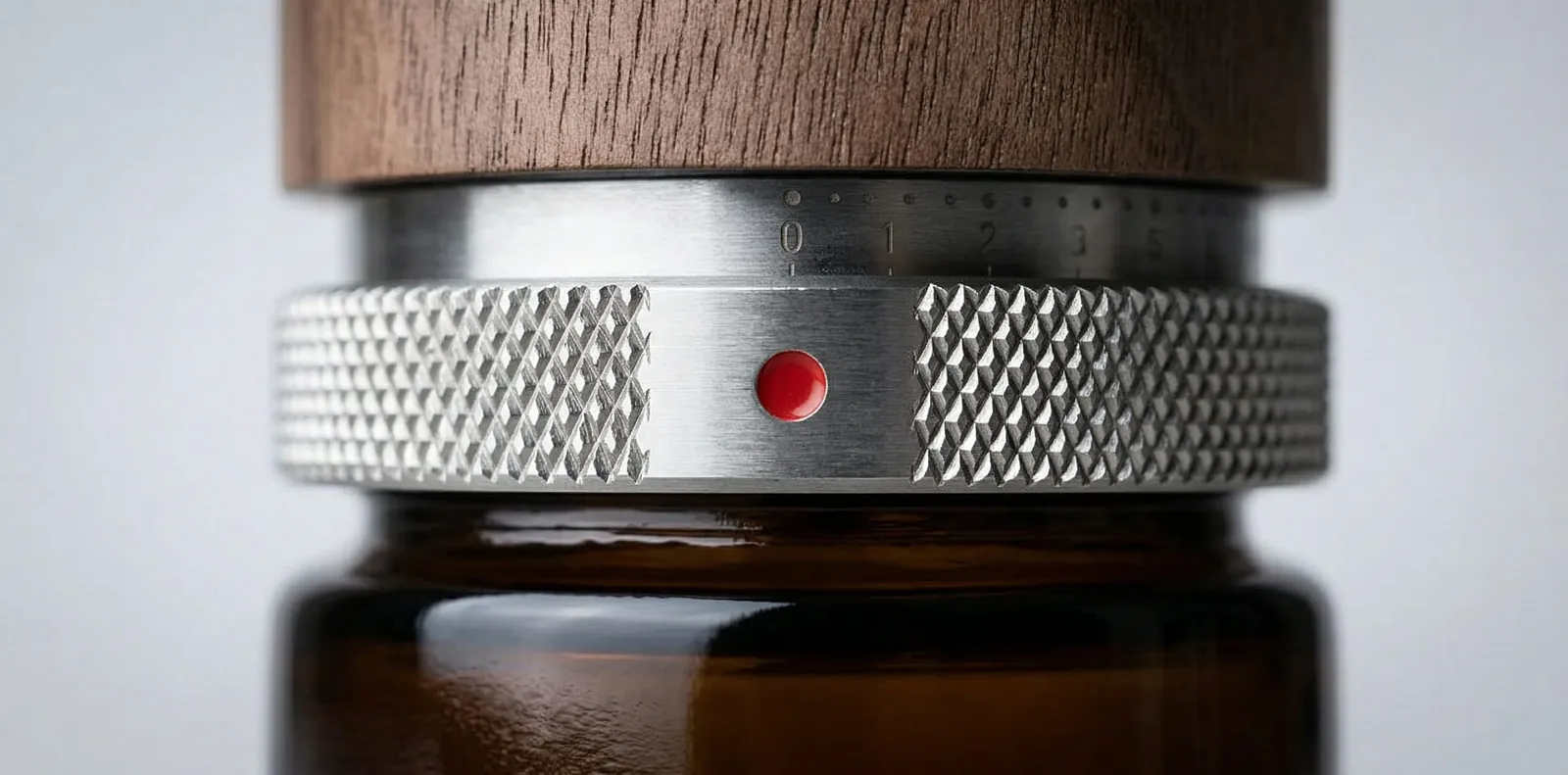
The adjustment is a click ring under the handle. Each click moves the burr by a small, fixed distance, so you can record "20 clicks for V60" and repeat it. Fine micro-adjustments are what make a hand grinder competitive with electric models for filter coffee. For exact pour targets, use the V60 ratio calculator.
The trade-off is physical: hand grinding takes effort and time, and espresso grinding takes the most. For filter drinkers, the payoff is clarity and low retention in a compact body. See manual vs electric grinders.
Who this mechanism suits: Think of it as a precision filter tool: V60, Kalita, AeroPress and travel brewing. Anyone grinding for several people, or for espresso every day, will be happier with an electric grinder. Our AeroPress calculator works out water and bloom for standard or inverted brewing.
Common problems and modern fixes
Typical ownership issues for this grinder type, and the tools and habits that solve them
Hand grinders have a few predictable issues.
- Burr wobble and drifting grind size: snug the lock nut to the right feel and check the click count after rebuilding. Align before use.
- Arm fatigue: use a stable grip, grind a smaller dose.
- Static and loose chaff: a light RDT mist cleans the cup. A dry brush clears the chamber.
- Calibration changes after cleaning: re-zero the dial and write down your base setting.
- Fine-grind frustration: if you want espresso daily, consider Mavo Phantox Pro or an electric alternative.
Use the coffee grind size chart for starting points per brew method.
Who should skip the Comandante C40?
Honest reasons to choose something else
Skip it if espresso is your main drink, since each 18g dose takes 75-120 seconds. Skip it if you brew large batches, because capacity is limited. Skip it if wrist or arm strength is a concern, or if you want the fastest possible morning routine.
And skip it if value per dollar is the priority. An electric grinder from our best coffee grinders list may suit you better. The manual vs electric grinders guide explains the trade-off.
Before you decide
What Actually Matters at This Price Point
At this price point, you're not buying marginally better grind quality than a $150 hand grinder. You're buying a specific combination of things:
- Burr longevity: measurably superior to cheaper hand grinders.
- Adjustment: precision micro-adjustment capability.
- Build: professional-grade quality with a 15–20 year service horizon.
- Experience: the tactile, ritual feel of premium German engineering.
If those things align with your coffee practice and values, the Comandante C40 delivers them better than anything else we've tested in the manual grinder category. If your goal is maximum performance-per-dollar across all brewing methods, including electric options, there are better ways to invest $299.
How It Measures Up on Key Grinder Criteria
- Grind range and adjustment
- A stepped click dial on 39mm Nitro Blade conical burrs, about 30 microns per click, covers espresso through French press. It excels at filter, and the optional Red Clix axle roughly halves each step for finer espresso control.
- Dose accuracy and retention
- A hand grinder that grinds the whole dose into a screw-on jar. You weigh beans first and very little coffee stays behind.
- Heat, noise and vibration
- No motor, so the only sound is the grinding itself. Espresso-fine grinding takes noticeably more effort and time than filter settings.
Long-Term Ownership
Durability, upkeep and running costs once the novelty wears off.
- Durability
No motor, PCB, or capacitors — the only wear surface is the burr set, which Comandante rates for a very long service life — well over a decade at one daily 20g dose.
More detail
Replacement Nitro Blade sets run $60–$80, and a 5-year ownership estimate with no burr replacement lands around $345–$450 total ($269–$349 purchase plus roughly $15–$20 a year upkeep).
- Reliability
Mechanical simplicity is the reliability advantage — nothing to break beyond the glass jar ($20–25 to replace).
More detail
Barista trainers have run their C40s 5–8 years without a mechanical failure.
- Parts
Nitro Blade burrs, catch jar, handle, and body components are all available through Comandante's authorized retailer network — better aftermarket support than most premium hand grinders.
- Upkeep cost
Minimal: brush clean every 2–3 weeks, deep clean every 2–3 months, roughly $15–20 a year.
More detail
No burr replacement expected within the first 10 years at typical home use.
- Warranty
2-year manufacturer warranty.
More detail
German quality control has meant no defective units among the C40s we've seen.
- Resale value
Among the strongest in the premium hand grinder segment — expect strong value retention on the used market, driven by Comandante's reputation and visible build quality.
This grinder was purchased independently for testing and was not provided by Comandante.
Final Verdict
Our rating, who it fits, and what it costs.
Comandante C40Recommended
4.4 / 5 — Is it worth buying?
After the full test period, the Comandante C40 lives up to its reputation. The Nitro Blade burrs showed zero measurable wear, and blind extraction comparisons against the Fellow Ode Gen 2 (a $350–$450 electric flat-burr grinder) produced cups trained cuppers struggled to tell apart.
✓ Best for
- Specialty pour-over and filter coffee at the highest level
- Professional travel coffee setup
✕ Skip if
- Daily high-volume espresso use
- Batch brewing or large household needs
Score breakdown
Grinds tested
600+
Testing period
60 days (daily use)
Ready to decide?
$269-$349typical street price
Our verdict: 4.4/5, recommended. Independently tested; commissions never change a rating.
Tools That Pair With This Review
Put it into practice with a free calculator built for what you just read.
- Coffee Grind Size CalculatorPick your brew method and get the right grind size, texture, and grinder setting.
- Espresso Dial-In CalculatorEnter your actual shot results to see whether you're on target — and what to adjust.
- Coffee Ratio CalculatorThe general-purpose ratio tool for drip machines and pour-over — enter water or coffee, pick your strength.
Reader questions
Questions or tips? Leave a comment
Ask about your setup or share what worked for you. Comments are checked before they appear.