
 4.5
4.5Timemore
Timemore Chestnut C3
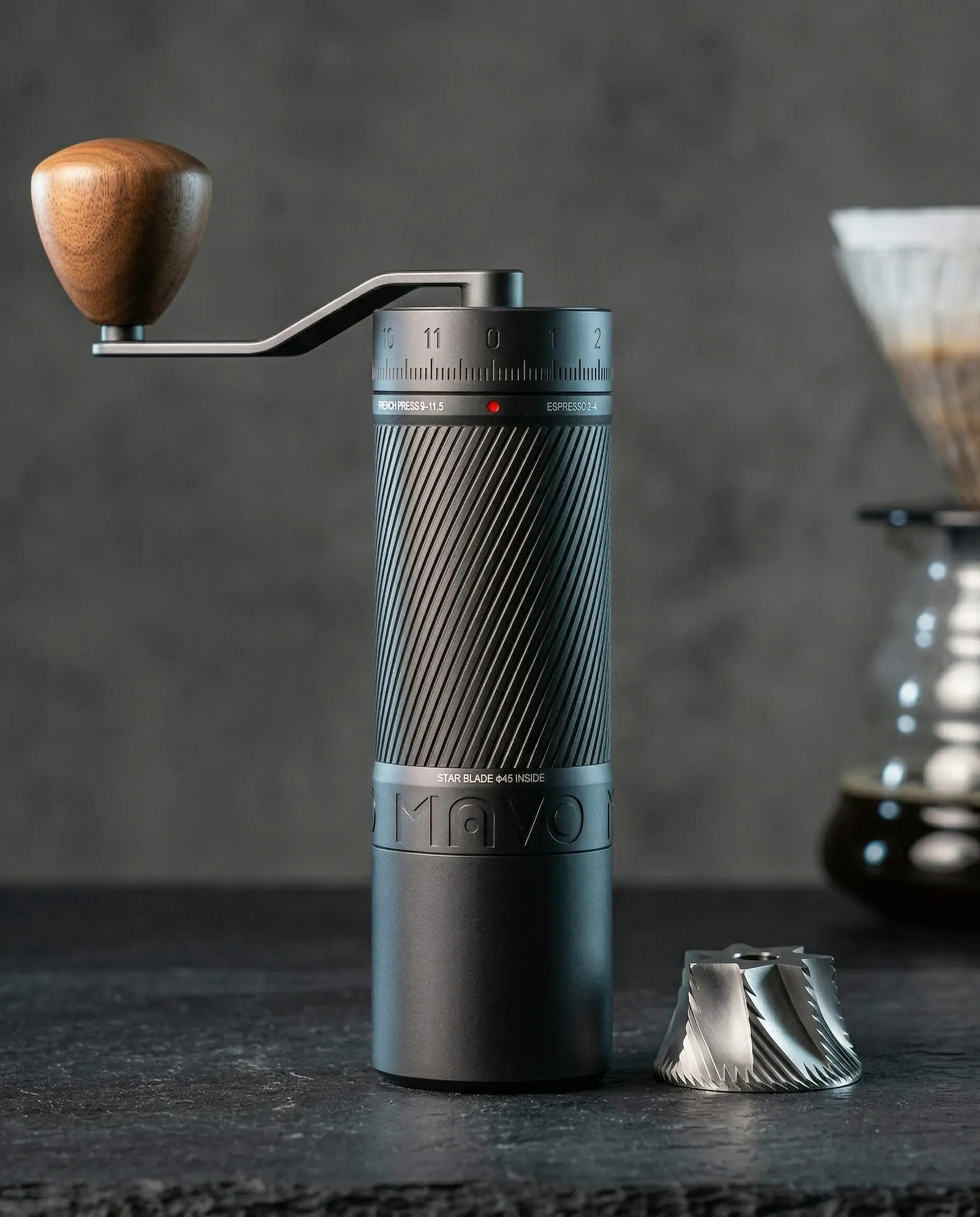
A portable, all-metal manual grinder built for travel and manual brewing rather than daily espresso use.
Coffee grinder review
Last updated
Mavo Phantox Pro hand grinder review: titanium nitride burrs and a stepless dial tested over 500+ grinds. Great for filter, slow for espresso. Who should buy?
Affiliate disclosure: this page contains Amazon affiliate links. We may earn a commission if you buy through them, at no extra cost to you, and it never affects our rankings. Read our full affiliate disclosure
Mavo Phantox Pro at a GlanceRecommended
A precision filter grinder worth the premium for daily single-origin brewers; slow for espresso.
Ultra-Premium Manual Grinder
Affiliate link: we may earn a commission at no extra cost to you. It never affects our rating.
On the grind bench· 500+ grinds · 45 days
Why it stands out
Watch out for
✓ Best for
Specialty filter and pour-over enthusiasts who want continuous micro-adjustment precision for single-origin
✕ Skip if
Daily espresso-primary users
This Mavo Phantox Pro review lands on a clear verdict: it is a precision stepless manual grinder for daily filter brewers, and a slow choice for espresso. In Kruve Sifter Pro testing, the titanium nitride burrs held calibration better than any manual grinder we've measured, and the stepless magnetic dial gave filter brewers micro-adjustment that click systems can't match.
The short answer: it's a precision tool for people who brew demanding single-origin filter coffee daily. If espresso speed matters most, keep looking.
For context, see our manual vs electric grinders guide and burr grinder buying guide.
Check where you fit before you look at the trade-offs below.
A strong match
Consider something else
What earns the rating, and what you give up to get it.
7 reasons it works
6 trade-offs to weigh
How it performed in day-to-day use, in the order you will meet it.
Daily use spanned morning filter sessions and dedicated espresso windows. The stepless dial took about ten days to feel natural — we marked three reference positions (V60, espresso, Chemex) with a paint marker rather than relying on click memory.
Once set, the workflow became consistent: the grinding action is smooth throughout the range, and the magnetic feedback provides enough resistance to keep the dial from drifting once positioned.
This is the best particle-calibration retention we've measured in a manual grinder. Kruve Sifter Pro checks at three points during testing showed the primary particle peak shift by under 4 microns — within our setup's measurement noise — across both a hard light-roast Ethiopian and an oily Sumatran dark roast, with no visible difference in wear between roast types. Uncoated steel burrs we've tested at this price tier typically drift 10–15 microns over a comparable window.
Retention stayed under 0.25g across every setting and bean type, and static was minimal — ground coffee falls cleanly into the catch cup rather than clinging to a snap-fit lid. For single-dose brewing where dose accuracy matters, that's close to ideal.
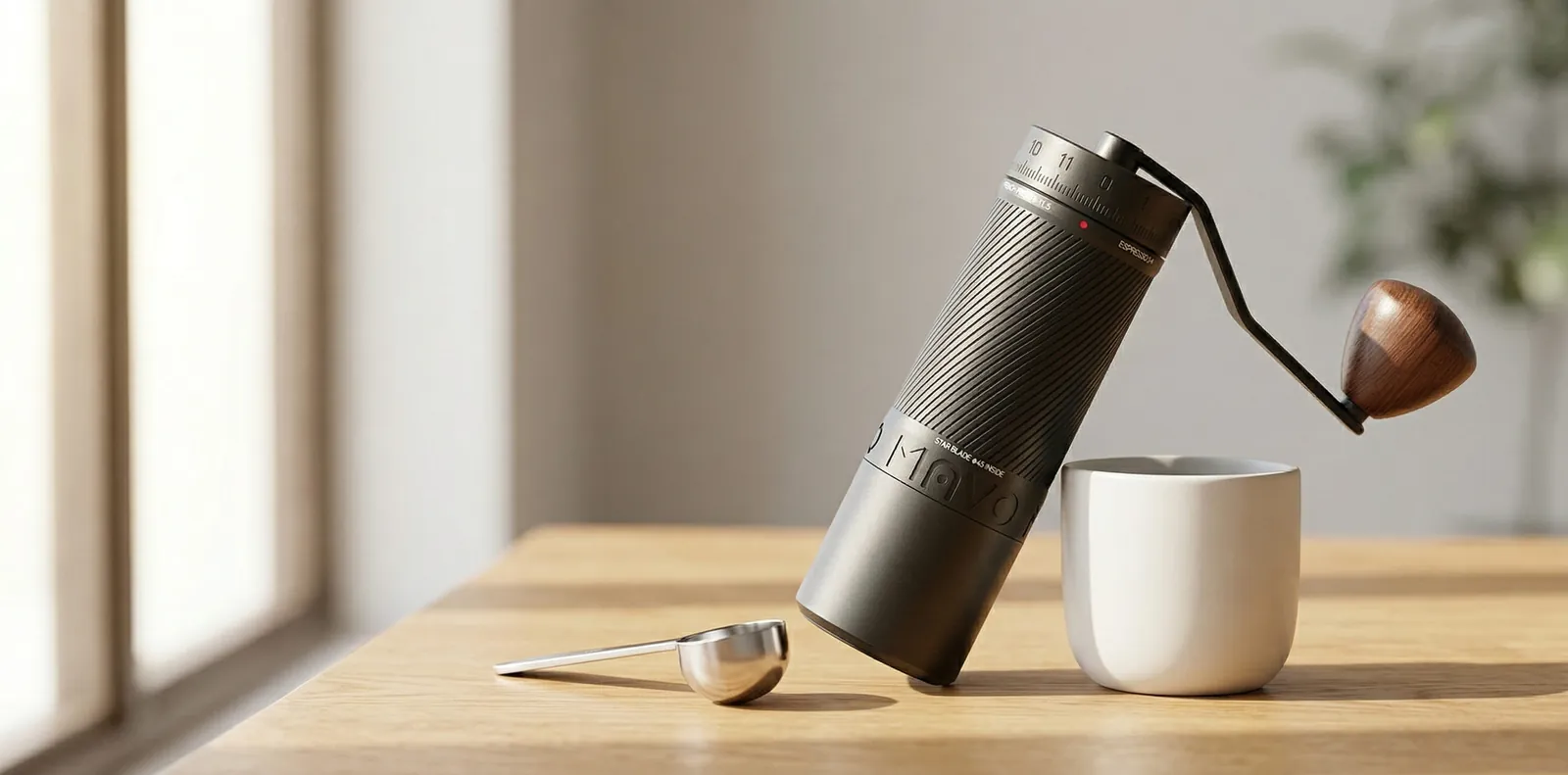
What the premium over cheaper hand grinders actually buys
The Phantox Pro is worth it for a specific buyer: someone who brews single-origin filter coffee most days, already knows that grind consistency drives the cup, and wants finer adjustment than click systems allow. The extra spend over the KINGrinder K6 buys continuous stepless control and a coated burr set built to last.
It is harder to justify if you brew casually. A cheaper hand grinder will make a perfectly good cup for a looser routine, and you would be paying for precision you do not use. The same goes for espresso-first households, where grinding time becomes the dominant cost.
Think of it as a long-term tool rather than a gadget. With rated burr life measured in thousands of hours and minimal maintenance cost, the ownership arithmetic favours daily use over occasional use.
Feature, practical impact, who benefits, trade-off
Which manual grinder fits which brewer
| Grinder | Burr | Capacity | Weight | Current price |
|---|---|---|---|---|
| Mavo Phantox Pro | 38mm conical | 40g | not listed | Check current price |
| Comandante C40 | 39mm conical | 25–35g | 510g | Check current price |
| KINGrinder K6 | 48mm conical | 55g | 620g | Check current price |
| Timemore Chestnut C3 | 38mm conical | 20–25g | 420g | Check current price |
| 1Zpresso K-Ultra | 48mm conical | 35g | 540g | Check current price |
Dial marking, cleaning and ownership costs
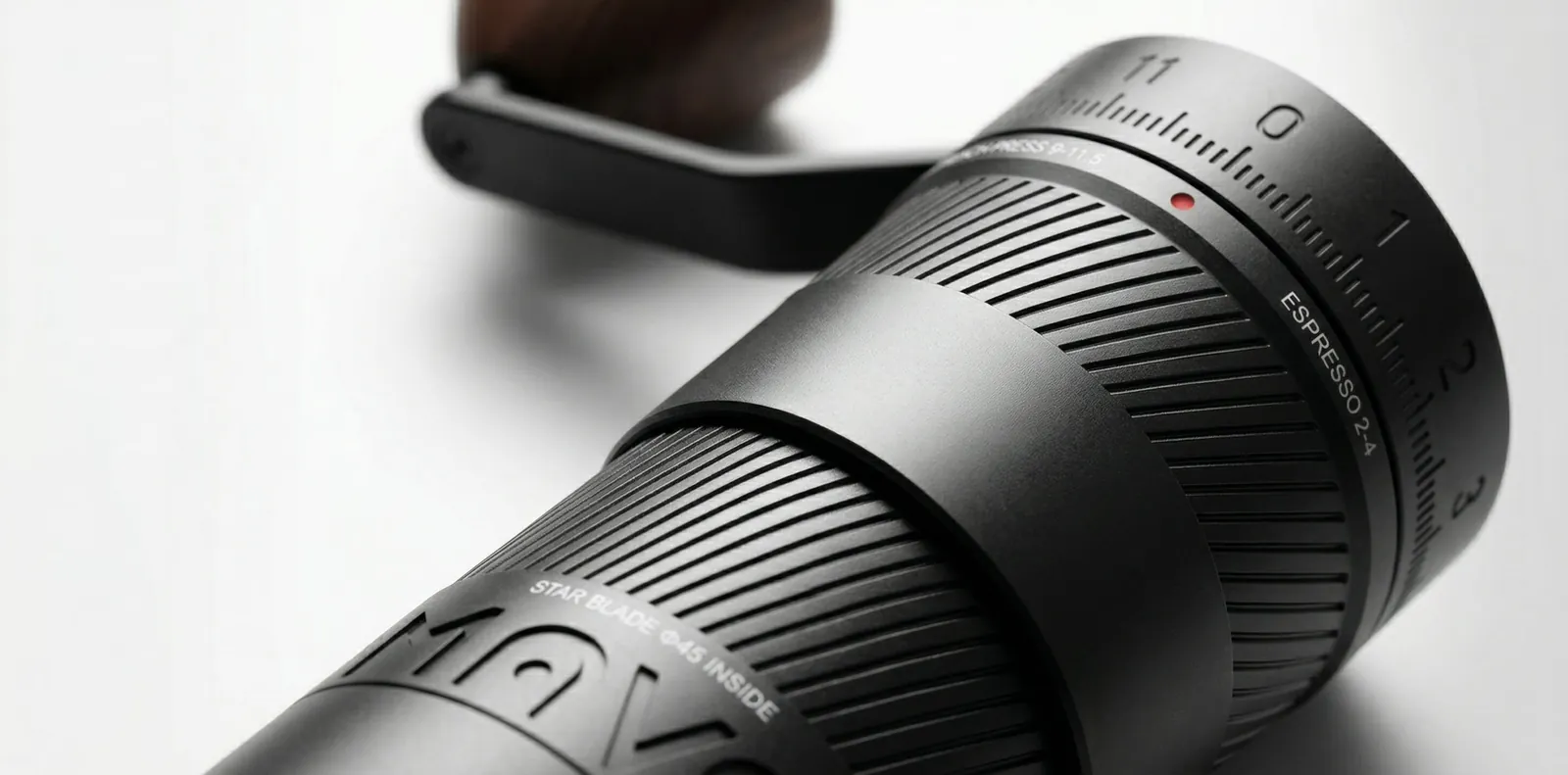
Plan on roughly ten days for the stepless dial to feel natural. A paint marker on three reference positions removed the guesswork for us, and the magnetic resistance kept the dial from drifting once set. If you also use an espresso machine, our guide to dialing in espresso explains how to adjust from those marks. The espresso dial-in calculator tells you what to change after each shot.
Cleaning is simple: a brush every two to three weeks and a deeper clean with grinder tablets every couple of months, which works out to around $15-20 a year. Disassembly is tool-free.
On the ownership side, Mavo sells replacement burrs, catch cups and handle assemblies through authorised retailers, and the warranty is two years. The parts network is smaller than Comandante's, so check availability in your region before buying. Resale value may trail more established brands for now.
The mechanism behind the grind, in plain English, and what it changes in your cup
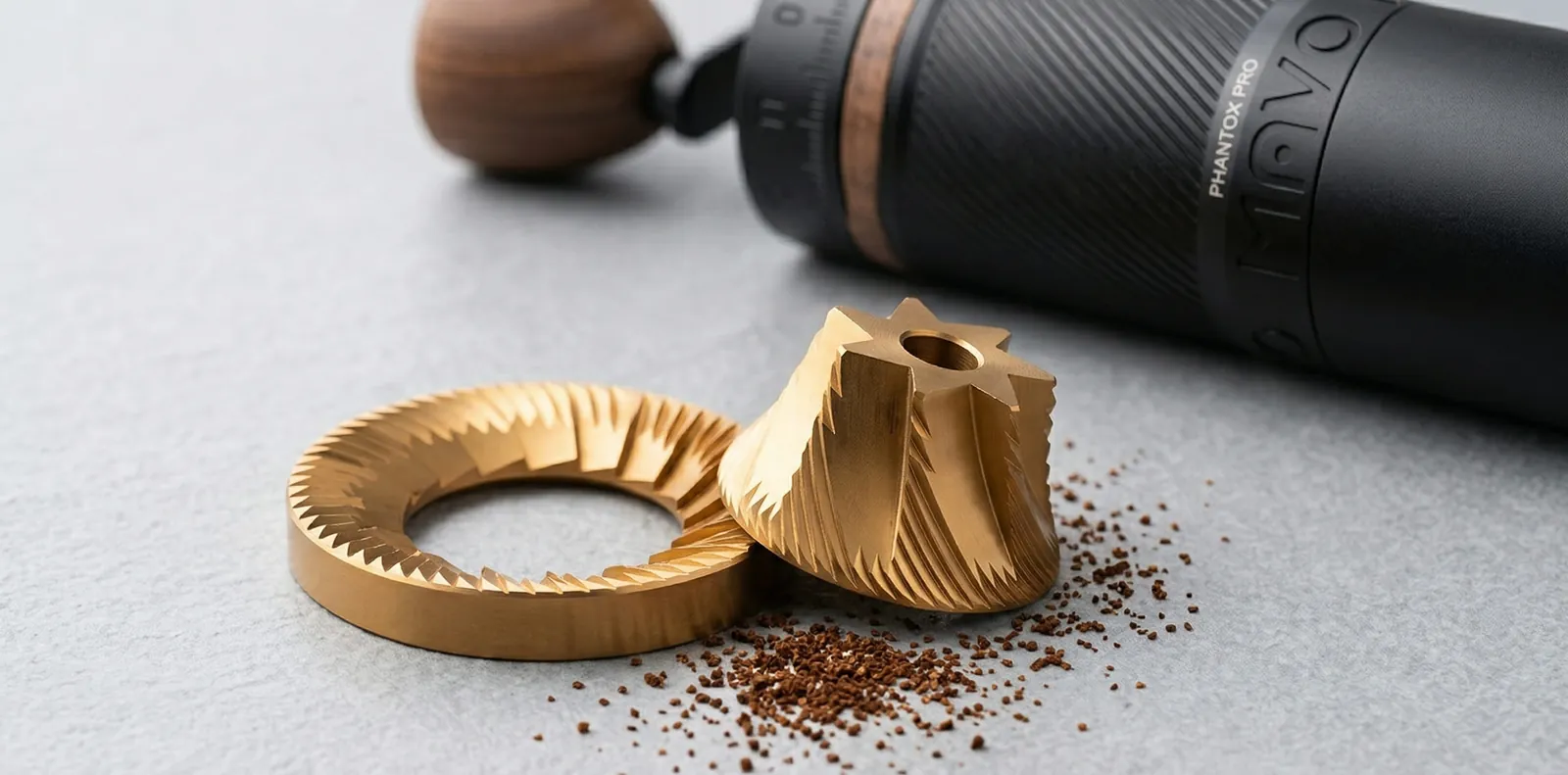
The Phantox Pro is a manual grinder with titanium nitride burrs, a hard coating that resists wear. Its stepless magnetic adjustment lets you turn a dial to any position, with no fixed clicks. That gives finer control than a click ring.
Why that matters for filter coffee: a very small change in grind size can shift a V60 draw-down by several seconds. With a stepless dial, you can tune to the exact flavor you like, then match it again with a mark on the body. For exact pour targets, use the V60 ratio calculator.
The trade-off is repeatability. A click system gives you a number. A stepless dial asks you to mark or remember it. Espresso is possible but slow by hand. See manual vs electric grinders.
Who this mechanism suits: It rewards drinkers who change beans regularly and enjoy tuning a V60 recipe by feel. If you want a set-and-forget routine, a click-numbered hand grinder is easier to live with.
Typical ownership issues for this grinder type, and the tools and habits that solve them
Common issues are marking settings, burr alignment and effort.
Compare with Comandante C40 for click-based control.
Honest reasons to choose another grinder
Skip it if:
Matching the grinder to how you actually brew
Questions that decide the purchase
Answer these honestly before buying:
If you answered yes to the first three, the Phantox Pro fits. If you answered no to most, one of the alternatives above will serve you better and cost less.
The real trade-off behind the Phantox Pro
The Phantox Pro competes less with other hand grinders than with the question of whether to go manual at all. Its filter results matched an electric flat-burr grinder in roughly half of our blind sessions, which shows hand grinding does not mean a worse cup.
What you give up is convenience and speed. An electric grinder adds a button, a hopper and a timer, and removes the arm work. What you gain from the Phantox Pro is silence, portability, no power dependency and a precision dial at a lower price than most electric grinders of similar cup quality.
If your household needs fast, repeatable multi-cup grinding every morning, choose electric. Browse the Fellow Ode Gen 2 review for a filter-focused electric option. If you value a quiet, deliberate morning routine and brew mainly for yourself, the Phantox Pro is a better fit.
Before you decide
At $125, the Phantox Pro isn't competing for the casual home brewer upgrading from a blade grinder. It's built for someone who already knows grind consistency drives cup quality, has outgrown stepped-click adjustment, and wants a burr set with a measurable longevity edge over uncoated steel. In that specific context — daily specialty filter work, dialing in single-origin coffee, buying equipment meant to last — the Phantox Pro delivers precision and durability that match its price.
Durability, upkeep and running costs once the novelty wears off.
The titanium nitride coating is the durability story here: Kruve analysis across testing showed the burrs holding within 4 microns of their original calibration, well ahead of the wear we've seen on uncoated steel at this price.
Mavo rates the burr set for 2,000+ hours, which at daily use puts replacement more than a decade out.
No motor or electronics means fewer failure points — the sealed angular-contact bearings and catch-cup seal showed zero degradation across testing, and grinding action stayed smooth throughout.
Mavo sells replacement burrs, catch cups, and handle assemblies through its authorized retailer network — less extensive than Comandante's global parts network, but sufficient for normal maintenance.
Minimal: a brush clean every 2–3 weeks and a deeper clean with grinder tablets every couple of months, running roughly $15–20 a year with no burr replacement expected inside a decade of typical use.
2-year manufacturer warranty through Mavo's authorized retailer network.
Mavo is still building specialty-coffee brand recognition, so resale value trails more established names like Comandante for now — likely to improve as awareness grows.
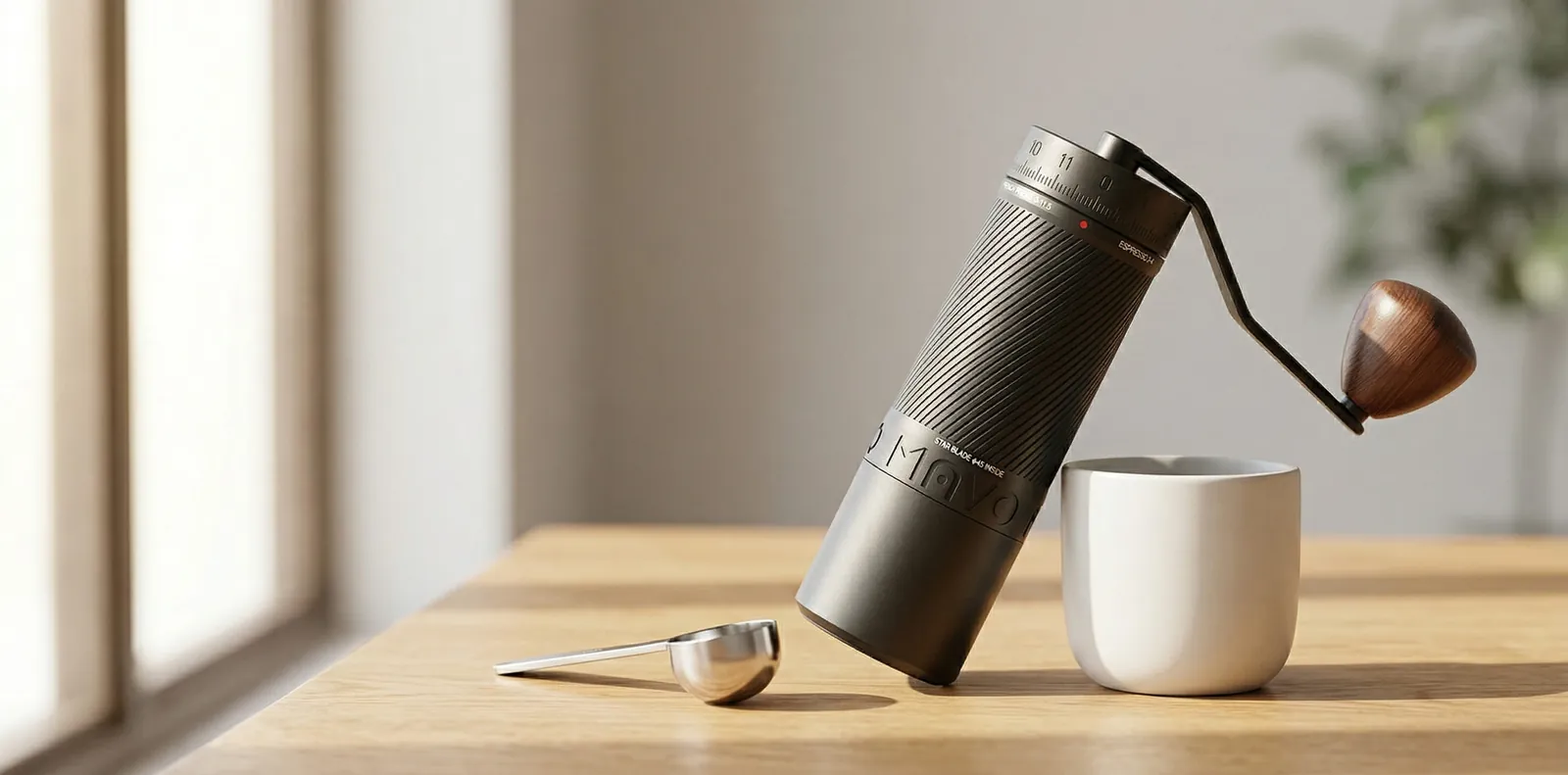
This grinder was purchased independently for testing and was not provided by Mavo. All particle-distribution measurements were conducted with a Kruve Sifter Pro.
Our rating, who it fits, and what it costs.
Mavo Phantox ProRecommended
4.3 / 5 — Is it worth buying?
The Phantox Pro earns its price in the specific lane it targets: precision filter coffee for home baristas who've outgrown stepped-click adjustment.
✓ Best for
✕ Skip if
Score breakdown
Grinds tested
500+
Testing period
45 days (daily use)
Ready to decide?
Our verdict: 4.3/5, recommended. Independently tested; commissions never change a rating.
See how the Mavo Phantox Pro compares with the other picks in each tested roundup.
Closest alternatives in price and purpose, each tested the same way.
4.5Timemore
A portable, all-metal manual grinder built for travel and manual brewing rather than daily espresso use.
 4.3
4.3OXO
A budget conical burr grinder for drip and pour-over brewers upgrading from a blade grinder, about $82-$120.
 4.1
4.1Capresso
An affordable conical burr grinder for drip and French press drinkers stepping up from a blade grinder, under $110.
 4.4
4.4Breville
A versatile electric grinder for both espresso and filter coffee, with a Dosing IQ feature for consistent shot-to-shot repeatability.
Put it into practice with a free calculator built for what you just read.
Quick answers before you buy.
For filter-focused specialty coffee enthusiasts: yes, if you want stepless micro-adjustment precision and titanium nitride burr longevity. Across testing, the Phantox Pro's particle distribution held within 4 microns of its original calibration — better retention than any manual grinder with uncoated steel burrs we've measured.
Filter extraction quality matched the Fellow Ode Gen 2 (electric flat-burr, $350-$450) in about half of blind cup sessions. However, if espresso is your primary drink or you want the best value-per-dollar in the manual segment, the Comandante C40 and 1Zpresso JX-Pro are strong (pricier) competitors, and the Timemore C3 and KINGrinder K6 are cheaper value options.
Most premium manual grinders use stepped click systems with fixed micro-increments — typically 20–50 microns per click. The Phantox Pro's stepless magnetic dial lets you position the burr gap at any point continuously, not just at fixed intervals.
In practical terms, this allowed us to adjust extraction yield by 0.3–0.4% in refractometer readings per movement — compared to roughly 1.2% jumps on 15-click stepped systems. For single-origin filter work where precise extraction targeting matters, this is a real performance difference.
The trade-off: you need to mark your preferred dial positions with reference dots rather than relying on numbered click counts.
Both use surface-hardening treatments to extend burr longevity over standard stainless steel. The Comandante C40 uses nitrogen-based nitriding (Nitro Blade).
The Mavo Phantox Pro uses physical vapor deposition (PVD) titanium nitride coating. Both outperform uncoated steel burrs in wear resistance.
In our testing, the Phantox Pro's burrs showed calibration retention comparable to the C40 within our measurement noise in Kruve Sifter Pro analysis — less than 4 microns of distribution drift vs. ~6 microns on the C40 over a comparable test window. In blind filter cup quality, we couldn't reliably distinguish their outputs.
Yes — we pulled proper espresso shots on a La Marzocco Linea Mini at fine dial positions with 28–32 second extraction times and excellent flavor clarity. The titanium nitride burrs produce low fines at espresso settings, which translates to sweet, balanced shots without the bitter edge from over-extracted particles.
The limitation is grinding effort and workflow: fine espresso settings require 70–115 seconds of continuous cranking per 18g dose. For one or two shots as a deliberate morning ritual, this is manageable.
For daily multi-shot espresso workflow, an electric grinder is the more practical tool.
This is where the Phantox Pro excels. In 30 controlled V60 sessions during testing, the grinder consistently hit 21–22.5% extraction yield at our target parameters (93°C, 1:15 ratio, 3:00 brew time) with tight shot-to-shot TDS variance of ±0.08 Brix.
Blind cup panels with Q Grader colleagues rated the cups as consistently clean and complex — indistinguishable from Fellow Ode Gen 2 cups in four of eight sessions. For single-origin filter work where extraction precision matters, the stepless dial lets you chase specific yield targets more precisely than click-system grinders.
Buy the Phantox Pro if you want stepless adjustment and a lower price; buy the C40 if you prefer numbered clicks and a larger parts network.
In our blind filter tastings the two were not reliably distinguishable.
See our Comandante C40 review for that side of the comparison.
Mavo rates the burr set for 2,000+ hours, which at daily use puts replacement more than a decade away.
In our testing the burrs held within 4 microns of their original calibration.
Replacement burrs are sold through authorised retailers.
Reader questions
Questions or tips? Leave a comment
Ask about your setup or share what worked for you. Comments are checked before they appear.