
 4.5
4.5Breville
Breville Barista Express Impress
A beginner-friendly semi-automatic that removes manual tamping from the equation, trading some hands-on control for consistency.
Espresso machine review
Last updated
Breville Barista Pro espresso machine review: ThermoJet heat-up in 4-6 seconds and live shot data, but manual tamping. Compared with the Impress models.
Affiliate disclosure: this page contains Amazon affiliate links. We may earn a commission if you buy through them, at no extra cost to you, and it never affects our rankings. Read our full affiliate disclosure
Breville Barista Pro at a GlanceRecommended
A smart middle-ground pick if you already tamp well; beginners should look at the entry-level Impress instead.
Mid-Range Semi-Automatic with Integrated Grinder
Affiliate link: we may earn a commission at no extra cost to you. It never affects our rating.
In the shot log· 60 shots · 18 days
Why it stands out
Watch out for
✓ Best for
Intermediate home baristas upgrading from a basic machine who already have tamping technique down
✕ Skip if
First-time espresso buyers who would benefit from the entry-level Impress's assisted tamping
Our Breville Barista Pro review starts with its headline claim: Breville says 3 seconds to heat up, and we measured 4–6 seconds from a cold machine to brew-ready, near enough to change a morning routine. The live shot display is the other workflow gain that turned out to be real.
The short answer: a good fit for intermediate home baristas who already tamp consistently; beginners are better served by the entry-level Impress.
For the full picture on where this fits in the Breville ecosystem, see our roundup of best espresso machines and our deep-dive on espresso machine types.
Check where you fit before you look at the trade-offs below.
A strong match
Consider something else
What earns the rating, and what you give up to get it.
8 reasons it works
8 trade-offs to weigh
How it performed in day-to-day use, in the order you will meet it.
Unboxing to first acceptable shot took 18 minutes — with ThermoJet, there's no boiler wait once it's plugged in, so the bottleneck is grinding, dosing, and tamping. The first shot ran a touch coarse at 19 seconds; the third was dialled in.
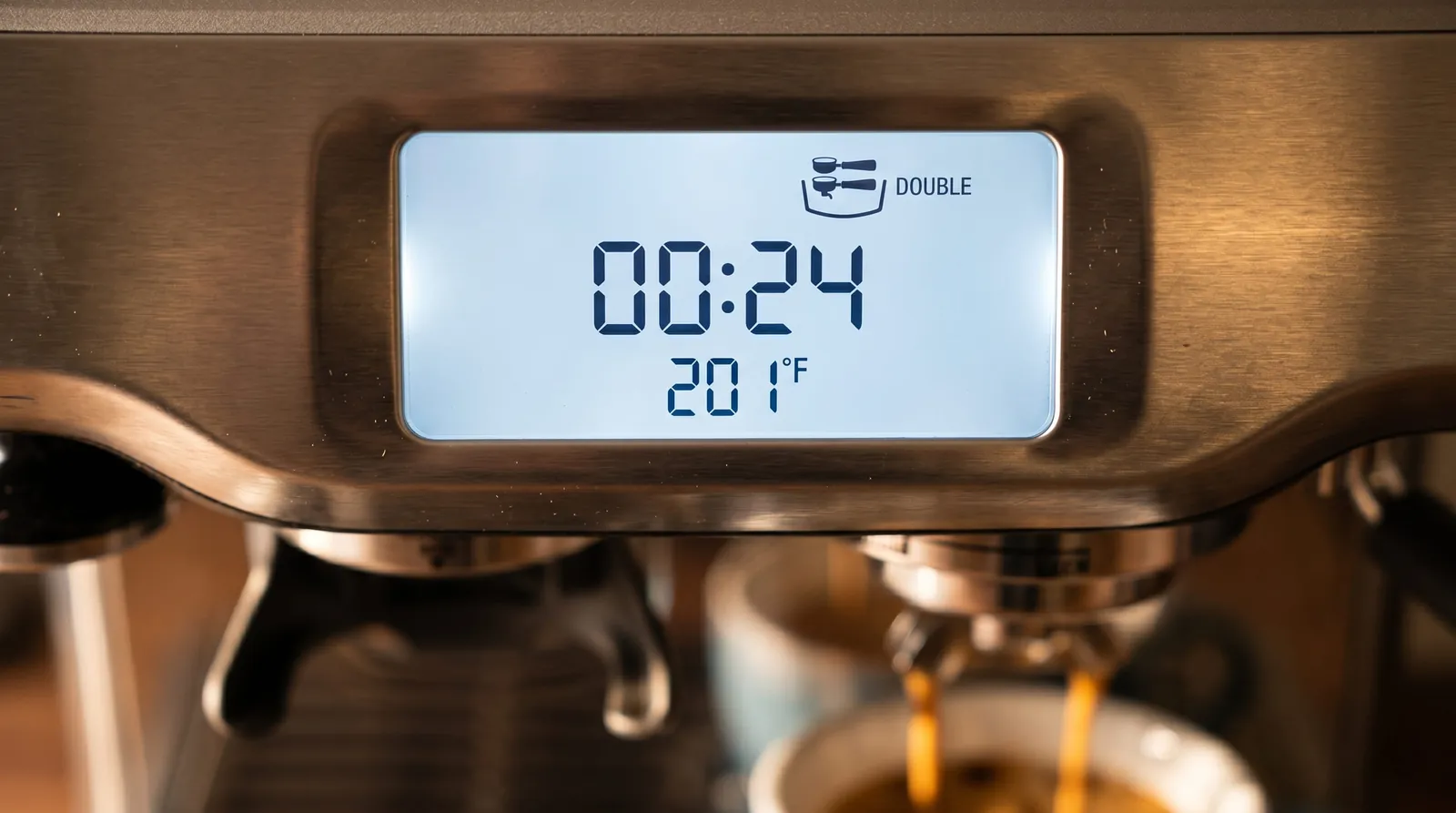
The onboard display earned its keep immediately: seeing shot time and brew temperature together let us diagnose that first shot without guessing, something that would normally need a timer and a thermocouple probe.
Manual tamping was the real learning curve. We tested three approaches across the first week — a light tamp, a firm tamp, and a firm tamp with a polished finish — and the display's shot-time readout made the differences obvious immediately. Consistency arrived by day four, once a repeatable stance and grip were in place.
Three bean profiles told the story:
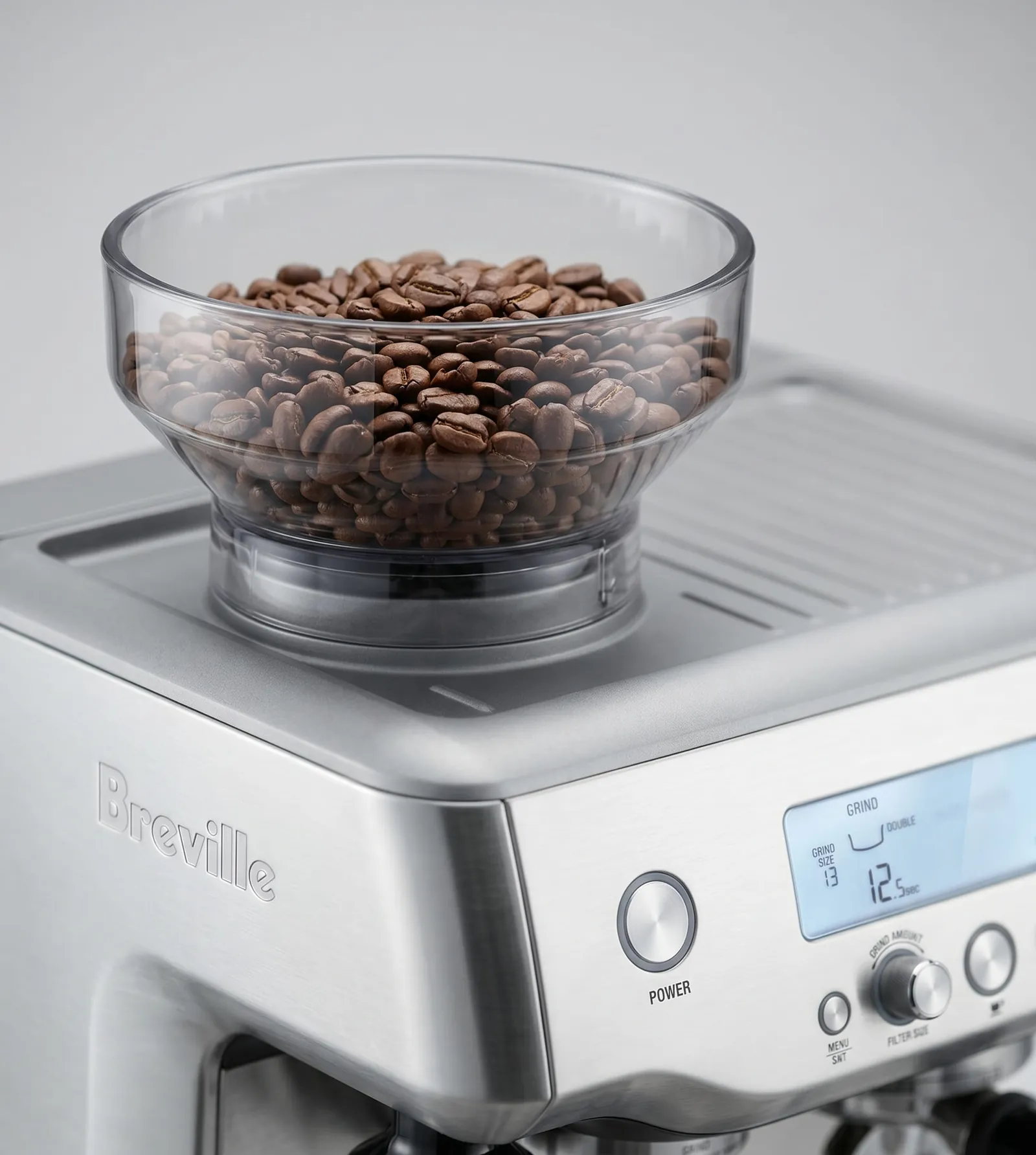
Each grind click here shifts extraction time by roughly 2–3 seconds — finer resolution than the entry-level Impress's 3–5 second swings, which makes dialling in noticeably faster.
Light roast was the real test of the upgraded grinder: an Ethiopian Yirgacheffe at grind setting 3, near the finest end, produced a viable shot with real jasmine and bergamot character — something the Impress's grinder couldn't manage at its own finest setting. It's still not dedicated-grinder territory for very light, Nordic-style roasts, but it's a clear step up.
Target protocol was 18g dose to 36g yield in 23–27 seconds.
One nuance worth knowing: after six consecutive doubles, the next shot pulled slightly faster, a sign the ThermoJet's smaller thermal mass runs marginally hotter under sustained back-to-back use. It's not an issue at normal home volumes of two to four drinks a session — just something to know if you're brewing for a crowd.
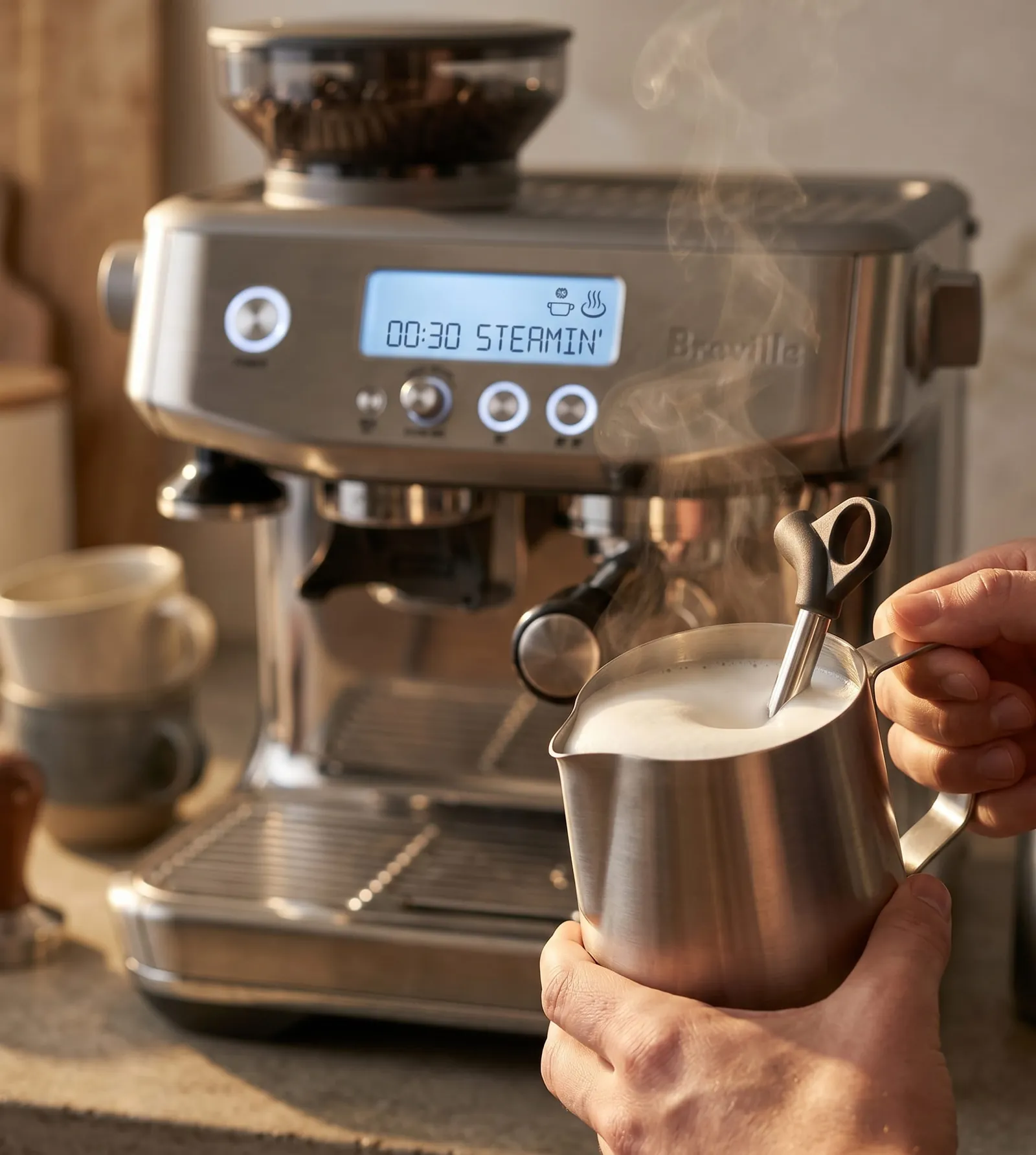
Across roughly twenty milk drinks, whole milk textured to silky microfoam in well under a minute per pitcher — marginally faster than the entry-level Impress, since the ThermoJet recovers steam pressure more quickly. Oat milk needs closer attention: the window between silky and watery is only a few seconds, though it becomes predictable once you know the visual cues.
The manual steam wand is where the Pro diverges most from the touchscreen model, which automates milk texturing entirely. We prefer the manual control over final texture and temperature, but first-time steamers should expect one to two weeks before it feels comfortable. Steam recovery between pitchers ran about 15 seconds, and consecutive milk drinks for a group held consistent microfoam with no meaningful pressure drop.
Maintenance is routine, with one recurring annoyance:
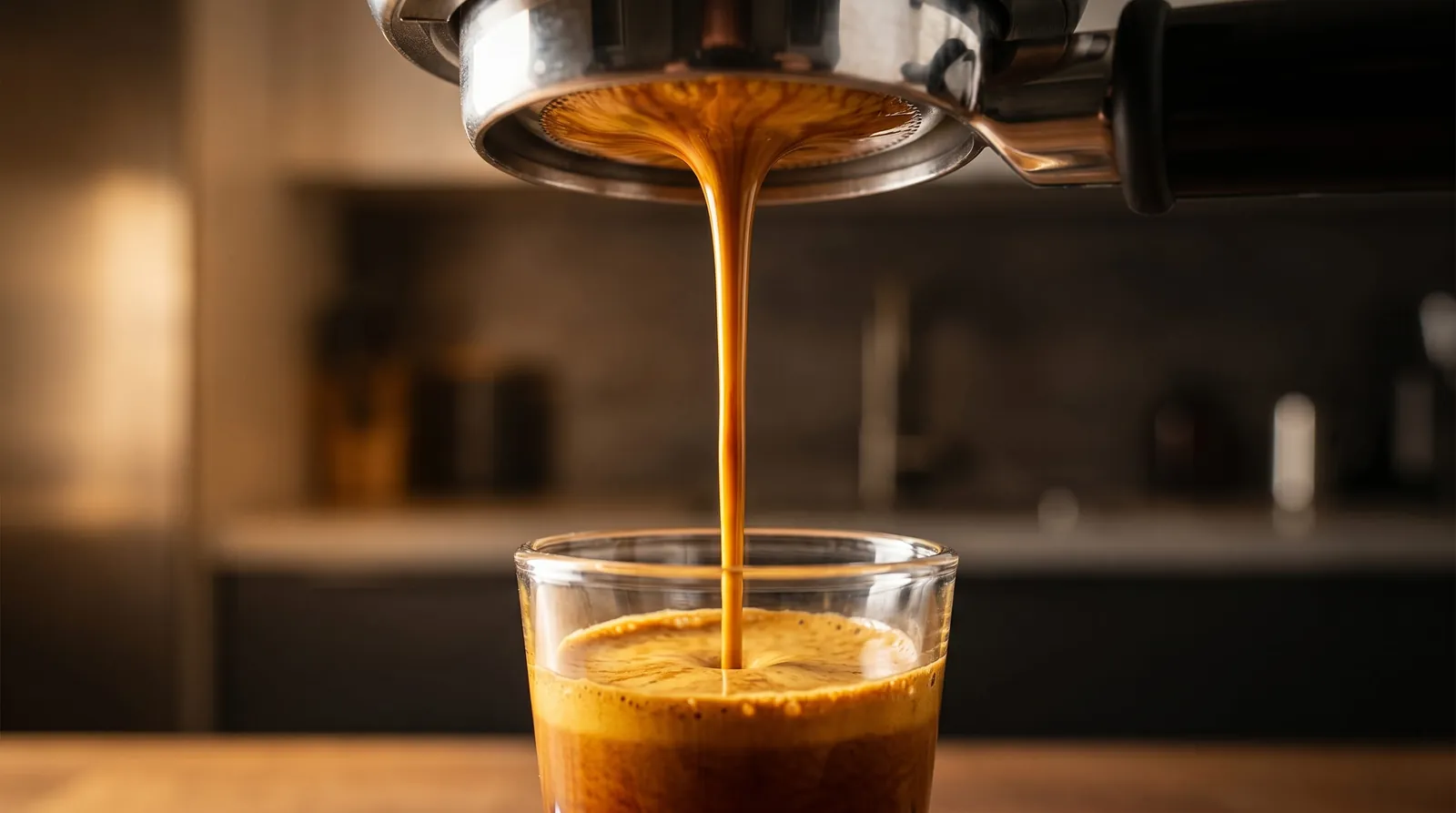
ThermoJet, display and grind control explained
Torn between Breville's three all-in-ones? Our Barista Express vs Barista Pro vs Express Impress comparison shows what each upgrade buys.
Common problems and best practice
Before you decide
Most integrated-grinder machines at the $600–$900 price point pair a thermocoil or thermoblock boiler with a mid-grade burr grinder and a basic analogue gauge. The Barista Pro breaks from that in two ways: ThermoJet reaches operating temperature in single-digit seconds from cold versus 2–3 minutes for typical competitors, and the onboard display surfaces shot time, temperature, and dose data that usually needs separate accessories to capture.
Those two features matter differently depending on your workflow — ThermoJet matters most if you resent waiting for one or two shots first thing in the morning, and the display matters most if you're actively dialling in beans, since it turns adjustment from guesswork into a data-informed loop. What the Pro doesn't change is the espresso itself once both machines are warm: at matched grind, dose, and yield, ThermoJet and thermocoil extract identically. The premium here buys workflow convenience and data visibility, not fundamentally better espresso.
Durability, upkeep and running costs once the novelty wears off.
Brushed stainless steel body with plastic housing on non-contact surfaces — build quality feels premium for the price tier, similar to the entry-level Impress model.
Expect 6–9 years of service at typical home use (1–4 drinks daily) with regular maintenance.
ThermoJet is mature technology Breville has used across several machines, including the Bambino line, with no widespread Pro-specific failure modes reported in community forums.
Plan on a group head gasket replacement every 18–24 months and grinder burrs every 2–3 years at average use.
Breville typically keeps parts available for years after a model's release, with common consumables — baskets, gaskets, steam wand tips — available directly and through third-party suppliers within a few business days.
Aftermarket 54mm accessories from the broader Breville ecosystem are widely available too, including 54mm puck screens — just confirm the 54mm sizing before buying, since 58mm screens won't fit.
Budget $30–$40 a year for descaling solution, cleaning tablets, and Grindz, or under $300 over five years including a gasket swap and one burr replacement.
2 years, covering manufacturing defects but excluding wear items like gaskets and burrs.
Breville's US support has typically responded within 1–3 business days per community reports, and extended coverage is available through select retailers for $60–80 a year.
Breville's integrated-grinder machines hold value reasonably well on brand recognition alone — expect to recover a bit more than half of the purchase price at two years and noticeably less at four, with consistent demand on resale marketplaces.
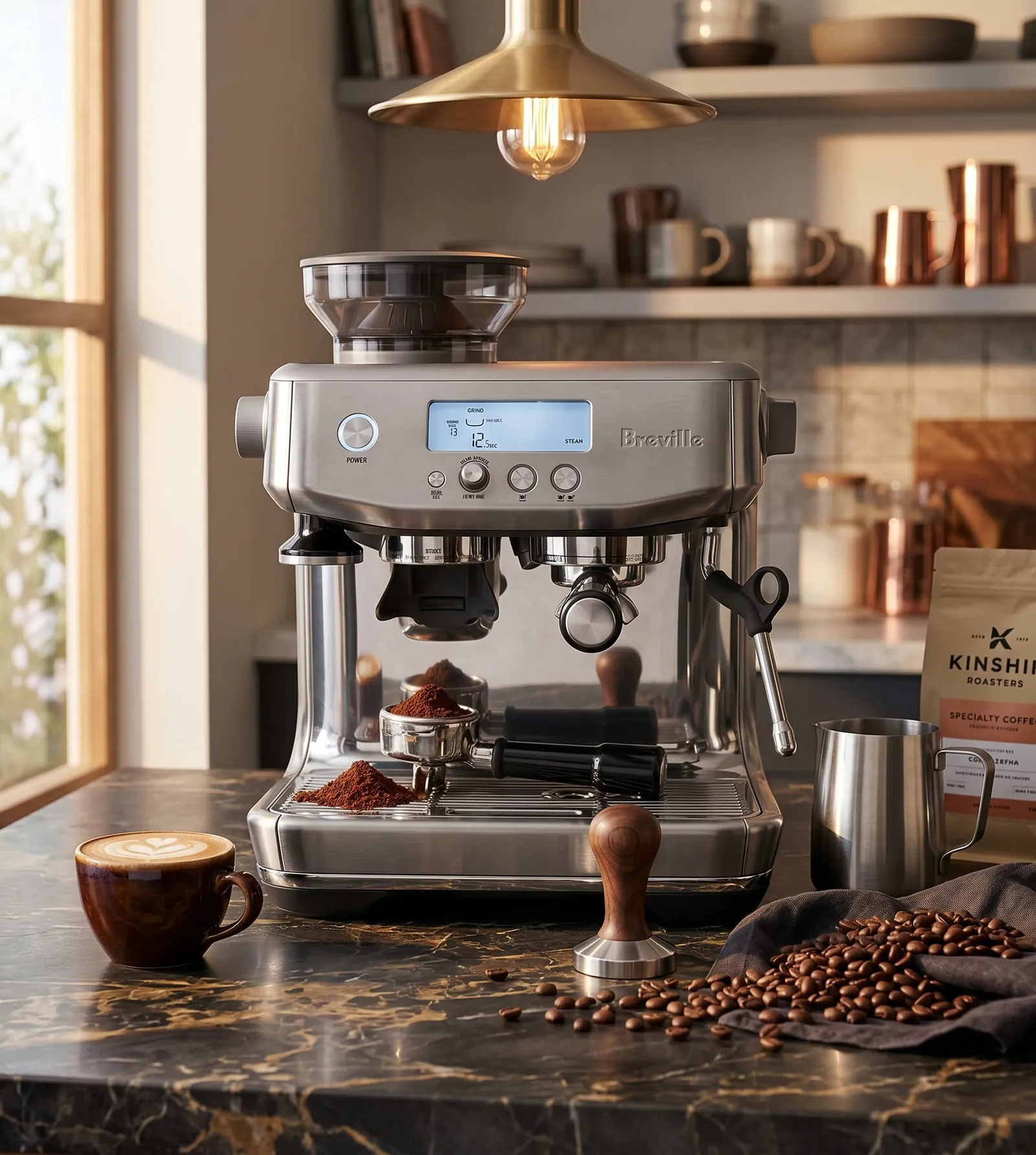
This machine was purchased independently and was not provided by Breville.
Our rating, who it fits, and what it costs.
Breville Barista ProRecommended
4.4 / 5 — Is it worth buying?
Manufacturer heating claims deserve scepticism, so when Breville says '3-second heat-up,' the default reaction is: prove it. The Barista Pro came close — consistently landing in single-digit seconds from cold, near enough to change a morning routine.
✓ Best for
✕ Skip if
Score breakdown
Shots tested
60
Testing period
18 days
Ready to decide?
Our verdict: 4.4/5, recommended. Independently tested; commissions never change a rating.
See how the Breville Barista Pro compares with the other picks in each tested roundup.
Closest alternatives in price and purpose, each tested the same way.
4.5Breville
A beginner-friendly semi-automatic that removes manual tamping from the equation, trading some hands-on control for consistency.
 4.4
4.4Philips
A bean-to-cup machine for busy households and office kitchens making several espresso drinks a day without barista training.
 4.7
4.7DeLonghi
A sensor-driven machine offering professional-level automation with minimal manual intervention required.
 4.6
4.6Breville
A touchscreen machine with one-touch lattes and cappuccinos, built for households making several milk drinks a day.
Put it into practice with a free calculator built for what you just read.
Quick answers before you buy.
It depends on two things: whether ThermoJet heat-up speed matters for your mornings, and whether shot data on a display changes how you dial in. If you pull one shot a day from a cold machine and actively adjust grind settings, the Pro pays for its roughly $50-$100 premium in real workflow gains.
If you pre-heat your machine while making breakfast anyway, and you're happy dialling in by feel, the Barista Express Impress delivers comparable espresso quality at lower cost — and adds assisted tamping that's useful for beginners. Neither machine is objectively 'better'; they serve slightly different users.
If you are also weighing the original Barista Express, the Pro's case is the same: faster heat-up and a clearer display, not a different class of espresso. Our Barista Express vs Barista Pro vs Express Impress guide compares all three side by side.
ThermoJet is Breville's name for a high-output thermoblock heating element that reaches optimal brew temperature almost immediately from cold. Compared to the thermocoil system in the entry-level Impress model (which takes roughly 2:50 from cold), ThermoJet eliminates the pre-heat wait entirely.
The result: you can pull your first shot within a minute of turning the machine on. For daily users who value a fast morning routine, ThermoJet is a real quality-of-life improvement.
The espresso itself, once both machines are at temperature, is essentially identical.
No. Unlike the Impress and the Touch model, the Barista Pro requires fully manual tamping with the included tamper. This is one of the key reasons the Pro is better suited to intermediate home baristas who've already developed consistent tamping technique.
If you're new to espresso and want automation to handle the tricky tamping step, the Impress is the better choice. If you're comfortable tamping and want ThermoJet speed plus an onboard display, the Pro is the right call.
The Barista Touch Impress (~$1199-$1299) adds three things over the Pro: a colour touchscreen interface, automatic milk texturing (TempTQ system), and guided step-by-step drink recipes. The Pro requires manual steaming and has a simpler onboard display.
Choose the Pro if you want to develop manual steaming skills and don't need touchscreen guidance. Choose the Touch if you want maximum automation and a premium interface — the roughly $350-$400 premium buys you the milk automation and the guided workflow, not meaningfully better espresso extraction.
Buyers who want dual boilers alongside automation can compare the Breville Oracle.
Better than the entry-level model, but with limits. In testing, we pulled a viable Ethiopian Yirgacheffe at grind setting 3 (18g dose, 35g yield, 26 seconds) with noticeable floral and citrus character — something the entry-level model couldn't achieve on its finest setting.
However, for serious Nordic-style light roasts requiring ultra-fine grinding, you'll still hit the integrated grinder's ceiling. If light roasts are 50%+ of your drinking, consider pairing a separate dedicated espresso grinder (Eureka Mignon Specialita, Niche Zero) with a machine without an integrated grinder.
Dark roasts: settings 11-14 (targeting 23-27 second extractions). Medium-dark blends: settings 9-11. Medium single-origins: settings 7-10.
Light roasts: settings 3-6. Each click adjusts extraction time by approximately 2-3 seconds — finer increments than the entry-level Impress. Start at setting 10 for a medium-dark roast, pull a test shot, and adjust one click at a time until extraction lands in your 23-27 second window for a 1:2 ratio.
The onboard display makes this process noticeably faster than on machines without shot timing.
It can work for beginners, but it's not optimised for them. The main challenge is manual tamping — without the assisted tamping system found on the entry-level Impress, our zero-experience testers reached consistent puck preparation in about four days, and beginners should expect 2-3 weeks to feel fully comfortable.
During that learning period, shot quality will be inconsistent in ways that can feel discouraging. The onboard readout does help beginners understand what's going wrong with a shot faster than analogue machines.
If you're brand new to espresso and don't want a steep early learning curve, the Impress is a more forgiving entry point. If you're willing to invest that learning period, the Pro will reward you with faster heat-up and better dialling-in data.
The main ones are practical rather than faults: no assisted tamping, a small 8 oz hopper that needs frequent top-ups with 12 oz bags, and a 54mm portafilter that limits aftermarket basket choice.
After six or more back-to-back doubles the next shot pulled slightly faster, which only matters if you are brewing for a crowd.
Plan on routine espresso machine maintenance such as daily backflushing and periodic descaling.
Reader questions
Questions or tips? Leave a comment
Ask about your setup or share what worked for you. Comments are checked before they appear.