
 4.1
4.1De'Longhi
De'Longhi Magnifica Evo ECAM290.21.B
A bean-to-cup super-automatic that delivers consistently good espresso without any of the semi-automatic learning curve.
Espresso machine review
Last updated
Breville Barista Express Impress review: does assisted tamping make espresso easier for beginners? 47 shots showed where the built-in grinder struggles.
Affiliate disclosure: this page contains Amazon affiliate links. We may earn a commission if you buy through them, at no extra cost to you, and it never affects our rankings. Read our full affiliate disclosure
Breville Barista Express Impress at a GlanceHighly recommended
A confident pick for beginners on medium-to-dark roasts; light-roast fans will hit the grinder's ceiling.
Entry-Level Semi-Automatic with Integrated Grinder
Affiliate link: we may earn a commission at no extra cost to you. It never affects our rating.
In the shot log· 47 shots · 14 days
Why it stands out
Watch out for
✓ Best for
First-time espresso buyers upgrading from pod machines
✕ Skip if
Experienced baristas who prefer traditional manual tamping control
We walked in skeptical of automated tamping, then 6 of 8 SCA-certified tasters couldn't reliably tell which blind-tasted shots came from which method. The assisted system was more consistent than manual tamping, which was humbling.
The short answer: worth the premium over the standard Barista Express for beginners who mostly drink medium-to-dark roasts and want to skip the tamping learning curve.
Check where you fit before you look at the trade-offs below.
A strong match
Consider something else
What earns the rating, and what you give up to get it.
8 reasons it works
7 trade-offs to weigh
How it performed in day-to-day use, in the order you will meet it.
Unboxing to first acceptable shot took 25 minutes, including water tank priming and a couple of blank shots to clear the system.
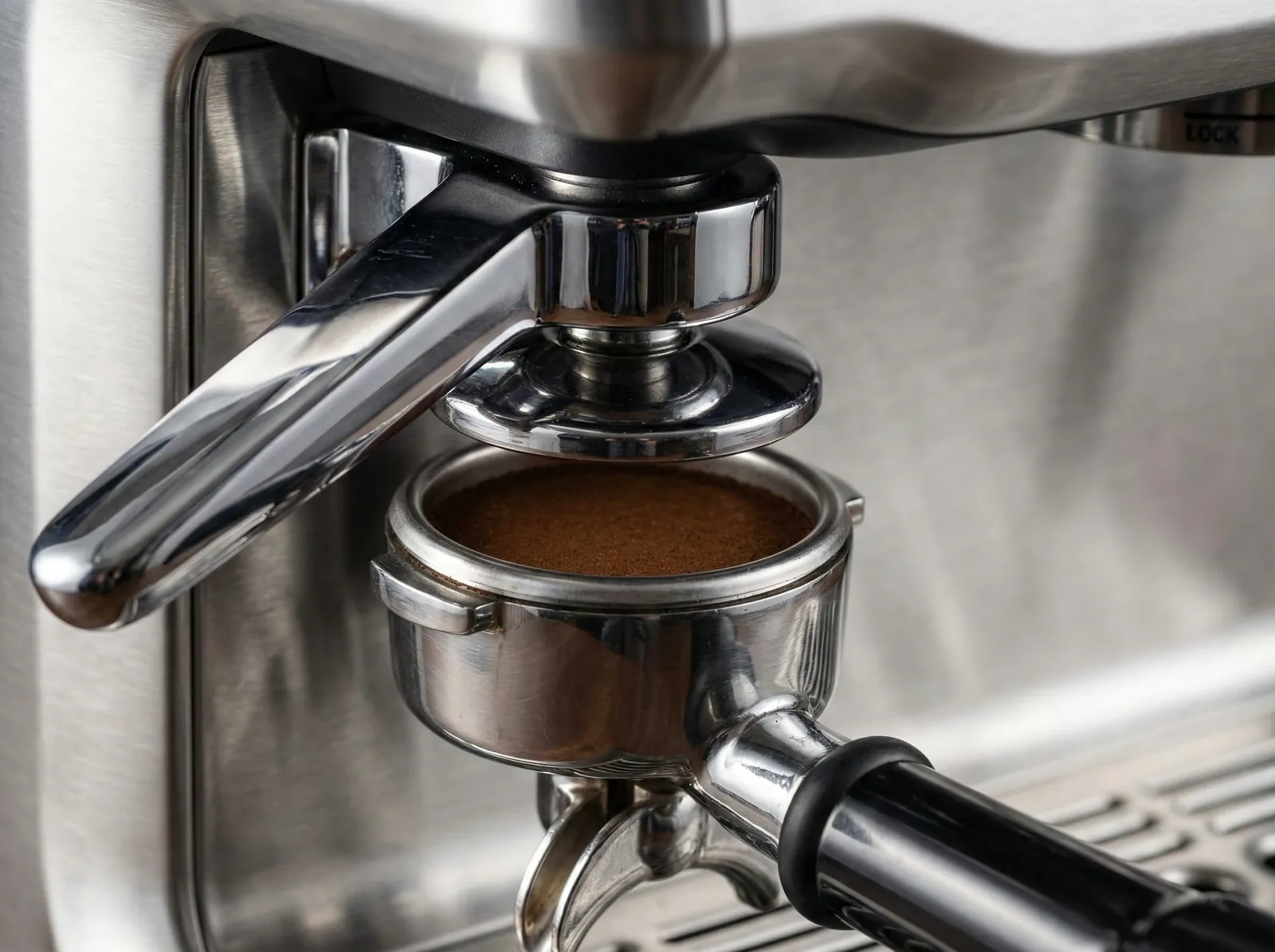
The assisted tamping mechanism needed zero learning — pull the lever, hear the mechanical click, and grounds compress to a consistent 22g. We pulled the basket mid-tamp twice in the first ten shots to check; the consistency held.
What it doesn't fix is distribution. Rushing and skipping the puck-leveling step on day three still produced channeling — the assisted tamp compresses evenly, but it can't correct uneven grounds underneath it. Once leveling became a habit, shot consistency matched what years of manual practice produce.
We ran three bean profiles to find where the grinder's limits show up:
The light-roast result is a mechanical limit of the conical burr geometry, not a technique problem. By the end of testing the whole routine felt automatic; medium and dark roast drinkers won't hit this ceiling.
Target extraction was 22g dose to 40g yield in 25–28 seconds. What we saw:
A meaningful share of shots during testing came down to user error — poor distribution, stale beans, wrong grind — rather than machine limitations. The real ceiling is temperature recovery on rapid back-to-back shots and light-roast extraction, not day-to-day consistency.
Across two weeks of milk drinks, whole milk textured to silky microfoam in under a minute per pitcher, with the steam wand's 360° swivel making it easy to angle the pitcher comfortably.
Maintenance is routine, with one recurring annoyance:
Fit, workflow and upkeep checks
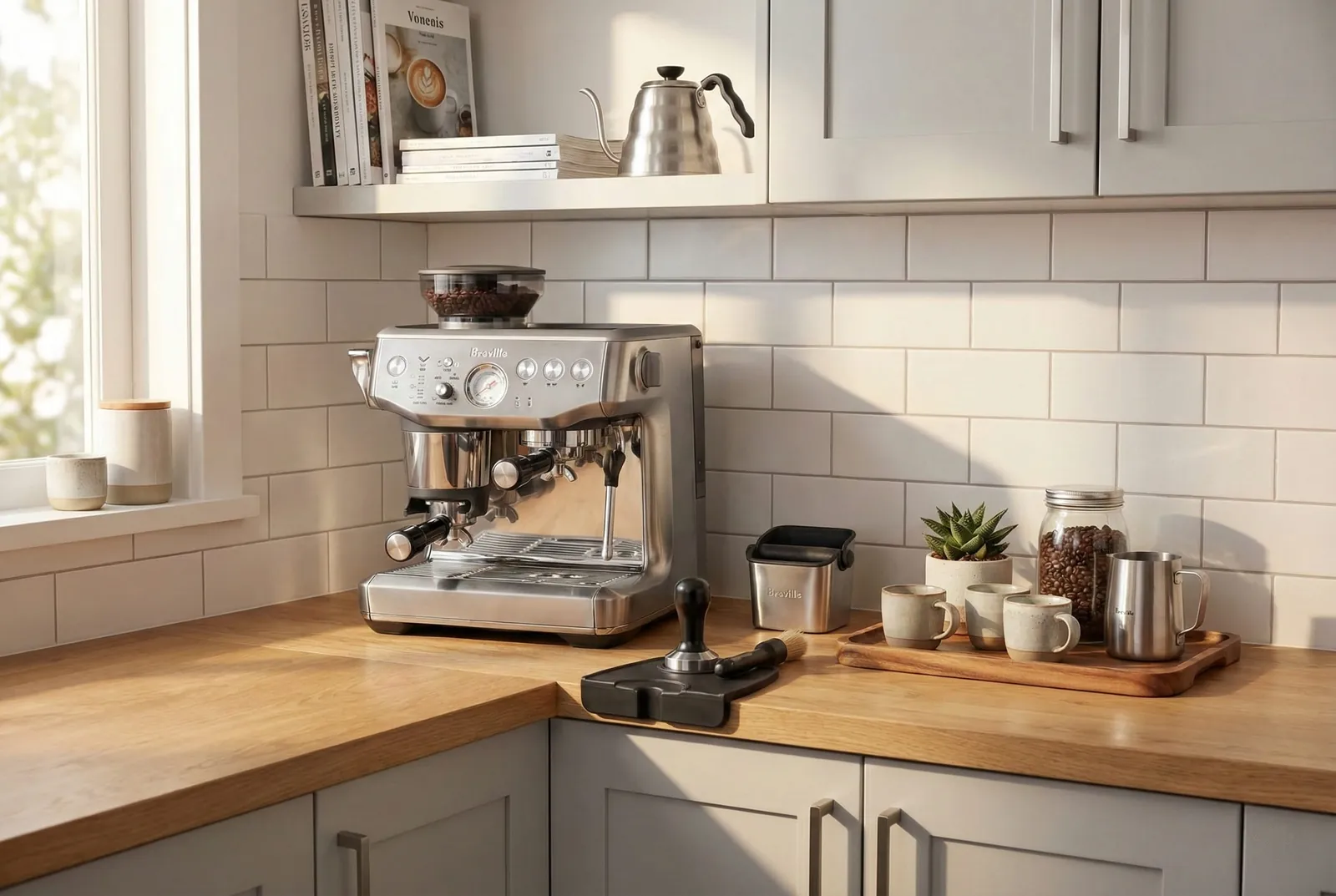
Before you order, think about counter space and cabinet clearance. All-in-one machines with a built-in grinder and hopper are taller and heavier than a standalone machine, so measure first and confirm dimensions on Breville's product page.
The built-in grinder keeps things simple, but you cannot swap it for a better one later. If you expect to move into light-roast single origins, you may prefer a standalone machine and a separate grinder; see our coffee grinder picks for that route.
Expect a short routine after each session: empty the used puck, rinse the portafilter and wipe the steam wand. Our guides on cleaning an espresso machine and machine maintenance explain the regular tasks, and you should follow Breville's manual for model-specific steps.
Choosing by how much you want to learn
If you want to learn tamping and distribution yourself, the standard Barista Express costs less and keeps those steps manual. If you want faster heat-up and more settings, look at the Barista Pro. For a higher-end automated tamping experience, see the Barista Touch Impress.
| Machine | Type | Heating system | Built-in grinder | Current price |
|---|---|---|---|---|
| Barista Express Impress | Semi-automatic | not listed | Yes | Check current price |
| Barista Express | Semi-automatic | not listed | Yes | Check current price |
| Barista Pro | Semi-automatic | ThermoJet | Yes | Check current price |
| Barista Touch Impress | Semi-automatic | ThermoJet | Yes | Check current price |
| Gaggia Classic Pro | Manual semi-automatic | Single boiler (aluminum) | No (separate grinder) | Check current price |
If you would rather separate grinder and machine, the Gaggia Classic Pro is a manual alternative that rewards practice. Our home espresso guide shows what a good workflow looks like whichever you choose.
The Impress makes sense when convenience and a shorter learning curve are worth the premium to you, and not when you want full manual control.
Torn between Breville's three all-in-ones? Our Barista Express vs Barista Pro vs Express Impress comparison shows what each upgrade buys.
Assisted tamping, grinder and heating explained
Common problems and modern fixes
Before you decide
Unlike marketing specs that emphasize bar pressure and wattage, real-world espresso quality comes down to a handful of factors: pressure stability during extraction, steam wand performance for milk drinks, grind precision, workflow complexity, and temperature stability.
Entry-level machines under $800 often compromise on one or more of these — sacrificing dual-boiler convenience for affordability, leaning on pressurized baskets to forgive a weak grinder, or using plastic components that cut into longevity. The Barista Express Impress takes a different approach: it automates the manual skill barrier — tamping — rather than compromising on extraction quality itself, which is why it holds up against machines built the traditional way. An inconsistent tamp is one of the more common causes of a shot running too fast or a puck coming out wet — see our wet puck guide for a full diagnosis.
For the Impress against its two siblings, see Barista Express vs Barista Pro vs Express Impress; if you are not sold on a built-in grinder at all, Breville Bambino Plus vs Barista Express covers the alternative route.
Durability, upkeep and running costs once the novelty wears off.
All-metal portafilter and group head with a stainless steel exterior; the water tank and drip tray are plastic, which is typical at this price.
The thermocoil heating system has a solid reliability track record in Breville's lineup, with an expected 5–8 year lifespan given regular descaling and cleaning.
Most-reported issues: pump vibration increasing after 2–3 years (normal wear) and a group head gasket needing replacement every 12–18 months — an $8 part, 15-minute DIY fix.
Burrs typically hold up 5–7 years under heavy use, and electronics including the PID rarely fail within the warranty period.
Breville maintains a strong parts catalog for years after a model's release — gaskets, shower screens, baskets, and burrs are available directly and through third-party retailers, usually shipping within a few business days.
Budget $30–$40 a year for descaling solution and cleaning tablets, or $150–$250 over five years including an occasional burr replacement — well under what super-automatic machines cost to maintain.
2 years, covering manufacturing defects and mechanical/electrical failures; normal wear items like gaskets and burrs aren't included.
Breville's support has a reputation for responsiveness, with repairs typically turning around in 10–14 days.
Well-maintained units tend to resell for roughly half their original price after two years, with the automated tamping feature drawing slightly stronger demand than the standard Barista Express.
This machine was purchased independently and was not provided by Breville.
Our rating, who it fits, and what it costs.
Breville Barista Express ImpressHighly recommended
4.5 / 5 — Is it worth buying?
This machine humbled a skeptic. The Barista Express Impress succeeds at its core mission: it removes the steepest technical barrier to consistent espresso extraction, and it held its own against careful manual technique in blind comparisons.
✓ Best for
✕ Skip if
Score breakdown
Shots tested
47
Testing period
14 days
Ready to decide?
Our verdict: 4.5/5, highly recommended. Independently tested; commissions never change a rating.
See how the Breville Barista Express Impress compares with the other picks in each tested roundup.
Closest alternatives in price and purpose, each tested the same way.
4.1De'Longhi
A bean-to-cup super-automatic that delivers consistently good espresso without any of the semi-automatic learning curve.
 3.9
3.9Bosch
A reliable automatic machine for one-touch cappuccino and latte macchiato without learning wand technique.
 4.2
4.2De'Longhi
A bean-to-cup super-automatic with 16 one-touch drink recipes and saved profiles — real convenience, not a craft project.
 4.2
4.2Ninja
A 4-in-1 machine covering espresso, drip, cold brew, and hot water, built around a weight-based grinder for beginners.
Put it into practice with a free calculator built for what you just read.
Quick answers before you buy.
They serve different buyers. The Impress ($750–$850) wins on automated tamping — automated dosing, leveling, and tamping at consistent pressure — plus a lower price and simpler workflow, which makes it the better pick for someone new to espresso.
The Barista Pro (~$849–$899) wins on faster ThermoJet heat-up, a more detailed LCD display, and quicker shot-to-steam recovery, and rewards buyers already comfortable with manual tamping. Both use 54mm portafilters and comparable built-in grinders, so the real decision comes down to whether you want tamping automated or want to keep full manual control for a bit less speed elsewhere.
If you want hands-free milk texturing and a touchscreen on top of that, the Barista Touch Impress costs roughly $450 more.
Yes — it's built specifically for this. The assisted tamping system removes the single biggest cause of bad beginner shots: uneven tamping pressure.
In testing, early attempts produced balanced espresso within the first two or three shots rather than the two-to-four-week learning curve typical of manual machines. It costs more than the standard Barista Express, but that premium buys you past the steepest, most frustrating part of learning espresso.
If you're an espresso purist who wants full manual control from day one, the Gaggia Classic Pro is the better starting point instead.
The Impress adds three things: an assisted tamping mechanism that auto-doses, levels, and tamps at consistent pressure; more precise, programmable dose control; and updated burr geometry for slightly better grind consistency. The standard Barista Express uses a manual tamper and rewards buyers who want traditional hands-on control.
The Impress typically costs roughly $150–$300 more than the standard Barista Express — worth it if consistent tamping is your priority, skippable if you're comfortable learning manual technique and want to save the difference. Our Barista Express vs Barista Pro vs Express Impress guide lays out all three, and the Barista Express review covers the original in depth.
Pull the lever down and the machine doses the grounds (programmable, roughly 18–22g), levels them with a leveling plate, then tamps at consistent pressure via a spring-loaded compression system, finishing with an audible click that confirms full compression. It can't be disabled — this machine is built around automating that step.
It also doesn't fix poor distribution underneath the tamp, so leveling the grounds before pulling the lever still matters. Buyers who specifically want manual tamping control should look at the standard Barista Express, Gaggia Classic Pro, or Rancilio Silvia instead.
In testing, medium roasts landed around setting 7 and dark roasts around setting 9, with each click shifting extraction time by a few seconds. Light single-origins need the finest settings and still pull too fast.
Start around setting 8, pull a test shot, and go finer if it runs under 25 seconds or coarser if it runs past 28. The grinder handles medium and dark roasts comfortably but reaches its finest-setting limit with ultra-light, Nordic-style roasts — a mechanical ceiling of the built-in conical burrs, not a dial-in problem.
For medium and dark roasts, the integrated conical burr grinder performs well — uniform particle distribution, low retention, minimal clumping — and it delivers the best coffee results when paired with fresh whole beans rather than pre-ground. Most users stay satisfied with it for a year or more.
Light roast specialty coffee drinkers will likely notice its ceiling sooner, since it can't reach the fine settings that dedicated espresso grinders like the Eureka Mignon or Baratza Sette can. If you drink mostly medium-dark roasts, the built-in grinder holds up well; light roast purists should budget for a standalone grinder upgrade down the line.
Choose the Barista Express Impress ($750–$850) if you want a built-in grinder plus automated tamping in one beginner-friendly package. Choose the Bambino Plus ($399–$449) if you already own a quality grinder, have limited counter space, and want automatic milk frothing with a much faster heat-up.
Choose the Gaggia Classic Pro ($450–$550) if you're an experienced home barista who wants a commercial 58mm portafilter, doesn't mind manual tamping, and values a long modding and upgrade path. The Impress offers the easiest all-in-one beginner experience of the three; the other two trade some convenience for lower price or more control.
Reader questions
Questions or tips? Leave a comment
Ask about your setup or share what worked for you. Comments are checked before they appear.