
 How to
Maintenance6 min read
Espresso Machine Maintenance: Daily to Yearly
Espresso machine maintenance schedule: daily, weekly and monthly cleaning tasks, backflushing, gasket care and descaling by water hardness.
Maintenance Guides
Last updated
Step-by-step descaling for the Breville Barista Express (BES870): what the Clean/Descale light means, the button sequence, rinsing and how to descale less often.
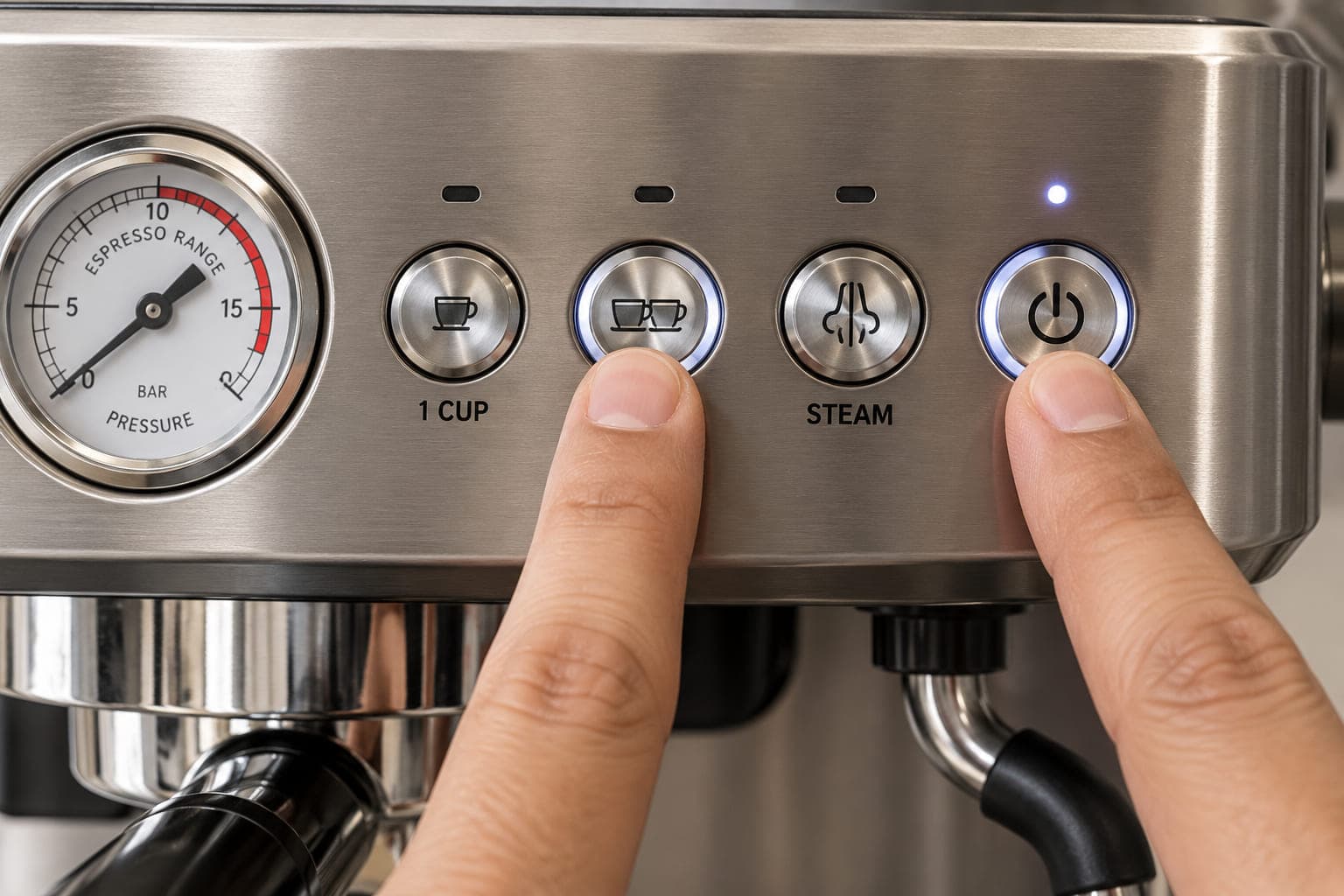
Remove the water filter, dissolve one descaling sachet in 1 L of water and pour it into the tank. With the machine off, press and hold the 2-cup button, then press and hold Power to enter descale mode. Press 1-cup to run solution through the group, then the steam and hot-water outlets, repeat until the tank is empty, and rinse with a full tank of fresh water the same way.
Read the Clean/Descale light first: flashing and solid mean different jobs.
| Clean/Descale light | What it means | What to do |
|---|---|---|
| Flashing | A cleaning cycle is due | Run a cleaning cycle with a cleaning tablet (backflush), not a descale |
| Solid | Descaling is due | Follow the steps below |
| Off | Nothing due yet | Keep using filtered water and change the filter on schedule |
How often the light comes on depends on your water. With hard tap water it can be every month or two; with soft or filtered water, much less often. If shots start pouring slower, the steam wand weakens or the machine sounds strained before the light comes on, descale anyway.
Everything fits on the counter; no tools needed.
| Item | Why |
|---|---|
| Breville descaling powder or a descaler made for espresso machines | One sachet dissolved in 1 L of water, as the manual specifies |
| A container of about 2 L | Catches the solution from the group head and the wand |
| Fresh cold water | For the rinse, a full tank to the MAX line |
| About 20 minutes | Most of it is waiting while the solution runs through |
Based on the descaling section of Breville's BES870 instruction book.
Prepare the machine. Empty the drip tray and the water tank, and take out the water filter.
Mix the solution. Dissolve one descaling sachet in 1 L (34 fl oz) of water and pour it into the tank.
Enter descale mode. With the machine off, press and hold the 2-cup button, then press and hold Power at the same time. The machine heats up and the lights show it is in descale mode.
Set out the container. Put the 2 L container under the group head and the steam wand.
Descale the brewing circuit. Press the 1-cup button. Solution runs through the group for about 25 seconds.25 seconds
Descale the steam and hot-water circuit. Turn the dial to steam and let it run, then turn it to hot water and let it run, then return the dial to the centre.
Empty the tank. Repeat steps 5 and 6 until the tank is empty. Empty the container whenever it gets close to full.
Rinse. Rinse the tank well, fill it with fresh cold water to the MAX line and repeat steps 5 and 6 until it is empty again. Do a second rinse tank if you can still taste or smell descaler.
Finish. Press Power to leave descale mode, refit the water filter and pull one shot to discard before brewing normally.
Hard water leaves minerals inside the thermocoil and the valves.
The Barista Express heats water as it passes through a thermocoil, a narrow stainless steel pipe inside a heated block. Calcium and magnesium in hard water come out of solution when heated and stick to the inside of that pipe and the valves after it. Over time the narrower path slows the flow, makes temperature less stable and weakens the steam.
Descaler is a mild acid that dissolves those deposits. Running it through all three outlets matters: the group head, the steam wand and the hot-water outlet each have their own path, and scale in any of them causes problems.
Rinsing matters as much as descaling. Descaler is designed to be flushed out, and a tank of fresh water through every outlet removes both the loosened scale and the acid itself. If you skip it, the first few shots can taste sour or metallic, and leftover solution sitting in the system is not good for seals over time. That is why the manual's sequence ends with a full rinse tank, and why a second one is a sensible habit.
Current best practice is to prevent scale rather than keep removing it.
Most problems come from the button order or an incomplete cycle.
If the machine simply turns on normally, it was not off when you started, or Power was pressed before 2-cup. Switch it off, wait a few seconds, then press and hold 2-cup first and add Power while still holding it. The lights change to show descale mode once the machine has heated.
If the Clean/Descale light is still solid after descaling, the cycle usually ended early: the tank emptied before the coffee, steam and hot-water stages had all run, or the machine was switched off part-way through. Run the full sequence again with a rinse tank. If the light is flashing instead, the machine is asking for a cleaning cycle with a tablet, which is a separate job covered in our cleaning guide.
If flow is weak through one outlet only, for example the steam wand, run extra solution through that outlet before rinsing. A wand that still spits or barely steams after descaling may have a blocked tip; our steam wand not frothing guide covers how to clear it.
Know your water. Inexpensive hardness test strips tell you how quickly scale will build. Hard water means descaling every month or two even with the filter; soft or filtered water can stretch that to several months. Write the date on the tank or in your phone after each descale so you can see your own interval.
Most problems after descaling come from one of these.
| Problem | Fix |
|---|---|
| Coffee tastes sour or chemical afterwards | Run another full tank of fresh water through the group, steam and hot-water outlets |
| Light still on after descaling | Make sure you entered descale mode with the button sequence and ran the full cycle, not just hot water |
| Water filter left in | Take it out before descaling; descaler shortens its life |
| Using vinegar | Use a descaler made for espresso machines; vinegar is harder to rinse out and leaves a taste |
| Steam wand skipped | Run solution through the steam and hot-water outlets as well as the group head |
Quick decision guide
The flow is still slow after descaling
Check the grind and dose first with our shot too fast or too slow guide.
You have a different coffee machine
Use our general how to descale a coffee machine guide.
You want a full upkeep routine
Follow the schedule in our espresso machine maintenance guide.
Quick answers before you buy.
When the Clean/Descale light is solid, or every two to three months with hard water.
With filtered or soft water it can be much less often.
A flashing light means a cleaning cycle is due, which uses a cleaning tablet.
A solid light means descaling is due.
It is better not to.
Use Breville's descaling powder or a descaler made for espresso machines.
Vinegar is harder to rinse out and can leave a taste in your coffee.
The Express Impress is very similar: with the machine off, hold 2-cup and Power together to enter descale mode.
The Barista Pro is different; you start descaling from its menu and follow the prompts.
About 20 minutes, including the rinse.
Most of that time is the solution running through the group and the wand.
Yes.
Take it out before adding descaler and refit it, or fit a new one, after the rinse.
Keep reading: more guides on the same topic.
How toMaintenance6 min read
Espresso machine maintenance schedule: daily, weekly and monthly cleaning tasks, backflushing, gasket care and descaling by water hardness.
 How to
Maintenance6 min read
How to descale a coffee machine: drip, Nespresso, Keurig or espresso steps, vinegar vs descaler, and how often to descale.
 How to
Maintenance6 min read
Best coffee machine cleaning tablets for espresso, bean-to-cup and drip machines: which to buy for yours and how to use them.
 How to
Maintenance6 min read
How to clean an espresso machine: daily, weekly and monthly steps for the portafilter, group head, steam wand and backflush.