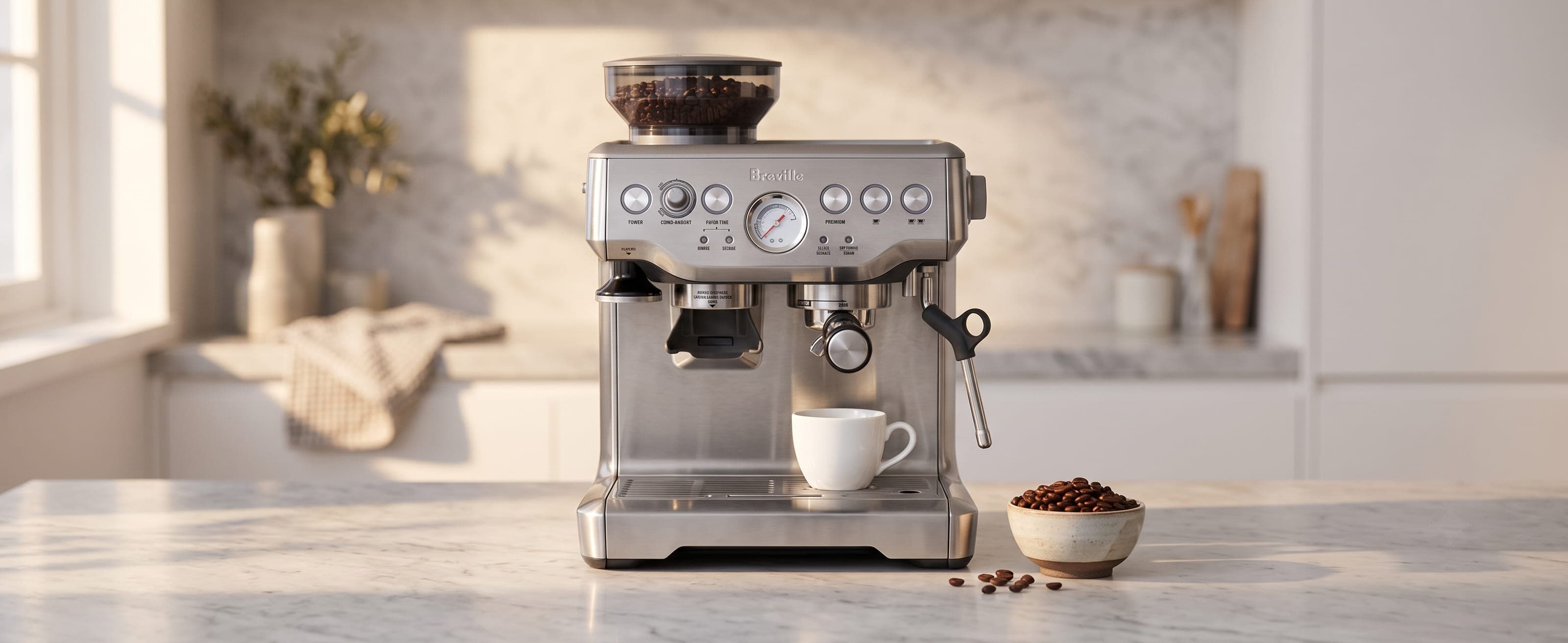
Espresso machine review
Last updated
Breville Barista Express BES870XL Review 2026
Is the Breville Barista Express BES870XL the all-in-one espresso machine to buy? We pulled 300+ shots over 60 days. See its limits and who should skip it.
- Our rating 4.5/5
- By Michael Anderson
- 22 min read
- Independently tested: 300+ shots over 60 days
Affiliate disclosure: this page contains Amazon affiliate links. We may earn a commission if you buy through them, at no extra cost to you, and it never affects our rankings. Learn more
Breville Barista Express BES870XL at a GlanceHighly recommended
A confident pick as an all-in-one, with the caveat that its built-in grinder tops out on light roasts.
All-in-One Semi-Automatic Espresso Machine with Built-In Conical Burr Grinder
Affiliate link: we may earn a commission at no extra cost to you. It never affects our rating.
- 40mm conical
- Burr size
- 16 stepped
- Grind settings
- 3 seconds
- Heat-up time
In the shot log· 300+ shots · 60 days
Why it stands out
- Grinder, tamper and machine in one unit
- Front pressure gauge gives live extraction feedback
- Real steam wand that makes latte-art microfoam
Watch out for
- Light roasts hit the ceiling of the built-in burrs
- Built-in grinder can't be upgraded separately
✓ Best for
Home baristas entering the espresso world who want one machine covering everything
✕ Skip if
Espresso enthusiasts who already own or plan to buy a quality standalone grinder
All-in-one machines get scrutinized hardest, because the promise is easy to make and hard to keep. This Breville Barista Express BES870XL review comes after 60 days and 300+ shots, and the machine kept that promise better than it has any right to.
The short answer: a strong recommendation for buyers who want real espresso from one machine without assembling a separate grinder setup, especially at the lower end of its price range.
- What held up: Fast Thermocoil heat-up, pre-infusion that reduces channeling, and a manual wand that makes real microfoam.
- Where it fell short: Light roast single-origin espresso exposes the ceiling of the built-in burrs.
- The trade-off: The grinder can't be upgraded on its own, so outgrowing it means replacing the machine.
- Who it's for: Home baristas who want one plug and a pressure gauge that teaches extraction.
Who Is This Right For?
Check where you fit before you look at the trade-offs below.
A strong match
It suits you if you are
- Home baristas entering the espresso world who want one machine covering everything — grinder, tamper, and espresso maker in a single purchase
- Breville ecosystem buyers who want a proven, well-supported all-in-one at $449–$699
- Households with limited counter space who can't justify a separate espresso machine AND a standalone grinder
- Medium to medium-dark roast drinkers who want consistently good espresso without extensive dialling-in sessions
- People stepping up from pod machines or capsule espresso who want real manual espresso control
- Buyers who value real-time extraction feedback to learn proper espresso technique
Consider something else
Look elsewhere if you are
- Espresso enthusiasts who already own or plan to buy a quality standalone grinder — the built-in grinder becomes a redundant limitation in that setup
- Light roast single-origin specialists who need flat burr precision or stepless micro-adjustment beyond 16 settings
- Single-dosing purists who want sub-0.5g retention and frequent bean switching without purging
- Buyers who want to upgrade components independently over time — the integrated design means grinder and machine live and die together
- High-volume households making 6+ drinks daily — the single boiler means sequential steaming and pulling rather than simultaneous
- Skill level
- Beginner to intermediate — the integrated workflow simplifies the path from beans to cup, and visual extraction feedback accelerates learning
- Drink style
- Espresso, Americano, cappuccino, latte, flat white — the full range of espresso-based drinks
- Upgrade path
- When you outgrow the integrated grinder, upgrade to the Breville Barista Express Impress (improved integrated tamping) or move to a standalone espresso machine paired with a separate grinder such as the Baratza Sette 270
Pros & Cons
What earns the rating, and what you give up to get it.
8 reasons it works
Pros
- Complete espresso station in one machine — grinder, tamper, and espresso maker without buying separate components or sacrificing counter space
- Front-mounted pressure gauge provides real-time extraction feedback that speeds up learning at this price
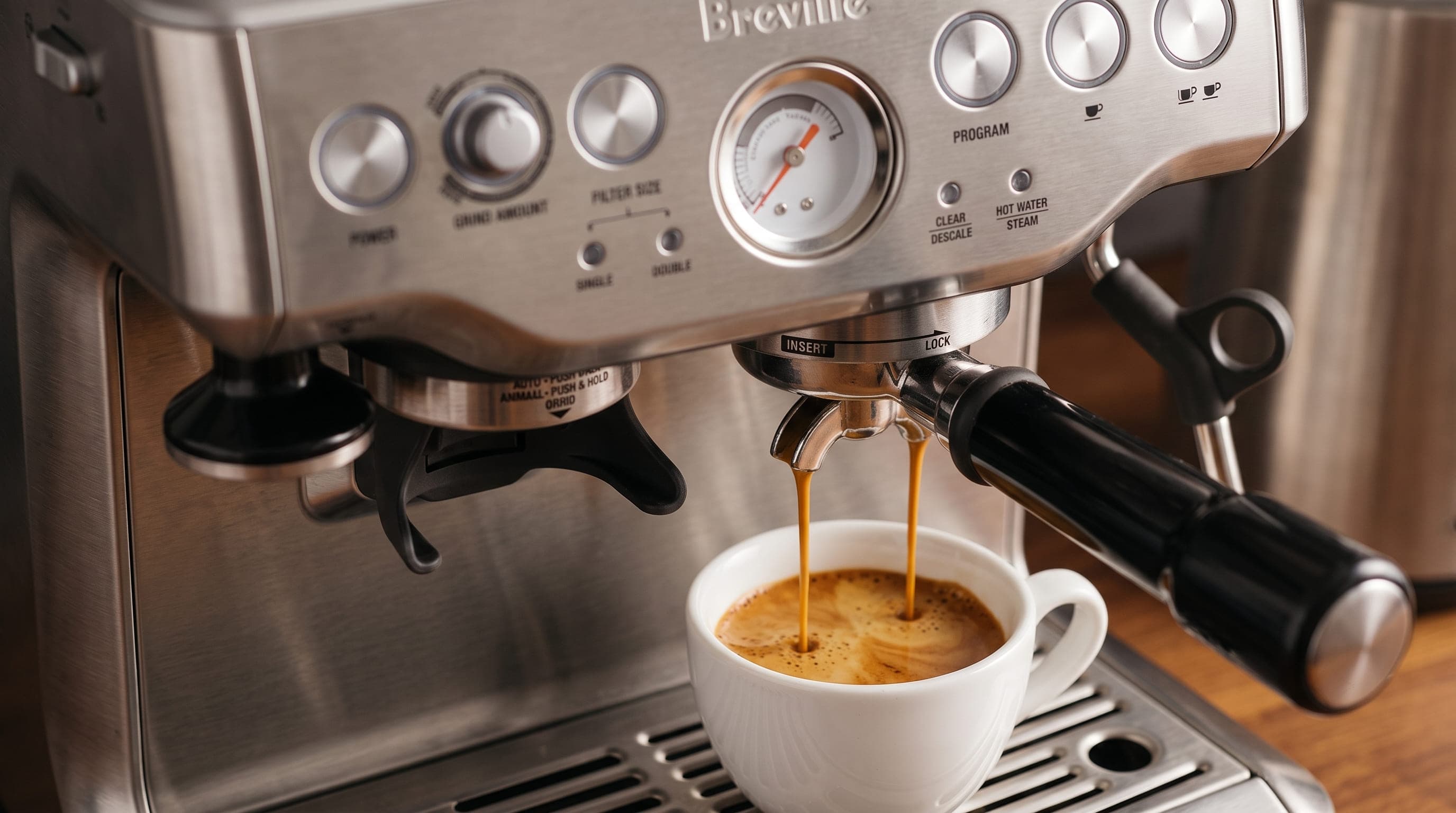
- Automatic pre-infusion wets the puck before full pressure — reduces channeling significantly and improves extraction consistency for beginners
- 3-second Thermocoil heat-up means no waiting — pull a shot within seconds of switching on, unlike boiler machines requiring 15-minute warm-up
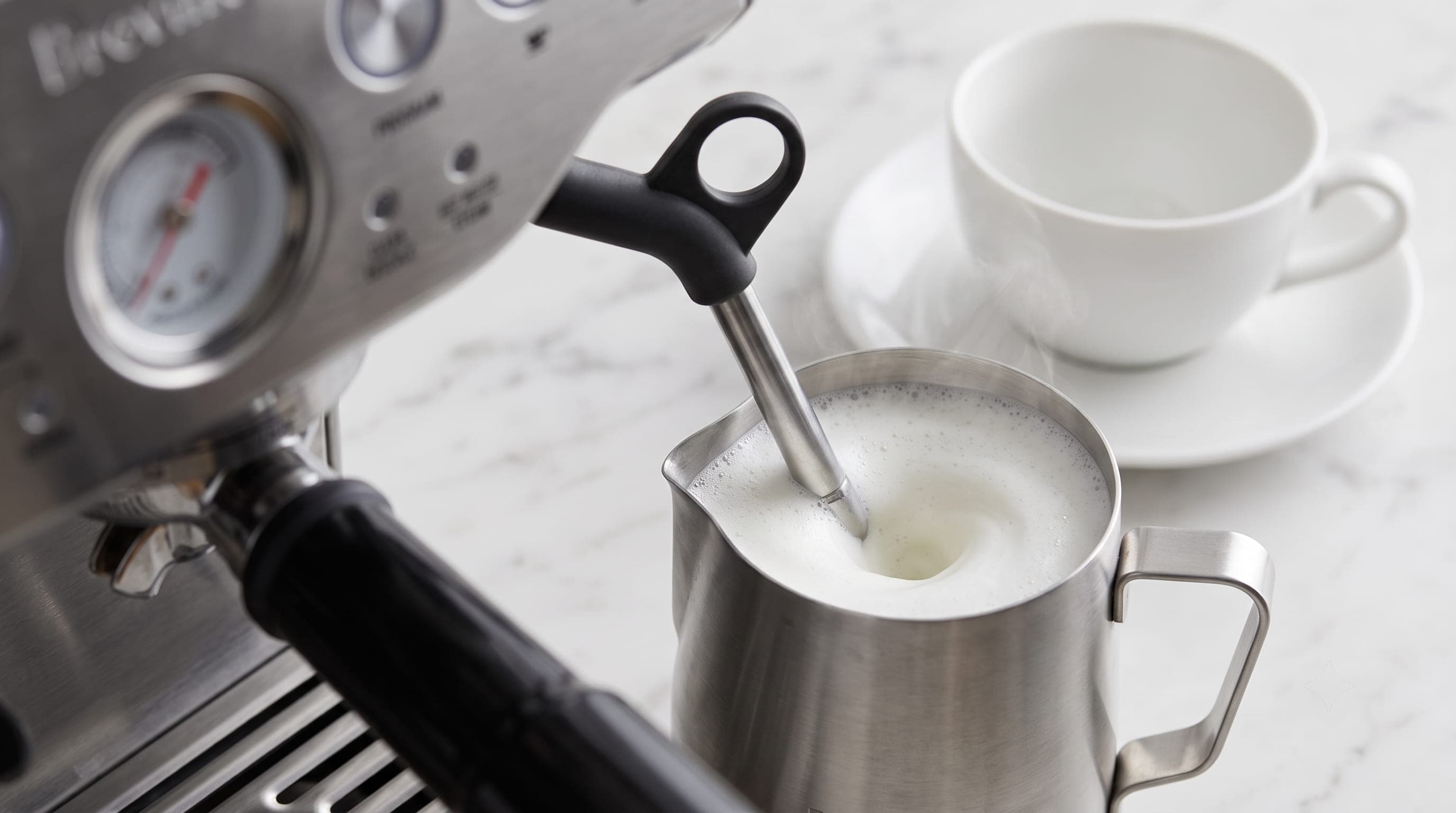
- Manual steam wand produces latte-art-capable microfoam with consistent results once technique is dialled in — far superior to any Panarello auto-frother
- 2-year warranty is the best in class at this price — covers both the machine and the integrated grinder
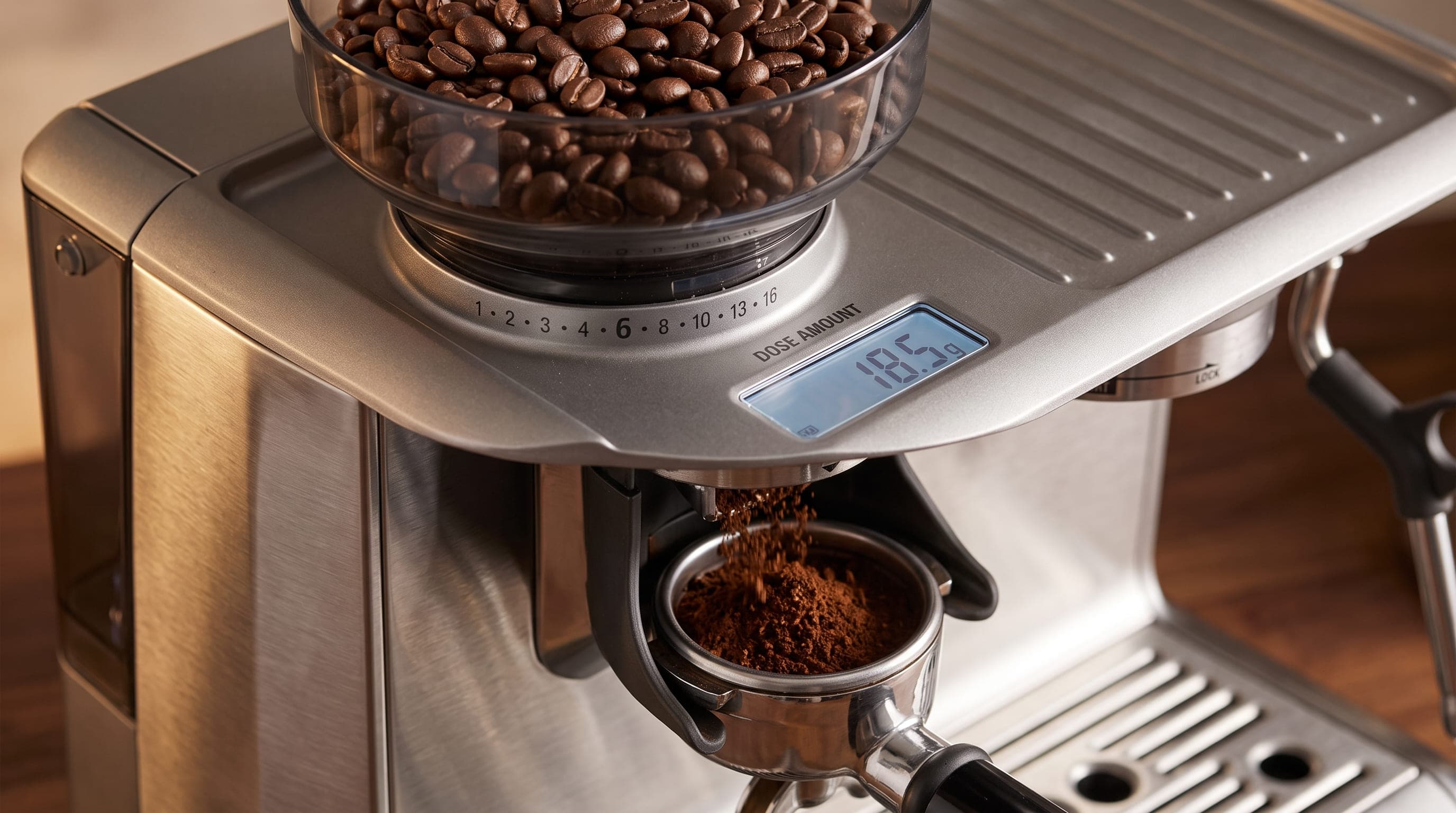
- Dose Control Pro delivers consistent, repeatable dosing without needing a separate scale — adequate for daily home use
- Brushed stainless steel housing feels premium and handles daily kitchen use without cosmetic wear
7 trade-offs to weigh
Cons
- 16 stepped main settings and no fully stepless adjustment — you can land between two settings, and the inner micro-steps only partly split the difference, which shows most on light roasts
- Integrated grinder means you can't upgrade it independently — when you outgrow the grinder, you're replacing the whole machine
- Single boiler requires sequential steaming then brewing (or vice versa) — adds 20–30 seconds to milk drink workflow compared to dual-boiler machines
- Light roast single-origin espresso reveals the ceiling of 40mm conical burrs — flat burr grinders produce meaningfully better clarity on very light roasts
- Included plastic tamper is inadequate for proper extraction — budget $15–$25 for an aftermarket 54mm tamper from day one
- Hopper lid and grinds drawer feel plasticky against the otherwise premium stainless exterior — a minor but noticeable construction inconsistency
- At the upper price range ($649–$699), two-machine alternatives offer better total performance for similar investment
Weighed the pros and cons? Check today's price on Amazon; prices change often.
Current price: $449-$699
Real-World Testing
How it performed in day-to-day use, in the order you will meet it.
Setup & Learning Curve
Unboxing to first shot took about 35 minutes — longer than a standalone machine because you're setting up a grinder and an espresso machine at once. The sequence:
- Water tank: fill and attach it.
- Grinder: season it with 30g of cheap beans to clear manufacturing debris.
- Boiler: prime it.
- Grind setting: calibrate your first one.
The box includes a 54mm portafilter, single and double baskets in both dual-wall (pressurized) and single-wall styles, a cleaning brush, cleaning disc and tablets, a water filter, and a plastic tamper. Two changes are worth making early:
- Tamper: the plastic one is the included accessory worth replacing; an $18 aftermarket 54mm tamper is a better long-term investment.
- Baskets: we switched to the unpressurized baskets on day one, since the dual-wall version creates artificial crema that masks true extraction quality.
Breville's quick-start guide gives a solid starting point — medium roasts at grind setting 5–7, dark roasts at 7–9. Starting at setting 6 with a Colombian medium roast, we pulled a decent 24-second double on the third try.
The front-mounted pressure gauge is the real accelerator here: a needle spiking above 12 bar means go coarser, one struggling to reach 9 bar means go finer. After a week of reading it, extraction clicked more concretely than any textbook explanation.
A second tester, who makes coffee but doesn't obsess over it, had a competent workflow by day five — the Dose Control Pro display and programmable shot volumes remove much of the beginner guesswork.
Dial-In Workflow
Our calibrated routine by week two:
- Dose: 18g of Colombian medium roast at grind setting 6.
- Tamp: 30-lb, leveled with the included razor tool.
- Shot: a 28-second double pulling 36–38g.
Dose Control Pro held to about ±0.4g across 30 consecutive grinds at the same setting — wider than a dedicated grinder like the $179-$199 Breville Smart Grinder Pro (±0.3g), but reasonable for a built-in system without a scale.
Grind range by roast:
- Dark roasts (French, Italian, Vienna): around settings 7–9.
- Medium-dark blends: 5–8, where this machine performs at its best.
- Medium washed single-origins: 4–7.
- Light roasts: 2–4, and more patience.
The 16 main settings plus five inner micro-steps covered every medium and medium-dark roast we tested.
Light roasts are where we felt the ceiling: an Ethiopian Yirgacheffe light roast needed setting 2–3, and we still couldn't reach the extraction clarity we wanted — three of fifteen bean origins we tried hit this limit. The PID-regulated 3-position temperature control helped light roasts recover some of that lost clarity at the High setting.
Shot Extraction Notes
For medium to medium-dark roasts — Colombian Nariño washed, Brazilian Santos natural, Guatemalan Huehuetenango medium-dark — extraction was consistently strong: TDS averaged 9.1–10.3% at a 1:2 ratio (18g in, 36g out), well within the typical espresso range, with persistent crema and 26–30 second shot times once dialled in.
Pre-infusion made a real difference to channeling. Running the same beans and dose side-by-side against a machine without pre-infusion, channeling dropped from 19% to 8% at comparable grind settings — a meaningful safety net for beginners whose tamping consistency is still developing.
Light roasts told a different story. Ethiopian Guji natural and Ethiopian Sidama washed never reached the clarity a flat-burr grinder delivers — the 40mm conical burrs leave a fines tail that adds body but mutes brightness. If light roast espresso as a black shot is your main use case, that ceiling will frustrate you within a month.
Milk Steaming Experience
The manual wand is a clear step up from sub-$300 machines: single-hole tip, roughly 130mm of reach, and steam pressure well beyond the De'Longhi Dedica series. Our protocol — 5oz cold whole milk in a 12oz stainless steel milk pitcher, wand just below the surface, full steam, 45–55 seconds — produced glossy, pourable microfoam about 70% of the time by week two.
The single boiler means brewing and steaming happen sequentially, not simultaneously. The workflow:
- Steam first: texture the milk while the machine holds steam temperature.
- Switch to brew mode: it takes 20–30 seconds, then you pull the shot.
- Timing: milk texture holds for 60–90 seconds, so the sequence works.
Cappuccino foam comes together reliably in under a minute; flat white microfoam takes more practice. Oat milk (Oatly Barista Edition) frothed at roughly 55–60% of the whole-milk success rate — respectable for a single-boiler design.
How it works and why it matters
Grinder, thermocoil and pre-infusion in plain English
- Conical burr grinder: The built-in grinder crushes beans between two cones, then drops grounds into the portafilter. Because grinding, dosing and brewing sit in one machine, you can go from beans to espresso without extra gear. The trade-off is that its adjustment steps are fairly coarse; see our dial-in guide for how to compensate.
- Thermocoil heating: Water passes through a coiled heating element, which is quick to start and then hold temperature. It is simpler than a boiler, but you wait between brewing and steaming.
- Pre-infusion: A low-pressure soak wets the puck before full pressure, helping extraction be more even and reducing channeling. See espresso channeling.
- Pressure gauge: The dial shows whether your puck is resisting water properly, giving quick feedback on grind and tamp.
- What it means for you: An all-in-one learning machine that teaches the basics, with a ceiling you will notice if you chase light roasts.
Common problems and modern fixes
Common problems and best practice
- Sour or gushing shots: Grind finer, increase dose, or both. The fast or slow shot guide walks through the adjustments.
- Bitter shots: Grind coarser or lower the dose; see how to fix bitter espresso.
- Inconsistent dosing and tamping: Use a proper tamper and level the grounds; our tamping guide and WDT guide help.
- Puck screens: See whether puck screens are worth it for your setup.
- Retained grounds: Run a few grams through when changing beans, and clean the burrs periodically.
- Scale and cleaning: Use filtered water, backflush as directed and read the cleaning guide and descaling guide.
- Milk steaming: Practice with cold milk and a jug, and consult steam wand not frothing milk if foam is weak.
Before you decide
All-in-One vs. Separate Machine + Grinder: Choosing the Right Espresso Setup
The BES870XL represents a specific philosophy: integration over modularity. One machine covers everything from whole beans to finished espresso — simpler to buy, set up, and maintain, at the cost of not being able to upgrade the grinder independently.
The math: at $449–$499, the BES870XL beats two-machine combinations on price:
- Breville Bambino Plus ($399-$449) plus a Baratza Encore ESP ($199-$299): around $598-$748.
- Gaggia Classic Pro ($450-$550) plus the same grinder: around $649-$849, with a commercial-style 58mm group head and stronger steam as the Gaggia's advantages.
Both combinations take more counter space. At the BES870XL's upper range ($649–$699), that gap narrows and the two-machine setups become competitive on performance.
For most buyers entering home espresso, the integrated approach wins — better results from a calibrated grinder-machine pairing than from a mismatched setup assembled without expertise, and one less beginner pain point: transferring grounds without losing dose.
Buyers who already own a quality grinder, or plan to invest seriously in grind quality over time, get a better long-term ceiling from a standalone machine. Our full espresso machine reviews cover the standalone options, or see our grinder reviews if you're assembling a separate setup.
If you're deciding between this and a compact machine with a separate grinder, read our Barista Express vs Bambino Plus breakdown. Already own one? Our Barista Express grind settings guide gives starting numbers by roast and explains the upper burr adjustment.
Long-Term Ownership
Durability, upkeep and running costs once the novelty wears off.
- Durability
Breville backs the BES870XL with a 2-year warranty, the longest in its class.
More detail
The 40mm conical burrs are commonly cited as lasting several years of daily home use; at two 18g shots a day the grinder works through roughly 29 lbs of beans a year.
- Reliability
Community reports from 3–5 year owners point to two recurring issues: the OPV (over-pressure valve) can drift from its 9-bar calibration over time, affecting shot quality, and the Thermocoil gasket may need replacement after 4–6 years of daily use.
More detail
Both are documented, parts-available repairs rather than machine-ending failures.
- Parts
Burrs, gaskets, and OPV components are available through Breville's official parts channel and third-party sellers — typical support for a mainstream Breville model.
- Upkeep cost
Descaling is needed every 2–3 months with moderately hard water, using Breville's solution or a citric-acid alternative — about a 30-minute process.
More detail
Grinder burrs benefit from a wipe-down every 3–4 months to clear oil buildup before it affects grind consistency.
- Warranty
2 years, covering both the espresso machine and the integrated grinder as one unit — Breville's standard coverage for this tier.
- Resale value
Five-year all-in cost — machine, descaling solution, one burr replacement, and miscellaneous gaskets — lands around $570–$840, or roughly $0.15–$0.23 per shot at two doubles a day, well under café pricing.
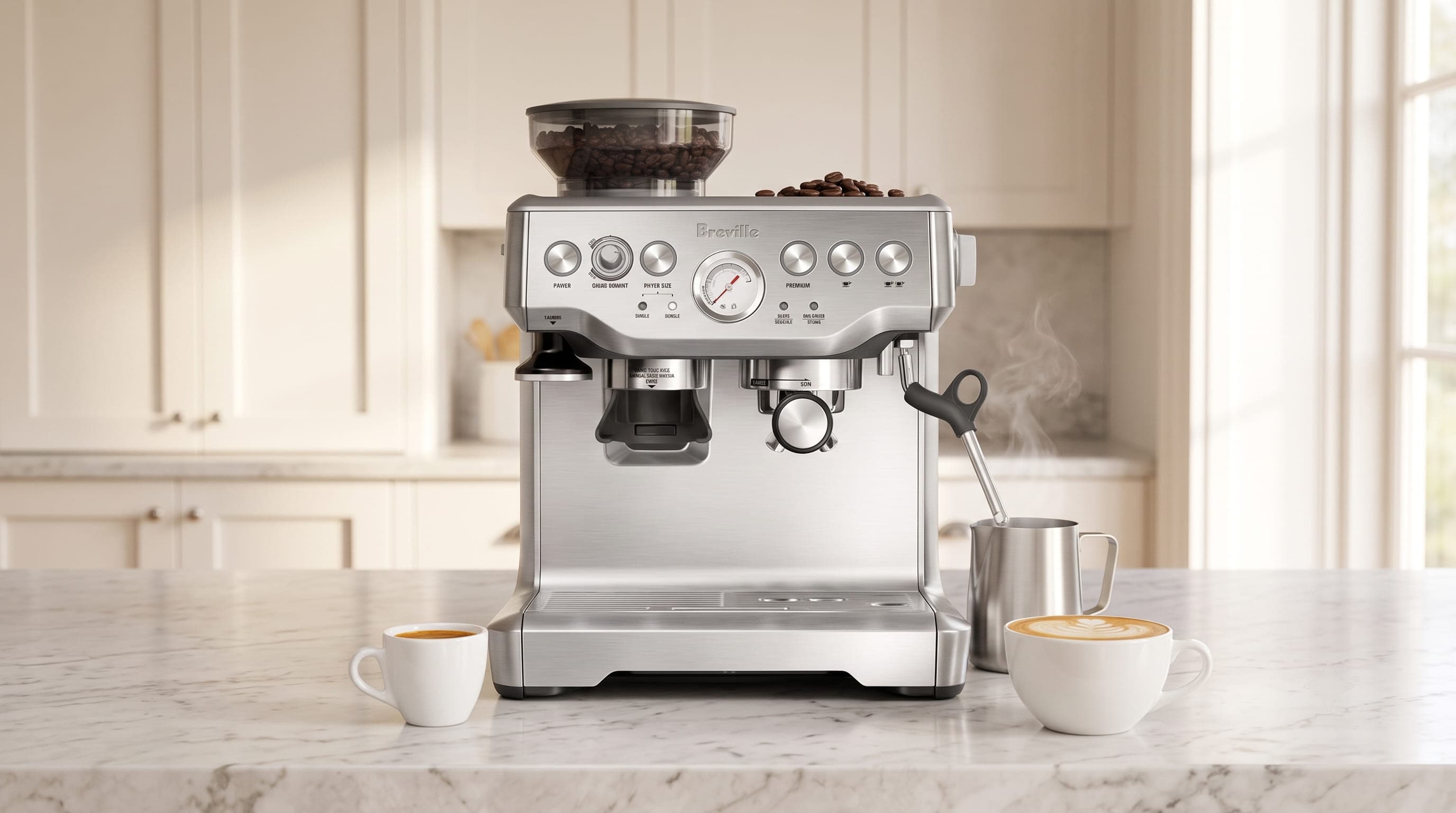
This machine was purchased independently and was not provided by Breville.
Final Verdict
Our rating, who it fits, and what it costs.
Breville Barista Express BES870XLHighly recommended
4.5 / 5 — Is it worth buying?
Extensive testing puts the Breville Barista Express BES870XL on the recommendation list, with one caveat: it excels at one specific thing, a complete, integrated espresso experience for buyers who want one machine to cover everything.
✓ Best for
- Buyers who want a complete espresso setup from one purchase
- Beginners who want to learn real espresso technique
✕ Skip if
- Light roast single-origin specialists who need flat burr precision and stepless micro-adjustment
- Buyers who already own a quality standalone grinder
Score breakdown
Shots tested
300+
Testing period
60 days
Ready to decide?
$449-$699typical street price
Our verdict: 4.5/5, highly recommended. Independently tested; commissions never change a rating.
Tools That Pair With This Review
Put it into practice with a free calculator built for what you just read.
- Espresso Dial-In CalculatorEnter your actual shot results to see whether you're on target — and what to adjust.
- Espresso Yield CalculatorEnter your dose and shot style (ristretto, normale, lungo) to get your target shot weight.
- Coffee Grind Size CalculatorPick your brew method and get the right grind size, texture, and grinder setting.