
 4.1
4.1De'Longhi
De'Longhi Magnifica Evo ECAM290.21.B
A bean-to-cup super-automatic that delivers consistently good espresso without any of the semi-automatic learning curve.
Espresso machine review
Last updated
Do beginners need training wheels? Our De'Longhi La Specialista Arte espresso machine review pulled 120+ shots. See Smart Tamping results and who should pass.
Affiliate disclosure: this page contains Amazon affiliate links. We may earn a commission if you buy through them, at no extra cost to you, and it never affects our rankings. Read our full affiliate disclosure
De'Longhi La Specialista Arte at a GlanceRecommended
Beginner-friendly automation that holds up at this price, as long as you don't need manual control or light-roast range.
Entry-Level Semi-Automatic with Integrated Grinder and Smart Tamping
Affiliate link: we may earn a commission at no extra cost to you. It never affects our rating.
In the shot log· 120+ shots · 35 days
Why it stands out
Watch out for
✓ Best for
Espresso beginners wanting consistent results from day one
✕ Skip if
Advanced home baristas needing 58mm compatibility
A tamping station sounds like it cheats the muscle memory of real technique, but in our blind tastings nobody could reliably tell automated tamping from manual, and more tasters preferred the automated shot.
The short answer: at $499–$549 it's a confident pick for aspiring home baristas who want help with mechanical precision but are happy to steam milk by hand.
Browse our espresso machine reviews hub for more options across every budget.
Check where you fit before you look at the trade-offs below.
A strong match
Consider something else
What earns the rating, and what you give up to get it.
15 reasons it works
15 trade-offs to weigh
How it performed in day-to-day use, in the order you will meet it.
Setup took 18 minutes: install the water tank, fill the bean hopper, prime with two blank runs. The Smart Tamping Station is intuitive. Place the portafilter in the cradle, the sensor triggers grinding, and the system doses, levels, and tamps at a consistent 30 pounds of pressure automatically.
Target ratio: 16-18g dose, 32-36g yield, 25-30 seconds. Because Smart Tamping doses by time rather than weight, we measured actual dose consistency directly.
The Arte ships with two ways to texture milk: the automatic LatteCrema system and a traditional manual steam wand (branded My LatteArt).
At 9.8"W x 13.4"D x 13.5"H and 22 lbs, the Arte is noticeably more compact than machines like the Barista Express, with a brushed-stainless finish that looks and feels more expensive than its price suggests.
We tested brewing temperature with a thermocouple probe through a blind basket across ten consecutive shots at three-minute intervals. Readings clustered tightly between about 93.7-94.4°C (200.7-201.9°F), averaging 94.1°C with a standard deviation of roughly 0.2°C. That's noticeably steadier than single-boiler machines without a PID mod, which commonly swing several degrees between shots.
The built-in conical burr grinder handles medium and medium-dark roasts well, but two limitations are worth flagging.
We measured with a decibel meter at roughly three feet: grinding runs 72-78 dB for roughly 12 seconds, brewing sits around 60-63 dB, and steaming/frothing lands 68-72 dB. For context, normal conversation is about 60 dB and a running vacuum cleaner is 70-80 dB, so the grinder burst, while brief, is loud enough to wake a household member sleeping nearby.
Recovery between drinks was roughly 45-60 seconds for consecutive espresso shots and about 35-40 seconds switching to steam. That was quick enough that pulling three or four drinks back-to-back for guests stayed practical, though a touch slower than machines with fully independent dual boilers.
Nothing about the Arte felt fragile during testing.
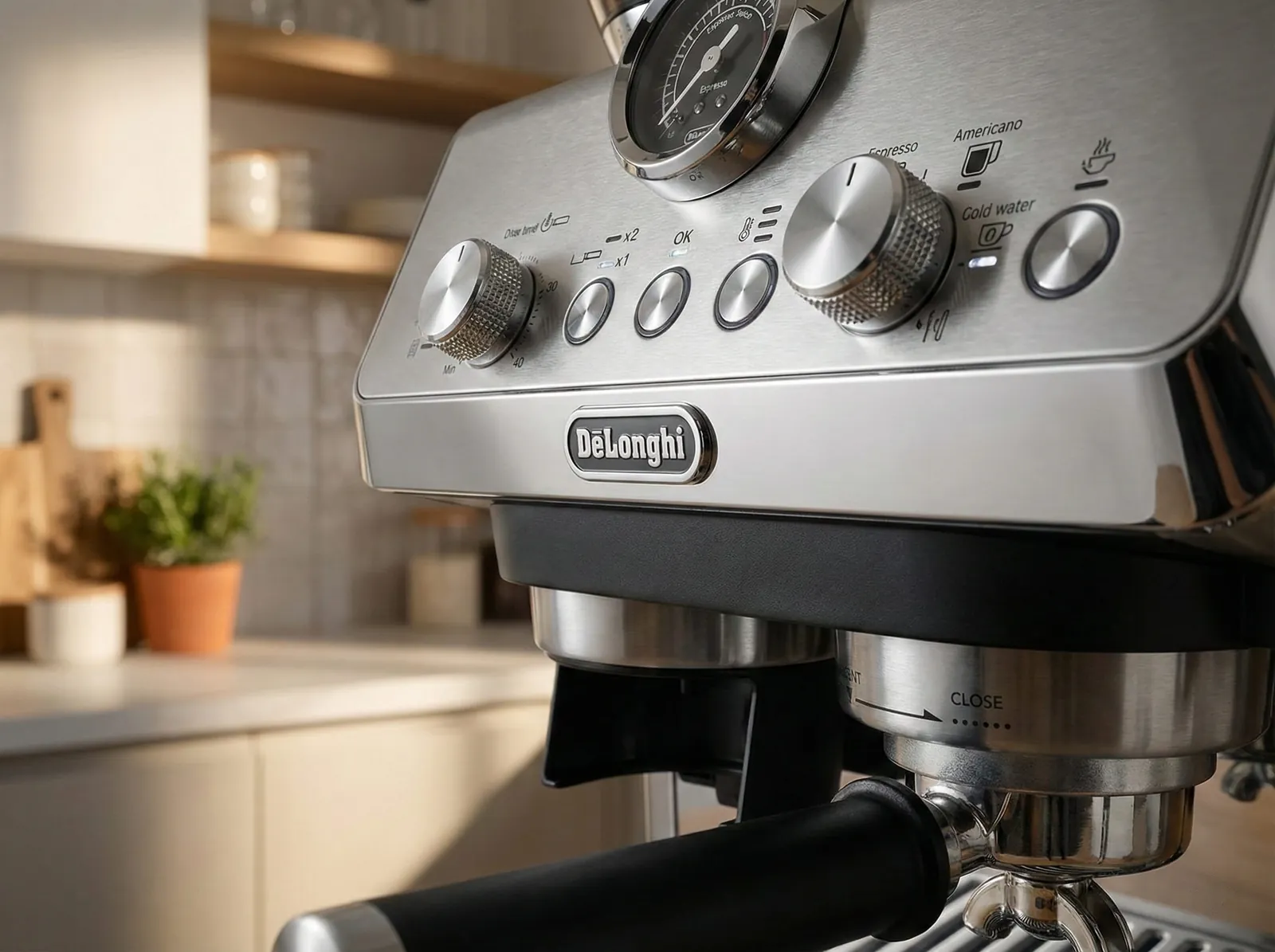
The La Specialista Arte pairs sensor grinding, a smart tamping station and a thermoblock with active temperature control. Here is how.
The built-in grinder senses how much coffee it has dispensed and stops at a set dose. The Smart Tamping Station then compresses the grounds, which removes the most common beginner error and reduces espresso channeling.
The thermoblock heats water on demand, and Active Temperature Control adjusts the heater as the water flows, so shots stay stable without a large boiler. The result is a repeatable, medium-bodied shot that tastes more consistent than most machines at this price.
Locking the temperature and limiting grind steps keeps things simple, but they also limit light-roast tuning. See espresso extraction to understand which variables you still control.
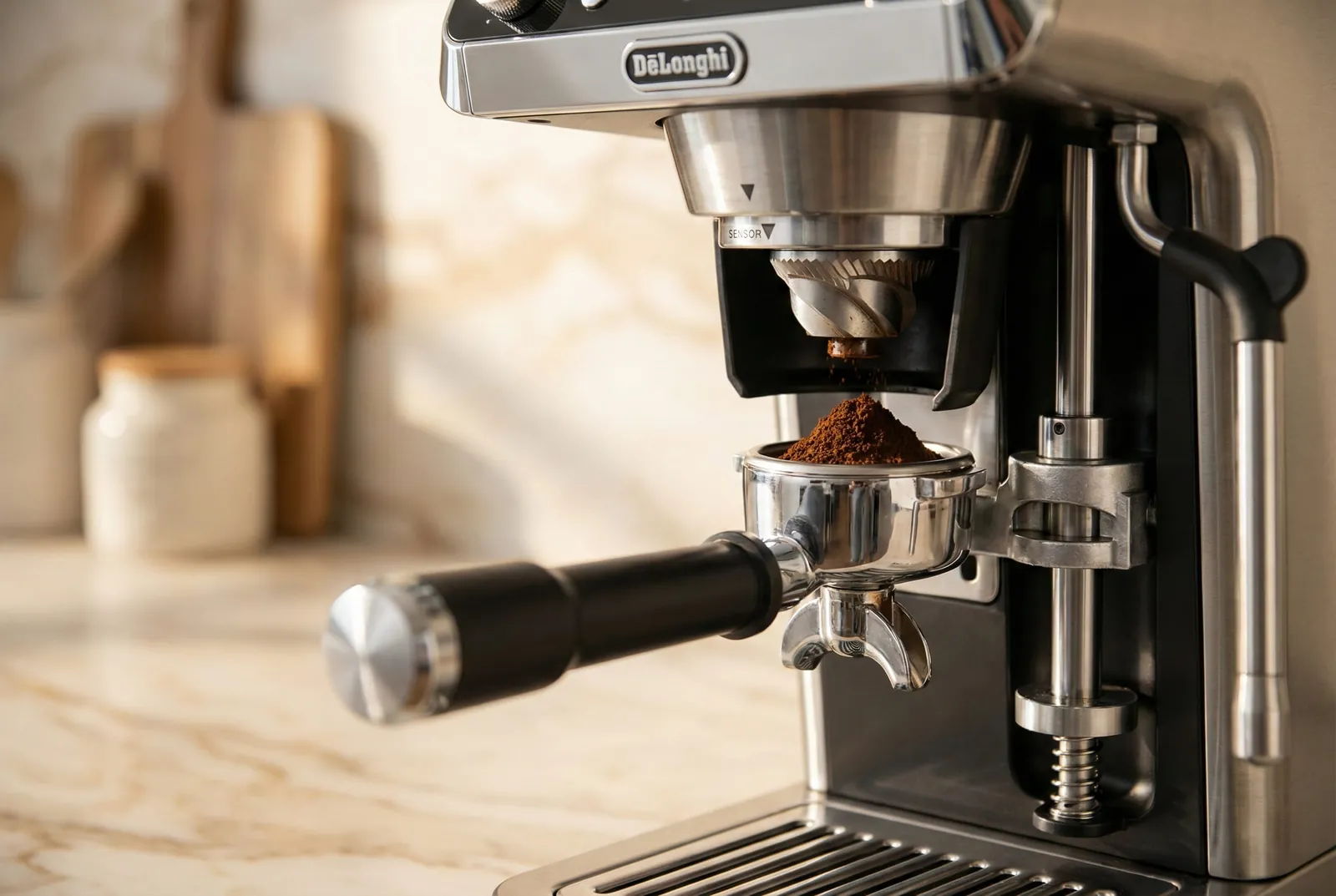
Smart-dosing machines have a few quirks. These fixes keep them consistent.
Grind steps are coarse, so the gap between two settings can be too big. Change the dose time slightly or switch beans before blaming the machine, using dialing in espresso as a guide. To check a shot, enter it in our espresso dial-in calculator.
Sensor dosing reads volume rather than weight, so very oily or very light beans can shift the dose. Weigh a few grinds on a scale and adjust.
Wipe the tamping station and grinder chute weekly, empty the tray, and follow the espresso machine maintenance routine. For milk drinks, keep the wand clean; fixing a steam wand that will not froth covers clogs.
Scale still matters. Use filtered water and run the descaling guide when the machine prompts you.
Before you decide
Marketing specs (bar pressure claims, flashy displays, vague “professional quality” promises) rarely predict how a machine performs day to day. Five things actually matter for beginner espresso machines, and we evaluate every machine against them.
Machines under $549 typically compromise on grinder quality, temperature control, or automation. The Arte succeeds by solving skill barriers through smart engineering rather than cutting corners on extraction fundamentals.
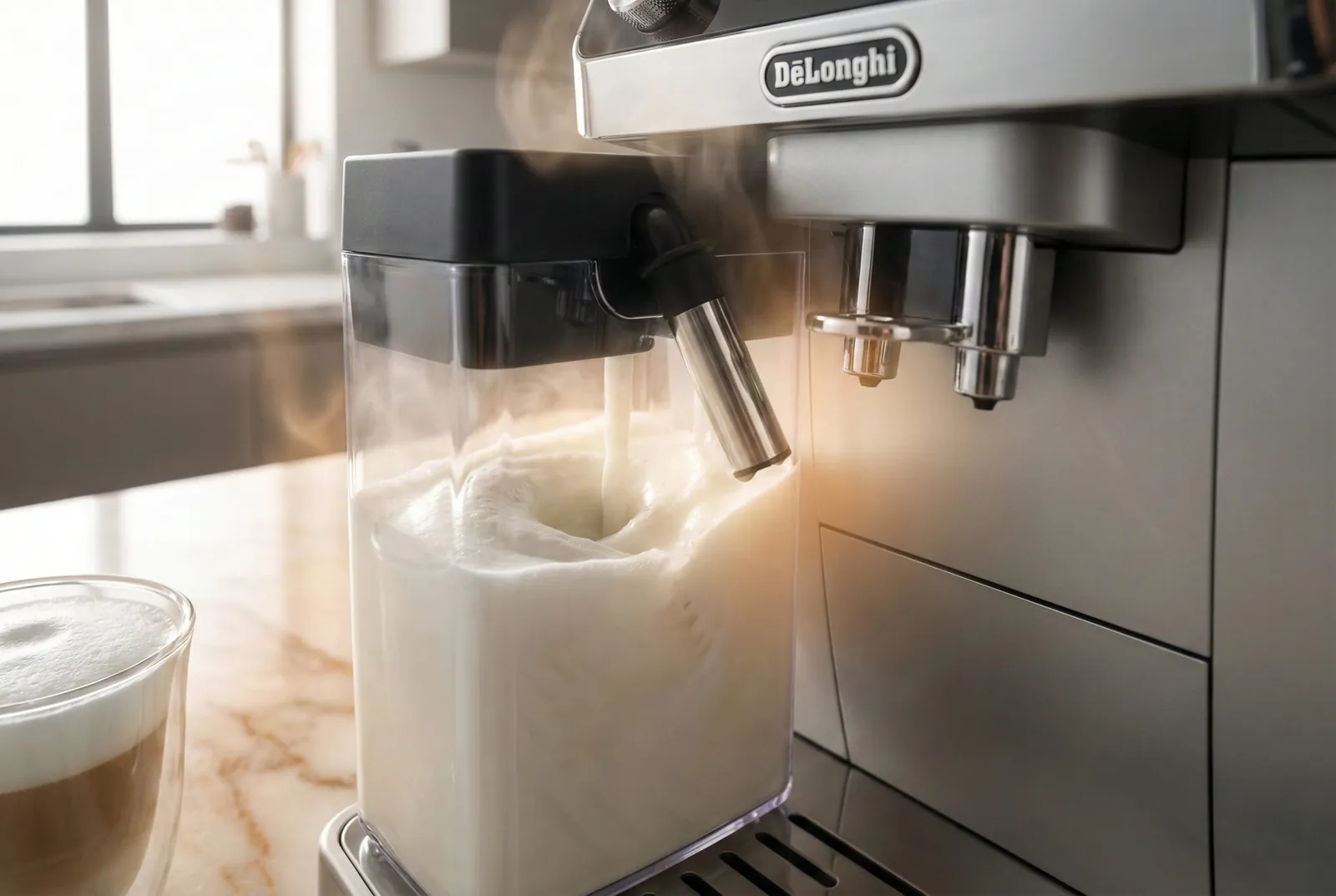
Durability, upkeep and running costs once the novelty wears off.
The metallic construction with premium finish feels substantial—throughout testing the exterior showed no visible wear despite regular coffee splatters and portafilter bumps.
The 51mm portafilter and group head are solid metal, while the water tank and some internals use plastic, a trade-off similar to comparably-priced Breville machines. The dual thermoblock system is proven De'Longhi technology we've seen perform reliably across other models. Based on build quality and components, we'd expect a 5-7 year lifespan with proper maintenance.
De'Longhi has a mixed-to-good reputation for home espresso machines.
Based on similar models and owner reports, the group head gasket typically needs replacement every 18-24 months ($10-15, a simple DIY job), and grinder burrs show wear after 5-8 years of regular use, with replacements available through De'Longhi. The Smart Tamping mechanism is newer technology, so long-term reliability data is still accumulating—but it performed flawlessly throughout testing, with no degradation or mechanical issues, and early owner reports we've tracked are positive.
Good availability—De'Longhi maintains parts inventory for several years post-production, and we verified stock on LatteCrema components, portafilter baskets, and water filters during testing.
Grinder burr replacements are available, though rarely needed.
Based on testing and typical use, expect roughly $40-60 a year: descaling solution ($12-18 for 3-4 cycles), optional water filters ($15-25), cleaning supplies (~$10), and a group gasket every 18-24 months ($10-15).
That's well below the $80-120 a year we've seen for super-automatic machines, and a five-year total of roughly $200-300 including occasional service—less time-intensive than a fully manual machine requiring daily backflushing.
Standard 2-year limited warranty covering defects in materials and workmanship, excluding wear items like gaskets, filters, and burrs—standard across the industry.
De'Longhi's customer service replied to our product questions within 24-48 hours. Extended warranties (typically $60-100 for 3-5 years) are often available through retailers, but we wouldn't consider them necessary given the machine's build quality.
Moderate secondary-market demand based on completed eBay and Facebook Marketplace listings we've researched—De'Longhi machines typically hold a reasonable share of their value over the first few years.
The Smart Tamping Station and integrated grinder help resale appeal, similar to Breville's assisted-tamping models. Realistically, expect roughly $200-300 after 2 years of normal use with proper maintenance and original accessories.
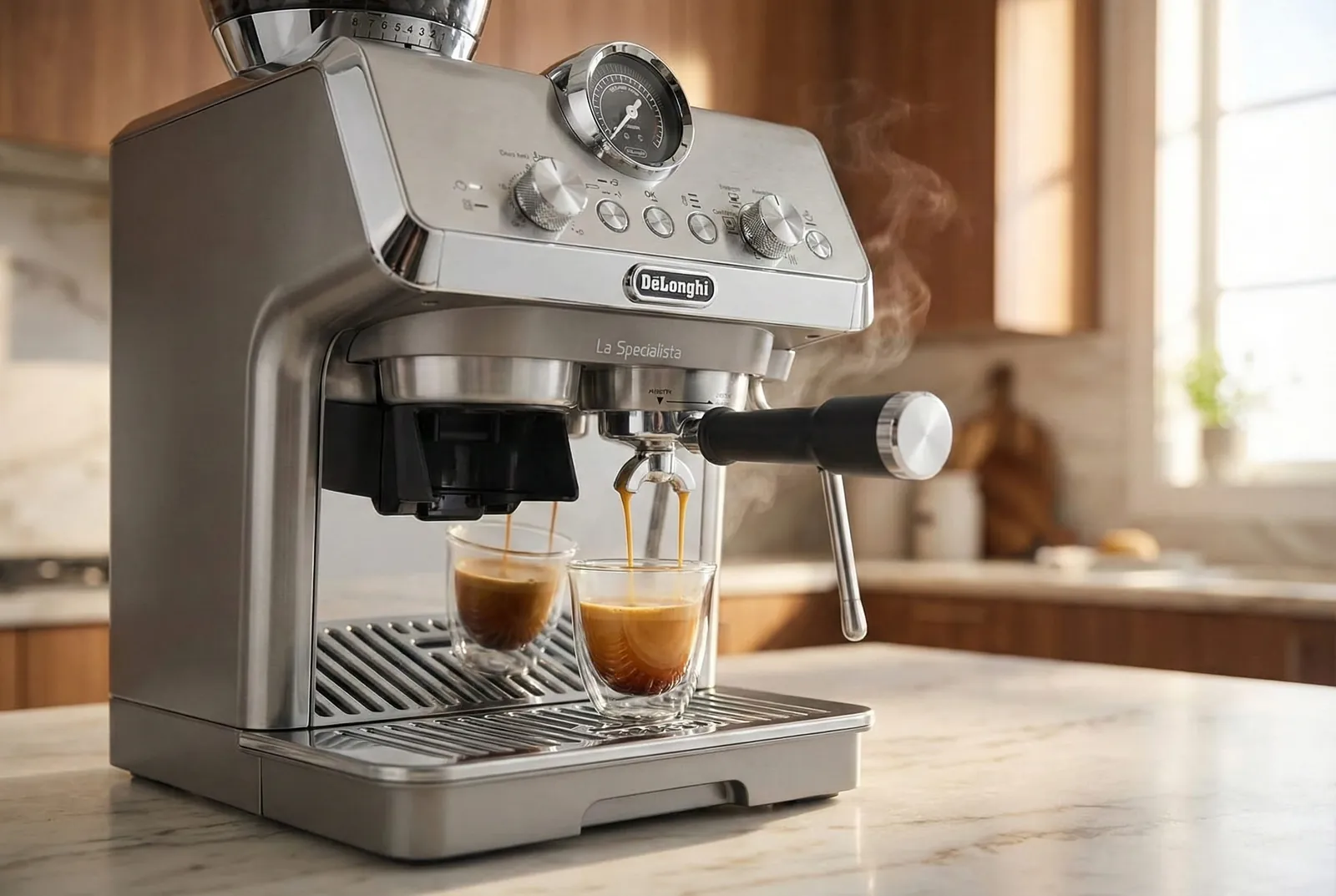
This machine was purchased independently and was not provided by De’Longhi.
Our rating, who it fits, and what it costs.
De'Longhi La Specialista ArteRecommended
4.3 / 5 — Is it worth buying?
The Smart Tamping Station isn't marketing fluff—it produced more consistent puck preparation than manual tamping technique, and Active Temperature Control delivered stability that rivals machines costing twice as much. The built-in grinder is merely adequate, but adequate is an achievement at $499-$549.
✓ Best for
✕ Skip if
Score breakdown
Shots tested
120+
Testing period
35 days
Ready to decide?
Our verdict: 4.3/5, recommended. Independently tested; commissions never change a rating.
See how the De'Longhi La Specialista Arte compares with the other picks in each tested roundup.
Closest alternatives in price and purpose, each tested the same way.
4.1De'Longhi
A bean-to-cup super-automatic that delivers consistently good espresso without any of the semi-automatic learning curve.
 4.3
4.3Philips
A convenience-focused super-automatic with a fast-heating LatteGo milk system, built for daily lattes and cappuccinos.
 4.2
4.2De'Longhi
A bean-to-cup super-automatic with 16 one-touch drink recipes and saved profiles — real convenience, not a craft project.
 3.9
3.9Bosch
A reliable automatic machine for one-touch cappuccino and latte macchiato without learning wand technique.
Put it into practice with a free calculator built for what you just read.
Quick answers before you buy.
The Opera is the step-up model; both were tested extensively. The Arte ($499-$549) is designed for beginners with a 51mm portafilter, 8 grind settings, and a manual steam wand that delivers excellent results once you build technique (it took us several weeks).
The Opera ($649-$699) steps up to a professional 58mm portafilter (compatible with commercial accessories), 15 grind settings for finer control, and dual independent heating for true simultaneous brewing and steaming—saving 30-40 seconds per drink in our testing. Choose the Arte if you value automation and exceptional value.
Choose the Opera if you want professional compatibility and are willing to pay $150 more for enhanced control and faster workflow. We find most home users are better served by the Arte.
No, and this is by design. The Arte's integrated grinder cannot be bypassed—the Smart Tamping Station only activates when grinding fresh beans directly into the portafilter.
This ensures fresh-ground coffee for every shot, which dramatically impacts flavor, but it does limit flexibility. If you primarily use pre-ground coffee, this machine isn't suitable.
For everyone else, the fresh-grind requirement is actually a benefit.
The station automates grinding, dosing, leveling, and tamping. Place the empty portafilter in the Smart Tamping Station cradle; an optical sensor detects it and activates the grinder, which grinds and doses directly into the basket (we measured an average of 16.2g with only 0.3g standard deviation across 30 doses).
A built-in leveling mechanism distributes the grounds evenly, and an automatic tamping arm applies exactly 30 pounds of pressure—the professional standard. The grinding step alone takes about 12 seconds, followed by leveling and tamping.
Throughout testing, this system produced zero channeling; every puck was evenly prepared. It eliminates the manual skill that takes beginners weeks to develop.
For medium to dark roasts, absolutely. We tested the Arte's grinder against six external grinders ranging from roughly $100 to $450. With Colombian medium roast at setting 4, particle distribution and extraction quality matched the Baratza Encore (around $200) and Breville Smart Grinder Pro ($179-$199).
With dark Italian blend at setting 5, it outperformed the Fellow Ode with an espresso burr ($350-$450). Grind retention measured only 0.3-0.5g—negligible for daily use. The limitation is very light roast specialty coffee: at its finest setting, the Arte produced acceptable but not exceptional clarity with Ethiopian light roast.
If you primarily drink medium to dark roasts, this grinder is excellent and saves $200-400 on external equipment. If very light roasts are the point, the sensor grinding on the La Specialista Prestigio ($800-$900) adjusts to the bean and handled everything from a super-light Nordic roast to an oily Italian blend in our testing.
For beginners and milk-drink lovers, yes. For enthusiasts who want grind control and manual technique, the Barista Express Impress wins.
The Arte's advantages: the Smart Tamping Station produces more consistent puck preparation than manual technique, the LatteCrema automatic milk system delivers microfoam matching manual steaming with zero skill required, a more compact footprint (9.8" vs 13.25" wide), and a short learning curve. The Barista Express Impress advantages: 25 grind settings vs the Arte's 8 (far more dialing-in flexibility), a larger 54mm portafilter with a wider accessory ecosystem, a PID temperature display, and proven Breville reliability.
Our verdict: for pure beginners making mostly milk drinks, the Arte; for enthusiasts who want to dial in precision, the Barista Express Impress. Compare our Barista Express Impress review and the original Barista Express review for the full picture.
Mostly no—this is one of the Arte's clearest weaknesses. During testing, several failed shots ran too fast (under 20 seconds), almost all with a light Nordic roast.
The integrated grinder at its finest settings couldn't produce the particle size needed for proper light roast extraction, and the Arte's fixed brew temperature limits the higher temps (95-96°C) that light roasts often benefit from. The Arte excels with medium to medium-dark roasts and traditional Italian espresso blends.
If light roasts are your primary focus, consider a machine with a higher-precision grinder and wider temperature range, such as the Breville Barista Express Impress, or a separate grinder paired with a temperature-adjustable machine.
Daily cleaning takes 2-3 minutes: empty the drip tray, rinse the portafilter, wipe the steam wand, and rinse LatteCrema components if used. Weekly (10-12 minutes): deep clean LatteCrema in the dishwasher, wipe the exterior, rinse the water tank.
Monthly (15-20 minutes): clean the grinder chute with the included brush, and descale if you have hard water. Quarterly: a full descaling cycle using De'Longhi solution (about $12 for a 3-pack).
Annual maintenance runs roughly $40-60, well below what we've seen for super-automatic machines. Compared to a manual machine requiring daily backflushing, the Arte's routine is refreshingly simple.
Yes, for beginners who drink medium to dark roasts and want help with dosing and tamping. Smart Tamping, the built-in grinder and a manual steam wand cover the whole espresso workflow in a narrow footprint, which is strong value for a first serious machine.
It is a poorer buy for light-roast drinkers or tinkerers, because the fixed temperature, limited grind steps and 51mm portafilter cap how far you can push it. Those buyers should look at the Barista Express Impress or a separate machine and grinder.
Reader questions
Questions or tips? Leave a comment
Ask about your setup or share what worked for you. Comments are checked before they appear.