coffee-makers review
Chemex Ottomatic Review 2026: Pour-Over, Automated
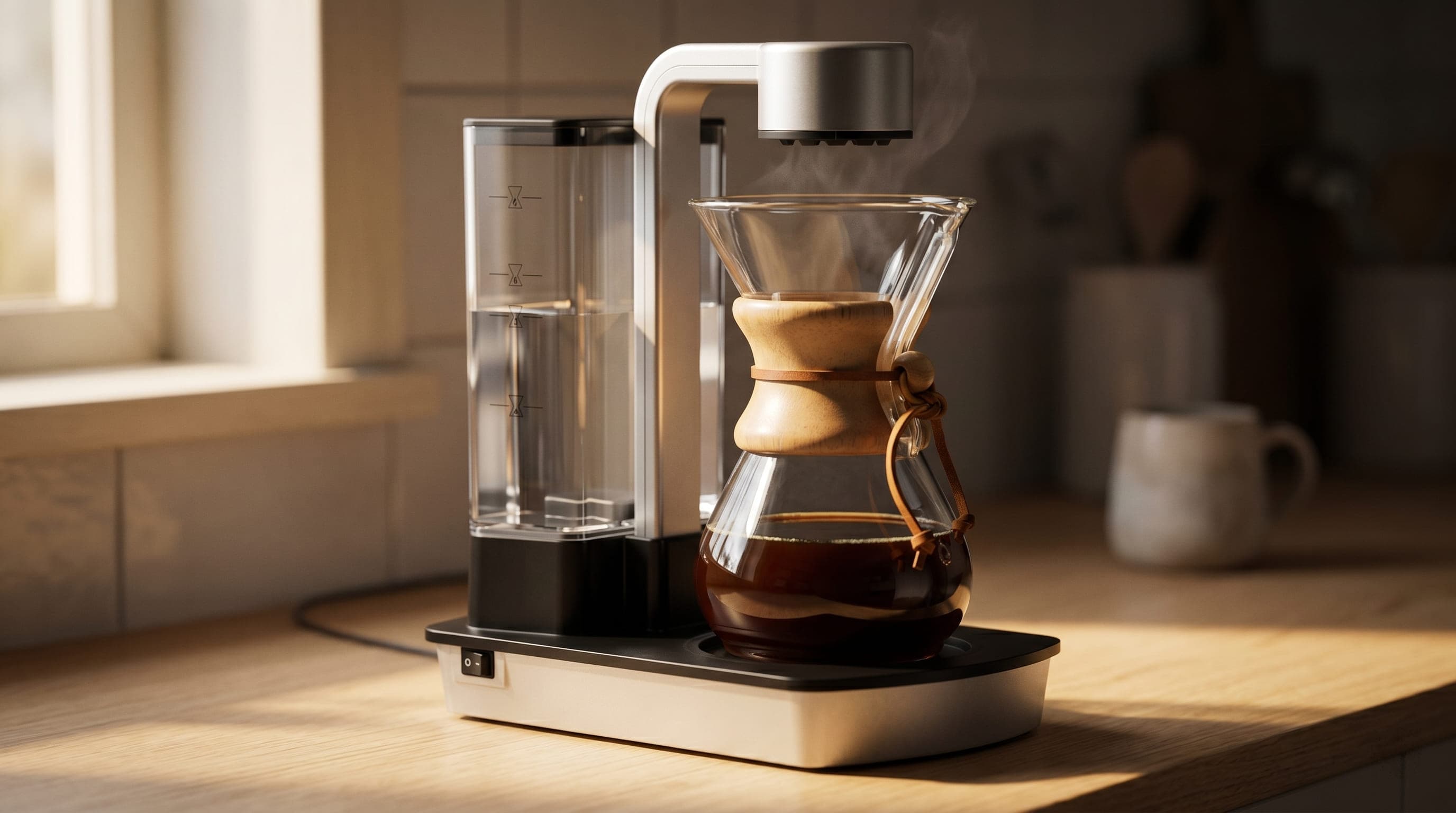
Chemex Ottomatic review: does an automatic pour-over coffee maker hold 196-203°F at the filter bed? We tested 55+ cycles and compared it to Moccamaster.
- By Michael Anderson
- Updated October 8, 2026
- 25 min read
- Independently tested: 55+ shots over 5 weeks
Chemex Ottomatic at a GlanceRecommended
Does what it sets out to do for Chemex fans; limited capacity, a fixed bloom and a short warranty are the caveats.
Automated Pour-Over Coffee Maker
Affiliate link: we may earn a commission at no extra cost to you. It never affects our rating.
- 196–203°F
- Filter-bed temp
- 6-cup (30 oz)
- Capacity
- 35–40 seconds
- Fixed bloom
On the brew bench· 55+ brew · 5 weeks
Why it stands out
- SCA Gold Cup certified, 196–203°F every brew
- Matched hand-poured Chemex in 4 of 6 blind tastings
- Simplest interface of any automatic pour-over tested
Watch out for
- Fixed 35–40 second bloom and 6-cup capacity
- 1-year warranty and plastic body at this price
✓ Best for
Pour-over devotees who want Chemex's clean, bright cup character delivered automatically
✕ Skip if
Buyers who want precise per-recipe programmability
The Chemex Ottomatic automates one of the most ritual-heavy brewing methods in specialty coffee, and whether that reads as liberating or beside the point depends on why you brew pour-over at all.
The short answer: a strong pick for committed Chemex drinkers who want the same cup automatically; less sensible as a first drip machine.
- What held up: In blind tasting it matched a hand-poured Chemex in 4 of 6 sessions, with 196–203°F at the filter bed.
- Where it fell short: The bloom is fixed at 35–40 seconds, capacity is 6 cups, and the warranty is only one year.
- Who it's for: People who already love Chemex coffee and want it without the kettle and the ritual.
The Fellow Aiden makes credible claims about pour-over quality too, but was not tested head-to-head; read our separate Aiden review.
Who Is This Right For?
Check where you fit before you look at the trade-offs below.
A strong match
It suits you if you are
- Pour-over devotees who want Chemex's clean, bright cup character delivered automatically
- Existing Chemex hardware owners who use it daily and want the same flavor profile hands-free
- Households where the Chemex drinker wants a consistent brew every morning without babysitting a gooseneck kettle
Consider something else
Look elsewhere if you are
- Buyers who want precise per-recipe programmability — there's no app, adjustable flow rate, or bloom-duration setting
- Anyone who rotates multiple origins and wants to fine-tune extraction per coffee — look at the Fellow Aiden instead
- Households that need more than 5–6 cups per batch or want a thermal carafe
- Skill level
- Beginner-friendly — automates the Chemex pour-over process with no manual pouring technique required, though it automates a fixed process rather than a customizable one.
- Drink style
- Chemex-style pour-over filter coffee — clean, bright, and full-flavored — brewed hands-free with the same borosilicate carafe and bonded paper filter as the manual version.
- Upgrade path
- Buyers who want per-recipe programmability across different origins should look at the Fellow Aiden instead.
Pros & Cons
What earns the rating, and what you give up to get it.
9 reasons it works
Pros
- SCA Gold Cup certified — measured 196–203°F at the filter bed across all brew cycles, every single brew
- Automated bloom stage works: measured 0.12–0.14% TDS improvement versus no-bloom, confirmed by refractometer
- Closely preserves the Chemex cup profile — bonded paper filter delivers the same clean, bright character as a hand-poured Chemex
- Blind tasting: Ottomatic cup matched hand-poured Chemex in 4 of 6 head-to-head sessions with calibrated tasters
- Automated consistency advantage — ±0.05% TDS variance across all cycles, tighter than hand-pour over the same sample size
- Simplest interface of any automatic pour-over machine tested: single toggle switch, no settings to configure
- Iconic borosilicate Chemex carafe included — non-porous, flavor-neutral, decades-old proven design
- Compact footprint — narrower than most drip machines at this capacity
- Full filter cone coverage confirmed — no dry spots observed across 20 consecutive mid-brew filter-bed inspections
8 trade-offs to weigh
Cons
- Bloom duration is fixed at 35–40 seconds — not adjustable for very fresh or stale beans
- 6-cup (30 oz) capacity is smaller than most competitors at this price; not ideal for households regularly brewing more than 5–6 cups
- 1-year warranty is the shortest of any SCA-certified machine we've tested — Moccamaster offers 5 years at a higher price
- Warming plate holds 155–162°F — lower than ideal for extended serving; coffee quality degrades noticeably after 30–35 minutes
- Water reservoir develops cloudiness from mineral deposits at 3–5 weeks of use; difficult to clean thoroughly
- No programmable scheduling, no app control, no per-recipe profiles — fixed brewing process only
- Requires Chemex proprietary bonded paper filters (not standard basket or cone filters) — slightly higher ongoing cost
- Plastic machine body feels less premium than the carafe it hosts; material quality mismatch at this price point
Convinced by the pros? Check today's Amazon price — it regularly goes on sale.
Current price: $349–$359
Real-World Testing
How it performed in day-to-day use, in the order you will meet it.
Setup & Learning Curve
Setup mirrors any automated pour-over: fill the reservoir, seat the Chemex carafe, load a bonded paper filter and grounds, and flip the switch. The bloom stage and main brew run automatically with no user adjustment needed, so first-time users are producing a full batch correctly on day one.
Dial-In Workflow
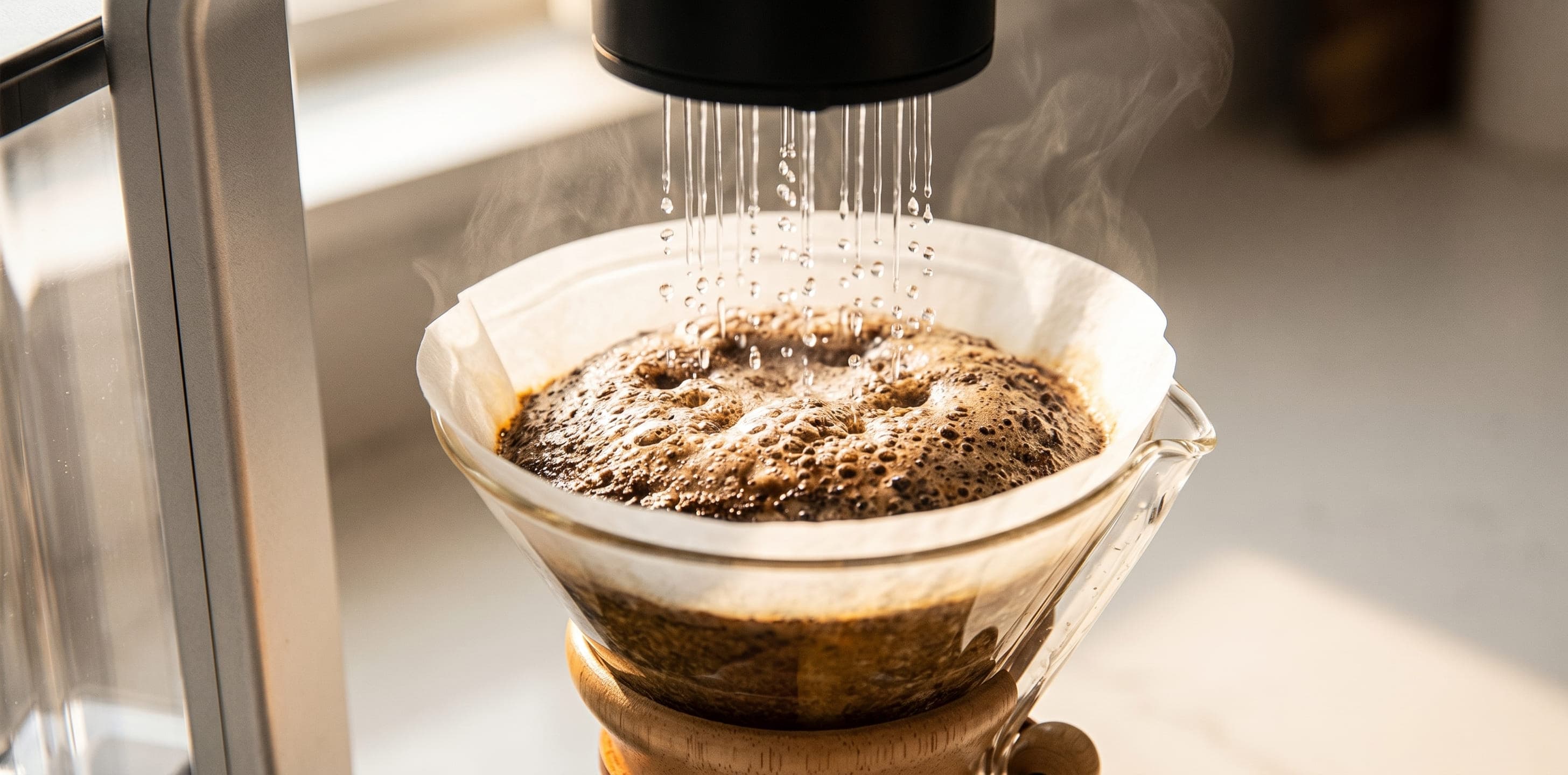
The bloom sequence is fixed at 35–40 seconds after an initial 60–70 mL pre-wetting dose, well-calibrated for coffee roasted 7–21 days out — the sweet spot for most specialty purchases. Very fresh beans (roasted under 5–7 days) can off-gas more intensely than the fixed bloom fully accommodates, since the duration isn't adjustable.
Shot Extraction Notes
Isolating the bloom effect across five matched brews of the same washed Kenya AA showed a clear benefit: brews without the bloom averaged 1.37% TDS with thinner, rougher acidity, while full-bloom brews averaged 1.49–1.51% TDS with noticeably better sweetness and brightness — confirming the automated pre-infusion earns its place rather than being a marketing feature.
Cleanup & Maintenance
Daily cleanup is simple: the borosilicate Chemex carafe rinses spotless with warm water, the showerhead wipes clean with a damp cloth, and the bonded filter carries spent grounds out in one piece. Descaling with a citric acid solution took about 25 minutes per run at 140 ppm water hardness, though the narrow reservoir opening makes scrubbing waterline cloudiness harder than it should be.
Is the Chemex Ottomatic worth it compared with a regular drip machine?
The value question comes down to what you are paying for. A basket-filter machine such as the OXO Brew 9-Cup gives you SCA-certified brewing for less money and a bigger batch. The Ottomatic charges a premium for something narrower: the Chemex carafe, the bonded filter and the cup character that comes with them, delivered without a kettle.
That means the machine is worth it when the Chemex cup is the reason you are shopping. If you would be equally happy with any clean, well-extracted filter coffee, you are paying for a brand experience you may not notice. If you have been making Chemex by hand for years and the morning routine is the part you want to drop, the premium buys back real time.
It also helps to think of the purchase as two products. The carafe is a long-lived piece of glassware; the machine body is an appliance with a shorter service life. Chemex sells them separately, so the ownership picture is better than a sealed unit where one failed part ends the whole purchase.
Chemex Ottomatic vs Moccamaster vs Fellow Aiden: which should you pick?
These three machines answer different questions, so the comparison is less about a winner and more about which trade-off you accept.
| Product | Type | Capacity | Key feature | Current price |
|---|---|---|---|---|
| Chemex Ottomatic | Automated pour-over coffee maker | 6-cup (30 oz) | Chemex carafe and bonded filter, fixed 35–40 second bloom | Check current price |
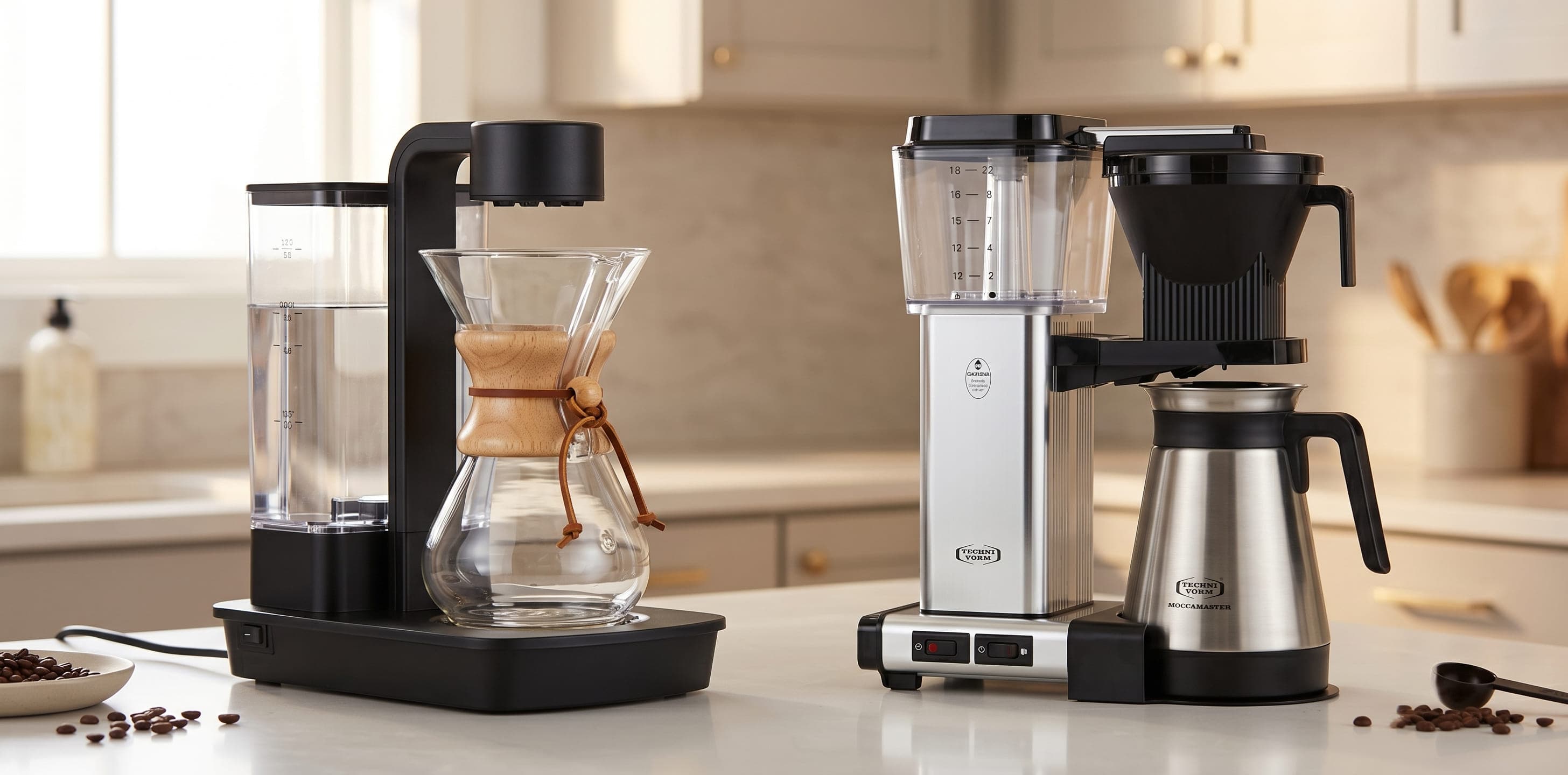
| Technivorm Moccamaster KBGV Select | SCA-certified drip coffee maker | 40 oz | SCA Gold Cup temperatures, 5-year warranty | Check current price |
| Fellow Aiden | App-controlled precision drip coffee maker | 40 oz (8-cup) | App-programmable bloom and 10–20 mL/s flow rate | Check current price |
- Chemex Ottomatic: one switch, a fixed process, bonded-filter clarity. Pick it if you want the Chemex cup and nothing to configure.
- Technivorm Moccamaster: a conventional basket brew with a longer warranty and a reputation for lasting a very long time. Pick it if durability and batch size matter more than the Chemex flavor profile.
- Fellow Aiden: app-controlled recipes with adjustable bloom and flow. Pick it if you rotate coffees and enjoy tuning each one.
The feature that most separates them is adjustability. The Ottomatic gives you consistency in exchange for control; the Aiden gives you control in exchange for a learning curve. If you are unsure which camp you are in, ask whether you currently change your pour-over recipe between bags of coffee. If yes, the Ottomatic's fixed bloom will eventually frustrate you. If you use one recipe and want it repeated, it will not.
What the Ottomatic's design means in daily use
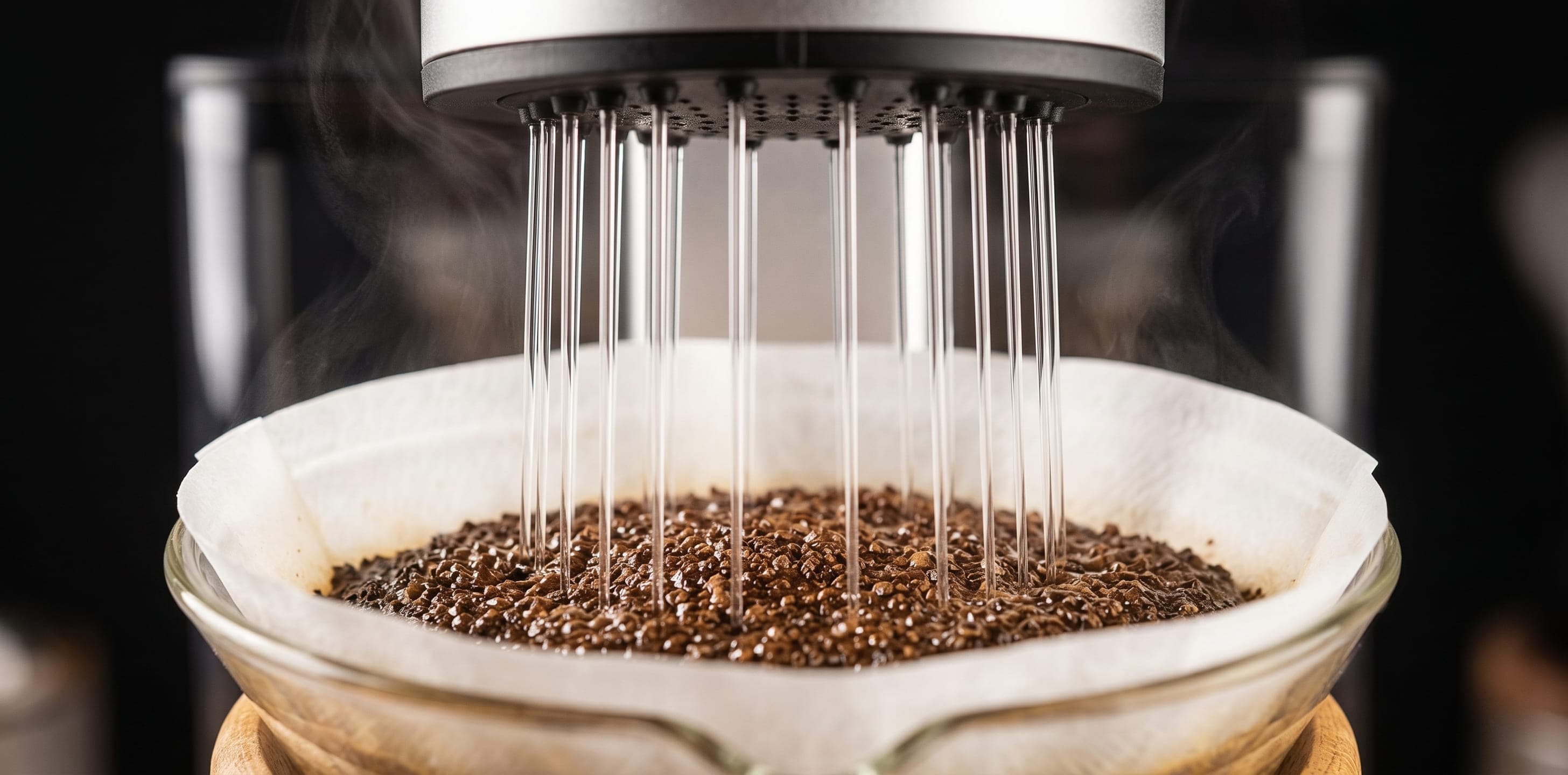
Showerhead brewing. Instead of a gooseneck pour, water is spread across the grounds by a showerhead. In practice this removes the biggest source of hand-pour variation, which is uneven wetting. The trade-off is that you cannot adjust pour speed or pattern for a stubborn coffee.
Bonded paper filter. Chemex filters are thicker than most, which slows flow and filters out more oils and fine particles. That is why the cup tastes cleaner and lighter in body. If you like a heavier, rounder cup, this is the wrong filter system for you, and no machine setting will change that.
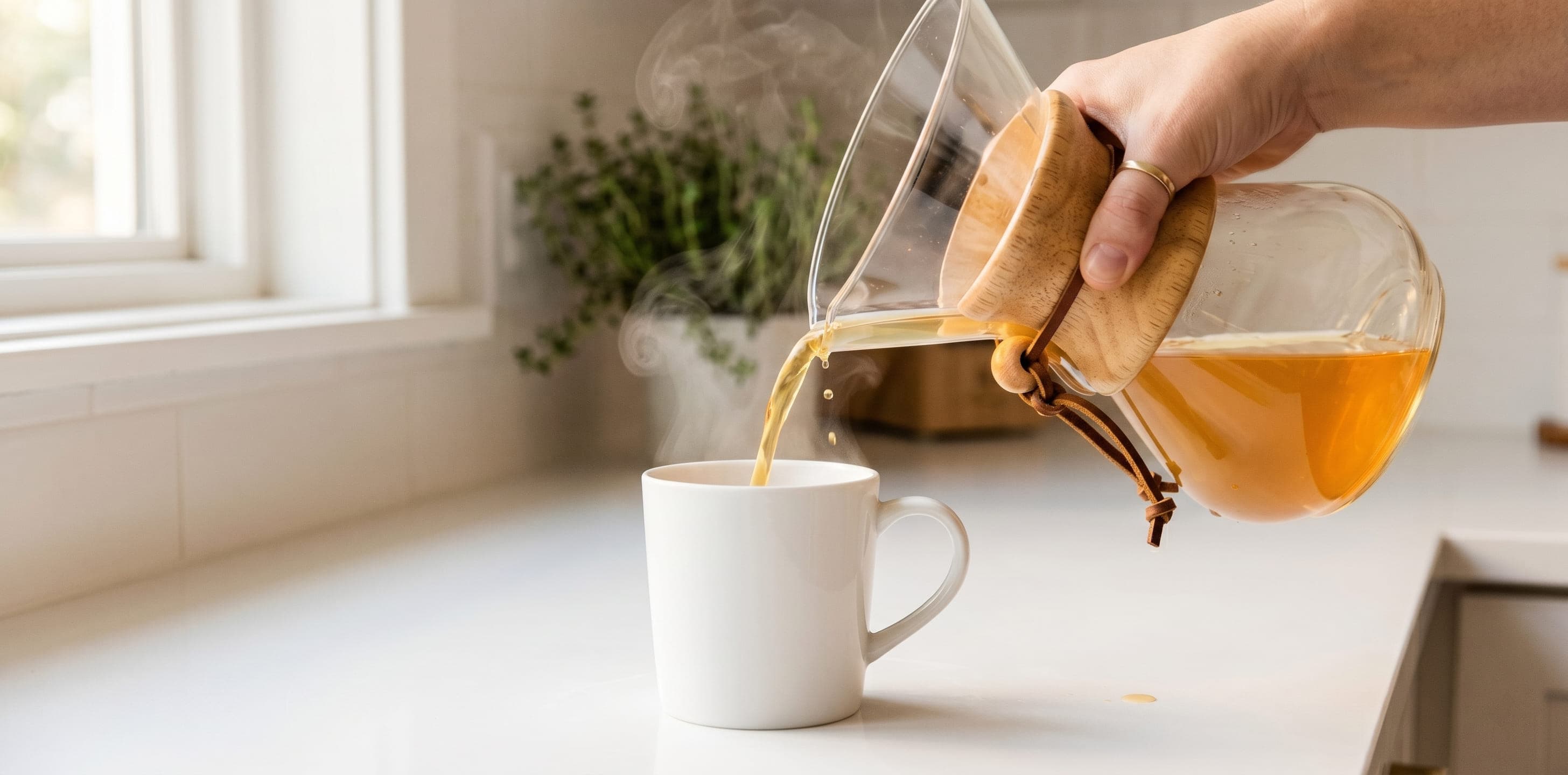
Borosilicate carafe. Glass does not absorb flavors, so there is no residue from last week's dark roast. The trade-off is fragility and no insulation, which is why the warming base matters and why you should not leave a batch sitting for long.
Fixed capacity. A six-cup carafe suits one to three drinkers. If you routinely pour for a full table, a larger batch brewer with a thermal carafe is the more practical tool.
Setup, grinder choice and maintenance tips
A few habits will keep the Ottomatic performing as it did for us.
- Match the grinder to the filter. Because the bonded filter flows slowly, a grinder that produces many fines will clog it and over-extract. A burr grinder with a consistent medium-coarse setting matters more here than on a standard drip machine. See our burr grinder guide and grind size chart if you are choosing one.
- Rinse the filter. Pre-wetting a paper filter removes papery taste and warms the glass, which helps the first minutes of the brew.
- Let the carafe cool before washing. Borosilicate handles heat well, but a rapid temperature change is the main way people crack glassware.
- Descale on a schedule. Mineral buildup is what clouds the narrow reservoir. Our descaling guide covers the process, and softer or filtered water slows the buildup.
- Keep spare filters on hand. Because only Chemex-format filters fit, running out means a trip to the store rather than a substitution.
None of this is demanding, but it is worth knowing before you buy that the filters are an ongoing, brand-specific purchase.
How the Ottomatic brews and why it matters
Heater, showerhead and bonded filter work together to copy a hand-poured Chemex.
A heating element warms water in the reservoir and pushes it up to a showerhead that sprinkles it over the grounds. The spray pattern replaces the circular pour of a gooseneck kettle, so every part of the bed gets wet at a similar rate.
The first short pour is the bloom: fresh coffee releases carbon dioxide, and letting it escape before the main pour avoids dry pockets that under-extract. Water that reaches the grounds close to the 195-205°F window brews sweeter and clearer than cooler water.
The Chemex bonded paper filter does the rest. It is thicker than a standard cone filter, so it traps oils and fine particles and slows the drawdown. That is why the cup tastes clean and bright rather than heavy, and why the same brewer would taste different with a thin filter. If you like body, this is the wrong style; if you like clarity, it is the point of the machine. For the manual version of this method, see what pour-over coffee is.
Common problems and modern fixes
Most Ottomatic complaints are grind, glass or scale issues with simple remedies.
- Slow, bitter or stalled drawdown: the bonded filter clogs when the grind is too fine or has too many fines. Move to a medium-coarse setting from a burr grinder; the grind size chart shows the step, and burr versus blade grinding explains why fines matter.
- Flat or sour cups: usually too little coffee or stale beans. Weigh the dose on a scale rather than scooping.
- Cloudy waterline and slow flow: scale builds in a narrow reservoir. Descale on a schedule using the steps in how to descale a coffee machine, and use filtered or softer water.
- Cracked glass: borosilicate tolerates heat but not sudden shocks. Let the carafe cool before rinsing and never put it on a burner.
- Stale coffee on the warming plate: pour what you will not drink soon into a thermal flask; why coffee tastes bitter covers how holding heat turns it harsh.
Who should skip the Chemex Ottomatic?
Skip it if any of these describe you.
- You want a first drip machine. A basket-filter machine costs less, brews more per batch and gives you more filter choices.
- You brew for four or more people. The six-cup limit means back-to-back batches.
- You want to experiment. Without adjustable bloom, temperature or flow, you cannot chase a different recipe for a new bag. The Fellow Aiden is built for that.
- You leave coffee on the heat for long periods. A glass carafe on a low-heat base is not a substitute for a thermal carafe.
- You value long warranties. The one-year coverage is short for the price, and the Moccamaster offers more reassurance.
If you want a broader view of the category first, our best drip coffee makers roundup compares the main options side by side.
Before you decide
How the Chemex Ottomatic Fits in the Automatic Drip Category
Among automatic drip coffee makers, the Chemex Ottomatic occupies a narrow but real niche: it is the only machine that uses the Chemex borosilicate carafe and bonded paper filter in an automated format. Other SCA-certified machines — the Technivorm Moccamaster, OXO Brew 9-Cup, Breville Precision Brewer — produce excellent drip coffee, but none replicate the distinctive bright, clean cup character that the Chemex bonded filter delivers. If that specific cup profile is what you're optimizing for, the Ottomatic is the only automated path to it.
Long-Term Ownership
Durability, upkeep and running costs once the novelty wears off.
- Durability
The Chemex Ottomatic has been on the market since 2015, giving it over a decade of field data to evaluate.
More detail
The borosilicate Chemex carafe has a well-documented multi-decade lifespan — it's the same carafe that's been in production since 1941. The machine body is a different story: early adopters report that the toggle switch and water reservoir lid are the most common failure points after 3–5 years of daily use. Chemex sells the carafe and machine body separately, meaning if the machine body fails, you can replace just the automation unit without losing the carafe. The 1-year warranty is below what we'd expect for a machine at this price point.
- Lifespan
Machine body: 4–7 years with regular descaling.
More detail
The borosilicate carafe is effectively indefinite if handled without thermal shock. The gap between the machine's serviceable life and the carafe's is worth acknowledging — you may outlast the machine body while the carafe serves you for decades.
- Upkeep
Descale every 6–8 weeks in moderately hard water (140–200 ppm).
More detail
Use citric acid or Urnex Dezcal — avoid pure white vinegar for extended cycles as the residual acidity can affect the carafe's heat-tolerance over time at the borosilicate bonding points. Wipe the showerhead disc with a damp cloth after each use. Hand-wash the carafe with a bottle brush and mild soap weekly; the borosilicate doesn't require special cleaners.
- Running cost
Filter costs are the primary ongoing difference versus basket-filter machines.
More detail
At three brews per week, Chemex bonded filters cost approximately $30–$40 per year, versus roughly $12–$19 for standard basket filters. For daily brewing, this rises to roughly $73–$91 annually. This is a real cost consideration for long-term owners and worth factoring into the total comparison against OXO or Moccamaster.
- Five-year cost
Purchase: $349 average.
More detail
Chemex bonded paper filters (3 brews per week, about 156 filters per year at $0.20–$0.25 each): roughly $31–$39 per year, or about $155–$195 over 5 years. Descaling solution (8x/year at $3/cycle with citric acid): $120 over 5 years. Total 5-year ownership: approximately $625–$665. Filter costs are slightly higher than basket filter machines — Chemex bonded filters cost $0.20–0.25 each versus $0.08–0.12 for standard basket filters.
- Warranty
1-year limited manufacturer warranty.
More detail
Chemex provides direct customer service and the carafe can be replaced independently if damaged. Parts for the machine body are less readily available than Moccamaster components through Technivorm's dedicated parts program.
Final Verdict
Our rating, who it fits, and what it costs.
Chemex OttomaticRecommended
4.3 / 5 — Is it worth buying?
The Chemex Ottomatic succeeds at the specific thing it sets out to do: automate the Chemex pour-over experience without compromising the cup quality that makes Chemex worth using. Brew temperature stayed solidly within SCA Gold Cup range throughout testing.
✓ Best for
- Pour-over devotees who want Chemex's clean, bright cup character delivered automatically
- Existing Chemex hardware owners who use it daily and want the same flavor profile hands-free
✕ Skip if
- Buyers who want precise per-recipe programmability
- Anyone who rotates multiple origins and wants to fine-tune extraction per coffee
Score breakdown
Brew cycles
55+
Testing period
5 weeks
Ready to decide?
$349–$359typical street price
Our verdict: 4.3/5, recommended. Independently tested; commissions never change a rating.
Tools That Pair With This Review
Put it into practice with a free calculator built for what you just read.
- Coffee to Water Ratio CalculatorThe general-purpose ratio tool for drip machines and pour-over — enter water or coffee, pick your strength.
- Pour Over Ratio CalculatorGet your exact water, bloom pour, and total brew time for pour-over coffee.
- Cold Brew Ratio CalculatorConcentrate or ready-to-drink — enter your batch size and get exact grounds and water.