
 3.9
3.9Mr. Coffee
Mr. Coffee 14-Cup Programmable Coffee Maker Stainless Steel
An affordable, large-batch programmable drip maker built for fast wake-up brewing rather than precise extraction.
Coffee maker review
Last updated
Need a simple 12-cup drip coffee maker? Our BLACK+DECKER review ran 40+ brews: the timer was reliable, but the hot plate scorches. See who should skip it.
Affiliate disclosure: this page contains Amazon affiliate links. We may earn a commission if you buy through them, at no extra cost to you, and it never affects our rankings. Read our full affiliate disclosure
BLACK+DECKER 12-Cup Programmable Coffee Maker at a GlanceWorth considering
A solid budget drip for pre-ground drinkers who want a reliable timer; the glass carafe is the real limitation.
Budget Programmable Drip Coffee Maker
Affiliate link: we may earn a commission at no extra cost to you. It never affects our rating.
On the brew bench· 40+ brews · 3 weeks
Why it stands out
Watch out for
✓ Best for
No-nonsense everyday coffee drinkers who want reliable, programmable brewing without a premium price tag
✕ Skip if
Anyone chasing specialty coffee clarity or precise SCA-range extraction
This BLACK+DECKER 12-cup coffee maker review follows 40+ test brews. The budget 12-cup programmable drip maker mostly did what it promised, and the glass carafe on a hot plate is where it cuts corners.
The short answer: yes for pre-ground coffee drinkers who want reliable automation, no for anyone expecting specialty coffee magic.
Check where you fit before you look at the trade-offs below.
A strong match
Consider something else
What earns the rating, and what you give up to get it.
7 reasons it works
7 trade-offs to weigh
How it performed in day-to-day use, in the order you will meet it.
Unboxing to first brew took about 5 minutes: remove packaging, install the glass carafe on the hot plate, fill the water reservoir, load a paper filter, add pre-ground coffee, and press brew. No manual was required — first-time users programmed the timer correctly without reading instructions.
The daily routine during testing is short:
Total setup time is about 3 minutes; brew time runs 9–13 minutes depending on water temperature.
Extraction TDS measured across 25+ brews using standard pre-ground medium roast coffee ranged 1.28–1.36%, averaging 1.32% — balanced extraction without over-extraction bitterness. Brew temperature averaged 197.8°F with ±2°F variance, solid for a budget machine.
Daily cleanup takes about 3 minutes: rinse the carafe, dump the grounds basket, wipe the hot plate. Beyond that, maintenance is standard drip-maker upkeep:
There's no complex disassembly; everything is accessible without tools.
Value at $59-$89 and when to spend more
At $59-$89 against an MSRP of $99, the BLACK+DECKER is easy to justify if your needs are modest: a big pot, a timer that works, and a machine you do not need to think about. It does those three things well. That is what "worth it" means at this price.
Where it stops being worth it is when your expectations move toward flavor. It cannot adjust strength, has no bloom function, and the glass-and-hot-plate carafe limits how long a pot stays good. Those are not defects so much as the compromises that keep the price low. To time the bloom and pours, follow the coffee brew timer.
Buy it if you brew pre-ground coffee for a household and want automation. Pay more if you want longer-lasting heat, adjustable strength or better extraction from specialty beans. A reasonable middle step is the Mr. Coffee 14-Cup Programmable, which adds a Bold brew setting and a bigger pot for a similar price.
Feature, practical impact, who benefits, trade-off
How the closest reviewed alternatives compare
Vs Mr. Coffee 14-Cup. The Mr. Coffee 14-Cup costs a little more but adds a Bold brew setting and a larger pot. The BLACK+DECKER is simpler, a bit cheaper and narrower. Pick the BLACK+DECKER if 12 cups is enough and you want the lowest price.
| Product | Type | Capacity | Key feature | Current price |
|---|---|---|---|---|
| BLACK+DECKER 12-Cup Programmable | Programmable drip coffee maker | 12-cup | Simple 24-hour programmable timer | Check current price |
| Mr. Coffee 14-Cup Programmable | Programmable drip coffee maker | 14-cup | Bold setting, 24-hour programmable timer | Check current price |
| Cuisinart 14-Cup Programmable | Programmable drip coffee maker | 14-cup | Bold mode and 1–4 cup small-batch mode | Check current price |
| Cuisinart Grind & Brew | Automatic grind and brew | 2–4 cups | Built-in blade grinder, 24-hour timer | Check current price |
| OXO Brew 9-Cup | Drip coffee maker | 9 cups | SCA-certified 197–204°F with 45-second bloom | Check current price |
For the full picture, our highest-rated programmable brewers and sub-$500 coffee makers comparisons cover the wider market.
Ownership routine
Daily care takes a few minutes: rinse the carafe, empty the basket and wipe the hot plate. Weekly, rinse the basket spray holes to clear mineral deposits. Monthly, run a white-vinegar descale. Our brew yield calculator accounts for the water the grounds keep.
Mineral build-up slows flow and can make brewing less consistent, so descaling matters most in hard-water areas. Our descaling guide explains the process, and the coffee maker leaking water guide helps if you see drips or overflow.
The machine accepts paper filters, and a reusable mesh filter cuts running costs, though it feels flimsy. Replacement glass carafes are widely available, and the 2-year limited warranty is longer than several premium machines' base coverage.
Small changes that help more than upgrades
For a wider look at what drip machines can do, see our drip vs pour-over guide.
If these apply, the alternatives above or a thermal carafe model will fit you better.
How a budget drip maker brews, and where it cuts corners
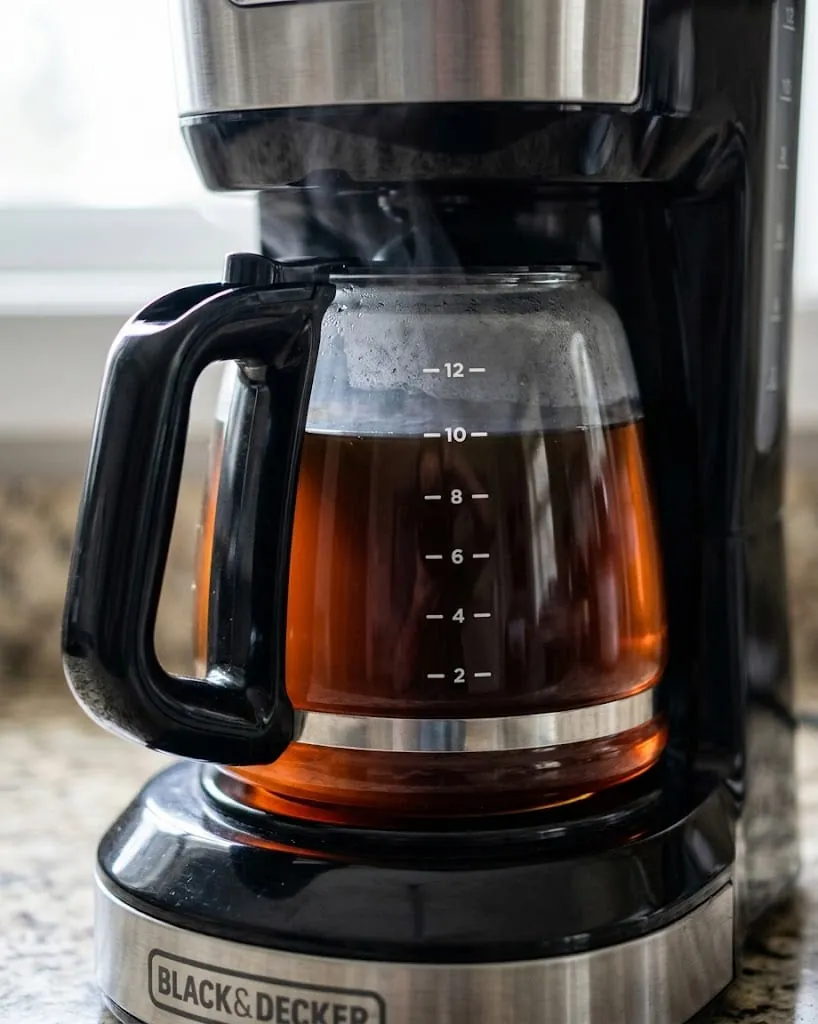
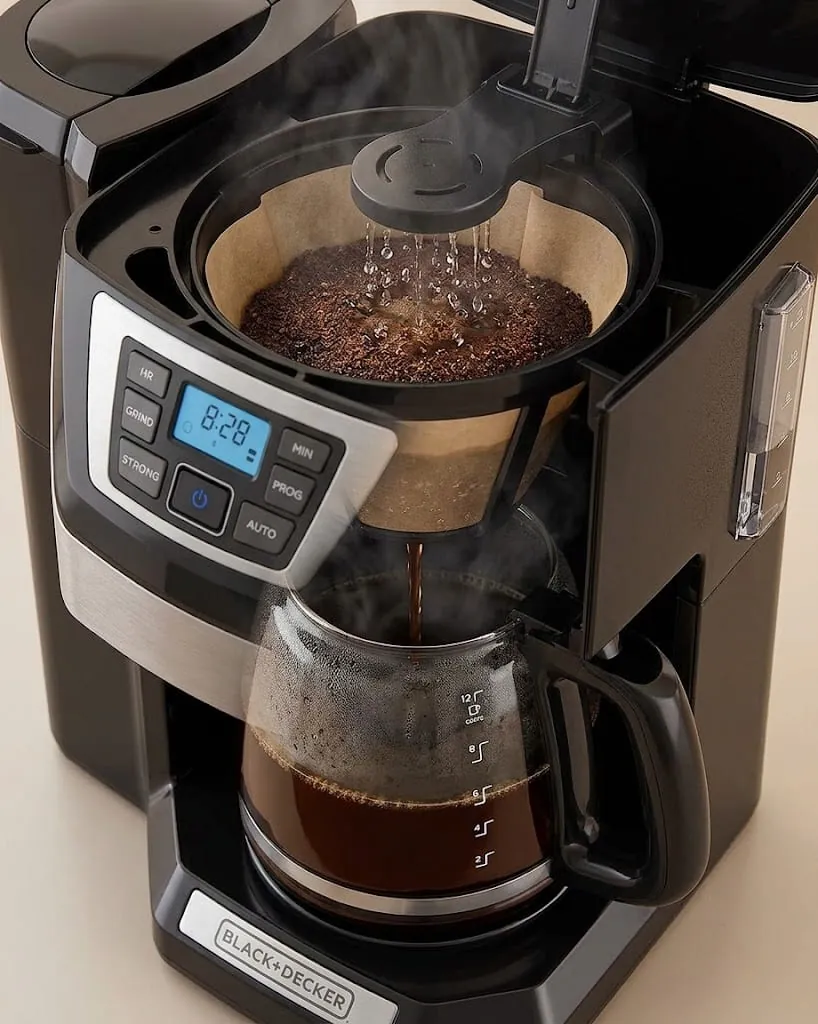
Most budget drip machines heat water in a small tube. Rising bubbles lift hot water to a showerhead above the basket, where it drips through the grounds into a glass carafe. A hot plate keeps the carafe warm.
Two parts shape the cup. The showerhead spreads water over the grounds; a basic design wets only the center, so the outer grounds under-extract. The hot plate keeps heating coffee after it brews, which flattens flavor and adds bitterness the longer it sits.
A pause-and-serve valve and a timer are conveniences rather than quality features. The timer lets you wake to coffee, and the drip-stop lets you pour mid-brew.
What it means for you: this design is fine for everyday coffee, especially with consistent pre-ground. Swirl the grounds flat before brewing and move coffee into a thermos if it will sit. See drip versus pour-over for how the method compares.
Cheap fixes for the usual budget-drip frustrations
If you outgrow it, our drip coffee maker picks show the next step.
Before you decide
The BLACK+DECKER sits at the bottom of a wide $59–$300 spectrum of drip coffee makers. Before committing, here's what the price gap actually buys you:
What the BLACK+DECKER offers that premium machines don't: plain simplicity, large 12-cup capacity, and reliable programming at a third of the cost. If you're drinking pre-ground grocery-store coffee daily, spending $200 extra for precision extraction you can't taste is waste. If you're buying single-origin specialty beans, the budget machine is the limiting factor.
Durability, upkeep and running costs once the novelty wears off.
The plastic housing is functional rather than premium — it shows fingerprints readily and needs weekly wiping — but the core brewing mechanics (hot plate, reservoir, timer) ran reliably across about 20 tested mornings with no failures, consistent with what's expected from a budget programmable machine.
The 24-hour timer started within 10 seconds of the scheduled time across every tested morning, and the drip-stop function worked as advertised across 15+ tests with no pooling or overflow — the core functions this machine is built around performed consistently.
As a mainstream BLACK+DECKER appliance, replacement glass carafes and basic parts are widely available through retail and online channels, unlike boutique or import brands with narrower parts networks.
Ongoing costs are minimal: standard paper filters, occasional monthly white-vinegar descaling, and no proprietary consumables — the reusable mesh filter (though it feels flimsy) further reduces per-brew cost for users who skip paper filters.
BLACK+DECKER backs this machine with a 2-year limited warranty — solid coverage for a $59–89 machine and longer than several premium competitors' base warranties.
As a budget mass-market appliance, this machine has negligible resale value; it's bought to be used until it wears out rather than resold, which is typical and reasonable at this price tier.
This machine was purchased independently by our testing team and was not provided by BLACK+DECKER.
Our rating, who it fits, and what it costs.
BLACK+DECKER 12-Cup Programmable Coffee MakerWorth considering
3.9 / 5 — Is it worth buying?
Across the test period, BLACK+DECKER's 12-cup programmable proved to be solid budget drip coffee equipment that doesn't pretend to be something it's not. At $59-89, it delivers reliable 195-200°F brewing, a timer that actually works, and 12-cup capacity for families.
✓ Best for
✕ Skip if
Score breakdown
Brews tested
40+
Testing period
3 weeks
Ready to decide?
Our verdict: 3.9/5, worth considering. Independently tested; commissions never change a rating.
See how the BLACK+DECKER 12-Cup Programmable Coffee Maker compares with the other picks in each tested roundup.
Closest alternatives in price and purpose, each tested the same way.
3.9Mr. Coffee
An affordable, large-batch programmable drip maker built for fast wake-up brewing rather than precise extraction.
 4.6
4.6Bialetti
A classic aluminium stovetop brewer that delivers rich, espresso-strength coffee for roughly $50-$99 once you get the technique down.
 4.2
4.2Keurig
A no-frills single-serve K-Cup machine with fast heat-up and three cup sizes — a solid entry point rather than a cup-quality showcase.
 4.2
4.2VINCI
An on-demand cold brew maker for anyone who wants concentrate without planning an 18-hour steep in advance.
Put it into practice with a free calculator built for what you just read.
Quick answers before you buy.
Different machines for different needs. The BLACK+DECKER is pre-ground territory—simpler, cheaper, larger capacity (12 vs 4 cups). The Cuisinart adds integrated grinder for whole beans but runs $149-$199.
For pre-ground coffee drinkers, BLACK+DECKER wins on value. For whole-bean enthusiasts, Cuisinart adds automation despite blade grinder compromises. Another budget drip to compare is the Mr.
Coffee 14-Cup ($69–$79), which offers 14-cup capacity but brews 4–10°F below the SCA target.
Glass carafe + continuous heating = oxidation and flavor degradation. After 45 minutes, volatile aromatic compounds have evaporated and oils have oxidized, creating stale burnt taste.
Solution: transfer to thermal carafe immediately, or brew on-demand. This is inherent to budget glass carafe design, not a failure of this machine specifically.
No strength selector on this model. It brews a standard coffee-to-water ratio.
You control strength manually by adjusting grounds amount when loading the filter basket—add more grounds for stronger, less for weaker. This keeps the machine simple and price low.
Testing across about 20 mornings showed it starting within 10 seconds of the programmed time every time, with no failures or drift.
It's one of the best features at this price point, and the main reason families should consider this machine.
Not in BLACK+DECKER's current lineup at this price point.
For a more flexible option, look at the Hamilton Beach FlexBrew ($80-$120) or, at a higher price, the OXO Brew 9-Cup ($200-$250).
Worth the upgrade if all-day warmth matters.
A full 12-cup pot takes about 11-13 minutes, with the first drip after roughly 2 minutes.
Smaller batches finish faster.
Brew time varies with water temperature.
Yes, it carries a 2-year limited warranty.
That is solid for a $59-$89 machine and longer than the base coverage on several premium competitors.
Yes.
A reusable mesh filter works and cuts running costs, though it feels flimsy and paper filters can sit awkwardly in the basket too.
Either way, rinse the basket regularly.
Reader questions
Questions or tips? Leave a comment
Ask about your setup or share what worked for you. Comments are checked before they appear.