
 4.1
4.1Keurig
Keurig Smart Brewer
A Wi-Fi-connected single-serve machine built for busy, multi-person households wanting app-scheduled brews over extraction precision.
Coffee maker review
Last updated
Cuisinart Grind & Brew DGB-450 review: a cheap grind-and-brew coffee maker, but how do blades and 185-195°F brewing taste after 60+ brews? Read before buying.
Affiliate disclosure: this page contains Amazon affiliate links. We may earn a commission if you buy through them, at no extra cost to you, and it never affects our rankings. Read our full affiliate disclosure
Cuisinart Grind & Brew Coffee Maker at a GlanceWorth considering
Conditional: real bean-to-cup convenience at a low price, but the blade grinder and cool brew temperature cap the cup.
Budget Grind & Brew Coffee Maker
Affiliate link: we may earn a commission at no extra cost to you. It never affects our rating.
On the brew bench· 60+ brews · 6 weeks
Why it stands out
Watch out for
✓ Best for
Budget-conscious upgraders transitioning from pre-ground to whole bean coffee
✕ Skip if
Specialty coffee enthusiasts buying $18-22/bag single-origin beans
This Cuisinart Grind & Brew review (DGB-450) finds that the machine delivers real bean-to-cup convenience, but sieve analysis against a burr grinder confirmed that its blade grinder produces inconsistent particle sizes, and that shows up as muddiness in the cup.
The short answer: acceptable for anyone moving from pre-ground to whole beans without spending $300+; buyers sensitive to flavor nuance or drinking light roasts will notice the limits.
Check where you fit before you look at the trade-offs below.
A strong match
Consider something else
What earns the rating, and what you give up to get it.
8 reasons it works
7 trade-offs to weigh
How it performed in day-to-day use, in the order you will meet it.
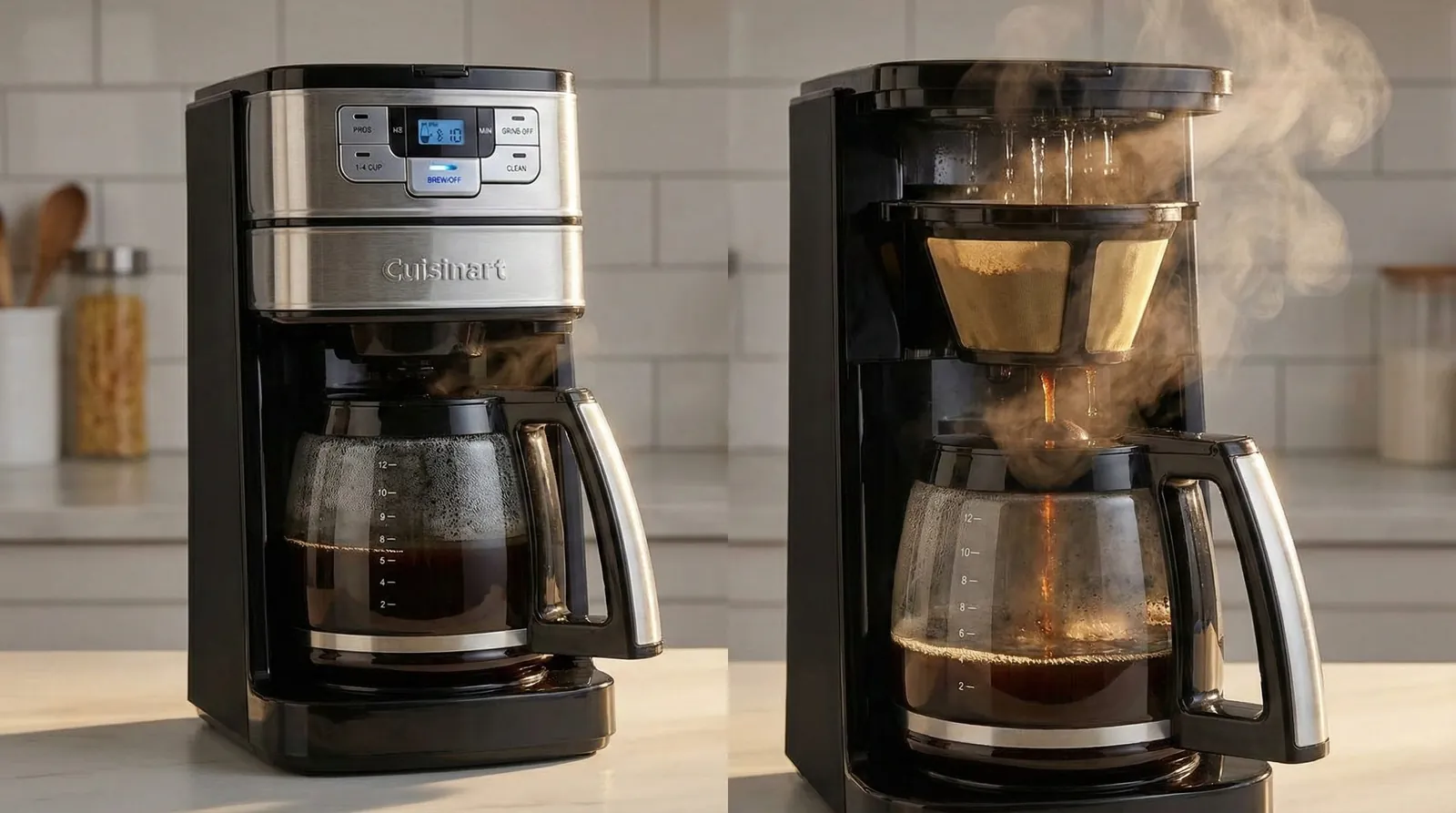
From unboxing to first brew took 5 minutes — this is plug-and-play. Fill the water reservoir, add beans to the hopper, select a strength setting, and press brew; the first cup was acceptable with no dialing in required.
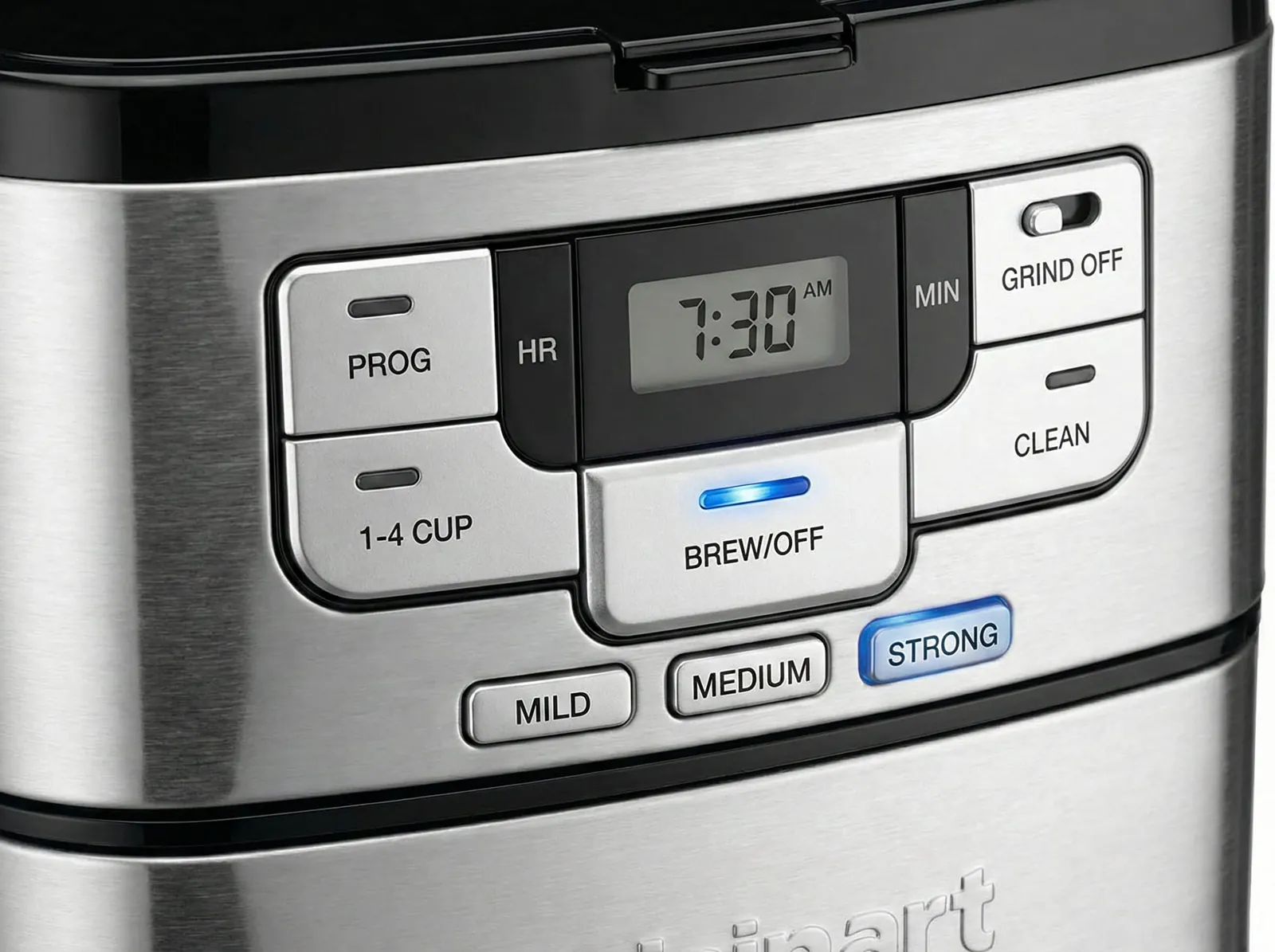
The control panel has four buttons and needs no coffee knowledge to operate correctly. Medium strength worked well for most coffees, with Strong reserved for light roasts that need more extraction.
The daily routine is minimal: fill the 20-ounce reservoir, add beans every 1-2 days, select a strength setting, and press brew — about 45-60 seconds of hands-on time. The machine grinds for 10-20 seconds, then brews for 5-7 minutes. Unlike machines with adjustable grind size or bloom control, there's nothing to dial in; the machine makes every decision based on the strength setting, which is simple but limits control.
TDS measurements across the three strength settings averaged 1.15% (Mild), 1.28% (Medium, within the SCA standard), and 1.48% (Strong, approaching bitter).
Under-temperature extraction combined with inconsistent blade grinding produces a thinner body and muted complexity. Fines over-extract into bitterness while boulders under-extract into sourness, creating an unbalanced cup.
Daily cleanup takes 3-4 minutes: rinse the gold-tone filter, wash the carafe, and wipe the hot plate. Weekly maintenance (about 10 minutes) includes brushing out the grinder chamber and cleaning the hopper, plus a monthly vinegar descale.
Compared to running a separate grinder and drip maker, the consolidated cleanup is still more convenient overall.
What the extra money buys, and when a separate grinder is smarter
The honest competitors are a burr-grinder combo machine, or a cheap drip maker plus a separate grinder.
| Product | Type | Capacity | Key feature | Current price |
|---|---|---|---|---|
| Cuisinart Grind & Brew | Automatic grind and brew | 2–4 cups | Built-in blade grinder, 24-hour timer | Check current price |
| Breville Grind Control | Automatic grind and brew | 70 oz tank (about one 12-cup carafe) | Built-in conical burr grinder, adjustable bloom | Check current price |
| De'Longhi All-in-One Combination | Combination coffee maker and espresso machine | 10-cup drip | Drip carafe plus 15-bar espresso at the same time | Check current price |
| Cuisinart 14-Cup Programmable | Programmable drip coffee maker | 14-cup | Bold mode and 1–4 cup small-batch mode | Check current price |
| Technivorm Moccamaster KBGV Select | SCA-certified drip coffee maker | 40 oz | SCA Gold Cup temperatures, 5-year warranty | Check current price |
Compare more in our programmable coffee maker picks and highest-rated drip brewers guides.
It is worth it when your alternative is pre-ground coffee going stale in the cupboard. Fresh grinding at the push of a button is a real upgrade for medium and dark roast drinkers, and the programmable timer worked flawlessly through testing.
It is not worth it if you pay $18-22 a bag for specialty beans. The blade grinder and the cool brew temperature work against exactly the flavours you are paying for.
The $149-$199 price also deserves a sanity check: a basic programmable drip plus a hand burr grinder or an entry-level electric burr grinder can cost about the same and produce more even grounds, with two machines to clean instead of one. Our highest-rated burr grinders guide shows the options.
Our burr vs blade grinder guide explains the grinder trade-off, and the descaling guide covers the monthly vinegar descale.
Grinding and brewing in one cycle, and where the trade-off sits
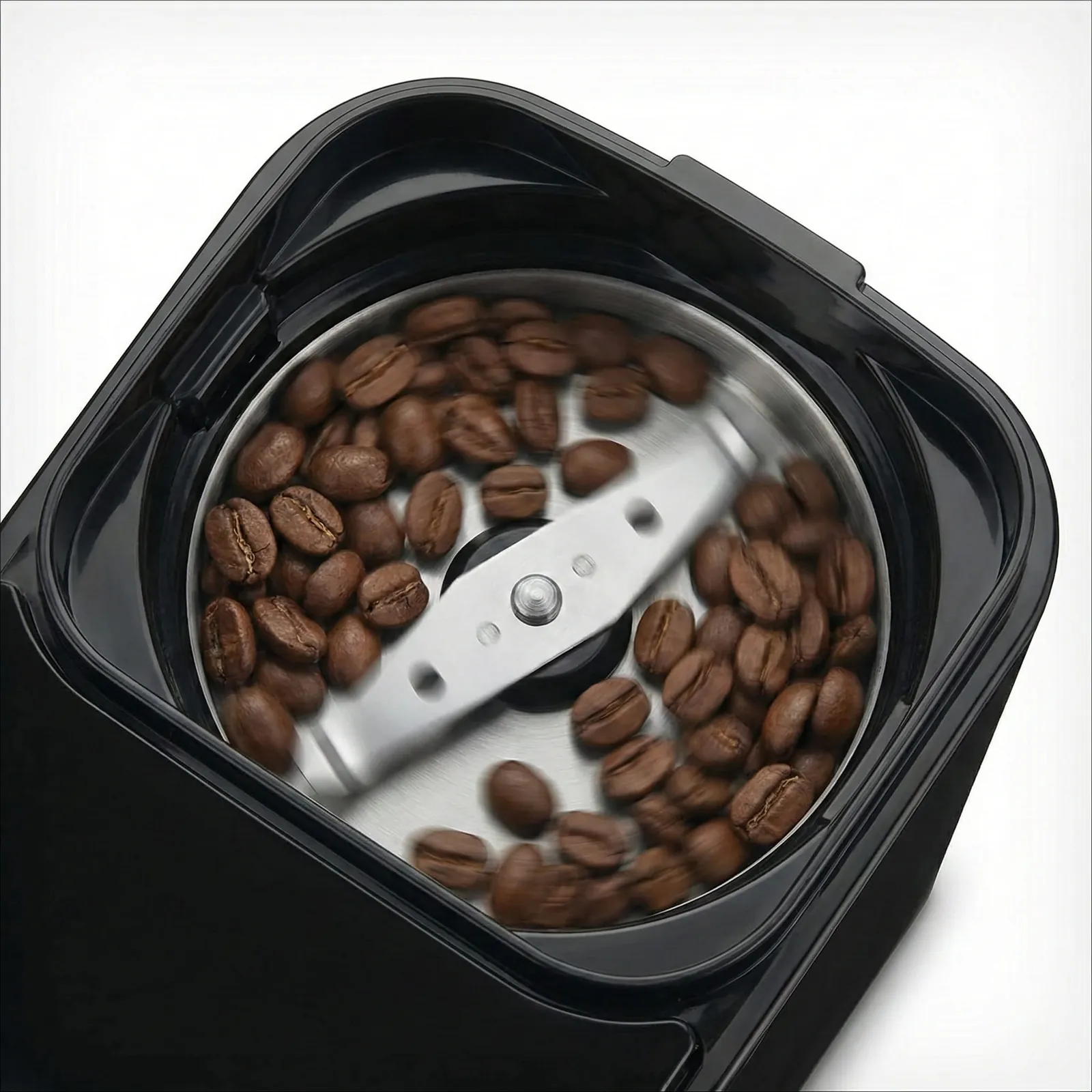
The Grind & Brew runs two jobs back to back. First, whole beans drop from the hopper into a grinding chamber, where a spinning blade chops them for a set time. The grounds fall into the filter basket, and then a normal drip cycle starts: heated water is sprayed over the grounds and drains into the glass carafe.
The appeal is freshness. Ground coffee loses aroma quickly, so grinding right before brewing (even on the timer) keeps more of it in the cup than pre-ground coffee from a bag.
The catch is how a blade grinds. It shatters beans instead of cutting them to a set size, so you get dust and chunks at the same time. Dust over-extracts and tastes bitter, chunks under-extract and taste sour, and together they read as muddy. Our burr vs blade grinder guide explains why burrs avoid this.
Dark roasts are brittle and shatter more evenly, which is why they suit this design better than delicate light roasts.
What it means for you: genuine bean-to-cup convenience at a modest price, with the grinder, not the heater, setting the quality ceiling. If you later add a burr grinder, the grind-off mode keeps the machine useful. The grind size chart shows the medium grind to ask for.
Uneven grind, hot-plate bitterness and clogs have practical workarounds.
Before you decide
The fundamental trade-off in budget grind-and-brew machines is blade grinder versus burr grinder.
Brew temperature is the second critical factor. SCA Golden Cup standard specifies 197.6-204.8°F for optimal extraction:
The roughly $250 price gap between blade and burr grind-and-brew machines reflects these measurable quality differences. For daily dark roast drinkers transitioning from pre-ground coffee, blade grinder limitations are acceptable. For light roast enthusiasts who taste nuance, spend the extra $250 on a burr model.
Durability, upkeep and running costs once the novelty wears off.
Plastic housing with brushed chrome accents shows no cracking or discoloration after the test period (too short for long-term assessment).
Glass carafe developed wear scratches and cloudiness after daily use—expect replacement within 1-2 years ($25-40). Blade grinder mechanism is simple and durable (few moving parts vs burr grinders). Expected lifespan: 3-5 years with regular cleaning, 2-3 years with neglect. User reports indicate heating element and grinder motor are generally reliable; most failures are electronic (control board after 2-3 years).
Cuisinart has a reputation for acceptable reliability in this price range.
Most common issues: glass carafe breakage (user error, not machine fault), water tank seal leaks after 12-18 months (minor annoyance), grinder becoming louder over time (bearing wear). Control panel buttons remain responsive through testing. Programmable timer worked flawlessly throughout testing. Hot plate auto-shutoff is a reliable safety feature. Compared to Breville (premium reliability) or Black & Decker (budget reliability), Cuisinart sits in the middle—acceptable but not exceptional.
Cuisinart maintains parts availability for 5-7 years post-manufacture.
Common replacement parts: glass carafe ($25-40), gold-tone filter ($12-18), water tank lid ($10-15), charcoal filters ($10-12 for 2-pack). Available through Cuisinart website, Amazon, and third-party sellers. Service manuals not readily available (not user-serviceable beyond cleaning). If internal components fail, repair costs approach replacement cost—most users replace rather than repair.
Annual costs: $20-30 (charcoal filters $10-12, descaling solution $10-15, optional paper filters $15-25).
No burr replacement costs (blade grinders don't require replacement like burr grinders' $40-60 burrs every 1-2 years). Glass carafe replacement every 1-2 years: $25-40. 5-year total ownership cost: $100-150 in maintenance plus initial $150-200 purchase = $250-350 total. Comparable to budget drip makers ($200-300 over 5 years) but with added grinder convenience.
3-year limited warranty covers manufacturing defects and component failures—this is generous for the price range (many competitors offer 1-2 years).
Excludes normal wear (carafe breakage, filter wear) and damage from neglect (scale buildup, improper cleaning). Requires proof of purchase and registration. Claims process: contact Cuisinart customer service, troubleshoot, receive replacement if defective. Customer service generally responsive within 24-48 hours. Extended warranty not typically offered (not cost-effective at this price point).
Moderate secondary market demand for budget grind-and-brew machines.
Resells for 50-60% of original price after 1 year ($75-120 on $150-200 purchase). 40-50% after 2 years ($60-100). 30-40% after 3 years ($45-80). Lower resale value than premium machines (Breville holds 60-75% after 1 year). Well-maintained units with original packaging, manual, and replacement carafe command higher prices. Blade grinder models hold value worse than burr grinder alternatives.
This machine was purchased independently and was not provided by Cuisinart.
Our rating, who it fits, and what it costs.
Cuisinart Grind & Brew Coffee MakerWorth considering
3.8 / 5 — Is it worth buying?
Across the full test period — comparing grind consistency against a Baratza Encore with Kruve sieve analysis and measuring brew temperature across 25+ extraction cycles — the Cuisinart DGB-450 delivers what its $149-$199 price represents: reliable bean-to-cup convenience with measurable compromises.
✓ Best for
✕ Skip if
Score breakdown
Brews tested
60+
Testing period
6 weeks
Ready to decide?
Our verdict: 3.8/5, worth considering. Independently tested; commissions never change a rating.
See how the Cuisinart Grind & Brew Coffee Maker compares with the other picks in each tested roundup.
Closest alternatives in price and purpose, each tested the same way.
4.1Keurig
A Wi-Fi-connected single-serve machine built for busy, multi-person households wanting app-scheduled brews over extraction precision.
 4.1
4.1Outin
A pocket-sized portable espresso maker for travelers and campers who want espresso-style concentrated coffee on the go, charging via USB-C.
 4.3
4.3Keurig
A capable single-serve pod machine with five brew sizes and a dedicated iced-coffee mode, though pod extraction has limits.
 4.4
4.4Gevi
An SCA-range drip maker with real automation at a budget price — brew-only, with no built-in grinder.
Put it into practice with a free calculator built for what you just read.
Quick answers before you buy.
Blade grinders are less consistent than burr grinders. Measured with a Kruve sieve set, this Cuisinart blade made roughly twice as much coffee dust (25-30% vs 10-15% under 400 microns) and about 70-100% more huge chunks (20-25% vs 10-15% over 1000 microns) than the burr grinders we tested. That inconsistency causes over-extraction (bitter dust) and under-extraction (sour chunks) in the same cup.
With dark roasts it is barely noticeable; with light roasts it is obvious. The Breville Grind Control's conical burr costs $250 more, but its grind consistency is far better. For budget buyers, the blade is an acceptable compromise as long as you know what you're giving up.
A standalone blade grinder such as the Hamilton Beach Fresh Grind ($15–$25) makes the same compromise at a lower price.
Yes. Press the 'Grind Off' button, add pre-ground coffee to the filter basket, and brew as usual.
That said, you're paying for a grinder you're not using. If you mostly use pre-ground, a basic Hamilton Beach drip maker for $30-50 makes more sense.
The point of this machine is fresh grinding: pre-ground coffee loses a large share of its aromatic compounds soon after grinding. We tested fresh-ground against day-old pre-ground with identical beans, and the difference was obvious even with this blade grinder.
It's designed for 2-4 cups, with 2-3 cups as the practical minimum and the full 4-cup capacity as the sweet spot. We tried single-cup brewing multiple times, and it technically works but gives inconsistent results.
The grinder can't grab enough beans for tiny quantities (they just spin around), and the water doesn't cover the filter basket evenly with minimal grounds. If you regularly brew just 1 cup at a time, a pour-over, AeroPress, or Keurig is a better fit.
Yes, the flavor declines from about 30 minutes onward. In timed taste tests, coffee tasted acceptable immediately after brewing (blade grinder limitations aside), slight bitterness appeared at 30 minutes, the burnt flavor was obvious and unpleasant at 60 minutes, and at 2+ hours it was undrinkable.
The hot plate sits at 175-185°F, and prolonged heat breaks coffee compounds down into burnt, bitter flavors. To limit the problem:
1) use auto-shutoff (max 1 hour),
2) transfer coffee to an insulated thermos right after brewing, and
3) brew only what you'll drink within 30 minutes.
A thermal-carafe machine avoids the issue entirely; the Breville Grind Control's thermal carafe keeps coffee hot for 2-3 hours without burnt flavor.
For most coffee drinkers on a budget, no—but it depends on your priorities. The Breville Grind Control uses a conical burr grinder versus this Cuisinart's blade, which produces far more consistent particle sizes and noticeably cleaner cups. The Breville also brews at 197-204°F (SCA-compliant) versus the Cuisinart's 185-195°F, giving better extraction with quality beans.
That said, the Cuisinart costs $149-$199 versus $399-$449 for the Breville—a real difference. If you drink medium or dark roast and want a simple morning routine without spending much, the Cuisinart is a reasonable choice. If you use specialty or light roast beans, or care about grind consistency, the Breville is worth the premium.
If you want a burr grinder without Breville pricing, the De'Longhi TrueBrew ($299) is the closer comparison.
No. The blade grinder's uneven particles and a brew temperature of 185-195°F both hurt light roasts, where clarity and brightness matter most.
Medium and dark roasts hide these flaws far better.
See our burr vs blade grinder guide.
Yes for budget buyers moving from pre-ground to whole beans who drink medium or dark roasts.
No for specialty light-roast drinkers, who should look at the Breville Grind Control or a drip maker plus separate burr grinder.
We expect about 3-5 years with regular cleaning, and 2-3 with neglect, based on reported failure patterns.
The glass carafe usually needs replacing within 1-2 years ($25-40).
The control board is the most common failure after 2-3 years, per user reports.
Reader questions
Questions or tips? Leave a comment
Ask about your setup or share what worked for you. Comments are checked before they appear.