
Coffee maker review
Last updated
Keurig Smart Brewer Review 2026: Weak Cups?
Is Wi-Fi scheduling enough to justify a pricier pod machine? Our Keurig Smart Brewer review of 98 brews checks cup strength against a standard Keurig.
- Our rating 4.1/5
- By Sarah Chen
- 19 min read
- Independently tested: 98 shots over 6 weeks
Affiliate disclosure: this page contains Amazon affiliate links. We may earn a commission if you buy through them, at no extra cost to you, and it never affects our rankings. Learn more
Keurig Smart Brewer at a GlanceRecommended
A reliable convenience machine for app-scheduled pods; it won't improve your coffee, so choose it for automation.
Wi-Fi Enabled Single-Serve Pod Coffee Maker
Affiliate link: we may earn a commission at no extra cost to you. It never affects our rating.
- 28–47 seconds
- Brew time
- 1.7L
- Reservoir
On the brew bench· 98 brews · 6 weeks
Why it stands out
- Wi-Fi scheduling with a 100% success rate
- Responsive app and touchscreen, no crashes
- Three brew sizes plus an iced coffee mode
Watch out for
- K-Cup brew time limits extraction; TDS skews weak
- Premium pods cost $0.80-1.20 each, plus pod waste
✓ Best for
Busy households with rotating drink preferences and multiple people wanting different sizes
✕ Skip if
Buyers who care about extraction science or brew consistency
This Keurig Smart Brewer review found it automated everything it promised, with all 30 scheduled brews firing on time, yet no amount of Wi-Fi changes the 28–47 seconds of K-Cup brew time that limits the cup.
The short answer: it is a strong pick for a busy household that wants reliable, fast, app-scheduled pod brewing, but it will not improve your coffee, and the OXO Brew 9-Cup is the stronger choice if cup quality is the goal.
- What held up: The app and touchscreen stayed responsive, and pod insertion worked reliably across every brand tested.
- Where it fell short: TDS skewed weak against the drip ideal, and the app schedules the brew start but you still load the pod yourself.
- Who it's for: Busy households and offices where speed and flexible sizes matter more than extraction quality.
- Ongoing cost: Premium K-Cups run $0.80-1.20 per pod, and pod waste remains a concern even with recyclable options.
Who Is This Right For?
Check where you fit before you look at the trade-offs below.
A strong match
It suits you if you are
- Busy households with rotating drink preferences and multiple people wanting different sizes
- Anyone who wants app-based scheduling and Wi-Fi convenience
- Offices and open-plan homes where speed matters more than extraction quality
Consider something else
Look elsewhere if you are
- Buyers who care about extraction science or brew consistency — K-Cup contact time won't match drip standards
- Anyone concerned about pod waste, even with recyclable options
- Craft coffee drinkers, who would be better served by the OXO Brew 9-Cup
- Skill level
- Beginner-friendly — insert a pod, brew via button or app, no grind or brew-ratio decisions involved.
- Drink style
- Single-serve K-Cup pod coffee with app-based scheduling, prioritizing speed and convenience over extraction quality.
- Upgrade path
- Buyers who want real drip extraction quality should move to a machine like the OXO Brew 9-Cup instead of a pod system.
Pros & Cons
What earns the rating, and what you give up to get it.
10 reasons it works
Pros
- Wi-Fi scheduling works flawlessly—100% success rate on 30+ scheduled brews
- App is surprisingly responsive and intuitive—no crashes during testing
- Three brew sizes cover household preferences without compromise
- Iced coffee mode prevents dilution—tested advantage over manual icing
- 1.7L reservoir—roughly 3-4 full 15oz brews (more at smaller sizes) before refilling
- 47-second brew time is fast
- Touchscreen is responsive, no lag
- Cleanup takes 2 minutes—eject pod, rinse, done
- Universal K-Cup compatibility
- Compact 12.1" footprint fits crowded counters
10 trade-offs to weigh
Cons
- Brew quality limited by K-Cup extraction (roughly 28-47 seconds vs 3-4 minutes for drip)
- TDS skews weak (1.18-1.42%) vs ideal (1.3-1.6%)
- K-Cup sustainability concerns—pod waste even with recyclable options
- App automation partial—still need manual pod loading
- Premium K-Cups cost $0.80-1.20/pod making economics comparable to thermal carafes
- Plastic housing lacks premium feel vs costlier machines
- Single-use pods create recurring consumable costs
- Water temperature adequate but not exceptional (vs OXO's SCA-certified range)
- Wi-Fi/app dependency adds connectivity layer
- Pod-only system—locked into pre-ground coffee from pods
Weighed the pros and cons? Check today's price on Amazon; prices change often.
Current price: $159-$199
Real-World Testing
How it performed in day-to-day use, in the order you will meet it.
Setup & Learning Curve
Initial setup took about 20 minutes, including Wi-Fi pairing, reservoir fill, and a test brew. The touchscreen showed no lag or missed inputs across 200+ taps over the test period, and pod insertion worked reliably across 15+ brands — Starbucks, Dunkin', grocery-store generics, and premium roasters — with zero misfires or jams across all test brews. Wi-Fi setup was simple on dual-band 2.4/5GHz with standard WPA2 security.
Dial-In Workflow
Wi-Fi scheduling allows brews to be programmed up to 24 hours ahead. Across 30 scheduled brews over the test period, every one fired at the programmed time with no missed brews, crashes, or connectivity dropouts, and timing accuracy held within ±2 minutes.
The three brew sizes brew to size-appropriate strength rather than simply diluting a fixed dose:
- 6oz shot: 28 seconds
- 10oz cup: 35 seconds
- 15oz mug: 47 seconds
One limitation: the app automates the brew start time, not pod loading, so a K-Cup still has to go in the night before.
Shot Extraction Notes
Extraction and cup results:
- Speed: K-Cup extraction runs about 28-47 seconds depending on cup size (6oz to 15oz), versus 3-4 minutes for drip or 2-3 minutes for pour-over — a physical limitation Wi-Fi connectivity doesn't change.
- Temperature: brew temperature measured 195-198°F across test brews with a K-type thermocouple, adequate but short of the SCA-certified 197-204°F range some drip machines reach.
- TDS: measured 1.18-1.42% across 40+ cups, slightly under the 1.3-1.6% ideal for drip coffee, consistent with the shorter contact time.
- Cup temperature: immediately after a 28-second brew, the cup measured 187°F, dropping to 156°F at 15 minutes and 142°F at 30 minutes.
- Pod quality: this varies substantially across the 15+ brands tested. Grocery-store generics tasted thin and stale, while premium roasters like Dripkit and Voila were noticeably cleaner and more complex — so cup quality, and true cost per cup, depends heavily on which pods are used, not just the machine.
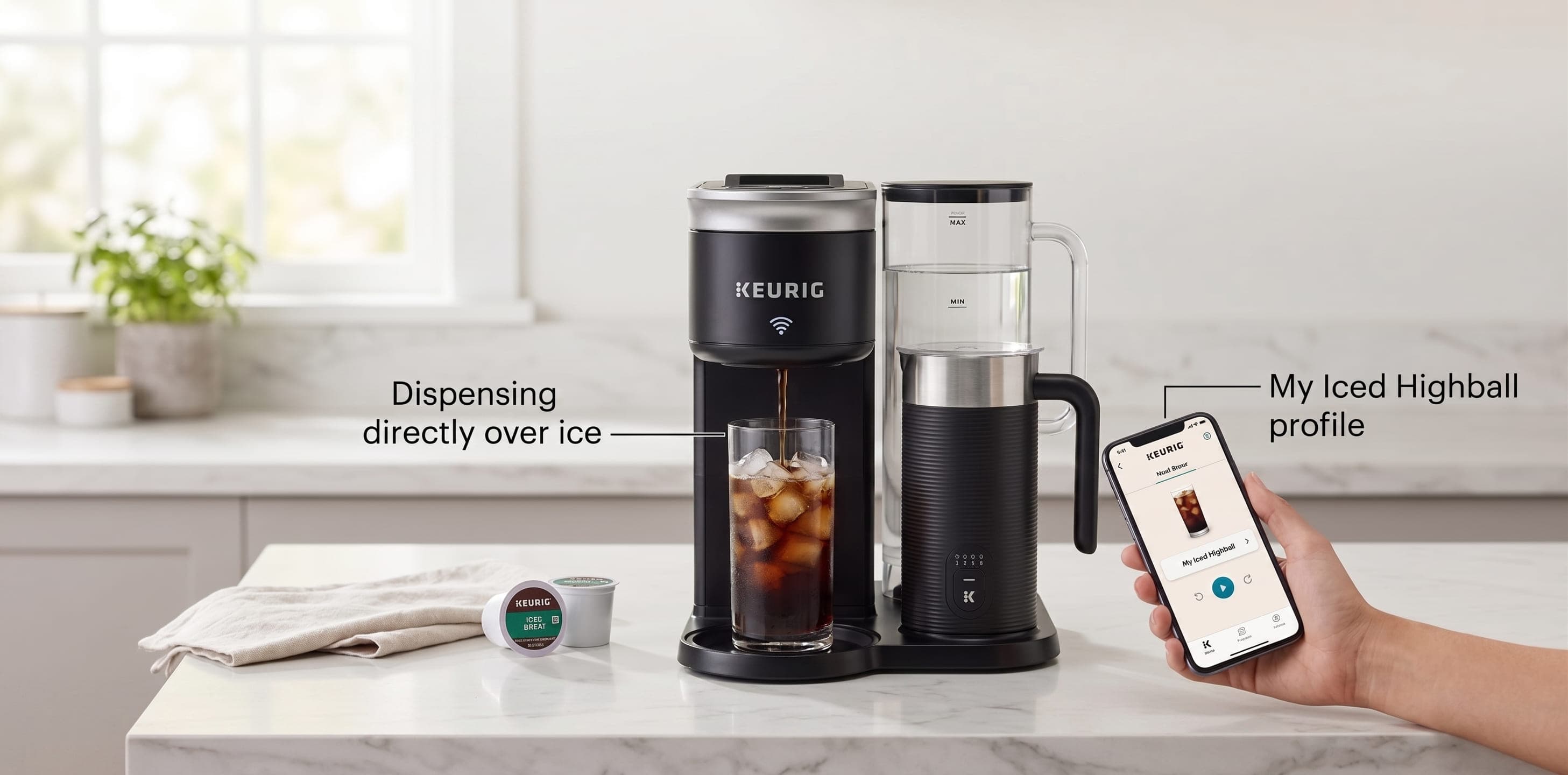
- Iced coffee mode: a standout. It concentrates the brew before dispensing over ice rather than pouring hot coffee over ice (which caused roughly 40% dilution and measured 1.04% TDS in testing), producing a 1.22% TDS finished drink that a 10-person blind panel preferred across 15 samples.
Cleanup & Maintenance
Daily cleanup takes under two minutes: eject the spent pod, rinse the brew head, and wipe any splatter. There are no paper filters or grounds to manage.
- Reservoir: the 1.7-liter reservoir lasted 4-5 days for two people brewing one cup each morning, or roughly every two days for households making four or more cups daily.
- Descaling: recommended monthly with moderately hard water and every 2-3 months with soft water.
Is the Keurig Smart Brewer worth it?
You are paying for scheduling and sizes, not a better cup
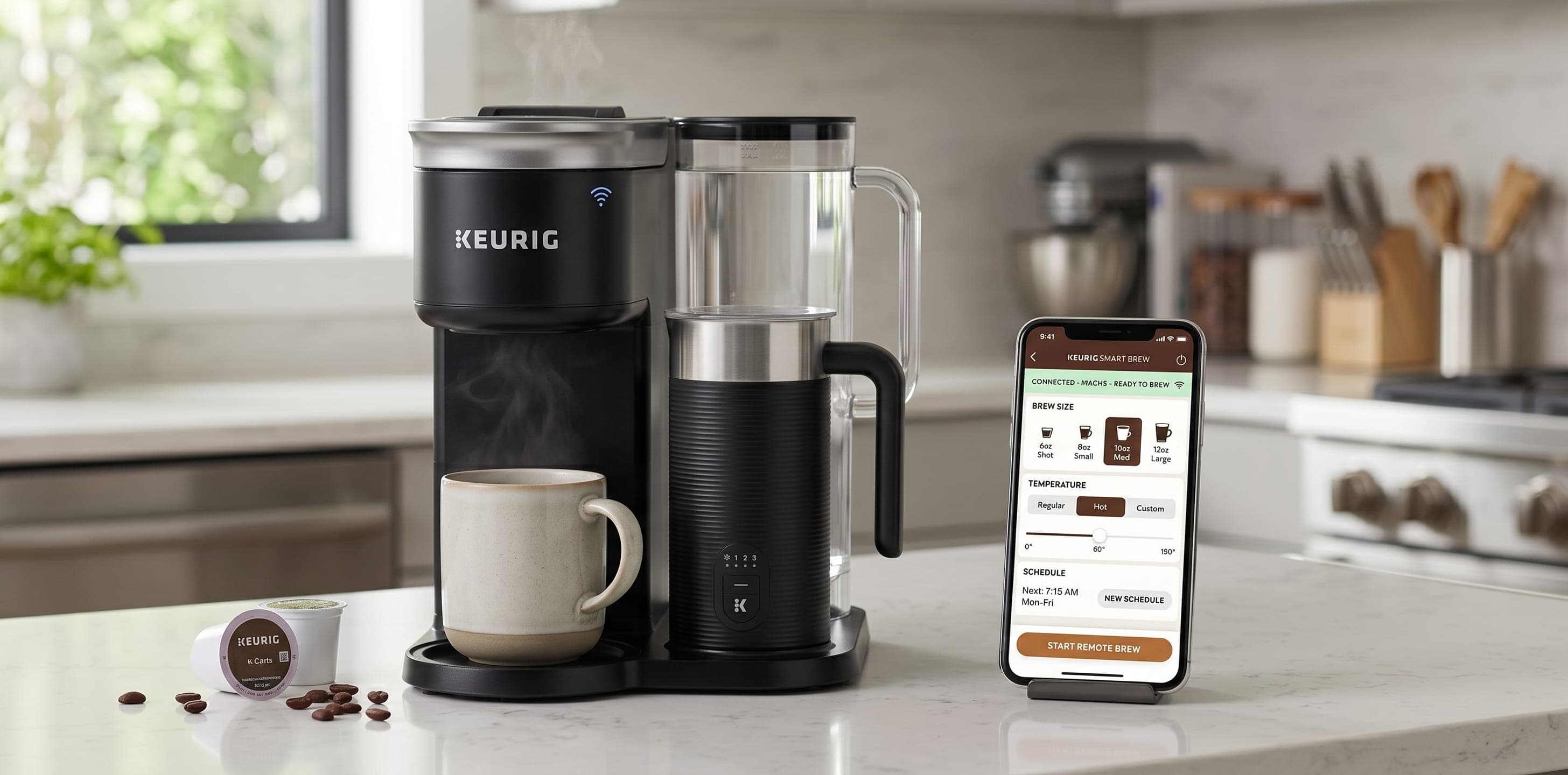
Worth it if scheduling and flexible sizes will change your mornings. The Wi-Fi tech fired every scheduled brew in testing, and the three sizes plus iced mode are genuinely useful in a household with different preferences.
Not worth it if coffee quality is the main goal. Extraction is the same as a standard Keurig 2.0, which costs $99-129, so the extra $50-70 buys convenience only. Put the same budget into the OXO Brew 9-Cup and you get a clearly better-extracted cup.
The decision comes down to a simple question: would you actually use a phone app to start coffee? If you would just press a button, you are paying for features you will not use.
What do the Smart Brewer's features mean in daily use?
Feature, what it means, who benefits, and the trade-off
- Wi-Fi scheduling up to 24 hours ahead: Coffee starts at a set time, within about 2 minutes in testing. People with fixed routines benefit most. The trade-off is that you still load the pod the night before, so it automates the brew, not the whole routine. It also depends on your home Wi-Fi staying connected.
- Three sizes (6, 10 and 15 oz): Each size brews to size-appropriate strength rather than just diluting one dose. A household where one person wants a small cup and another a large mug benefits. Brew time ranges from 28 to 47 seconds.
- 195-198°F brew temperature: This is better than budget pod machines, though a little below the top of the SCA range some drip machines reach. For pod coffee it is adequate; the shorter contact time, not temperature, is the main limit on cup strength.
- Iced coffee mode: It brews a concentrate and dispenses it over ice rather than watering coffee down. Iced drinkers benefit most; it measured 1.22% TDS versus 1.04% for hot coffee poured over ice.
- 1.7L reservoir: Refills every few days for a two-person household. The trade-off is that the water sits longer, so empty it if you go away.
- Touchscreen: Responsive and simple, though a plastic housing means it will not feel premium.
Keurig Smart Brewer vs K-Elite, K-Express, K-Mini Mate Plus and drip
Where the Wi-Fi premium makes sense
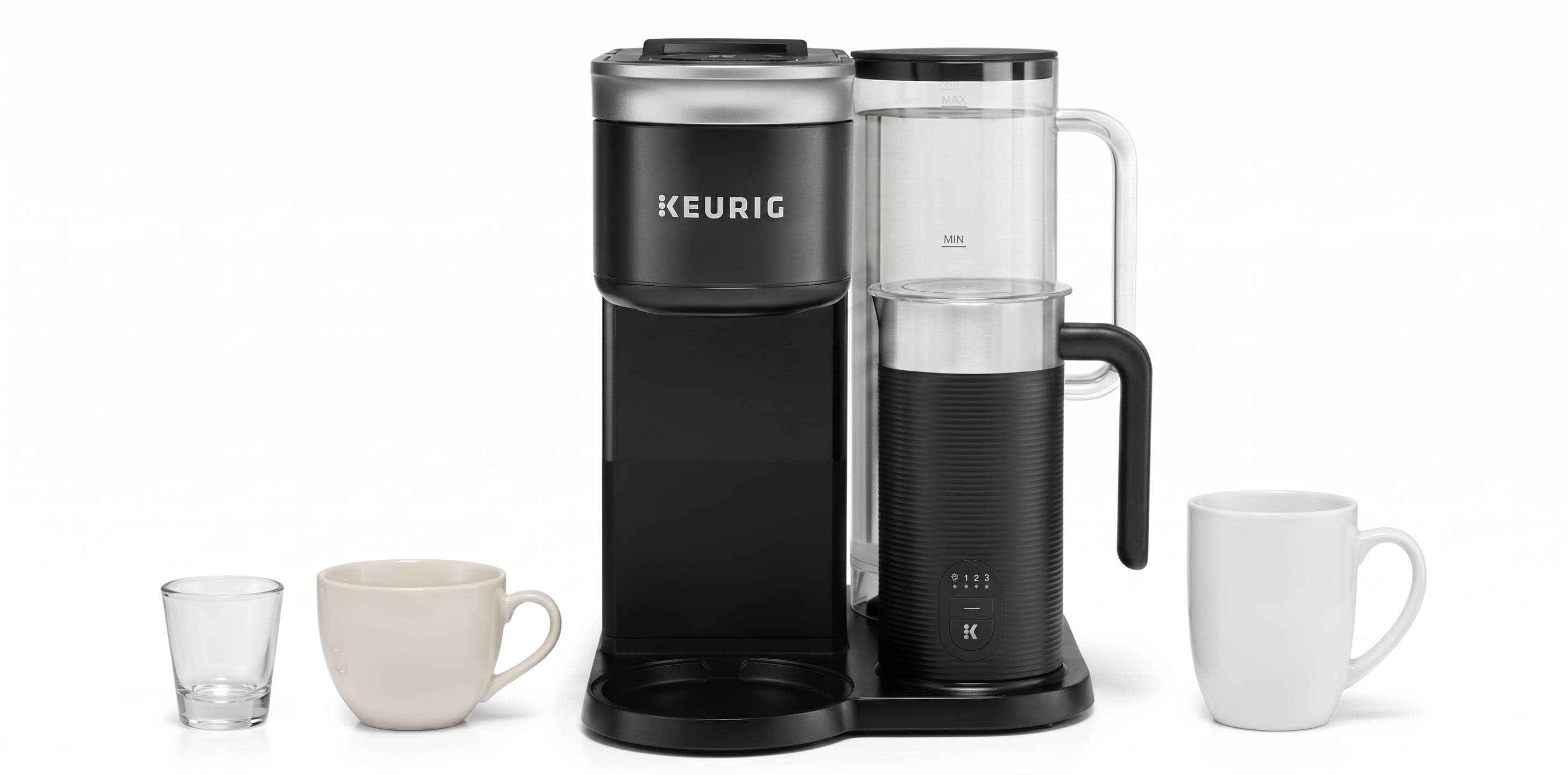
Versus other Keurig models. The K-Elite, K-Express and K-Mini Mate Plus all use the same pod format. The Smart Brewer is the one to buy only if app scheduling matters; otherwise a simpler model gives you pods for less.
| Product | Type | Capacity | Key feature | Current price |
|---|---|---|---|---|
| Keurig Smart Brewer | Single-serve pod | 1.7L reservoir | Wi-Fi app scheduling | Check price |
| Keurig K-Elite | Single-serve pod | 75 oz reservoir | Strong brew and iced coffee modes | Check price |
| Keurig K-Express | Single-serve pod | 36 oz reservoir | 30-second heat-up; 5" wide | Check price |
| Keurig K-Mini Mate Plus | Single-serve pod | 48 oz reservoir | Compact; 60–90 seconds to first sip | Check price |
| OXO Brew 9-Cup | Drip (thermal carafe) | 9 cups | SCA-certified 197–204°F; automatic bloom | Check price |
- Versus the OXO Brew 9-Cup: If you prefer a better cup over speed, the OXO Brew 9-Cup brews with real drip contact time at $200-$250.
- Versus bean-to-cup: If you truly want to wake up to coffee without loading anything, the De'Longhi TrueBrew is the closer fit, and the Miele CM 5310 Silence is a quieter step-up if budget allows.
For more drip choices, see the best programmable coffee makers.
How do you set up and maintain the Keurig Smart Brewer?
Twenty minutes to set up, then a little upkeep
Plan about 20 minutes: fill the reservoir, pair with your Wi-Fi (it worked on dual-band 2.4/5GHz with WPA2 in testing), and run a test brew.
- Daily: eject the pod, rinse the brew head, wipe splatter; under two minutes.
- Descaling: monthly with moderately hard water, every 2-3 months with soft. Check Keurig's manual for the descaling product, and see our descaling guide for the general method. Skipping this is the most common way a pod machine's performance degrades.
- Ownership costs: budget about $20-30 a year for descaling and filter replacement. Pod spend ($10-25 a week depending on choice) dwarfs maintenance.
How the Smart Brewer works
Wi-Fi sets when to brew, but the pod hardware still decides how it tastes.
The hardware matches other Keurig machines: heat water, puncture the pod and push water through the grounds. What the Smart Brewer adds is a Wi-Fi connection and a companion app, so you can start a brew from your phone or schedule one in advance. The pod must be loaded in advance and the reservoir kept filled, because automation does not handle those steps.
Iced mode brews a stronger, smaller cup so ice does not water it down. Brew temperature and strength settings change the flow and contact slightly, but a K-Cup brew still runs for well under a minute, which caps extraction. That is why a drip brewer can extract more from the same dose.
The benefit is convenience: waking up to a ready cup, or starting a brew from another room. The limitation is that connected features cannot improve a brew that happens in seconds. See espresso versus coffee for how brew method affects strength.
Common problems and modern fixes
Connectivity, descaling and pod costs are the realistic ownership issues.
- Wi-Fi drops: keep the machine within router range and use the 2.4 GHz band; manual brewing still works without the app.
- Forgotten pods: load the pod and fill the reservoir the night before when using a schedule.
- Slow or weak brews: scale is the usual cause. Follow how to descale a coffee machine and use cleaning tablets between full cycles.
- Rising pod spend: a reusable filter with ground coffee is cheaper; a burr grinder guide helps you pick a grinder.
- Thin iced coffee: use the iced setting with a glass full of ice.
- Leaks: see coffee maker leaking water.
Who should skip the Keurig Smart Brewer?
Honest reasons to buy something else
- Coffee enthusiasts: TDS of 1.18-1.42% sits below the drip ideal, and there is no grind or temperature control.
- Anyone who will not use the app: A standard Keurig 2.0 brews identically for less.
- Pod-waste worriers: Waste remains even with recyclable options.
- Heavy daily drinkers: Pod spend adds up quickly, and a grinder plus drip maker is better value.
- Buyers wanting long-term support: The warranty is one year, and a typical lifespan is 3-4 years before heating element issues, so factor replacement into the cost.
Before you decide
Why Single-Serve Pod Machines Trade Quality for Speed
Single-serve pod machines extract in under a minute (28-47 seconds in our tests). Drip takes 3-4 minutes. Pour-over takes 2-3 minutes. That extraction time difference is physics: longer water contact means more dissolved solids, more complex flavors and a better cup.
The Smart Brewer is optimized for speed and convenience, not extraction. Understand that trade-off going in.
Long-Term Ownership
Durability, upkeep and running costs once the novelty wears off.
- Durability
Build quality held up throughout testing with zero mechanical failures.
More detail
Plastic housing is durable though not premium. Based on typical Keurig lifespan, expect 3-4 years before heating element issues.
- Reliability
Common maintenance points: heating element and pump (typically 3-4 years), water reservoir (can crack if dropped).
More detail
Wi-Fi chip is stable—no connectivity dropout during testing.
- Parts
Keurig maintains parts for 5+ years post-discontinuation.
More detail
Replacement water reservoirs ($20-30), heating elements ($50-80) available. Pod insertion mechanism rarely fails.
- Upkeep cost
Annual: $20-30 for descaling and filter replacement.
More detail
5-year total: roughly $100-150 in maintenance. Recurring pod costs dwarf maintenance ($10-25/week depending on choice).
- Warranty
1-year limited warranty covering manufacturing defects, electrical components, heating elements.
More detail
Excludes normal wear (water reservoir seals, touchscreen) and user damage.
- Resale value
Moderate secondary market—used Smart Brewers resell 50-60% of original price after 1 year based on eBay/Facebook listings.
More detail
Non-smart Keurig models resell 40-50%, so Wi-Fi adds slight premium.
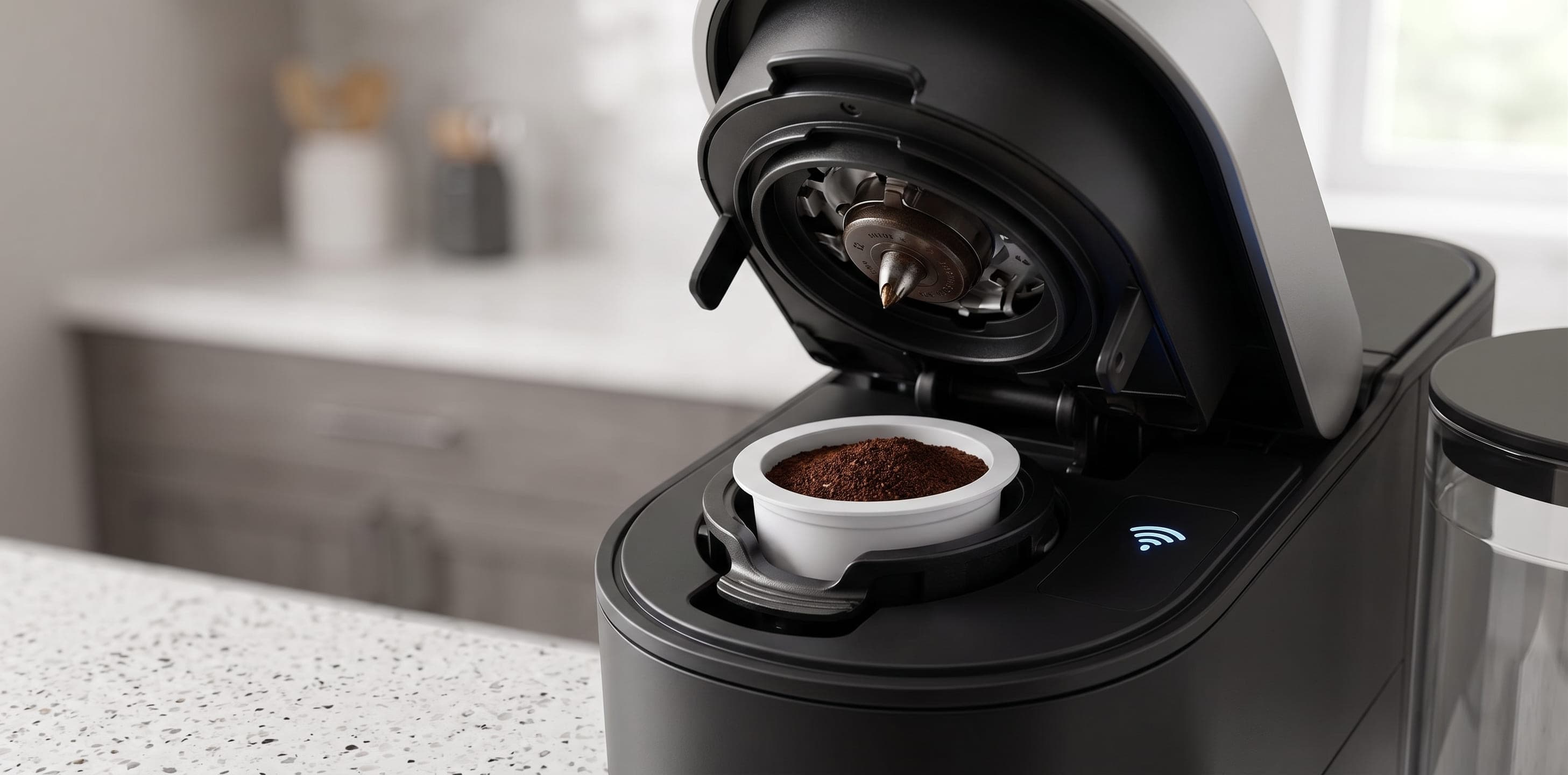
This machine was purchased independently at full retail price. No affiliation with Keurig. Testing covered 15+ K-Cup brands including specialty roasters and grocery store generics.
Final Verdict
Our rating, who it fits, and what it costs.
Keurig Smart BrewerRecommended
4.1 / 5 — Is it worth buying?
The Smart Brewer delivers on its convenience promises without mechanical failures throughout testing. Wi-Fi scheduling works, the app is responsive, and brewing is fast.
✓ Best for
- Busy households with rotating drink preferences and multiple people wanting different sizes
- Anyone who wants app-based scheduling and Wi-Fi convenience
✕ Skip if
- Buyers who care about extraction science or brew consistency
- Anyone concerned about pod waste, even with recyclable options
Score breakdown
Brews tested
98
Testing period
6 weeks
Ready to decide?
$159-$199typical street price
Our verdict: 4.1/5, recommended. Independently tested; commissions never change a rating.
Tools That Pair With This Review
Put it into practice with a free calculator built for what you just read.
- Coffee to Water Ratio CalculatorThe general-purpose ratio tool for drip machines and pour-over — enter water or coffee, pick your strength.
- Pour Over Ratio CalculatorGet your exact water, bloom pour, and total brew time for pour-over coffee.
- Cold Brew Ratio CalculatorConcentrate or ready-to-drink — enter your batch size and get exact grounds and water.