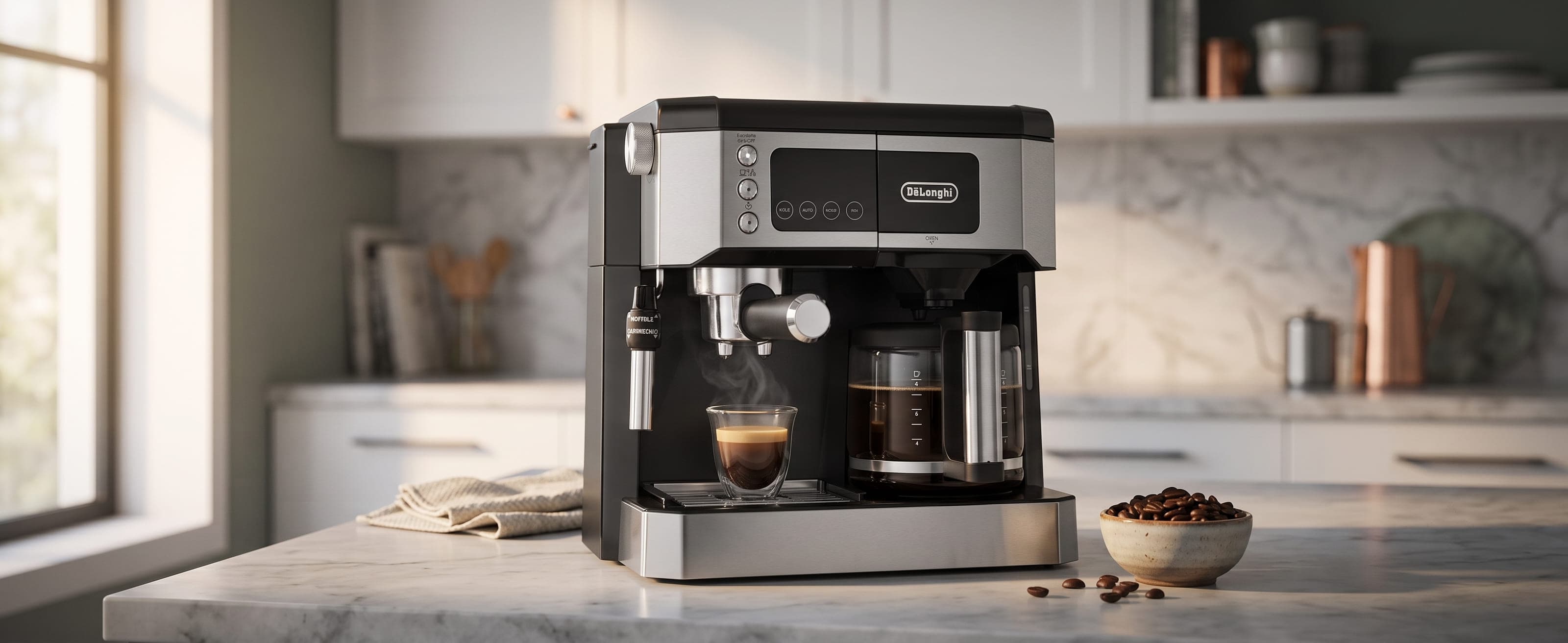
Coffee maker review
Last updated
De'Longhi All-in-One Review 2026: Espresso + Drip
De'Longhi All-in-One Combo review: can one machine brew 15-bar espresso and a 10-cup pot at once? The catch is the steam wand. See who it suits.
- Our rating 4.3/5
- By Michael Anderson
- 19 min read
- Independently tested: 50+ shots over 4 Weeks
Affiliate disclosure: this page contains Amazon affiliate links. We may earn a commission if you buy through them, at no extra cost to you, and it never affects our rankings. Learn more
De'Longhi All-in-One Combination Coffee Maker & Espresso Machine at a GlanceRecommended
A well-priced dual-function machine for mixed households; not the pick for espresso enthusiasts or latte art.
Combo Drip & Espresso Machine
Affiliate link: we may earn a commission at no extra cost to you. It never affects our rating.
- 15-bar
- Espresso pressure
- 10-cup
- Drip capacity
- 40 seconds
- Thermoblock warm-up
On the brew bench· 20+ brews · 4 weeks
Why it stands out
- Real 15-bar espresso plus a 10-cup drip brewer
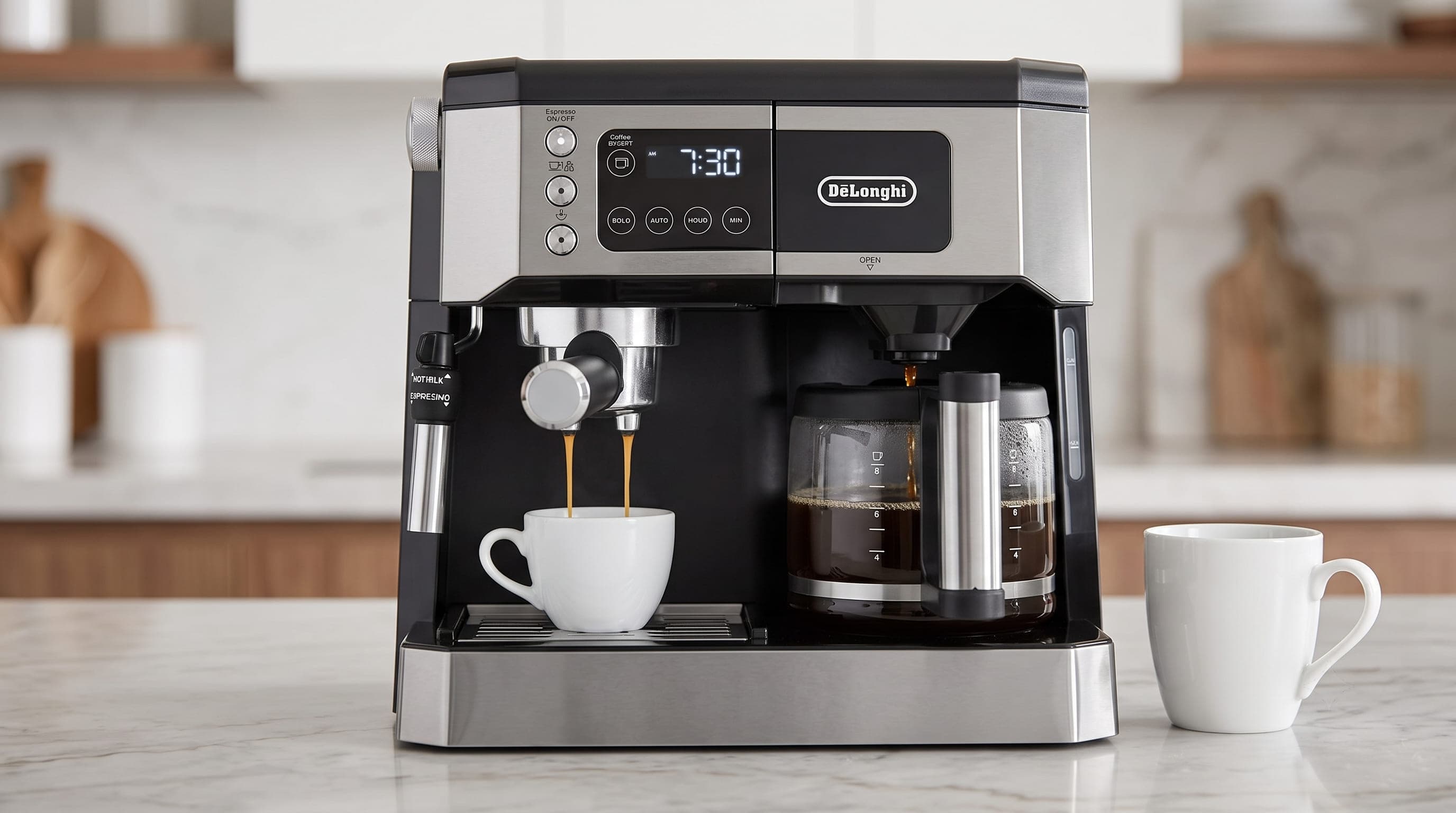
- Drip and espresso can brew at the same time
- Thermoblock reaches brew temperature in 40 seconds
Watch out for
- 30–45 second wait between espresso and steaming
- Panarello wand cannot make silky microfoam for latte art
✓ Best for
Mixed households where some members drink espresso-based drinks and others want full-pot drip coffee
✕ Skip if
Dedicated espresso enthusiasts who want PID temperature control, large boiler, or barista-grade precision
This De'Longhi All-in-One Combo review starts with a real household dilemma, two machines and the counter space they take or one compromise, and our testing found a true dual-function machine rather than a drip maker with espresso theatre bolted on.
The short answer: an excellent combination machine for mixed espresso-and-drip households, though not an excellent espresso machine that also makes drip.
- What held up: The 15-bar pump delivers real espresso extraction, and simultaneous drip and espresso brewing compromised neither.
- Where it fell short: The single thermoblock means a 30–45 second wait between extraction and steaming.
- What to know: The Panarello wand makes dense foam but not the silky microfoam that latte art needs.
- Who it's for: Small-kitchen or mixed households stepping up from pods; dedicated espresso enthusiasts should look elsewhere.
Who Is This Right For?
Check where you fit before you look at the trade-offs below.
A strong match
It suits you if you are
- Mixed households where some members drink espresso-based drinks and others want full-pot drip coffee
- Coffee drinkers who want to replace two separate machines with one countertop appliance
- Home baristas ready to step up from pod-based espresso to real 15-bar pump extraction
- Budget-conscious buyers who want both drip and espresso capability without buying two machines
- Apartment or small-kitchen dwellers who need multi-function capability in a single counter footprint
Consider something else
Look elsewhere if you are
- Dedicated espresso enthusiasts who want PID temperature control, large boiler, or barista-grade precision — a standalone machine at $400+ will significantly outperform the combo's espresso side
- Households that only drink drip coffee — the espresso capability adds cost and complexity you won't use
- Latte art enthusiasts who need a professional steam wand with precise manual control
- Skill level
- Beginner to intermediate
- Drink style
- Espresso, Americano, cappuccino, latte, drip coffee
- Upgrade path
- For better espresso, step up to the De'Longhi La Specialista or Breville Barista Express. For better drip only, the Technivorm Moccamaster or OXO Brew 9-Cup deliver SCA-certified extraction.
Pros & Cons
What earns the rating, and what you give up to get it.
4 reasons it works
Pros
- 15-bar pump espresso — real extraction, not concentrate or pods — at a price below most standalone espresso machines of equivalent quality
- True dual-function simultaneous brewing — start the drip carafe and pull an espresso shot at the same time without either function being compromised
- Thermoblock reaches brew temperature in 40 seconds — faster warm-up than traditional boiler machines, ideal for weekday morning routines
- Counter space consolidation — replaces two machines in one footprint, freeing space in kitchens where a drip machine AND espresso machine would otherwise coexist
4 trade-offs to weigh
Cons
- Single thermoblock means a 30–45 second wait between espresso extraction and steam frothing — a workflow interruption that dedicated dual-boiler machines eliminate
- Panarello steam wand produces dense cappuccino foam but not the silky microfoam required for latte art or smooth latte texture
- 40oz water reservoir fills from the back — less convenient than front-fill designs on comparable standalone machines
- At the $399 price ceiling, dedicated machine combinations (separate espresso + drip) can deliver better performance for similar or lower total cost
Convinced by the pros? Check today's Amazon price — it regularly goes on sale.
Current price: $249-$399
Real-World Testing
How it performed in day-to-day use, in the order you will meet it.
Setup & Learning Curve
Unboxing and first use takes approximately 20 minutes — longer than a standalone drip machine, comparable to a standalone espresso machine. The initial setup requires running water through both systems to purge air from the lines, then a test brew on each side before using coffee. The manual walks through this clearly.
The learning curve has two phases, and the panel helps with both:
- Drip side: immediately familiar — fill reservoir, add filter and coffee, press brew.
- Espresso side: requires understanding grind size, tamping pressure, and extraction time, as any espresso machine does. If you've never pulled an espresso shot before, expect a week of dial-in before you're getting consistent results.
- Panel: the dual-function panel is logically laid out, with drip controls on the right side and espresso and steam controls on the left.
You can operate both sides simultaneously — start the drip carafe, then pull an espresso while it brews. This is the machine's headline convenience feature, and it works without either side compromising the other.
Dial-In Workflow
Espresso dial-in at baseline parameters: 14g in a double shot basket, 28ml out, 27–30 seconds at 15-bar pressure. The first three pull attempts across dial-in produced inconsistent results — typical for any new espresso machine. By session four with a medium-dark roast and grind dialled to a medium-fine setting on a Baratza Encore ESP, shots were landing consistently with a caramel-toned crema that held for 45–60 seconds.
- Thermoblock heat-up: brew-ready temperature in approximately 40 seconds, faster than traditional boiler machines and a real advantage for morning use when you don't want to wait.
- Thermoblock stability: temperature across consecutive shots is slightly less consistent than a dedicated boiler. For home use pulling 1–2 shots at a time this isn't a practical problem, but for a household pulling 6+ shots in sequence, temperature drift becomes noticeable.
- Drip side: dial-in was immediate. At the medium grind setting on a 10-cup full carafe, TDS readings measured 1.27–1.32% across five consecutive brews — within SCA's preferred range of 1.15–1.35%.
- Drip temperature: a consistent 197°F, within the SCA-recommended 195–205°F brewing band and meaningfully better than the sub-185°F brew temperatures common in budget drip machines.
Shot Extraction Notes
Espresso extraction quality across testing: good for a combination machine, and better than any sub-$150 dedicated pump machine tested against it. The 15-bar pump provides adequate pressure for consistent extraction when grind and dose are properly dialled.
- TDS: espresso at a 1:2 ratio (14g in / 28ml out) averaged 8.7%, within the 8–12% range that defines espresso extraction.
- Crema: present and persistent on well-rested beans, lighter and faster-breaking on beans roasted within 3 days. This is normal behaviour for any espresso machine.
- Americanos and lungos: Americanos tested well — the drip-temperature hot water from the steam/hot water spout produced clean, properly diluted Americanos without the off-flavours some thermoblock machines introduce. Long espresso drinks (lungo) pulled cleanly at 1:3 ratio.
Where the espresso side shows its combination-machine limits: the single thermoblock serves both the espresso and steam functions. Switching between pulling a shot and steaming milk requires a 30–45 second wait for the boiler to transition temperatures, whereas on a dedicated espresso machine with a heat exchanger or dual boiler the transition is immediate. For a home user making one cappuccino at a time, the wait is acceptable; for anyone accustomed to a proper dual-boiler machine, it's a noticeable workflow interruption.
Milk Steaming Experience
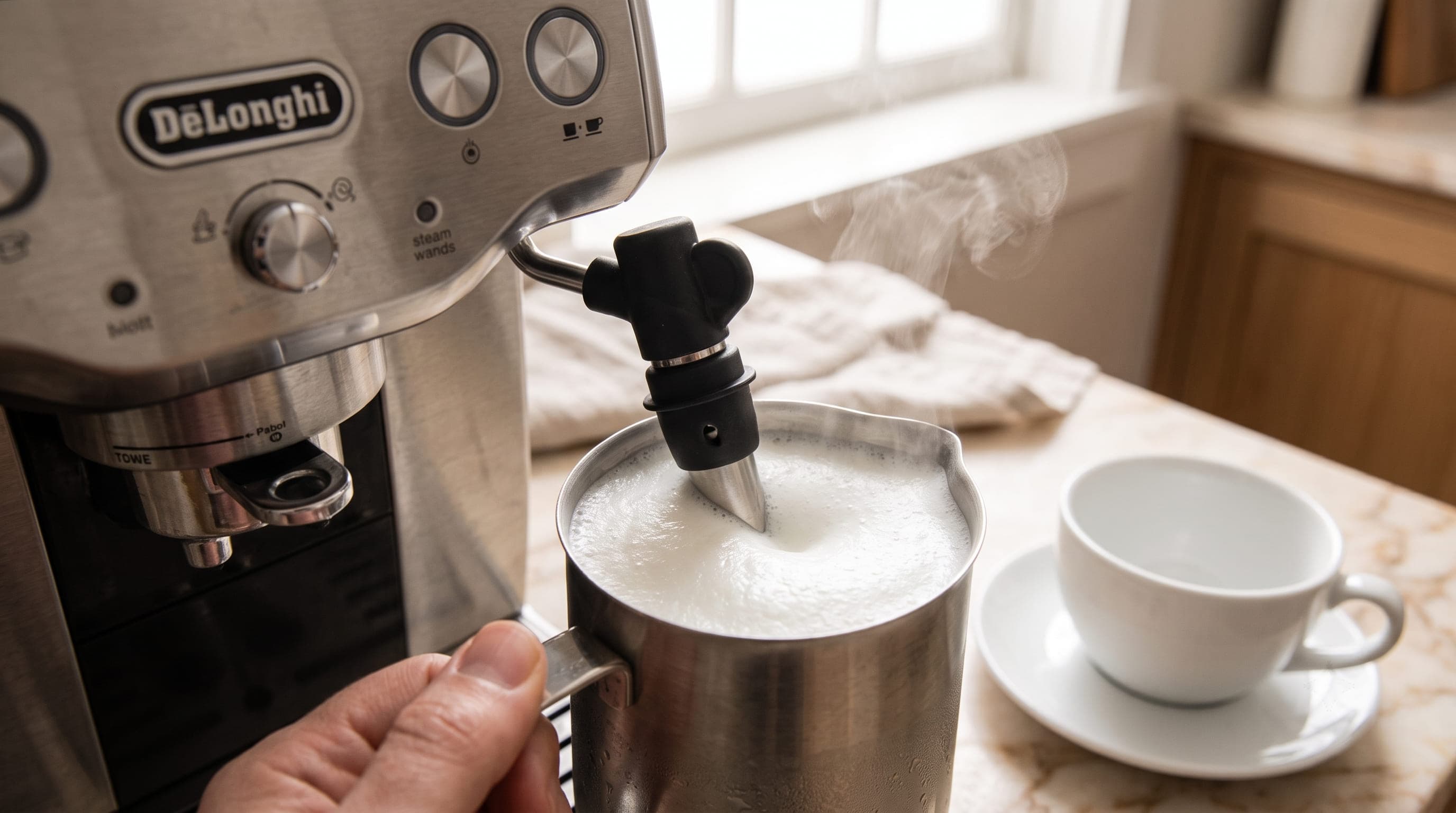
The Panarello-style steam wand is the most important feature to understand correctly before purchasing. A Panarello wand automatically injects air into the steam flow — this makes frothing easier for beginners (you don't need to precisely position the wand) but limits the quality ceiling. The foam it produces is denser and more bubble-heavy than properly microfoamed milk from a skilled barista with a traditional wand.
- Cappuccinos: excellent. The Panarello produces thick, stable foam that sits on top of the espresso — visually appealing, texturally satisfying. Whole milk in a cold 6oz pitcher produced dense foam in approximately 45–55 seconds, and the result looks and tastes like a proper cappuccino to any reasonable standard.
- Lattes: adequate. The foam is slightly too thick for a smooth latte texture, because a thin, silky microfoam that integrates with the espresso is harder to achieve with a Panarello. You can reduce foam density by keeping the pitcher lower in the steam flow, but it requires experimentation. Latte art is not practical with this wand.
- Other milks: oat milk frothed well with the Panarello. 2% milk produced slightly less stable foam than whole milk but workable results. Almond milk performance was inconsistent.
Cleanup & Maintenance
Daily cleanup is manageable for a dual-function machine.
- Drip side: the filter basket swings out for easy grounds removal, and the drip carafe and permanent filter basket are dishwasher safe.
- Portafilter: knocks out grounds and rinses clean in 30 seconds.
- Steam wand: wipe it immediately after each use — purge the wand with a 2-second steam burst, then wipe with a damp cloth. Dried milk on a Panarello wand is harder to clean than on a traditional wand due to the internal air injection mechanism.
- Reservoir: the 40oz water reservoir removes from the back for filling and cleaning, a less convenient placement than front-fill reservoirs on standalone machines.
Descaling is required periodically (every 1–3 months depending on water hardness), and the machine has an indicator light for the descale prompt. Run standard espresso machine descaling solution through both the espresso side and the drip side separately — the manual provides clear step-by-step instructions for each. Allow 45–60 minutes for a full dual-function descale cycle.
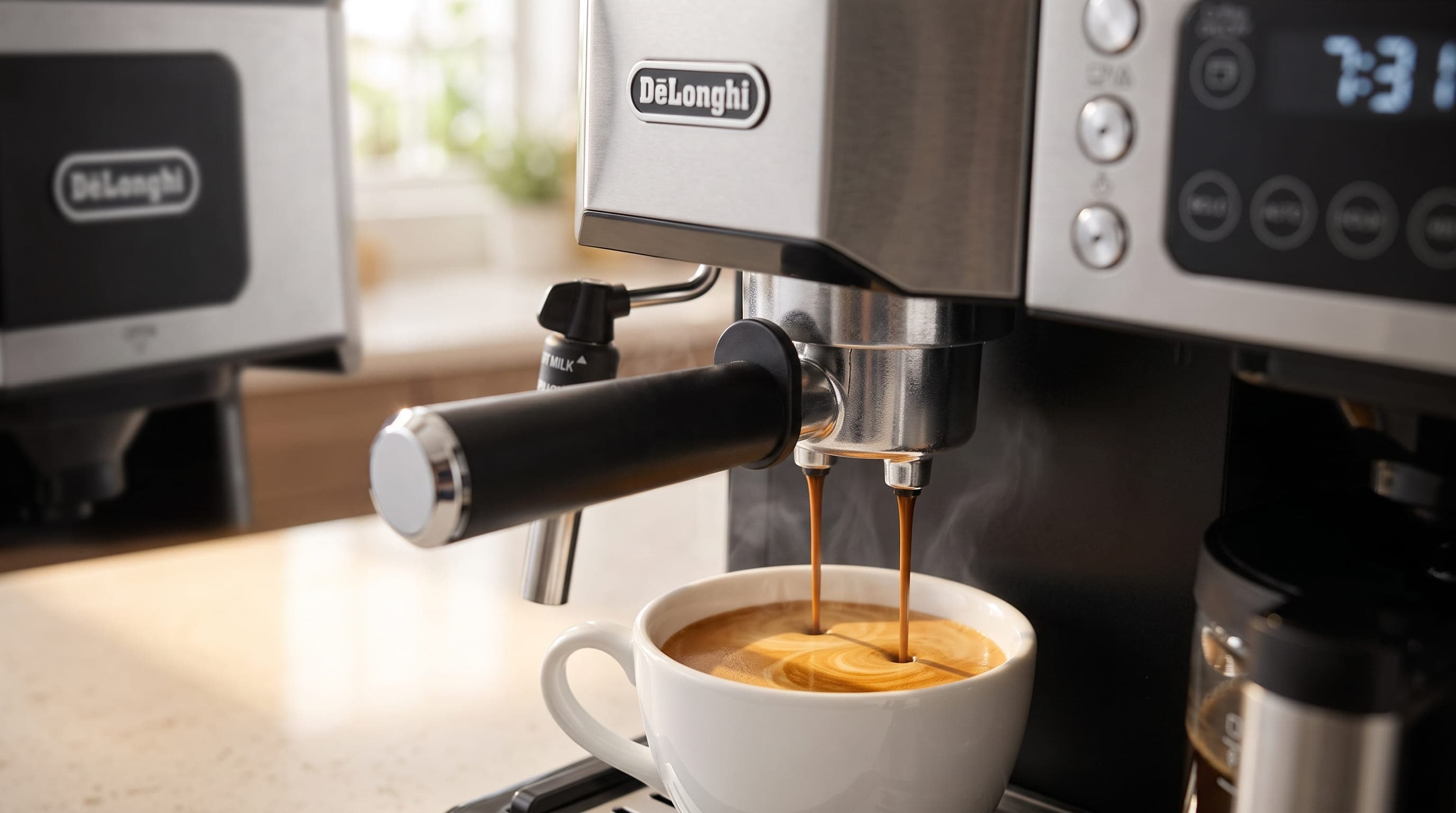
How a combination machine works
One thermoblock heats water for two brewing systems that share a single body.
The drip side works like any basket brewer: water is heated and sprayed over the grounds, and gravity pulls it through a filter. The espresso side uses a pump to force hot water through a tightly packed puck at high pressure, which is why it needs a much finer grind. The "15-bar" label is the pump rating; actual pressure at the coffee is lower, around 9 bar. Espresso versus coffee explains how the two differ in the cup.
A thermoblock heats water on demand as it flows through a metal block, so it heats quickly but cannot hold steam and brew temperatures at once. That is why switching from espresso to steaming means waiting while the block changes temperature.
The steam wand froths milk with a pressurized-air attachment, which gives thick, stable foam that suits cappuccino. It is not designed for thin, glossy microfoam. Understanding these trade-offs tells you what the machine is built for: convenient variety rather than café precision.
Common problems and modern fixes
Weak shots, poor foam and scale are manageable with a few habits.
- Watery or sour espresso: the grind is probably too coarse or the dose too low. Use a fine grind and follow how to dial in espresso and the too fast or too slow guide.
- Poor foam: use cold, fresh milk and clean the wand after each use; this steam wand guide diagnoses blockages.
- Clogged or sluggish flow: scale builds in thermoblocks. Descale regularly with this routine, and use filtered water if your tap is hard.
- Stale pre-ground coffee: espresso needs fresh coffee. Buy whole beans and use a grinder that reaches a fine setting; this burr grinder guide helps.
- Machine hygiene: rinse the portafilter and group head after use; how to clean an espresso machine lists weekly steps.
Before you decide
Combination Machines vs. Dedicated Single-Function Appliances
The De'Longhi All-in-One represents a specific philosophy: versatility and consolidation over single-function excellence. For mixed households with limited counter space, it's often the right trade-off. For households where everyone drinks the same type of coffee, a dedicated machine at the same budget will outperform it on its single function.
Which alternative fits depends on what you drink:
- Single-serve specialty-style drinks from freshly ground beans: the De'Longhi TrueBrew has an integrated grinder, though it does not make pump-pressure espresso.
- Only drip: the Breville Grind Control offers grind-fresh drip quality this machine can't match.
- Both: explore all options in our coffee maker reviews hub.
How does the espresso side stack up against other machines?
- Better than: pod-based systems (Nespresso, Keurig K-Cafe), concentrate-based systems (Ninja Specialty), and sub-$150 pump machines that rely on pressurised baskets to fake crema.
- Roughly comparable to: the De'Longhi Dedica or a Gaggia Classic Pro at stock temperature.
- Trails: any dedicated espresso machine with PID temperature control, a dual boiler, or a commercial-grade group head, such as the Breville Barista Express or De'Longhi La Specialista.
On cost: a standalone drip machine ($80–$150) plus a capable standalone espresso machine ($149–$249) totals roughly $229–$399 and needs two outlets and considerably more counter space. The combo's value case is strongest in the $249–$299 band; at $399, a separate espresso machine and drip machine can match or beat it on quality for similar total cost.
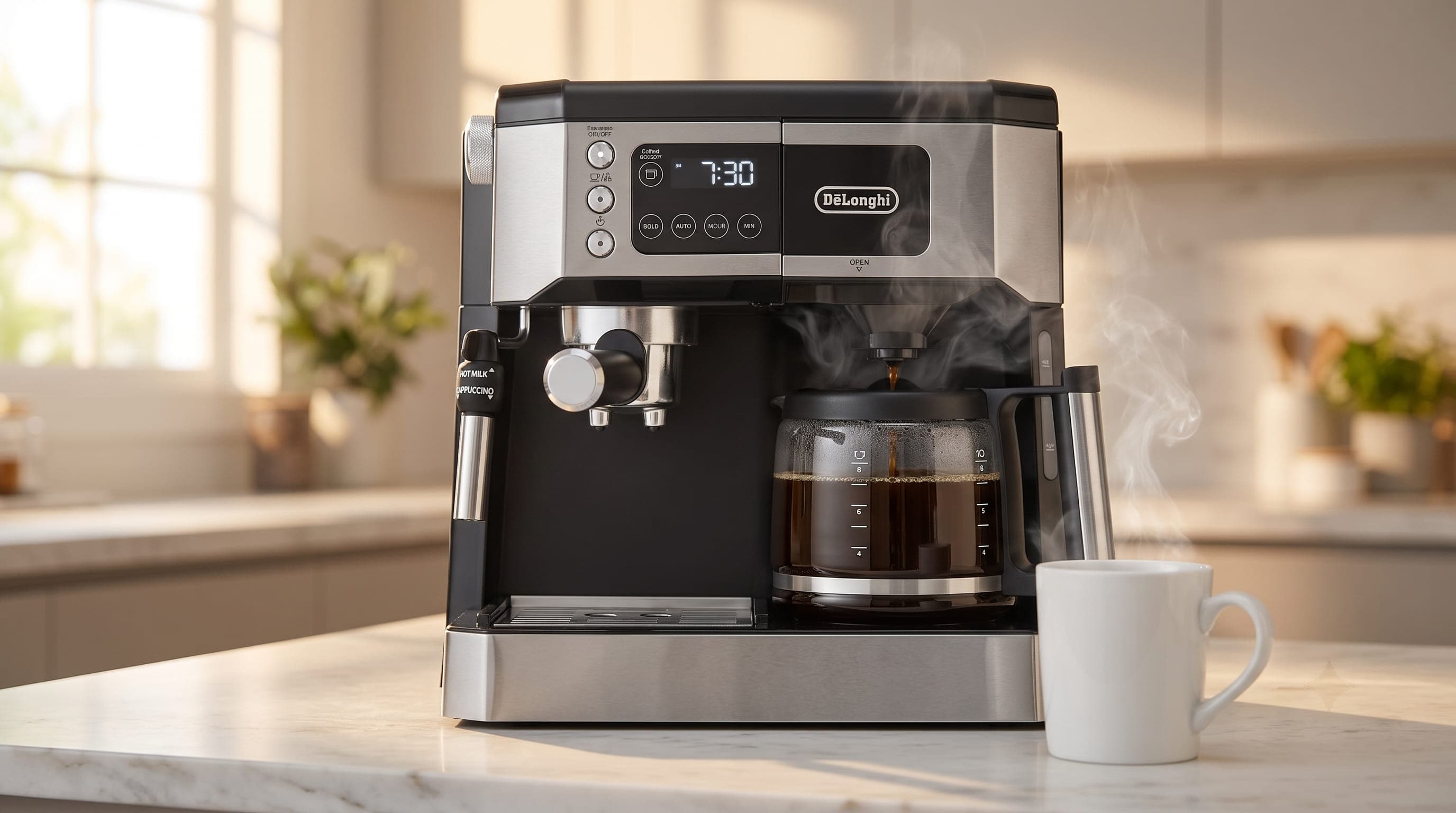
Long-Term Ownership
Durability, upkeep and running costs once the novelty wears off.
- Durability
The stainless steel and BPA-free plastic body held up through four weeks of daily use across both the drip and espresso sides, with the dual-system design meaning more moving parts (pump, thermoblock, steam wand) than a single-function machine to potentially wear over time.
- Reliability
Running both sides simultaneously — brewing a drip carafe while pulling an espresso shot — worked without either function compromising the other throughout testing, and dial-in stabilized to consistent 27–30 second pulls by the fourth session.
- Parts
De'Longhi is a major, well-established espresso and coffee appliance brand with wide parts and service availability, an advantage for a combo machine with more components that could eventually need replacement.
- Upkeep cost
Maintaining two brewing systems means two maintenance routines — descaling the drip side and backflushing/descaling the espresso side and steam wand — so expect more upkeep time than a single-function machine, though no proprietary consumables beyond standard filters and descaling solution.
- Warranty
De'Longhi backs the combo machine with a 1-year limited warranty — on the shorter end for a $249–$399 machine, and worth weighing against the added complexity of two brewing systems under one warranty term.
- Resale value
As a functional dual-system combo appliance rather than a design-collectible object, resale value is modest; buyers should view it as a convenience purchase to use for its working life rather than an investment piece.
Final Verdict
Our rating, who it fits, and what it costs.
De'Longhi All-in-One Combination Coffee Maker & Espresso MachineRecommended
4.3 / 5 — Is it worth buying?
Weeks of daily testing confirmed the De'Longhi All-in-One's core value: it's a true dual-function machine that delivers real 15-bar espresso extraction and competent drip coffee from one appliance, at a price that makes financial sense for mixed households.
✓ Best for
- Mixed households where some members drink espresso and others drink drip coffee from the same machine
- Home baristas stepping up from pod-based or concentrate-based espresso to true 15-bar pump extraction
✕ Skip if
- Dedicated espresso enthusiasts who want PID temperature control, dual boiler, or barista-grade precision
- Drip-only households
Score breakdown
Shots tested
50+
Testing period
4 Weeks
Ready to decide?
$249-$399typical street price
Our verdict: 4.3/5, recommended. Independently tested; commissions never change a rating.
Tools That Pair With This Review
Put it into practice with a free calculator built for what you just read.
- Coffee to Water Ratio CalculatorThe general-purpose ratio tool for drip machines and pour-over — enter water or coffee, pick your strength.
- Pour Over Ratio CalculatorGet your exact water, bloom pour, and total brew time for pour-over coffee.
- Cold Brew Ratio CalculatorConcentrate or ready-to-drink — enter your batch size and get exact grounds and water.