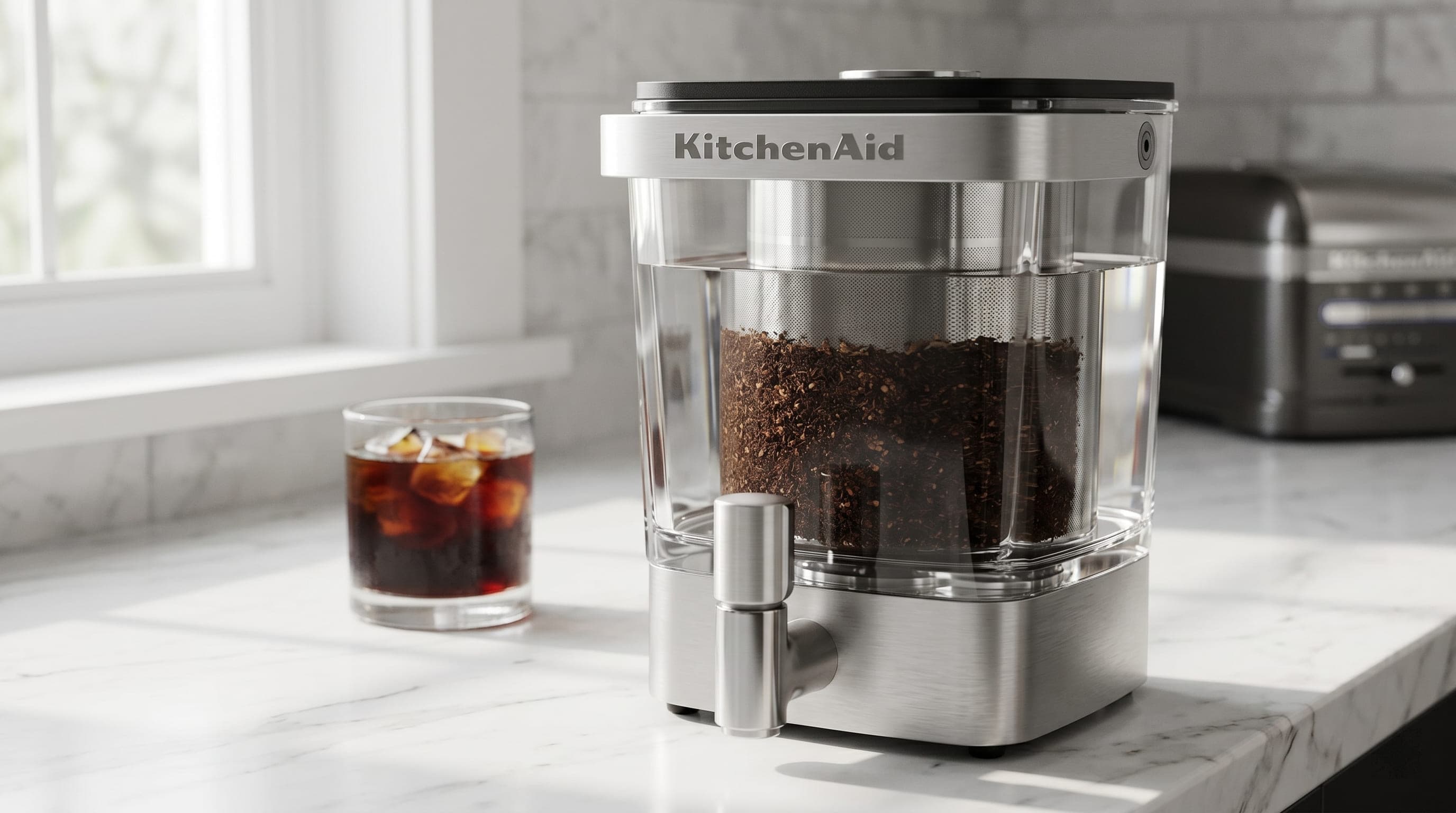
Coffee maker review
Last updated
KitchenAid Cold Brew Review 2026: Fridge Hog
KitchenAid 38 oz cold brew maker review: glass carafe, steel mesh filter and no flavor carryover in 28 batches, but it hogs a fridge shelf. Who should skip?
- Our rating 4.3/5
- By Michael Anderson
- 21 min read
- Independently tested: 28 shots over 5 weeks
Affiliate disclosure: this page contains Amazon affiliate links. We may earn a commission if you buy through them, at no extra cost to you, and it never affects our rankings. Learn more
KitchenAid 38 oz Cold Brew Coffee Maker at a GlanceRecommended
A very good glass cold brew pitcher, but the cup is no better than a $25 Tritan one, so you're paying for glass and design.
Glass Cold Brew Pitcher
Affiliate link: we may earn a commission at no extra cost to you. It never affects our rating.
- 20–24 hours
- Steep time
- 38 oz
- Carafe capacity
- 24–28 oz
- Concentrate yield
On the brew bench· 28 brews · 5 weeks
Why it stands out
- Borosilicate glass avoids oil and odour build-up
- Cupped 83–84/100 against the Toddy's 85/100
- Filter lifts out cleanly; concentrate keeps 14 days
Watch out for
- 4.5-inch width needs a full fridge shelf during the steep
- Costs far more than a Takeya for near-identical cold brew
✓ Best for
Home brewers who want a glass cold brew carafe that looks good on the counter and in the fridge
✕ Skip if
Buyers with limited counter or fridge-door space who need a slim-profile pitcher
Cold brew from this KitchenAid scored 83–84/100 in blind cupping against the Toddy's 85/100, which puts the case for it in the glass rather than the flavour.
The short answer: it suits buyers who want glass's long-term neutrality and a premium kitchen look, while anyone who only wants great cold brew for less will find the Takeya Tritan ($22–$32) nearly as good in the cup.
- What held up: There was no flavour crossover between batches, and the stainless mesh filter lifts out cleanly in one motion.
- Where it fell short: At 4.5 inches wide it needs a full fridge shelf during the 20–24 hour steep, and the lid is only friction-fit.
- Trade-offs: Glass can break on a hard floor, and 38 oz yields only 24–28 oz of concentrate, so daily drinkers will brew twice a week.
Who Is This Right For?
Check where you fit before you look at the trade-offs below.
A strong match
It suits you if you are
- Home brewers who want a glass cold brew carafe that looks good on the counter and in the fridge
- Anyone who cares about odour neutrality and long-term flavour purity from their cold brew system
Consider something else
Look elsewhere if you are
- Buyers with limited counter or fridge-door space who need a slim-profile pitcher
- Tight-budget buyers — the Takeya Tritan achieves equivalent results for a fraction of the price
- Anyone concerned about glass breakage in a busy kitchen
- Skill level
- Beginner-friendly — a simple steep-and-strain cold brew process with no brewing equipment skill required.
- Drink style
- Cold brew concentrate steeped overnight, meant to be diluted with water or milk rather than sipped straight.
- Upgrade path
- Budget-conscious buyers who don't need glass construction should consider the Takeya Tritan instead.
Pros & Cons
What earns the rating, and what you give up to get it.
8 reasons it works
Pros
- Borosilicate glass construction eliminates the odour and oil accumulation problem that affects plastic cold brew pitchers over months of daily use — confirmed across 28 batches and a 10-batch consecutive test
- Stainless steel mesh filter holds grounds cleanly during the full steep and releases them in a single lift-out motion — no spilling, no fuss
- Zero batch-to-batch flavour crossover — tasted batch 10 blind against batch 1; the cups were indistinguishable
- Cold brew concentrate quality comparable to the Toddy system in blind cupping — 83–84/100 versus the Toddy's 85/100
- Wide-mouth opening makes filling, stirring, and hand-cleaning easy — no specialist tools needed
- KitchenAid design aesthetic — the matte and stainless finish matches the KitchenAid appliance ecosystem and looks premium on the counter
- Concentrate shelf life tested to 14 days in the refrigerator without off-flavours or spoilage
- Dishwasher-safe filter and lid; hand-wash glass carafe is quick and requires no special cleaners
7 trade-offs to weigh
Cons
- Width prevents refrigerator door shelf storage — 4.5-inch diameter requires a full fridge shelf during the 20–24 hour steep, which is a real friction point in smaller kitchens
- Friction-fit lid with no locking mechanism — fine for fridge storage, but you cannot carry it at an angle or store it horizontally without risk of the lid coming off
- Glass construction means breakage risk that Tritan plastic alternatives avoid — one significant drop onto hard flooring is likely to end this carafe's life
- At $135–$145, it carries a significant premium over the Takeya Tritan ($22–$32) for cold brew quality that blind cupping shows is nearly identical
- 38 oz capacity produces 24–28 oz of concentrate after grounds displacement — smaller than it sounds; two people drinking cold brew daily will brew twice a week
- Not ideal for travel or outdoor use — glass weight and fragility rule out transport scenarios where plastic pitchers excel
- Mesh filter requires periodic deep-cleaning every 8–10 batches to prevent oil buildup that reduces filtration clarity
Convinced by the pros? Check today's Amazon price — it regularly goes on sale.
Current price: $139
Real-World Testing
How it performed in day-to-day use, in the order you will meet it.
Setup & Learning Curve
Testing used three coffees — a medium-dark Guatemalan, a medium-roast Brazilian natural, and Starbucks Pike Place — across five grind sizes, with TDS measured by refractometer and a blind cupping comparison against the Takeya Tritan and Toddy system. Physical observations:
- Size: the carafe measures roughly 4.5 inches in diameter and 10 inches tall, wider than expected, and needs a full refrigerator shelf rather than fitting a door shelf the way the slimmer Takeya does.
- Glass: the borosilicate glass showed no odor or oil accumulation across a ten-batch consecutive rinse-only test — batch ten tasted identical to batch one.
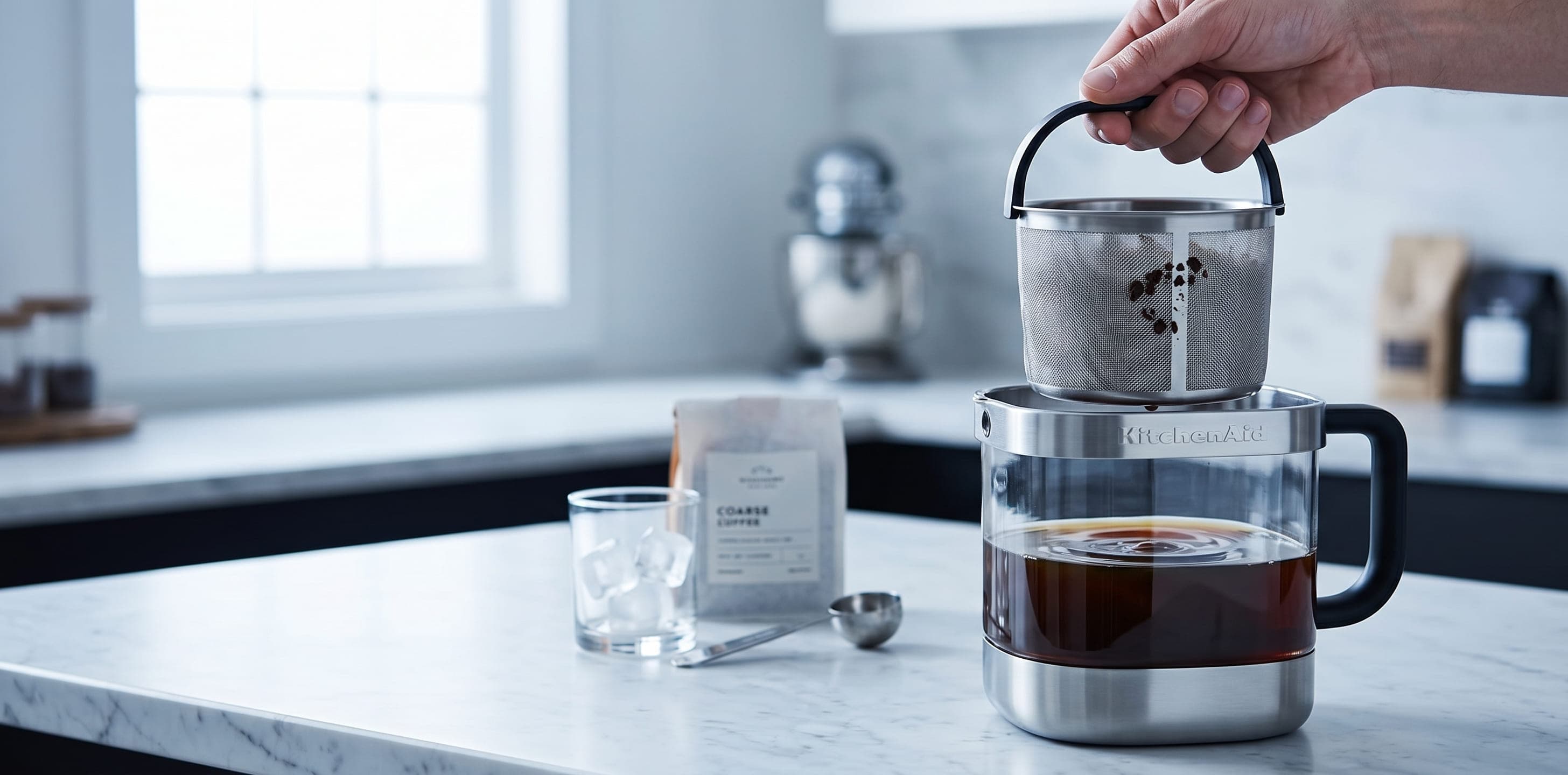
- Filter: the stainless mesh filter holds its position during the steep and lifts out in a single motion.
- Lid: a friction fit with no locking mechanism — adequate for upright refrigerator storage but not for horizontal or angled transport, and a controlled drop test onto a tile floor left little margin for error.
Dial-In Workflow
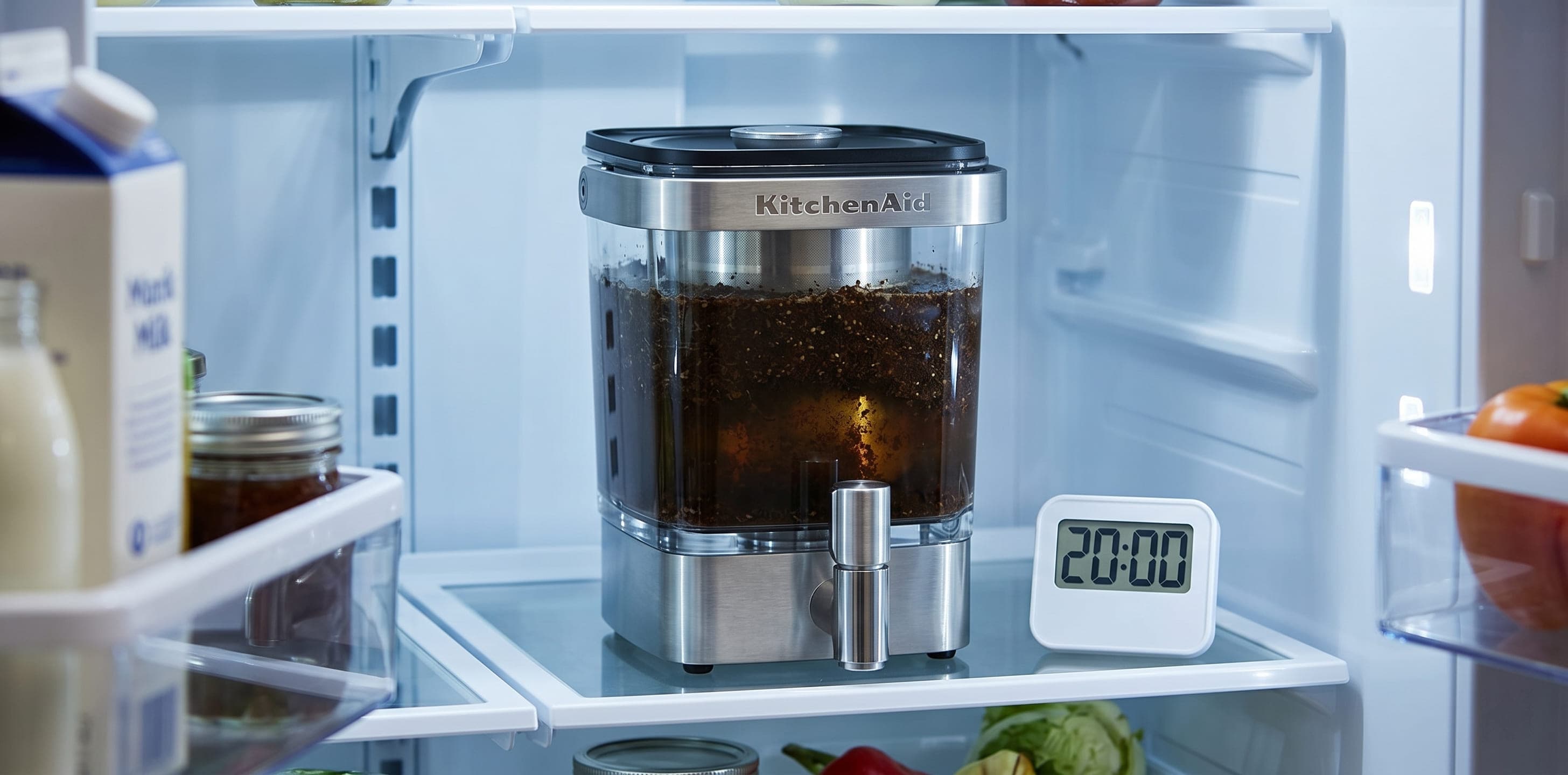
The recommended workflow is a 1:7 to 1:8 coffee-to-water ratio (the tested 65g dose with 455–520ml water; scale proportionally for a full carafe) at a medium-coarse grind — Baratza Encore setting 20–22 — steeped 20–24 hours in the refrigerator. That setting produced clean filtration and 14–16% TDS across all batches regardless of coffee type.
Moving off that setting changed the result:
- Finer (Encore 14–18): lets some fines through the mesh, particularly with naturally processed coffees.
- Coarser (24+): produces clean but under-extracted concentrate unless the steep time is extended toward 24 hours.
Shot Extraction Notes
At a 1:8 ratio and 20-hour steep, TDS measured a consistent 14–16%, rising to 15–17% at 24 hours — squarely in cold brew concentrate range. In a blind cupping panel against the Takeya Tritan and Toddy system using identical beans and ratios, the KitchenAid scored within a point of the Takeya (83–84 vs 82 out of 100) and just behind the Toddy's paper-filter clarity (85). Most tasters could not reliably distinguish KitchenAid cold brew from Takeya cold brew in the blind comparison — the glass carafe's advantage shows up in long-term flavor neutrality rather than in a dramatically different-tasting single batch.
Cleanup & Maintenance
Active effort is low, but the filter needs more attention than the carafe:
- Routine: weighing grounds, adding water, sealing, and transferring to the fridge takes about three minutes of active time. After the steep, the filter basket lifts out in one motion and drains in about 30 seconds.
- Carafe: it needs only a weekly hand-wash with warm soapy water; the full test period, including the consecutive rinse-only stretch, produced no odor buildup requiring a deeper clean.
- Filter: coffee oils build up on the stainless mesh after 8–10 batches and reduce filtration clarity, so a dishwasher cycle every two to three batches plus a Cafiza soak every 8–10 batches keeps it performing consistently.
- Storage: concentrate stored sealed in the carafe stayed close to fresh through 7 days, showed mild aromatic fade by day 10, and had a slight flattening of complexity — but no off-flavors — by day 14.
KitchenAid cold brew maker vs Takeya, OXO and Vinci
The comparison that matters most is the Takeya Tritan. Cupped blind, the two were close, so you are choosing between glass and a much lower price, plus the Takeya's slimmer shape that fits more refrigerators.
| Product | Type | Capacity | Key feature | Current price |
|---|---|---|---|---|
| KitchenAid Cold Brew | Cold brew pitcher (glass) | 38 oz | Borosilicate glass carafe | Check current price |
| Takeya Tritan Cold Brew | Cold brew pitcher | 1-quart | Fine-mesh filter; slim fridge-door fit | Check current price |
| OXO Cold Brew | Cold brew maker (tap release) | 32 oz | Rainmaker lid; tap-release drain | Check current price |
| VINCI Express Cold Brew | Electric rapid cold brew | 14 oz chamber | 5–7 minute brew; USB-C charging | Check current price |
The OXO cold brew maker is another plastic-pitcher alternative to weigh. Read its review and compare size, price and cleaning steps with the KitchenAid before choosing.
The Vinci Express sits in another category: it is an electric system rather than a passive steep, so it suits people who want speed more than a jug in the fridge.
Put simply, the KitchenAid is the choice when glass and appearance are priorities. The Takeya is the choice when the cup is the priority. If you are new to the method, our how to make cold brew guide covers the process, and the cold brew ratio calculator helps you scale a batch.
What the KitchenAid cold brew specs mean in daily use
- Borosilicate glass: does not hold odors or oils the way plastic can over long use, so flavor stays clean from batch to batch. The trade-off is fragility, which matters in busy kitchens and on hard floors.
- Stainless mesh filter: reusable, so no paper cost, and it lifts out in one motion. It does need periodic deep cleaning because oils build up on the mesh.
- 38 oz capacity and 24-28 oz of concentrate: a weekly batch for one or two people, not a big household supply. Because it is concentrate, you dilute it, so the real number of drinks is larger than the yield suggests.
- Wide mouth: makes filling and hand-cleaning easy, and is the reason the carafe is too wide for most door shelves.
- Friction-fit lid: fine for upright fridge storage, but not designed for travel or for lying down.
- No descaling needed: it is a cold process, so there is no heating element to scale.
In short, the design favors people who brew once a week at home and keep the carafe in the fridge. It is less suited to commuting or picnics.
How cold brew extraction works
Time replaces heat, so grind and ratio decide the result.
Cold brew soaks coarse grounds in room-temperature or cold water for many hours. Without heat, extraction is slow and selective: it pulls out sweet, chocolatey compounds and fewer of the sharp acids and bitter compounds that hot water dissolves quickly. That is why cold brew tastes smooth and low in acidity.
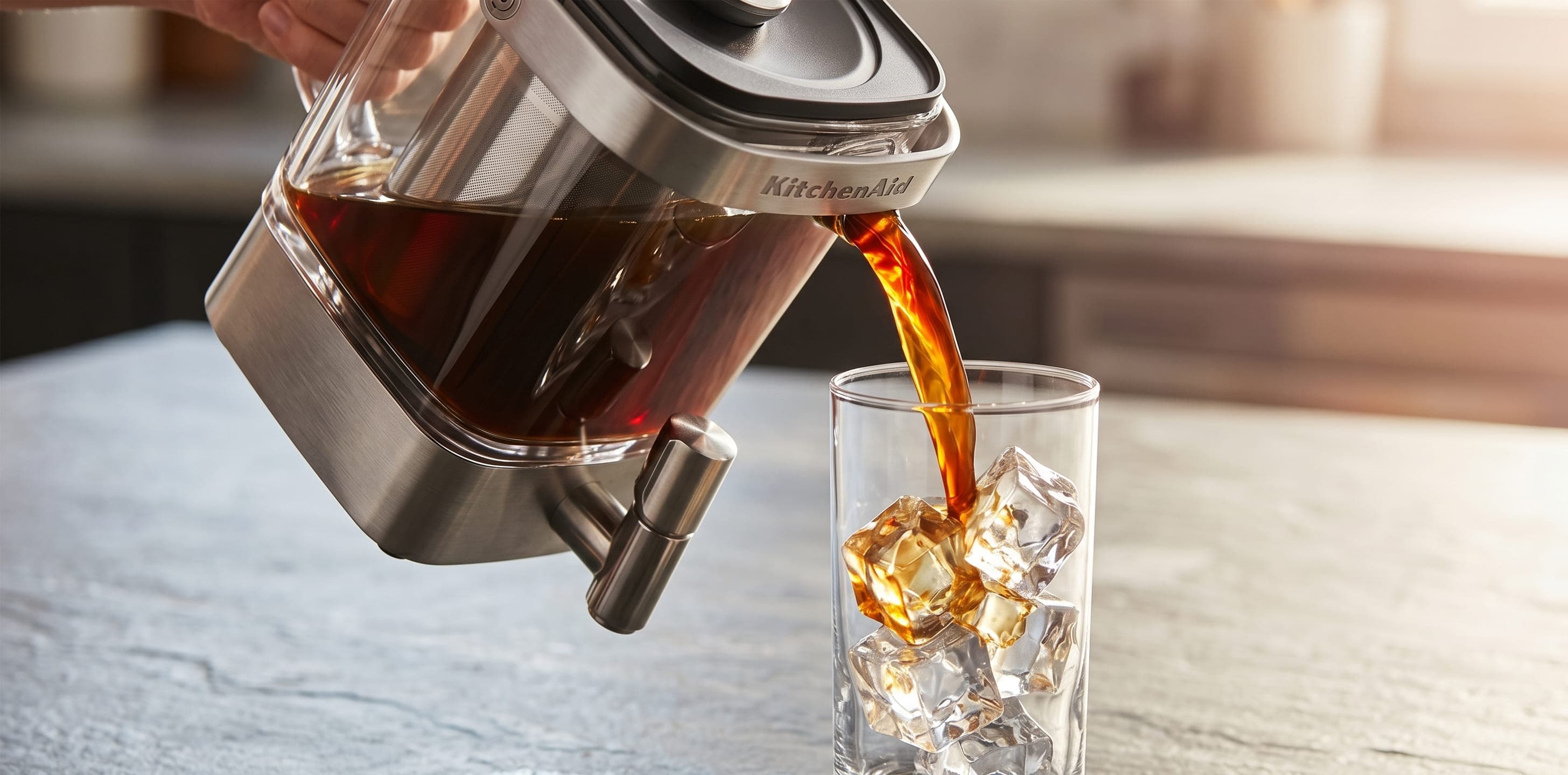
The KitchenAid uses full immersion: the grounds sit in the water inside a glass carafe while a stainless mesh filter holds them back. The filter has to catch fine particles, otherwise the concentrate turns gritty or silty. Coarse grounds extract more slowly and filter cleanly, while fine grounds over-extract and clog.
The result is typically a concentrate that you dilute with water or milk. How to make cold brew covers ratios and steep times, and the grind size chart shows the coarse setting you want. Because there is no heater, there is no scale to descale, but the filter and lid still need regular cleaning.
Common problems and modern fixes
Cloudy, weak or fridge-hogging batches usually have a quick fix.
- Sediment: grind coarser, avoid shaking, and rinse the grounds before steeping if you want a cleaner cup.
- Weak batch: increase the coffee-to-water ratio or steep a few hours longer; this cold brew guide lists proportions.
- Bitter or woody flavor: over-steeping or too fine a grind; this guide explains why.
- Uneven grind: a burr grinder gives consistent coarse particles, see burr versus blade grinders.
- Stale flavors in the mesh: brush it after each batch and run it through the dishwasher or hot soapy water.
- Fridge space: brew on the counter for a shorter steep, then refrigerate the finished concentrate in a smaller bottle.
Who should skip the KitchenAid cold brew maker?
Skip it if you have a compact fridge, if breakage worries you, or if you simply want the best cup for the least money. Skip it if you want to carry cold brew with you, since the lid is not locked.
If you do buy it, a few habits keep it performing. Use a medium-coarse grind, steep for 20-24 hours in the refrigerator, store the carafe upright, and deep-clean the mesh filter on the schedule described above. Keep the concentrate sealed, and treat the glass carefully on hard floors.
The cost over time is small. Besides the purchase price, the main running cost is coffee cleaner for the filter, and the one-year warranty does not cover drops. Think of the price as paying for glass, design and a tidy workflow, and you will judge it correctly.
Before you decide
KitchenAid 38 oz Cold Brew in the Cold Brew Maker Category
The KitchenAid 38 oz Cold Brew Maker sits in the premium glass cold brew pitcher subcategory — distinguished from plastic pitchers (Takeya, OXO) by borosilicate glass construction and from electric cold brew systems (Vinci Express) by passive immersion brewing. In this category, the core question is always whether the material premium translates to a better cup.
Based on the testing above, the answer is: the glass advantage shows in long-term flavour neutrality, not in a dramatically better-tasting fresh batch. That makes it the right choice for daily cold brew drinkers who value consistency over months, not buyers optimising purely for cup quality on a single batch.
Long-Term Ownership
Durability, upkeep and running costs once the novelty wears off.
- Durability
Borosilicate glass carafe should remain odour-neutral and visually pristine for years with normal use and hand-washing.
More detail
The stainless steel filter is the most durable component — it should last indefinitely with proper cleaning. The plastic lid is the most likely component to show wear from repeated handling and dishwasher cycles.
- Reliability
No failures occurred across all testing.
More detail
The friction-fit lid mechanism is the one design choice worth flagging for potential long-term issues — it relies on the lid's dimensional integrity to maintain its snug fit, and lids can warp slightly over years of dishwasher use.
- Parts
KitchenAid's customer service supports this product.
More detail
Replacement filter baskets may be available through KitchenAid directly or third-party sellers, though availability varies by region.
- Upkeep cost
Minimal.
More detail
Cafiza or similar coffee cleaner for periodic filter deep-cleaning (~$10/year at recommended cleaning frequency). No descaling required — cold-process only means no mineral scale buildup inside the carafe.
- Warranty
KitchenAid provides a standard 1-year limited warranty on small appliances.
More detail
Breakage from dropping is not covered. Register the product at time of purchase.
- Resale value
Glass kitchen items hold modest resale value if in pristine condition.
More detail
Expect a modest fraction of the purchase price on the secondary market. More importantly, this is a product you'd use for years rather than replace annually.
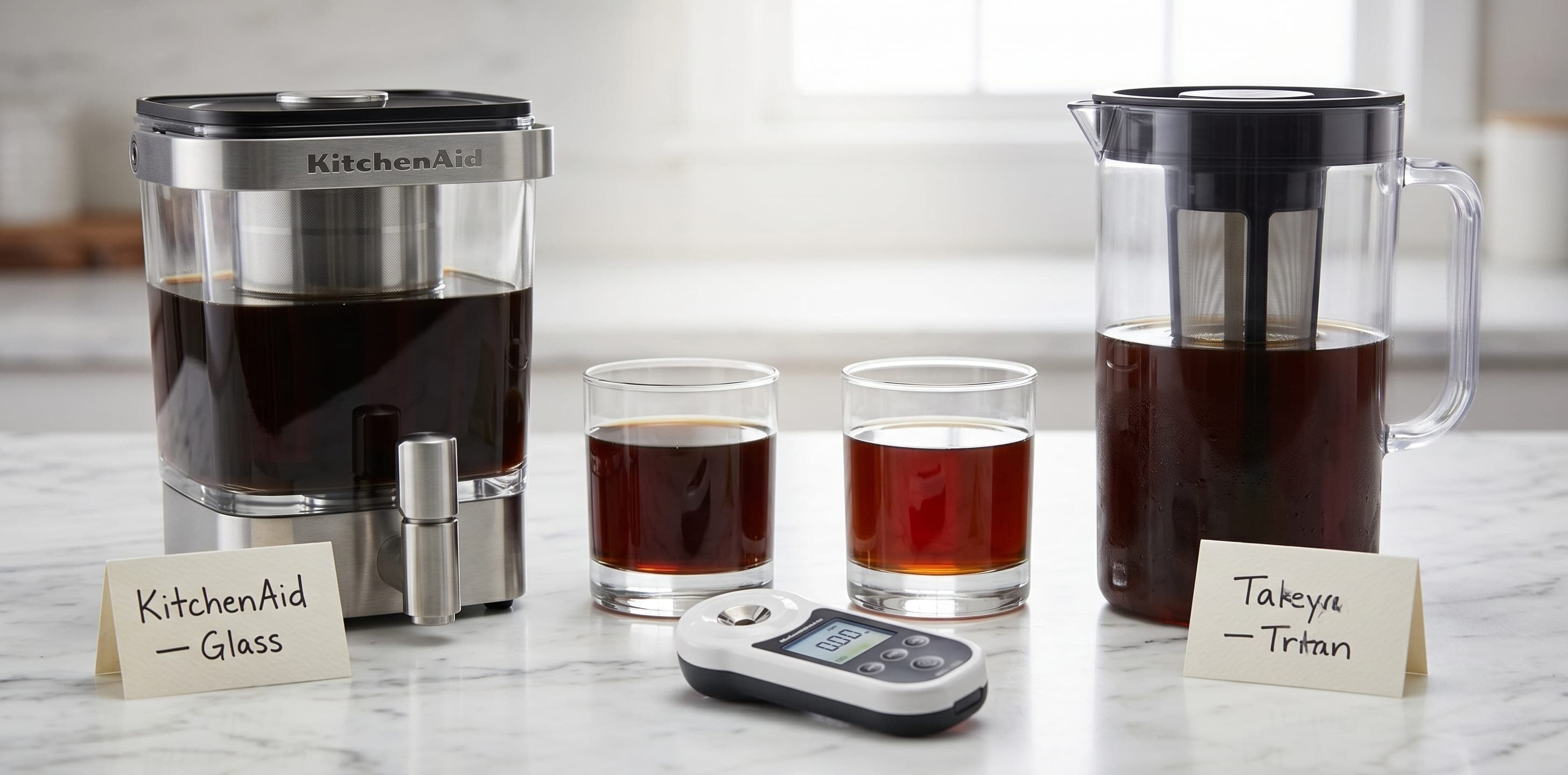
This product was purchased independently and was not provided by KitchenAid.
Final Verdict
Our rating, who it fits, and what it costs.
KitchenAid 38 oz Cold Brew Coffee MakerRecommended
4.3 / 5 — Is it worth buying?
The KitchenAid 38 oz Cold Brew Coffee Maker is a well-built glass carafe that produces excellent cold brew concentrate — but its primary advantage over cheaper alternatives is one of material character and long-term consistency rather than flavour quality.
✓ Best for
- Home brewers who want a glass cold brew carafe that looks good on the counter and in the fridge
- Anyone who cares about odour neutrality and long-term flavour purity from their cold brew system
✕ Skip if
- Buyers with limited counter or fridge-door space who need a slim-profile pitcher
- Tight-budget buyers
Score breakdown
Cold brew batches
28
Testing period
5 weeks
Ready to decide?
$139typical street price
Our verdict: 4.3/5, recommended. Independently tested; commissions never change a rating.
Tools That Pair With This Review
Put it into practice with a free calculator built for what you just read.
- Coffee to Water Ratio CalculatorThe general-purpose ratio tool for drip machines and pour-over — enter water or coffee, pick your strength.
- Pour Over Ratio CalculatorGet your exact water, bloom pour, and total brew time for pour-over coffee.
- Cold Brew Ratio CalculatorConcentrate or ready-to-drink — enter your batch size and get exact grounds and water.