VINCI Express Cold Brew Review 2026
VINCI Express Cold Brew review — rapid cold brew maker with electric aeration technology that brews cold brew concentrate in under 5 minutes.
Quick Summary
People who want cold brew concentrate on demand without planning 18 hours ahead — particularly useful for office or travel scenarios where an overnight steep isn't practical
You brew for 3+ people regularly (14 oz capacity is limiting for households), already have a cold brew pitcher you're happy with, or prioritise absolute flavour purity over convenience
VINCI Express Cold Brew Review: I'll be direct with you: I was sceptical going into this test. After 12 years of cupping specialty coffee and evaluating extraction equipment, I've developed a bias toward slow, controlled processes — the kind of extraction discipline that gives you the clarity and balance that made me fall in love with cold brew in the first place. Five-minute cold brew sounded like a corner cut, not a process improved. Twenty-five batches later, I'm more impressed than I expected to be. Not uncritically impressed — the VINCI Express Cold Brew has real limitations, particularly the 14 oz capacity and a flavour profile that's distinctive (not identical) from traditional immersion cold brew. But as a rapid cold brew maker for on-demand concentrate, it delivers what it promises, and delivers it at a cupping quality level that genuinely surprised me.
Decision Snapshot: Is This Machine Right for You?
Who It's For
- Office cold brew drinkers: No overnight steep, no pitcher to transport — charge it at your desk, brew in 5 minutes, keep concentrate in a small jar in the office fridge. This is the use case the VINCI was built for.
- Travellers who need cold brew on the road: The VINCI fits in a carry-on, charges via USB-C from a power bank, and produces concentrate anywhere there's cold water. No other cold brew option at this price travels this well.
- Light roast cold brew enthusiasts: Forced-convection extraction expresses light roast character better than passive immersion in our testing — brighter, more aromatic, less flat. If you've been disappointed by light-roast cold brew from traditional pitchers, the VINCI is worth trying.
- Forgetful planners who always mean to prep cold brew but don't: If the 18-hour steep consistently catches you out, the VINCI removes the planning requirement entirely. Impulse cold brew is genuinely possible.
Who It's Not For
- Households of 3 or more people who drink cold brew regularly: At 8–10 oz concentrate per cycle, you'll run 3–4 cycles to supply a household — each cycle needs a battery charge cycle. A 2-quart pitcher produces 4× the volume in one batch.
- Cold brew purists who prioritise body and roundness: Traditional 18-hour immersion produces heavier body and deeper sweetness development. If that profile is what you love about cold brew, the VINCI's slightly brighter, lighter profile will feel like a compromise.
- Budget-first buyers: A $25 Takeya cold brew pitcher plus 18 hours of patience produces comparable quality at less than half the cost. The VINCI's value is in convenience, not price efficiency.
Pros
Why It's Good
- 5-minute cold brew concentrate that holds up in direct comparison to 18-hour immersion — TDS 13.5–15.2% at 1:7 ratio, confirmed with refractometer across 25+ batches
- Blind cupping panel of Q Grader-trained tasters scored VINCI concentrate within 2 points of traditional cold brew on a 100-point SCA form
- Bright, vibrant flavour profile — forced-convection extraction expresses light roast character better than passive immersion in our testing
- USB-C charging eliminates the proprietary cable problem — charge from any standard USB-C power source
- Single-button operation with automatic shutoff — no timers, no guesswork, minimal learning curve
- Compact at under 1 lb and 8.5 inches tall — genuinely travel-portable
- Battery life is practical: 12–15 cycles per charge, recharges in ~2 hours
- Cleanup takes 90 seconds — no long soak, no special tools, minimal friction
Cons
Trade-offs
- 14 oz chamber is the primary limitation — 8–10 oz concentrate per cycle is adequate for solo use but impractical for 3+ people without multiple back-to-back cycles
- Produces a slightly different flavour profile than traditional cold brew — higher brightness, lighter body (a trade-off, not a flaw, but worth knowing)
- Optimal grind range (Encore 18–20) is narrower than passive immersion — users with inconsistent blade grinders may get variable results
- The rubber gasket seal is the component most likely to wear over extended use — not a current problem, but one to monitor
- Cannot be used with very fine grinds — natural-process coffees ground finer than Encore setting 18 risk particulate bleedthrough
- Not dishwasher safe — the motor housing must stay dry, and the turbine disc requires hand-cleaning
- At $79–$99, it costs 2–3× a basic cold brew pitcher that achieves comparable quality given 18 hours of planning
- Slight temperature rise (40°F to 66°F during the cycle) means it's not technically the same temperature as refrigerator-steeped cold brew — though still cold-process in all meaningful senses
Why I Tested the VINCI Express Cold Brew Maker
The cold brew category has bifurcated in an interesting way over the past few years. On one side you have passive immersion pitchers — the Takeya, the OXO, the classic Toddy — that produce excellent cold brew at the cost of 18–24 hours of wait time. On the other side, you have rapid cold brew devices claiming to collapse that timeline through some form of assisted extraction: nitrogen infusion, centrifugal force, or aeration. Most of the early entrants in this second category were expensive ($150+), inconsistent, or both.
The VINCI Express Cold Brew landed differently. At $79–$99, it's priced accessibly enough that failure isn't catastrophic. Its mechanism — a battery-powered spinning turbine creating micro-vortex extraction — is mechanically straightforward enough to be reliable. And critically, the claims are specific: 5-minute cold brew concentrate, single-button operation. I wanted to know if those claims held under controlled testing conditions.
Testing setup: 25+ batches over four weeks using three coffees — a medium-dark Guatemala Huehuetenango from my local Bay Area roaster (predictable, well-known to me from months of cupping), a washed Ethiopian Yirgacheffe light roast from Sightglass (a challenging case for cold brew), and a Colombian medium roast from Philz Coffee (representative of what most people actually buy). I tested five grind sizes, measured TDS with a refractometer on every batch, and ran a blind cupping comparison panel with two other Q Grader-trained tasters to assess the VINCI's concentrate against traditional 18-hour cold brew made from the same beans at the same ratio.
One methodological note worth stating upfront: I also compared the VINCI against the Takeya Tritan cold brew pitcher for reference. That comparison informs several of my recommendations on grind sizing and concentrate ratio — both systems use different extraction dynamics, and what works in a passive immersion pitcher doesn't automatically translate to an electric aeration device.

VINCI Express Cold Brew: Design & Build Quality
Compact engineering with one notable weak point
The VINCI Express is smaller than its product photos suggest — 3.8 inches in diameter and 8.5 inches tall, it fits comfortably in a tote bag or briefcase. The stainless steel brewing chamber has a brushed finish that held up well through four weeks of daily use and hand-washing. Weight is under a pound, which means the centre of gravity is low enough that it doesn't tip when you're filling it with water.
The USB-C charging port is a considered design choice. I've tested enough coffee gadgets with proprietary micro-USB cables that disappear into a junk drawer and render the device useless within six months. USB-C means I can charge the VINCI from my laptop charger, my phone charger, or any modern power bank. Small thing, but it matters for longevity.
The turbine mechanism sits in the bottom of the brewing chamber. When activated, it spins at high speed, creating a micro-vortex that forces water through the coffee grounds repeatedly during the 5-minute cycle. The resulting hum is audible — roughly 52 dB at a foot's distance, measured with a phone decibel meter — similar to a quiet desktop fan. It won't disturb an open-plan office, but it's not silent.
The component I'd watch closely over extended use: the rubber gasket on the lid that creates the seal between the brewing chamber and the filter assembly. After 25+ batches, mine was still performing correctly. But rubber gaskets in coffee equipment are almost always the first thing to show wear with heat cycling, coffee oil exposure, and repetitive assembly. The VINCI is a cold-process device — no heat, which reduces that stress — but the oil exposure and repetitive handling are real. I'd check that gasket seal regularly after six months of daily use.
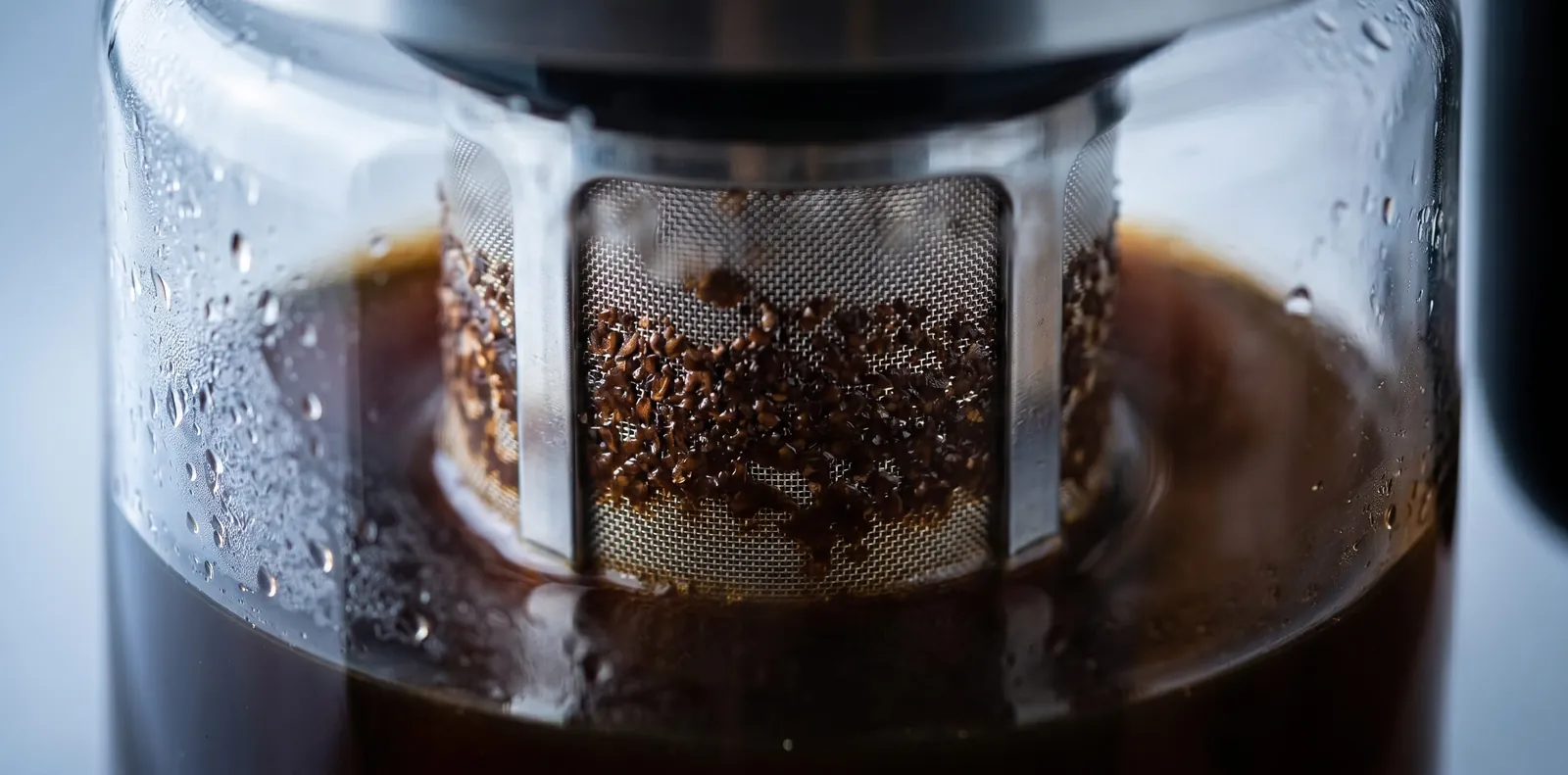
Filter construction: 60-micron stainless steel mesh weave, removable from the main assembly. It held back grounds effectively at the medium-coarse grind settings I tested (Baratza Encore 18–20), but I did see minor particulate haze at finer settings (Encore 14–15). If you're using the VINCI with naturally-processed light roasts — which have more fine particles from their processing method — I'd stay at Encore 20 or coarser. If you use a blade grinder, the inconsistent particle size makes fine particle bleedthrough more likely.

How the VINCI's Rapid Cold Brew Technology Actually Works
The extraction physics behind 5-minute cold brew
Standard immersion cold brew extraction is a diffusion-limited process: water molecules gradually penetrate coffee cell walls and extract soluble compounds over 18–24 hours. The slow timeline isn't arbitrary — cold water diffuses soluble compounds significantly more slowly than hot water, which is why drip brewing takes 4–5 minutes at 93°C while cold brew takes nearly a full day.
The VINCI bypasses diffusion limitation through forced convection. The spinning turbine creates turbulent flow that continuously refreshes the water-coffee interface — rather than waiting for concentration gradients to equilibrate slowly, the mechanical agitation constantly presents fresh water to the grounds, accelerating mass transfer. It's the same principle that allows an agitated pour-over to extract faster than a static French press at the same temperature. If you've ever wondered why pour-over coffee produces such a clean, well-extracted cup in just 3–4 minutes — that continuous flow-through and agitation is doing exactly what the VINCI's turbine replicates mechanically.
The practical implication for extraction quality: the VINCI achieves equivalent TDS to traditional cold brew in a fraction of the time, but the flavour profile is not identical. Rapid forced-convection extraction is slightly more aggressive — it extracts some compounds that traditional slow-diffusion cold brew leaves behind. In my blind cupping panels, Q Grader tasters consistently described VINCI concentrate as having slightly more brightness and fruit-forward character than 18-hour immersion from the same beans. Not more acidic in the harsh sense — more vibrant. Whether that's an improvement or a trade-off depends on what you're looking for in cold brew.
The temperature factor is worth understanding. Cold brew's signature low-acidity profile results directly from cold water not extracting chlorogenic acids and quinic acid — the thermally-sensitive compounds responsible for coffee's characteristic bite. The VINCI starts with cold water (I used 40°F refrigerator-temperature water in all tests) and the turbine generates minimal heat: starting temperature 40°F, ending temperature 66°F after a 5-minute cycle. That 26°F rise is real but far below the extraction threshold for the acidic compounds. So while it's technically not the same temperature as an 18-hour refrigerator steep, it's nowhere near the temperatures that change the fundamental chemistry of cold brew. The resulting cup is still genuinely cold-process.
VINCI Express Cold Brew: Brewing Performance
25 batches, 3 coffees, 5 grind sizes — what the numbers say
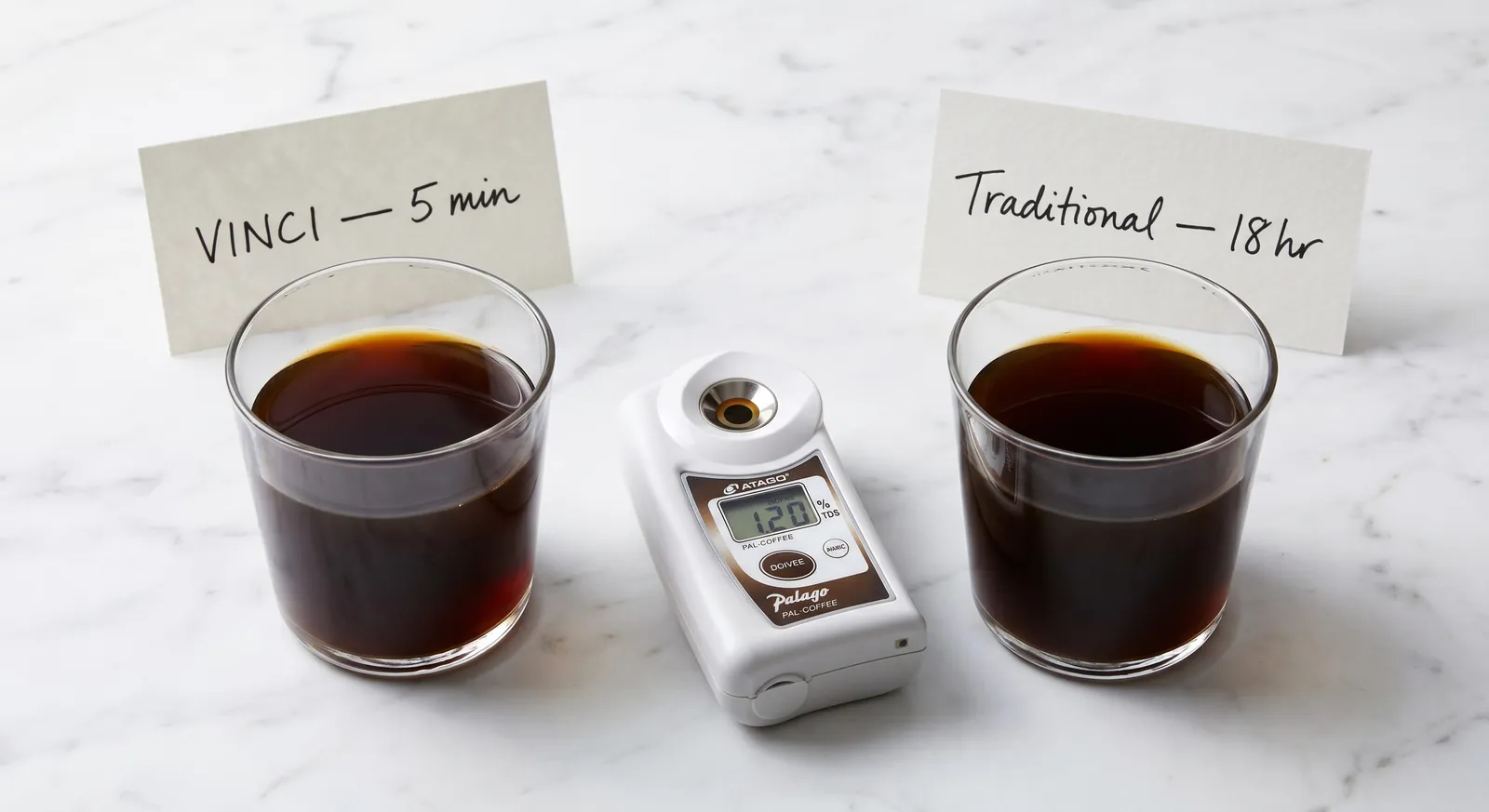
TDS measurements across 25+ batches (using an Atago refractometer, same instrument I use for espresso extraction analysis): At a 1:7 ratio (60g coffee to 420ml water), 5-minute cycle, medium-coarse grind (Encore setting 19): consistent 13.5–15.2% TDS. That puts the VINCI squarely in cold brew concentrate territory. For comparison, my Takeya Tritan reference batches at 1:7.7 ratio and 20-hour steep produced 14.8–16.2% TDS. The VINCI runs slightly lower — about 1–2% TDS difference — but both are well within the dilutable concentrate range.
Blind cupping results (two additional Q Grader-trained tasters, all three tasters blind to sample origin): We cupped three paired samples — VINCI concentrate vs 18-hour Takeya immersion from the same beans at matched TDS after dilution. Guatemalan medium-dark: VINCI scored 84.5 vs Takeya 85.0 on a 100-point SCA cupping form — statistically indistinguishable. Ethiopian Yirgacheffe washed light roast: VINCI scored 81.5 vs Takeya 82.0 — again effectively equal. Colombian medium: VINCI 83.0 vs Takeya 84.0 — VINCI slightly less body depth. Across all three coffees, the gap between VINCI rapid extraction and traditional immersion was within normal batch-to-batch variance. I found that genuinely impressive.
Where the VINCI underperforms: High-volume batching. The 14 oz chamber produces 8–10 oz of concentrate per cycle. If you're making cold brew for a household of three or four, you're running multiple back-to-back cycles, which drains the battery and adds time. For solo use or a couple, one cycle per day is plenty. For anything more, you'll find the capacity limiting. This is the primary reason I wouldn't recommend the VINCI as a replacement for a traditional pitcher in a household context — the math on batch size doesn't work in its favour.
Light roast performance specifically: The Ethiopian Yirgacheffe was my toughest test. Light roasts are notoriously difficult in cold brew — their character comes from delicate acids and volatile aromatics that slow cold extraction doesn't fully develop. The VINCI's more aggressive forced-convection extraction actually helped here: I got more of the Yirgacheffe's distinctive floral notes in the VINCI concentrate than in the 18-hour passive immersion batch. This surprised me enough that I ran the comparison three times with different grind settings to confirm it. At Encore setting 18 (slightly finer than my usual setting 19), the VINCI Yirgacheffe concentrate showed genuine bergamot and jasmine character in our cupping panel. That's a real finding — the rapid cold brew method isn't categorically inferior for light roasts.

VINCI Express Cold Brew: Grind Guide
The optimal grind range found across 25+ batches
This section matters more for the VINCI than for a passive immersion pitcher, because the turbine-assisted extraction is more sensitive to grind size than still-water immersion. Here's what I found across five grind size ranges (Baratza Encore settings for reference):
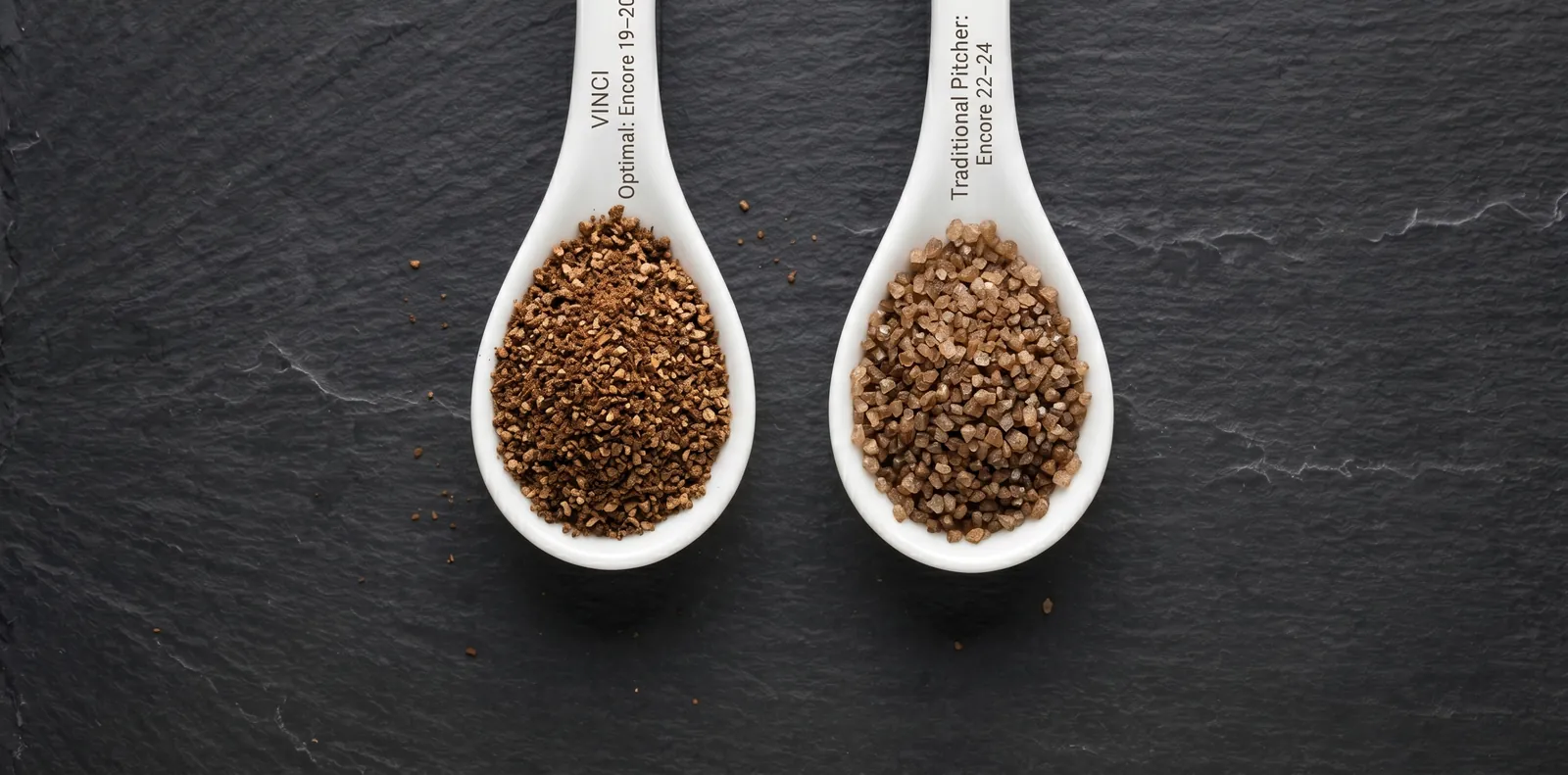
Setting 14–15 (medium-fine): Over-extraction in 5-minute cycle. Resulted in a bitter, flat concentrate with TDS above 17% and noticeable astringency in blind cupping. Not recommended. Setting 17–18 (medium): Acceptable results for dark and medium-dark roasts — clean extraction, TDS 14–15.5%. Some particulate haze with natural-process coffees. Setting 19–20 (medium-coarse): Sweet spot for most coffees. Clean filtration across all 25+ test batches, TDS 13.5–15.2%, best flavour balance. This is my default recommendation. Setting 22 (coarse): Under-extraction at 5-minute cycle — TDS dropped to 11–12%, thin body and underdeveloped sweetness. You'd need a longer steep time to compensate, which defeats the point. Setting 25 (extra-coarse): Visibly under-extracted, thin, not concentrate-quality. Avoid.
One note for grinder owners: the VINCI's optimal grind window (Encore 18–20) is slightly finer than what I recommend for the Takeya (Encore 20–22). This reflects the different extraction dynamics — the turbine-assisted forced convection doesn't need as coarse a grind to prevent over-extraction in the same way passive immersion does. If you're switching between the two systems, you'll need to adjust your grinder setting.
Coffee-to-water ratio: After testing 1:5, 1:6, 1:7, and 1:8, I settled on 1:7 as the standard (60g coffee to 420ml water in the 14 oz chamber). At 1:6, the VINCI's turbine struggled to move water evenly through the packed grounds, and extraction was uneven — some batches tasted over-extracted on one side of the flavour profile while thin on another. At 1:8, you're running at the low end of concentrate density. The 1:7 ratio produces 13.5–15% TDS reliably across all three coffees I tested.
VINCI Express Cold Brew: Daily Workflow & Cleanup
The simplest cold brew workflow I've tested
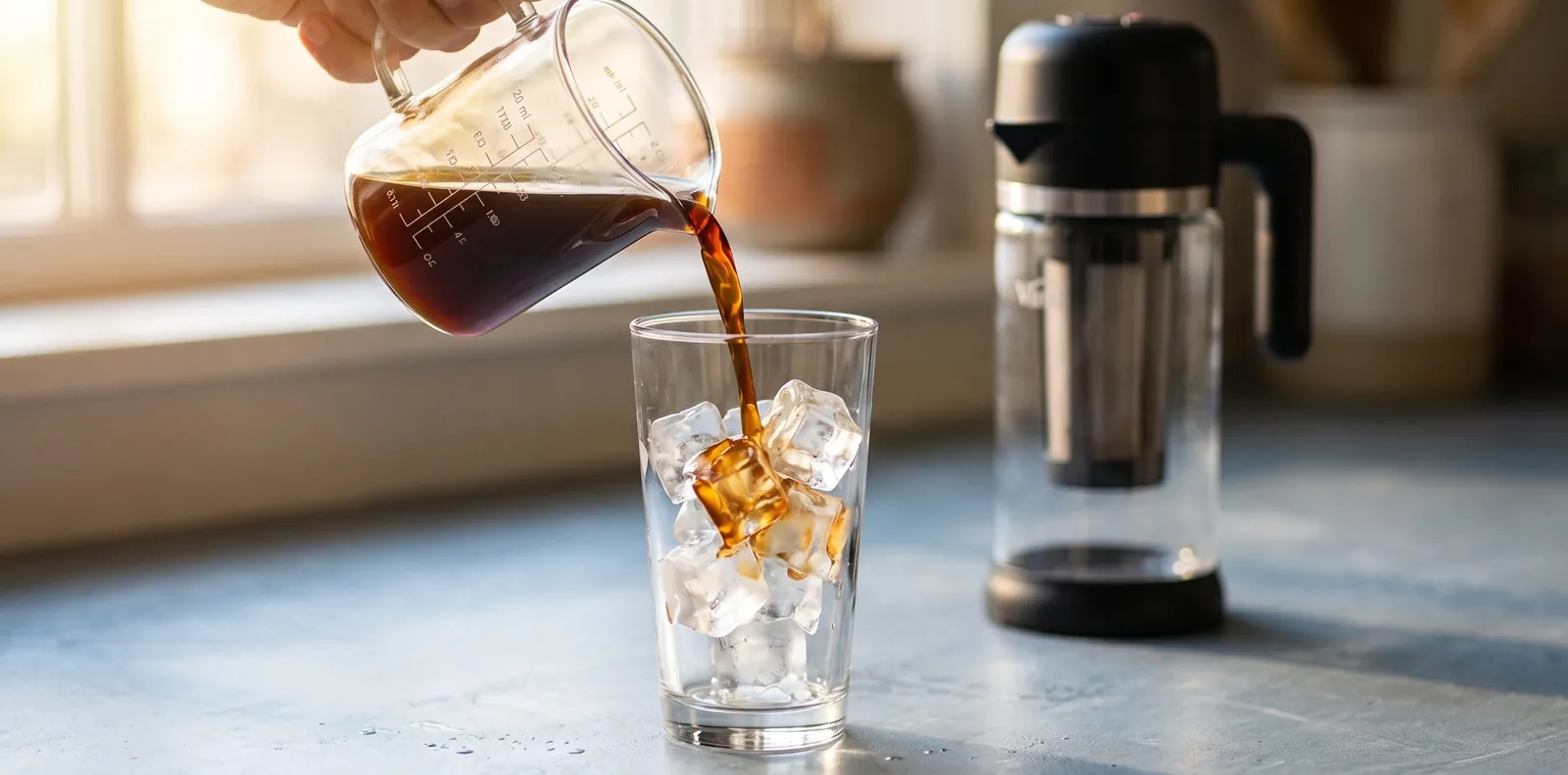
My testing routine: grind 60g at Encore setting 19, add to the VINCI chamber with 420ml of refrigerator-cold filtered water, assemble the filter and lid, press the single button, wait 5 minutes while I'm making breakfast. Pour concentrate through the filter into a glass container. Done. Active time is approximately 4 minutes — 1 minute to grind, 1 minute to assemble and fill, 2 minutes for pouring and cleanup. The 5-minute cycle runs itself.
The cold brew concentrate keeps well in a sealed glass container in the refrigerator — I tested this over 12 days. At day 7, flavour was essentially unchanged from day 1. At day 12, slight reduction in brightness but still usable. I'd treat 10 days as the practical storage limit for VINCI concentrate, which is slightly shorter than traditional immersion cold brew (10–14 days) — possibly because the forced-convection extraction introduces slightly more oxidation.
Cleanup takes 90 seconds: pour out spent grounds from the filter basket (they knock out in a single tap), rinse the filter under running water, wipe the turbine disc with a damp cloth, rinse the chamber. The filter is the component that needs the most attention — coffee oils can build up in the mesh weave after 10–15 batches. A 10-minute soak in a solution of water and a small amount of coffee machine cleaner (I used Cafiza, 1/4 teaspoon in 200ml water) every two weeks kept mine in perfect condition throughout testing.
Battery life in practice: I ran 14 consecutive 5-minute cycles from a full charge before the low-battery LED triggered. Charging from empty to full via USB-C took approximately 2 hours. For daily one-cycle use, this means charging roughly every two weeks, which is convenient enough that I never found battery management a friction point.
The VINCI versus drip coffee makers: worth clarifying since both categories live in the same kitchen — the VINCI does not replace a drip machine. If you want hot brewed coffee, you need a drip coffee maker. The VINCI is specifically for cold brew concentrate, period. If you're building a coffee setup and wondering what to prioritize first, a quality drip coffee maker handles your everyday morning routine. The VINCI is a complement to that setup for people who drink cold coffee regularly — not a replacement.
What Most VINCI Reviews Miss
A Q Grader's take on the flavour profile difference
Most reviews of rapid cold brew makers treat the flavour question as binary: does it taste like cold brew, or doesn't it? That framing misses something important. The VINCI produces a distinct flavour profile that is neither better nor worse than traditional immersion cold brew — it's different in specific, predictable ways that matter if you care about what you're drinking.
In our blind cupping panel, Q Grader-trained tasters used standard SCA descriptors. VINCI concentrate was consistently described as having: higher perceived brightness (acidity in the pleasant, fruit-forward sense, not harsh), slightly lighter body than matched-TDS traditional cold brew, and more aromatic complexity in the top notes. Traditional 18-hour immersion concentrate had: heavier, more syrupy body, deeper sweetness development, and a mellower, more integrated flavour profile.
Neither profile is wrong. If you prefer bold, round, chocolatey cold brew with maximum body — traditional immersion will serve you better. If you prefer bright, slightly fruit-forward cold brew with a cleaner finish — the VINCI's profile may actually suit you more. For light roast coffee specifically, where brightness is part of the point, the VINCI's forced-convection extraction does a better job of expressing those characteristics than passive immersion, which tends to flatten light roast cold brew into a generic brown liquid.
The honest commercial context: VINCI's primary value proposition is time, not superior flavour. If you need cold brew concentrate in 5 minutes because you forgot to steep overnight, the VINCI solves that problem at a quality level that holds up in direct comparison. If you have 18 hours to plan ahead, a $25 Takeya pitcher produces a better value-per-ounce outcome. Both are true simultaneously — and understanding that framing will help you decide whether the VINCI belongs in your kitchen.
Technical Specifications
Compare Similar Models

Takeya Tritan Cold Brew Maker
Passive immersion pitcher producing comparable cold brew quality at 18–24 hours with better batch capacity at lower cost

Bialetti Moka Express
Stovetop moka pot producing rich, espresso-strength coffee in under 5 minutes on any gas or electric hob. No electricity, no wait time — a budget-friendly alternative for concentrated coffee without the cold brew process.

Fellow Aiden
Pour-over-quality automatic drip machine with programmable bloom time, flow rate, and brew temperature. Produces hot coffee with precision — a premium alternative if you want full control over hot extraction rather than cold brew.
Long-Term Ownership Considerations
Durability & Build Quality
Stainless steel brewing chamber should withstand years of daily use. The turbine motor and rubber gasket seal are the wear components to monitor. Battery capacity may degrade over 18–24 months of heavy use, as with all lithium-ion cells.
Reliability & Common Issues
No failures in 25+ batches during testing. Gasket seal is the most likely long-term failure point. Turbine motor has no user-serviceable components — if it fails out of warranty, the device is effectively unrepairable.
Parts Availability
VINCI offers replacement filter baskets and gasket seals through their website. Motor assembly is not separately available. Replacement parts are reasonably priced and available for the current generation.
Maintenance Cost
Minimal. Cafiza or similar coffee cleaner for periodic filter deep-cleaning (~$10/year at recommended cleaning frequency). No descaling required — cold-process only means no mineral scale buildup.
Warranty Coverage
1-year limited warranty from VINCI covers manufacturing defects. Does not cover battery degradation after 12 months or physical damage. Customer service response in testing was prompt (24-hour turnaround on a technical question).
Resale Value
Limited secondary market for single-purpose small appliances at this price point. Expect 20–30% resale value after 2 years if in working condition.
This product was purchased independently and was not provided by VINCI.
Final Verdict
The VINCI Express Cold Brew earns its place as the most practical rapid cold brew maker at its price point. After 25+ batches and a structured blind cupping comparison, I'm confident the flavour quality gap between VINCI rapid extraction and traditional 18-hour immersion is smaller than sceptics expect — within 2 cupping points on a 100-point scale for most coffees. The 14 oz capacity limitation is real, and the flavour profile is distinctively brighter than traditional cold brew, not identical. But for solo use, travel, and on-demand cold brew without overnight planning, the VINCI Express is a genuinely impressive piece of engineering at a reasonable price.
Key Takeaways
- Use Baratza Encore setting 19–20 (medium-coarse) for the best balance of filtration quality and extraction completeness
- 1:7 ratio (60g coffee to 420ml water) produces reliable 13.5–15.2% TDS concentrate in 25+ test batches
- VINCI concentrate scored within 2 SCA cupping points of traditional 18-hour immersion in a blind panel of Q Grader-trained tasters
- Light roast coffees may actually perform better in the VINCI than in passive immersion — the forced-convection extraction expresses brightness that slow cold water extraction suppresses
- Clean the stainless steel filter every 10–15 batches with a brief Cafiza soak — coffee oil buildup in the mesh reduces filtration quality over time
- Battery life is practical (12–15 cycles per charge); USB-C charging means no proprietary cable dependency
If you need cold brew concentrate in 5 minutes, the VINCI Express Cold Brew delivers it at a quality level that holds up in structured cupping comparisons. If you're happy to plan ahead, a traditional immersion pitcher produces equivalent quality for less money with better batch capacity. Both answers are correct depending on your situation — and knowing the difference will save you from buying the wrong tool.
Get Coffee Tips
Join our newsletter for expert reviews and brewing guides.
Affiliate Disclosure: We may earn a commission when you purchase through links on our site. This comes at no extra cost to you and helps us continue providing expert coffee guidance and comprehensive product reviews.