
 3.5
3.5Krups
Krups XP444C50
A tight-budget entry point for first-time espresso owners making one or two drinks a day.
Espresso machine review
Last updated
Upgrading from pods? Our Breville Cafe Roma ESP8XL espresso machine review pulled 64+ shots in 3 weeks. See how the manual wand feels and who it suits.
Affiliate disclosure: this page contains Amazon affiliate links. We may earn a commission if you buy through them, at no extra cost to you, and it never affects our rankings. Read our full affiliate disclosure
Breville ESP8XL Cafe Roma at a GlanceRecommended
A fair starter at its price if you buy it for the build and service backing; don't expect pricier-machine performance.
Traditional Entry-Level Manual Espresso Machine
Affiliate link: we may earn a commission at no extra cost to you. It never affects our rating.
In the shot log· 64+ shots · 3 weeks
Why it stands out
Watch out for
✓ Best for
First-time espresso makers upgrading from Keurig or Nespresso pods
✕ Skip if
Serious enthusiasts needing commercial 58mm portafilter
This Breville Cafe Roma review starts with the verdict: the design has barely changed in over a decade, and after 64 espresso shots across three weeks our take is that sometimes unchanged just means it already worked.
The short answer: a solid first real espresso machine for pod users on a budget, bought for its stainless build, Breville's service network and a forgiving dual-wall basket rather than top performance.
Check where you fit before you look at the trade-offs below.
A strong match
Consider something else
What earns the rating, and what you give up to get it.
7 reasons it works
7 trade-offs to weigh
How it performed in day-to-day use, in the order you will meet it.
Unboxing to first acceptable shot took 15-20 minutes — reservoir fill, priming, and getting familiar with the manual dial. Heat-up from cold averaged 90 seconds, fast enough for a morning routine.
The pressurized basket produced consistent crema from day one, masking beginner mistakes in grind and tamp. Most first-time users get drinkable espresso within 2-3 attempts, and shot consistency improves fast once dosing (18g) and tamping settle in.
A traditional machine normally takes 15-20 attempts before consistency. That basket compresses that to 5-7 — smart design for beginners who need an early win before investing real practice time.
Dialing in new beans took 3-5 test shots per roast. Our target held steady at 18g in, 36g out, 25-30 seconds, and the thermoblock kept temperature within about ±3-4°F for the price range — pre-heating the portafilter under the group head for 30 seconds noticeably improved first-shot clarity.
By roast:
Crema told two different stories: the pressurized basket produced a thick, mechanically-created layer that looked better than it tasted, while the single-wall basket gave a thinner crema that actually added to mouthfeel. Shot-to-shot consistency improved once the thermoblock settled into a rhythm — the best pull of the testing period was thick, syrupy, and balanced, easily specialty-grade for a $249 machine, even if not every shot reached that bar.
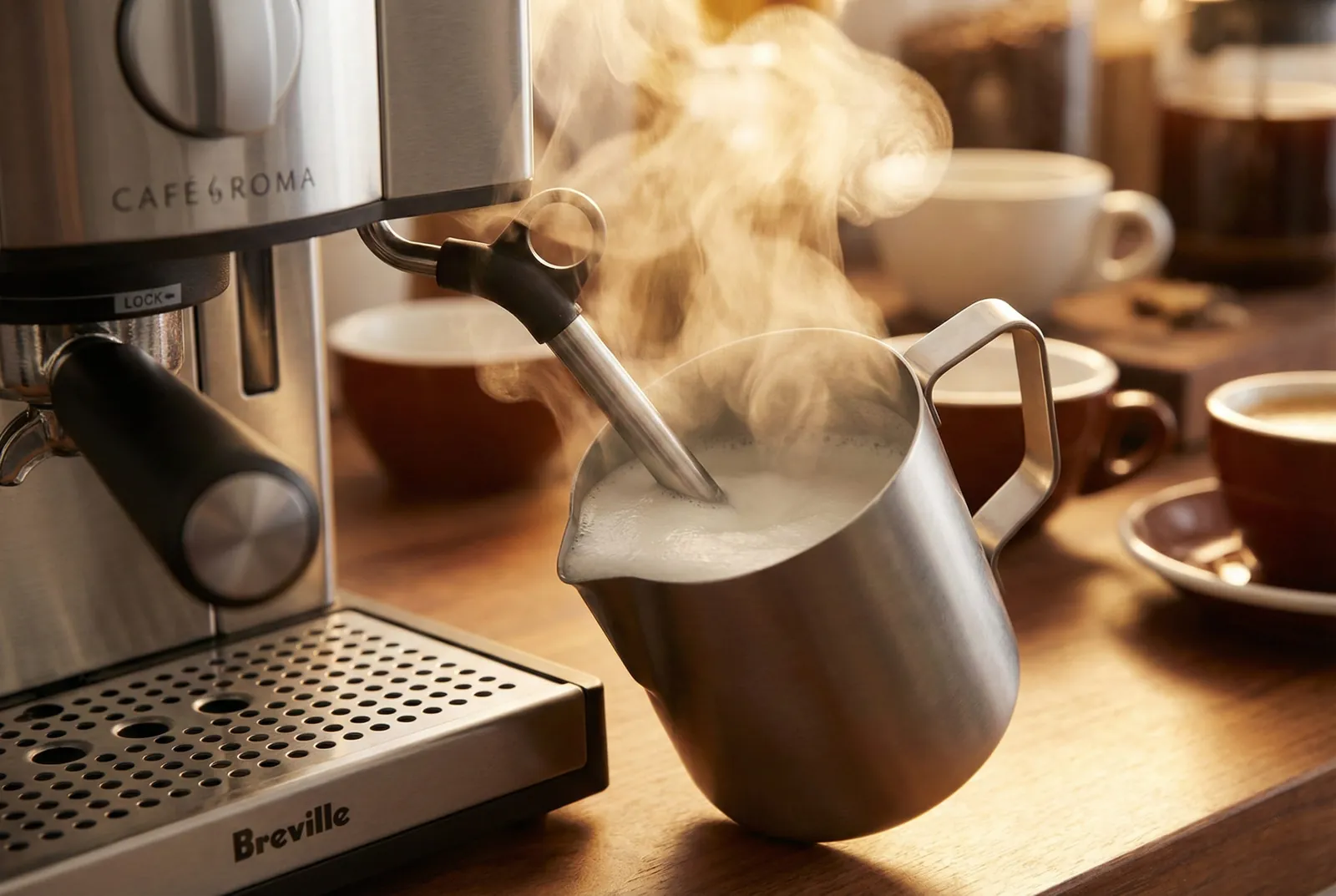
The manual steam wand is adequate, not impressive — roughly a third of the power of commercial machines. Texturing 8oz of whole milk took 60-90 seconds, against 30-45 seconds on dual-boiler machines, plus a 45-60 second wait for the boiler to shift from brew to steam mode.
The learning curve was real:
A clip-on thermometer helped enormously — without one we scalded milk past 160°F more than once; with one, we consistently landed in the 150-155°F sweet spot.
Whole milk gave the best texture; oat milk (Oatly Barista) worked but never matched dairy's silkiness, and almond milk didn't work at all — a limitation of the milk, not the machine.
Daily cleanup — knocking the puck, rinsing the basket, wiping the wand — takes 2-3 minutes. Two small annoyances come with it:
Weekly maintenance and upkeep:
We deliberately used inconsistent tamp pressure, the wrong grind, and stale beans to stress-test the dual-wall basket — it still produced crema every time, proof of how forgiving pressurized extraction really is. The single-wall basket showed no such mercy: poor puck prep meant a channeled, uneven shot. Medium-to-dark roasts stayed this machine's comfort zone throughout testing, regardless of which basket was in use.
We descaled after three weeks rather than waiting 2-3 months, because we could taste temperature drift creeping into the shots. First-shot quality improved noticeably afterward, which suggests filtered water alone isn't enough to stretch descaling intervals much beyond a month of daily use.
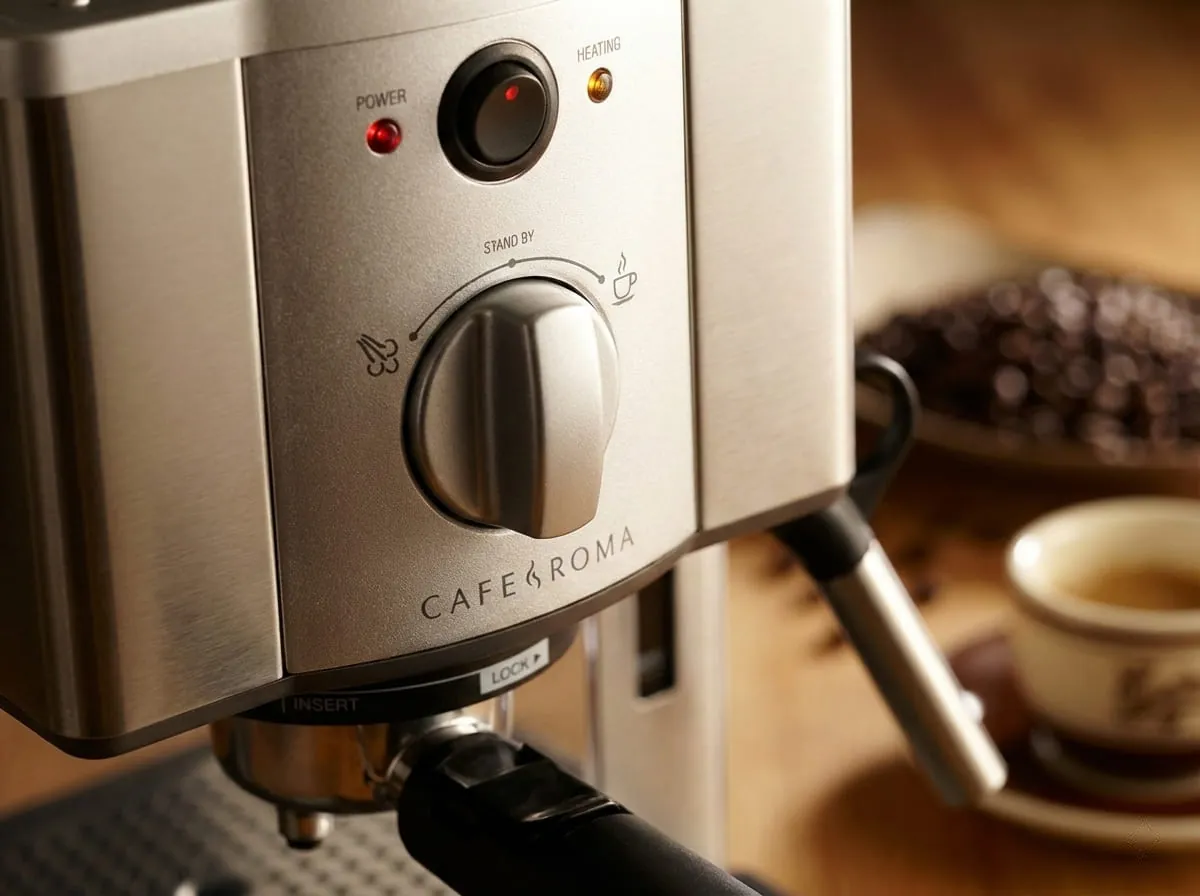
Which entry-level machine fits which buyer
At $249-$299 the Cafe Roma sits between cheap thermoblock starters and the first serious machines.
| Machine | Type | Heating system | Built-in grinder | Current price |
|---|---|---|---|---|
| Cafe Roma | Manual semi-automatic | Thermoblock | No (separate grinder) | Check current price |
| De'Longhi Dedica | Semi-automatic | Thermoblock | No (separate grinder) | Check current price |
| De'Longhi EC155 | Semi-automatic | Thermoblock | No (grinder not needed with ESE pods) | Check current price |
| Gaggia Classic Pro | Manual semi-automatic | Single boiler (aluminum) | No (separate grinder) | Check current price |
| Bambino Plus | Compact semi-automatic | ThermoJet | No (separate grinder) | Check current price |
For a broader shortlist, see our sub-$500 espresso machines.
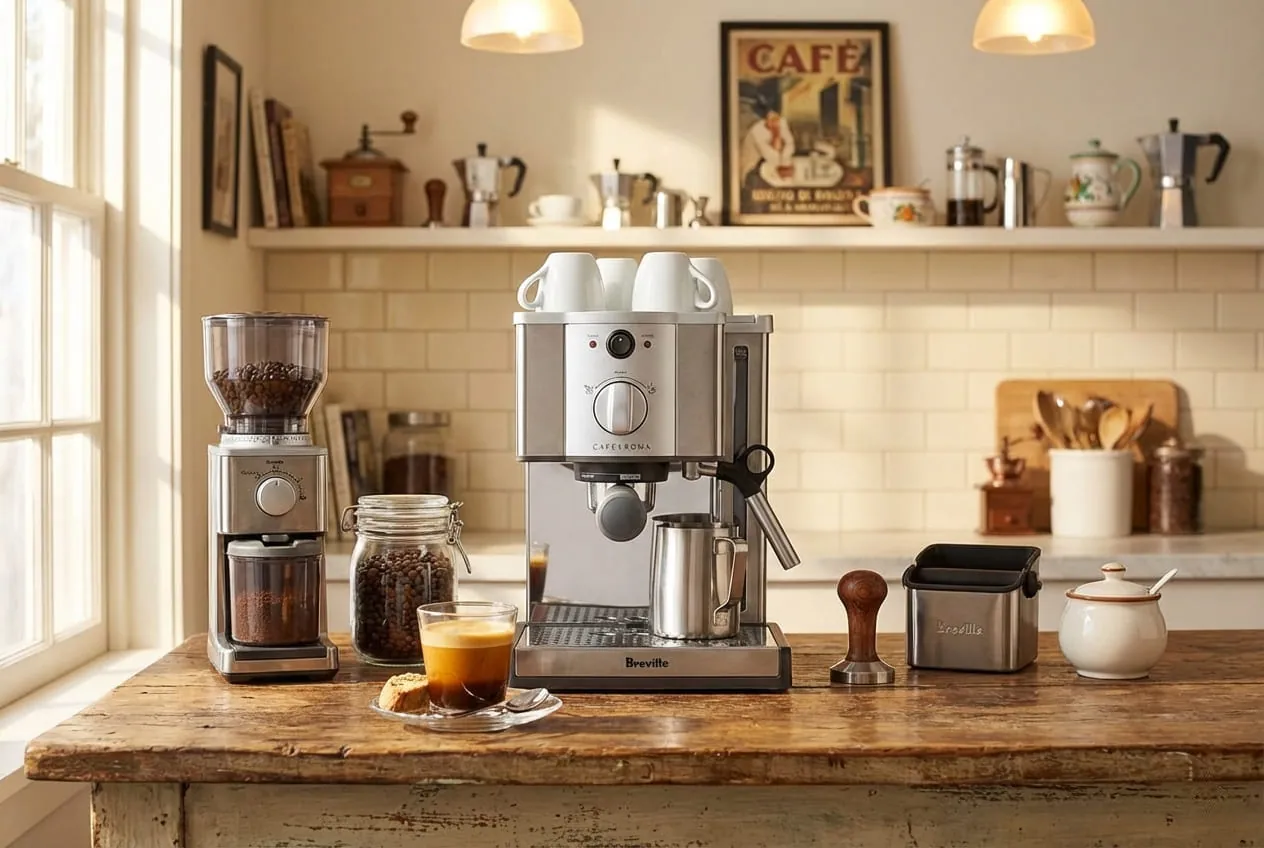
It is worth it if you are leaving pods behind and want a stainless-steel machine with real parts and service backing, and you accept the limits of a thermoblock. The included pressurized basket compresses the learning curve, and the single-wall basket gives you somewhere to grow.
It is not worth it if you want light-roast clarity, one-touch milk drinks, or room to upgrade. The temperature variance of about ±3-4°F and the 45-60 second switch between brewing and steaming are baked into the design.
The real cost is not the machine but the grinder. A pressurized basket forgives mediocre grounds, but moving to the single-wall basket needs a grinder that can hold a consistent fine setting. Budget for one; our top-rated coffee grinders guide is a starting point.
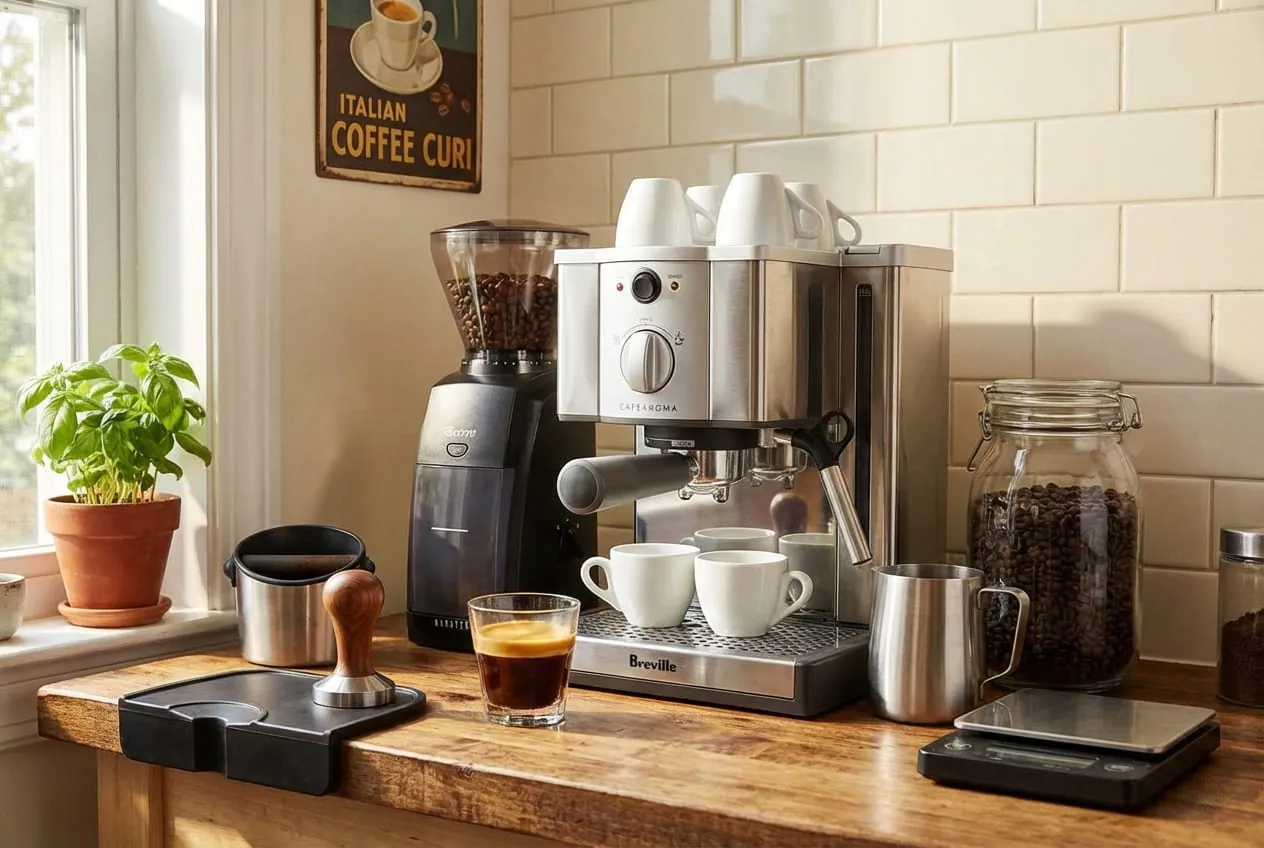
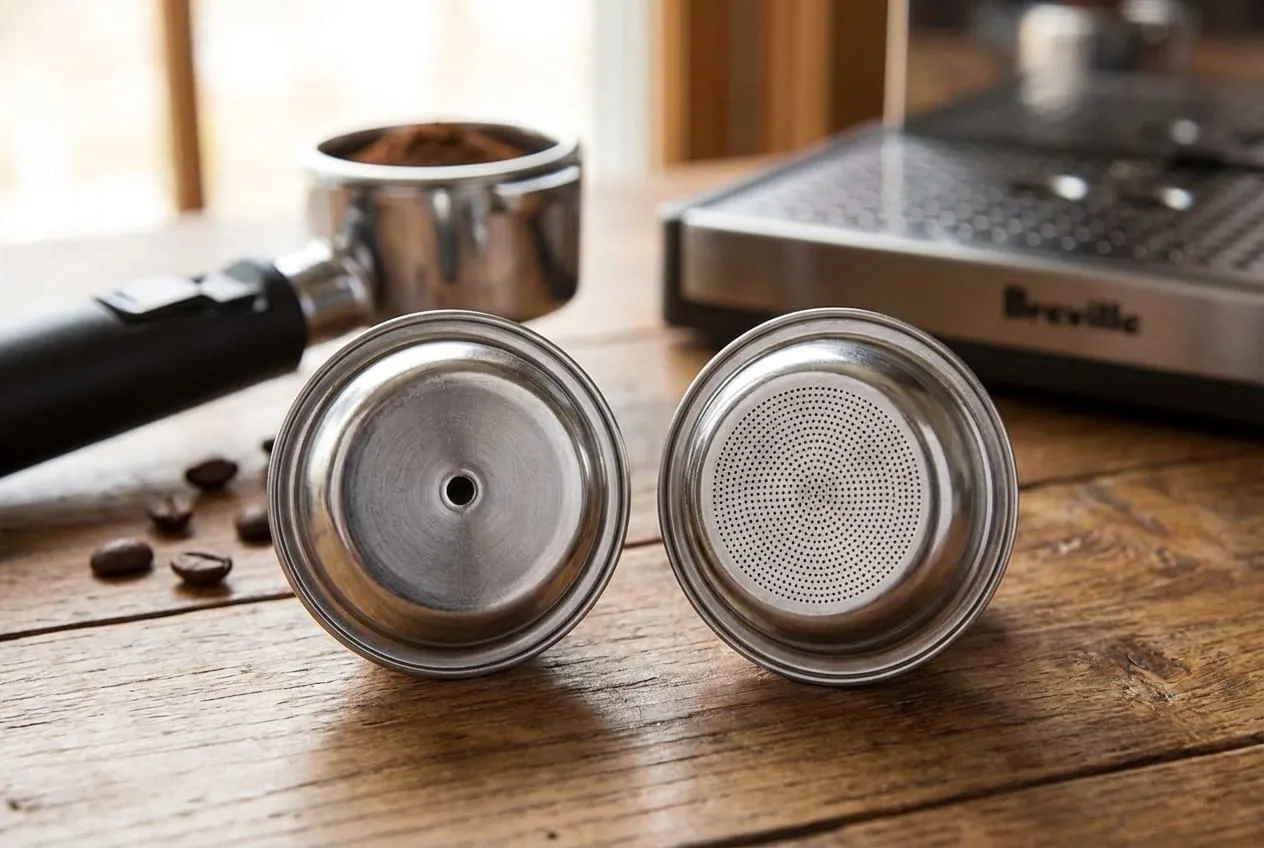
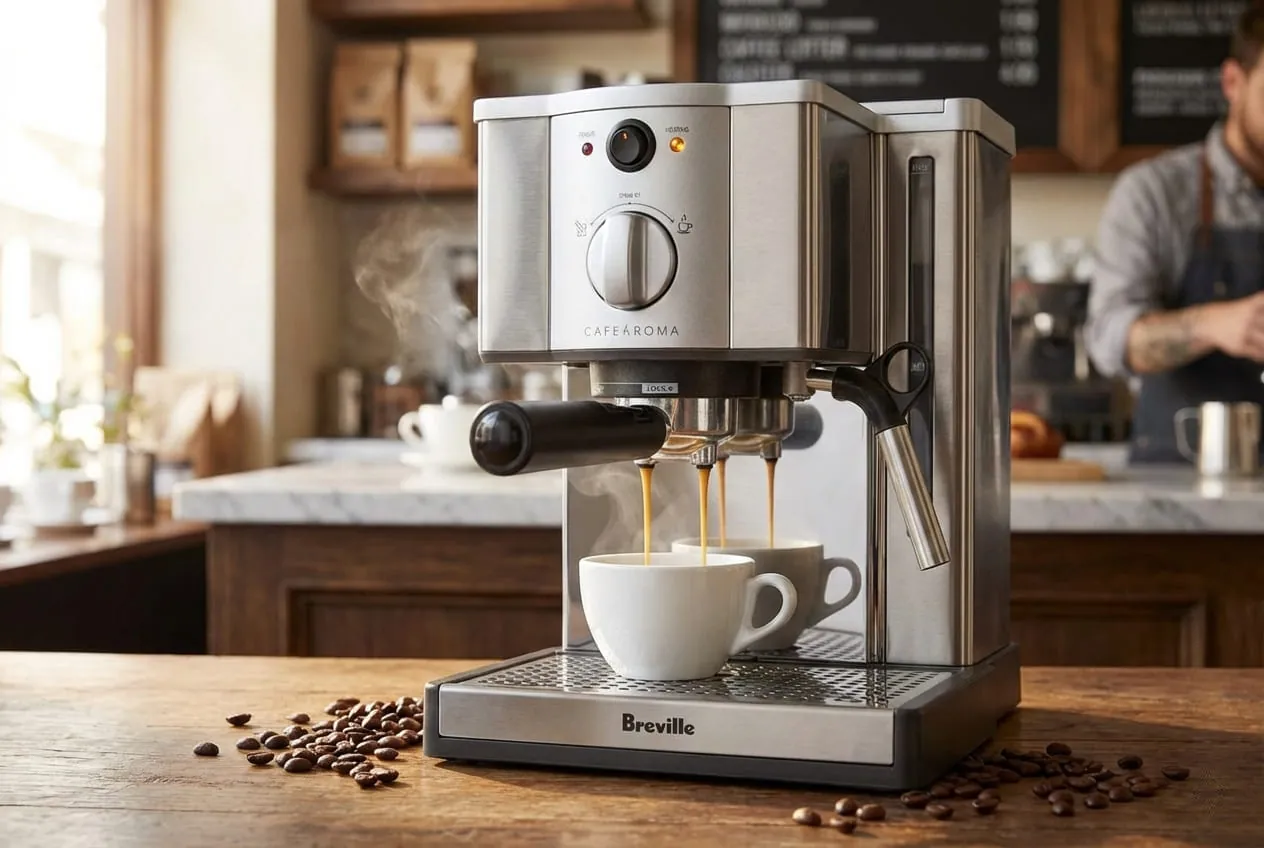
The Cafe Roma is a thermoblock machine with a pump and a manual steam wand. Here is how that shapes the cup.
A thermoblock is an aluminum block with a heating element and a thin water channel. Water is heated as it flows through instead of waiting in a boiler, which is why these machines are ready within a minute and stay small and cheap. The Cafe Roma's pump pushes that water through the puck at a regulated pressure, and its manual wand uses steam to texture milk by hand.
A pressurized basket adds a small restrictor at the exit, so pressure builds even when the grind is imperfect. That forgives uneven grounds and stale beans, but it also hides the feedback that teaches you to grind finer or coarser. For the cup, expect reliable crema and a rounder, less detailed shot than a standard basket gives.
The included non-pressurized basket is where the learning starts, because espresso extraction depends on grind, dose and tamp working together. Beginners can stay on the forgiving basket and move over once their shots are repeatable.
Entry-level thermoblock machines share a few ownership issues. The fixes are cheap.
Thermoblock machines drift in temperature, especially after steaming. Run a blank shot through the empty portafilter to warm the metal, and let the ready light settle before brewing. Cooler water is the usual cause of sour espresso; a hotter, rushed shot is where bitter espresso starts.
Scale is the other slow killer. Use filtered or softened water and follow the descaling guide on schedule, because mineral build-up narrows the block's channel and cuts flow. Rinse the portafilter and group screen after each session, as covered in cleaning an espresso machine.
The rear-fill tank is the daily annoyance. Fill it before you start a session rather than mid-drink, and wipe the drip tray so milk splashes do not harden. If steam turns weak, clear the tip with a pin and see fixing a steam wand that will not froth.
Before you decide
Budget espresso machines under $300 come down to real trade-offs: build material, heating speed versus stability, basket forgiveness versus authenticity, and brand support — and, just as much, which of the many coffee grinders on the market you pair it with. Most compromise on PID control, pressure profiling, and upgrade paths.
If you'd rather skip the manual technique entirely, a fully automatic coffee maker with built-in espresso functions trades hands-on control for convenience. It's not built for cold brew or drip coffee either — this is strictly an espresso machine.
The Cafe Roma leans into traditional aesthetics and simple, dependable operation over feature complexity. Its dual-wall basket gives you a real learning path — forgiving pressurized extraction first, authentic single-wall once your technique catches up — and the stainless steel build should outlast the all-plastic competition.
For more options at every budget, see our espresso machine reviews hub, our best espresso machines under $500 guide, or the full best home espresso machines comparison.
Durability, upkeep and running costs once the novelty wears off.
Stainless steel body with a plastic water tank and drip tray, a chrome-plated portafilter, and Breville's proven thermoblock heating.
Expect 5-7 years of service with regular descaling and filtered water.
Common issues, per user reports: thermoblock scaling without regular descaling, a group gasket that wears out every 12-18 months ($5-10, DIY), and a steam wand valve that can start leaking after 3-4 years.
Electronics have generally held up well within the expected lifespan.
Breville keeps parts in stock for 5-7 years — gaskets, baskets, and steam wand components ship within 5-7 business days through Breville and third-party retailers.
Budget $20-30 a year for descaling solution and an occasional gasket — around $100-150 over five years, lighter than a commercial-grade machine but still worth staying on top of.
A 1-year limited warranty covers manufacturing defects and mechanical failures — shorter than some competitors, though Breville's support is generally responsive with a 7-10 day repair turnaround.
Moderate resale demand — well-maintained units typically fetch 40-50% of original price after 2 years and 25-35% after 4, or roughly $100-150 and $60-105 respectively.
This machine was purchased independently and was not provided by Breville.
Our rating, who it fits, and what it costs.
Breville ESP8XL Cafe RomaRecommended
4.0 / 5 — Is it worth buying?
The Cafe Roma holds its own as the best traditionally-styled espresso machine under $300 — not through cutting-edge performance, but through stainless steel build, a smart dual-wall-to-single-wall learning path, and Breville's parts-and-service backing.
✓ Best for
✕ Skip if
Score breakdown
Shots tested
64+
Testing period
3 weeks
Ready to decide?
Our verdict: 4.0/5, recommended. Independently tested; commissions never change a rating.
See how the Breville ESP8XL Cafe Roma compares with the other picks in each tested roundup.
Closest alternatives in price and purpose, each tested the same way.
3.5Krups
A tight-budget entry point for first-time espresso owners making one or two drinks a day.
 4.5
4.5Breville
A beginner-friendly semi-automatic that removes manual tamping from the equation, trading some hands-on control for consistency.
 4.0
4.0De'Longhi
An adjustable-frother machine for pod-machine graduates learning real espresso craft without Bambino Plus pricing.
 3.8
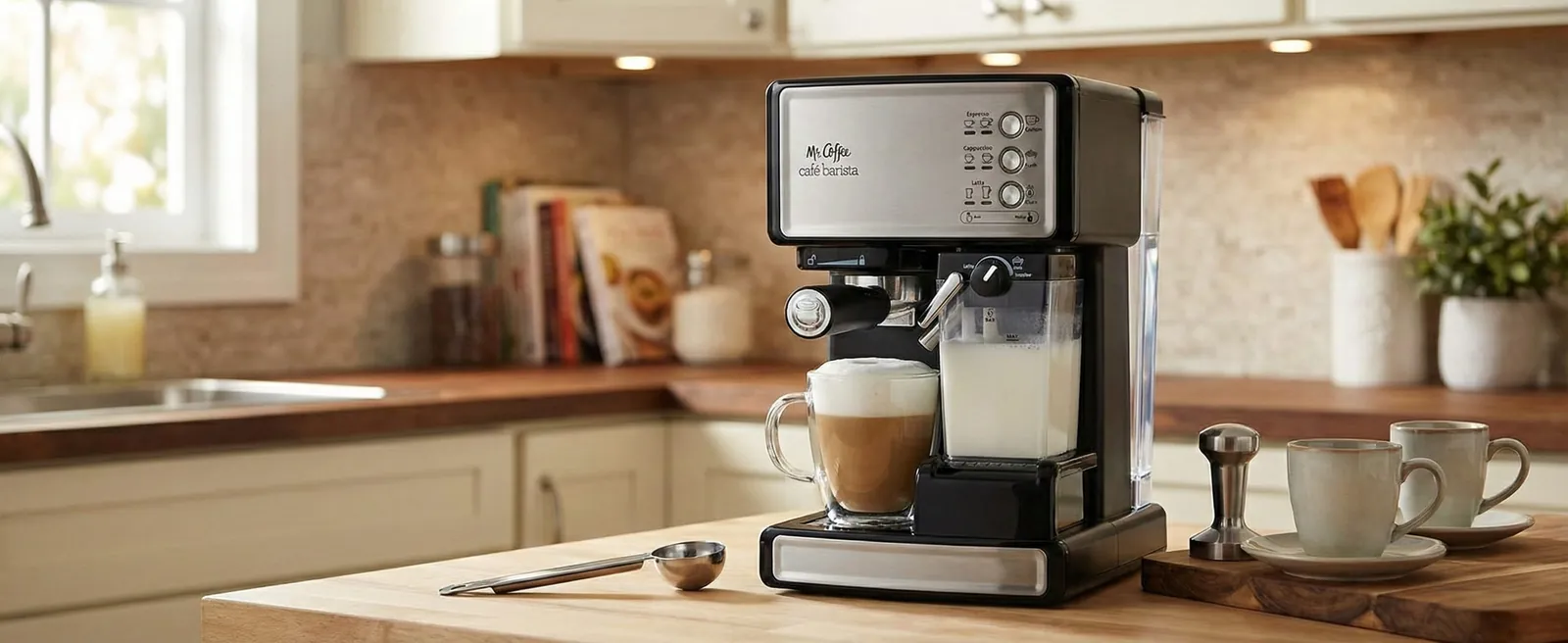
3.8Mr. Coffee
A budget beginner machine under $200 for occasional drinkers who want one-button milk drink convenience.
Put it into practice with a free calculator built for what you just read.
Quick answers before you buy.
Yes—this is one of the better options for first-time users at this price. The pressurized basket produces consistent crema even with mediocre grind quality and imperfect technique. We deliberately tested this by using coarser grinds than recommended, inconsistent tamping pressure, and even stale beans—still achieved acceptable results with that forgiving basket.
Once you've developed confidence (we'd estimate a few weeks of regular use, maybe 30-40 shot attempts), transitioning to the single-wall basket provides authentic espresso extraction feedback. That progression path is actually smart design—start with training wheels, remove them when ready.
You will still need a quality burr grinder, though. Minimum $199-$299 for electric (Baratza Encore ESP with M2 burr), or $159 for hand grinding (1Zpresso JX-Pro). The manual steam wand requires patience to master—budget 20-30 practice sessions, maybe 2-3 weeks of regular use, to develop comfortable milk frothing technique if you're completely new to espresso.
It depends on what you prioritize. These are the two most common budget espresso machines.
The DeLonghi EC155 advantages: a more compact footprint and marginally better temperature stability in our testing. Prices overlap — about $249–$349 for the EC155 versus $249–$299 for the Roma — so check current listings. The EC155 also uses a traditional 51mm portafilter with a more forgiving pressurized basket.
The Cafe Roma advantages: better build quality (heavier, more durable feel), stronger steam wand pressure, and Breville's superior customer service and parts availability. The Roma's steam wand produced microfoam faster and more consistently across the 28 milk drinks tested.
Our recommendation: if build quality, steam power, and brand support matter to you, the Cafe Roma is the stronger pick at similar prices. If the EC155 happens to be cheaper on the day and you just want a basic machine that works, it delivers. Both are entry-level machines — neither will satisfy a serious espresso enthusiast long-term. The Krups XP444C50 ($250–$300) sits in the same price band, but its proprietary portafilter has no single-wall basket upgrade, so there is less room to grow.
Invest at least $150 in a quality burr grinder, because the grinder matters as much as the machine. Best options for this specific machine: Baratza Encore ESP ($199-$299) for electric convenience with espresso-focused burr set, 1Zpresso JX-Pro ($159), a strong choice for manual grinding, Timemore Chestnut C3 ($99-$149) as a budget manual option that's adequate but not ideal, or Eureka Mignon Manuale ($250-$300) for premium flat burrs if budget allows.
Avoid blade grinders completely—we tested one deliberately for comparison and the results were catastrophic even with the forgiving pressurized basket. Also avoid entry-level burr grinders under $50 (like cheap Cuisinart or Mr. Coffee models)—inconsistent particle sizes sabotage espresso quality regardless of machine capability. For more options across budgets, see our coffee grinders buying guide.
Yes—the manual steam wand creates proper microfoam suitable for lattes and cappuccinos, but it requires technique and practice. Realistic expectations: expect 20-30 practice sessions before achieving consistently silky microfoam, plan for 60-90 seconds per milk pitcher frothing time (not fast, but adequate), manual temperature control using cheap $8 thermometer recommended, and good microfoam definitely achievable—we managed basic latte art (hearts, simple rosettas) after mastering technique.
Not automatic—you absolutely must develop manual steaming skills. Single-boiler design means 45-60 second wait between pulling shot and steaming milk due to temperature transition. For completely automatic push-button milk frothing with zero learning curve, you want Breville Bambino Plus instead (roughly $150 more expensive but convenient).
A dual-wall (pressurized) basket creates artificial pressure through a small valve at the bottom, producing consistent crema from virtually any grind quality. It's forgiving for beginners and masks mediocre grinder quality, but produces 'fake' cosmetic crema created mechanically, not from proper extraction chemistry. Use this when learning basics or if using lower-quality grinder.
Single-wall (traditional) basket is just a perforated metal basket—authentic espresso extraction requiring proper grind fineness and tamping technique. Provides direct (sometimes brutal) feedback where poor grind quality equals poor results, creates real crema from proper extraction when technique is right, and reveals the machine's true extraction capability. Use once you've mastered basics and have quality burr grinder producing consistent particle size.
Recommendation based on our testing: start dual-wall for first 1-2 months or until you've pulled maybe 30-40 shots, then transition to single-wall when achieving consistent results. We made the switch around shot #35 during testing and immediately noticed the difference—both in difficulty and in more authentic flavor complexity.
Choose the Cafe Roma if: traditional Italian aesthetics matter to you (it looks better on the counter), you value Breville's brand reputation and customer service, you prefer slightly more robust construction with real stainless steel, and you want the basket progression path for skill development.
Choose the DeLonghi Dedica if: counter space is extremely limited (Dedica is only 5.9" wide versus the Cafe Roma's 9.5"), you want faster 40-second heat-up time, you prefer more modern minimalist design aesthetic, and you're okay with similar performance at a similar price.
Performance-wise they're comparable—both are single-boiler thermoblocks with similar temperature stability (the EC155 is marginally better), both have manual steam wands requiring technique, both suitable for beginners. The decision comes down to aesthetics, brand preference, and available kitchen space more than dramatic performance differences.
About 90 seconds from a cold start in our daily testing.
Pre-heating the portafilter for around 30 seconds improved first-shot clarity.
The main limits are temperature variance, a 45-60 second recovery between brewing and steaming, a small drip tray, and a rear-access water tank.
None are faults; they are trade-offs of a budget thermoblock machine.
Reader questions
Questions or tips? Leave a comment
Ask about your setup or share what worked for you. Comments are checked before they appear.