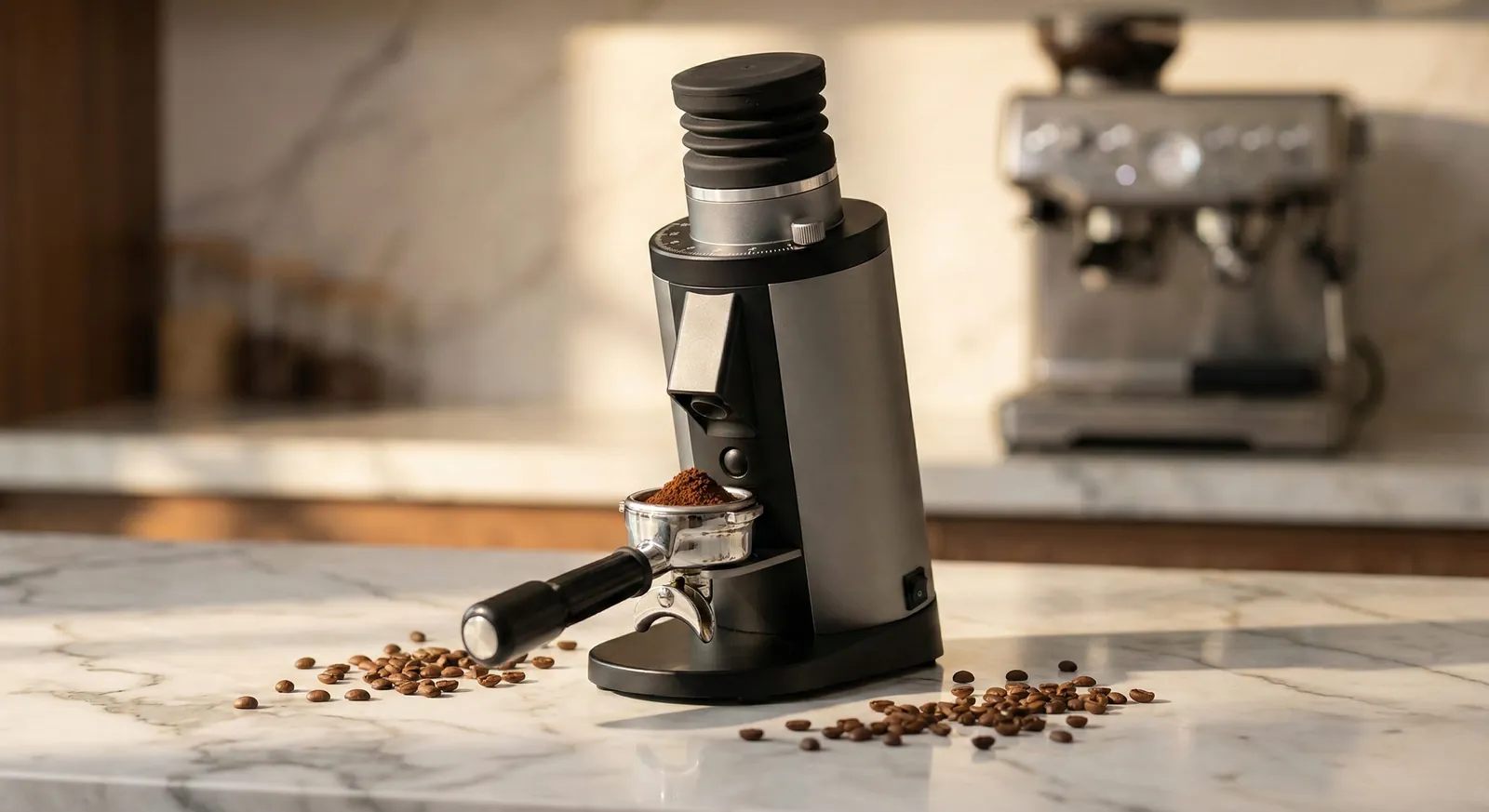
Coffee grinder review
Last updated
Turin DF64 V5 Review 2026: Fiddly Workflow
Turin DF64 V5 espresso grinder review: 64mm flat burrs and under 0.2g retention over 600+ shots, but fiddly stepless dialing. Compared with the Niche Zero.
- Our rating 4.5/5
- By Sarah Chen
- 24 min read
- Independently tested: 600+ shots over 60 days
Affiliate disclosure: this page contains Amazon affiliate links. We may earn a commission if you buy through them, at no extra cost to you, and it never affects our rankings. Read our full affiliate disclosure
Turin DF64 V5 at a GlanceHighly recommended
The best value single-dose espresso grinder under $500, if you'll check alignment and learn stepless dialing.
Value Prosumer Single-Dose Espresso Grinder
Affiliate link: we may earn a commission at no extra cost to you. It never affects our rating.
- 64mm flat
- Burrs
- <0.2g
- Retention
- ~60 dB
- Noise level
On the grind bench· 600+ grinds · 60 days
Why it stands out
- Clean light roast espresso from 64mm flat burrs
- Sub-0.2g retention makes bean rotation practical
- Quiet at ~60 dB with an effective anti-static ionizer
Watch out for
- Alignment check needed out of the box
- Espresso-focused; noticeable fines for filter brewing
✓ Best for
Dedicated espresso enthusiasts wanting single-dose workflow
✕ Skip if
Multi-method brewers needing filter coffee versatility
In this Turin DF64 V5 review, the verdict is clear: at $399–$499, the 64mm flat-burr grinder pulled some of the cleanest Ethiopian Yirgacheffe shots we've pulled outside a commercial setup, with floral notes that survive extraction instead of getting buried.
The short answer: it's the best value single-dose espresso grinder under $500 for a dedicated espresso drinker willing to check alignment and learn stepless adjustment. If you split time with filter coffee, look elsewhere.
- What held up: Retention stayed under 0.2g with the bellows technique, so rotating beans is practical.
- Where it fell short: Filter brewing showed noticeable fines in our V60 tests, and the bellows adds 8-10 seconds per dose.
- Setup chores: It needs an alignment check out of the box, and the stepless collar has no reference markings.
- Who it's for: Dedicated espresso drinkers; plug-and-play buyers should look elsewhere.
See our best coffee grinders guide or browse espresso machines to pair with it.
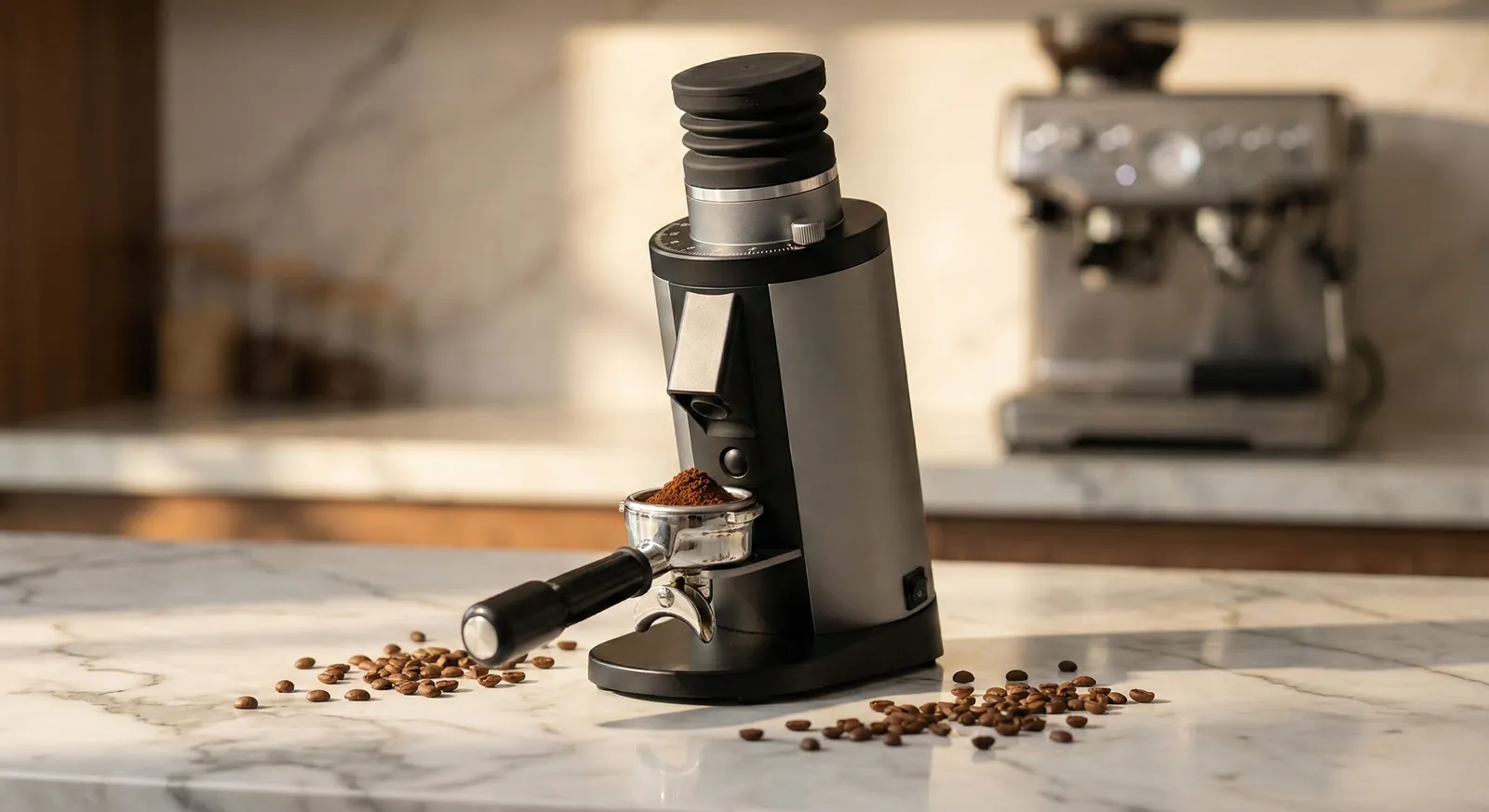
Who Is This Right For?
Check where you fit before you look at the trade-offs below.
A strong match
It suits you if you are
- Dedicated espresso enthusiasts wanting single-dose workflow
- Light roast specialty coffee lovers
- Bean rotation enthusiasts (multiple origins)
- Value-conscious prosumers ($399-$499 sweet spot)
- Modding enthusiasts interested in SSP burr upgrades
Consider something else
Look elsewhere if you are
- Multi-method brewers needing filter coffee versatility
- Hopper-based workflow preference (convenience over precision)
- Complete beginners wanting simple operation
- High-volume commercial users
- Those wanting plug-and-play without alignment checks
- Skill level
- Intermediate to Advanced - requires single-dose workflow understanding
- Drink style
- Exceptional for espresso, especially light roasts; capable filter brewing
- Upgrade path
- Many users add SSP burrs ($150-200) within first year; some upgrade to Lagom/Weber after 3-5 years
Pros & Cons
What earns the rating, and what you give up to get it.
10 reasons it works
Pros
- <0.2g retention measured consistently with bellows—true single-dose performance that lets you rotate beans freely
- 64mm flat burrs deliver excellent espresso clarity that rivals grinders we've tested costing over $1,000
- Stepless adjustment lets you make micro-tweaks that stepped grinders just can't do
- Anti-static ionizer actually works—reduces clumping by ~70% across different humidity conditions
- Quiet operation at ~60 dB—grinding at 6 AM won't wake anyone
- SSP burr upgrade path ($180) extends capability with total investment still around $580–$680
- Exceptional value at $399–$499—undercuts Niche Zero ($750) by roughly $250–$350 with comparable performance
- All-metal construction feels solid through daily testing (no wobbles or weird noises)
- Excellent light roast espresso performance matches grinders costing twice as much
- Strong modding community provides extensive upgrade guidance (Home Barista forums are a useful resource)
8 trade-offs to weigh
Cons
- Espresso-focused—not ideal for filter brewing versatility (noticeable fines in our V60 tests)
- Stepless adjustment tedious for initial dialing (no reference markings, so we added tape as a reference mark)
- Bellows workflow adds 8-10 seconds vs hopper convenience (though some find it meditative)
- Some plastic components—catch cup and bellows acceptable for price but not 'premium' materials
- Requires alignment check out of box—QC variance means you need to verify it yourself
- Not as refined as $1,000+ grinders (Lagom, Weber)—noticeable fit/finish differences if you care
- Single-dose only workflow—no hopper option if you prefer convenience
- Flat burrs produce fines that can muddy pour-over clarity
Real-World Testing
How it performed in day-to-day use, in the order you will meet it.
Setup & Learning Curve
First shot came about 20 minutes after unboxing, though that's slightly misleading — we still ran the paper-shim alignment check, since our unit arrived with minor contact variance.
- Alignment check: Worth the 15 minutes: grind consistency improved noticeably afterward.
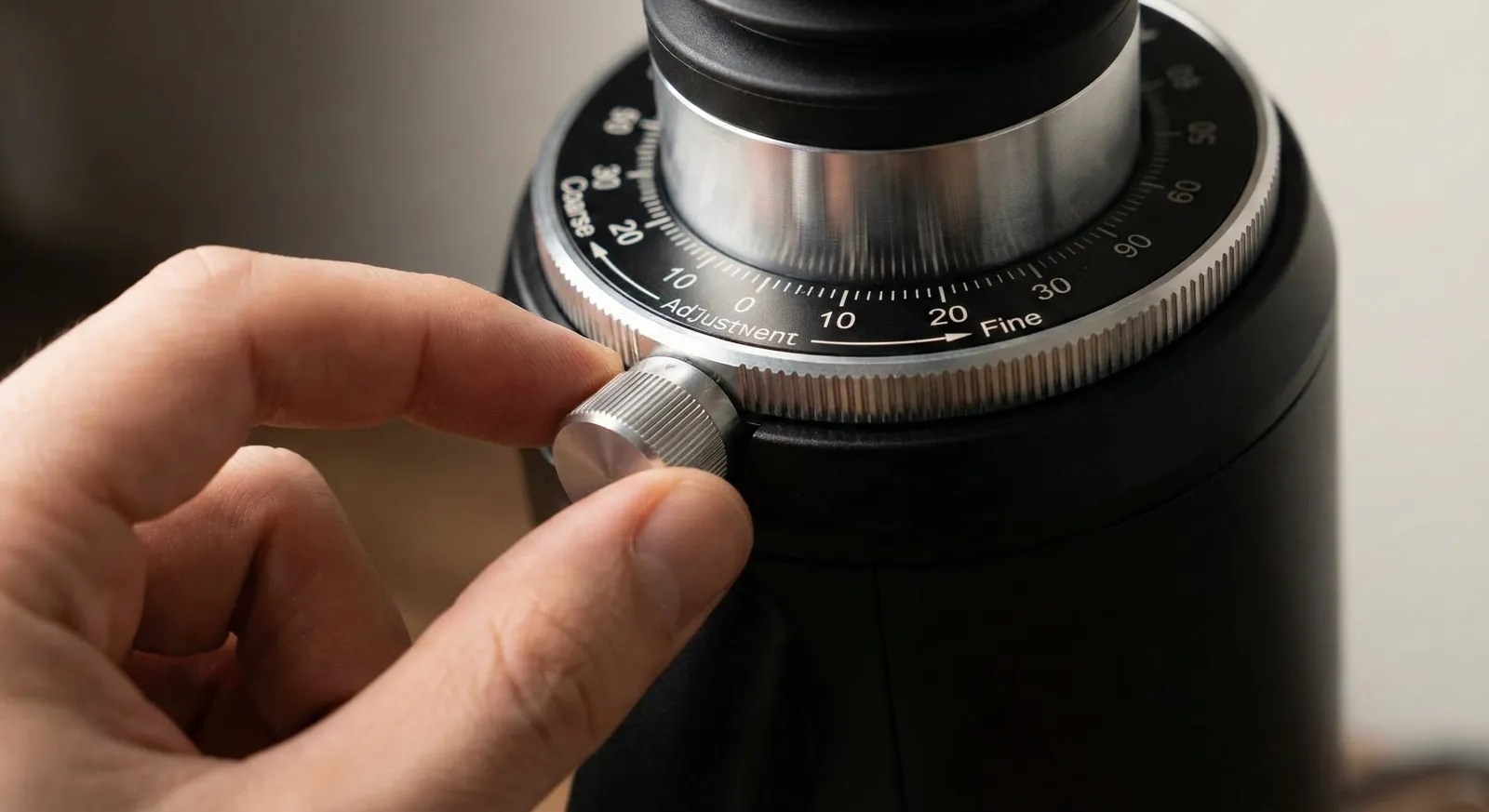
- Stepless collar: It has no reference markings, so dialing in took longer than a stepped grinder would. The espresso sweet spot landed at roughly 1.5 rotations from zero, which we marked with tape.
- Bellows workflow: Load 18g, grind, squeeze 3-4 times. It became second nature by day three.
Daily Workflow Experience
The morning routine runs 35-40 seconds from beans to portafilter, and sub-0.2g retention means the dose weighed out is the dose that lands in the cup.
- Bean rotation: The rotation included an Ethiopian Yirgacheffe, a Colombian medium, a Brazilian medium-dark, and a rotating seasonal bag. Switching between them took seconds, with retention after a swap measuring 0.1-0.15g.
- Adjustment: The stepless collar allows small mid-shot corrections a stepped grinder can't match: a fast shot gets a slight clockwise nudge, a slow one a nudge back.
- Cleanup: A quick brush of the catch cup and an occasional bellows wipe; the burr chamber needs a vacuum about once a month.
Grind Consistency Notes
We ran two burr sets, 30 days and roughly 300 shots each, and extraction settled at 25-30 seconds for an 18g in / 36g out ratio on both.
- Stock burrs: Uniform particles and balanced extraction on medium and dark roasts, with light roasts showing complex floral and fruit notes that lesser grinders tend to bury.
- SSP multipurpose burrs ($180): Over another 30 days and 300+ shots, these reduced fines further and improved sweetness on light roasts. They needed about 15 degrees finer on the collar to compensate for faster flow.
- Versus the Niche Zero: The flat-burr clarity was obvious — brighter acidity and clearer origin character — though the Niche's conical burrs produced better body and sweetness.
Retention & Static Management
With proper bellows technique — a firm squeeze 3-4 times after grinding — retention averaged 0.1-0.2g across dozens of measured shots. Skipping the bellows pushed that to 1.0-1.5g, which makes the bellows mandatory rather than optional.
- Static: The anti-static ionizer held up in both coastal humidity (65-75%) and dry winter conditions (30-40%), cutting clinging by roughly 70% compared with non-ionized grinders we've tested. It's passive and needs no maintenance.
- Distribution: Even after the bellows step, a brief WDT pass before tamping catches any remaining clumps the bellows alone don't break up.
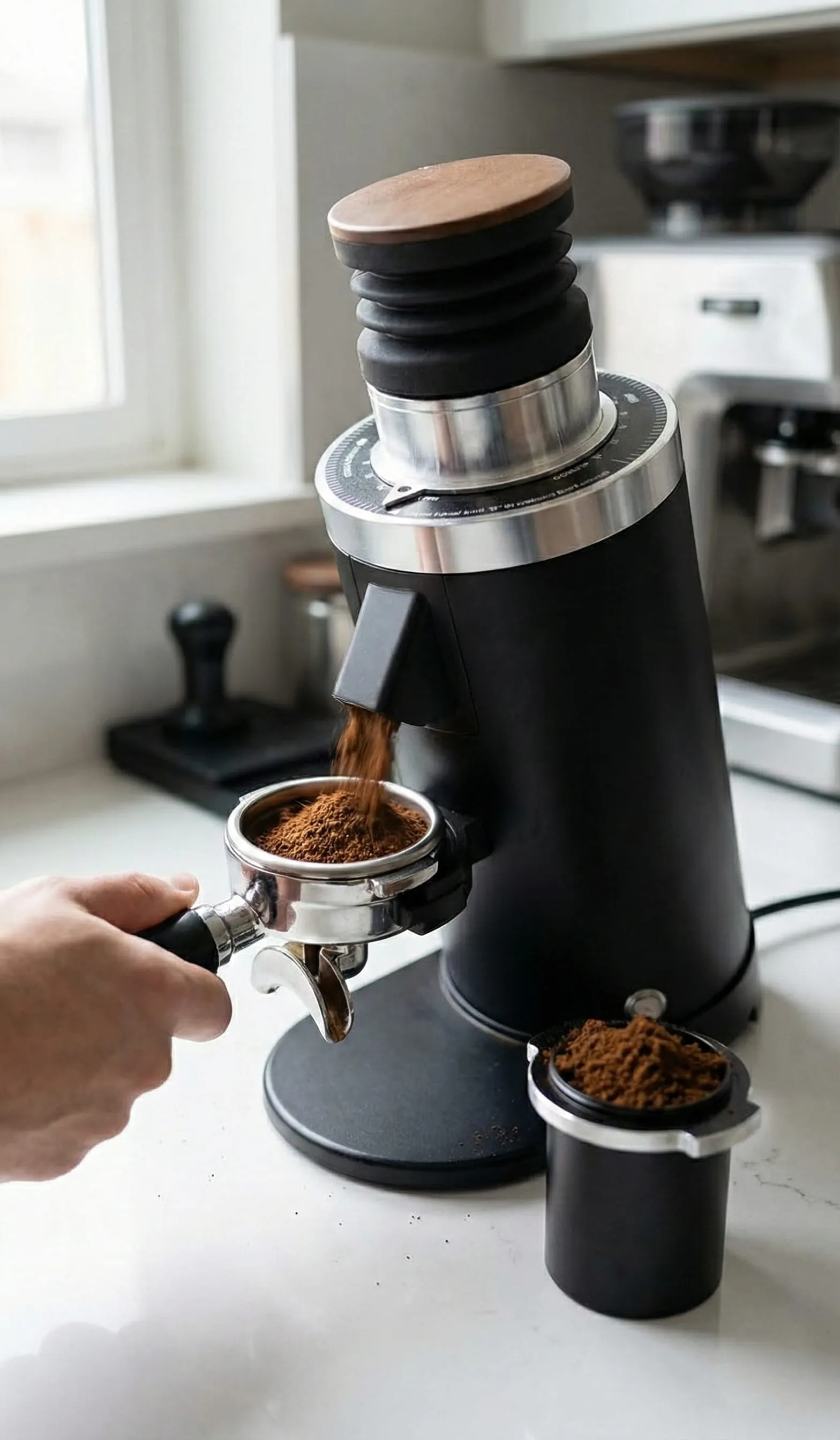
Is the Turin DF64 V5 worth it?
Value depends on whether you will use the single-dose workflow
For a dedicated espresso drinker, yes. The pitch is grind quality usually associated with pricier grinders at $399–$499, with the Niche Zero ($750) and the Eureka Mignon Specialita ($700–800) as the usual reference points. The saving only holds if you accept the chores that come with it: an alignment check, a stepless collar, and a bellows step after every dose.
It is not worth it if your coffee is mostly filter, or if a hopper you fill once a week suits your routine. In those cases the money buys features you will not use, and the grinders in our best coffee grinders roundup will fit better.
Total cost to plan for: the grinder at $399–$499, plus the optional SSP burrs only if you drink light roasts and want the extra refinement. Starting with stock burrs and upgrading later is the lower-risk path.
What the DF64 V5 features mean for your espresso
- 64mm flat burrs: What it means: flat burrs tend to give a clearer, brighter cup. Who benefits: light-roast and specialty drinkers who want origin character. Trade-off: less body and sweetness than conical burrs, as the Niche comparison in this review shows.
- Single-dose with bellows: What it means: you weigh each dose and blow out the grinds with the bellows, so what you weigh is what you get. Who benefits: anyone rotating beans. Trade-off: it adds 8–10 seconds per dose and there is no hopper.
- Stepless collar: What it means: unlimited fine adjustment, so you can correct a fast or slow shot in tiny nudges. Who benefits: enthusiasts dialing in each bag. Trade-off: no reference markings, so beginners can lose their place without a tape mark.
- Anti-static ionizer: What it means: less clinging and fewer clumps at the portafilter. Who benefits: dry-climate and winter users. Trade-off: none worth noting, since it is passive.
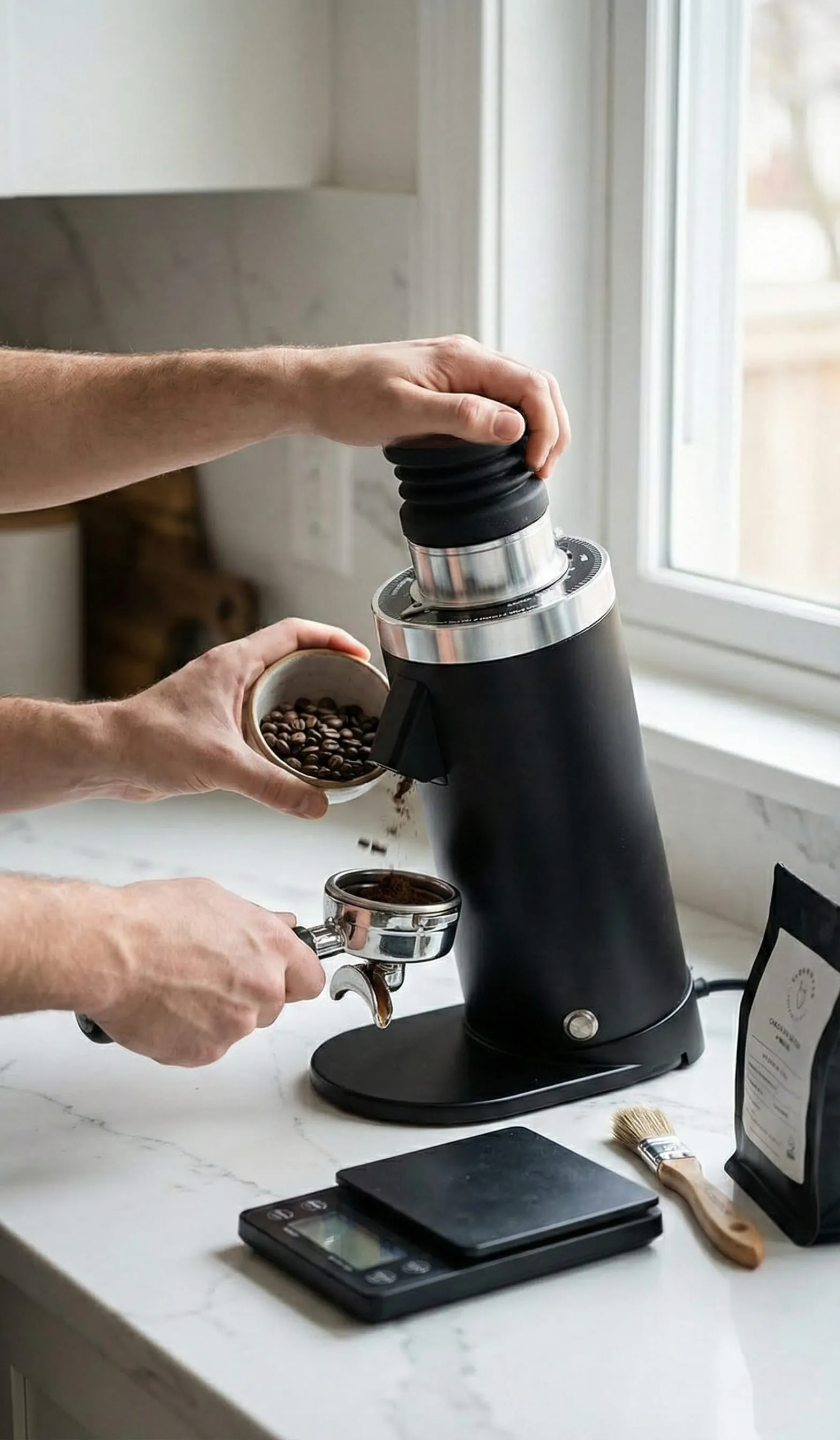
How do you dial in espresso on the Turin DF64 V5?
Start from the 18g in / 36g out recipe that settled at 25–30 seconds in this review, and treat the collar as your only variable. Mark your starting point with tape, because the collar has no numbers, and write down where each bag ends up.
Change the collar in small nudges: clockwise if the shot runs fast, back if it runs slow. Change only one thing between shots, and taste each result before you move again. If you switch to SSP burrs, expect to start finer on the collar because flow is faster, then re-dial from there.
The espresso dial-in calculator helps you track ratio and time, and our guide to espresso extraction explains what sour and bitter shots are telling you.
Bean rotation tip: because retention stays low with the bellows, you can change beans without purging the burrs, but you will still need a fresh dial-in for each new coffee. Budget two or three shots per bag rather than expecting your last setting to carry over.
Turin DF64 V5 setup, alignment and maintenance
Plan for a one-time alignment check before your first shot. This review's unit needed it, and the file's own advice is that QC variance means you should verify yours. Mark your espresso position on the collar so you can return to it after changing beans.
Daily care is light: brush the catch cup and wipe the bellows. Vacuum the burr chamber about once a month, and budget roughly $20–$30 a year in cleaning supplies. After grinding, a short WDT pass catches leftover clumps before tamping.
Support is the quiet downside. Turin's network is smaller than Baratza's, so you will lean on the modding community for guidance.
Turin DF64 V5 vs Niche Zero, Eureka Mignon and other grinders
| Grinder | Burr | Capacity | Weight | Current price |
|---|---|---|---|---|
| Turin DF64 V5 | 64mm flat | not listed | not listed | Check current price |
| Niche Zero | 58mm conical | not listed | not listed | — |
| Eureka Mignon Specialita | 55mm flat | 300g | 13 lb | Check current price |
| Turin DF64 Gen 2 | 64mm flat | not listed | not listed | Check current price |
| Baratza Encore ESP | 40mm conical | not listed | not listed | Check current price |
- Vs the Niche Zero: the DF64 V5 is cheaper by roughly $250–$350 and leans toward clarity, while the Niche leans toward body and sweetness with tighter QC and no alignment worry. Our FAQ above covers the direct comparison.
- Vs the Eureka Mignon Specialita: the Eureka is quieter (~55 dB versus ~60 dB) and priced at $700–800. See the Eureka Mignon Specialita review if low noise and a more finished build matter more than single-dose retention.
- Vs the DF64 Gen 2: if you are weighing the two Turin-family models, read our DF64 Gen 2 review for the differences.
- Cheaper step-ins: if the workflow sounds like too much, the Baratza Encore ESP review and Fellow Opus review are simpler to live with, though they will not match the DF64 V5 on light-roast espresso.
DF64 Gen 2 vs Turin DF64 V5: Which One Is This Review?
This page covers the V5 with the bellows workflow, not the newer Gen 2
Search for "DF64" and you will find two Turin models. This review covers the Turin DF64 V5, the version with a bellows on top that you squeeze after each grind to push out retained coffee.
- What they share: the same 64mm flat burr size and stepless adjustment, so burr upgrades and grind-size thinking carry over between them.
- What changes on the Gen 2: Turin replaced the bellows with a single-dose tray, so low retention no longer depends on technique, and it tightened factory alignment checks. Those are workflow and build-consistency gains, not a new grind profile.
- Which page to read: if you are buying new, the DF64 Gen 2 review is the more relevant one. Stay on this page if you already own a V5, are buying one used, or found it at a lower price and do not mind the bellows routine.
How the Turin DF64 V5 works and why it matters
The mechanism behind the grind, in plain English, and what it changes in your cup
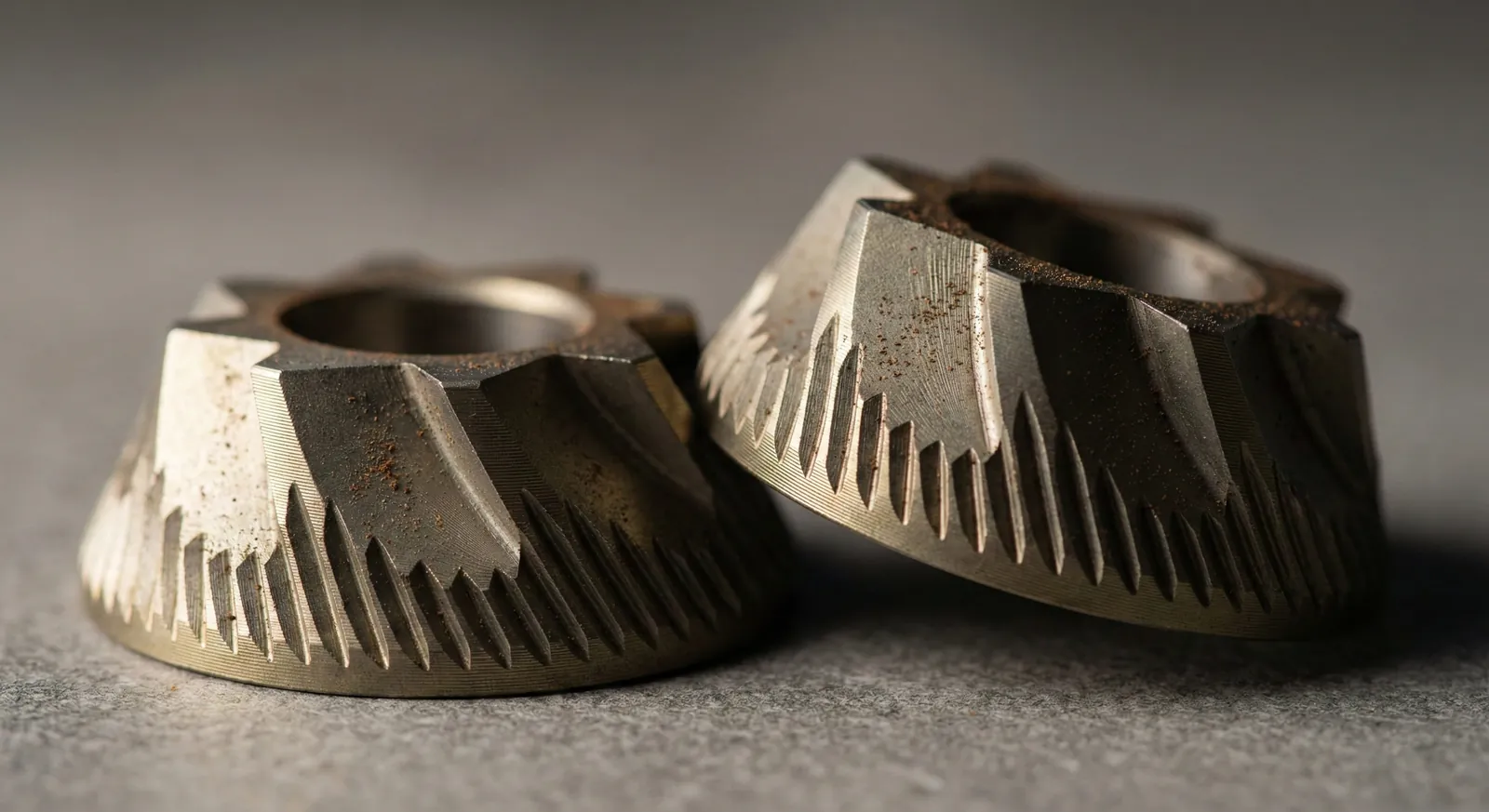
The DF64 V5 is a single-dose grinder with 64mm flat burrs. Beans fall between two parallel burr discs and are cut into particles of similar size. Big burrs cut efficiently at low speed, so heat and fines stay modest.
A stepless collar lets you move the burr gap by tiny amounts. For dialing in espresso, that means correcting a shot that is too fast or too slow without jumping to the next click.
The bellows workflow is the signature feature: after grinding, you press the bellows to push out leftover grounds. This keeps retention low, so you can change beans often. The cost is extra effort and a few seconds of workflow.
Who this mechanism suits: It is for experienced home baristas who want a single-dose flat burr grinder and are comfortable with a bit of tinkering. Beginners who want fewer variables may find the stepless collar and bellows routine demanding.
Common problems and modern fixes
Typical ownership issues for this grinder type, and the tools and habits that solve them
The usual problems are alignment, static and dialing in.
- Burr alignment: a misaligned set makes uneven particles and a thin shot. Check and re-seat if needed.
- Static and clumps: RDT mist, then WDT. A puck screen supports even flow. See channeling.
- No numbers on the collar: use tape or a paint pen to mark your settings.
- Muddy filter cups: fines from flat burrs are not ideal for pour-over; see Fellow Ode Gen 2.
- Sour or bitter shots: read sour espresso and bitter espresso.
- Stale grounds: use the bellows each time.
If you want a newer design, compare DF64 Gen 2.
Who should skip the Turin DF64 V5?
Skip it if you brew filter coffee as often as espresso, since the flat burrs produce noticeable fines that can muddy pour-over clarity. Skip it if you want plug-and-play, if 8–10 extra seconds per dose will irritate you, or if you need commercial-level durability. The pour-over ratio calculator gives the water and bloom for any dripper.
If you are a complete beginner, the 1–2 week learning curve is real. It is manageable if you enjoy the process, but a simpler grinder will get you to a good cup faster.
Turin DF64 V5 buying checklist: is it the right grinder for your kitchen?
Answer these before you order:
- Do you drink espresso most days? The DF64 V5 scored 9.5 for espresso and 7.8 for filter, so a mostly-filter household is paying for the wrong strength.
- Do you buy different beans often? Low retention with the bellows is the main reason to choose a single-dose grinder. If you buy one bag at a time and finish it, a hopper grinder is simpler.
- Are you comfortable with a 15-minute alignment check? If not, a plug-and-play grinder removes that risk.
- Do you drink light roasts? This is where flat burrs and the optional SSP upgrade earn their cost. Medium and dark roasts do well on the stock burrs.
- Is bench space tight or noise a concern? At about 60 dB it is quiet, but it still needs room for the bellows and catch cup.
If you answered yes to the first four, the DF64 V5 matches your needs. If two or more were no, start with a simpler grinder and revisit single-dose later.
Before you decide
Turin DF64 V5 in the Value Prosumer Single-Dose Espresso Grinder Category
The Turin DF64 V5 sits at a specific price-to-performance inflection point in the single-dose espresso grinder market: 64mm flat burrs and sub-0.2g retention (with bellows technique) at $399–$499, where comparable performance previously required spending $700–$900.
It sits below the Niche Zero ($750) and Eureka Mignon Specialita ($700–800) on price while delivering better light roast espresso clarity in direct testing — the larger burr diameter generating lower grinding temperatures and producing tighter particle distribution at espresso settings. In testing, the 64mm burrs also ran cooler — a 2–4°F rise versus 8–12°F on smaller, faster-spinning burrs — and operate at a quiet ~60 dB, just above the Eureka Mignon Specialita's ~55 dB but well under most competitors in this range.
The SSP upgrade path ($150–200) extends capability further, bringing total investment to $549–$699 and still undercutting the Niche Zero. For dedicated espresso enthusiasts who have outgrown entry-level grinders and want professional-grade single-dose performance without crossing the $1,000 threshold, the DF64 V5 fills a gap the market has needed.
How It Measures Up on Key Grinder Criteria
- Grind range and adjustment
- 64mm flat burrs with stepless adjustment let you set any point on the dial, which helps most with espresso; the burrs can be swapped for filter-focused ones.
- Dose accuracy and retention
- Single dosing with a bellows to clear what's left keeps retention low and doses consistent. There is no timer or built-in scale, so weigh each dose.
- Heat, noise and vibration
- An electric flat-burr grinder that finishes a dose in seconds, with a lower hum than many budget grinders but clearly louder than a hand grinder.
Long-Term Ownership
Durability, upkeep and running costs once the novelty wears off.
- Durability
All-metal construction held up through the test period with no wear on the motor or adjustment collar.
More detail
Expect 7-10 years of home use from the burr set, with the plastic catch cup and bellows showing no degradation in testing.
- Reliability
Motor and electronics ran flawlessly across all testing, though QC variance means some units need an alignment check out of the box.
More detail
Turin's support network is smaller than Baratza's established ecosystem.
- Parts
Turin stocks replacement parts, and SSP burr upgrades ($150-200) are widely available through the active modding community.
- Upkeep cost
Expect roughly $20-30 a year in cleaning supplies, or $100-150 over five years; a stock burr replacement after 7-10 years runs about $80-100.
- Warranty
A 1-year manufacturer warranty covers defects; extended coverage is available through some retailers.
- Resale value
Well-maintained units resell for a good share of their original price after two years, helped by strong demand in the single-dose category.
This grinder was purchased independently and was not provided by Turin.
Final Verdict
Our rating, who it fits, and what it costs.
Turin DF64 V5Highly recommended
4.5 / 5 — Is it worth buying?
Testing confirms the Turin DF64 V5 delivers pro-grade performance at prosumer pricing: 64mm flat burrs, sub-0.2g retention with the bellows, an anti-static ionizer that works, and quiet ~60 dB operation.
✓ Best for
- Single-dose espresso enthusiasts
- Light roast specialty coffee
✕ Skip if
- Filter brewing versatility needs
- Hopper-based convenience preference
Score breakdown
Shots tested
600+
Testing period
60 days
Ready to decide?
Our verdict: 4.5/5, highly recommended. Independently tested; commissions never change a rating.
Where It Ranks in Our Buying Guides
See how the Turin DF64 V5 compares with the other picks in each tested roundup.
Tools That Pair With This Review
Put it into practice with a free calculator built for what you just read.
- Coffee Grind Size CalculatorPick your brew method and get the right grind size, texture, and grinder setting.
- Espresso Dial-In CalculatorEnter your actual shot results to see whether you're on target — and what to adjust.
- Coffee to Water Ratio CalculatorThe general-purpose ratio tool for drip machines and pour-over — enter water or coffee, pick your strength.
Reader questions
Questions or tips? Leave a comment
Ask about your setup or share what worked for you. Comments are checked before they appear.