What Is Espresso Extraction? Yield, Ratio & Taste Explained
The science and practice of pulling great shots — brew ratio, grind size, channeling, under- and over-extraction explained by a former barista trainer who's tested 500+ machines
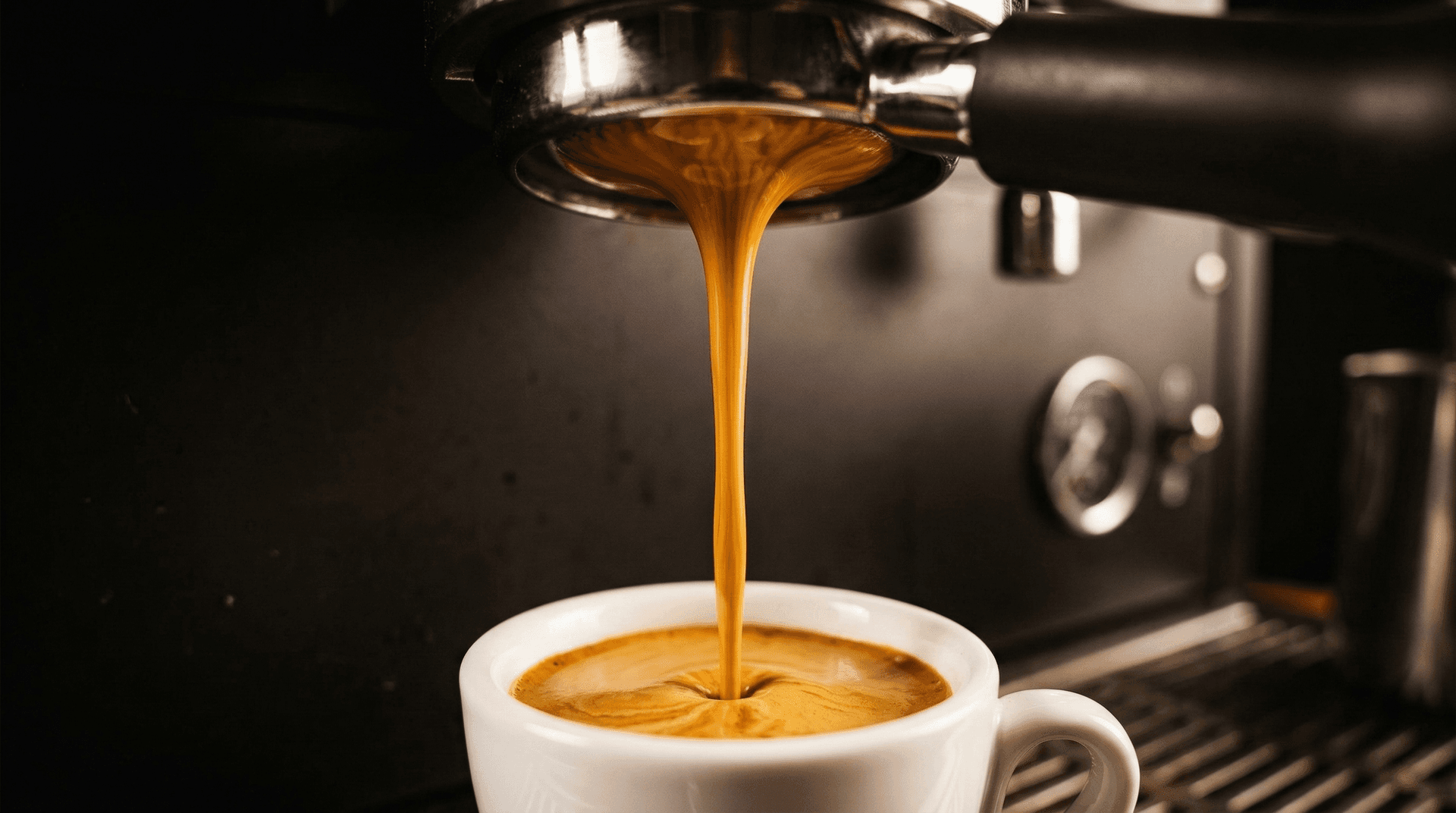
Espresso extraction is the process of dissolving soluble coffee compounds into water under pressure. That one sentence covers a lot of ground. In practice it means: hot water at 9 bars forces through a compacted puck of finely ground coffee, dissolving acids, sugars, lipids, and bitter compounds in a specific time-ordered sequence — and the quality of your shot depends almost entirely on how much of each you pull through.
I trained over 200 baristas across the UK and Ireland on extraction technique, and the pattern I saw every time was the same: most shot problems trace back to one of three things — grind size, distribution, or an incomplete understanding of the brew ratio. Once those click, everything else falls into place. This guide covers all three, plus channeling, pre-infusion, and a practical diagnosis framework you can use the next time a shot goes wrong.
Espresso Extraction at a Glance
Under-Extracted
- Taste: sour, sharp, thin
- Shot runs too fast (<20s)
- Fix: grind finer
Ideal Extraction
- Taste: balanced, sweet, round
- 25–32s at 1:2 ratio
- 18–22% extraction yield
Over-Extracted
- Taste: bitter, dry, harsh
- Shot runs too slow (>35s)
- Fix: grind coarser
What Espresso Extraction Actually Is
When you pull an espresso shot, water at 90–96°C is forced through a bed of compacted, finely ground coffee at approximately 9 bars of pressure. The water acts as a solvent, dissolving water-soluble compounds from the ground coffee into the liquid — acids and fruity esters first, then sweetness and body compounds, then bitter and astringent ones last.
This sequential extraction is why timing and ratio matter so much. Pull the shot for 15 seconds and you capture mostly acids — sour, sharp, thin. Pull it for 50 seconds and you've dragged out every bitter compound available — harsh, dry, unpleasant. The 25–32 second window at a 1:2 ratio is designed to catch the sweet spot: enough sweetness and body, minimal bitterness, controlled acidity.
In over 15 years of testing espresso equipment — from entry-level De'Longhi machines to commercial La Marzocco Lineas — I've pulled this shot at thousands of different settings. The extraction window is consistent across machines: the variable is always the preparation that happens before pressure engages, not the pressure itself.
Extraction Yield and What It Measures
Extraction yield is the percentage of the dry coffee mass that dissolved into your cup. If you use 18g of grounds and 3.24g of those grounds ended up dissolved in the liquid, your extraction yield is 18%. Specialty coffee targets 18–22% as the range where most espresso tastes balanced.
You can measure yield precisely with a refractometer — a tool that reads TDS (total dissolved solids) as a percentage of the liquid. The calculation is: Extraction Yield = (TDS × Beverage Weight) / Dose Weight. A refractometer reading of 10% TDS on a 36g shot pulled from 18g of coffee gives you a 20% extraction yield — right in the middle of the ideal window.
Most home baristas don't need a refractometer. Your palate is measuring the same thing — sour = low yield, bitter = high yield, balanced = ideal. Where TDS measurement earns its keep is when you're dialling in a new bean origin and want to replicate a recipe reliably across different brew days, or when you're comparing machines in a testing environment.
Under-Extraction: Signs, Causes, and Fixes
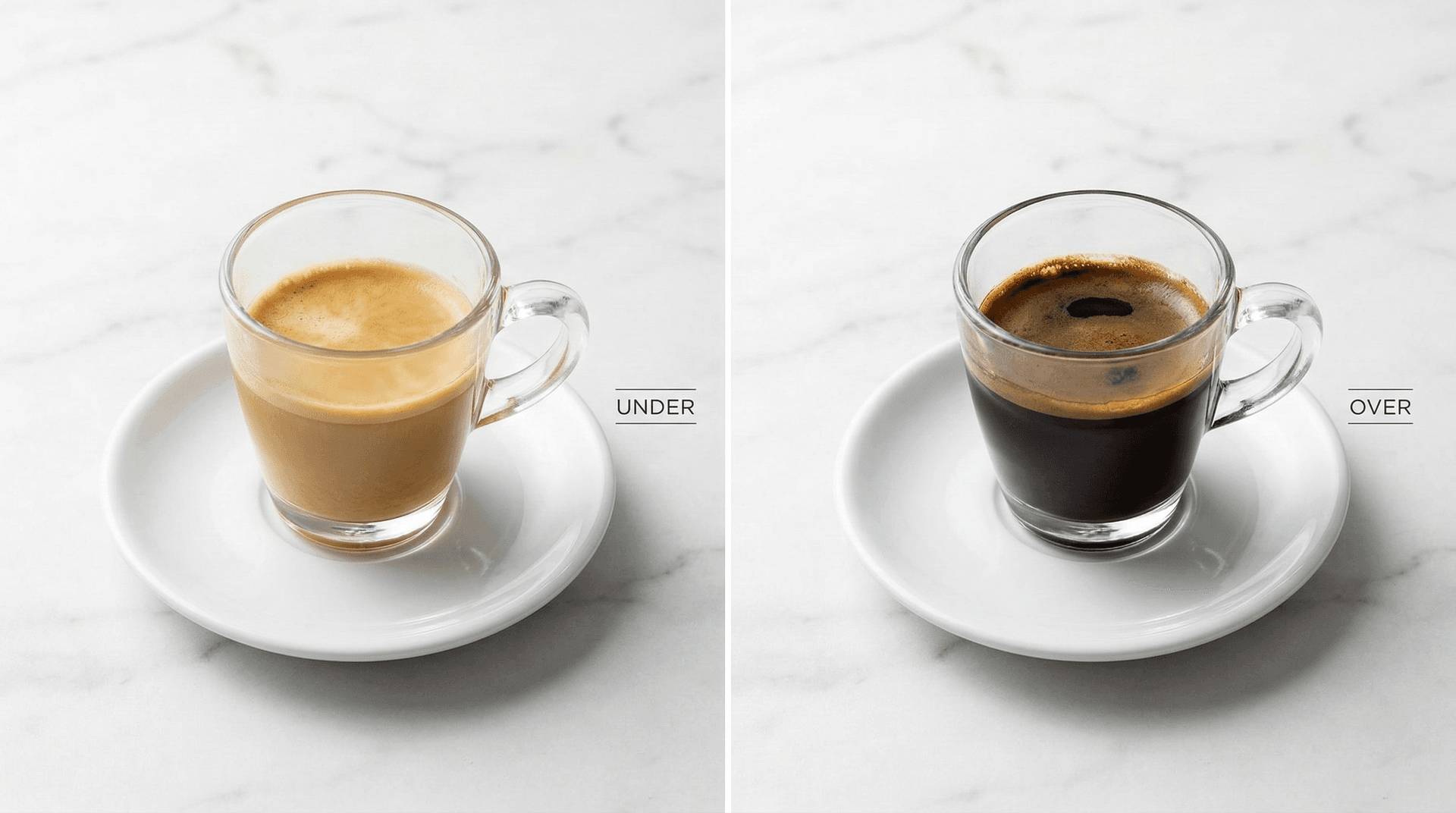
Under-extracted espresso is what you get when water moves through the puck too quickly, dissolving only the early-extraction acids and missing the sweetness that comes after. It's the most common problem I see in home setups — and almost always a grind-size issue.
Signs of Under-Extraction
- →Taste: sharp sourness, vinegary acidity, thin mouthfeel, no lingering sweetness
- →Visual: blonde crema almost immediately, watery colour, fast shot time
- →Time: shot pulls in under 20 seconds at a 1:2 ratio
- →Puck: wet, sloppy puck after extraction — grounds absorbed water unevenly
Common Causes
- 1.Grind too coarse — the most common cause. Larger particles create less flow resistance, so water speeds through
- 2.Dose too low — not enough coffee in the basket creates a thin, low-resistance puck
- 3.Water temperature too low — cooler water extracts less efficiently across the board
- 4.Channeling — water bypassing large areas of the puck, effectively under-extracting those sections
- 5.Stale beans — coffee that has lost most of its CO2 compacts differently and may channel or extract unevenly
Over-Extraction: Signs, Causes, and Fixes
Over-extraction pulls too many compounds out of the grounds, including the harsh, astringent ones that develop late in the extraction process. The result is a coffee that finishes dry, bitter, and unpleasant — it doesn't linger sweetly, it coats your palate in a way that makes you want to rinse your mouth.
Signs of Over-Extraction
- →Taste: pronounced bitterness, dry astringency, hollow body, harsh finish
- →Visual: very dark shot, crema that collapses quickly or tastes harsh on its own
- →Time: shot drips slowly and runs past 35 seconds
- →Puck: very dry, cracked puck — the coffee was squeezed of nearly all moisture
Common Causes
- 1.Grind too fine — excessive resistance slows flow, extending extraction time
- 2.Water temperature too high — above 96°C extracts bitter compounds aggressively
- 3.Dose too low for a fine grind — less coffee in the basket with a fine grind creates extreme resistance
- 4.Stale, dark roast beans ground too fine — dark roasts extract more aggressively and need a coarser grind than beginners expect
The Six Variables That Control Extraction
Every extraction problem traces back to at least one of these variables. I list them here in rough order of influence — the ones at the top have the most impact per adjustment unit. Mastering grind size alone will resolve 70% of shot problems.
1. Grind Size
The single most influential variable. Finer grind = more resistance = slower flow = longer extraction = more dissolved compounds. Coarser grind = less resistance = faster flow = shorter extraction = fewer dissolved compounds. A quality burr grinder is not a luxury — it's the most impactful upgrade you can make to your espresso setup. Blade grinders produce irregular particles that create channeling and unpredictable extraction regardless of any other setting. See our guide on how to choose a burr grinder if you're still using a blade.
2. Dose (Coffee Weight)
The weight of dry coffee grounds in the portafilter basket. Standard double baskets are designed for 17–21g depending on the manufacturer. A larger dose creates a denser, thicker puck with greater resistance; a smaller dose creates less resistance. Dose also directly sets up your brew ratio — changing dose without adjusting yield changes the ratio and therefore the extraction balance. For most 58mm double baskets, 18g is a reliable starting point.
3. Yield (Liquid Weight)
The weight of liquid espresso in the cup. Combined with dose, yield defines your brew ratio. Increasing yield (more water through the same dose) extracts more total compounds and dilutes concentration; decreasing yield does the opposite. A scale under your cup is the most practical tool for controlling yield consistently — shot glasses and volumetric presets are far less accurate than weight-based targets.
4. Water Temperature
The standard window is 90–96°C (194–205°F). Temperature affects extraction efficiency: higher temperatures extract more aggressively, favouring darker roasts where you want efficiency but not excess time. Lower temperatures extract more selectively, preserving delicate aromatics in light roasts. Machines with PID controllers let you dial in temperature to ±1°C — a feature that matters most when working with single-origin light roasts. Budget machines without PID often run 97–99°C, which tends to push extraction into bitter territory.
5. Time
Extraction time is an output, not an input — you don't set it directly. Time is the result of grind size, dose, distribution, and tamping. A target time of 25–32 seconds for a 1:2 double shot tells you whether your other variables are dialled correctly. If you're hitting 25–32 seconds and the shot tastes sour, the problem is channeling or grind uniformity, not time itself. Chase taste, not the clock — time is a diagnostic, not a goal.
6. Pressure
Standard espresso pressure is 9 bars. Most commercial machines are factory-set to this; many prosumer machines (Breville Barista Express, Rancilio Silvia Pro, Gaggia Classic Pro) have adjustable OPV (over-pressure valves) that let you dial in 8–9 bars precisely. Higher pressure extracts more quickly and produces more crema; lower pressure (7–8 bars) can round out harsh edges on certain beans. Variable pressure profiling — ramping pressure up and down during extraction — is a feature of high-end machines that allows even finer extraction control but is not necessary for consistently great espresso.
Brew Ratio: The Framework That Makes Sense of It All
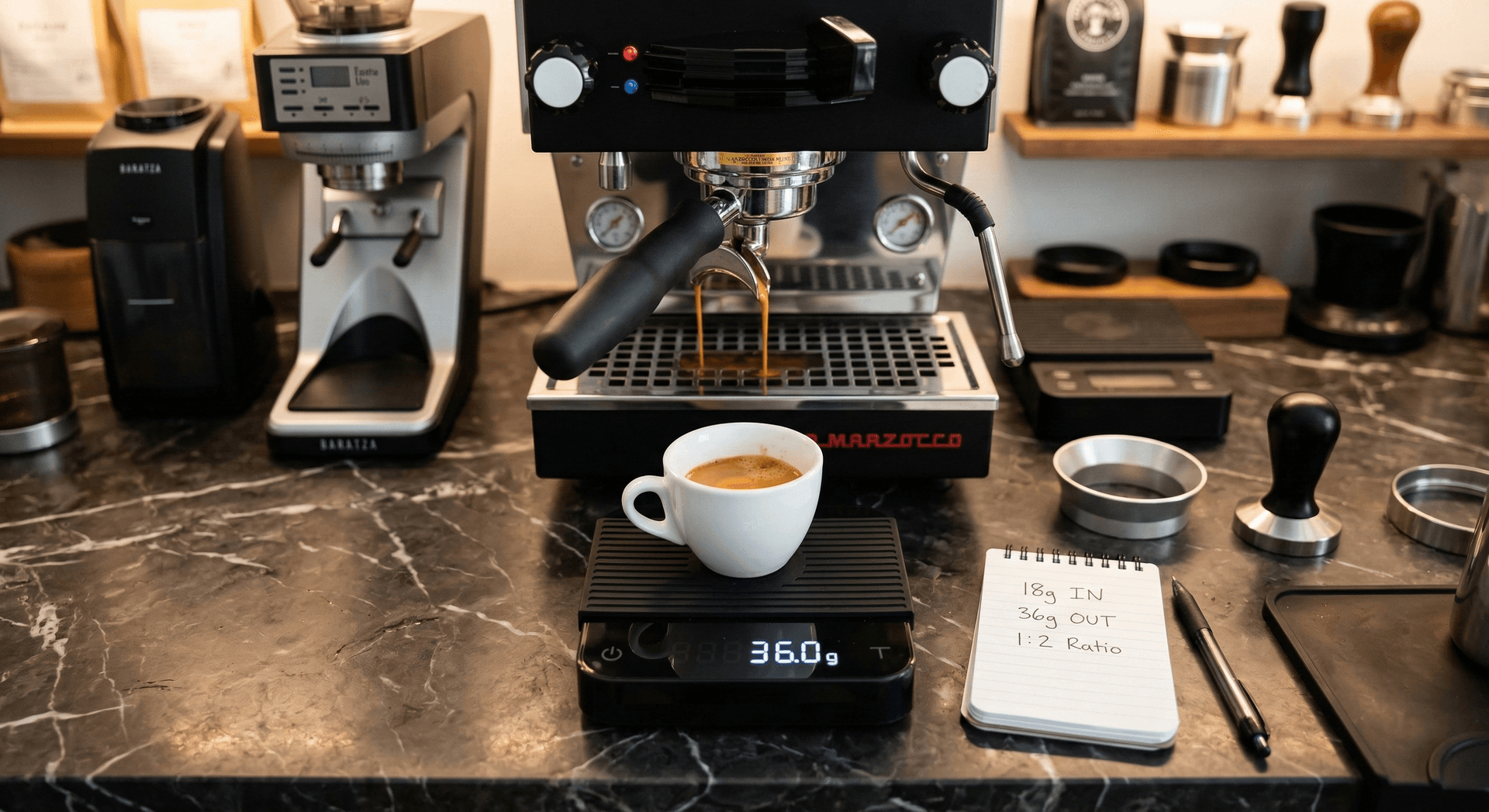
Brew ratio is simply the relationship between how much dry coffee you use (dose) and how much liquid espresso you produce (yield). It's expressed as dose:yield. A 1:2 ratio means 18g of coffee produces 36g of liquid. A 1:1.5 ristretto ratio means 18g in, 27g out.
The reason the ratio framework is so useful is that it separates concentration (how strong the coffee tastes) from balance (whether the extraction is correct). Two shots with identical 1:2 ratios but different grind sizes can taste completely different — one balanced, one sour — because the grind affects how compounds extract, not just how much water passes through.
| Shot Type | Dose | Yield | Ratio | Character |
|---|---|---|---|---|
| Ristretto | 18g | 20–22g | 1:1.1–1:1.2 | Sweet, syrupy, concentrated, no bitterness |
| Standard Double | 18g | 34–40g | 1:2 | Balanced, full-bodied, slight sweet finish |
| Lungo | 18g | 54–60g | 1:3+ | Milder, more bitter, larger volume |
| Americano base | 18g | 36g espresso | 1:2 then diluted | Balanced espresso extended with hot water |
I use 18g / 36g as my default across all testing because it's the easiest number to work with and produces results that translate well across origins. For beans with pronounced brightness (Ethiopian naturals, Kenyan washed) I sometimes tighten to 18g / 32g to reduce acidity. For very dark Italian-style blends, I extend to 18g / 40g to dilute bitterness. These are small adjustments — never more than 8g off the base target.
Puck Preparation and Distribution
Even a perfectly dialled grind size delivers inconsistent results if the coffee isn't distributed evenly in the basket before tamping. Uneven distribution creates density differences in the puck — and water always takes the path of least resistance.
Distribution Methods
- The Stockfleth move (finger levelling): Resting your index finger on the rim of the basket and rotating it in a circular motion while the portafilter tilts redistributes grounds toward the centre. Quick, effective, no extra tools needed.
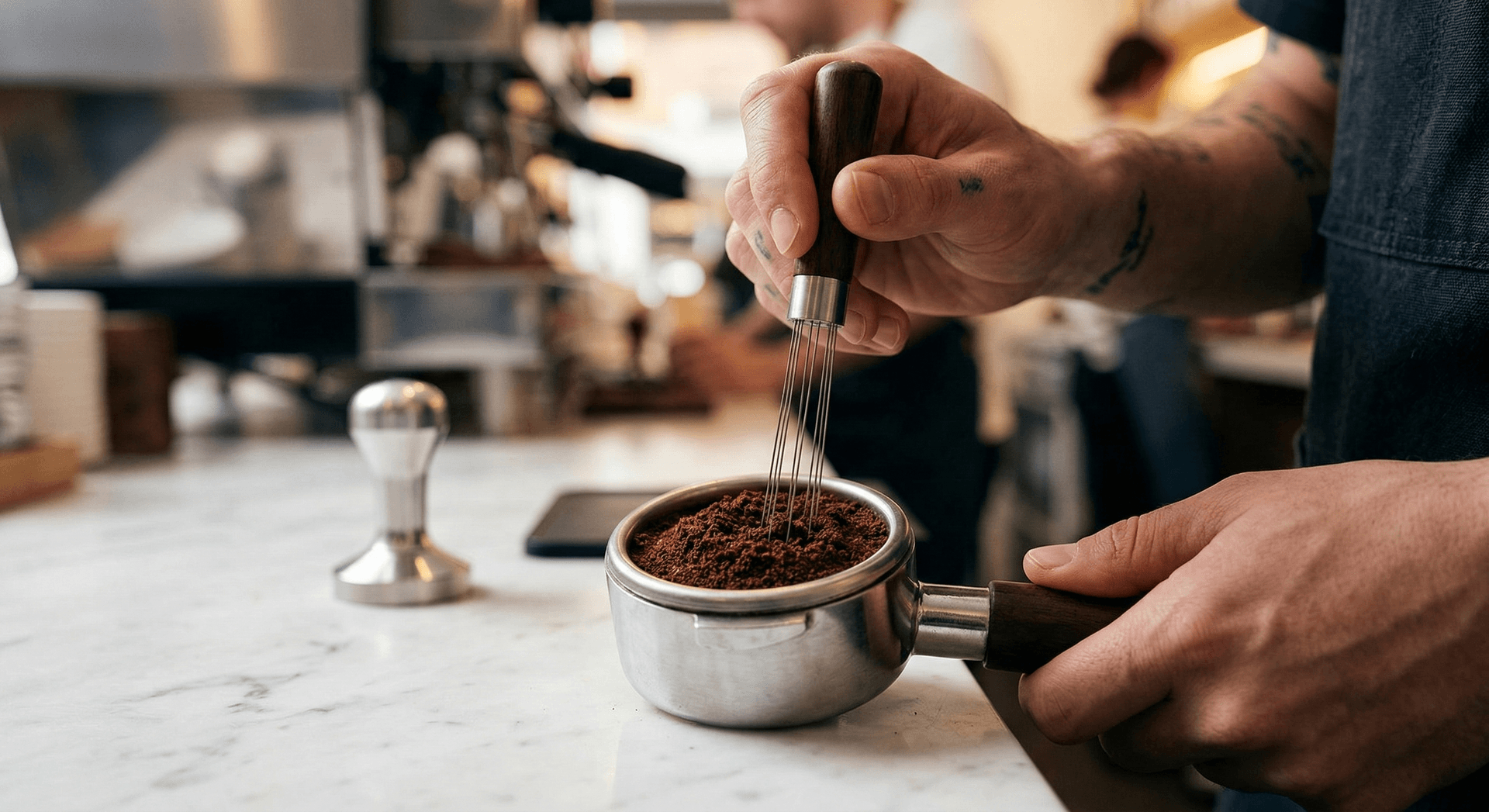
- WDT (Weiss Distribution Technique): Stirring grounds with a thin needle or WDT tool breaks up clumps from the grinder chute. Particularly effective for grinders with alignment issues. Takes 5–10 seconds and meaningfully reduces channeling — I started recommending this to barista trainees about 8 years ago and it remains the best simple upgrade for most home setups.
- Dosing funnel + distribution tool: A puck screen or OCD-style distribution tool set to your basket depth spins and levels grounds consistently. More expensive, less variable than manual methods.
Tamping
Tamping compresses the distributed grounds into a level, dense puck. The goal is two things: level surface (so water encounters equal resistance across the entire puck) and firm compression (to prevent the puck from moving under pressure). Tamping pressure of approximately 15–20kg (30–45 lbs) is enough to achieve this — harder tamping doesn't meaningfully improve extraction and risks wrist strain over hundreds of shots.
The most critical element of tamping is levelness, not pressure. An angled tamp creates a thinner section on one side — water channels straight through it every time. Use a calibrated tamper that fits your basket diameter exactly (58mm for most home machines) and develop a consistent, perpendicular press. A tamping mat that holds the portafilter at 90° is worth buying.
If you want to understand exactly how much pressure matters — including calibration methods and why most guides overstate its importance — our espresso tamping pressure guide goes into that in full.
Channeling: The Silent Shot Killer
Channeling is when water bores through one or more narrow paths in the puck rather than saturating it uniformly. The channel extracts aggressively (the narrow stream is at high velocity), while the rest of the puck barely extracts at all. The result: simultaneous over-extraction in the channel and under-extraction everywhere else. The shot tastes like both — sour and bitter at the same time — which is genuinely confusing when you first experience it.
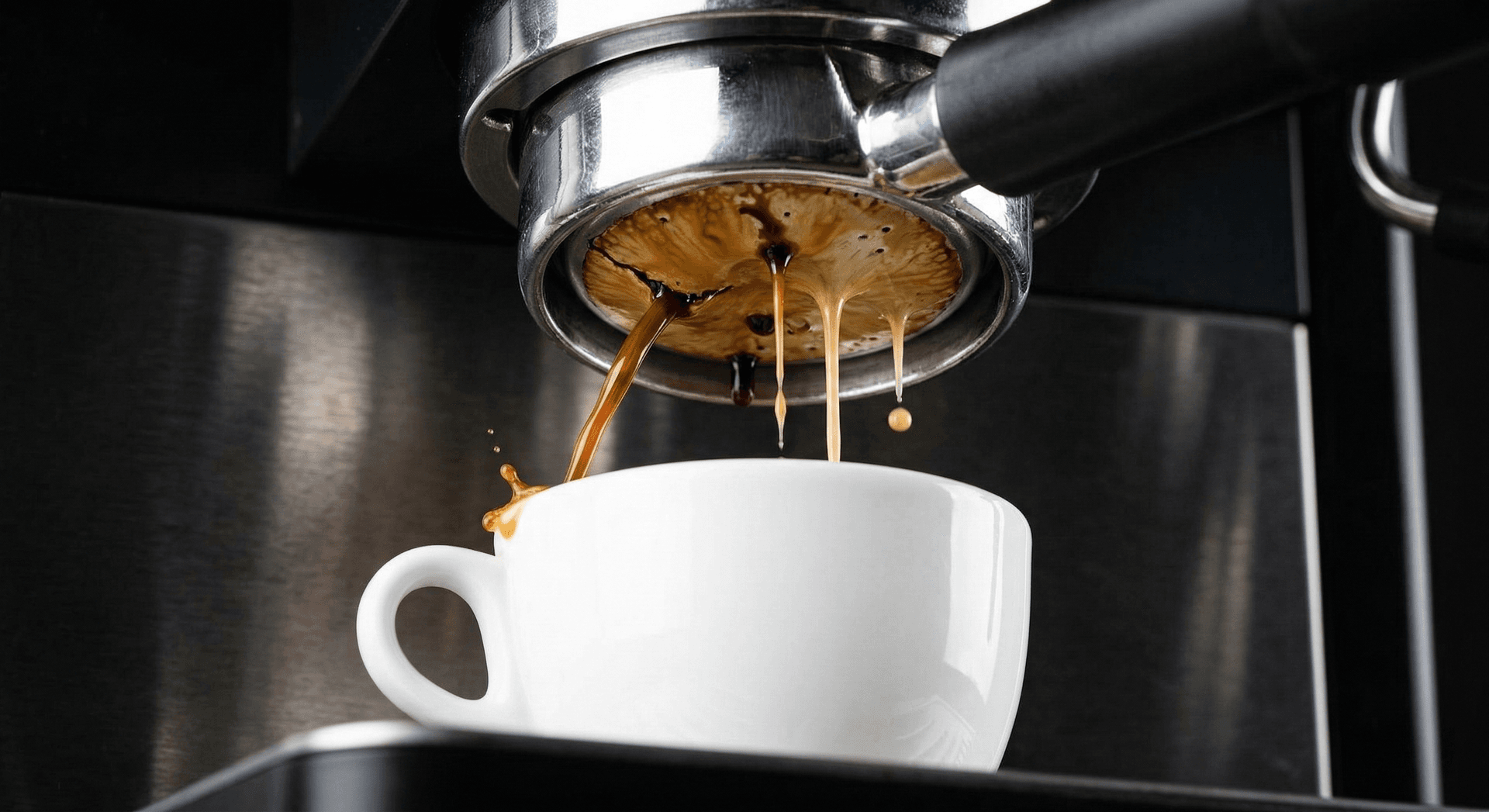
A bottomless (naked) portafilter is the most effective diagnostic tool for channeling I know. With the basket visible from below, you can see the extraction in real time. A perfect shot shows a single symmetrical curtain of espresso forming from the centre and spreading evenly. Channeling shows as one or more spurts or jets that appear on one side before the others, or streams that detach and reattach.
What Causes Channeling
- →Uneven distribution before tamping — clumps create density variations
- →Angled or uneven tamp — creates a thin zone on one side
- →Very light roasts with high CO2 — grounds can be porous and fragile, creating cracks under pressure
- →Worn or damaged basket — small holes or scratches create preferred flow paths
- →Overfilling the basket — too much coffee with no headspace gets displaced by the group head screen
Pre-Infusion and Its Effect on Extraction
Pre-infusion is a low-pressure soak (typically 1–4 bars) applied to the coffee puck for 5–10 seconds before full extraction pressure engages. The idea is to slowly saturate dry, CO2-rich grounds before the full 9-bar pressure hit, giving them time to expand, release gas, and seal any micro-cracks in the puck.
The practical benefit: reduced channeling, more even saturation, and sweeter extraction — particularly noticeable with freshly roasted beans (3–10 days post-roast) that have the most CO2. I've tested the same bean and grind with and without pre-infusion on multiple machines, and the improvement in sweetness and body is real and consistent, though incremental — roughly the equivalent of a 0.5 step better grind distribution.
Most modern mid-range machines include some form of pre-infusion — the Breville Barista Express uses a mechanical pre-infusion through its solenoid valve; the Gaggia Classic Pro can be modified for pre-infusion; higher-end machines like the Rocket Appartamento and ECM Synchronika allow programmable pressure profiling that includes extended pre-infusion phases. For the machines we recommend in our best espresso machines roundup, pre-infusion capability is one of the features we specifically test.
Shot Diagnosis: Reading What You See and Taste
After 15 years of testing equipment and training baristas, the single most valuable skill I developed was diagnosing shots from taste and visual cues alone — without a refractometer, without a timer, just the feedback in front of me. Here's the framework I use:
Shot tastes sharp and sour, finishes quickly
Under-extraction. Grind finer. Check shot time — if under 20s, this confirms under-extraction. Check distribution for clumps.
Shot tastes bitter and dry, leaves mouth coating
Over-extraction. Grind coarser. Check shot time — if over 35s, confirms it. Check water temperature if machine has PID.
Shot is sour AND bitter simultaneously
Channeling. Improve distribution (WDT), check tamp angle, inspect basket. Grind adjustment alone won't fix this.
Shot is balanced but weak, lacks body
Low concentration. Reduce yield by 4–6g (tighter ratio), or increase dose by 0.5g. Grind may also be slightly too coarse for the ratio.
Shot is balanced, sweet, round finish
Correct extraction. Note your dose, yield, grind setting, and temperature. Replicate it. This is the target.
The most important habit I encourage in every barista training session: change one variable at a time. If you adjust grind and dose simultaneously, you can't know which change made the difference. Patience here pays off — two focused adjustments will get you to a great shot faster than six simultaneous guesses.
If you're also trying to fix bitterness in other brew methods or want a deeper look at why coffee tastes bitter in general, that guide covers extraction-related bitterness alongside other common causes like water quality and stale beans. For a step-by-step diagnosis specifically for espresso — covering grind, temperature, dose, channeling, and machine cleanliness in one place — see our guide on how to fix bitter espresso.
Equipment That Makes a Difference
Great extraction requires a machine that delivers consistent pressure and stable temperature — and a grinder that produces uniform particle size. These aren't marketing points; they're the foundation the entire extraction framework above depends on.
I've tested over 500 coffee products including espresso machines at every price point. My consistent finding: a $400 semi-automatic machine with a quality burr grinder outperforms a $400 machine with a blade grinder in every measurable extraction metric. If you're choosing between upgrading your machine or your grinder, upgrade the grinder first. Our best coffee grinders guide covers tested picks at every budget.
For machines, the main extraction-relevant features to look for are: PID temperature control (for accurate, adjustable brew temperature), pre-infusion capability, and a quality 9-bar OPV. Our best espresso machines guide details how each of our top picks performs across these parameters. For those on a budget, our best espresso machines under $500 covers machines that deliver genuine extraction quality without the prosumer price tag.
If you're earlier in your espresso journey and want to understand the basics before diving into extraction variables, our what is espresso guide covers the fundamentals — pressure, grind, crema, and dose — in a way designed for complete beginners. Curious specifically about crema — what it is, what causes tiger stripes, and whether thick crema actually means better coffee? Our dedicated espresso crema guide answers those questions in detail. And when you’re ready to put extraction theory into practice, our step-by-step espresso dial-in guide walks through grind adjustment, dose, and yield until every shot is consistent. If puck preparation is your weak point, our detailed espresso tamping guide covers distribution, levelness, and tamping pressure step by step.
Frequently Asked Questions
Frequently Asked Questions
Espresso extraction is the process of dissolving soluble compounds from ground coffee into water under pressure. When 9 bars of pressure forces hot water (90–96°C) through a compacted coffee puck at roughly 200ml per minute, it dissolves acids, sugars, oils, and bitter compounds in a specific sequence.
The goal is to extract the right proportion of those compounds — not too little (sour, thin) and not too much (bitter, dry). In practical terms, ideal extraction pulls 18–22% of the coffee mass as dissolved solids, measured through the brew ratio: typically 18g of grounds yielding 36g of liquid espresso in 25–32 seconds.
Get Coffee Tips
Join our newsletter for expert reviews and brewing guides.