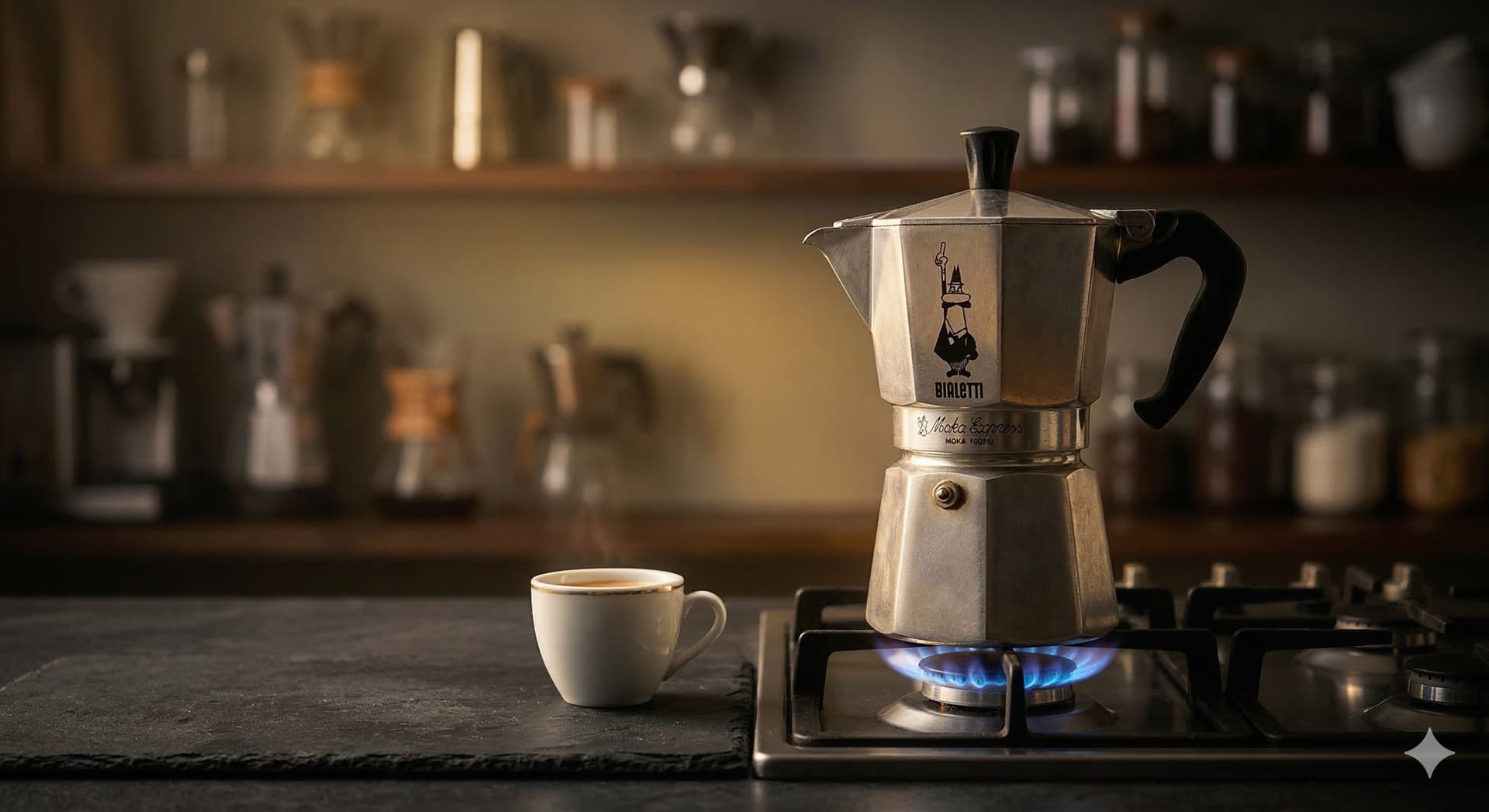
What Is a Moka Pot and How Does It Work?
The stovetop espresso maker demystified — a former barista trainer with 15+ years testing coffee equipment explains exactly what a moka pot is, how it really works, and why it's not quite the same as espresso
The moka pot has been on every Italian stovetop since 1933. It's cheap, simple, and makes strong concentrated coffee without electricity. But after fifteen years testing coffee equipment and training baristas, I still get asked the same question: is it really an espresso machine? The honest answer — and the full explanation of how it works — is what this guide is about.
I've brewed through perhaps fifty different moka pots — from the original Bialetti Moka Express to stainless-steel versions, induction-compatible models, and a handful of imitators. What follows is everything I'd tell a barista student on their first day handling one.
What Is a Moka Pot?
A moka pot is a stovetop coffee brewer that uses steam pressure to push hot water up through a bed of ground coffee and into an upper collection chamber. It was invented in 1933 by Alfonso Bialetti, an Italian engineer who wanted to replicate the concentrated coffee of espresso bars at home without expensive machinery. The result was a six-sided aluminium pot that became one of the most recognisable kitchen objects in the world.
The name comes from the city of Mocha in Yemen — historically one of the most famous coffee-trading ports in the world. Whether that was a deliberate nod to coffee heritage or simply a name that sounded right, it stuck. Today, “moka pot” and “stovetop espresso maker” are used interchangeably, though as I'll explain, the “espresso” part of that label is technically questionable.
How a Moka Pot Actually Works
Understanding the moka pot's mechanics matters because it directly explains why things go wrong when they do — and what to do about it.
The pot has three distinct sections. The lower chamber is sealed and watertight — you fill it with cold water up to the safety valve, never above. Sitting in the neck of the lower chamber is the filter basket: a small funnel-shaped container with a perforated base and sides where you load your ground coffee. Above that, threaded onto the lower body, is the upper collection chamber with a central rising tube.
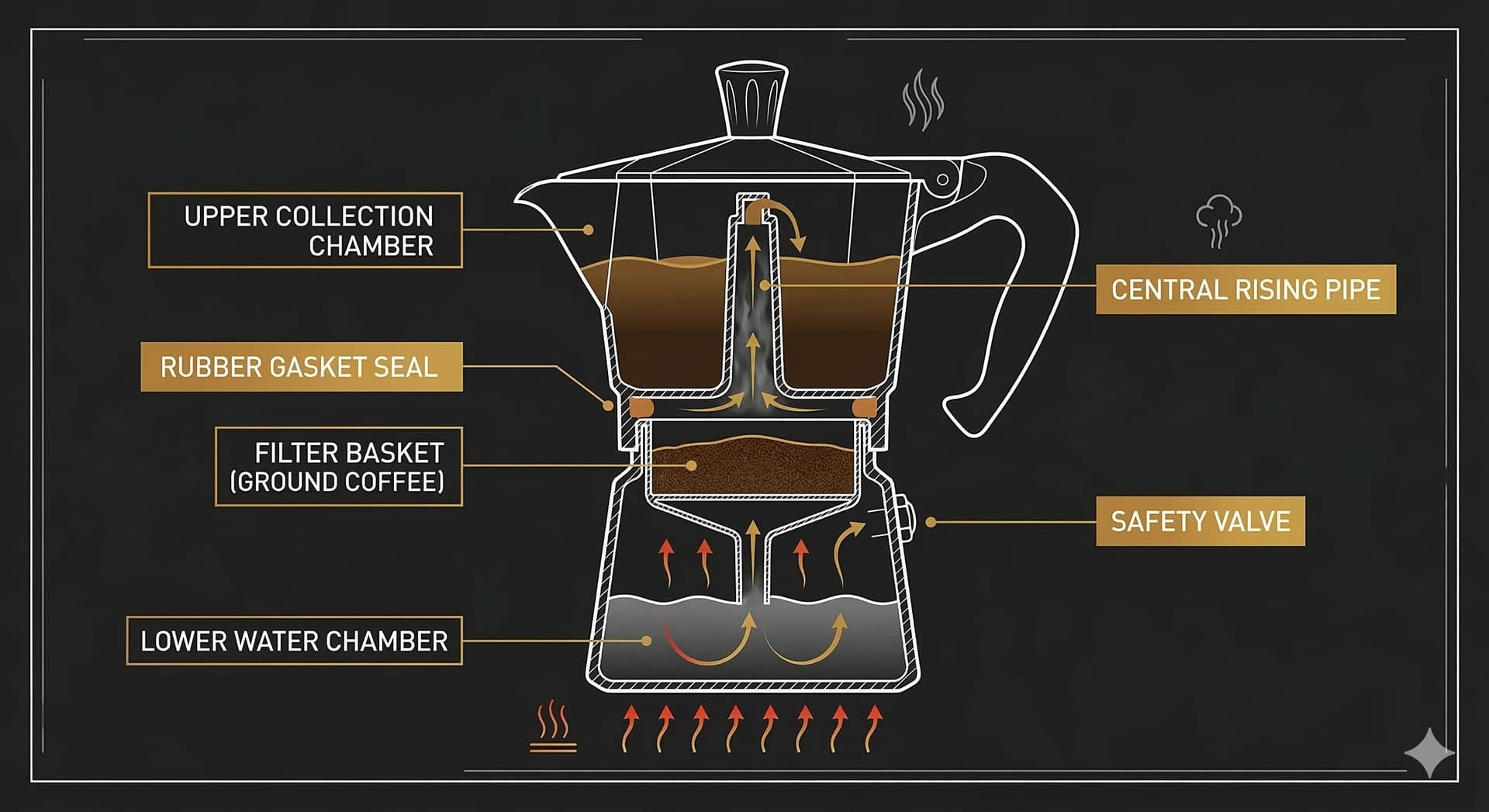
When you place the assembled pot on the heat, the water in the lower chamber begins to warm. As it approaches boiling, it turns to steam — and because the chamber is sealed, that steam has nowhere to go except down, into the remaining liquid water, where it creates pressure. That pressure builds until it exceeds the resistance of the coffee puck sitting in the basket above.
At that point, water is forced up through the small hole in the base of the filter basket, through the coffee grounds, through the upper filter plate, and up the central tube into the collection chamber. The characteristic gurgling and spluttering sound you hear near the end of the brew is the steam-water mix hitting the nearly-empty lower chamber — your signal to take the pot off the heat.
Moka Pot Pressure: The Real Numbers
This is where the “stovetop espresso maker” label starts to break down. Genuine espresso extraction requires 9 bars of pressure — that's approximately nine times atmospheric pressure — delivered by a pump-driven machine. A moka pot produces 1 to 2 bars of steam pressure. That's a substantial difference.
Why does pressure matter? Because it fundamentally changes what gets extracted from the coffee. At 9 bars, espresso extraction emulsifies oils, forces dissolved CO₂ out as crema, and pulls a complex range of soluble compounds from the grounds in a 25–30 second window. At 1 to 2 bars, water moves through the grounds more slowly, extraction is less forceful, and the resulting cup — while genuinely strong — has a different chemical profile.
In practical terms: moka pot coffee has a bold, intense flavour, but it lacks the syrupy mouthfeel of espresso, it does not produce crema, and it tends to have more emphasis on bitter notes if the heat is too high or the brew runs too long.
Moka Pot vs Espresso: Key Differences
I spent several years training baristas, and the moka pot question came up constantly. New baristas would taste moka coffee and assume it was espresso — or worse, assume it was inferior espresso. It's neither. It's a different drink produced by a different method.

| Factor | Moka Pot | Espresso Machine |
|---|---|---|
| Pressure | 1–2 bars (steam) | 9 bars (pump) |
| Crema | None | Yes (CO₂ emulsified oils) |
| Brew time | 4–5 minutes | 25–30 seconds |
| Grind size | Medium-fine | Fine (espresso) |
| Mouthfeel | Thin to medium body | Thick, syrupy body |
| Equipment cost | £20–£60 | £200–£2,000+ |
| Requires electricity | No | Yes |
| Produces crema | No | Yes |
| Milk drinks possible | Yes (add steamed milk) | Yes (steam wand) |
One point that often surprises people: despite its lower pressure, a moka pot can produce coffee with a similar or even higher caffeine concentration than espresso by volume — because the extraction time is longer. What makes espresso distinct is not primarily its caffeine but its brewing chemistry — the pressure-driven emulsification that produces that characteristic thick texture and crema.
If you're comparing the moka pot to an Americano (espresso diluted with hot water), moka coffee drunk straight is often more comparable in taste — bold, black, slightly bitter — though the underlying extraction chemistry differs.
The Bialetti Moka Express
There are dozens of moka pot brands, but Bialetti remains the benchmark. The Moka Express — that distinctive octagonal aluminium design with the mustachioed “little man” logo — is still manufactured in essentially the same form as the 1933 original. That alone tells you something: it works.
Aluminium conducts heat well and is lightweight, but it does have characteristics worth knowing. Aluminium can impart a slight metallic taste in early brews — this seasons out after ten to fifteen uses. Never clean a Bialetti Moka Express with soap or in the dishwasher; water and a light scrub is all it needs, and the seasoning that builds up on the inside surface actually contributes to flavour consistency over time.
Bialetti also makes the Moka Induction (stainless steel, induction-compatible), the Brikka (a double-valve version that traps more pressure and produces a small amount of foam — I've tested it and it does work, though it's not true crema), and several other variants. For most people, the standard Moka Express is the right starting point. It's inexpensive, durable, and available in sizes from 1-cup to 12-cup. If you're deciding between the 3-cup and 6-cup, or want to know how the Moka Express compares to a pump espresso machine after hands-on testing, see our detailed Bialetti Moka Express review.
How to Use a Moka Pot: Step by Step
Using a moka pot is straightforward once you understand the principle. The variables that matter most are water level, grind size, and heat management — get those right and the pot does the rest.
- 1
Fill the lower chamber with cold water
Fill to just below the safety valve — never cover or block it. The safety valve releases excess pressure if the system clogs.
- 2
Fill the filter basket
Add medium-fine ground coffee, level with the rim. Do not tamp. Do not pack the grounds down. Level off any mound by running a finger across the top.
- 3
Screw the upper chamber on firmly
Not with excessive force. The rubber gasket creates the seal — it doesn't need to be torqued. Make sure the gasket is seated correctly.
- 4
Place on medium-low heat
Not high. High heat drives the pressure too fast, pushes water through the grounds before optimal extraction temperature, and produces harsh bitter coffee.
- 5
Leave the lid open and watch
When the stream changes from dark brown to a thin, pale tan trickle — or when you hear the first gurgling — take the pot off the heat immediately.
- 6
Stop the brewing
Run the base under cold water for a few seconds. This stops residual heat from continuing to push steam through the grounds.
- 7
Pour immediately
Moka coffee sitting in the upper chamber continues to cook on the hot metal. Serve right away.
For a deeper dive into the full technique — including the pre-boiled water method, stovetop type differences, the cold-stop finish, and troubleshooting by symptom — see our dedicated step-by-step moka pot brewing guide.
Grind Size for Moka Pot
Grind size is the single most common variable I see people get wrong. After years of training baristas and testing equipment, the pattern is consistent: people either grind too fine (treating a moka pot like an espresso machine) or too coarse (treating it like drip coffee).
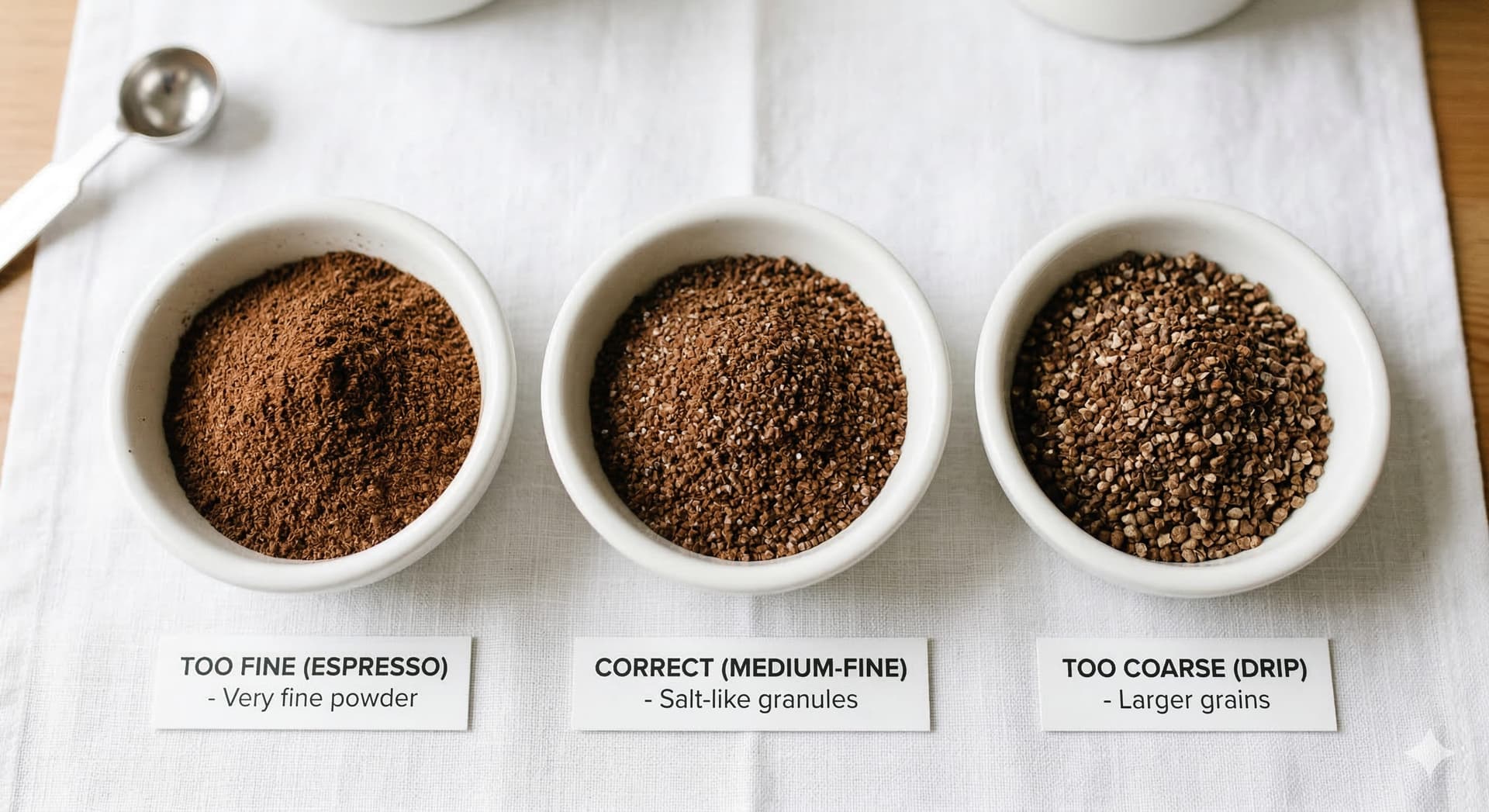
The target is medium-fine — noticeably coarser than espresso, but finer than what you'd use for a drip coffee maker. On most consumer burr grinders, this is two to three clicks coarser than your espresso setting. Visually, think table salt: you should see individual particles, not powder, but they should be fine enough that the grind feels slightly tacky between your fingers.
Too fine and the puck creates excessive resistance for the 1–2 bars of steam pressure. The result is slow, sputtering extraction with harsh over-extracted coffee, or the safety valve releases entirely. Too coarse and water flows through too freely — the coffee is thin, watery, and sour from under-extraction.
Water and Heat: The Variables That Matter
Two variables that get less attention than grind size but matter considerably: water temperature going in, and the heat setting on the hob.
Starting water temperature: I've tested both cold-start and pre-boiled water methods across multiple moka pot sizes and roasts. Pre-boiling the water before filling the lower chamber consistently produces better results — particularly for lighter roasts. Cold water means the grounds sit on hot metal for longer as the pot heats up, which can scorch the coffee before brewing even begins. Starting with hot or near-boiling water shortens that pre-heat window significantly. Use a cloth or oven mitt when screwing it together if using hot water.
Heat level: Medium-low is the answer, regardless of stovetop type — gas, electric, or ceramic. High heat pushes the steam pressure up too quickly. You want a steady, controlled push of water through the grounds, not a sudden blast. On a gas hob, the flame should just barely lick the sides of the lower chamber. On electric or ceramic, a setting around 40–50% works well. Be patient. The best moka pot coffee I've made took 5–6 minutes. The worst took 2 minutes on high heat.
What Moka Pot Coffee Tastes Like
Moka pot coffee is strong. If you're used to drip coffee or pour over, the first cup from a moka pot will likely feel intense — more body, more bitterness, and a more assertive flavour. That's by design.
At its best — correct grind, medium-low heat, right-sized pot, quality beans — moka coffee is deeply satisfying: earthy, chocolatey, with a clean finish and enough intensity to carry a splash of milk. Italians commonly serve it with just a small amount of sugar stirred in while it's hot, which rounds out the bitter edges beautifully.
At its worst — too-fine grind, high heat, or left on the stove too long — moka coffee is acrid, metallic, and harsh. The difference between these two outcomes is often only a few degrees of heat and two clicks on a grinder.
Compared to true espresso, moka coffee lacks the syrupy body and rich crema. But it carries its own character. If you want to explore where moka coffee sits in the full landscape of coffee styles, our guide to coffee drink differences covers every method side by side.
The Most Common Moka Pot Mistakes
After testing hundreds of brewing devices and training baristas on technique, the same moka pot errors come up time and again:
Grinding too fine
Espresso-fine grounds clog a moka pot filter and produce over-extracted, bitter coffee. Target medium-fine.
Tamping the basket
Never tamp a moka pot. At 1–2 bars, a tamped puck creates resistance the brewer can't overcome. Fill level, settle gently.
Overfilling the water chamber
The safety valve must be above the water line. Covering it is a safety risk and blocks pressure regulation.
Using high heat
It burns the coffee and produces a harsh, metallic extraction. Medium-low heat for the full brew.
Leaving it on after the gurgle
Remove the pot as soon as you hear the first gurgling. Continuing to heat it scorches the last of the extraction.
Not drying the gasket
A wet or worn gasket fails to seal properly. After every wash, dry thoroughly. Replace every 12–18 months.
Frequently Asked Questions
No. A moka pot is often called a "stovetop espresso maker," but that label is misleading.
True espresso requires 9 bars of pressure — a moka pot generates only 1 to 2 bars. The coffee produced is strong and concentrated, similar in feel to espresso, but the extraction mechanism is fundamentally different.
The flavour tends to be less syrupy and lacks the characteristic crema you get from a proper espresso machine.
Get Coffee Tips
Join our newsletter for expert reviews and brewing guides.