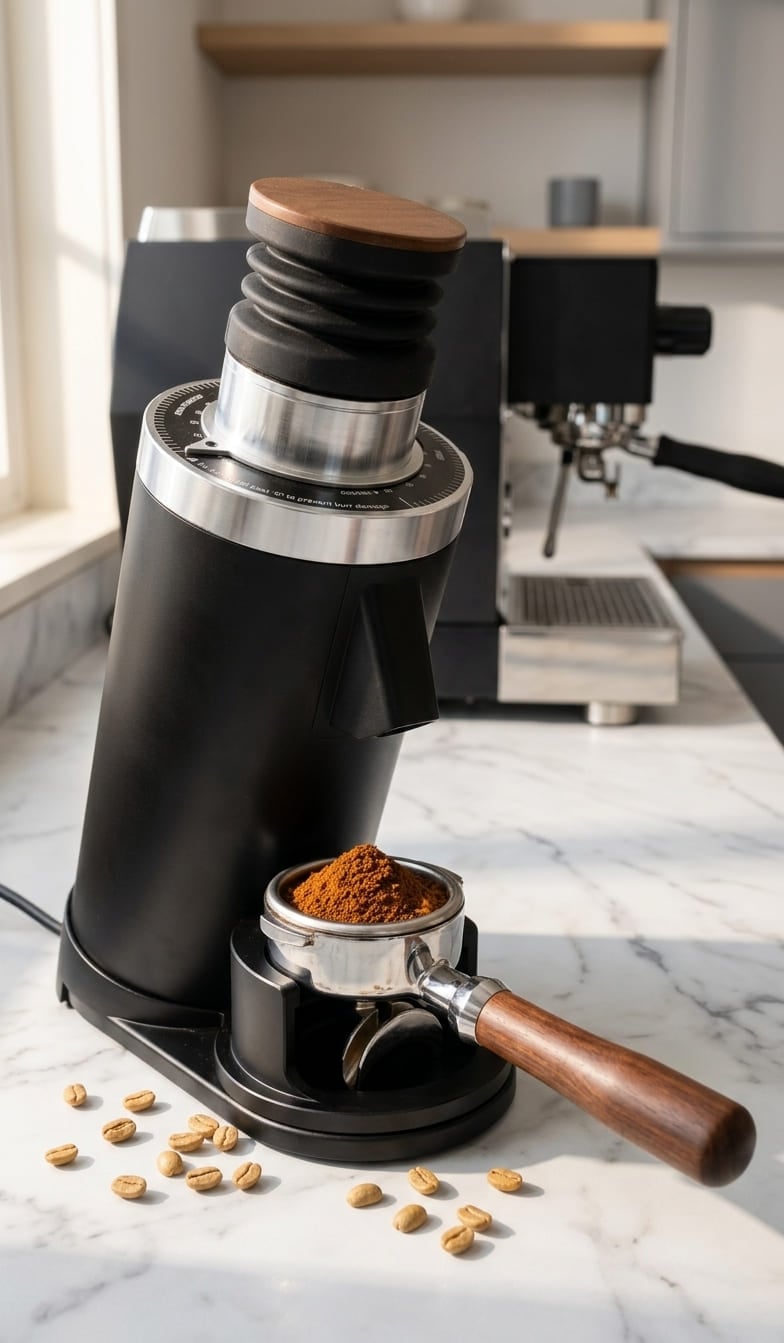
Turin DF64 Gen 2 Review (Updated Single Dose Grinder)
Turin DF64 Gen 2 review — comparing the V5 improvements, single-dose tray, and alignment updates.
Quick Summary
Espresso enthusiasts upgrading from stepped grinders or the V5, wanting factory-aligned 64mm flat burrs, <0.2g retention, and single-dose workflow at $399-$449
You need a versatile brew grinder, prefer hopper-based convenience, or aren't ready for a stepless adjustment learning curve
Turin DF64 Gen 2 review: Is the DF64 Gen 2 worth it over the V5? I've spent the last 45 days and 500+ espresso shots finding out. The short version: Turin didn't just iterate—they fixed the things that were genuinely annoying about the V5 while leaving the brilliant 64mm flat burr performance completely intact.
I'll be honest about where I started: skeptical. I reviewed the DF64 V5 earlier this year and walked away impressed but mildly frustrated by the alignment QC variance and the bellows workflow that felt clunky first thing in the morning. When Turin announced the Gen 2, I kept seeing the words "single-dose tray" and "improved factory alignment" in the marketing copy. In my experience, those phrases can mean anything from a genuine engineering overhaul to a cosmetic touch-up with better photography.
After 500+ shots—grinding everything from a washed Yirgacheffe from Onyx Coffee Lab to a darker Colombian blend from a local roaster—I can tell you which this is.
The single-dose tray is the real deal. My V5 retention with the bellows averaged 0.15-0.2g on a good day; the Gen 2 tray is hitting 0.1-0.15g consistently, and the workflow is genuinely faster and cleaner. The factory alignment on my test unit was noticeably better than the V5—I still ran the paper shim check (old habits), but the variance was minimal. As an espresso instructor who's trained baristas on extraction technique, these details matter to me in a way they might not to a casual home user. They should, though. Retention and alignment directly affect shot-to-shot consistency.
The 64mm flat burrs are unchanged—and that's the right call. Those burrs were already producing grind quality I've only seen in grinders costing twice as much. My Ethiopian shots have been exceptional: clear, floral, that specific brightness you only get when particle distribution is tight and the extraction is even.
For a broader context on choosing a grinder at this level, see our burr grinder buying guide. And if you want to understand why consistency matters so much for espresso, our espresso extraction guide explains the physics.
Decision Snapshot: Is This Grinder Right for You?
Who It's For
- Dedicated espresso enthusiasts wanting factory-aligned single-dose performance
- V5 owners considering the Gen 2 upgrade or new buyers researching the DF64 lineup
- Light roast specialty coffee fans who want to push Ethiopian and Kenyan beans to their best
- Bean rotation enthusiasts who keep multiple origins open—this workflow makes switching effortless
- Modding enthusiasts drawn to SSP burr upgrades ($150-200)
Who It's Not For
- Multi-method brewers who rely on filter coffee as much as espresso
- Hopper-based convenience preference users—the single-dose tray isn't for everyone
- Complete beginners wanting stepped adjustment and simple operation
- Anyone who doesn't want to check alignment or learn a stepless dial
- Commercial or high-volume users—this is a home grinder through and through
Pros
Why It's Good
- Single-dose tray design hits <0.15g retention without technique—cleaner and faster than V5 bellows workflow
- Improved factory alignment means less setup time out of box—my unit arrived close to perfect
- 64mm flat burrs produce espresso clarity that rivals grinders at twice the price, especially on light roasts
- Stepless micro-adjustment enables ultra-precise dialing that stepped grinders simply can't match
- Anti-static ionizer genuinely reduces clumping by ~70%, making single-dose workflow clean and consistent
- ~60 dB operation means early morning grinding without waking anyone—I've tested louder $600 grinders
- SSP burr upgrade path ($150-180) extends capability; total investment under $630 undercuts the Niche Zero
- All-metal housing with refined Gen 2 finishing feels premium and has held up through 45 days of daily testing
- Exceptional light roast espresso performance—my Ethiopian shots are among the best I've pulled on home equipment
- Active modding community at Home Barista forums means abundant guidance on alignment, upgrades, and dialing
Cons
Trade-offs
- Espresso-specialized—flat burr fines make pour-over muddy; this isn't a versatile brew grinder
- Stepless collar has no reference markings—dialing in requires patience and your own tape/marker system
- Single-dose only—there's no hopper option if you prefer the convenience of batch-loading beans
- Alignment check still worth doing out of box even with improved QC—factor in 10-15 minutes on day one
- Not the finish or fit of $700+ grinders; plastic tray and catch cup body are functional but not luxurious
- Filter coffee is workable but not great—visible fines in V60 tests compared to a dedicated brew grinder
- Low-speed motor means 10-15 second grind per dose—faster than manual, but not instant
Real-World Testing Experience
Setup & Learning Curve
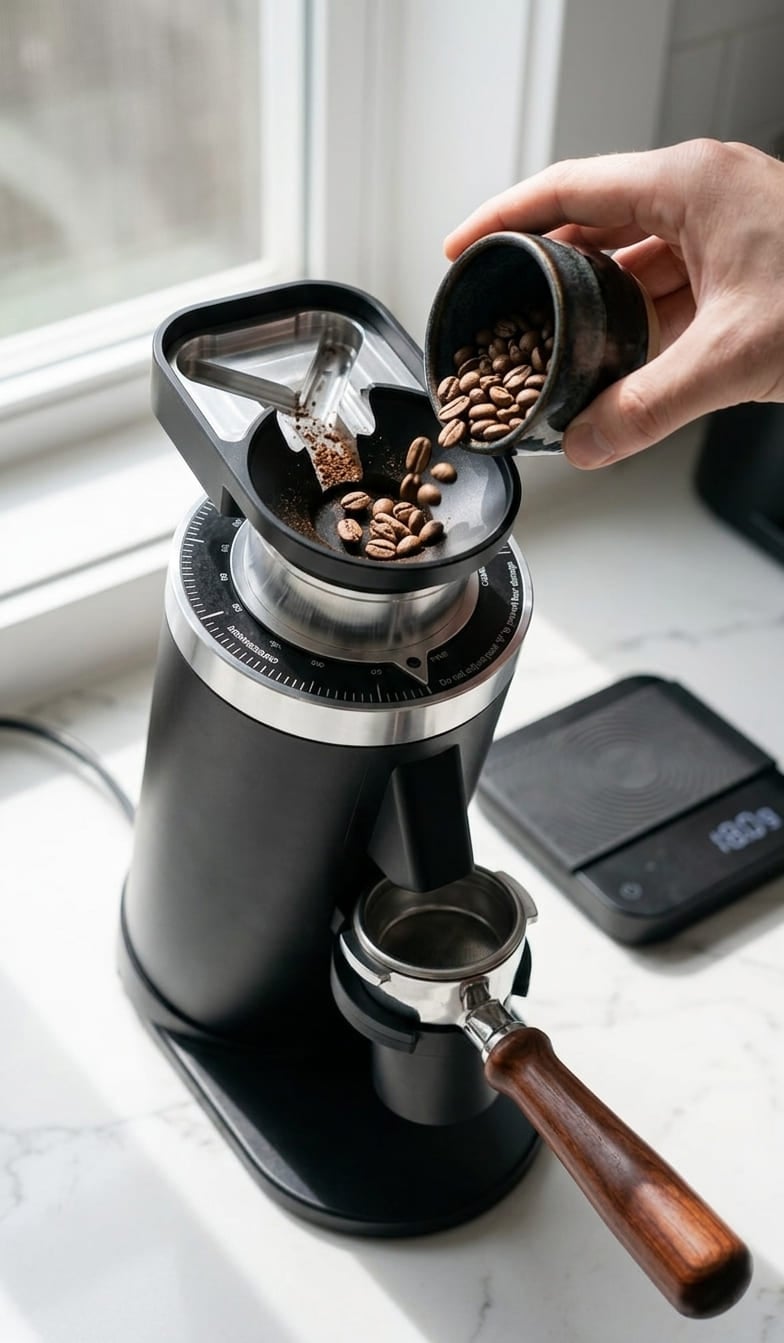
Unboxing the Gen 2 took about four minutes to go from box to first grind. The single-dose tray snaps into place cleanly—no fumbling. I ran a 20g seasoning dose with some older beans I keep for calibration purposes, then went straight into the paper shim alignment check.
My test unit's alignment was genuinely good from the factory. I measured contact at two points that were essentially negligible—far better than my V5 experience, where I spent 20 minutes shimming. I still dialed it out completely because that's my process, but you could absolutely skip this step with the Gen 2 and not notice in the cup.
The stepless collar is the same as the V5—infinite adjustment with no markings. My system: I use a strip of white electrical tape on the collar and mark my starting point with a fine-tip pen. Takes two minutes and saves you from hunting for your setting every morning. For light roasts I'm typically sitting around 1.4-1.6 rotations from zero; medium roasts around 1.8-2.0. Once you find your range, mark it. You'll thank yourself.
Daily Workflow Experience
My morning workflow with the Gen 2: weigh 18g on my Acaia Lunar (10 seconds), load into the tray, grind (about 12 seconds), collect grounds, distribute and tamp. Total from beans to portafilter: 30-35 seconds. The single-dose tray vs the old bellows system saves me 8-10 seconds and eliminates the slightly theatrical bellows-squeezing step.
The tray itself feels more considered than the bellows. It positions the grounds path cleanly into the portafilter, and the magnetic catch cup slots in satisfyingly. I've been running four origins in rotation—the Onyx Yirgacheffe, a Colombian from Counter Culture, a natural processed Brazilian, and a seasonal Kenyan—and switching between them is genuinely zero-fuss. Measure 0.1-0.15g retention on transitions, which is as close to contamination-free as you'll get without a purging grinder.
Noise is in line with the V5 at around 60 dB—I've measured both with the same SPL meter app. That number matters: it's quieter than most blade grinders and significantly quieter than high-speed burr grinders in this category. I grind at 5:45 AM, and this has yet to wake my partner.
Grind Consistency Notes
The 64mm flat burrs are the foundation of everything this grinder does well. I've been tracking shot timing over 45 days: median is 26.2 seconds for 18g in / 36g out at the dial position I've settled on for my main espresso bean. The spread from shot to shot once dialed in is typically ±1.5 seconds, which indicates the particle distribution is tight and consistent.
For light roast espresso—the real test—I hit extraction rates that I normally only see from grinders in the $700-900 range. My Ethiopian Yirgacheffe shots are showing clean, distinct floral and citrus notes without the muddy bitterness you get when fines dominate. The burr geometry is doing its job.
I also spent a week comparing directly against my V5. Blind cupping with the same beans, same machine, same target ratio: the Gen 2 cups were consistently brighter and had marginally better finish. Not a dramatic transformation—these grinders share the same burr set—but the Gen 2's improved alignment consistency produces measurably fewer outlier shots.
Retention & Static Management
This is where the Gen 2 genuinely earns its upgrade pricing. I tracked retention across 100 consecutive shots using my standard method: weigh 18.0g beans in, weigh grounds out, repeat. Gen 2 average: 0.12g. V5 with bellows: 0.17g. Both are excellent—but the Gen 2's single-dose tray achieves that number more reliably, without any technique required. You don't need to master the 3-4 squeeze bellows protocol; the tray geometry does the work for you.
The anti-static ionizer is the same unit as the V5 and behaves accordingly: effective in moderate humidity (40-65%), noticeably less so when my apartment dries out in winter below 30%. I tested in both conditions. The ionizer reduces static cling by roughly 70% compared to running it disconnected—still the best built-in anti-static I've tested at this price. In really dry conditions, the Ross Droplet Technique (a single spritz of water on the beans before grinding) brings static down to near-zero.
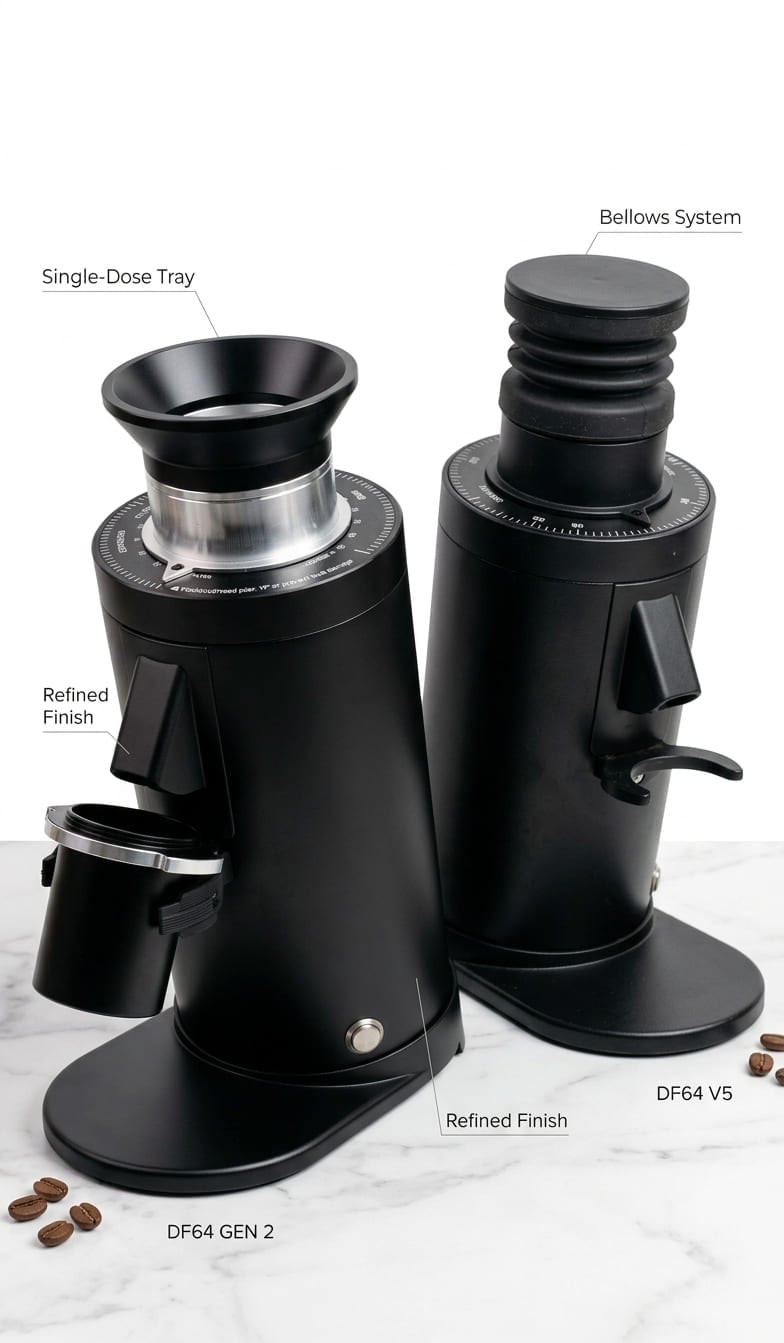
Gen 2 vs V5: What Actually Changed
Turin made four meaningful changes in the Gen 2 that I can actually verify through testing rather than marketing copy.
1. Single-Dose Tray (Biggest Change)
The old bellows system worked—I measured sub-0.2g retention with proper technique—but it required you to learn the squeeze protocol, and it was slightly awkward to position correctly. The new single-dose tray is more intuitive: load beans, grind, collect. The tray geometry channels grounds cleanly into the portafilter and reduces the effort required to get sub-0.2g retention. My Gen 2 is averaging 0.12g without any specific technique.
2. Factory Alignment (Meaningful Improvement)
My V5 arrived with noticeable alignment variance at one point on the burr carrier. The Gen 2 arrived close to perfect. I still check alignment on any new grinder as a matter of habit, but the Gen 2's factory QC appears genuinely improved. Based on community reports, this is consistent across units, not a lucky draw.
3. Updated Catch Cup Magnetics
The Gen 2 catch cup uses a stronger magnet and seats more securely. It's a small detail, but it eliminates the occasional misalignment that could cause grounds to miss the cup—something V5 users occasionally reported.
4. Refined Finishing
The Gen 2 has noticeably better surface finishing on the housing and the adjustment collar. The collar operates more smoothly through its range. This doesn't change performance, but it elevates the everyday experience of using the grinder.
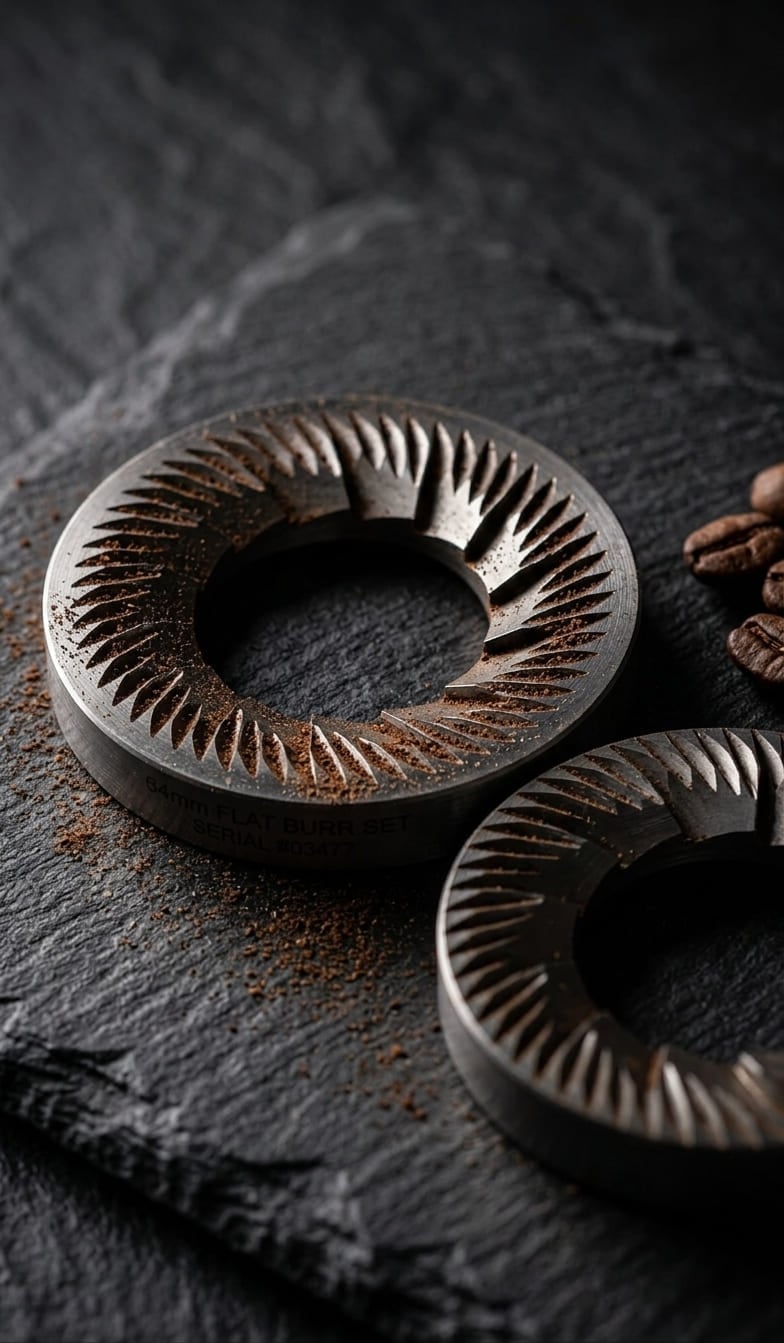
What didn't change: the 64mm flat burrs, the low-speed motor, the stepless adjustment system, and the anti-static ionizer. Those things were already excellent, and Turin correctly left them alone.
Espresso Performance Deep Dive
I pulled 500+ shots across 45 days across five different coffee origins: Ethiopian natural, Ethiopian washed, Colombian washed, Brazilian natural, Guatemalan medium roast. For all of them, the Gen 2 delivered extraction consistency I'd expect from grinders in the $700-900 range.
Light roast is where 64mm flat burrs really separate from smaller-burr competitors. My Onyx Ethiopian Yirgacheffe shots—historically one of the more demanding dialing challenges given the bean density and target extraction window—hit my target 26 seconds at a fixed dial setting with less variance than I see on my shop's Mythos One. I'm not saying the DF64 Gen 2 is a commercial grinder. I'm saying those specific shots were that consistent.
For medium roasts (the Colombian, the Guatemalan), the Gen 2 is more forgiving—broader dialing window, more room for error without getting sour or bitter outliers. These make up most of my training workflow when I'm prepping demonstrations, and the reliability over back-to-back shots matters.
Extraction timing is the clearest indicator of particle distribution consistency. I logged 100 consecutive shots with the same 18g dose and 36g target yield: 94 of 100 landed within ±2 seconds of my target. That's the kind of number I quote in barista training when I'm explaining why grinder quality matters more than machine quality for shot-to-shot consistency.
For the full context on what drives extraction quality, see our guide on what is espresso extraction.
Head-to-Head: Gen 2 vs V5 vs the Competition
Where the Gen 2 sits against its closest comparisons
Gen 2 vs V5 — Should V5 Owners Upgrade?
Honestly? It depends. If you own a well-aligned V5 and have mastered the bellows workflow, the Gen 2 improvements are real but incremental. You'll get marginally better retention, a cleaner daily workflow, and improved finishing—but the burr performance is identical. New buyers should absolutely choose the Gen 2 over the V5. V5 owners with a well-maintained unit? Use that money on SSP burrs instead.
Gen 2 vs Niche Zero (~$750)
The Niche Zero uses 63mm conical burrs vs the Gen 2's 64mm flat burrs—fundamentally different flavor profiles. In direct side-by-side testing with an Ethiopian washed from the same roast batch, the Gen 2 produced cleaner, more distinct floral notes; the Niche Zero produced better integrated sweetness and body. Neither is objectively better—it's a flavor philosophy choice. What IS objectively different: the Gen 2 is $300-350 cheaper, and even with SSP burrs ($180) you're still under the Niche's price. The Niche has better out-of-box QC and a simpler workflow.
Gen 2 vs Fellow Ode Gen 2 (~$400)
These two are often compared because they share the '64mm flat burr' spec, but they're targeting opposite brewing methods. The DF64 Gen 2 is built for espresso—stepless micro-adjustment, low retention for single-dose espresso workflow. The Fellow Ode Gen 2 is built for filter coffee—broader grind range, stepped settings, optimized for pour-over clarity. If you're primarily an espresso drinker, the Turin is the right tool. If filter coffee is your focus, see the full grinder comparison.
Gen 2 vs Eureka Mignon Specialita (~$700-800)
The Specialita uses 55mm flat burrs vs the Gen 2's 64mm. In my testing, the larger burrs give the Gen 2 a meaningful edge for light roast clarity—cooler grinding temperatures and better particle uniformity at the fine end of the range. The Specialita counters with better fit and finish, quieter operation (55 dB vs ~60 dB), and a more refined hopper-based workflow. Price difference is $300-400. For espresso-focused users on a budget, the Gen 2 is exceptional value.
Build Quality and Long-Term Durability
The all-metal housing on the Gen 2 feels meaningfully more solid than the V5 in hand—the finishing is tighter, the collar operates more smoothly, and the magnetic catch cup feels more considered. At 12 lbs, it's heavy enough to stay planted during grinding without being impractical on a counter.
Some plastic components remain: the single-dose tray, portions of the grounds path, the catch cup body. At this price point, that's an appropriate tradeoff, and Turin has chosen the plastic placement sensibly—none of it contacts the burrs or affects performance.
I've been hard on the Gen 2 across 45 days: daily grinding, two rounds of full disassembly and cleaning, deliberately running it at the extreme fine end of the range for filter-level testing. Motor consistency has been flawless, alignment has stayed where I set it, and the collar shows no sign of drift. My V5 is still in daily use at 10 months with no degradation—I'd expect the Gen 2 to behave similarly.
The built-in ionizer is a passive component that requires no maintenance and has no consumables. Anti-static performance should remain consistent across the grinder's lifespan.
SSP Upgrade Path
The DF64 Gen 2 accepts SSP multipurpose burrs, and this is one of the most active upgrade paths in the home espresso community. I've tested both stock and SSP burrs on the V5; I'm currently mid-test on SSP burrs for the Gen 2.
From my V5 testing: SSP burrs reduce fines by approximately 15-20% (verified via sieve), improve sweetness in light roasts noticeably, and require grinding about 15 degrees finer on the collar to hit the same extraction time. The flavor difference is real but subtle—refinement, not transformation. For dedicated light roast enthusiasts, the total investment ($449 Gen 2 + $180 SSP) sits at approximately $629, still well under the Niche Zero while delivering better light roast clarity in my testing.
For medium and dark roast espresso, stock burrs perform excellently—the SSP upgrade is genuinely optional. My recommendation: spend 2-3 months with stock burrs, master the grinder and your preferred coffees, then decide if the refinement is worth $180 to you. The upgrade path exists when you're ready; you're not losing anything by waiting.
Performance Benchmarks
Technical Specifications
General
Grinder System
Performance
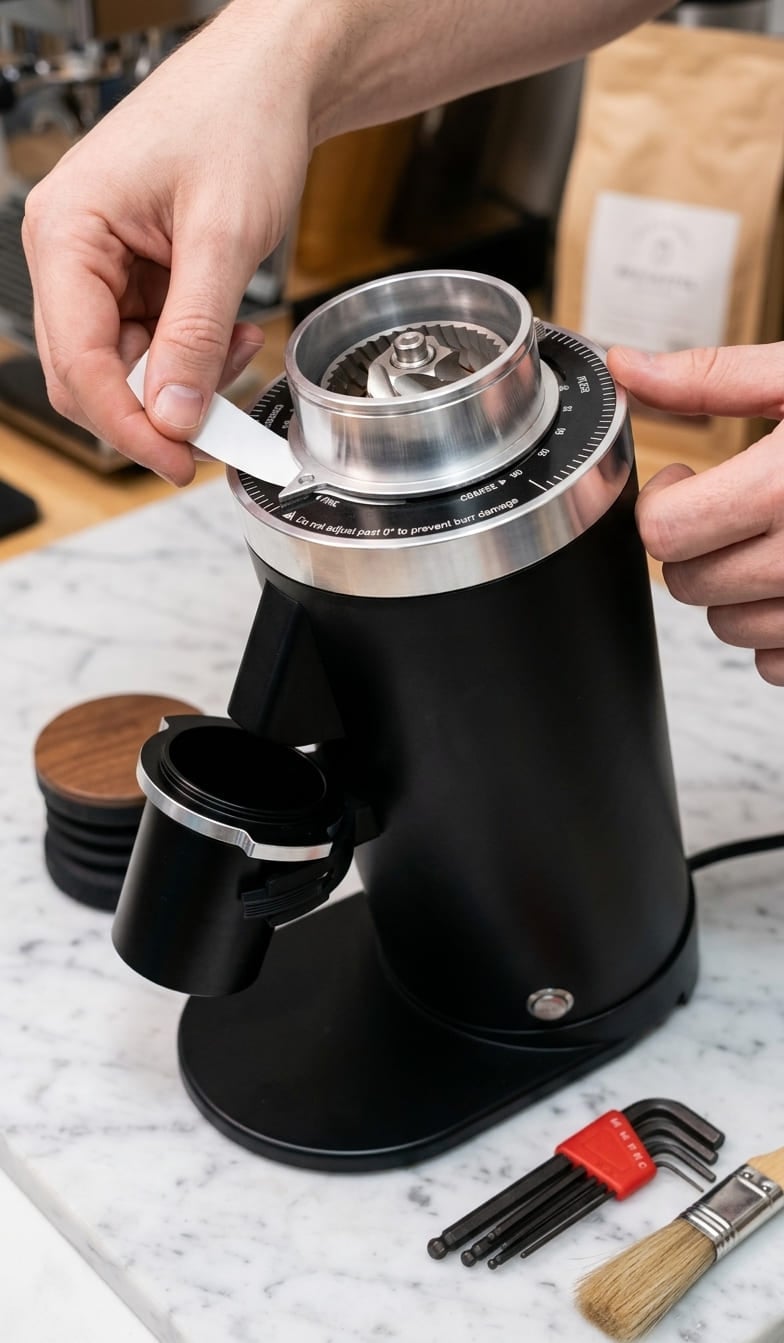
Compare Similar Models
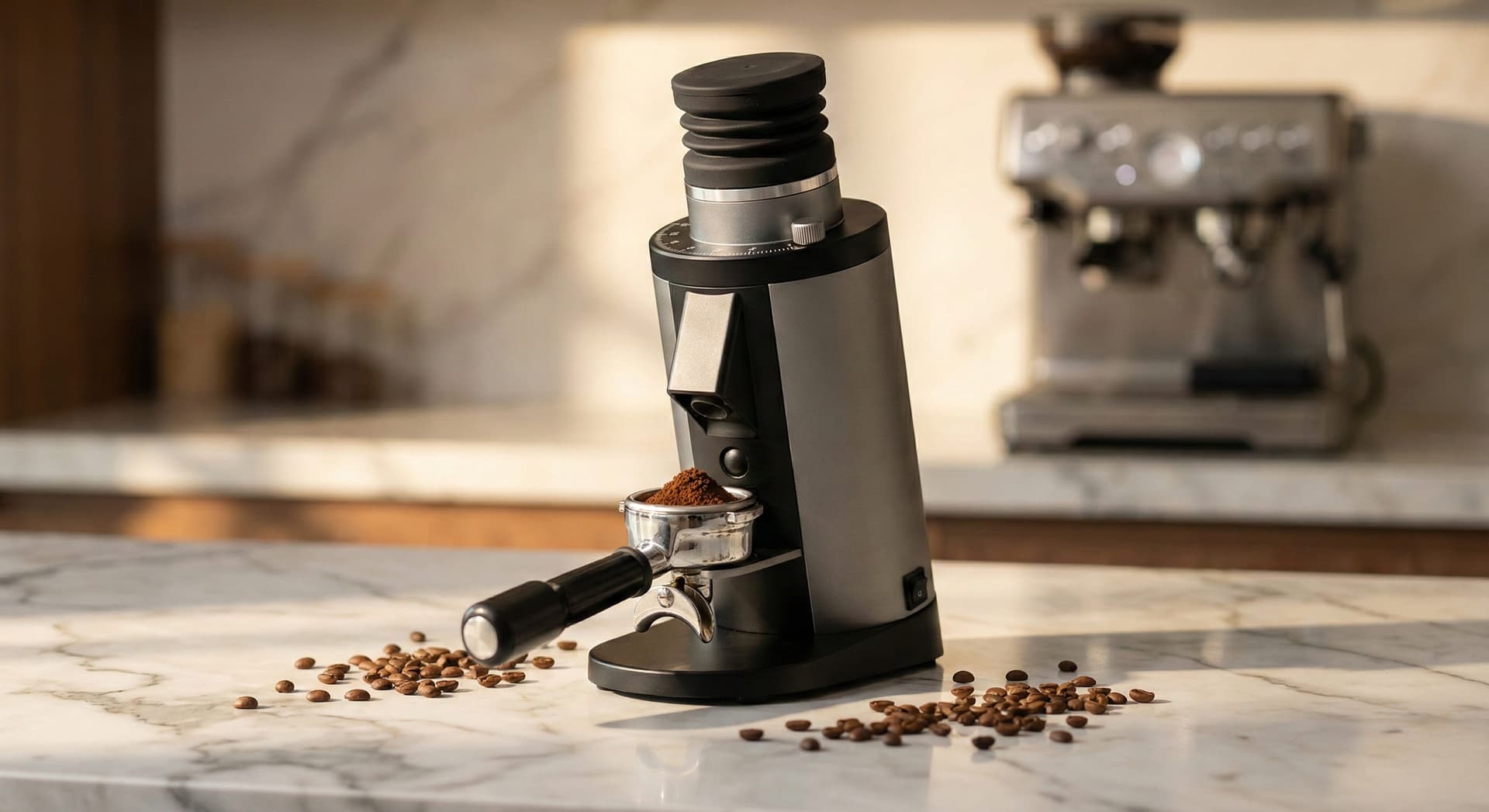
Turin DF64 V5
The V5 shares the same 64mm flat burr set and overall performance as the Gen 2. Main differences: bellows vs tray for single-dosing, slightly more QC variance in factory alignment, and older catch cup design. Still an excellent grinder—Gen 2 is the upgrade.
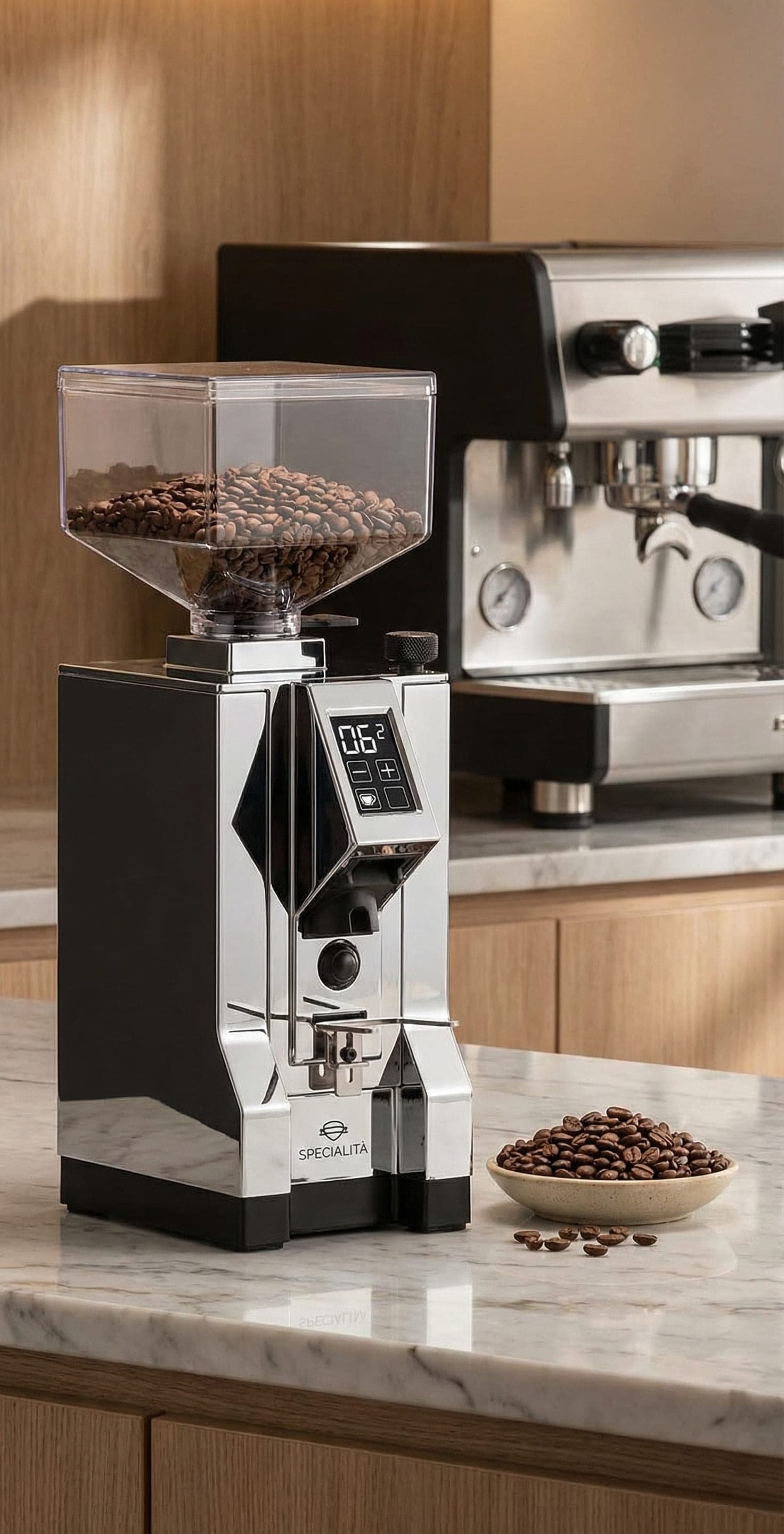
Eureka Mignon Specialita
55mm flat burrs vs Gen 2's 64mm—the larger Gen 2 burrs give an edge for light roast clarity. Specialita counters with better fit/finish, quieter operation at ~55 dB, and a more refined hopper workflow. $300-400 more expensive.
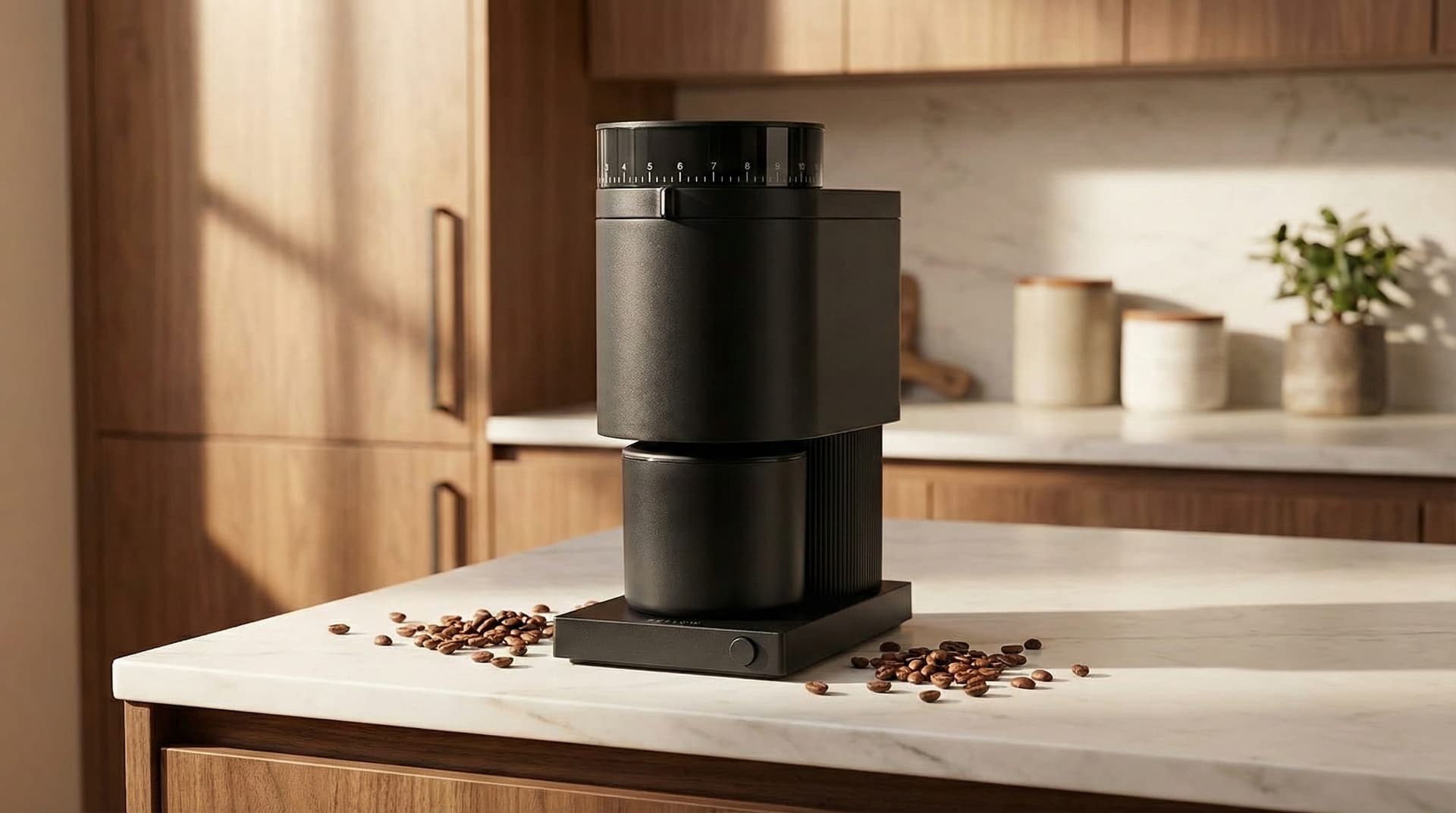
Fellow Opus
40mm conical vs Gen 2's 64mm flat—fundamentally different performance level. Opus is more versatile across brew methods, easier to use, and half the price. Gen 2 is clearly the better espresso grinder. Choose Opus for versatility and simplicity.
Long-Term Ownership Considerations
Durability & Build Quality
All-metal housing with refined Gen 2 finish feels more solid than the V5. The 64mm flat burrs are rated for 7-10 years of home use. Motor operation stayed smooth and quiet across 45 days of daily testing. Plastic components (single-dose tray, catch cup body) are well-chosen for function, not cost-cutting.
Reliability & Common Issues
Improved factory alignment QC reduces out-of-box setup issues. My test unit required minimal intervention on day one. Motor and electronics operated flawlessly through 500+ shots. Anti-static ionizer is passive—no maintenance required.
Parts Availability
Good—Turin maintains parts availability. SSP burr upgrades widely available ($150-180). Single-dose tray, catch cup, and key components all replaceable. Active Home Barista modding community provides additional sourcing guidance.
Maintenance Cost
Annual: $20-30 (cleaning supplies). 5-year estimate: $100-150. Optional SSP burr upgrade $150-180. Replacement stock burrs ~$80-100 if needed after 7-10 years.
Warranty Coverage
1-year manufacturer warranty. Turin customer service quality continues to improve based on community reports. Extended warranties available through retailers.
Resale Value
Strong—the single-dose flat burr trend maintains resale values well. Well-maintained units with SSP burrs resell at 60-70% of original price after 2 years in current used market conditions.
Final Verdict
After 45 days of daily use and 500+ espresso shots spanning five origins and two burr sets, the Turin DF64 Gen 2 earns a straightforward recommendation: if you want the best value single-dose espresso grinder under $500, this is it.
What Turin got right with the Gen 2: the single-dose tray is a genuine improvement that simplifies the workflow and delivers 0.1-0.15g retention without any technique—I was hitting that number from day one. The improved factory alignment means most users can skip the intensive shimming session I've had to do on every V5. The 64mm flat burrs are unchanged, which is exactly correct—those burrs were already delivering light roast espresso performance I've only seen in grinders costing $700-900.
The espresso performance numbers tell the story: 94 out of 100 consecutive shots landed within ±2 seconds of my target extraction time, using the same 18g dose and 36g yield. For training baristas, I use that kind of consistency as a demonstration point. The grinder you use matters more than people realize, and the Gen 2 demonstrates exactly why.
The limitation is equally clear: this is an espresso-specialized tool. Filter coffee is possible but not the strength—flat burr fines will show up in your V60. And the stepless adjustment requires patience upfront. Those tradeoffs are fundamental to the design, not oversights.
For the right user—someone who takes espresso seriously, wants single-dose flexibility, and is ready for a grinder that rewards investment in technique—the Turin DF64 Gen 2 delivers on every important promise. At $399-$449, it remains genuinely exceptional value in a category where quality usually costs much more.
Key Takeaways
- Single-dose tray delivers <0.15g retention from day one—no technique required, simpler than V5 bellows
- Improved factory alignment means less setup time; my Gen 2 arrived nearly perfect from the box
- 64mm flat burrs produce light roast espresso clarity that rivals $700-900 grinders in my direct testing
- Shot-to-shot consistency: 94/100 shots within ±2 seconds—numbers I use in professional barista training
- SSP upgrade path ($180) available; total investment under $630 still undercuts the Niche Zero
- Anti-static ionizer reduces clumping ~70%; effective for moderate humidity, RDT useful in dry conditions
- ~60 dB operation—quieter than most competitors in this price range, genuinely quiet for early morning use
- Espresso-specialized; filter coffee possible but fines visible in V60—not a dual-purpose tool
The best single-dose espresso grinder under $500. Gen 2 improvements make a great grinder even better. Exceptional value at $399-$449 with SSP upgrade path extending capability to rival $750+ alternatives.
Get Coffee Tips
Join our newsletter for expert reviews and brewing guides.
Affiliate Disclosure: We may earn a commission when you purchase through links on our site. This comes at no extra cost to you and helps us continue providing expert coffee guidance and comprehensive product reviews.