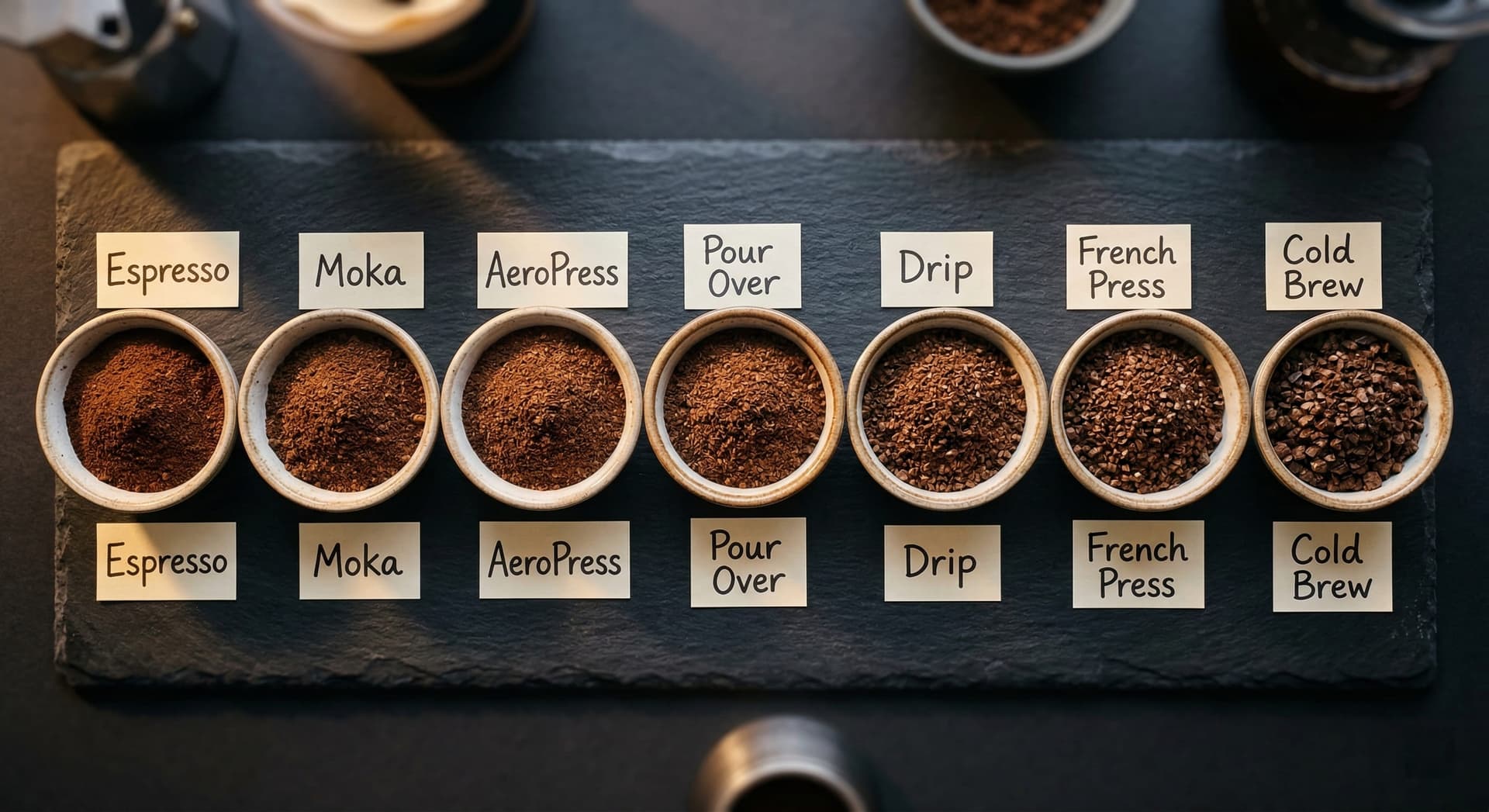
Coffee Grind Size Chart: Every Brew Method Explained
Espresso, French press, pour over, cold brew, AeroPress — exact grind sizes, micron ranges, and calibration steps for every method. No dial numbers. Just results.
The number one question I get from home brewers — after “which grinder should I buy?” — is “what grind size should I use?” And my honest answer is always the same: the chart below is a starting point, not a finish line. Every grinder is calibrated differently, every bag of beans extracts slightly differently, and every brewing device has its own quirks.
What this guide gives you is the science behind grind size selection — the micron ranges, the extraction logic, and the calibration process — so you can find the correct grind quickly regardless of which grinder you are using. I have tested this across more than 100 grinders over eight years, from entry-level burr grinders to £2,000 flat-burr machines, and the fundamentals hold across all of them.
One upfront caveat worth stating plainly: dial numbers on grinders are meaningless for comparison between machines. A “5” on a Baratza Encore is not the same grind as a “5” on a Niche Zero. Throughout this guide I use descriptive labels (fine, medium, coarse) and micron estimates — those transfer across machines and are the only reliable shared reference.
Why Grind Size Is the Most Underrated Variable
Grind size is not just a setting — it is the primary control lever for extraction. When water contacts ground coffee, it dissolves compounds in a predictable sequence: first acids (fruity, bright), then sugars (sweet, round), then bitter compounds last. Grind size controls how fast that sequence happens by changing the total surface area exposed to water.
A fine espresso grind at 200 microns has roughly twice the surface area of a medium pour-over grind at 500 microns. That means compounds dissolve in seconds rather than minutes — exactly what espresso's 25-second brew window requires. Put that same espresso-fine grind in a French press for four minutes and you extract everything, including the bitter compounds you wanted to leave behind, with nothing left to balance them.
The practical lesson: each brew method has a target extraction window, and grind size is how you hit it. Get it right and coffee tastes balanced and clean. Get it wrong by even one or two steps and the cup shifts from sweet to sour or bitter noticeably. To understand the extraction chemistry in more depth, our espresso extraction guide covers how surface area, brew ratio, and time interact in the cup.
The Grind Size Spectrum: Coarse to Fine
Most burr grinders — even entry-level models — cover a range from extra fine (100–200 microns) to extra coarse (1000–1500 microns). That is roughly a 10x difference in particle diameter. Each end of the spectrum has a dedicated brew method that specifically needs it.
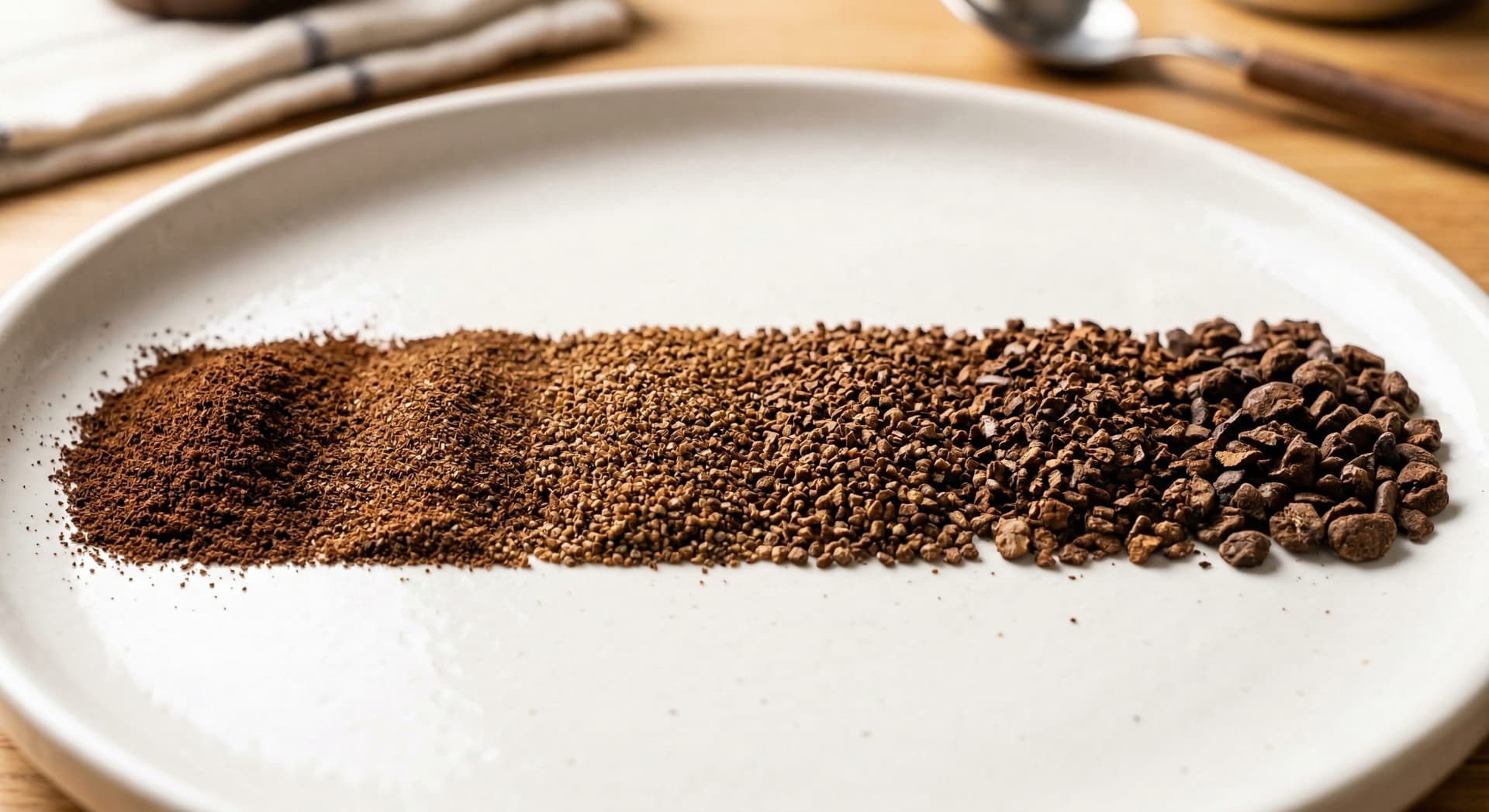
From left to right: extra fine (Turkish), fine (espresso), medium-fine (moka/AeroPress), medium (pour over/drip), coarse (French press), extra coarse (cold brew).
Turkish coffee — powdery, almost flour-like
Espresso — like fine sand, clumps slightly when pressed
Moka pot — between sand and table salt
Pour over, drip — roughly like table salt or coarse sand
Chemex — like rough beach sand
French press — like breadcrumbs or raw sugar
Cold brew — coarse sea salt or cracked peppercorns
The texture comparisons above are genuinely useful for sanity-checking your grinder output — especially when switching to a new machine or after burr replacement. I use them constantly when dialling in an unfamiliar grinder for the first time.
Quick Reference: Grind Size by Brew Method
This table is the core reference. Micron values are estimates — your grinder's actual output will vary by burr geometry, wear, and bean density. Use these as targets, then calibrate to your specific setup using the brew-time guidelines in each section below.
| Brew Method | Grind Label | Approx. Size | Target Time |
|---|---|---|---|
| Turkish Coffee | Extra Fine | 100–200 μm | 3–5 min |
| Espresso | Fine | 200–300 μm | 25–32 sec |
| Moka Pot | Medium-Fine | 300–400 μm | 4–6 min |
| AeroPress | Medium-Fine to Med | 300–600 μm | 1–3 min |
| Pour Over (V60) | Medium | 500–700 μm | 2:30–3:30 |
| Chemex | Medium-Coarse | 600–800 μm | 4–5 min |
| Kalita Wave | Medium | 500–700 μm | 3–4 min |
| Drip Machine | Medium | 500–800 μm | 5–8 min |
| French Press | Coarse | 800–1100 μm | 4 min |
| Cold Brew | Extra Coarse | 1000–1500 μm | 12–24 hrs |
Espresso Grind Size
Espresso is the most demanding grind application. The combination of fine particle size (200–300 microns), high brew pressure (9 bar), and short brew time (25–32 seconds) means any inconsistency in grind — clumping, bimodal distribution, or oversized particles — shows up immediately in the cup and in shot timing.
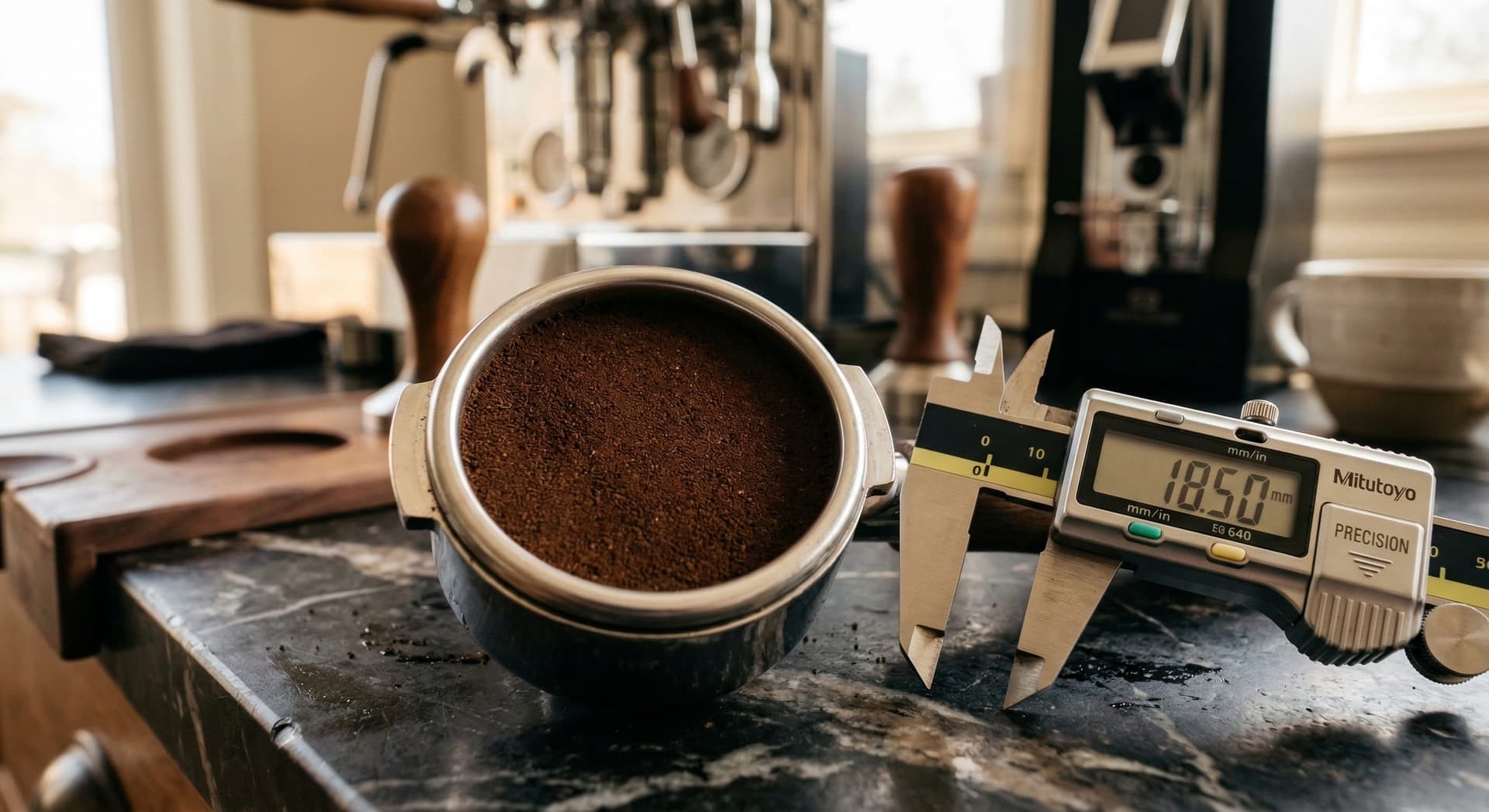
Correct espresso grind: uniform, fine-sand texture that clumps slightly when pinched. This is what 200–300 microns looks like in a 58 mm basket.
How to Calibrate Espresso Grind Size
Never calibrate espresso grind by dial number. Calibrate by shot time:
- Set dose to 18 g in, target yield 36 g out (1:2 ratio)
- Pull a shot and time it from pump start to 36 g
- Target: 25–32 seconds. Under 20 seconds → grind finer. Over 35 seconds → grind coarser
- Change one increment at a time, then pull again
- Once in the time window, taste. Sour → finer. Bitter → coarser
In my testing across 40+ espresso-capable grinders, the single biggest quality jump at espresso settings is from blade to entry-level burr. The second biggest is from stepped to stepless burr adjustment. Stepped grinders can jump 5–8 seconds per click at espresso settings — fine enough that the sweet spot sometimes sits between two clicks with no way to reach it. For daily espresso use, a stepless or micro-stepped grinder pays for itself in shot-to-shot consistency.
For a full breakdown of how grind size interacts with dose and yield, our espresso extraction guide covers the full extraction science, including how fine particles and boulders in the same batch create channeling and unpredictable shot times.
Moka Pot Grind Size
Moka pot is the most commonly mis-ground brew method I encounter. Most online sources say “fine, like espresso.” That is wrong, and it is why so many people get bitter, harsh moka pot coffee. The correct target is medium-fine — 300–400 microns, finer than pour over but meaningfully coarser than espresso.
A moka pot generates approximately 1–2 bar of steam pressure — nowhere near espresso's 9 bar. At espresso-fine grinds, the filter plate clogs, pressure builds, and brew time extends to 8–10 minutes, pulling bitter compounds the entire time. At medium-fine, a correctly filled moka pot produces coffee in 4–6 minutes over medium heat with a steady, clean stream into the upper chamber.
Calibration signal: a correctly ground and filled moka pot should begin producing coffee after 3–4 minutes on medium heat, with a steady stream (not sputtering) into the upper chamber. Sputtering or very rapid production means too coarse. Slow, laboured extraction means too fine.
AeroPress Grind Size
AeroPress is the most versatile brew method for grind size — it works across an unusually wide range and is deliberately forgiving. The combination of plunger pressure and a short steep time means it compensates for grind inconsistency better than any other method I have tested.
My default starting point for AeroPress: medium-fine, around 400 microns — finer than a V60, coarser than a moka pot. From that baseline:
Stronger, espresso-style
Grind finer (300–350 μm). Use 1:5–1:6 ratio, 1-minute steep. Press slowly.
Cleaner, filter-style cup
Grind medium to medium-coarse (450–550 μm). Use 1:12–1:15 ratio, 2–3 minute steep.
Inverted AeroPress method
Medium-fine works well. A 2-minute steep compensates for a slightly coarser grind.
Metal filter vs paper filter
With paper: grind slightly finer — paper removes more fines, so you can run tighter without muddiness.
The clearest calibration signal for AeroPress: if the plunger requires significant force — if you are genuinely straining — the grind is too fine. A correctly ground AeroPress takes 20–30 seconds of gentle, steady pressure to fully press.
Pour Over Grind Size (V60, Chemex, Kalita Wave)
Pour over is where grind size precision matters most after espresso. Slow, gravity-fed percolation through a paper filter is sensitive to particle consistency — a burr grinder producing uniform 550-micron particles will extract far more cleanly than a blade grinder producing particles from 100 to 1000 microns in the same batch. This is the method where upgrading from blade to burr makes the most dramatic flavour difference.
Each pour over dripper has its own target range due to differences in filter thickness, bed depth, and drainage speed:
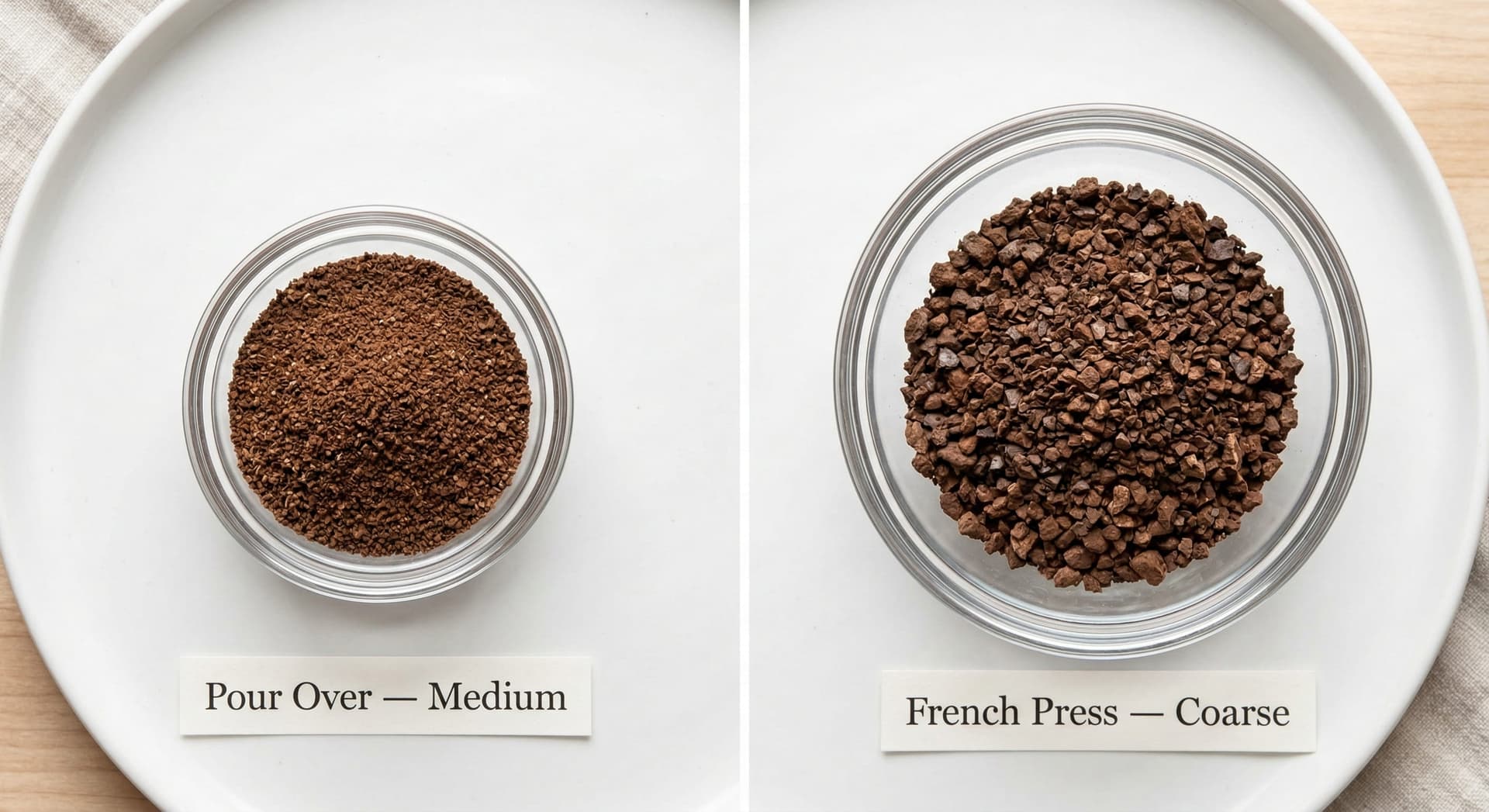
Left: medium pour over grind (~550 μm). Right: coarse French press grind (~900 μm). The visual difference is obvious — the extraction difference is dramatic.
Hario V60 — Medium (500–650 μm)
Target brew time: 2:30–3:30 for 200 ml. The cone shape and large single drain hole make it somewhat self-regulating. Grind slightly finer for light roasts (denser beans, slower extraction), slightly coarser for dark roasts.
Chemex — Medium-Coarse (650–800 μm)
Target brew time: 4–5 minutes for 500 ml. Chemex paper is significantly thicker than V60 paper — it filters more fines and creates more flow resistance, requiring a coarser grind. Using V60-grind fineness in a Chemex is the single most common Chemex mistake I encounter.
Kalita Wave — Medium (520–680 μm)
Target brew time: 3–4 minutes for 200 ml. The flat-bed design and three small drain holes create a more even extraction bed than a cone dripper — slightly less sensitive to grind inconsistency than a V60, but still benefits from a consistent burr grinder.
Universal pour over calibration rule: if drawdown drains in under 90 seconds, grind finer. If it takes more than 5 minutes, grind coarser. Everything else is fine-tuning for flavour.
Drip Coffee Grind Size
Drip machines cover a wide range because basket geometry varies enormously between models. A flat-bottom basket (like the Technivorm Moccamaster or Breville) retains water in the grounds longer than a cone-bottom basket, meaning you can use a slightly coarser grind without sacrificing extraction. Cone baskets drain faster and generally need a finer grind.
Target for drip: medium, 500–800 microns, adjusted to your specific machine and basket. Starting-point diagnosis: weak and watery → grind finer. Bitter and harsh → grind coarser. Most drip machines have no flow-rate control, so grind adjustment is your primary lever.
One finding worth noting from my drip machine testing: water temperature is often as important as grind size. Many budget drip machines brew at 80–85°C rather than the correct 90–96°C. If coffee consistently under-extracts (weak, sour) despite medium-fine grind, the machine may simply be brewing too cool — a problem no grind adjustment can fully fix.
French Press Grind Size
French press has the most specific grind requirement of any filter method: genuinely coarse — 800–1100 microns, coarser than table salt, closer to breadcrumbs. The reasons are structural: French press uses a metal mesh filter (not paper), which does not catch fine particles, and it is an immersion method where grounds steep for a full 4 minutes at 90–95°C.
Fine grounds in a French press produce three simultaneous problems: over-extraction (bitter from the 4-minute steep), a muddy, heavy texture (fines pass through the mesh into the cup), and a sediment layer that continues extracting as you drink. A wrong grind in French press is more noticeably punishing than in most other methods — the bitterness is immediate and unmistakable. If your French press coffee regularly tastes bitter, this is usually the cause, and wrong grind size is also one of the primary reasons coffee tastes bitter across brew methods generally.
One frequently overlooked French press tip: after pressing, pour all the coffee into a separate vessel immediately. Leaving brewed coffee sitting on the pressed grounds continues extracting and progressively makes the cup more bitter — entirely independent of grind size.
Cold Brew Grind Size
Cold brew is the easiest method to get right on grind size: use the coarsest setting on your grinder — 1000–1500 microns. Cold water extracts coffee compounds extremely slowly compared to hot water. The solution is time (12–24 hours) and surface area minimisation. A coarser grind prevents the extended steep from over-extracting and turning bitter.
Most grinders reach their maximum useful coarseness for cold brew at their coarsest position. I set my grinder to maximum and steep for 16–18 hours at room temperature (faster than refrigerator cold brew, which needs the full 24 hours due to the lower temperature). The result should be smooth, low-acid, and sweet — cold brew's characteristic flavour profile that makes it so palatable straight or over ice without adding anything.
Cold brew ratio: 1:8 coffee to water by weight (100 g coffee to 800 g cold water) for concentrate, then dilute 1:1 with water or milk to serve. With the right coarse grind and the right steep time, the simplest recipe produces excellent results.
How to Calibrate Your Grinder
Every time you get a new grinder, switch to a new bag of beans, or change brew method, you need to recalibrate. Here is the process I follow consistently across every grinder I have tested:
- 1
Start at the manufacturer's recommended position
Most grinder manuals list a starting position for common brew methods. Use that as your zero point — not the midpoint of the dial range.
- 2
Brew and record the result
For espresso: time the shot from pump start. For pour over: time total drawdown. For French press: observe grind texture and taste. These are your calibration signals.
- 3
Taste before adjusting
Sour and thin = under-extracted (too coarse or too short). Bitter and harsh = over-extracted (too fine or too long). Balanced and sweet = correct. Time confirms it; taste decides it.
- 4
Adjust one increment at a time
Move one notch or step in the required direction. Purge old grounds from the burrs (grind 2–3 g and discard). Brew again. Repeat until balanced.
- 5
Record your setting
Note the position, the bean, the roast date, and the result. Next time you open a bag from the same roaster, you have a starting point that gets you there in 1–2 adjustments.
One critical calibration note: roast level shifts the optimal grind position significantly. Light roasts are denser and harder than dark roasts — they require a finer grind to achieve the same extraction time at the same setting. When switching from a dark to a light roast, expect to go 1–3 steps finer. The beans themselves are a variable, not just your grinder.
If you are still choosing which grinder to buy, our burr grinder buying guide covers specific requirements for each brew method — including why stepless adjustment matters for espresso and what to look for at each price tier. For ranked recommendations, our best coffee grinders guide covers top-tested options from under £100 to prosumer flat-burr machines.
Frequently Asked Questions
Espresso needs a fine grind — roughly 200–300 microns — fine enough that 9 bars of pressure takes 25–32 seconds to push 36 g of water through 18 g of coffee. In practice, calibrate by shot time, not dial number: if your 18 g dose pulls 36 g in under 20 seconds, grind finer.
Over 35 seconds, grind coarser. Grind uniformity matters as much as fineness — a quality burr grinder producing consistent particles will outperform a blade grinder at any setting.
Get Coffee Tips
Join our newsletter for expert reviews and brewing guides.