
What Is a Cappuccino? The Classic Espresso Drink Explained
The exact 1:1:1 ratio, the dry vs wet distinction, Italian tradition, and why most café cappuccinos miss the mark — explained by a former barista trainer
The cappuccino is the drink that most people picture when they think of Italian coffee culture: a small, wide cup, a thick dome of foam, a rich espresso base visible at the edges. It's also the drink that generates more ordering confusion and disappointment than almost any other item on a café menu — because what most chains serve under that name bears almost no resemblance to the original.
I've been training baristas for over 15 years, and the cappuccino comes up in every single session. Not because it's technically complicated — the recipe is actually simple — but because it's so frequently misunderstood by both baristas and customers. Get the ratio right, understand what the foam is supposed to be, and you have one of the best coffee drinks in existence. Get it wrong, and you end up with a small latte wearing a foam hat. Here's everything that actually matters.
Cappuccino at a Glance
- Espresso:2 oz (60ml) double shot
- Steamed milk:2 oz (60ml)
- Milk foam:2 oz (60ml)
- Total volume:6 oz (180ml)
- Ratio:1:1:1 (espresso:milk:foam)
- Temperature:150–160°F (65–71°C)
- Caffeine:~120–140mg
- Calories:80–120 (whole milk)
- Cup style:Wide-mouth porcelain, 6–8 oz
- Intensity:6/10 — balanced, coffee-forward
What “Cappuccino” Actually Means
The name comes from the Capuchin friars — a Catholic monastic order whose brown hooded habits closely resemble the colour of the drink when espresso and milk foam blend at the edges of the cup. The precise etymology is contested, but most coffee historians trace it to early 20th century Vienna and northern Italy, where the drink evolved from the kapuziner (a coffee with milk and cream) into the pressurised espresso-based version we know today.
By the post-war period, the cappuccino had become a fixture of Italian breakfast culture — a specific drink served in a specific cup at a specific time of day. That cultural specificity is part of what makes the cappuccino unusual compared to other espresso drinks: it has rules, traditions, and a clear identity that most café menu items lack. Whether you observe those traditions or not, understanding them helps you order and evaluate a cappuccino more confidently.
The 1:1:1 Ratio: Why It Matters
The most important thing to understand about a cappuccino is its ratio. Equal thirds: espresso, steamed milk, foam. This isn't aesthetic tradition for its own sake — each component has a functional role, and the balance between them is what defines the drink's character.
Espresso (⅓)
2 oz / 60ml
Provides intensity, caffeine, and flavor complexity. The espresso sits at the bottom and concentrates further as you drink through the foam and milk layers.
Steamed Milk (⅓)
2 oz / 60ml
Adds sweetness, body, and fat content that softens the espresso. The steamed milk integrates with the espresso below the foam layer, creating the drink's mid-palate richness.
Milk Foam (⅓)
2 oz / 60ml
Creates textural contrast and insulation. The foam dome holds heat, releases espresso aromatics on first contact, and creates the three-phase tasting experience unique to cappuccino.
When you start shifting away from this ratio — more milk, less foam, larger cup — you stop making a cappuccino and start making something else. A 12 oz cup marketed as a cappuccino is functionally a latte with extra foam. The ratio matters because it determines the espresso prominence, the textural experience, and the total calorie count. It's not snobbery to insist on the correct size; it's just accuracy.
Dry Cappuccino vs Wet Cappuccino
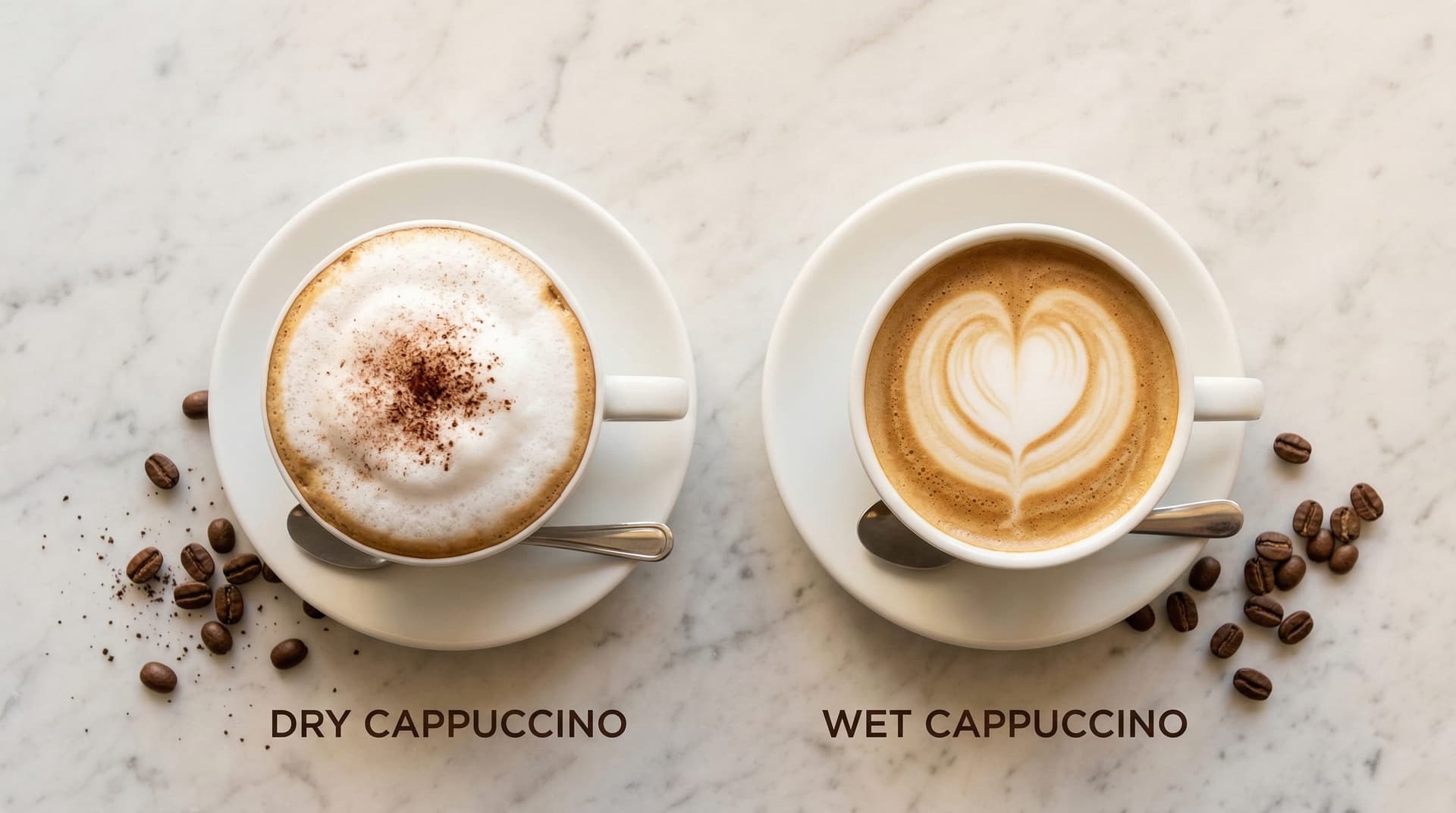
Within the cappuccino family, there's a spectrum from dry to wet. These aren't wildly different drinks — they're adjustments to the foam-to-milk balance within the same overall ratio. Knowing the difference lets you customise your order meaningfully rather than guessing.
| Style | Milk Foam | Steamed Milk | Texture | Best For |
|---|---|---|---|---|
| Bone Dry | Almost all foam | Minimal | Very light and airy | Foam enthusiasts only |
| Dry (Cappuccino Scuro) | More foam than milk | Less than standard | Light, airy, intense coffee | Strong coffee presence with foam |
| Traditional (1:1:1) | Equal parts | Equal parts | Balanced — foam + body | Most people, classic experience |
| Wet (Cappuccino Chiaro) | Less foam than milk | More than standard | Smoother, heavier body | Dislike thick foam, want more body |
What a Cappuccino Tastes Like
A properly made cappuccino is a three-phase experience. That's not poetic exaggeration — the three distinct layers genuinely taste different as you work through the drink. I've pulled and evaluated hundreds of cappuccinos across machine types, milk varieties, and roast levels, and this progression is consistent in every well-made version.
First contact — the foam
Seconds 0–20
The foam meets your lips first. It's airy, barely sweet, and lighter than expected. Good cappuccino foam shouldn't taste sour or milky on its own — it should taste like barely sweetened air with a ghost of espresso. This phase is entirely about texture: the foam melts on contact, releasing trapped coffee aromatics. If the foam tastes too milky and heavy here, it's been over-steamed or the milk was too hot.
Middle layers — where it all integrates
Minutes 1–5
As the foam layer deploys, you reach the steamed milk mixed with espresso — this is where the cappuccino actually tastes like itself. The espresso's bitterness is softened by milk fat; the milk's sweetness is sharpened by the espresso's acidity. In testing a Breville Dual Boiler against a La Marzocco GS3 using the same Ethiopian Yirgacheffe medium roast, this middle phase was where both machines produced their most complex, nuanced results. Bean quality and espresso extraction are most detectable here.
Final sips — concentrated espresso
Minutes 5–8
The bottom of the cup is always the most espresso-forward section. As you drink through the foam and milk, the concentration shifts. A great cappuccino becomes intentionally bolder at the end — rewarding rather than punishing you for finishing it. If this phase tastes overly bitter or harsh, the espresso was over-extracted or the milk was under-heated and didn't integrate properly.
Cappuccino vs Latte
This is the most common comparison question I get from people new to espresso drinks. The confusion is understandable: both contain espresso and milk, both are common morning drinks, and both are available at every café. The differences are real and significant once you understand them.
| Feature | Cappuccino | Latte |
|---|---|---|
| Total volume | 6 oz (180ml) | 8–12 oz (240–360ml) |
| Espresso | 2 oz double shot | 2 oz double shot |
| Steamed milk | 2 oz (⅓ of drink) | 5–9 oz (up to 75–80% of drink) |
| Foam | Thick dome, 1–1.5 inches | Thin layer, under ½ inch |
| Espresso prominence | High — coffee-forward | Low — milk-forward |
| Texture | Three distinct layers | Uniform, silky throughout |
| Calories | 80–120 | 180–250 |
| Best for | Coffee lovers wanting structure | Milk lovers wanting approachable coffee |
The fundamental difference is espresso prominence. In a cappuccino, espresso is one of three equal components; you taste it clearly at every stage. In a latte, espresso is diluted across four to six times its volume of milk — you get the background warmth of coffee flavor without the directness. Neither is better; they're optimised for different experiences and preferences. For a full exploration of how all café drinks compare, see our guide to coffee drink differences.
Cappuccino vs Flat White
This comparison trips up even experienced coffee drinkers because both drinks are small, both are coffee-forward, and both sit on the same size spectrum. The difference is entirely in the milk preparation.
Cappuccino
- Milk treatment: Steamed milk layer + separate thick foam cap
- Foam: Dense, stable, 1–1.5 inches, resists a spoon
- Experience: Three phases — foam, milk+espresso, concentrated espresso
- Temperature: 150–160°F; foam provides insulation
- Cup: Wide-mouth porcelain, 6–8 oz
- Espresso type: Standard double shot
Flat White
- Milk treatment: Microfoam integrated throughout — no separate foam layer
- Foam: Thin (under ½ inch), wet, incorporated into milk
- Experience: Uniform silky texture from first sip to last
- Temperature: 145–155°F; no insulation from foam layer
- Cup: Tulip or ceramic, 6–7 oz
- Espresso type: Often ristretto for extra sweetness
The practical test: pick up the cup and look at the surface. If the foam stands proud of the cup rim and looks dry and stable, it's a cappuccino. If the surface is glossy, wet-looking, and level with the cup rim with only a thin layer visible, it's a flat white. For the full three-way comparison including cortado, see our flat white vs cappuccino vs cortado guide.

The Italian Rules Around Cappuccino
Understanding the Italian cultural rules around cappuccino isn't just trivia — it gives you a lens for evaluating whether what you're being served is the real thing. The rules aren't arbitrary; they emerged from centuries of culinary logic.
Only before 11 AM
Cappuccino is breakfast food in Italy. The milk content is considered too rich and filling after a full meal; it interferes with digestion. After lunch or dinner, you order espresso or macchiato — small, digestive-friendly shots. This isn't snobbery; there's genuine practical logic in consuming milk-heavy drinks when you need the sustenance and calories, not when you're already full.
Always 5–6 oz
Traditional Italian cappuccino is never large. The size constraint is structural, not arbitrary — you physically cannot maintain a 1:1:1 ratio in a 12 oz cup without it becoming something else entirely. Once the cup size exceeds 8 oz, the espresso-to-milk ratio has already drifted into latte territory regardless of what you call it.
No cocoa powder, vanilla, or flavour syrups
Traditional Italian cappuccino is plain. A dusting of unsweetened cocoa on top is a common café flourish internationally, but even that is considered a deviation by purists. Syrups, cinnamon, or whipped cream are distinctly non-Italian additions that change the fundamental character of the drink.
Consumed at the bar, standing up
In traditional Italian coffee culture, espresso and cappuccino are consumed quickly, standing at the bar — not lingered over at a table for an hour. This shapes why the drink is small: it's designed to be consumed in minutes while standing, not sipped for 45 minutes at a desk.
How the Foam Is Made
Cappuccino foam is the most technically demanding part of the drink, and it's where most café versions fail. The foam should be thick, stable, and microfoam-quality — not large-bubble froth, and not so stiff it doesn't integrate when you sip through it. Here's what distinguishes good cappuccino foam from bad.
The Steaming Process
Cappuccino foam requires more aggressive aeration than flat white microfoam, but controlled aeration — not the haphazard foam that comes from leaving the wand too high for too long. The goal is to roughly double the milk's volume while maintaining microfoam consistency (tiny, uniform bubbles).
- Start cold: Use 38–45°F milk in a cold pitcher. Cold milk gives you more time to aerate before hitting the target temperature — more foam incorporation at lower temperatures produces better bubble structure.
- Surface position: Place the steam wand tip just below the milk surface, tilted slightly off-centre to create a rolling vortex. Too deep: no aeration, just heating. Too high: large unstable bubbles.
- Aeration phase: Introduce air for 5–8 seconds — you should hear a distinctive tearing or hissing sound. The milk volume visibly increases. Cappuccino requires roughly 50% more aeration time than flat white.
- Integration phase: Lower the wand tip as the milk rises, maintaining the vortex without introducing more air. The rolling motion breaks up any large bubbles while the temperature climbs to 150–155°F.
- Finish: Stop when the pitcher is too hot to hold comfortably (about 55°C / 130°F on the outside). Tap the pitcher on the counter, swirl vigorously, and pour within 30 seconds before foam and milk begin to separate.

Signs of Good vs Bad Foam
Good cappuccino foam
- Dense, stable, holds shape for 3+ minutes
- Surface appears glossy, not mattified
- No large visible bubbles (bigger than 1mm)
- Resists a spoon gently pressed onto the surface
- Pours as a cohesive mass, not runny or fluffy
- Tastes slightly sweet, not sour or milky
Bad cappuccino foam
- Separates quickly from the liquid below
- Large, visible bubbles that pop
- Dry and stiff — bounces rather than pours
- Tastes burnt, sour, or scalded
- Disappears within 1–2 minutes of pouring
- Looks like bath foam rather than food
How to Order a Cappuccino
Ordering a cappuccino sounds straightforward, but there are a few nuances worth knowing to make sure you actually receive what you want.
- At a specialty café: Just say “cappuccino.” You'll receive a traditional 6 oz version with proper foam. If you want a larger drink, be aware that asking for a “large cappuccino” is effectively asking for a latte — the barista will serve something larger but the ratio will have shifted. If you specifically want more volume while keeping the cappuccino character, ask for a “dry latte” instead.
- At a chain café: Specify “traditional cappuccino” or “small cappuccino” and clarify you want proper foam, not just a small latte. Many chain cappuccinos are simply lattes with slightly more foam — the 1:1:1 ratio is rarely maintained at scale.
- Dry vs wet: Say “dry cappuccino” for more foam and less milk, or “wet cappuccino” for more milk and less foam. Most baristas understand these terms without further explanation.
- Milk type: Oat milk produces decent cappuccino foam at most cafés; soy milk is less consistent; almond milk foams poorly and separates quickly. If foam quality matters to you, oat milk is the best non-dairy alternative for cappuccinos.
Making a Cappuccino at Home
A home cappuccino requires an espresso machine with a steam wand — that's the only non-negotiable. You can produce passable foam with a handheld frother, but it degrades quickly and lacks the microfoam quality that defines a proper cappuccino. If you make cappuccinos regularly, the steam wand is worth prioritising in your machine selection.
Equipment Minimum
- Espresso machine with steam wand — the core requirement. Budget range: Gaggia Classic Pro ($449-$499), Breville Bambino Plus ($500), De'Longhi Dedica Arte ($250) if budget is tight.
- Burr grinder — essential for consistent espresso extraction. A blade grinder will consistently under-extract and produce sour, thin espresso that makes a poor cappuccino base.
- Milk pitcher (12 oz) — stainless steel, straight-sided for better vortex control during steaming.
- Wide-mouth cup (6–8 oz) — the cup shape matters for foam pouring and the final foam dome presentation.
- Kitchen scale — for weighing espresso dose and yield reproducibly.
The Recipe
- Pull the espresso: 18g dose, target 36g yield in 25–32 seconds at 9 bars and 93°C. Pull this first — cappuccino espresso should be waiting for the milk, not the other way round. Waiting espresso loses heat and crema quality.
- Steam the milk: Use 4 oz (120ml) of cold whole milk in a 12 oz pitcher. Aerate for 5–8 seconds to incorporate enough air for the foam layer, then integrate for another 10–15 seconds until 150–155°F. You should end up with about 6 oz of steamed milk and foam combined.
- Pour: Start pouring steamed milk into the espresso from a low height to introduce the liquid layer. As the cup fills, raise the pitcher slightly to let the thicker foam pour on top, creating the dome. Don't stir — the layering is intentional.
- Serve immediately: Cappuccino deteriorates fast. Foam begins separating from the liquid within 2–3 minutes; the three-phase experience disappears. Drink it while it's fresh.
Looking for the right machine to make cappuccinos at home? Our best espresso machines guide covers every tested option from entry-level to prosumer. If the grinder is your next upgrade, our best coffee grinders guide has hands-on recommendations at every price point. For more on how espresso drinks compare and which drink to order when, see our macchiato vs latte guide.
Frequently Asked Questions
Frequently Asked Questions
A cappuccino is an Italian espresso drink made with a double shot of espresso and equal parts steamed milk and milk foam — typically 2 oz of each, totalling 6 oz.
The three-part 1:1:1 ratio creates three distinct layers: espresso at the bottom, steamed milk in the middle, and a thick foam dome on top.
It is one of the most widely recognised espresso drinks in the world, though it is also one of the most commonly misrepresented by café chains that serve oversized, under-foamed versions.
Get Coffee Tips
Join our newsletter for expert reviews and brewing guides.