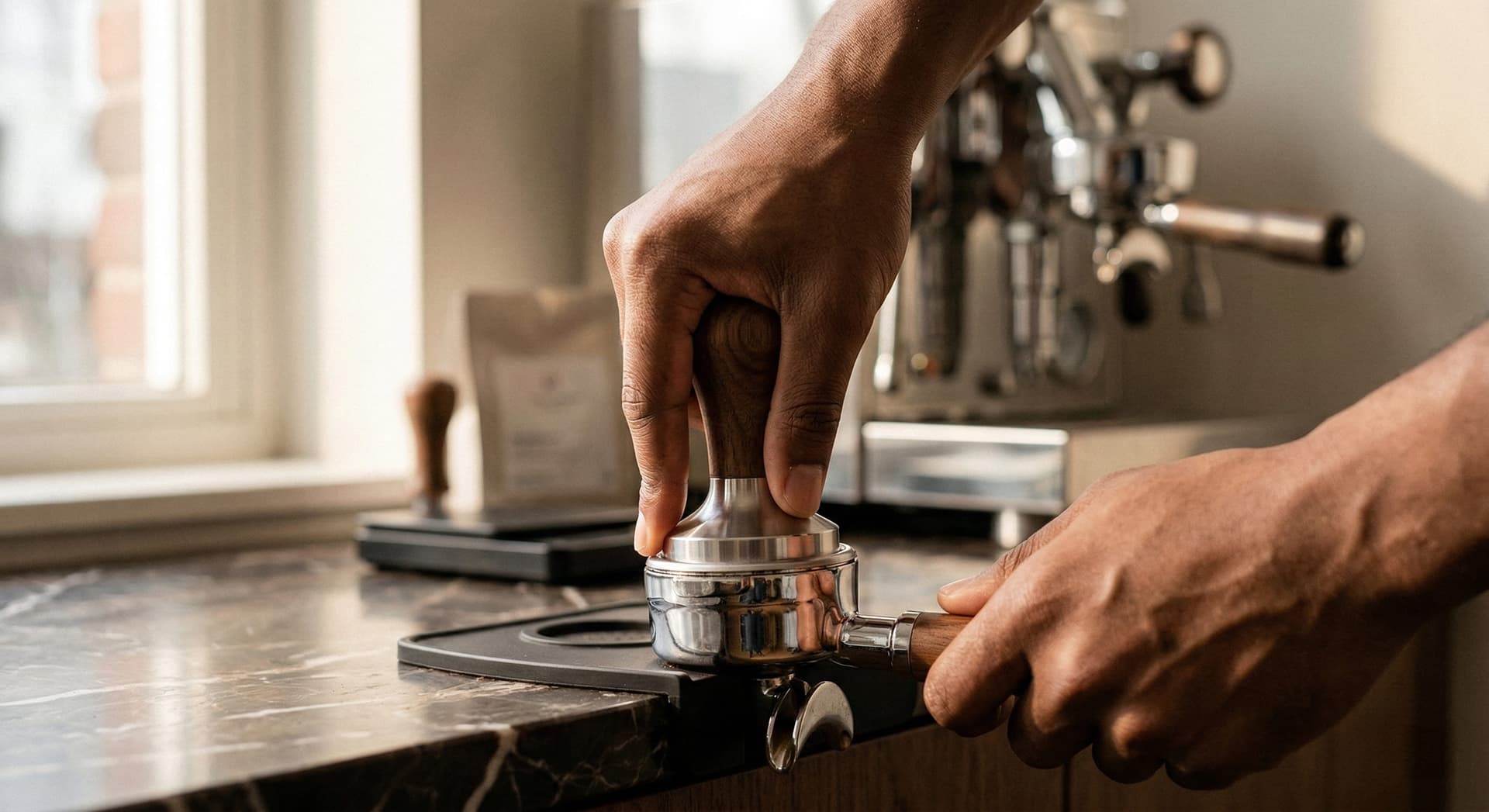
Espresso Tamping Pressure: How Hard Should You Actually Tamp?
Every guide tells you 30 lbs. Almost none of them tell you why — or explain that pressure is actually the least important tamping variable. Let's fix that.
When I first started training baristas, “30 lbs” was the answer to every tamping question. New barista joins, first session: “how hard do I tamp?” — “30 lbs”. It's the answer the whole industry has passed down for decades, and it's not wrong exactly. It's just incomplete in a way that causes real problems.
In 15 years of training — over 200 baristas, thousands of shots pulled side-by-side, and a lot of time staring at bottomless portafilters — I've watched the same pattern repeat: the barista obsessing over how hard they're pressing while the actual problem (a tilted tamp, skipped distribution, mismatched tamper size) goes unfixed. Pressure gets blamed because it's concrete. It's a number. Numbers feel actionable.
This guide gives you the honest answer on espresso tamping pressure — how much you actually need, what happens when you use too little or too much, and why the number matters far less than the two variables almost nobody talks about.
If you're looking for the full end-to-end technique guide — grip, distribution steps, puck prep sequence — our espresso tamping technique guide covers the complete process. This article specifically unpacks the pressure question, why it's so persistently misunderstood, and how to calibrate yours accurately.
The 30 lb Myth (And Where It Comes From)
The 30 lb recommendation originates from early commercial espresso training manuals — it was a practical threshold chosen to ensure baristas applied enough pressure to seat the puck properly, not a scientifically derived optimal force. It's a floor, not a target.
The problem is that it became the target. Home baristas and training guides adopted it as the correct espresso tamping pressure, and it stuck. Ask ten specialty coffee trainers what the right pressure is and at least seven will say “20–30 pounds.” Ask them what happens above 30 pounds and most will shrug — because nothing meaningfully different happens.
The physical reality: espresso grounds compact quickly under downward force. The first few kilograms of pressure reduce the puck height significantly. By 8–10 kg (roughly 18–22 lbs), most of the compression that can occur has occurred. Adding more force beyond that compresses the puck by a progressively smaller amount each additional kilogram — a curve of rapidly diminishing returns.
I ran informal pressure tests over several training cohorts using a digital platform scale under the portafilter to measure actual applied force. The variation within a single barista's tamping session — same person, same workflow, not consciously varying — was typically 4–8 kg. A barista “targeting 30 lbs” was often applying anywhere from 20 to 40 lbs shot to shot without noticing. The shots tasted consistent anyway, because within that range, pressure differences produce almost no perceptible extraction change.
How Much Pressure You Actually Need
You need enough pressure to compress the grounds into a firm, stable puck that does not shift when 9 bars of water pressure hits it from above. That threshold is lower than most people expect.
Practically speaking:
- Below ~5 kg (11 lbs): The puck is under-compressed. Water pressure from the group head can disturb it, causing cracking and immediate channeling. This is actual under-tamping — it is rarer than people think, because you have to tamp with almost no pressure to get here.
- 5–10 kg (11–22 lbs): The puck is compressed enough to be stable. Shots pull cleanly. Some baristas work in this range without any issues, particularly with lighter roasts where the coffee is already quite dense.
- 10–20 kg (22–44 lbs): The standard working range for most baristas. Full compression is achieved. Shot times are stable. This is where espresso tamping pressure recommendations converge for good reason.
- Above 20 kg (44 lbs): No meaningful additional compression occurs. You are adding force without adding benefit. Wrist and shoulder fatigue increases over high-volume sessions. Some baristas in this range report minor wrist strain after extended service periods.
The number that matters is consistency, not the absolute value. Two baristas with different natural tamping pressure — one working at 12 kg and one at 20 kg — will both produce consistent shots as long as each applies the same pressure every time. The problem occurs when the same barista wildly varies their force between shots, because it changes one variable unpredictably while you are trying to diagnose others.
How to Calibrate Your Tamping Pressure
The most reliable way to develop consistent espresso tamping pressure is the kitchen scale method — a technique I use in every barista training session I run. You do not need to repeat this indefinitely; once your muscle memory is set, a brief calibration every few months is sufficient.
- Set a digital kitchen scale on your counter or tamping station. Put the portafilter (empty, or filled with a dose of coffee) on top of it.
- Place your tamper centrally in the basket. Keep it level — hold it as you normally would when tamping.
- Press down slowly and watch the scale reading climb. Stop when you hit 15 kg. Hold that position for a second. Register how it feels — the amount of lean from your upper body, the resistance in your wrist.
- Repeat 20–30 times. On each repetition, estimate the pressure before checking the scale. After about 20 reps, your estimates will typically be within 2–3 kg of the actual reading.
- Run 10 shots using only feel. Glance at the scale reading after each one. You are looking for consistency within ±3 kg — not hitting a specific target, just repeating the same feel.
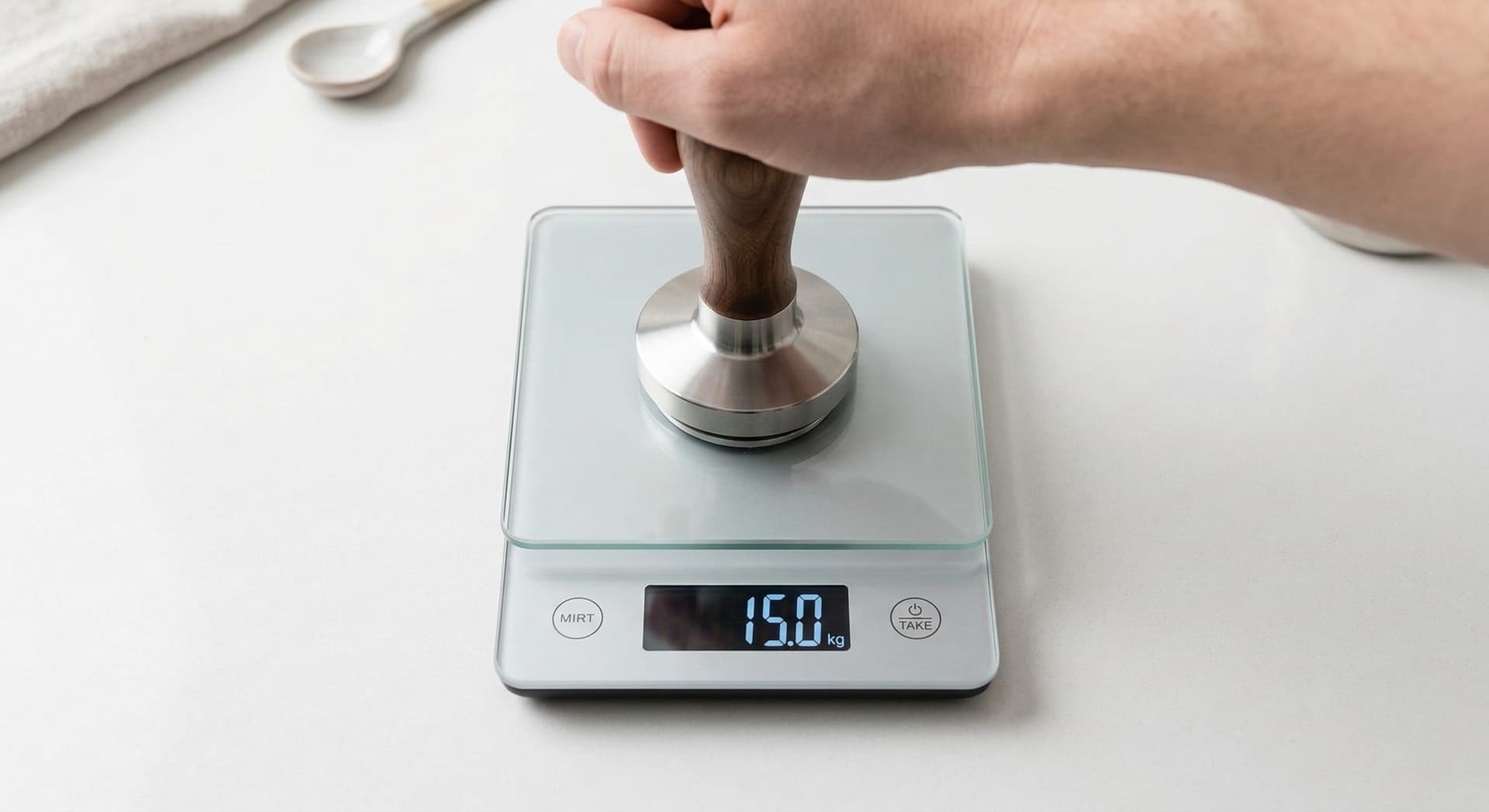
The kitchen scale calibration method: press until you hit your target reading, memorise the feel, then repeat without looking. 20–30 repetitions builds reliable muscle memory for consistent espresso tamping pressure.
One note on training environment: your “correct” tamping pressure feel depends partly on the surface height where you are working. If you calibrate at a counter that puts your elbow at 90°, then tamp at a different surface height, the same muscle memory produces a different force. Set up your calibration at the same surface where you pull shots day-to-day.
Why Levelness Beats Pressure Every Time
I have demonstrated this comparison in training probably a hundred times. The setup: pull a shot with a 25 lb tilted tamp (visible tilt of 5–7 degrees), then pull a shot with a 12 lb perfectly level tamp on the same grind and dose. The level shot pulls evenly every time. The tilted shot channels every time — regardless of the higher pressure.
The physics are straightforward. A tilted tamp compresses the grounds more on the side the tamper presses into first, and less on the opposite side. The thin side of the puck — where compression is lowest — offers the least resistance to water flow. At 9 bars of pressure, water finds that thin section immediately and channels straight through it while bypassing the rest of the puck.
The result on a naked portafilter: a spray on one side, a drip on the other. In the cup: a shot that tastes simultaneously sour (the under-extracted dense section the water bypassed) and bitter (the over-extracted channel). The over-extraction in the thin channel can happen in seconds — you are getting 90% of the extraction from 30% of the grounds.
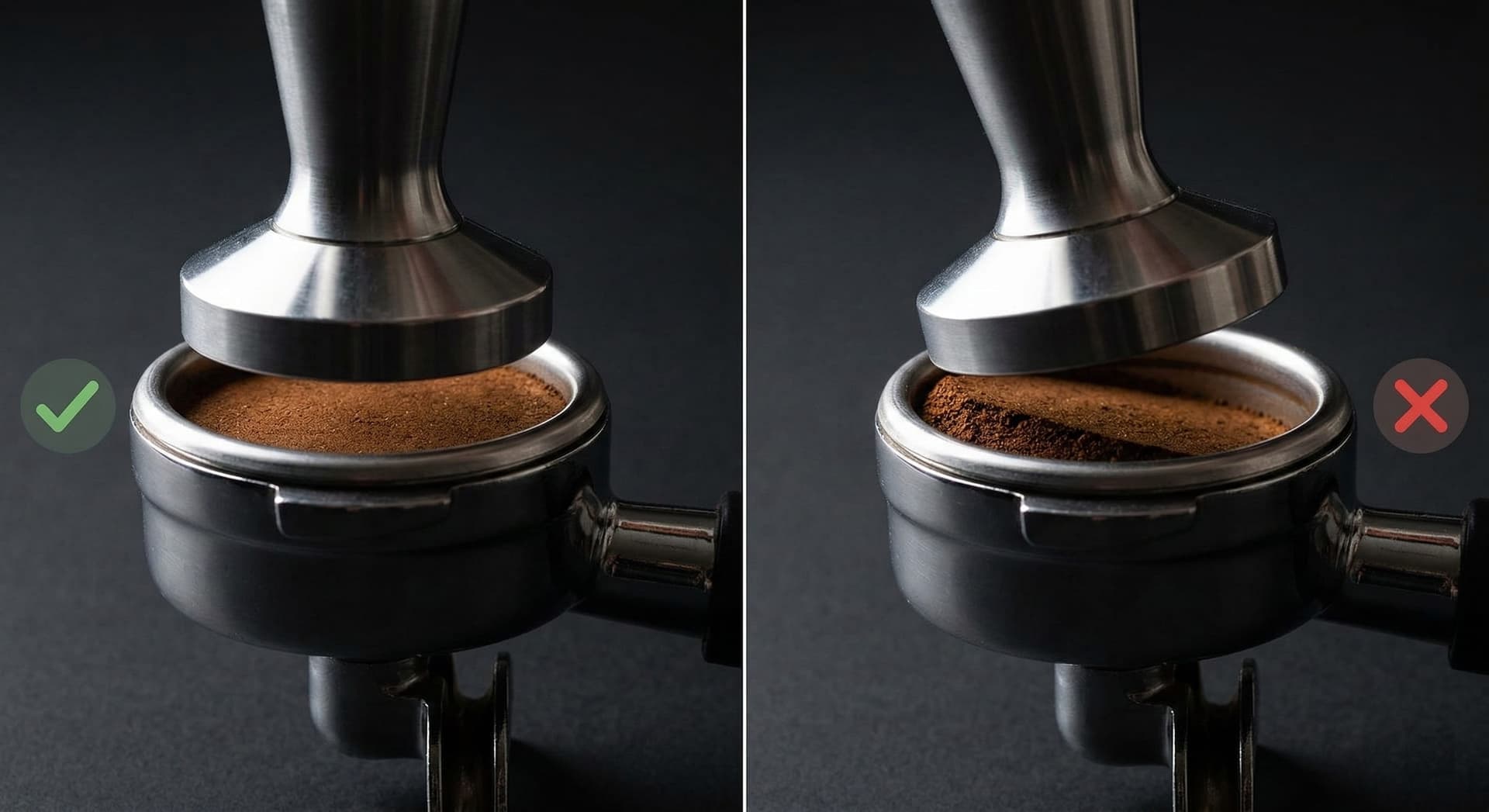
A level tamp compresses the puck uniformly across the entire basket diameter. A tilted tamp creates a thin section — water channels through it at every shot.
Practical ways to improve levelness are covered thoroughly in our espresso tamping technique guide — including elbow position, tamping station setup, and self-levelling tampers. For now, the key principle: before you commit to full downward pressure, place the tamper in the basket and look at it from the side. The base should be parallel to the basket collar — visible all the way around. Only once it is sitting level do you press.
Calibrated Tampers: Worth It?
A calibrated tamper (also called a spring-loaded or self-calibrating tamper) uses an internal spring mechanism that “clicks” and stops further compression when you reach a set pressure — typically 15 kg or 30 lbs. Once you hear or feel the click, you know you have hit the correct espresso tamping pressure without measuring.
My assessment after testing several models across training programs:
Genuine benefits
- Eliminates pressure variability entirely — you hit the same force every shot
- Removes cognitive load (no need to estimate pressure, focus goes entirely on levelness)
- Self-levelling models (Normcore V4, Pesado) also address tilt issues in one tamper
- Accelerates technique development for beginners — one less variable to think about
Honest limitations
- Pressure is already the least important variable — solving it first addresses the wrong problem
- Spring mechanism adds a slight flex to the downward press — some baristas find it harder to hold level
- Quality models cost £30–£80, which buys a WDT tool plus tamping mat that solve higher-priority issues
- Pressure click gives false confidence if distribution and levelness are still inconsistent
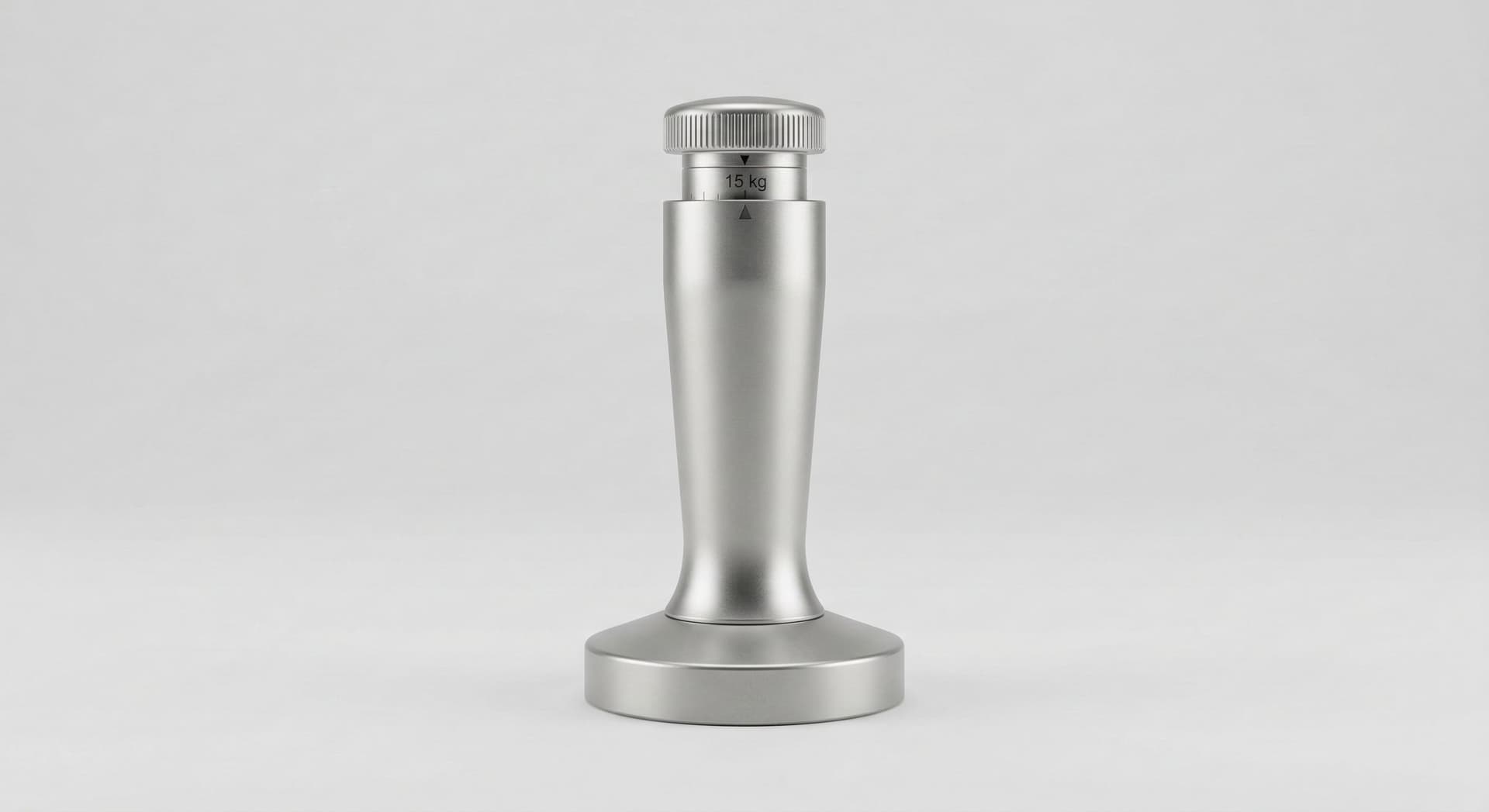
A calibrated (spring-loaded) tamper clicks when you reach the set pressure — useful for building consistent tamping habits, especially when learning.
My recommendation: if you are just starting out with espresso and want to eliminate one variable quickly, a calibrated tamper is a reasonable purchase. If you have been pulling espresso for a while and your pressure is already roughly consistent, the money is better spent on a WDT distribution tool or a tamping station. Fix distribution and levelness first; those variables actually move the needle.
Does Pressure Actually Change Extraction?
The honest answer: within normal ranges, barely. This is one of the more rigorously tested questions in home espresso, and the consistent finding across experiments (and my own informal testing) is that varying tamp pressure between 15–40 lbs changes shot time by 1–4 seconds — less than one grind-size click on most burr grinders.
The reason is that puck permeability — how easily water flows through the compressed grounds — is primarily determined by grind particle size and distribution, not compression. A tightly ground, evenly distributed bed is dense regardless of how hard you press. A coarsely ground, clumpy bed remains porous even under maximum hand pressure.
Understanding espresso extraction fully means understanding that grind size, dose, and water temperature are the primary extraction levers. Tamp pressure is a supporting variable — you need enough of it to seat the puck, but beyond that threshold it contributes very little. The variables that people spend time obsessing over (tamp pressure, exact dose to the 0.1g) often have less extraction impact than the variables they ignore (grind uniformity, distribution quality, pre-infusion profile).
If you are experiencing over-extraction (bitter espresso), the fix is almost certainly grind size — coarsen the grind rather than lightening your tamp. Our guide on why coffee tastes bitter walks through the full over-extraction diagnosis, including every variable that actually controls extraction yield.
Pressure Mistakes That Cost You Shots
1. Using pressure to fix shot speed
Shot running too fast? The instinct is to press harder. It won't work — or it'll work so marginally that the shot still tastes wrong. Grind finer. Tamp pressure cannot compensate for a grind that is too coarse.
2. Varying pressure between shots while diagnosing taste problems
If you are adjusting grind size to dial in your espresso and you are also varying your tamp pressure shot to shot, you are changing two variables simultaneously. You cannot isolate what caused the taste change. Nail your pressure consistency first, then adjust grind size one increment at a time.
3. Assuming hard tamping prevents channeling
Channeling is almost always caused by uneven distribution before tamping, or a tilted tamp. Pressing harder on a poorly distributed, crooked puck compresses the bad distribution — it does not fix it. You are locking in the problem, not solving it.
4. Ignoring surface height
Tamping at a counter that is too high forces your wrist into extension, which naturally angles the tamper. At the wrong height, consistent level tamping is physically difficult regardless of how hard you press. Find or create a surface where your elbow bends at approximately 90° when the tamper is in the basket.
5. Buying a calibrated tamper before sorting distribution
A calibrated tamper solves the least important tamping variable. If you are still tapping the portafilter to settle grounds (creates density gradients), dosing inconsistently, or skipping WDT, a calibrated tamper will not produce better shots. Fix the higher-impact steps first.
The full puck preparation sequence — distribution, settling, tamping, and headspace check — is covered step by step in our how to tamp espresso guide. If you want to improve shot-to-shot consistency across all the variables (not just pressure), that is the place to start.
For machine-level recommendations — including espresso machines with quality group heads that complement good puck prep — our best espresso machines guide covers tested picks at every price point, with notes on pre-infusion, OPV pressure settings, and portafilter basket quality across each model. Similarly, our best coffee grinders guide addresses grind consistency directly — because a grinder producing clumpy, uneven grinds makes distribution and tamping harder than they need to be.
Frequently Asked Questions
The standard recommendation is 20–30 lbs (9–14 kg) of downward force. In practice, anything above about 10–12 kg compresses the puck enough that water flow is not meaningfully affected.
What matters far more than the exact number is consistency between shots and — above all — a perfectly level tamp. A 15 lb level tamp beats a 40 lb crooked one every time.
Get Coffee Tips
Join our newsletter for expert reviews and brewing guides.