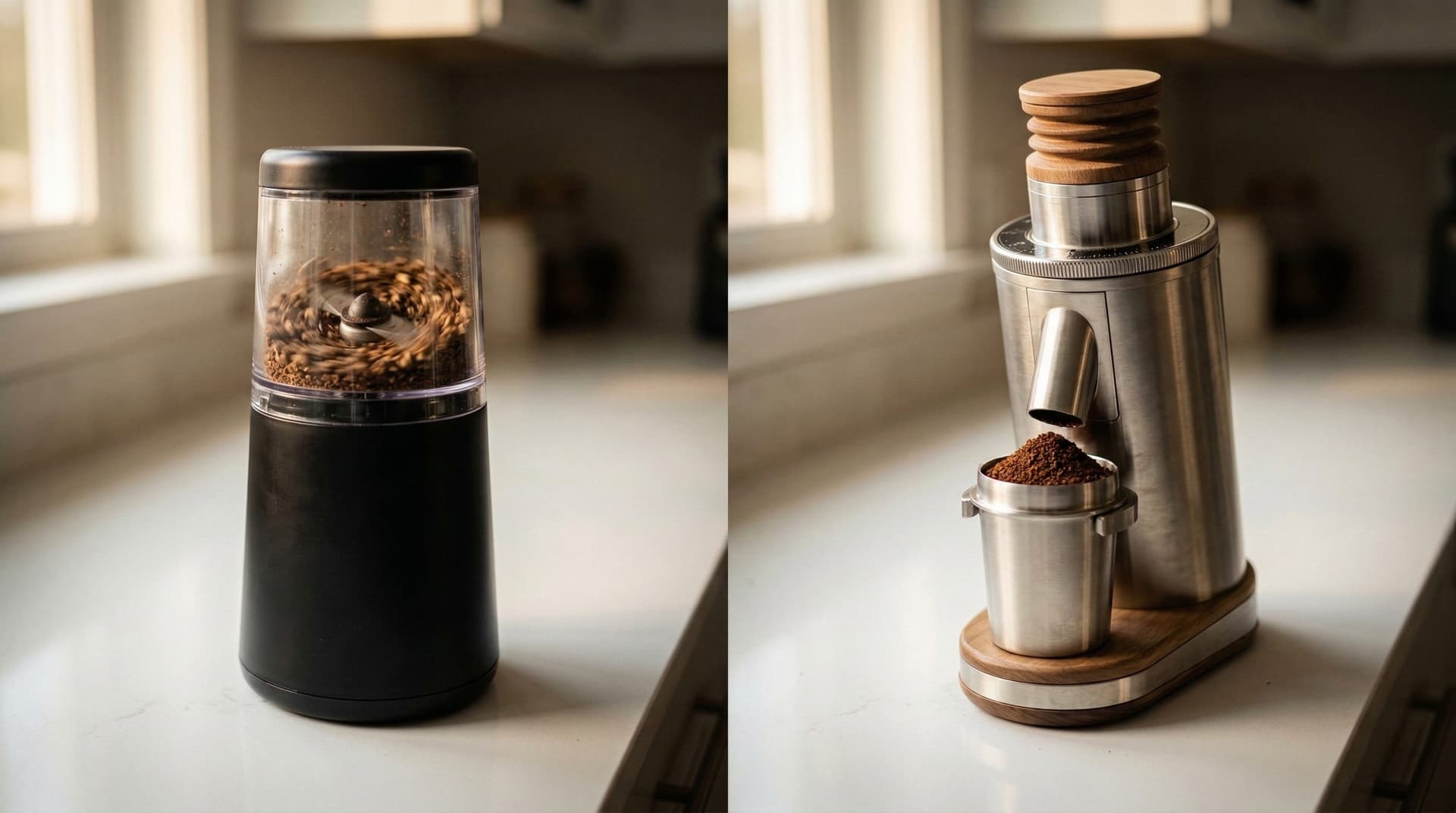
Burr Grinder vs Blade Grinder: What the Difference Actually Does to Your Coffee
After testing over 100 grinders, here's the honest answer on whether a burr grinder is worth it — and at what budget it pays off
I bought my first blade grinder at 22, convinced the $20 price tag was sensible for something I'd use every morning. About three years later, a colleague at a specialty coffee shop handed me a cup of pour-over made from the same beans I'd been buying, just ground fresh on a burr grinder. The difference was embarrassing. My version tasted harsh and flat; hers tasted like actual coffee — sweet, clean, with a complexity I hadn't tasted from my home setup.
That experience launched twelve years of grinder testing. I've now evaluated over 100 grinders across every price point and grinding technology, and I can give you a genuinely honest answer to this question: the burr grinder vs blade grinder debate isn't really a debate. But the nuance matters — because there are real situations where a blade grinder is the right call, and real price points where a burr grinder doesn't deliver enough improvement to justify the cost.
This is that honest comparison.
Burr vs Blade: At a Glance
Blade Grinder
- ✗Chops beans randomly — chaotic particle sizes
- ✗Simultaneous over- and under-extraction
- ✗No grind size adjustment
- ✗Generates heat that degrades aromatics
- ✓$15–$30 price point
- ✓Fast, low-maintenance
Burr Grinder
- ✓Crushes beans between two burr surfaces — uniform particles
- ✓Even extraction — cleaner, sweeter, more complex cup
- ✓Precise, repeatable grind size settings
- ✓Lower heat generation (especially conical burr models)
- ~$60–$250+ depending on quality tier
- ~Requires occasional cleaning
Quick answer→A burr grinder is worth it for almost anyone who brews fresh coffee daily. At $60+ (manual) or $150+ (electric), the taste improvement is immediate and permanent.
What Blade Grinders Actually Do to Coffee
A blade grinder works exactly like a small food processor: a spinning metal blade chops through whole beans at high speed. You control grind size by deciding when to stop — shorter pulses produce coarser grounds, longer grinding produces finer grounds. It sounds simple and controllable. It isn't.
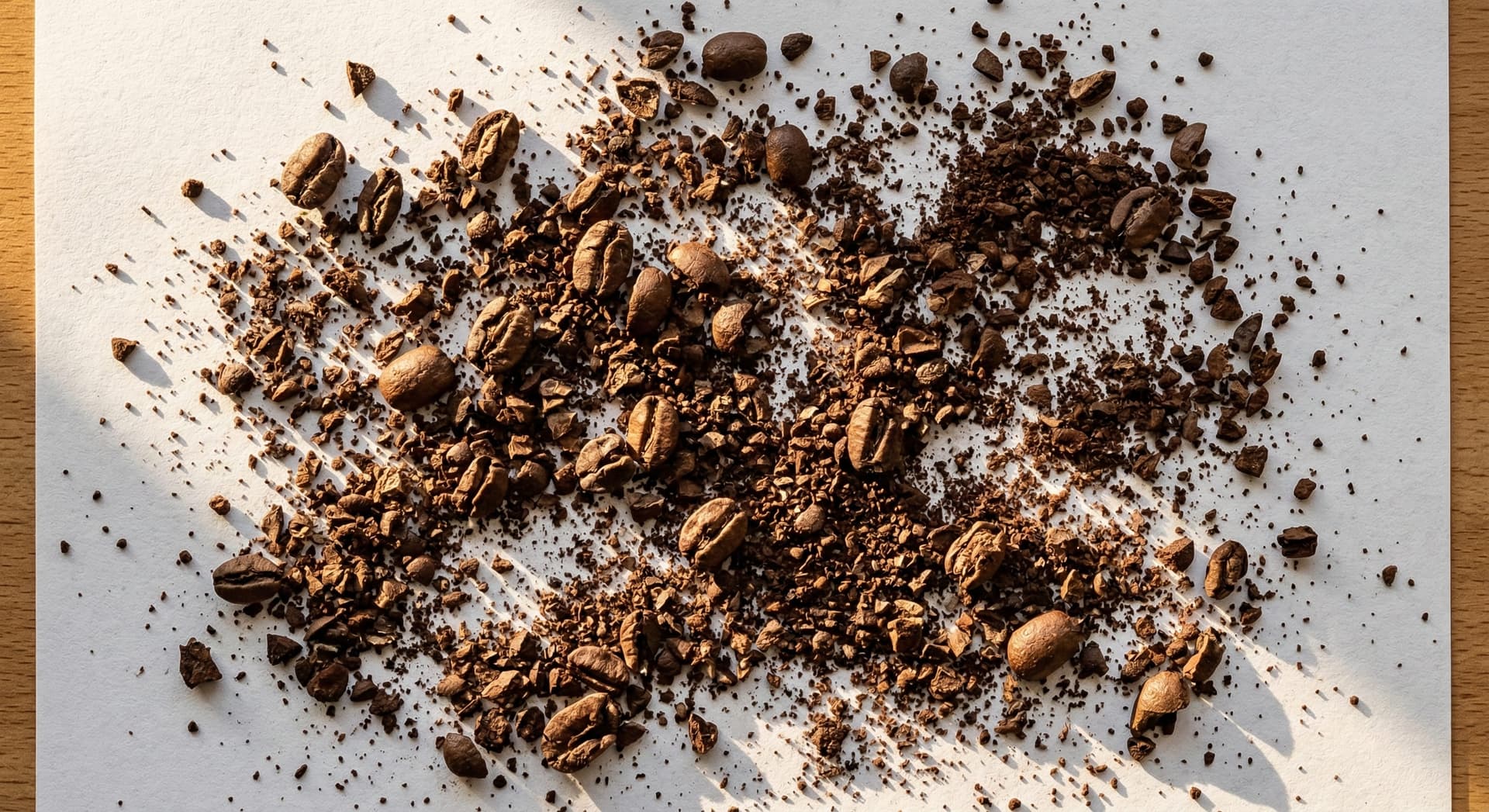
The fundamental problem with blade grinding is particle distribution. When a blade spins through a chamber of whole beans, it contacts beans at different distances from the blade, traveling at different velocities, and hitting each bean at different angles. Some beans get chopped into near-powder. Others barely get touched and remain oversized. The result is a mixture of particle sizes spanning orders of magnitude — from fines barely visible to the eye, to chunks that are still close to whole-bean size.
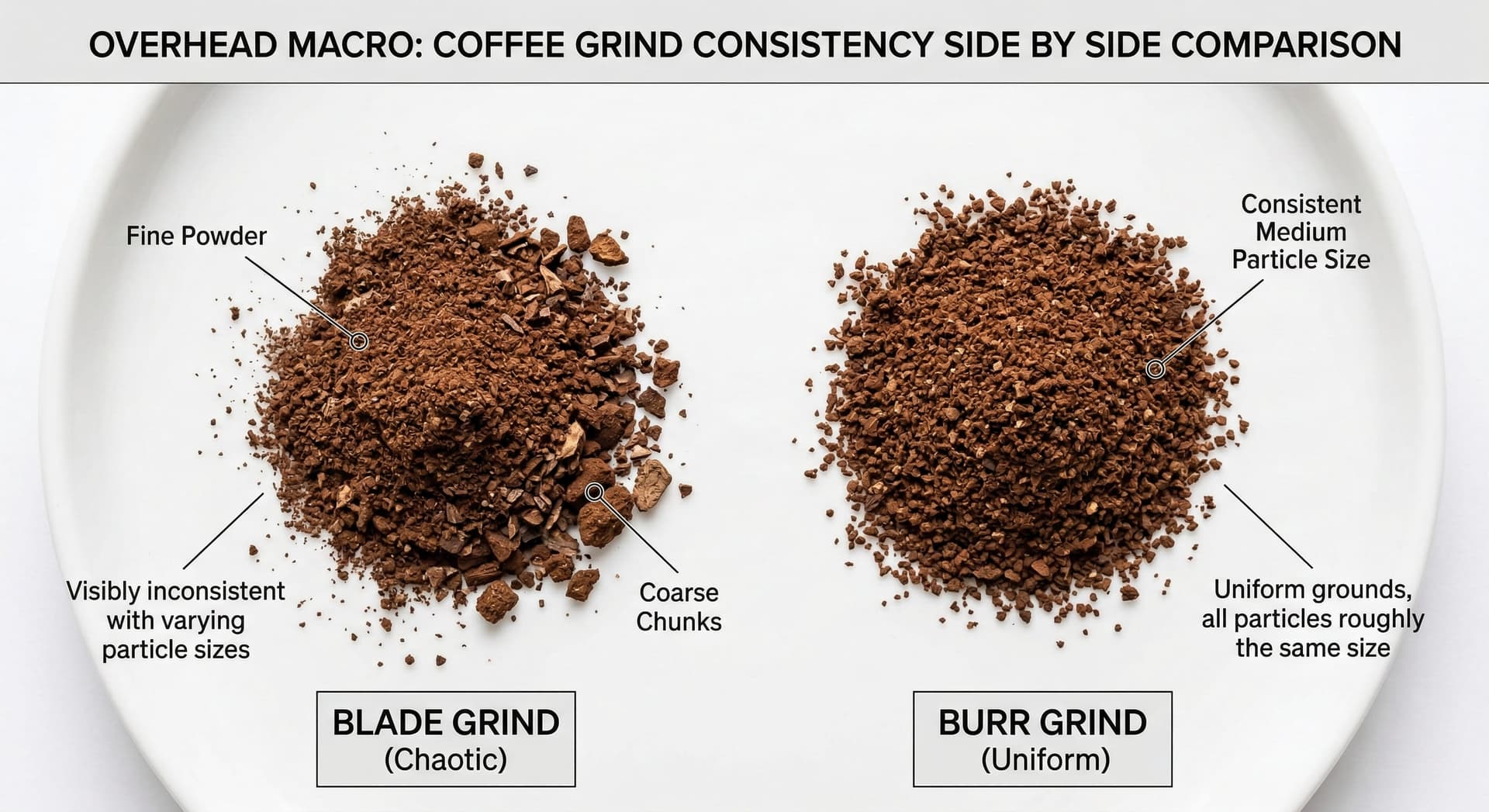
This is a real problem because coffee extraction rate is almost entirely determined by particle surface area. Hot water dissolves soluble compounds from the surface of each coffee particle — the smaller the particle, the greater the surface area relative to volume, and the faster it extracts. When you grind with a blade grinder and brew, you are simultaneously brewing:
What's Happening in a Blade-Ground Brew
- →The ultra-fine powder: Over-extracts within seconds, dumping harsh bitter compounds and chlorogenic acids into your cup before the rest of the grounds have started
- →The coarse chunks: Under-extract throughout the entire brew, contributing sourness, grassiness, and hollow flatness
- →The medium particles: Extract reasonably well — but they can't compensate for what the other two fractions are doing
I've run particle distribution analysis on blade-ground coffee using professional coffee lab sieve sets. A typical 30-second blade grind at "medium" produces particles ranging from under 100 microns (espresso-fine) to over 1,500 microns (coarser than French press target). The same grind time in different sessions produces completely different distributions depending on how much coffee is in the chamber, its moisture content, and random variation in blade contact. There's no reproducibility.
This is also why blade grinders run hot. The high-speed blade generates friction heat throughout the grinding chamber. Research from coffee science labs has measured temperature rises of 10–15°C during a typical blade grind — enough to volatilise some of the aromatic compounds responsible for floral, fruity, and delicate notes in lighter roasts. By the time you pour water over blade-ground coffee, some of what made those beans interesting has already evaporated.
How Burr Grinders Work — and Why It Matters
A burr grinder uses two abrasive surfaces — the burrs — separated by a fixed, adjustable gap. Beans are fed between the burrs and crushed as they pass through. The gap between the burrs determines particle size: wider gap, coarser grind; narrower gap, finer grind. The mechanism is mechanically constrained — particles cannot exit the burrs until they're small enough to fit through the set gap.
This constraint is the key to consistent grind coffee. Unlike a blade that randomly contacts beans at varying angles and velocities, burrs process every bean through the same mechanical pathway. The result: a particle distribution that's narrow and repeatable. Instead of spanning from 100 to 1,500+ microns, a quality burr grinder at medium setting might produce particles between 400 and 700 microns — roughly the right range for pour-over, with almost all particles extracting at the same rate.
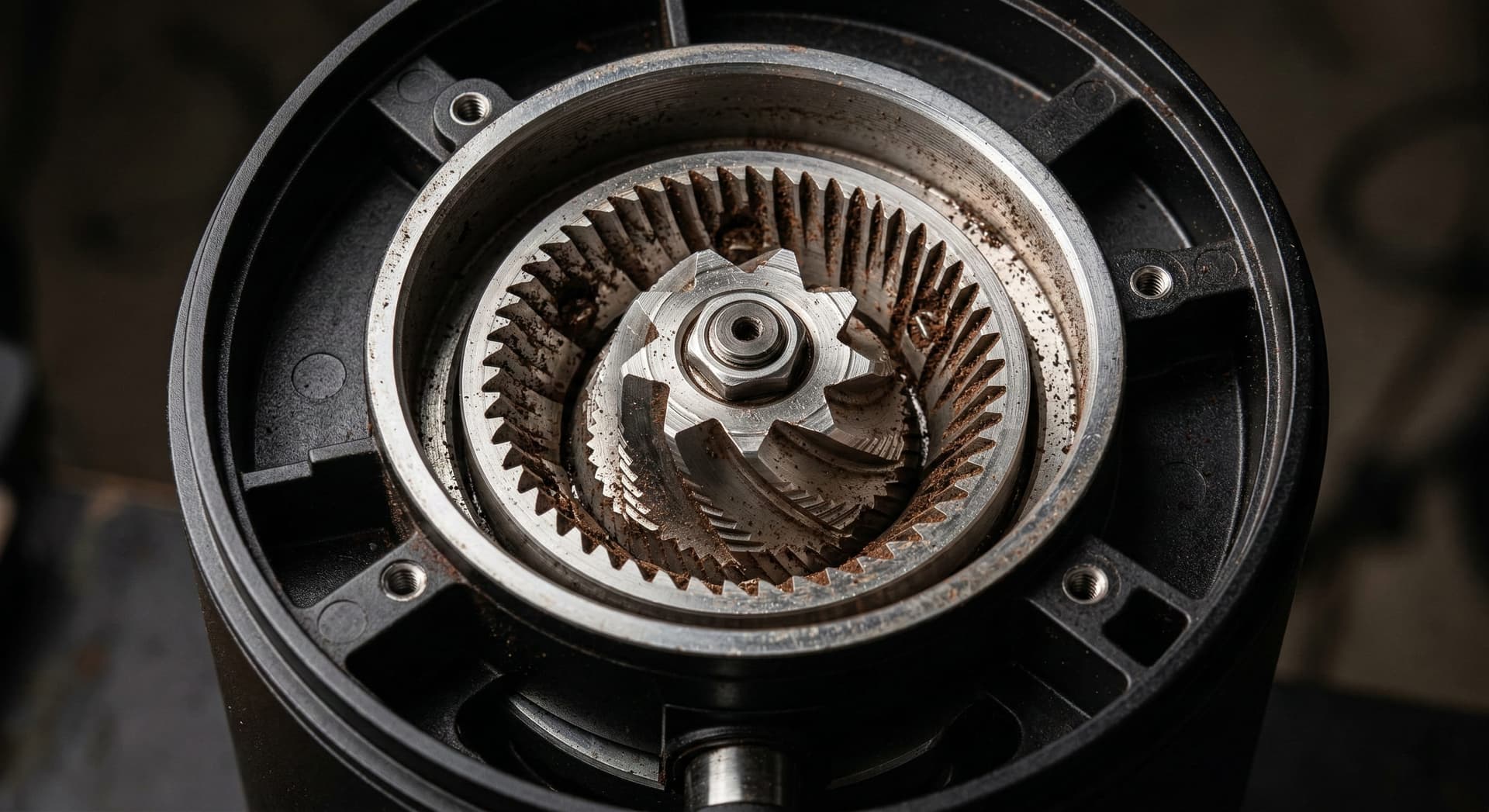
There are two main burr geometries you'll encounter:
Conical Burrs
A cone-shaped inner burr rotating inside a hollow ring-shaped outer burr. Beans flow vertically downward through narrowing gaps. Most home grinders use conical burrs.
- ✓Quieter operation (slower RPM)
- ✓Lower cost at same quality level
- ✓Less heat generation
- ✓Works well with oily dark-roast beans
Flat Burrs
Two parallel disc-shaped burrs facing each other. Beans are fed through the center and flung outward through the gap. Used in most commercial and high-end home grinders.
- ✓Superior particle uniformity
- ✓Clearer, brighter cup clarity
- ~Higher cost at equivalent build quality
- ~Louder and more heat generation
The adjustable gap is the other critical feature. A burr grinder with stepless adjustment lets you dial in exactly the particle size you need for your brew method and adjust in tiny increments as your beans age, change humidity, or when you switch to a new bag. This precision is what makes espresso extraction controllable — espresso's 9-bar pressure amplifies grind inconsistencies to a degree that makes a blade grinder genuinely unsuitable for the method.
The Taste Difference: Is It Really That Noticeable?
The most common question I get is whether you can actually taste the difference between blade-ground and burr-ground coffee in everyday brewing. The honest answer: yes, clearly, and in almost every brewing context.
The most dramatic difference is in espresso — blade-ground espresso is effectively a different (worse) drink than burr-ground espresso. The inconsistent particle sizes create simultaneous over-extraction channels and under-extracted puck sections, producing a shot that's simultaneously harsh, sour, and flat. I've never pulled a blade-ground espresso that tasted good. I have pulled many blade-ground espressos that tasted genuinely bad.
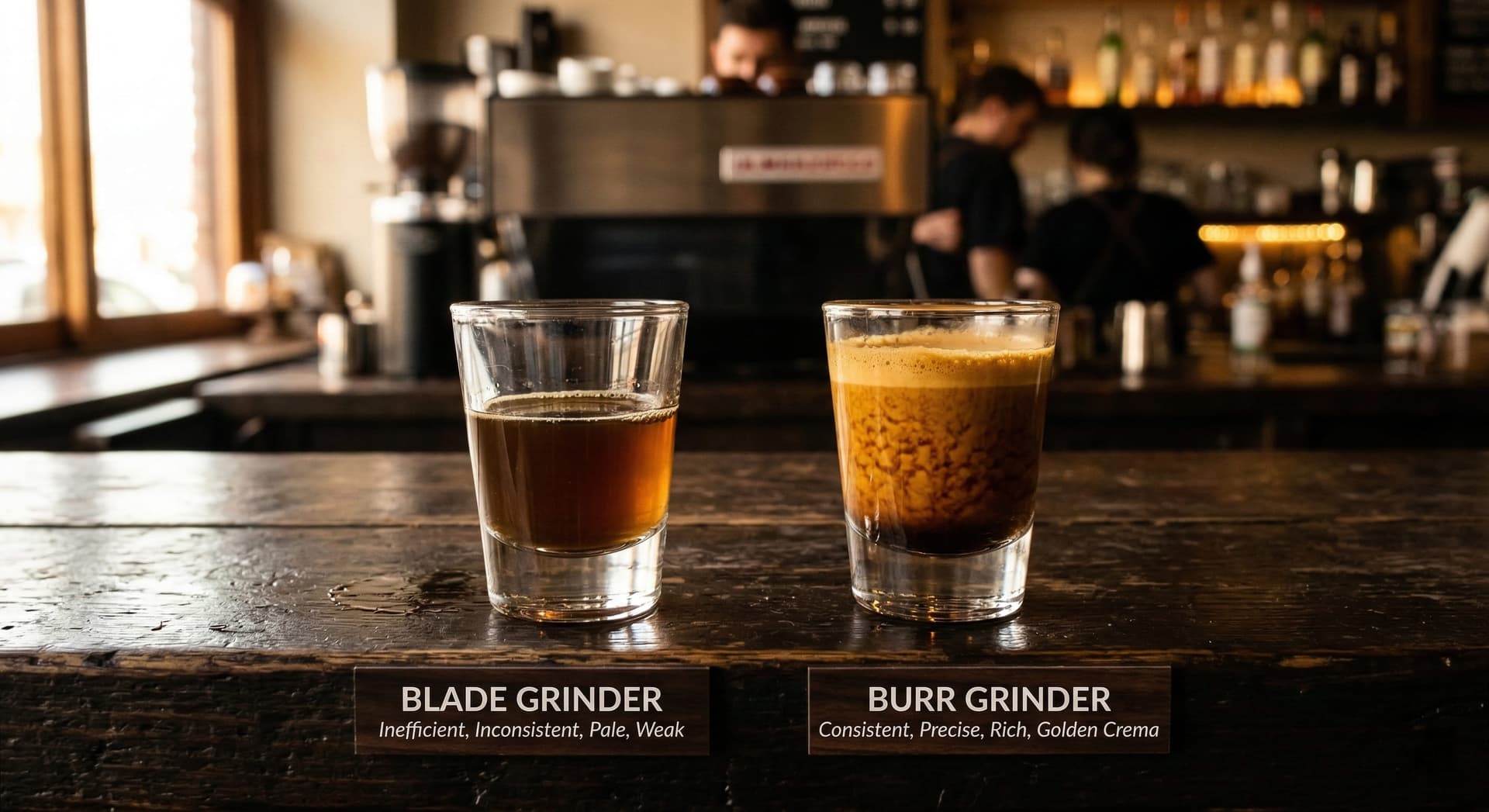
For pour-over, the difference is almost as clear. Pour-over brewing depends on controlled, even water flow through a uniform coffee bed. When the bed contains wildly inconsistent particles, water finds paths of least resistance through the coarser areas, bypassing the finer sections — a partial channeling effect. The result is the same pattern as espresso channeling: simultaneously bitter (from the fines) and sour and flat (from the coarse under-extracted chunks).
For drip coffee, the gap narrows — but still exists. Drip brewing is more forgiving because the extraction happens over a longer period with more controlled water contact. But even here, blade-ground coffee produces noticeably more bitterness, less clarity, and less perceived sweetness than burr-ground coffee made from the same beans. In side-by-side tastings I've run with coffee-curious but non-specialist participants, the majority consistently identifies burr-ground drip coffee as tasting better, even when they can't articulate exactly why.
What Burr-Ground Coffee Tastes Like Compared to Blade
- ✓Sweeter: Sweet compounds extract at the right rate when all particles are the same size
- ✓Cleaner finish: No bitter over-extracted fines tainting the aftertaste
- ✓More complex: Origin character and roast nuances come through instead of being masked by extraction noise
- ✓More aromatic: Lower heat generation during grinding preserves volatile aromatic compounds
- ✓Reproducible: The same grind setting on the same beans produces the same cup every time
Who Should Keep Using a Blade Grinder
I'm not going to pretend every situation demands a burr grinder upgrade. There are real cases where a blade grinder makes sense, and it's worth being honest about them.
You brew cold brew exclusively
Cold brew's 12–24-hour steep time and high coffee-to-water ratio make it the most forgiving brewing method for grind inconsistency. Blade-ground cold brew is noticeably rougher in texture and less refined in flavour than burr-ground — but if cold brew is your only use and taste standards are flexible, a blade grinder is defensible here.
You only use it for occasional spice grinding and rarely make coffee
If you grind coffee once a month and the rest of the time use the blade grinder for spices, the maths don't support upgrading. Blade grinders double as spice mills; burr grinders don't.
Your budget is truly under $50 and you need an electric grinder now
Sub-$50 electric burr grinders I've tested (with some honourable exceptions) don't deliver reliable enough burr alignment and consistency to meaningfully outperform blade grinders. If $50 is the hard ceiling for an electric grinder, I'd either look at a manual burr grinder in that range (the Timemore C3 is around $60 and excellent) or wait and save.
You buy pre-ground coffee and the blade grinder is redundant anyway
If you're grinding whole beans to make pre-ground coffee texture, you're better off buying pre-ground. The grind quality from a blade grinder doesn't justify the effort over quality pre-ground.
In every other scenario — daily drip coffee, pour-over, AeroPress, espresso — a burr grinder will meaningfully improve what's in your cup, and the upgrade pays for itself through better coffee enjoyment from beans you're already buying.
When a Burr Grinder Is Actually Worth It
"Is a burr grinder worth it?" depends heavily on what you're comparing it to and what you're currently tasting in your cup. Let me be specific.
Burr grinder is clearly worth it if:
- •You brew espresso — the pressure-based extraction makes grind consistency non-optional
- •You brew pour-over or AeroPress — both reward uniform grounds with dramatically better clarity and sweetness
- •You make coffee every day — the quality improvement compounds across hundreds of cups per year
- •You're spending $15+ per 250g on specialty beans — buying good beans and blade-grinding them is genuinely wasteful
- •You have persistent bitter coffee problems — switching from blade to burr is the highest-impact single fix for bitter, harsh coffee
The beans point deserves emphasis. I consistently see home brewers spend $20–$30 per 250g on single-origin specialty coffee, then grind it on a blade grinder. The blade grinder destroys a significant portion of the flavour complexity those beans were roasted and selected to deliver. If you're investing in quality beans, a burr grinder is the most efficient way to protect that investment.
For a deeper dive into how grind size affects every aspect of espresso extraction — and why even small inconsistencies create compounding extraction problems — our guide on espresso extraction covers the mechanics in full. For filter brewing and other methods, grind consistency matters for the same reasons, just with slightly more tolerance for variation.
Budget Entry Points: What to Expect at Each Price
Based on my testing across price tiers, here's what you actually get at each budget level — and where the value genuinely sits.
Manual Burr Grinders
The Timemore Chestnut C3 (~$60–$75) and similar hand grinders in this range deliver genuine burr-grinder consistency — narrow particle distribution, precise stepless adjustment, and build quality that lasts years. They require 60–90 seconds of hand-cranking per dose, which most people adapt to quickly as a morning ritual. For drip, pour-over, AeroPress, and French press: excellent. For espresso: the C3 Pro (~$85–$100) handles it well; the base C3 less so.
Best for: Filter brewing, travel, anyone comfortable with 90 seconds of manual grinding
Entry Electric Burr Grinders
The Baratza Encore ESP is the grinder I most often recommend at this tier — 40mm steel conical burrs, 40 grind settings spanning espresso to French press, reliable motor, and Baratza's industry-leading repair support. I've tested it extensively and it performs significantly better than its price suggests. The Fellow Opus in this range is also very strong for filter brewing. Both deliver a day-one, immediately-noticeable improvement over any blade grinder.
Best for: Daily espresso and filter brewing, anyone wanting set-and-forget convenience
Mid-Range Electric Burr Grinders
This is where grind uniformity becomes genuinely excellent rather than just good. The Eureka Mignon Specialita and similar models in this bracket produce espresso-grade particle distribution that reveals flavour complexity you simply don't access below this price point. For serious home espresso with high-quality single-origin beans, the jump from $200 to $350–$400 is meaningful. For filter coffee, it's incremental.
Best for: Serious espresso enthusiasts, specialty single-origin brewing
For tested recommendations with specific models at every budget, our best coffee grinders guide covers the full range with hands-on testing notes. If you're ready to go deeper on selecting the right burr type, burr size, and features for your specific brewing method, the complete burr grinder buying guide walks through every decision point with the same hands-on testing methodology.
Frequently Asked Questions
Frequently Asked Questions
For anyone who drinks coffee daily and cares about taste, yes — unambiguously. Burr grinders produce consistent particle sizes that extract evenly, resulting in balanced flavour with clarity you simply can't get from blade-ground coffee.
The difference is most obvious if you brew espresso or pour-over; less dramatic but still real for drip coffee. I've tested dozens of grinders on both sides of this divide, and the cup quality gap is significant enough that most people who switch to a burr grinder never seriously consider going back.
Get Coffee Tips
Join our newsletter for expert reviews and brewing guides.