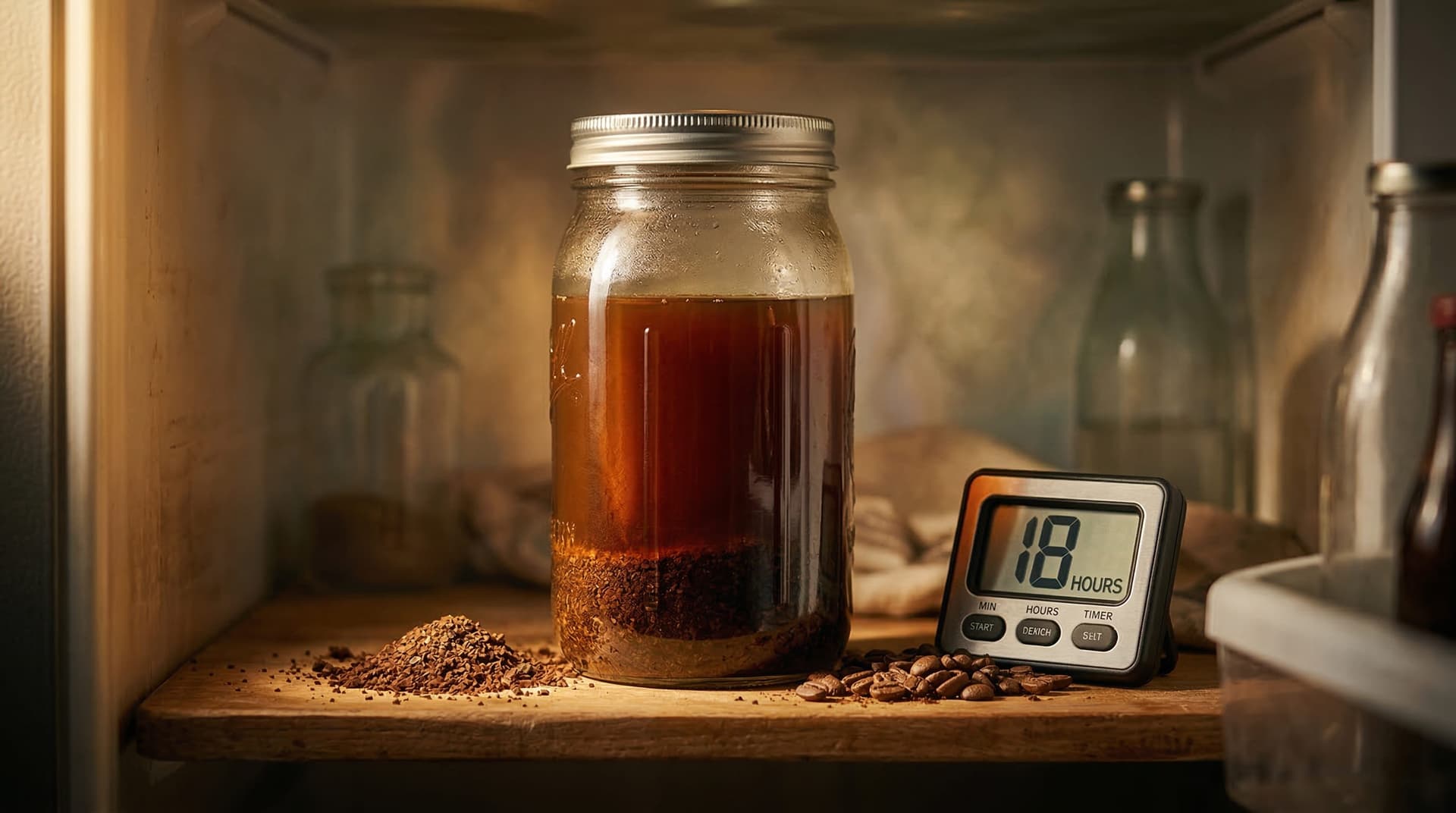
How to Make Cold Brew Coffee at Home
The exact cold brew ratio, steep time, and filtering method I use after testing 20+ setups — including why 18 hours beats 24, and when concentrate beats ready-to-drink
I've been testing cold brew methods for over a decade — in café back-offices, at home in a 32-oz mason jar, and across a range of dedicated cold brew systems from the Oxo Brew to the Toddy. Most of the cold brew advice online gets at least one critical variable wrong. Either the ratio is off, or the steep time is copied from packaging without any testing, or someone's equating cold brew with iced coffee as if they're the same thing.
They're not. And the variables that actually matter — ratio, grind size, water temperature, and steep time — interact in ways that trip up even experienced home brewers when they switch from hot methods to cold.
This guide covers everything I've learned from making hundreds of cold brew batches. I'll give you the exact recipe I use, explain why each variable is set where it is, and flag the mistakes that consistently ruin batches for people who are otherwise competent home brewers.
What Is Cold Brew Coffee?
Cold brew is coffee brewed by steeping coarsely ground coffee in cold or room-temperature water for an extended period — typically 12–24 hours. No heat is involved at any stage.
This matters more than most people realize. Heat is the primary driver of acid extraction in hot-brewed coffee. Chlorogenic acids, quinic acid, and other acidic compounds that create coffee's characteristic brightness (and, in excess, its bitterness) are thermally sensitive — they extract rapidly with hot water and barely at all with cold water over a long steep.
The result is a coffee that's naturally sweeter, much lower in perceived acidity, and significantly smoother in body than any hot-brewed method. Cold brew isn't just coffee that's been chilled — it's a chemically distinct product. I've blind-tasted cold brew made from the same beans using hot and cold methods side-by-side with baristas during training sessions, and even experienced tasters are sometimes surprised at how different the two products taste from identical source material.
Cold Brew vs Iced Coffee: Why They're Not the Same Thing
This distinction comes up in every cold brew conversation, so I'll be direct: iced coffee is brewed hot and then cooled or poured over ice. Cold brew is never heated. That's the entire difference, but it produces dramatically different results.
| Factor | Cold Brew | Iced Coffee |
|---|---|---|
| Brew temp | Cold / room temp | Hot (~93°C / 200°F) |
| Steep time | 12–24 hours | 3–5 minutes |
| Acidity | Low — smooth | Higher — can taste sour when cooled |
| Body | Full, syrupy | Lighter, can become watery over ice |
| Caffeine | Higher (concentrate) | Standard drip levels |
| Shelf life | 10–14 days (concentrate) | 1–2 days max |
| Cost per serving | Uses more coffee per cup | Standard coffee yield |
The practical implication: if you've tried iced coffee and found it sour or harsh after the ice melted, that's the hot-brewed acids coming through as the drink dilutes. Cold brew doesn't have this problem because it never contained those acids in the first place. Many people who describe themselves as "not a coffee person" because regular coffee is too bitter find cold brew genuinely enjoyable — sometimes even black.
To understand how cold brew fits into the broader landscape of coffee drink differences, it helps to know that cold brew is effectively its own brewing category rather than a variant of drip or espresso.
What You Actually Need to Make Cold Brew at Home
I want to be clear about this upfront: you do not need a dedicated cold brew system to make excellent cold brew. I've made side-by-side comparisons of mason jar cold brew and Toddy cold brew from the same beans, same ratio, and same steep time. The flavor difference is marginal — the Toddy filters slightly faster and produces slightly less sediment, but the cups taste nearly identical.
The Minimum Setup
- ✓Wide-mouth mason jar — 32 oz or larger. A French press also works well.
- ✓Kitchen scale — ratio control is the single biggest variable. Volume measurements are unreliable for coffee.
- ✓Burr grinder — set to coarse. A consistent burr grinder prevents fines that make filtering a nightmare and produce bitterness.
- ✓Fine-mesh strainer lined with a paper coffee filter or two layers of cheesecloth.
- ✓Filtered water — hard tap water will dull the flavor. It matters more in cold brew because there's no heat to work around mineral issues.
Optional Upgrades
- →Dedicated cold brew maker (Oxo, Toddy) — faster filtering, slightly cleaner cup, less mess.
- →Cold brew bag or sock filter — allows you to pull grounds out cleanly without pouring through a strainer.
- →Glass storage bottles — 500ml swing-top bottles are ideal. Plastic absorbs coffee oils over time.
Start with the mason jar method for your first few batches. Once you know the ratio and steep time that works for you, then decide if specialized equipment is worth buying.
Choosing the Right Coffee for Cold Brew
Cold brew rewards good coffee more than almost any other method because it has no heat to mask defects. Robusta-heavy blends or low-grade dark roasts will produce harsh, earthy concentrates that no amount of dilution will fix.
My preference is medium or medium-dark roast single-origin beans — specifically those with tasting notes of chocolate, caramel, or stone fruit. These roast levels produce the best cold brew body. Light roasts can work but often taste thin in cold brew because they rely on acidity for their character, and cold extraction suppresses that acidity almost entirely.
Guatemalan, Colombian, and Brazilian beans tend to perform best for cold brew in my testing. Brazilian naturals in particular — with their heavy body and low natural acidity — produce exceptional cold brew concentrate.
Cold Brew Ratio: The Number That Changes Everything
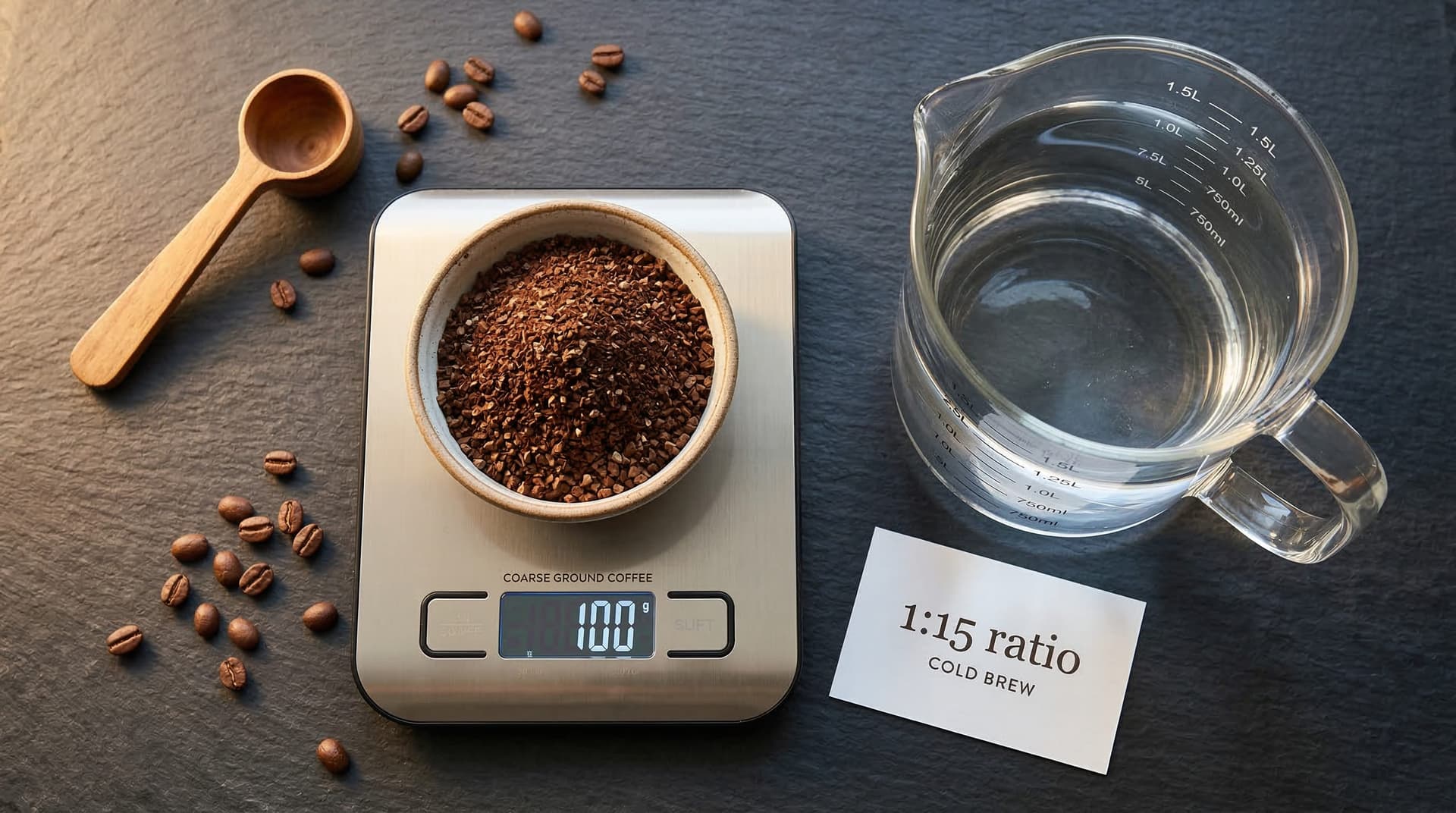
The cold brew ratio is the weight of coffee grounds divided by the weight of water. It's the most important variable in cold brew, and it's where most recipes either make the process more complicated than it needs to be or give you a useless single-number recommendation without context.
There are two main approaches:
Cold Brew Concentrate
100g coffee : 800ml water
This is my default method. You get a concentrated extract that you dilute at serving. More flexible — you can adjust strength to taste, add milk or cream without the final drink becoming watery, and it stores longer.
Ready-to-Drink
100g coffee : 1500ml water
Makes cold brew you can drink straight from the fridge without dilution. Simpler workflow, but less versatile. If you pour it over ice, it will dilute further — a problem concentrate doesn't have.
One note: always measure by weight, not volume. "1 cup of ground coffee" can vary by 20–30g depending on grind size and how tightly the grounds are packed. A kitchen scale eliminates this variable completely and makes your batches reproducible.
Cold Brew Coffee Recipe: Step-by-Step
This is the exact method I use for standard concentrate batches. It's been refined across hundreds of batches and tested against more complex methods that use nitrogen flushing, specific water mineral profiles, and temperature-controlled environments. The simple version consistently produces comparable quality for home use.
Recipe at a Glance
- 1
Grind your coffee coarse
Set your burr grinder to its coarsest setting — coarser than you'd use for French press, even. The particles should look like coarse sea salt or raw sugar. Fines (fine coffee dust) are the enemy in cold brew: they pass through most filters, cloud the concentrate, and over-extract during the long steep. A blade grinder will create so many fines that filtering becomes a frustrating slog. If you're serious about making cold brew regularly, a decent burr grinder is the one piece of equipment worth investing in.
- 2
Weigh the coffee and water
Weigh out 100g of grounds and 800ml (800g) of cold filtered water. These amounts scale linearly — for a larger batch, use 200g coffee to 1600ml water, and so on. Filtered water makes a real difference in cold brew. The flat mineral profile of filtered water lets the coffee's natural sweetness come through without interference from chlorine or heavy mineral content.
- 3
Combine and stir
Add grounds to your mason jar first, then pour the cold water over them slowly. Stir gently but thoroughly for 30–45 seconds, making sure every particle is saturated. Dry pockets of grounds at the top won't extract and you'll lose yield. Don't be aggressive — you're not trying to extract anything yet, just ensuring even saturation before the long steep.
Tip: Pour in circular motions from the outside inward, like you're doing a pour over bloom — it helps wet grounds evenly.
- 4
Seal and refrigerate for 18 hours
Seal the jar tightly and place it in the refrigerator. Write the start time on a sticky note if you have a tendency to forget. The fridge temperature (~4°C / 39°F) slows extraction and produces a smoother, cleaner result than room-temperature cold brew. You can steep at room temperature and reduce time to 8–12 hours, but the flavor profile shifts — slightly more acidic, slightly less clean. I prefer the fridge method for almost every batch.
- 5
Filter the cold brew
This step trips up more people than any other. Set a fine-mesh strainer over a large bowl or pitcher. Line it with a paper coffee filter (Chemex or standard drip size both work) or two layers of dampened cheesecloth. Pour the steeped cold brew slowly into the strainer. Don't stir or press the grounds — gravity-fed filtering produces a clearer concentrate. Expect this to take 10–20 minutes depending on how coarse your grind is and how saturated your filter is.
If filtering is very slow, your grind was too fine. Adjust coarser next batch.
- 6
Store in a sealed glass container
Transfer the filtered concentrate to a clean glass container — mason jars, swing-top bottles, or any glass bottle with a seal works. Label it with the date. Concentrate keeps for 10–14 days refrigerated. Plastic containers are fine if that's all you have, but glass is preferable for long-term storage: plastic can absorb coffee oils and impart off-flavors to future batches if the container is reused.
Cold Brew Steep Time: Why 18 Hours Outperforms 12 and 24
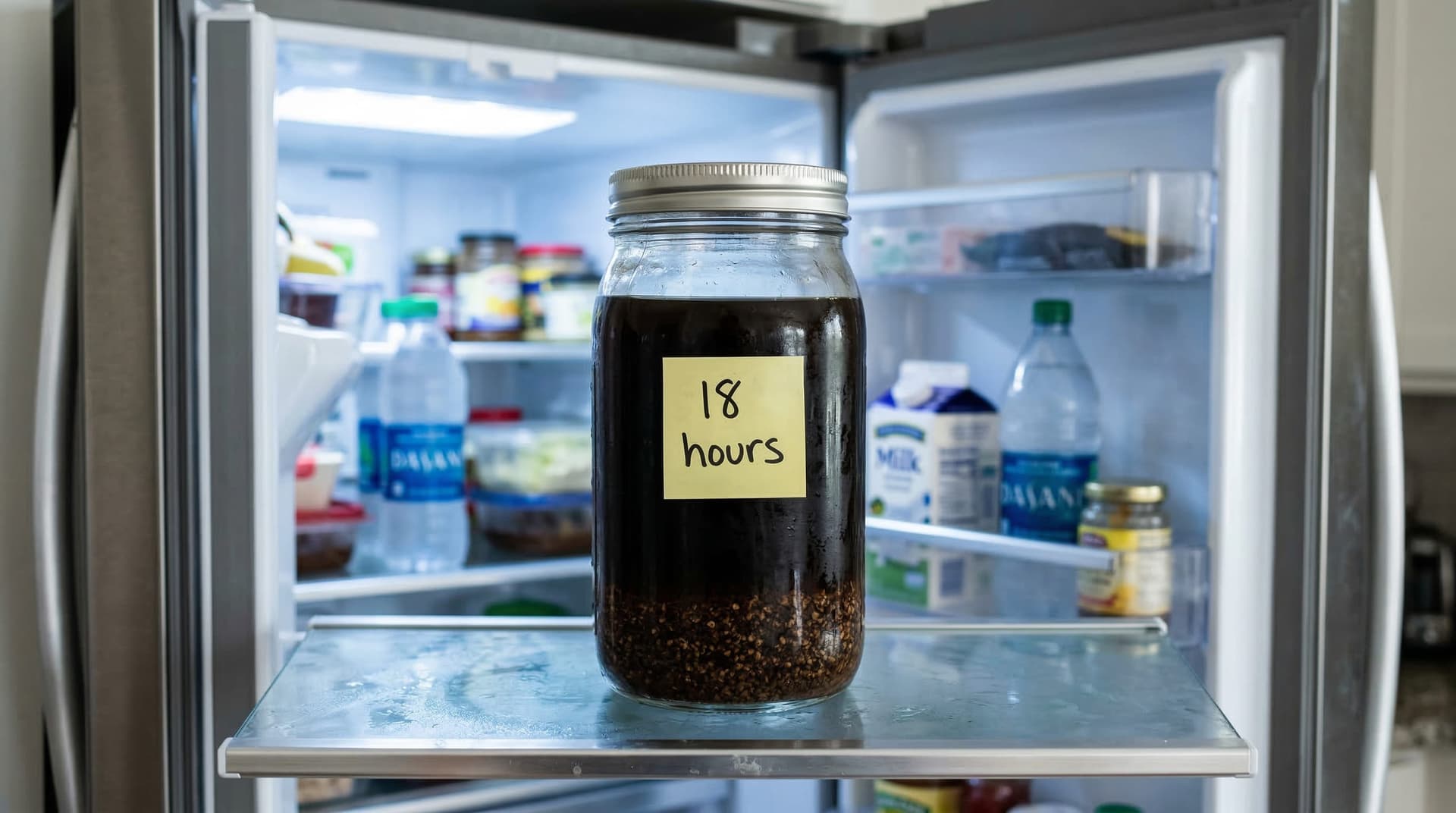
Cold brew steep time is the variable people spend the most energy debating, but the answer is simpler than most guides make it. Here's what I found after running systematic comparison batches:
12 Hours — Under-extracted
Thin body, lacks the characteristic smoothness and sweetness of proper cold brew. Tastes closer to weak iced coffee. You haven't given the coarse grounds enough contact time at cold temperatures to fully extract sugars and body compounds.
18 Hours — The Sweet Spot ✓
Full body, maximum natural sweetness, smooth and clean finish. The extraction curve plateaus around 16–20 hours for a coarse grind at refrigerator temperature. 18 hours hits the middle of this plateau consistently. This is where I land for nearly every batch.
24 Hours — Slightly Over-extracted
Noticeable increase in bitterness and a slightly harsh, woody edge — especially with darker roasts. The gains in body beyond 18 hours are marginal, but the bitter compounds continue extracting. Fine with very light roasts and very coarse grinds, but risky for most beans.
Cold Brew Concentrate vs Regular Cold Brew: Which Should You Make?
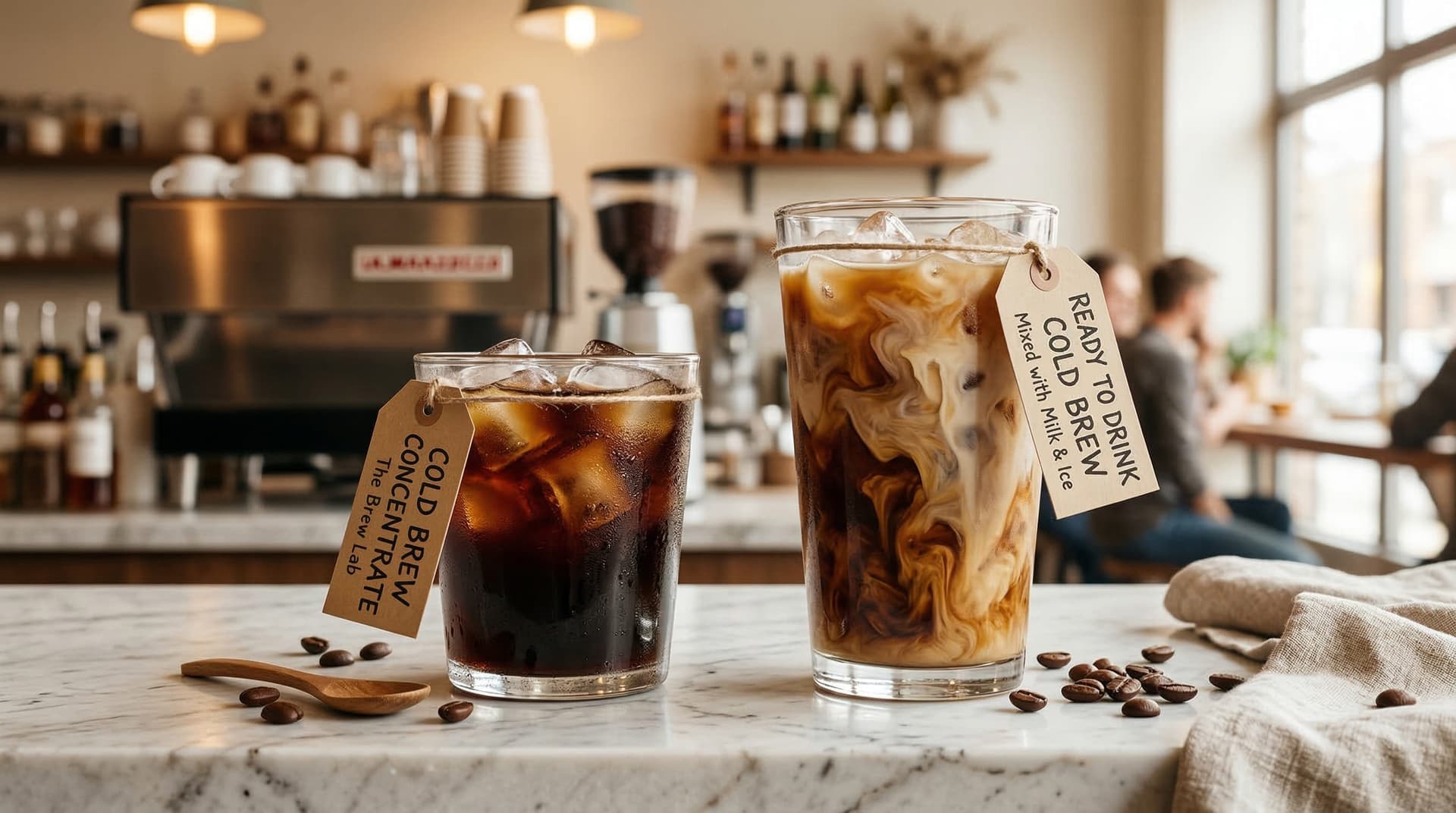
Cold brew concentrate (brewed at 1:8) is essentially a coffee stock — like a stock cube rather than a bowl of soup. You dilute it at the point of serving. Ready-to-drink cold brew (brewed at 1:15) skips the dilution step.
| Factor | Concentrate (1:8) | Ready-to-Drink (1:15) |
|---|---|---|
| Shelf life | 10–14 days | 5–7 days |
| Serving flexibility | High — dilute to taste | Low — fixed strength |
| Works well with milk | Yes — dilute 1:1 with milk | Can become too diluted |
| Pours over ice | Yes — dilute 1:1 with water first | Yes — but dilutes further |
| Coffee used per batch | More (100g per 800ml) | Less (100g per 1500ml) |
| Best for | Most home brewers | Quick grab-and-go drinks |
My recommendation for most home brewers: make concentrate. The flexibility to serve at different strengths, and the longer shelf life, make it the better option for almost every household use case. If you primarily want to grab a cold coffee to go without thinking about it, ready-to-drink makes sense — but even then, a small bottle of concentrate and a tap is faster than you'd expect once you have it set up.
How to Serve Cold Brew
Cold brew is more versatile at serving than most people realise. Once you have a jar of concentrate in the fridge, you have the base for a range of drinks that take under a minute to prepare.
Cold Brew Over Ice
Fill a tall glass with ice. Add 2–3 oz cold brew concentrate, top with 2–3 oz cold filtered water. Stir briefly. Tastes cleaner than café cold brew because you control the ratio and the freshness of the concentrate.
Cold Brew Latte
Fill a glass with ice. Add 2 oz concentrate, then pour 4–6 oz cold oat milk or whole milk over it. Don't stir — watch the milk cascade through the dark concentrate. Naturally sweet, no sugar needed if your beans are good.
Cold Brew Tonic
This surprises people the first time. 2 oz concentrate over ice, topped with 4 oz quality tonic water (Fever-Tree works well). The bitterness of the tonic complements the sweetness of cold brew in a way that's genuinely refreshing in summer.
Warm Cold Brew (Hybrid)
Don't heat the concentrate directly — it changes the chemistry. Instead, add concentrate to a mug and top with hot water at a 1:3 ratio. You get a warm drink with cold brew's low-acid profile. Useful for cold mornings when you want the smooth flavor without iced coffee.
One serving note: always use large ice cubes or spherical ice for cold brew. Small ice melts fast and dilutes the drink within minutes. Large ice cubes release water slowly, keeping your drink at full concentration for longer. It's a small thing that makes a noticeable difference.
Common Cold Brew Mistakes (And How to Fix Them)
After training baristas and watching dozens of home brewers try cold brew for the first time, these are the mistakes that come up most consistently:
❌ Grind too fine
Symptom: Bitter, astringent concentrate; filtering takes over an hour
Fix: Switch to coarser grind. For cold brew, you should be grinding coarser than French press. If your grinder only has a few settings, use the absolute coarsest.
❌ Using tap water without filtering
Symptom: Flat, muted flavor; sometimes an off-taste or chlorine note
Fix: Use filtered water — a Brita filter is sufficient. Cold water doesn't have the heat to mask mineral or chemical interference the way hot brewing does.
❌ Squeezing or pressing grounds during filtering
Symptom: Cloudy, bitter concentrate with unpleasant fines
Fix: Let gravity do the work. Don't press the filter. This is the same reason you don't plunge a French press aggressively — pressure pushes fines and bitter compounds through.
❌ Steeping too long with too-fine a grind
Symptom: Very bitter, almost unpleasantly harsh concentrate
Fix: Both variables compound each other. Finer grind + longer steep = severe over-extraction. If your batches are consistently bitter, address grind coarseness first, steep time second.
❌ Not using enough coffee
Symptom: Watery, thin result even after 18+ hours
Fix: Check your ratio. Many people eyeball the coffee amount and under-dose significantly. Weigh your grounds. 100g per 800ml for concentrate isn't negotiable — there's no amount of steep time that compensates for using too little coffee.
❌ Storing in plastic long-term
Symptom: Off-flavors developing after the first few days
Fix: Move to glass storage. Coffee oils absorb into plastic and create rancid-tasting residue that affects subsequent batches. Mason jars are cheap and indefinitely reusable.
Frequently Asked Questions
For cold brew concentrate (meant to be diluted), I use 1:8 — 100g coffee to 800ml water. For ready-to-drink cold brew, use 1:15 — 100g coffee to 1500ml water.
The concentrate ratio gives you more flexibility when serving: you can dilute to taste, add milk, or pour over ice without the final drink becoming watery. After testing both side-by-side across dozens of batches, most people prefer concentrate made at 1:8 then diluted 1:1 with water or milk at serving.
Your First Batch Starts Tonight
Cold brew is one of the easiest methods to master and one of the most consistent to reproduce once you nail the ratio. 100g coarse coffee, 800ml filtered water, 18 hours in the fridge — that's genuinely all it takes to produce a concentrate that outperforms most café cold brew at a fraction of the cost.
Start tonight. By tomorrow afternoon you'll have a full jar of cold brew concentrate that lasts nearly two weeks in the fridge. Once you have that base established, you'll wonder why you ever bought the premade bottled version.
If you want to explore other brewing methods alongside cold brew, our complete guide to coffee drink differences covers how cold brew, pour over, espresso, and other methods compare from a flavor and technique standpoint.
Get Coffee Tips
Join our newsletter for expert reviews and brewing guides.