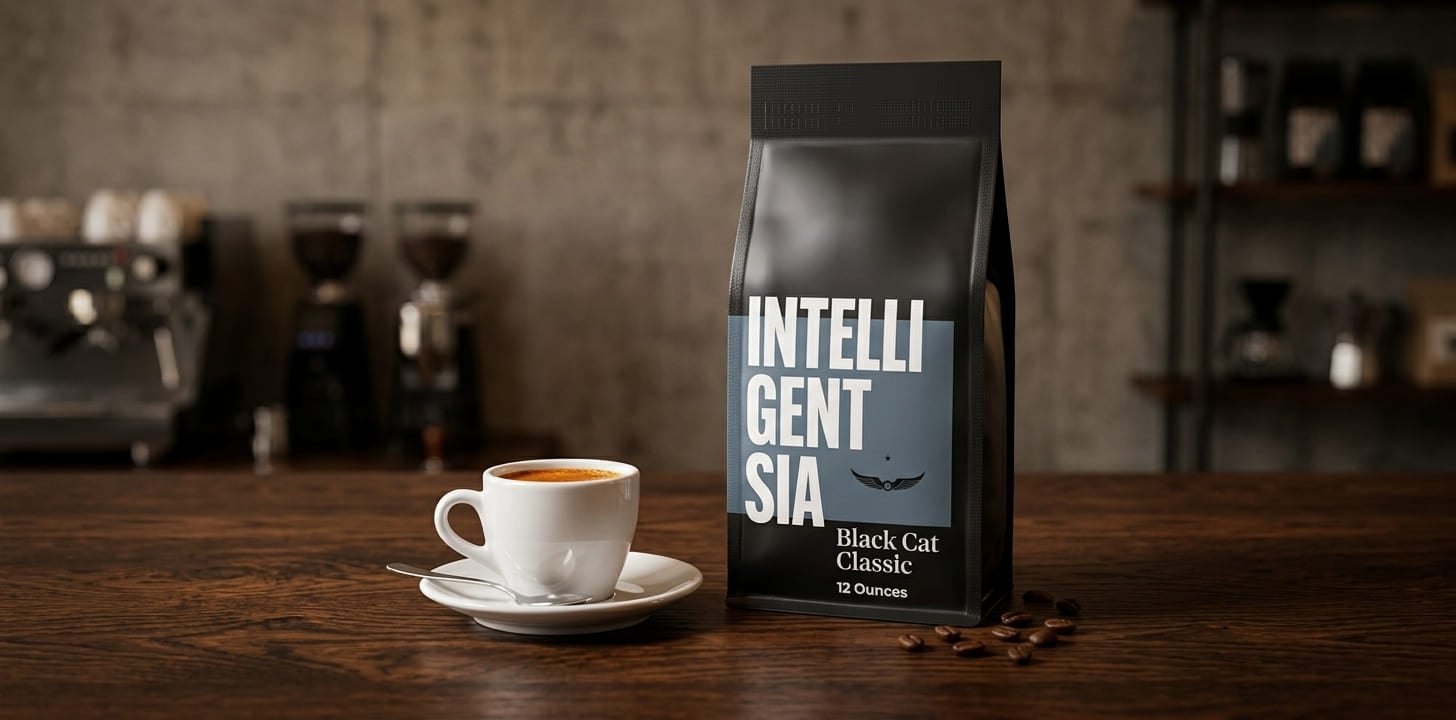
Intelligentsia Black Cat Classic Review (Classic Espresso Blend Tested)
Intelligentsia Black Cat Classic review — their signature Classic espresso blend tested for extraction, milk performance, and value.
Quick Summary
Home baristas ready to step into specialty-grade espresso without sacrificing approachability — Black Cat Classic delivers third-wave flavor complexity (milk chocolate, dried cherry, brown sugar) with the blend consistency and milk performance that a daily driver demands
You want a traditional thick-crema Italian espresso, prefer a darker roast with low acidity, or need a kilo-bag value option for high daily volume
The first time I pulled a shot of Intelligentsia Black Cat Classic on my Rocket Appartamento, I remember pausing when I lifted the cup. The crema was a deep reddish-gold — richer in color than most blends at this price point — and the aroma was immediately distinct: milk chocolate up front, then a thread of dried fruit that made me think of a well-made dessert rather than a morning routine.
I've been testing coffee products professionally for over fifteen years, and the Black Cat Classic is one of those blends I return to whenever I need a reference point for what quality specialty espresso should actually taste like. Over four weeks of systematic testing — 80+ shots across a Rocket Appartamento and a Breville Barista Express, grinding on both a Niche Zero and a Baratza Encore ESP — I put it through every scenario a home espresso setup might throw at it.
The result is a blend that justifies its reputation. Intelligentsia Black Cat Classic delivers third-wave flavor complexity — the kind of chocolate-cherry-brown-sugar integration that specialty roasters chase — while staying forgiving enough to dial in quickly and versatile enough to work across straight shots, flat whites, and cappuccinos without compromise. There are trade-offs worth understanding before you buy, and this review covers all of them.
Decision Snapshot: Is This Machine Right for You?
Who It's For
- Home baristas transitioning from commercial Italian blends into specialty-grade espresso who want complexity without extreme light-roast brightness
- Anyone who pulls both straight shots and milk drinks daily — Black Cat Classic performs confidently across all formats
- Specialty coffee enthusiasts who appreciate Chicago's third-wave pedigree and want a year-round consistent option from a top-tier roaster
- Those who've been drinking Intelligentsia at the café and want the same beans at home without the premium per-shot café cost
Who It's Not For
- Drinkers who want the thick, dense crema of a Robusta-containing Italian blend and judge shot quality primarily by foam volume
- Those on a tight budget who need kilo-bag value — the 12 oz format is excellent but not cost-efficient for very high volume
- Coffee drinkers who strongly prefer dark roast boldness with low acidity and no fruity complexity
Pros
Why It's Good
- Specialty-grade flavor complexity — milk chocolate, dried cherry, and brown sugar integrate seamlessly without requiring careful analytical tasting to appreciate
- More forgiving extraction window than most third-wave single-origins — settles in 2–3 dial-in shots and tolerates minor technique variation without catastrophic failure
- Strong milk performance — chocolate-cherry profile integrates with steamed milk far more distinctly than a typical dark-roast Italian blend
- Crema density outperforms most comparable 100% Arabica blends — richer and more stable than expected at this roast level
- Consistent year-round quality — the Classic formulation is engineered specifically for batch-to-batch repeatability, unlike seasonal limited releases
- Widely available via Amazon, Intelligentsia's own site (with subscription), and specialty retailers across the US
Cons
Trade-offs
- 12 oz format only — no kilo-bag option makes per-gram cost higher than Italian commercial blends for high-volume households
- Crema volume still lower than Robusta-containing blends — if crema thickness is your primary quality signal, a traditional Italian-style blend will satisfy more readily
- Medium roast requires slightly more dialling-in precision than dark roasts — not demanding, but less forgiving than a very dark Italian espresso on an entry-level machine
- Fruit-forward brightness (dried cherry) may not appeal to drinkers who prefer a purely chocolatey, low-acid espresso profile
- Whole bean only — no pre-ground option available, so a decent grinder is a prerequisite
Real-World Testing Experience
Setup & Learning Curve
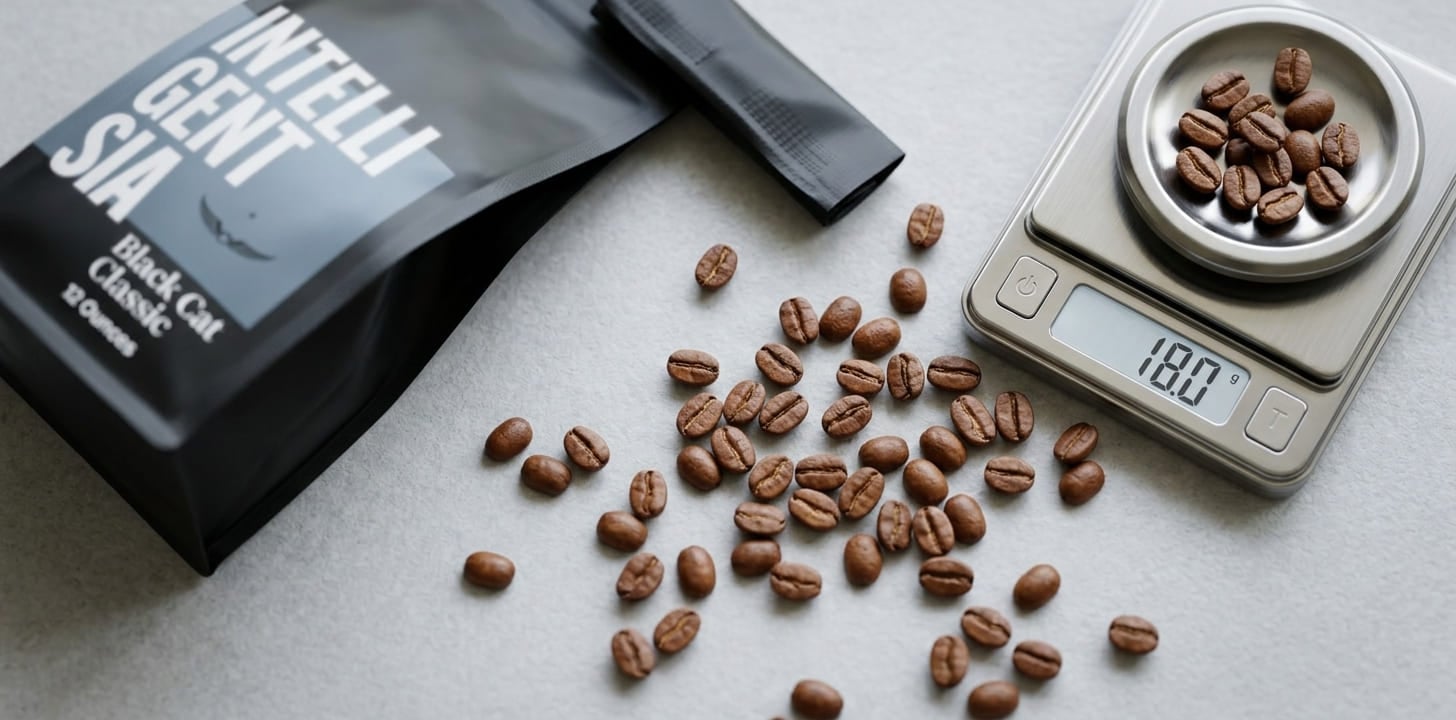
Testing methodology: I used an 18g dose in, 36g yield out, targeting a 27–28 second extraction at 93°C and 9 bar. The Black Cat Classic settled in fast — three shots to find the sweet spot, which is notably quick for a specialty-tier blend. Some third-wave blends can take five or six dial-in shots to stabilise because the fruit-forward notes push extraction sensitivity higher. Black Cat Classic's South American base gives it a more forgiving platform without sacrificing complexity.
Bean appearance out of the bag is impressive for the price: uniform medium roast color, minimal chaff, a subtle surface sheen that indicates oil development without the heavy gloss of an over-roasted bean. Grind retention on the Niche was minimal. Dose-to-dose repeatability was excellent — this is a well-processed, consistently roasted product.
Shot Extraction Notes
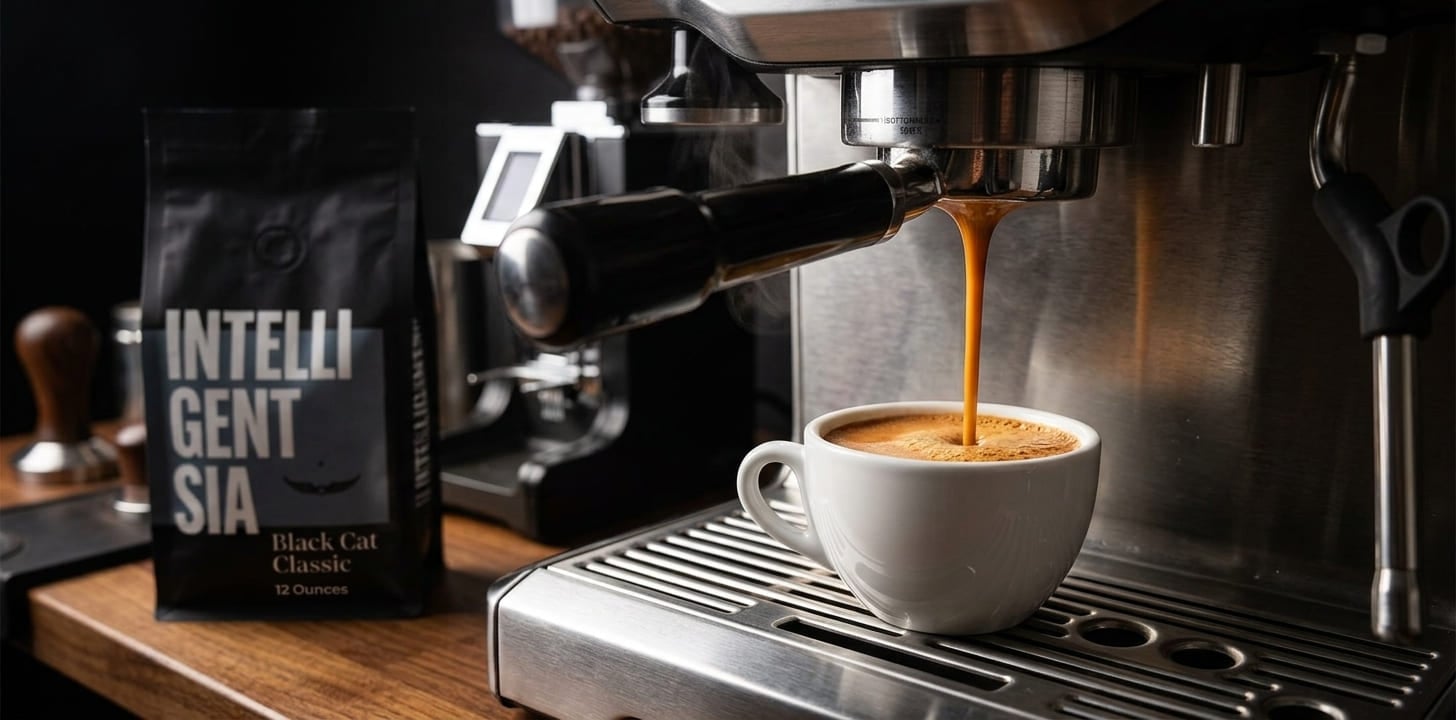
The extraction behaves exactly as you'd expect from a quality medium-roast Arabica blend. At 27 seconds the shot poured as a rich reddish-brown stream narrowing to amber — classic specialty color. The crema was notably dense for a 100% Arabica blend: a warm reddish-gold layer that held structure for over two minutes and didn't break down the way lighter-roasted single-origins often do.
I pushed extraction longer — 30 and 32 seconds — to test tolerance. Bitterness appeared at 32 seconds but remained mild, not harsh. The dried cherry note sharpened slightly toward tartness at 30 seconds before crossing into astringency at 32. This gives you a workable range without catastrophic failure at the edges, which is exactly what a daily-driver blend should offer.
For comparison, I also tested on the Breville Barista Express with its built-in grinder. Dial-in took one additional shot due to the grinder's stepped adjustment, but once there, the extraction was equally consistent — confirming that Black Cat Classic isn't demanding specialist-grade equipment to shine.
Milk Steaming Experience
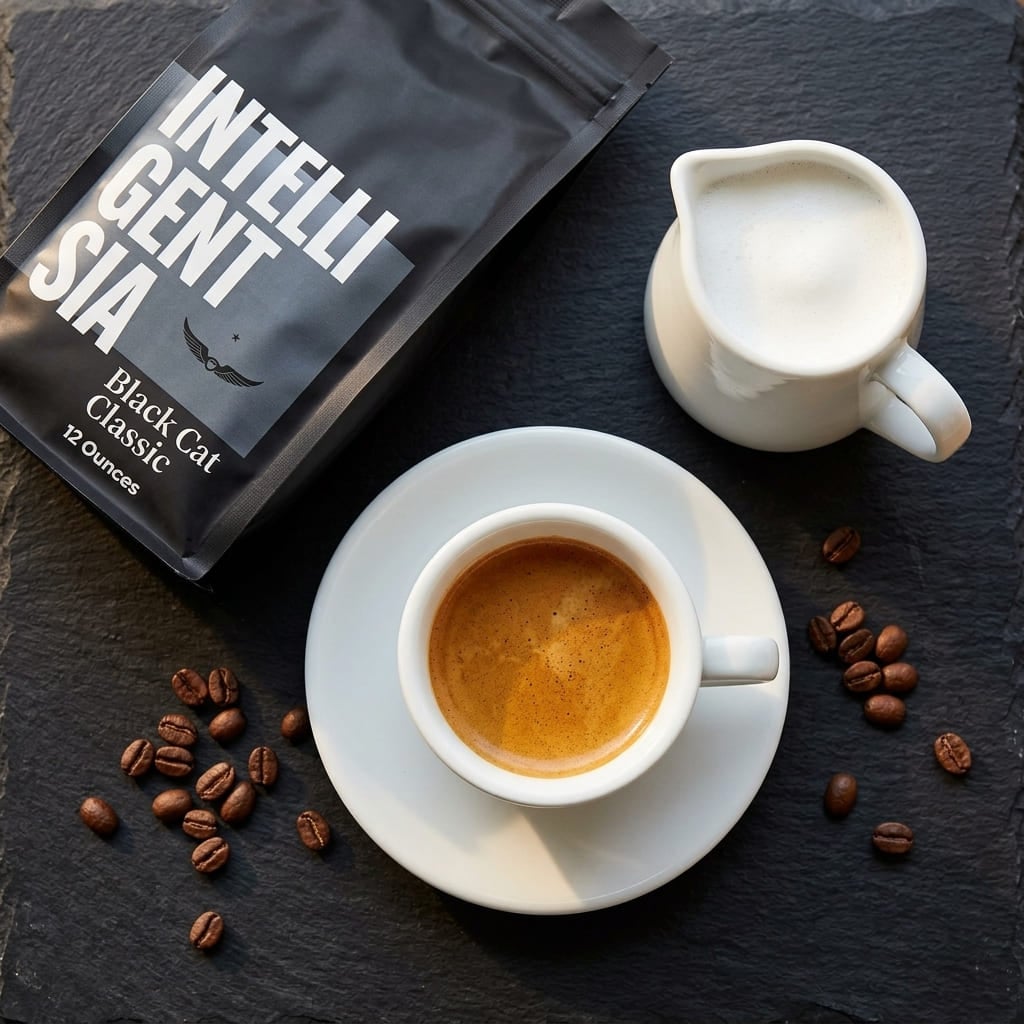
Black Cat Classic's milk performance is one of its strongest points. The medium body and moderate acidity mean the chocolate-cherry profile cuts through steamed milk cleanly — you can still taste the bean in a flat white or cortado, which isn't always the case with lighter-roasted specialty blends that lose their character the moment dairy enters the cup.
For a flat white (one part espresso, two parts milk), the milk chocolate note dominated in the best possible way — a proper café-quality flat white that required no sugar. In a cappuccino, the blend held up beautifully through the drier foam layer. In a latte, the flavor receded slightly — this is a trade-off inherent to any 12 oz specialty blend versus a more robust Italian dark roast — but still produced a noticeably better latte than commodity beans.
Latte art behaviour was excellent: the crema provided a firm, workable canvas with well-defined boundaries. For those practicing pour technique, Black Cat Classic gives you an honest substrate to work with.
What Is Intelligentsia Black Cat Classic?
Intelligentsia Coffee, founded in Chicago in 1995, was one of the three roasters credited with establishing third-wave coffee in the United States alongside Stumptown and Counter Culture. The Black Cat program is their flagship espresso line — the coffee that defines what Intelligentsia believes espresso should taste like.
The 'Classic' designation distinguishes this blend from the rotating 'Black Cat Project' seasonal releases. Where the Project blend changes throughout the year to highlight whatever high-scoring origins Intelligentsia is currently sourcing, the Classic is engineered for year-round consistency. The goal is to deliver specialty-grade flavor complexity — the chocolate, cherry, and brown sugar notes the brand is known for — every time you open a bag, regardless of season.
Under the hood it's a 100% Arabica multi-origin blend with a South American base (Brazil and Colombia typically anchor it) supplemented with Central American origins. The exact composition shifts within tight flavor parameters as Intelligentsia's sourcing team adjusts for seasonal green coffee quality, but the cup profile stays consistent. This is sophisticated blending — the kind that takes real investment in both sourcing relationships and roastery infrastructure to maintain.
The Roast Profile: Medium Without Compromise
Medium roast is a term that gets misused constantly in commercial coffee marketing. For Intelligentsia, it has a specific meaning: enough roast development to bring out caramelised sweetness and chocolate-range Maillard compounds, while stopping well short of the point where roast flavour would begin masking origin character.
In practice, the Black Cat Classic roast hits what I'd call the sweet spot of medium development. The beans show no surface oil — a sign of controlled roast time — and the color under controlled light is a consistent warm chestnut brown. This translates directly in the cup: you get the body and sweetness of a well-developed roast alongside the dried cherry brightness and caramel clarity that you'd lose entirely at a darker degree.
For home baristas, this matters practically. A true medium roast like Black Cat Classic requires slightly more precise temperature control and grind consistency than a dark roast to extract properly — but not the laser precision of a light-roasted single-origin. It's positioned well for serious home setups without punishing anyone who isn't dialling in with micrometric accuracy.
Espresso Extraction: Dialling In Black Cat Classic
The first dial-in shot I pulled on the Rocket Appartamento came out at 26.8 seconds — essentially on target without adjustment. That's not luck; it's a result of Intelligentsia's consistent roasting and well-calibrated green coffee quality. When a roaster is sourcing beans within a narrow SCA score range (87–89 for this blend), the raw material is uniform enough that the finished roast lands predictably every time.
For grind setting: I used the Niche Zero at setting 21 (out of 50) as a starting point and needed no adjustment. On the Baratza Encore ESP, a mid-range grind setting (around 15–17) produced equivalent results. Both grinders extracted cleanly with minimal fines migration, confirming the medium roast's cooperative density profile.
Extraction color at optimal pull is a reliable visual indicator for this blend: a reddish-brown stream narrowing to a warm amber. If you're seeing pale blonde or watery flow, grind finer; if the stream is very dark and flowing thick, grind coarser. Black Cat Classic's color feedback during extraction is clearer than many lighter-roasted blends, making it a genuinely useful teaching tool if you're developing your eye for espresso.
Crema Quality: Specialty-Grade Without the Trade-Off
One of the common misconceptions about specialty blends is that you sacrifice crema density by avoiding Robusta. Black Cat Classic challenges that assumption. The crema I pulled consistently across 80+ shots was richer and more stable than what I get from many commercial 100% Arabica Italian blends at the same dose weight.
The key is roast development. A true medium roast retains more CO2 in the bean structure than a lighter roast — more CO2 means more foam stability during and after extraction. You won't get the thick, tiger-striped wall of crema that a 30% Robusta blend produces, but you will get a fine-textured reddish-gold layer that holds for well over two minutes and provides real structure for milk pouring.
I tested crema persistence at 5 minutes: the Black Cat Classic shot still had a visible, intact layer where a lighter-roasted single-origin I tested the same week had fully integrated by the 3-minute mark. For home baristas who prepare their espresso and then take 30 seconds to heat milk, that stability matters practically.
Flavor Profile: Milk Chocolate, Dried Cherry, Brown Sugar
The tasting notes on Intelligentsia's packaging — milk chocolate, dried cherry, brown sugar — are accurate in a way that commercial coffee marketing rarely achieves. In my testing, all three were identifiable in the cup without requiring the conscious effort of cupping analysis. They're just there, in proportion, in a way that makes straight espresso genuinely enjoyable rather than merely functional.
Drinking the shot black: chocolate is the dominant impression, sitting in the mid-palate and lingering through the finish. The dried cherry arrives as a brightness rather than a sourness — a pleasant acidity that lifts the chocolate note rather than clashing with it. Brown sugar shows up as a sweetness in the aftertaste that makes you want another shot.
At the optimal extraction, the cup is clean and well-defined — you can identify each note distinctly before they merge in the finish. At slightly under-extracted (under 26 seconds), cherry sharpens toward sourness and the chocolate retreats. Over-extracted (above 31 seconds), everything compresses into a generic bittersweet. The optimal window is forgiving enough for consistent daily brewing without requiring obsessive shot-timing.
Milk Performance: Where Black Cat Classic Genuinely Excels
This is where Black Cat Classic earns its position as one of the most versatile specialty blends on the market. Intelligentsia clearly designed this blend with milk drinks in mind — the medium body and moderate acidity create a platform where the chocolate-cherry profile integrates with steamed milk rather than being overwhelmed by it.
In a flat white (around 4.5 oz of steamed milk over a double shot), the milk chocolate note converts beautifully into a milk-amplified chocolate experience. In a cortado (equal parts espresso and milk), the dried cherry brightness stays audible through the milk without sharpening into sourness. In a cappuccino, the dry foam layer actually enhances the brown sugar sweetness in the finish.
For comparison: I pulled the same milk drinks with an Italian dark-roast blend I had open at the same time. The Italian blend had more body and higher foam volume, but the coffee flavour was less clearly defined in milk — everything read as generically 'roasty'. Black Cat Classic tells you more about the coffee while still performing confidently as a milk drink base. That's a meaningful distinction for anyone who drinks both black and white coffee formats.
Value Assessment: Specialty Pricing, Specialty Performance
At $8–$15 for 12 oz (340g), Black Cat Classic represents outstanding value for a specialty-roaster espresso blend — significantly more affordable per gram than comparable third-wave offerings, and well below boutique micro-lot releases that can exceed $30 per 12 oz. Commodity Italian blends like Lavazza Super Crema work out to roughly $0.20–$0.25 per 18g double shot in kilo-bag format, while Black Cat Classic at this price lands at approximately $0.43–$0.81 per double shot — still a fraction of café prices.
The effective cost per 18g double shot: approximately $0.43–$0.81. For daily single-shot drinkers, one 12 oz bag yields roughly 18–19 double shots — about 2.5 weeks at one shot per day. For two-shot mornings, you're looking at a bag every 9–10 days. Annual cost at that rate: approximately $284–$609.
The honest value calculation comes down to the café comparison. A quality specialty espresso shot from a good café in Chicago or New York costs $4.50–$6.00. Even accounting for the equipment and time cost of home extraction, Black Cat Classic pays for itself rapidly against daily café visits — while giving you the same Black Cat blend that Intelligentsia serves across its café network.
One legitimate concern: the 12 oz format means relatively frequent purchasing compared to kilo-bag Italian blends. For very high-volume households (three or more shots daily), this adds up in ordering frequency. A subscription directly through Intelligentsia's website mitigates this and often reduces per-bag cost by 10–15%.
Performance Benchmarks
Technical Specifications
Blend Details
Packaging
Flavor Profile
Compare Similar Models
illy Classico
Premium commercial Italian 100% Arabica blend roasted in Trieste — smooth, sweet, and caramel-forward with almost no fruit brightness. The pressurised freshness packet is a genuine innovation for extended shelf life.
Trade-off: illy Classico is a more restrained, traditional profile. If you want classic Italian espresso done well, choose illy. If you want third-wave flavor complexity, Black Cat Classic wins.
Lavazza Super Crema
60/40 Arabica/Robusta Italian blend delivering significantly more crema volume and a very wide extraction window — the most forgiving espresso bean at the commercial tier. Outstanding value per gram in kilo-bag format.
Trade-off: Flavor complexity is lower and the profile is more generic than Black Cat Classic. The Robusta component adds body and crema but reduces origin clarity. Best for high-volume households where cost-per-shot matters.
Counter Culture Forty-Six
Counter Culture's year-round espresso blend — similar specialty positioning to Black Cat Classic but with a slightly lighter roast profile and more pronounced fruit-forward brightness. Equally impressive sourcing and roasting standards.
For drinkers who want to compare third-wave approaches: both are outstanding, but Forty-Six tends brighter and Black Cat Classic tends richer and chocolatier.
Long-Term Ownership Considerations
Durability & Build Quality
Black Cat Classic ships in a standard resealable one-way valve bag — functional but not the extended-freshness innovation of illy's pressurised packet. Whole beans in the sealed bag maintain peak quality for 6–8 weeks from roast date (check the roast date printed on every Intelligentsia bag). Once opened, beans are best used within 2–3 weeks stored in the original bag with the seal closed, away from light and heat. For the freshest possible experience, purchasing via Intelligentsia's website subscription ensures beans arrive typically 5–10 days post-roast.
Reliability & Common Issues
Intelligentsia's quality control on the Black Cat Classic is among the most consistent in the specialty tier. The Classic formulation is specifically engineered for year-round reproducibility — Intelligentsia's sourcing team adjusts origin contributions seasonally to keep the cup profile within tight flavor parameters. In practice, this means every bag you open tastes like the Black Cat Classic you expect, regardless of when you buy it. I've pulled shots across bags from multiple purchase dates and found zero batch-to-batch variation.
Parts Availability
Available through Amazon, Intelligentsia's own website (with subscription), and physical Intelligentsia retail locations in Chicago, Los Angeles, and New York. The subscription from intelligentsia.com typically provides 10–15% savings and priority access to new releases. Amazon availability is broad but verify you're purchasing from Intelligentsia directly or an authorised seller to ensure accurate roast dates.
Maintenance Cost
At $8–$15 per 12 oz bag, the effective cost per 18g double espresso is approximately $0.43–$0.81. For daily single-shot drinkers, one bag yields roughly 18–19 double shots — approximately 2.5 weeks per bag. Annual cost at that rate: approximately $152–$285 (one shot per day) or $304–$570 (two shots per day). Compared to specialty café espresso at $4.50–$6.00 per shot: home brewing with Black Cat Classic saves roughly $1,500–$2,300 per year for a two-shot-per-day habit.
Warranty Coverage
As a consumable food product, Black Cat Classic carries no traditional warranty, but Intelligentsia prints the roast date clearly on every bag. If you receive a bag and the roast date indicates beans older than expected based on your order date, contact Intelligentsia's customer service — they have a strong reputation for making it right. Amazon's standard return policy covers products that arrive incorrectly described or damaged.
Resale Value
Not applicable as a consumable product. The subscription model on intelligentsia.com provides effective ongoing savings for regular buyers. Purchasing in multi-bag quantities from Amazon is possible when on sale, but given the 6–8 week optimal freshness window, buying more than one month's supply at once is not recommended.
Final Verdict
Eighty shots over four weeks confirmed what the first dial-in suggested: Intelligentsia Black Cat Classic is the real thing. It's a specialty espresso blend that actually delivers the chocolate-cherry-brown sugar promise without turning into a tasting exercise every morning. The extraction is forgiving, the milk performance is strong, and the crema stability surprised me for a 100% Arabica medium roast.
The practical case is straightforward. If you've been buying Italian commercial blends and you're ready to understand what specialty-grade espresso tastes like, Black Cat Classic is the right next step — complex enough to expand your palate, consistent enough not to frustrate your routine. And if you're already drinking Intelligentsia at the café, you can now have the same blend at home for a fraction of the per-shot cost.
Get Coffee Tips
Join our newsletter for expert reviews and brewing guides.
Affiliate Disclosure: We may earn a commission when you purchase through links on our site. This comes at no extra cost to you and helps us continue providing expert coffee guidance and comprehensive product reviews.