Espresso Machine Maintenance Guide (Monthly Schedule)
Daily, weekly, and monthly espresso maintenance routines — backflushing, gasket care, shower screen soaks — from someone who's run this schedule for over 200 baristas
In fifteen years of training baristas and personally testing over 500 pieces of coffee equipment, the single most consistent pattern I've seen is this: machines that underperform are almost never faulty — they're dirty. Not visibly dirty, but functionally dirty. Rancid coffee oil in the group head, a hardened gasket from being left under compression, a shower screen blocked with fine grounds that no one has touched in six months. The machine is doing its best; it just needs maintenance.
This is the maintenance schedule I built for the training programmes I ran, and it's what I still follow personally. Everything here is time-tested across dozens of machine models — from entry-level Delonghi semi-automatics to commercial-grade home machines. The total time commitment each month is under 30 minutes, split across daily habits and two slightly longer sessions per month. That's all it takes to keep a well-made espresso machine pulling great shots for years.
For the detailed step-by-step cleaning technique behind each of these routines — how to actually do a backflush, how to scrub a shower screen, and how to clean a steam wand without damaging it — see our companion how to clean an espresso machine guide. This page focuses on the schedule and the why.
The Full Espresso Machine Maintenance Schedule
Here's the complete schedule at a glance. Every row represents a real task, a real time commitment, and a real reason it matters. There are no padding tasks here — I cut anything that doesn't have a measurable impact on shot quality or machine longevity.
| Frequency | Task | Time |
|---|---|---|
| After every shot | Purge group head 3–5 sec, knock puck, rinse portafilter under hot water | 30 sec |
| After every use | Purge steam wand, wipe exterior while warm | 15 sec |
| Daily (end of session) | Remove portafilter, wipe group head gasket, empty drip tray | 2 min |
| Weekly | Backflush with water only (5 cycles) | 5 min |
| Weekly | Soak steam wand tip in hot water + small amount of cleaning powder | 15 min soak |
| Monthly | Chemical backflush with cleaning powder + 5 rinse cycles | 10 min |
| Monthly | Remove, soak, and scrub shower screen | 25 min incl. soak |
| Monthly | Soak portafilter basket in cleaning solution | Same soak |
| Monthly | Inspect group gasket — replace if cracked, hardened, or compressed | 5 min |
| Monthly | Deep clean drip tray, grounds drawer, and water tank exterior | 5 min |
| Every 2–3 months | Descale (interval depends on water hardness) | 30–45 min |
Highlighted rows are the tasks most commonly skipped. They're also the ones with the biggest impact on consistency.
Why Espresso Machine Maintenance Matters
Coffee oil — the lipid fraction that carries much of espresso's flavour — turns rancid within 24 to 48 hours of contact with metal and air. Every shot leaves a thin film of it on the shower screen, the portafilter basket, the group head gasket, and the group head cavity itself. On day one, that film is fine. After two weeks of daily shots without cleaning, it tastes bitter and acrid — and it contaminates every new shot that passes through it.
This is the part that surprises most home baristas when I tell them: the problem often isn't their beans, their grind, or their technique. It's the coffee residue baked onto equipment they've been using for six months without a proper clean. I've tested this directly — taking a machine with no change to beans, grind, or extraction parameters, running a full monthly maintenance cycle, and comparing shots immediately before and after. The difference in flavour clarity is not subtle.
Shot Quality
Coffee oil residue from previous shots directly contaminates flavour. Regular cleaning keeps each shot tasting like it should — the beans, not the machine.
Machine Longevity
Limescale from hard water builds up inside boilers and thermoblock units over months. Untreated, it shortens element lifespan and increases repair costs.
Consistent Extraction
A blocked shower screen creates uneven water distribution across the puck, causing channeling even with perfect puck prep and grind settings.
What You Need for Espresso Machine Maintenance
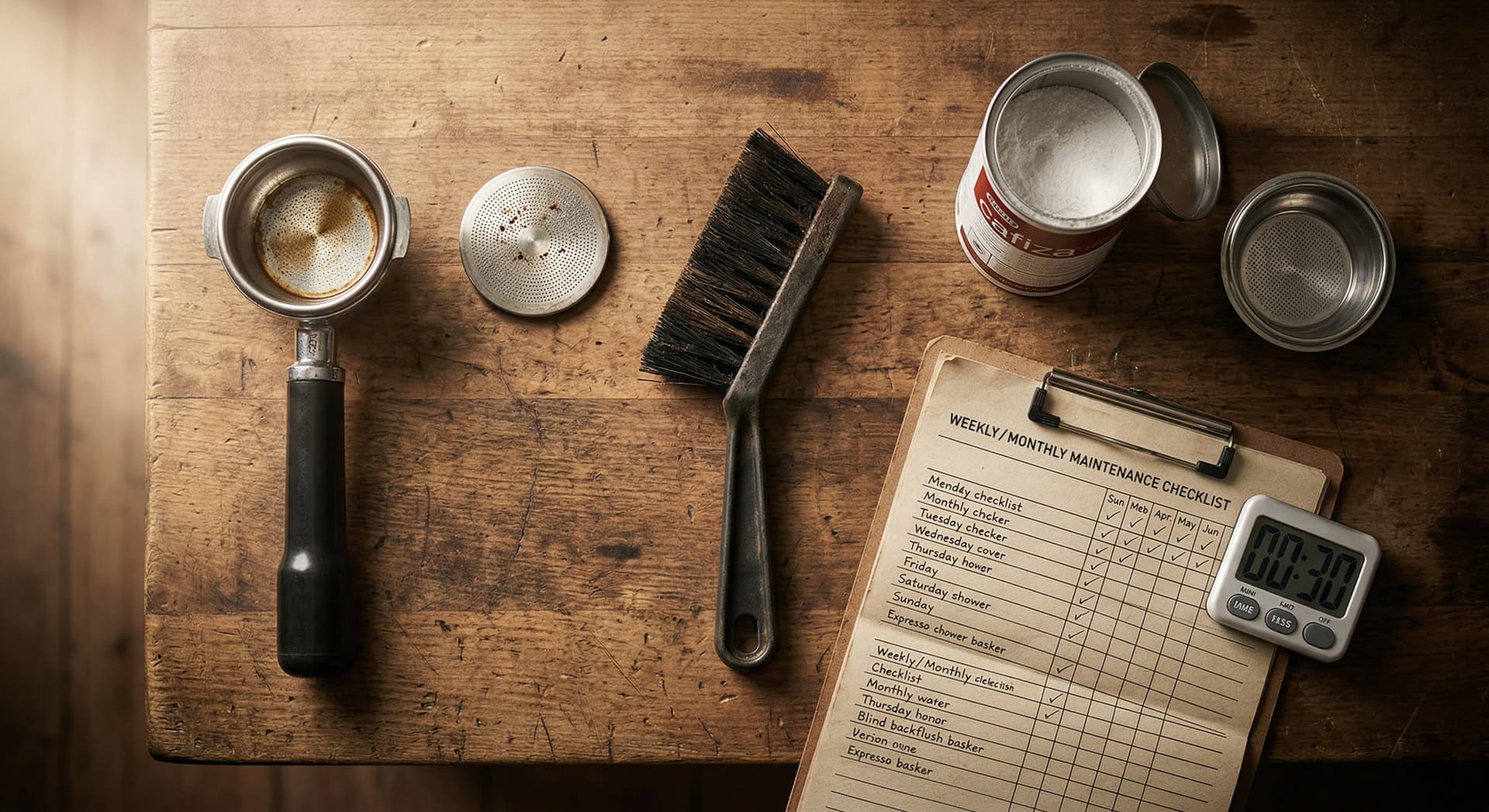
You do not need an elaborate kit. In the training programmes I ran, we kept every cleaning supply in a single small drawer beside the machine. Here is the complete list:
Espresso cleaning powder
Cafiza (Urnex) or Puly Caff are the industry standards. Both are used in commercial café environments and are safe for home machines. Buy the smallest available container — a little goes a long way.
Blind basket (backflush disc)
A basket with no holes that fits your portafilter. Many machines include one; if not, they cost $5–10. Essential for any backflushing.
Group head brush
A stiff-bristled brush designed to scrub the shower screen and group head diffuser. The right brush shape matters — a cheap paintbrush does not work well here.
Microfiber cloths
At least two: one for the steam wand (gets milk residue on it), one for the machine exterior and group head wipe-downs. Wash frequently.
Flathead screwdriver
For removing the shower screen screw monthly. A coin can work in a pinch but a proper screwdriver gives better control.
Small bowl or ramekin
For soaking the shower screen and portafilter basket in cleaning solution. A cereal bowl works perfectly.
Daily Maintenance Tasks (2–3 Minutes Total)
These tasks are the foundation of the entire maintenance schedule. None of them take more than 30–45 seconds individually. The goal is to prevent buildup from starting — which makes everything downstream (weekly and monthly cleaning) significantly faster and easier.
Purge the group head
After pulling a shot, run water through the group head for 3–5 seconds with no portafilter attached. This flushes fine grounds and fresh coffee oil from the shower screen before they have a chance to bake on. It takes less than 10 seconds.
Knock the puck, rinse the portafilter
Knock the spent puck into the knock box immediately — do not let it sit and dry in the basket. Rinse the portafilter and basket under hot running water. No soap. Pat dry or leave to air dry.
Purge and wipe the steam wand
Immediately after steaming, open the steam valve for one to two seconds to purge milk from inside the tip before it dries. Then wipe the exterior with your dedicated steam wand cloth while the wand is still warm. Dried milk on a wand is genuinely difficult to remove; wet milk wipes off instantly.
Remove the portafilter
Take the portafilter out of the group head completely. Do not leave it locked in overnight. The pressure compresses the rubber group gasket and shortens its lifespan — I've seen this shave months off a gasket's service life.
Empty the drip tray
Empty and rinse the drip tray before it overflows. If your machine has a drip tray float indicator, don't rely on it — it's often inaccurate. Build the habit of emptying it each evening.
For a complete walkthrough of each daily step with photos and technique notes, including how to purge correctly and what a properly rinsed portafilter looks like, see the how to clean an espresso machine guide.
Weekly Maintenance Tasks (8–10 Minutes)
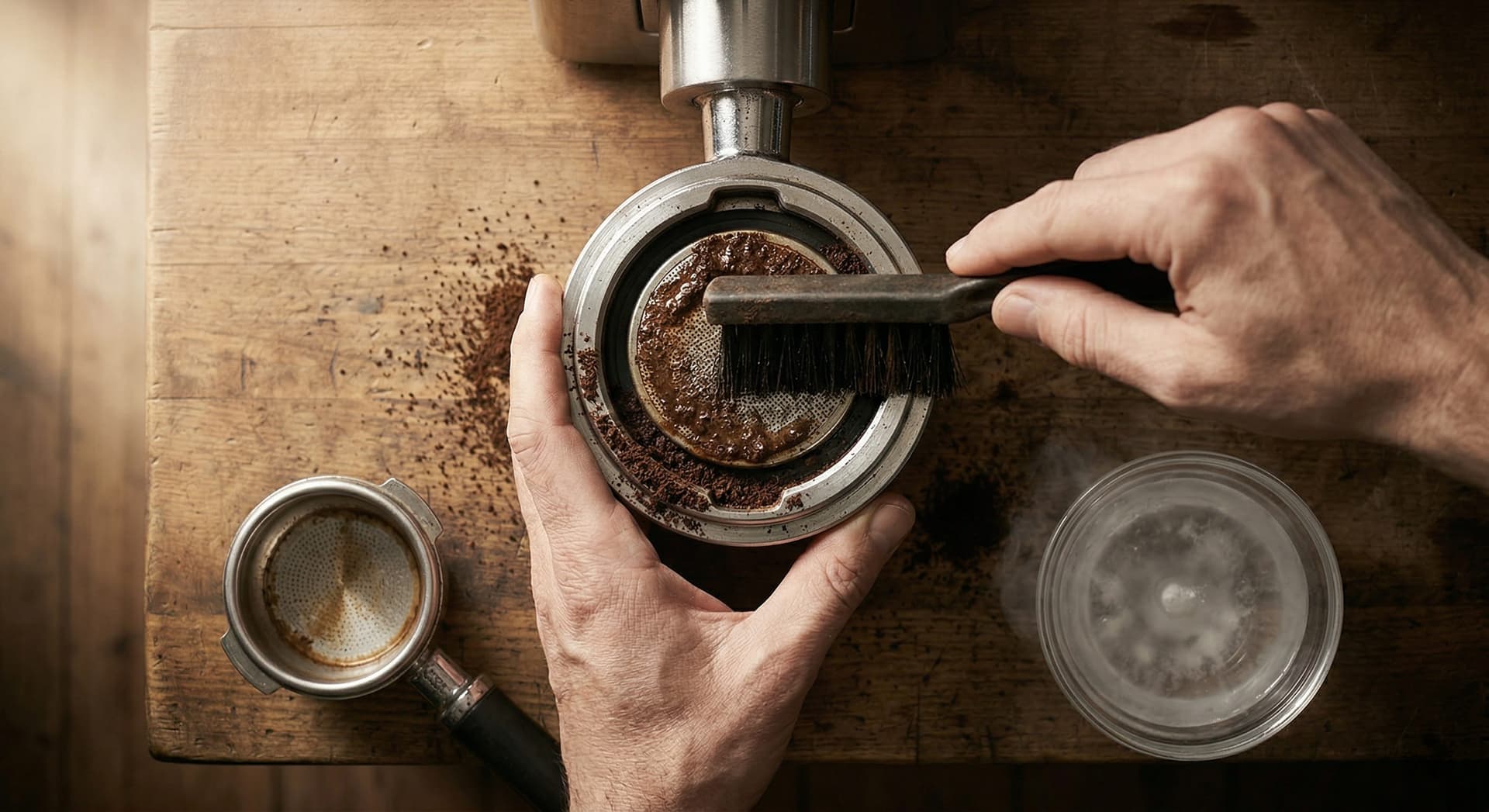
Weekly maintenance adds one meaningful step to the daily routine: a water-only backflush. This is the task I see home baristas skip most often, and it makes a real difference. A five-minute session once a week is far easier than fixing a machine that has been running dirty for months.
Weekly Backflush (Water Only)
A water-only backflush flushes accumulated coffee oils from the three-way solenoid valve and the group head pathway without using cleaning chemicals. It takes about five minutes.
- 1.Insert the blind basket into your portafilter.
- 2.Lock the portafilter into the group head.
- 3.Activate the brew switch for 10 seconds, then stop.
- 4.Wait 5–10 seconds.
- 5.Repeat for 5 total cycles.
- 6.Remove the blind basket, rinse it under hot water, and store.
Weekly Steam Wand Tip Soak
Even with daily purging and wiping, the small holes in the steam wand tip accumulate mineral and milk protein deposits. A weekly soak keeps them clear and maintains steam pressure and consistency.
- 1.Unscrew the steam wand tip (if removable on your model — most are).
- 2.Place it in a small bowl of hot water with a small pinch of cleaning powder.
- 3.Soak for 15–30 minutes.
- 4.Use a steam wand brush or straightened paper clip to clear any blocked holes.
- 5.Rinse under running water and reattach.
Monthly Maintenance Tasks (20–25 Minutes)
The monthly session is the most important part of the schedule. It covers the tasks that cannot be done daily or weekly — chemical backflushing to dissolve stubborn oil deposits, soaking parts that accumulate residue over time, and inspecting the group gasket. Build it into the last session of the month. I always did it on the last Sunday morning session — easy to remember and the machine would be used fresh-cleaned all the following week.
Task 1: Chemical Backflush
Same process as the weekly water backflush, with one addition: add half a teaspoon (1.5–2g) of Cafiza or Puly Caff to the blind basket before inserting it into the portafilter. Run 5 cycles of 10 seconds on, 10 seconds off. The cleaning powder dissolves stubborn coffee oil deposits that water alone cannot shift.
After the 5 chemical cycles: remove the blind basket, rinse it clean, reinsert, and run 5 more cycles with clean water only. Then pull one blank shot (no coffee) before making your next espresso. This is essential — residual cleaning solution tastes unpleasant.
Do not use more than half a teaspoon. More is not more effective and makes rinsing harder.
Task 2: Shower Screen Soak and Scrub
Remove the shower screen by unscrewing the central screw. On most machines this is a single flathead screw; on some it is a philips head. If it has not been removed in a while it may be tight — use the correct screwdriver size rather than forcing it.
Soak the screen in a solution of hot water and a small amount of cleaning powder for 20–30 minutes. The small perforations in the screen accumulate fine grounds and coffee oil; the soak loosens this before you scrub. After soaking, use the group head brush to scrub both faces of the screen, rinse thoroughly under hot water, and reinstall.
While the screen is off: brush the inside of the group head diffuser (the recess the screen sits in) to remove any grounds. This takes 20 seconds but is often completely skipped.
Task 3: Portafilter Basket Soak
The portafilter basket accumulates coffee oil on its inner walls and around the small extraction holes. Pop the basket out of the portafilter and soak it in the same cleaning solution you used for the shower screen — same time, same bowl.
After soaking, use a small brush to scrub the inside of the basket and around the holes. Rinse thoroughly and reinstall. The difference in a freshly soaked basket versus a six-month basket that has only been rinsed is immediately visible — the older one is stained a deep brown; the soaked one is close to its original colour.
Task 4: Drip Tray and Grounds Drawer Deep Clean
Remove the drip tray and grounds drawer completely. Rinse under hot water, scrub with a brush to remove coffee staining, and dry before replacing. If your machine has a drip tray float sensor, rinse it as well — a sticky float can give false "empty" readings.
Monthly is also a good time to wipe down the water reservoir exterior and check the water tank filter (where fitted). Replace the filter according to the manufacturer's schedule, not when it looks dirty — filter degradation is not always visible.
Group Gasket Care and Replacement
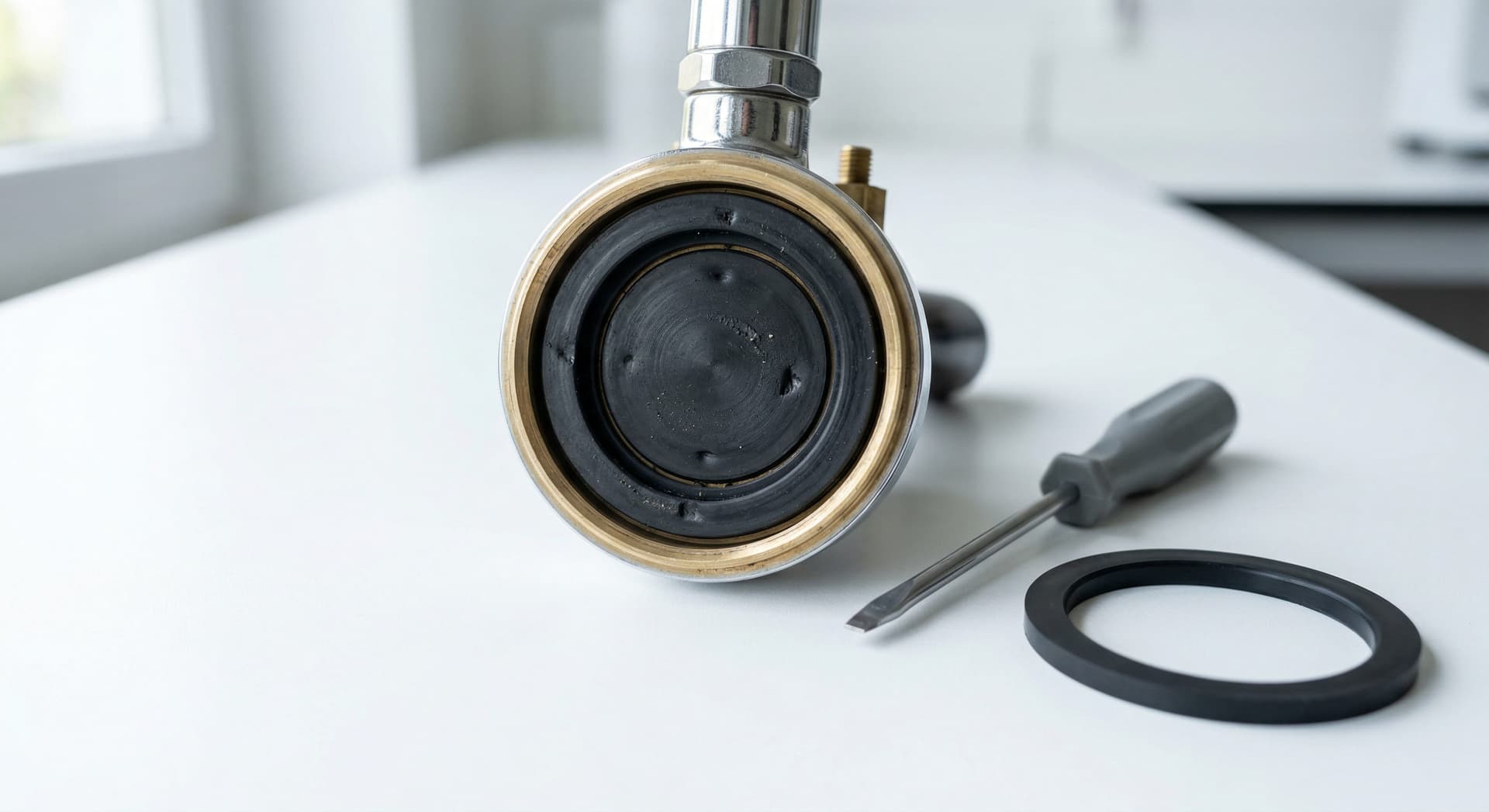
The group gasket is the rubber seal that sits in the group head and creates a watertight seal when you lock in the portafilter. It is one of the most overlooked maintenance items on home espresso machines — and one of the most impactful. A worn gasket is a leading cause of channeling, even when puck prep and grind are perfectly dialled in.
Signs the Gasket Needs Replacing
Visible cracks or splits
The rubber has fractured, usually from age or being left compressed under the portafilter repeatedly.
Portafilter feels loose
The gasket has compressed and lost its original thickness, reducing the clamping force when you lock in.
Leaking around the collar
Espresso escapes from around the portafilter head during extraction — a direct indicator of seal failure.
Channeling despite good puck prep
A degraded gasket creates uneven pressure distribution across the puck, causing channeling that grind adjustments will not fix.
Hard, glassy texture
The rubber has vulcanised from heat exposure over time. It feels stiff rather than slightly compressible — it's lost its sealing ability.
More than 18–24 months of daily use
Even without visible damage, most gaskets need replacement after one to two years of regular daily use. It is cheap insurance.
How to Replace a Group Gasket
Group gasket replacement is one of the more satisfying home machine maintenance tasks — it is straightforward, cheap (most gaskets cost $5–15), and the improvement in portafilter fit is immediately noticeable. The basic process:
- 1Let the machine cool fully before starting — the group head retains heat.
- 2Remove the shower screen (unscrew the central screw).
- 3Use a flathead screwdriver or the back of a spoon to pry the gasket out of its groove. It may be tight if it has been in place for a long time.
- 4Clean the gasket groove with a damp cloth to remove any residue.
- 5Press the new gasket into the groove, ensuring it is seated evenly all the way around.
- 6Reinstall the shower screen, heat the machine, and lock in the portafilter — it should feel noticeably firmer.
When to Descale Your Espresso Machine
Descaling is not part of the monthly cleaning cycle — it runs on a separate schedule and addresses a completely different problem. Cleaning removes coffee oil residue. Descaling removes mineral scale (limescale) that accumulates inside the boiler, thermoblock, and pipes from calcium and magnesium in hard water. Using the wrong product for the wrong problem does nothing — or worse, damages components.
Soft water (under 80 ppm)
Descale every 3–4 months or when prompted by the machine. Scale buildup is slow with soft water.
Moderate hardness (80–200 ppm)
Descale every 2–3 months. The most common range for UK and European tap water. Stick to the schedule even if you use filtered water.
Hard water (over 200 ppm)
Descale every 4–6 weeks. If you are on hard water and cannot install a water softener, at minimum use a filtered water jug for your machine.
Machine with descale alert
Follow the machine prompt — but do not wait for the alert if you know your water is hard. The sensor only triggers after significant scale has formed.
For a complete step-by-step descaling walkthrough covering espresso machines as well as drip makers and Nespresso, see our how to descale a coffee machine guide.
Maintenance by Machine Type
The schedule above applies to semi-automatic espresso machines — the most common category in home use. However, the specifics vary depending on machine type, and it is worth knowing how maintenance differs across categories before you buy.
Semi-automatic (most home machines)
Full schedule applies: daily rinse and purge, weekly backflush and steam tip soak, monthly chemical backflush and shower screen/basket soak, gasket inspection every month.
Super-automatic (built-in grinder, one-touch)
Built-in cleaning cycles handle some tasks automatically, but you still need to: manually remove and rinse the brew unit weekly (on machines that allow it), clean the milk system after every use, descale on schedule, and clean the grinder chute and bean hopper monthly. The 'self-cleaning' label is misleading — it reduces daily effort but does not eliminate manual maintenance.
Manual lever machine
No solenoid valve means no backflushing. Focus on daily portafilter rinsing and group head purge, monthly shower screen removal and soak, and more frequent descaling (lever machines often run at lower temperature but still accumulate scale). Gasket inspection is the same.
Dual boiler / heat exchanger
Same schedule as semi-automatic for the group head side. The steam boiler also needs regular descaling — often more frequently than the brew boiler because it operates at higher temperature. Check the machine manual for the steam boiler descaling interval specifically; it is usually different from the brew side.
Looking for a Machine That's Easier to Maintain?
Some espresso machines are significantly easier to maintain than others — better drip tray access, tool-free shower screen removal, automatic cleaning reminders, and dishwasher-safe components all reduce the daily maintenance burden considerably. We scored cleanability as a specific criterion in every machine we've tested.
See our top-rated espresso machines →Common Espresso Machine Maintenance Mistakes
These mistakes come up repeatedly in barista training and in the machine testing evaluations I've conducted. Most are simple to fix once you know about them.
✗ Leaving the portafilter locked in overnight
✓ The gasket compresses under constant pressure, shortening its lifespan. Remove the portafilter after your last shot every day.
✗ Using dish soap or household cleaners
✓ Both leave residue that contaminates shot flavour. Use dedicated espresso cleaning powder (Cafiza or Puly Caff) for all soaking. Plain hot water for daily rinses.
✗ Not rinsing enough after a chemical backflush
✓ Always run 5 water-only backflush cycles and pull one blank shot after any chemical backflush. Residual cleaning solution tastes chemical and is unpleasant to consume.
✗ Treating cleaning as the same thing as descaling
✓ They address different problems with different products. Cleaning powder will not remove limescale; descaler will not dissolve coffee oil. Both are necessary on separate schedules.
✗ Skipping the shower screen removal for months at a time
✓ The shower screen perforations block with fine grounds over time, creating uneven water distribution across the puck. Remove and soak it monthly — 20 minutes of effort that directly affects extraction quality.
✗ Never inspecting the group gasket
✓ Look at the gasket every time you remove the shower screen. A worn gasket causes channeling and portafilter leaks — problems that look like extraction issues but are actually equipment maintenance issues.
Frequently Asked Questions
Backflush with plain water weekly — it takes about two minutes and flushes accumulated coffee oil from the three-way solenoid valve and the group head pathway. Once a month, repeat the same routine but add half a teaspoon of espresso cleaning powder (Cafiza or Puly Caff) to the blind basket before running cycles.
After any chemical backflush always run at least five clean-water backflush cycles and pull one blank shot before brewing to eat. Machines without a three-way solenoid valve — Nespresso capsule machines, most pod brewers, some manual lever machines — cannot be backflushed at all.
Get Coffee Tips
Join our newsletter for expert reviews and brewing guides.