Coffee Bloom Explained: What CO2 Degassing Does to Your Cup
Why those 30 seconds at the start of your brew matter more than most people realise — and how the bloom connects directly to freshness, extraction, and flavour
The first time I watched a student skip the bloom, I let her. We were in the middle of a pour over session — twelve trainee baristas, six V60s, sixty grams of a washed Ethiopian Yirgacheffe roasted four days earlier. She poured everything straight in, no pre-infusion, no wait. The coffee came out in two minutes flat, tasted thin and slightly sharp, and she looked at me like the beans were the problem.
I handed her a fresh dose, walked her through a 40-second bloom, and had her brew again with the exact same grind and ratio. The difference in the cup was significant enough that the whole room noticed.
That is what this guide is about. The coffee bloom is one of the simplest techniques in brewing — and also one of the most frequently dismissed or misunderstood. After 15 years testing equipment and training baristas across the UK and Ireland, I want to explain what is actually happening during those 30–45 seconds, why it matters, and when it matters most. This is not a soft "it improves flavour" answer. There is a mechanism. Understanding it makes you a better brewer.
Coffee Bloom at a Glance
What It Is
- CO2 releasing from fresh grounds
- Triggered by hot water contact
- Lasts 30–45 seconds (pour over)
Why It Matters
- CO2 repels water (blocks extraction)
- Bloom lets gas escape first
- Enables even, consistent extraction
How to Bloom
- 2x coffee weight in water
- Saturate all grounds evenly
- Wait 30–45 sec before brewing
What Is Coffee Bloom?
Coffee bloom — also called the pre-infusion pour over phase or simply the pre-infusion — is the initial wetting stage at the start of brewing where you pour a small amount of hot water over freshly ground coffee and allow it to sit for 30–45 seconds before beginning the main extraction.
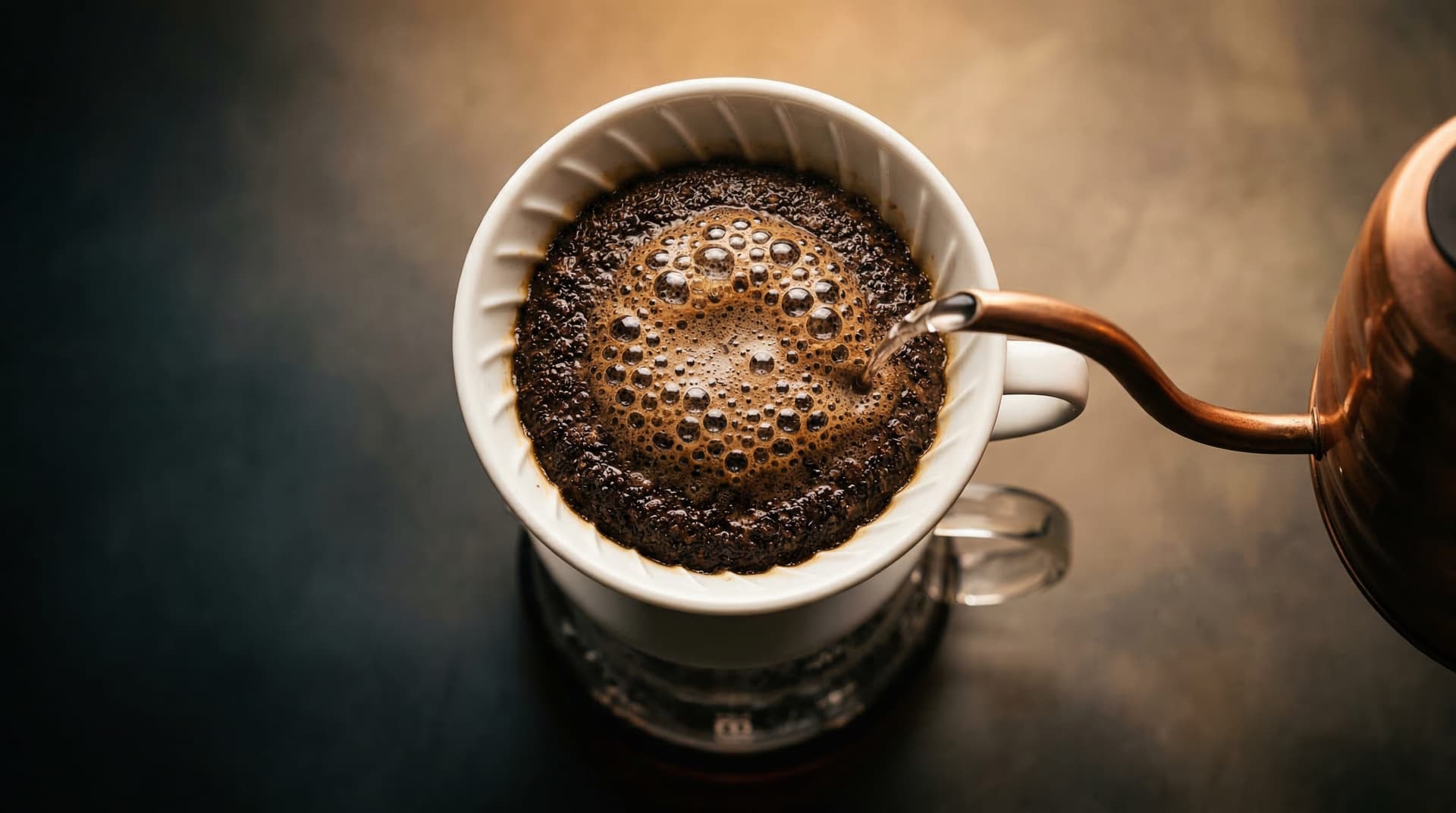
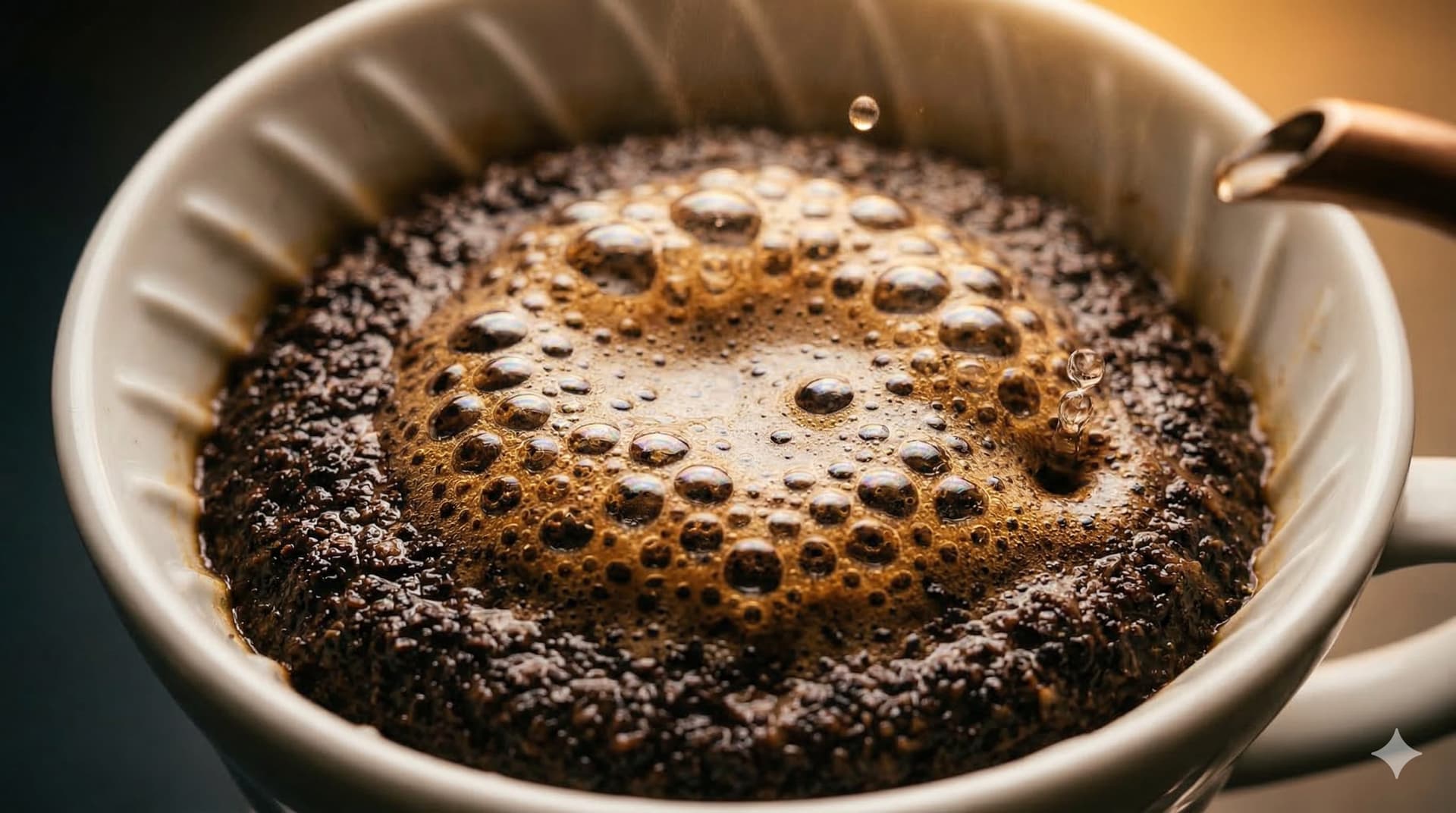
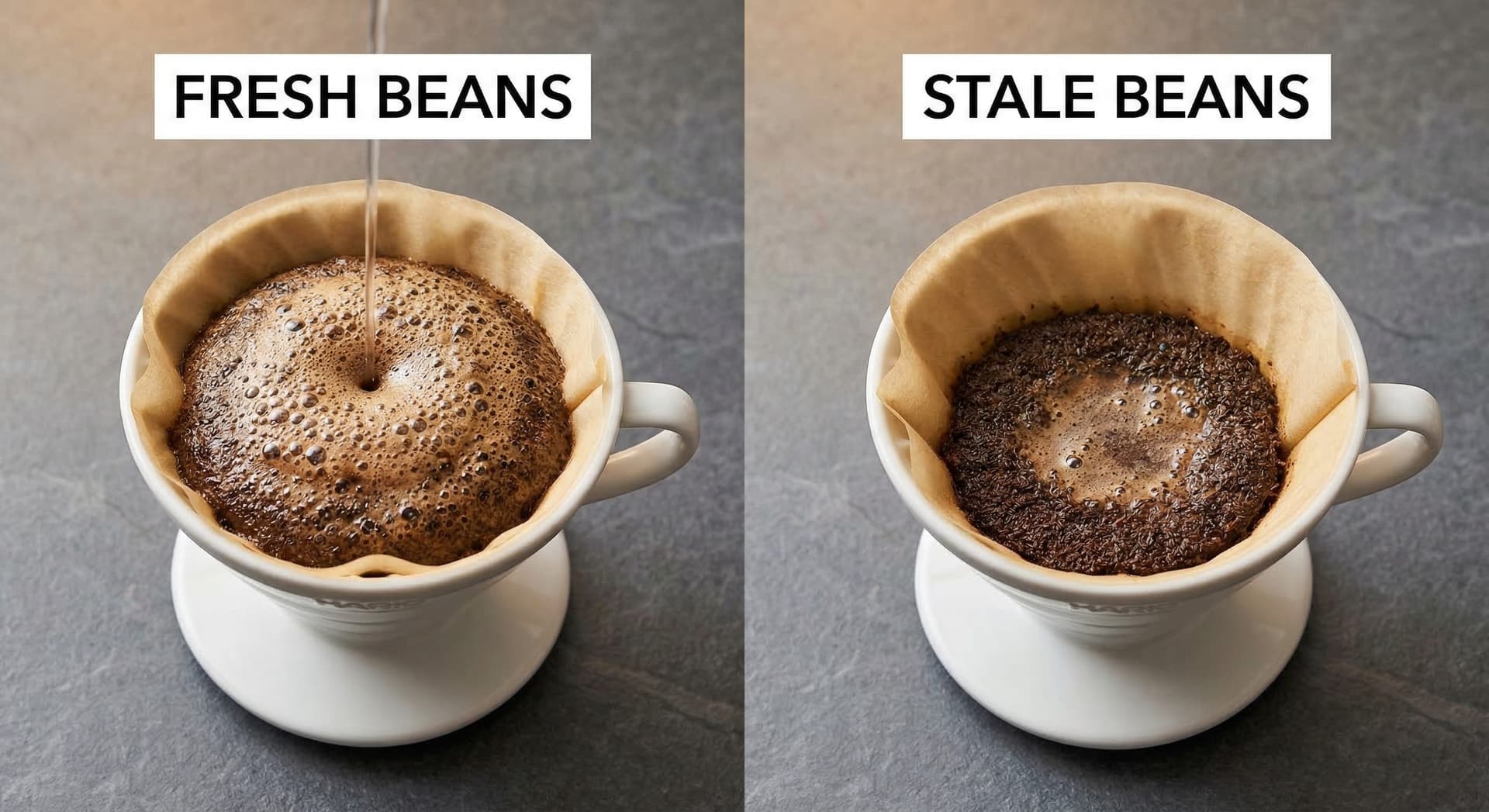
During those seconds, you will see the coffee bed visibly rise, puff up, and produce bubbles. That is CO2 gas escaping from the ground coffee. The more vigorously and rapidly it bubbles, the fresher the beans.
The term "bloom" is a visual description — the coffee bed swells and rises like a flower opening. It is most dramatic and visible in pour over methods, but the same coffee degassing process occurs at the start of espresso extraction and in any brewing method that uses freshly ground coffee.
Why Does Coffee Bloom? The CO2 Science
Coffee bloom happens because of what occurs inside the bean during roasting. When green coffee is roasted, the Maillard reaction and caramelisation produce CO2 as a byproduct. This gas gets trapped inside the bean's cellular structure — in large quantities. A freshly roasted bean contains significantly more CO2 than it can easily release at room temperature, which is why coffee bags have one-way degassing valves.
When you grind the coffee, you break open those cells, exposing the trapped CO2. When hot water hits the grounds, the heat and solvent action rapidly accelerates CO2 release — and you get the bloom.
Why CO2 Disrupts Extraction
Here is the key point: CO2 is hydrophobic. It actively repels water. When CO2 is still escaping from the grounds during extraction, it forms a barrier between the water and the coffee particles — inhibiting the solvent action that extracts flavour compounds. The result is patchy, uneven extraction across the coffee bed.
In a pour over, this shows up as some sections of the bed extracting too little while water finds the path of least CO2 resistance. The overall brew tastes flat, slightly sour, or underdeveloped — not because of grind or ratio, but because CO2 was competing with water for contact with the grounds.
Coffee degassing the CO2 before the main extraction removes that competition. Water can then saturate the entire coffee bed evenly, contacting every particle uniformly, which is the basis of consistent extraction.
Without Bloom
- ✗CO2 actively escaping during extraction
- ✗Water repelled from grounds unevenly
- ✗Patchy extraction across the bed
- ✗Flat, underdeveloped, or sour cup
- ✗Brew time often shorter than expected
With Bloom
- ✓CO2 escapes before main extraction
- ✓Water contacts all grounds evenly
- ✓Consistent extraction bed-wide
- ✓Balanced, developed, sweeter cup
- ✓More predictable, repeatable brews
How to Bloom Coffee Properly
The bloom is simple to execute, but there are a few specifics worth getting right. I've seen brewers use too little water (dry patches remain), too much water (starts extracting before CO2 escapes), pour too fast (disrupts the bed), and cut the bloom short (CO2 still escaping when main pour begins). Here is the correct approach.
Pour Over Bloom: Step by Step
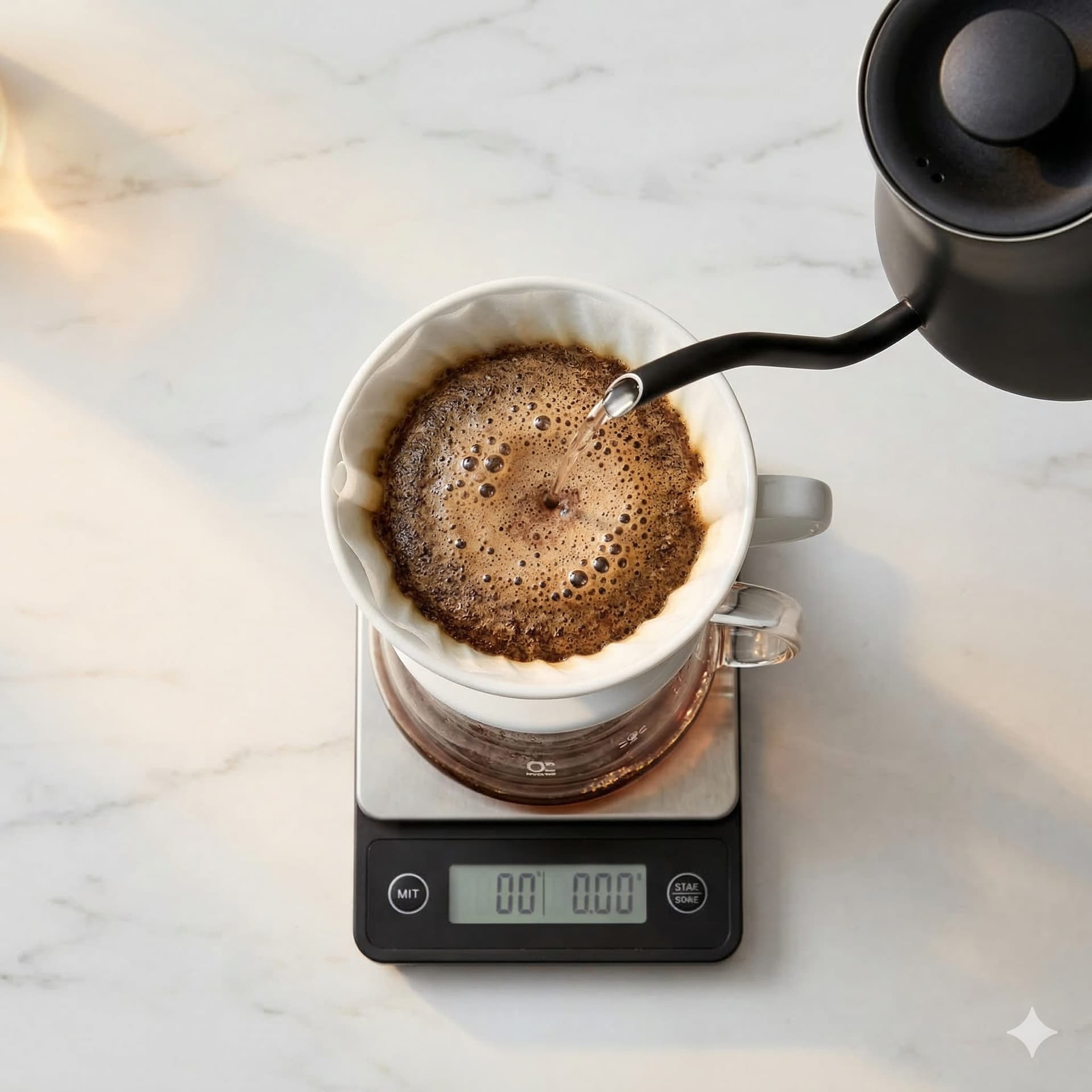
- 1Measure your bloom water (2:1 ratio)Use twice the weight of your coffee dose in bloom water. 15 g coffee → 30 g bloom water. 17 g coffee → 34 g bloom water. Weigh it — eyeballing consistently leads to either under-saturating the bed or triggering early extraction.
- 2Pour in a slow spiral from centre to edgeStart in the centre and move outward in a gentle spiral. The goal is to wet all the grounds evenly — no dry patches, no channelling. The pour should be slow and controlled, not a splash. A gooseneck kettle makes this considerably easier.
- 3Stop and waitOnce all the grounds are saturated, stop pouring completely. Start your timer. Wait 30–45 seconds. You should see the bed rise, swell, and bubble. Very fresh beans will bloom aggressively. This is normal and desirable.
- 4Proceed with main extractionAfter 30–45 seconds (when visible bubbling has slowed significantly), begin your main pours. The bed will have settled and is now ready for even, unobstructed extraction. Your total brew time should run 3–4 minutes including the bloom.
Bloom Timing: Does 30 vs 45 Seconds Make a Difference?
In testing, the improvement curve flattens beyond about 35 seconds for most coffees. A 30-second bloom and a 45-second bloom on the same beans often produce similar cups. What matters more is that the bloom is long enough for the visible CO2 activity to slow — that is your actual signal, not a fixed timer.
Very fresh beans (roasted within 4–7 days) may benefit from 45 seconds because CO2 output is higher and takes longer to calm. Beans 2–3 weeks past roast typically release their CO2 within 25–30 seconds. Use the visual cue — when active bubbling has significantly slowed, the bloom has done its job.
Which Brew Methods Benefit Most?
Not all brewing methods benefit equally from bloom. The improvement is most dramatic in methods where uneven extraction is hardest to fix mid-brew — which means filter methods, particularly pour over.
Pour Over (V60, Chemex, Kalita Wave) — Most Impact
Pour over rewards the bloom more than any other method. The entire extraction depends on even water-to-coffee contact through a static bed. CO2 disruption here directly translates to uneven extraction and a noticeably flatter cup. Always bloom. The improvement with fresh beans is substantial enough that I consider it non-negotiable. For the full pour over technique, see our complete pour over brewing guide.
Drip Coffee Makers — High Impact If Machine Supports It
Most automatic drip machines do not perform a bloom phase, which is one reason their results often lag behind manual pour over even with the same beans and grind. High-end drip machines (Technivorm Moccamaster, Breville Precision Brewer) include a bloom or pre-infusion mode that makes a real difference. If yours does not, you can manually bloom by pausing the machine after initial saturation — though it is imprecise with most machines.
AeroPress — Moderate Impact
A 30-second bloom at the start of an AeroPress brew (pour water to just above the grounds, stir gently, wait) improves clarity and reduces the slight sourness that sometimes appears without it. The improvement is less dramatic than pour over because the AeroPress brew is shorter and involves agitation — but it is still worth doing with fresh beans.
French Press — Moderate Impact
French press uses immersion rather than percolation, so CO2 disruption is less of a problem than in filter brewing — but blooming still reduces the slight astringency that fresh beans can produce in an immersion brew. Pour enough water to saturate the grounds, give a brief stir, wait 30 seconds, then add the remaining water and brew normally.
Espresso — Pre-Infusion, Not Traditional Bloom
Espresso does not have a traditional bloom phase, but machines with pre-infusion capability perform the equivalent function: they apply low pressure (1–4 bars) for 5–10 seconds before ramping to full 9-bar extraction. This wets the puck evenly and allows initial CO2 release before full pressure hits, which reduces channelling and improves extraction consistency. For more on how extraction works, see our guide to espresso extraction.
Freshness and Bloom: The Direct Connection
The bloom is fundamentally a freshness phenomenon. The more CO2 in the beans, the more vigorous the bloom. The more vigorous the bloom, the more benefit you get from performing it. This creates a direct relationship: bloom technique matters most with fresh beans, and matters almost not at all with stale ones.
I have tested this repeatedly with controlled variables — same grind, same ratio, same water temperature, same dripper, same brewer. With beans 10 days past roast: blooming vs not blooming produced a clearly detectable difference in cup quality. With beans 8 weeks past roast: the difference was negligible because most CO2 had already degassed during storage.
Bloom Activity by Bean Age
| Days Since Roast | Bloom Activity | Bloom Benefit | Notes |
|---|---|---|---|
| 0–3 days | Very aggressive | High — extend to 45–60 sec | Too much CO2 can cause overflow in small drippers; rest beans if possible |
| 4–14 days | Active and vigorous | High — standard 30–45 sec | Peak window; bloom delivers most noticeable improvement in cup |
| 15–30 days | Moderate | Moderate — 30 sec is sufficient | Still noticeably better with bloom; beans still good quality |
| 31–45 days | Minimal | Low — bloom is largely cosmetic | Freshness is the limiting factor, not technique |
| 46+ days | Almost none | Negligible — buy fresh beans | CO2 long since depleted; bloom will not rescue a stale cup |
The practical implication: if you want to improve your brews with bloom technique, start by buying fresher beans. The bloom technique amplifies what fresh beans already offer — it does not compensate for staleness. Our guide on how to pick espresso beans covers what to look for in roast dates, sourcing, and why freshness should be your first consideration before any technique refinement.
Common Bloom Mistakes
After training over 200 baristas, here are the bloom errors I see most often — and how to fix each one.
Mistake 1: Using too little bloom water
Problem: Dry patches in the coffee bed mean CO2 in those areas does not escape before extraction begins. Result: uneven extraction, flat spots in the cup.
Fix: Use 2x coffee weight in water, minimum. Pour slowly in a spiral to reach all grounds. You should see the entire surface saturate and begin to swell — not just the centre.
Mistake 2: Cutting the bloom short
Problem: Starting the main pour too early (10–15 seconds) means active CO2 is still releasing when extraction begins. The bloom was decorative rather than functional.
Fix: Wait until the visible bubbling has slowed significantly — ideally 30–45 seconds with fresh beans. Watch the bed, not the clock. When the rise and bubble activity plateaus, the bloom is done.
Mistake 3: Pouring too aggressively during bloom
Problem: A hard, fast bloom pour disrupts the coffee bed and can start washing grounds into the filter walls before CO2 has escaped.
Fix: The bloom pour should be slow and gentle — the goal is even saturation, not agitation. A gooseneck kettle makes precision much easier here.
Mistake 4: Expecting bloom to fix stale beans
Problem: Spending time on perfect bloom technique when the beans are 2 months past roast. The bloom phase will be near-absent because there is little CO2 left to release.
Fix: Check your roast date first. Bloom technique only amplifies what fresh beans can offer. If the beans are stale, buy fresher ones — no amount of technique adjustment will compensate.
Mistake 5: Skipping bloom entirely
Problem: This is the most common one. Many home brewers skip it to save time.
Fix: It adds 40 seconds. The cup quality improvement with fresh beans is real and consistent. Once it becomes habit — which takes about a week of daily brewing — you will not think about it as extra effort.
Frequently Asked Questions
Frequently Asked Questions
Coffee bloom is the brief pre-infusion phase at the start of brewing where a small amount of hot water saturates freshly ground coffee and releases trapped CO2 gas. The gas escapes visibly as bubbles rising through the coffee bed — this is the bloom.
It occurs because roasting generates CO2 inside the bean structure, and when hot water hits the grounds, that CO2 releases rapidly. Blooming allows the CO2 to escape before main extraction begins, so water can make full, even contact with the coffee for a cleaner, more balanced cup.
Get Coffee Tips
Join our newsletter for expert reviews and brewing guides.