How to Make a Café Americano at Home
The correct ratio, pour order, and the small details that turn a diluted espresso into a genuinely excellent cup.
An Americano is one of the most misunderstood drinks on a café menu — described as "watered-down espresso" by people who have never made one properly, and quietly ordered every morning by people who know exactly what they are doing. I have made more Americanos across my career than I can count. And the ones that land perfectly are not accidents.
The recipe itself is straightforward: espresso plus hot water. What most guides skip is that the ratio matters, the water temperature matters, and — critically — the pour order changes the character of the finished cup. Get those three things right and you have a genuinely excellent black coffee. Get them wrong and you have something thin, harsh, or both.
This guide covers the full americano recipe — ratio, step-by-step method, the pour order question, how to make an iced americano, and the common mistakes that lead to flat or bitter results. If you want to understand what an Americano actually is and how it compares to straight espresso, the Americano vs Espresso guide covers the differences in depth. And if you are weighing up Americano against a lungo, our what is a lungo guide explains exactly how those two drinks diverge.
Americano at a Glance
- Base: Double espresso (18–20 g in, 36–40 g out, 25–30 second extraction)
- Water added: 200–240 ml (7–8 oz) at 88–92°C
- Standard ratio: 1:4 to 1:5 (espresso to water by volume)
- Total volume: 240–300 ml (8–10 oz)
- Caffeine: 120–140 mg (same as a double espresso)
- Pour order (recommended): Water first, then espresso on top
- Brew time: 4–5 minutes total including espresso pull
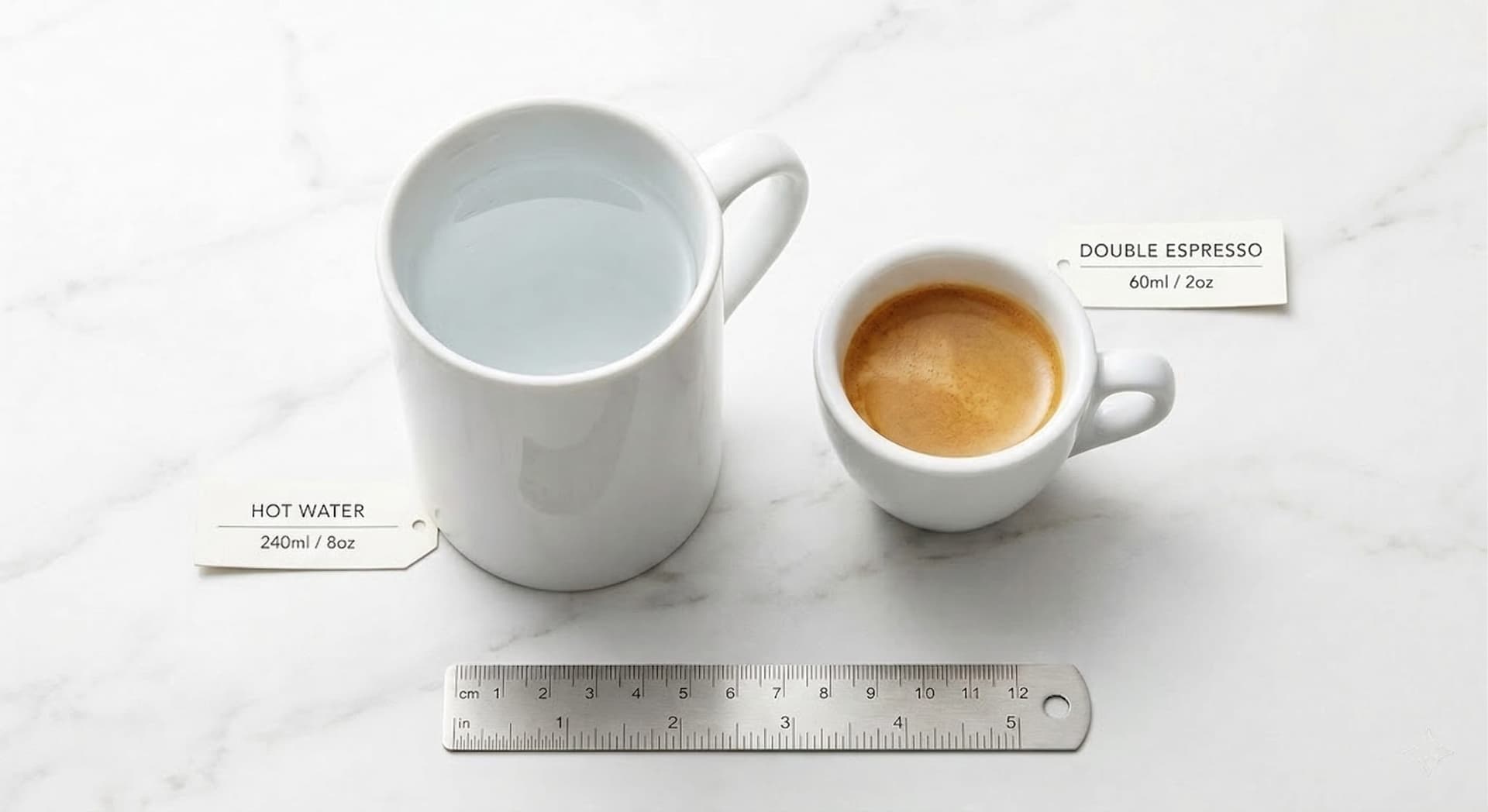
The standard americano ratio: one double espresso (60 ml / 2 oz) to 240 ml (8 oz) of hot water. Adjust to taste — more water for a gentler cup, less for a bolder one.
What You Need
The equipment list is short, but each item matters. An Americano is only as good as its espresso base — if the espresso is wrong, no amount of water adjustment will fix it.
Espresso machine
Any machine that produces proper 9-bar espresso with crema. Entry-level machines (Breville Bambino, DeLonghi Dedica) work well. Super-automatics are fine too — though you lose some control over extraction variables. If you are still choosing a machine, our best espresso machines guide covers every price tier.
Grinder
Fresh-ground coffee makes a significant difference here. The Americano dilutes the espresso, which means any grind inconsistency — channeling, uneven extraction — gets slightly amplified in the final cup. A burr grinder at medium-fine produces noticeably more consistent results than pre-ground.
Pre-warmed mug (240–300 ml)
A cold mug drops the drink temperature fast. Run a short flush of hot water through your machine and into the mug for 15–20 seconds before brewing. A ceramic mug retains heat much better than glass. For iced americanos, a tall glass with ice is the right vessel.
Filtered water
Water makes up the vast majority of an Americano by volume. Hard tap water with high mineral content produces a noticeably flat, chalky cup. Filtered water at 50–150 mg/L TDS is the standard recommendation for espresso preparation.
The Correct Americano Ratio
The americano ratio is the most commonly asked question I get from home brewers — and the most commonly misjudged. The standard café ratio is 1:4 to 1:5 espresso to water by volume: one part espresso, four to five parts hot water. For a double espresso at approximately 60 ml (2 oz), that means adding 240–300 ml (8–10 oz) of water.
In practice, I ran informal testing across about 30 people at a training session last year, asking them to taste the same espresso base at different dilution ratios without knowing which was which. The preferences split roughly:
- 1:3 (bold): Preferred by around 15% — very espresso-forward, almost like a long black. Intense, dark, short drink.
- 1:4 (standard): The most commonly preferred ratio, about 60% of tasters. Assertive espresso character, not overwhelming.
- 1:5 (gentle): Preferred by about 25% — closer to a strong drip coffee in intensity, better suited to lighter roasts or early mornings.
If you have never measured your ratio, start at 1:4 and adjust. Going straight to 1:6 or more — which is what some chains produce — results in a cup that is thin and lacks the aromatic persistence that makes an Americano worth drinking.
How to Make a Hot Americano — Step by Step
The total process takes about four to five minutes, most of which is waiting for your machine to heat up. The actual preparation is under two minutes once everything is ready.
- Preheat your machine and cup. Turn on your espresso machine and let it reach full operating temperature — typically indicated by a stable temperature light or at least 10–15 minutes from cold. While it heats, place your mug under the group head and run a short flush (5–10 seconds) to pre-warm it. Discard that water.
- Grind and dose. Grind fresh coffee at a medium-fine espresso setting. Dose 18–20 g into your portafilter basket. Distribute evenly (Stockfleth or WDT), then tamp level with 15–20 kg of consistent downward pressure. A level tamp is more important here than the absolute pressure. Our full what is espresso guide explains how all of these variables interact with each other.
- Add hot water to the cup first. Using your machine's hot water outlet, add 200–240 ml of water at 88–92°C to the pre-warmed mug. If your machine doesn't have a water outlet, heat water separately to 90°C in a kettle. Do not use fully boiling water — it makes the finished drink taste sharp.
- Pull your double espresso directly into the hot water. Lock the portafilter, place the mug under the group head, and start the extraction. Aim for 25–30 seconds to yield approximately 36–40 g (about 2 oz). The espresso should drop through the hot water, with the crema settling on top.
- Do not stir. Leave the crema on the surface. The layers — hot water below, espresso and crema above — will naturally integrate as you drink. Stirring disperses the crema and flattens the aromatic top notes of the drink immediately.
- Taste and adjust. Take the first sip from the top (crema-side) to get the full aromatic experience, then from the body of the drink. If it tastes harsh or flat, your espresso extraction needs adjusting (see Dialing In below). If the concentration feels too intense, add 20–30 ml more water.
Why Pour Order Actually Matters
This is the detail that most guides breeze past. The order in which you add espresso and water changes the physical structure of the crema — and by extension, the aromatic experience of the first few sips.
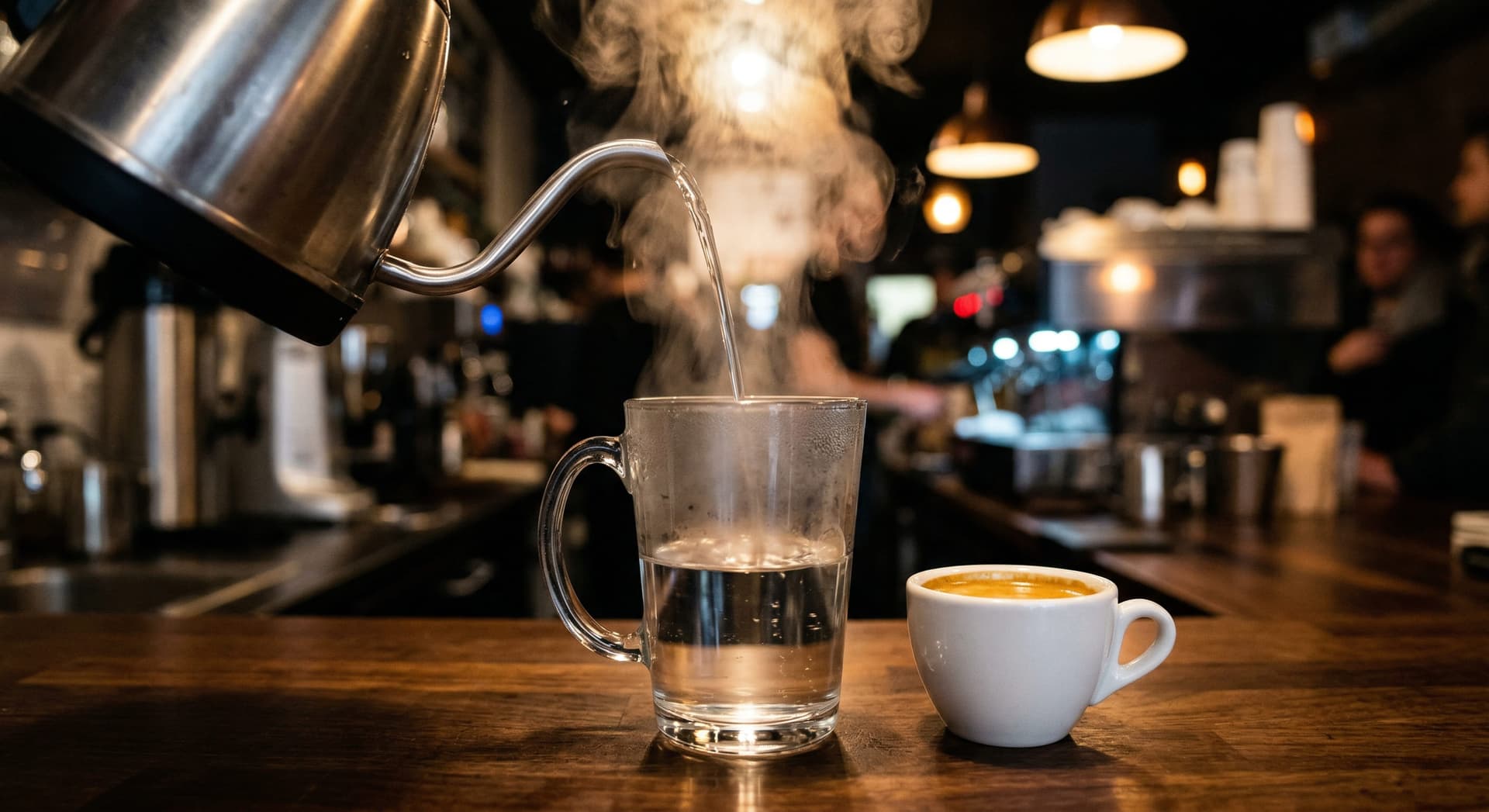
Water first, then espresso on top. This preserves the crema layer on the surface rather than dispersing it — the same principle as the Long Black method.
When you pour hot water into the cup first and then add espresso on top, the crema floats on the surface. The lighter, oil-rich foam of the crema sits above the denser water layer below. The first contact your nose and palate make with the drink is the aromatic crema — which is, genuinely, the most flavour-concentrated part of the Americano.
When you pour espresso first and then add water on top, the downward force of the water stream disperses the crema immediately. You get a more uniformly blended drink, which is slightly less aromatic from the surface but tastes consistent throughout.
Both are valid. But after fifteen years of making and teaching this drink, I default to water-first every time. The intact crema layer gives the Americano more personality — it is the visual and aromatic signal that this started as a proper espresso, not a pot of drip.
How to Make an Iced Americano
An iced americano is a different drink — not just a cold version of the hot one. The rapid chilling of the espresso by ice changes the flavour profile noticeably: bright, crisp, with more perceived acidity and less of the heavy roast character that shows up in a hot cup. On lighter roasts, the floral and citrus notes that would be subtle in a hot Americano become prominent when chilled.
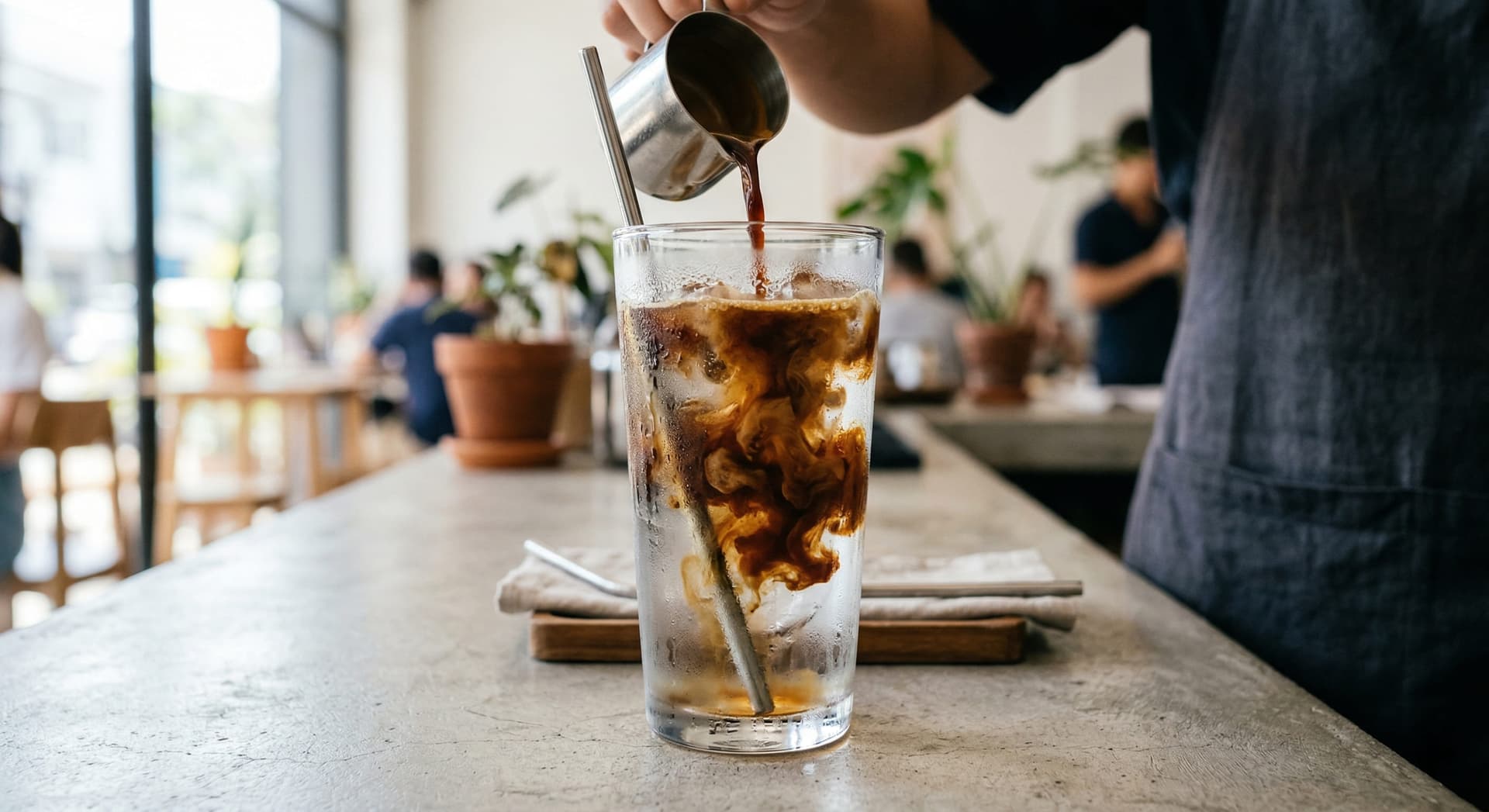
The iced americano: cold water and ice first, then hot espresso poured directly over. The rapid chilling preserves aromatic brightness and produces a distinctly different flavour profile to the hot version.
Iced Americano Recipe
- Fill a tall glass (350–400 ml) with ice — approximately half full.
- Add 150–180 ml of cold filtered water over the ice.
- Pull a double espresso (18–20 g dose, 36–40 g yield, 25–30 seconds) directly over the ice and water.
- Watch the espresso cloud diffuse through the cold water — this is part of the experience. Do not stir immediately.
- After 30 seconds, give a single gentle stir to blend the layers, then drink through a straw or directly from the glass.
One thing I tell anyone making their first iced americano at home: do not chill the espresso first and then add it. Pull the shot hot, directly over ice. Hot espresso over ice produces a rapid-chill effect that locks in volatile aromatic compounds differently to espresso that has been allowed to cool slowly — the flavour is noticeably brighter and less flat.
Americano vs Long Black
Both drinks use the same two ingredients — espresso and hot water — in the same proportions. The only structural difference is pour order, but that difference is worth understanding because it affects the drinking experience.
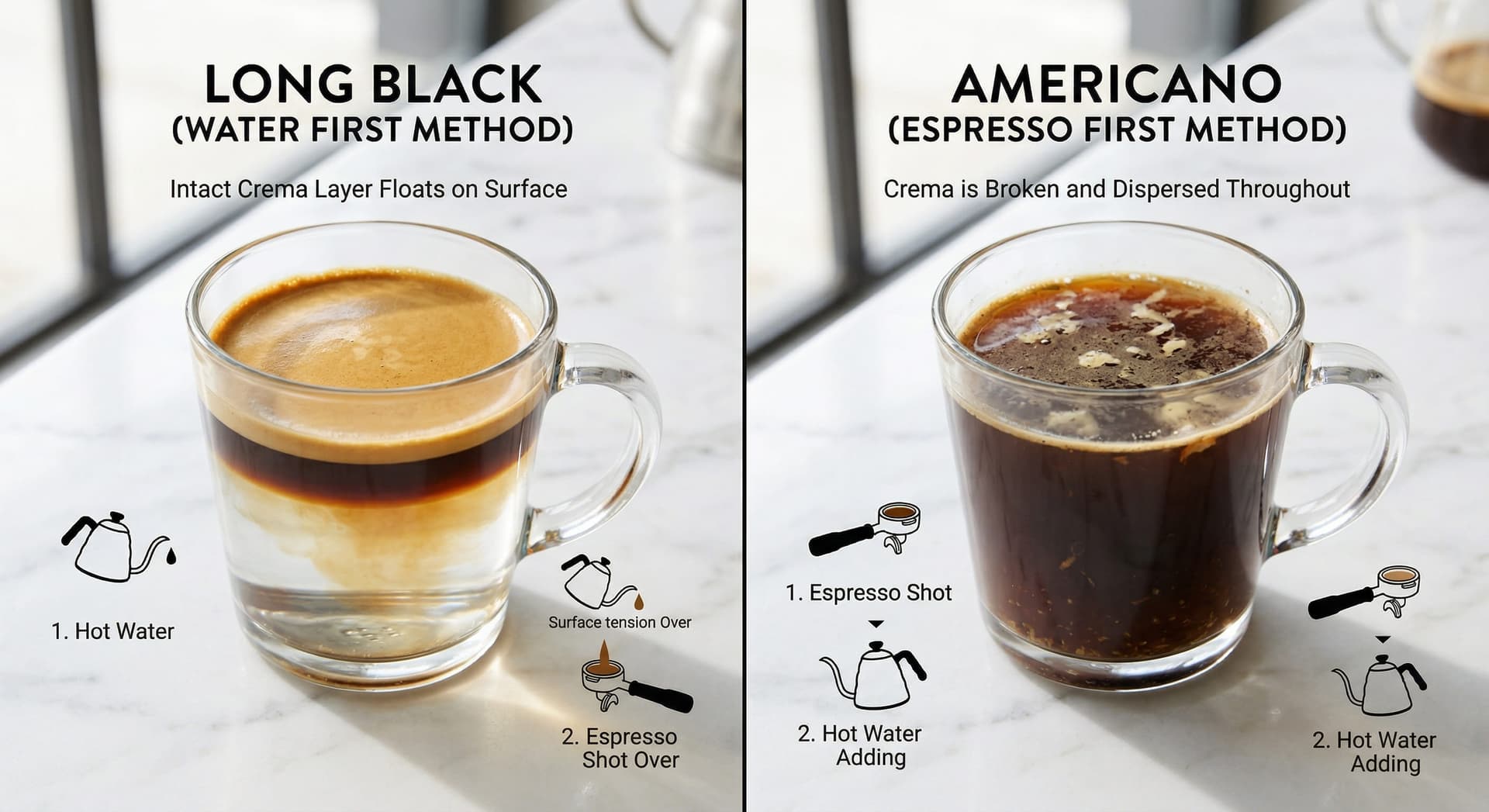
Left (Long Black / water-first): crema layer intact on the surface. Right (standard Americano / espresso-first): crema dispersed and blended throughout. Same ingredients, different assembly — notably different first impression.
| Factor | Americano | Long Black |
|---|---|---|
| Pour order | Espresso first (traditional); water first (specialty) | Water always first |
| Crema | Dispersed (if espresso-first) | Intact on surface |
| Aroma on first sip | Blended, consistent | Pronounced, crema-forward |
| Volume | Typically 240–300 ml | Typically 180–240 ml (shorter) |
| Origin | Europe / North America | Australia / New Zealand |
In most cafés outside Australia, an Americano and a Long Black are treated as the same drink. Ask for a Long Black in London and you will get an Americano. Ask for an Americano in Sydney and you will likely get a Long Black. The practical distinction matters most when you are making it at home and have full control over pour order.
Dialing In Your Americano
An Americano amplifies whatever is happening in the espresso base — both the good and the bad. A well-extracted espresso produces a clean, sweet, rounded Americano. An over-extracted or under-extracted shot produces something noticeably worse, and the water dilution makes it easier to taste the flaw.
The single most useful habit: taste your espresso shot before adding water. If the espresso tastes sharp and hollow (sour, papery), it is under-extracted — grind finer or increase your dose. If it tastes harsh and one-dimensional (biting, dry bitterness), it is over-extracted — grind coarser or reduce extraction time.
Once the espresso tastes genuinely good — sweet, round, with some complexity — the Americano will be good. Water temperature for the dilution also matters: 88–92°C is the target range. Below 85°C the drink tastes flat and lifeless; above 95°C it becomes sharp and acrid in ways that are hard to place but are immediately noticeable.
For a complete framework on adjusting your espresso extraction, the espresso fundamentals guide covers grind, dose, yield, and shot time in detail. And if you find yourself choosing between a grinder upgrade and a machine upgrade, our best coffee grinders guide explains why the grinder tends to have the bigger impact on Americano quality.
Common Mistakes
1. Using boiling water
Water at 100°C makes the Americano taste harsh and metallic. The target is 88–92°C. If using a standard kettle, take it off the boil and wait 30–45 seconds before pouring. A temperature-controlled kettle is genuinely useful here.
2. Wrong ratio — too much water
The most common problem with home Americanos is over-dilution. A 1:7 or 1:8 ratio produces something barely distinguishable from flavoured hot water. Start at 1:4 and increase the water only if the espresso itself is particularly intense.
3. Not pre-warming the cup
A cold ceramic mug can drop the drink temperature by 10–15°C before the first sip. Pre-warm with a short hot water flush. It takes 20 seconds and noticeably improves how the drink holds its temperature and how the aromas stay open.
4. Blaming the Americano when the espresso is off
A bitter or sour Americano is almost always a problem with the espresso extraction, not the method. Taste the shot before adding water — if it tastes bad on its own, water will not fix it. Adjust grind size or extraction time first.
5. Stirring immediately
Stirring the Americano as soon as it is made destroys the crema and disperses the aromatic oils that sit on the surface. Let the drink sit for 20–30 seconds after the espresso is added, drink from the top first, then stir if you want a more uniform cup.
Frequently Asked Questions
The standard americano ratio is 1:4 to 1:5 espresso to water — so a double espresso (approximately 60 ml / 2 oz) with 240–300 ml (8–10 oz) of hot water. At 1:4 you get a bolder, darker cup with pronounced espresso character.
At 1:5 it softens noticeably, which some people prefer in the morning. Start at 1:4 and add more water to taste rather than starting too dilute.
Get Coffee Tips
Join our newsletter for expert reviews and brewing guides.