Espresso Machine Types Explained: The Complete 2026 Buyer's Guide
Expert guidance for selecting the perfect espresso machine type for your skill level, budget, and coffee preferences
After fifteen years training baristas and conducting hands-on testing of over 500 coffee products across 12 categories, I've learned that the espresso machine you choose fundamentally shapes your daily coffee experience—from the ritual of preparation to the quality in your cup and the learning curve you'll navigate. Having personally tested and evaluated over 200 espresso machines across every category and price point, from $100 pod machines to $15,000 commercial lever systems, I can confidently state: understanding the different types of espresso machines before buying prevents costly mismatches between your expectations and reality—whether you're searching for the best espresso machine for beginners or planning a serious prosumer upgrade.
In my barista training workshops with over 200 professionals across specialty cafés from Seattle to Melbourne, I've witnessed countless purchasing mistakes that could have been avoided with proper guidance on how to choose an espresso machine suited to specific needs and workflows. Unlike drip coffee makers or French presses, espresso machines operate under precise mechanical and thermodynamic principles—forcing pressurized hot water at exactly 9 bars through finely ground coffee to extract concentrated flavor, aromatic oils, and that signature golden crema. Questions like semi-automatic vs automatic espresso machine, or whether a super-automatic justifies its price, become straightforward once you understand the fundamentals—which is exactly what this espresso machine buying guide is designed to deliver.
Through my hands-on testing protocols and as a regular contributor to specialty coffee publications and industry testing panels, I've evaluated the espresso machine landscape that spans from $100 budget pod machines delivering acceptable convenience to $15,000+ commercial-grade lever machines offering unparalleled shot customization. Between these extremes lies a diverse ecosystem: semi-automatic machines balancing automation with control, fully automatic push-button convenience, super-automatic bean-to-cup systems, and traditional manual lever machines for purist enthusiasts.
This comprehensive 2026 guide demystifies every espresso machine category, explaining the mechanics behind each type, analyzing advantages and limitations honestly, exploring critical features like boiler configurations and PID temperature control, and providing price-to-performance expectations. Whether you're a complete beginner exploring your first espresso setup or an experienced home barista upgrading equipment, understanding machine types ensures your investment delivers satisfaction for years to come.
Our testing promise: Every machine type and recommendation in this guide is backed by hands-on testing and long-term ownership analysis across dozens of machines—from budget entry-level models to $15,000 commercial systems. We buy equipment independently, live with it for months, and report results without brand influence.
Espresso Machine Types at a Glance
| Machine Type | Skill Required | Price Range | Milk Capability | Best For |
|---|---|---|---|---|
| Manual Lever | Expert | $300–$2,500 | Limited (small boiler) | Purists, pressure profiling enthusiasts |
| Semi-Automatic | Beginner–Intermediate | $200–$3,000+ | Excellent (steam wand) | Home enthusiasts, skill builders |
| Automatic | Beginner–Intermediate | $400–$2,500 | Excellent (steam wand) | Consistency-focused home baristas |
| Super-Automatic | None | $700–$5,000+ | Good (auto frother) | Convenience-first users, offices |
| Pod / Capsule | None | $100–$700 | Limited (basic frother) | Casual drinkers, tight budgets |
What Is an Espresso Machine and Why Machine Type Matters
An espresso machine is a specialized coffee brewing device that forces hot water at approximately 9 bars of pressure (130 PSI) through finely ground, compacted coffee to produce a concentrated 1-2 ounce beverage in 25-30 seconds. This pressurized extraction fundamentally differs from gravity-based methods like pour over coffee or immersion brewing like French press—delivering espresso's characteristic intense flavor, syrupy body, and signature crema layer.
The critical components every espresso machine shares: A water reservoir or plumbed water connection, heating element or boiler maintaining water at 195-205°F optimal brewing temperature, pump generating consistent pressure (vibratory or rotary), group head distributing pressurized water evenly across the coffee puck, portafilter basket holding tamped coffee grounds, and typically a steam wand for milk frothing.
However, how these components integrate and the automation level they incorporate creates dramatically different user experiences, shot consistency, learning curves, and price points. Machine type determines whether you manually control every extraction variable or rely on programmed automation, whether you wait between brewing espresso and steaming milk or operate simultaneously, and whether you develop hands-on barista skills or prioritize push-button convenience.
Why machine type matters more than brand or features: A manual lever machine demands technical expertise, physical technique, and patience but rewards skilled users with unmatched shot customization. A super-automatic delivers consistent results instantly but offers minimal control over extraction variables. Semi-automatic machines strike the balance most home baristas prefer—automating pressure and temperature while preserving manual control over grind, dose, distribution, tamping, and shot timing.
Understanding these fundamental differences prevents the most common buyer mistake: purchasing based on price or brand reputation without considering whether the machine's automation level matches your preferences, skill level, and daily workflow. A $2,000 super-automatic frustrates hands-on enthusiasts craving manual control, while a $1,500 dual-boiler semi-automatic overwhelms beginners expecting one-touch simplicity.
Professional baristas and specialty coffee experts emphasize that espresso machine type represents your fundamental decision point—affecting every subsequent choice about grinder pairing, learning investment, maintenance requirements, and long-term satisfaction. Features like PID temperature control, dual boilers, and pre-infusion matter enormously, but only after selecting the machine category aligned with your brewing philosophy and lifestyle demands.
Manual Lever Espresso Machines: Artisanal Control and Mechanical Elegance
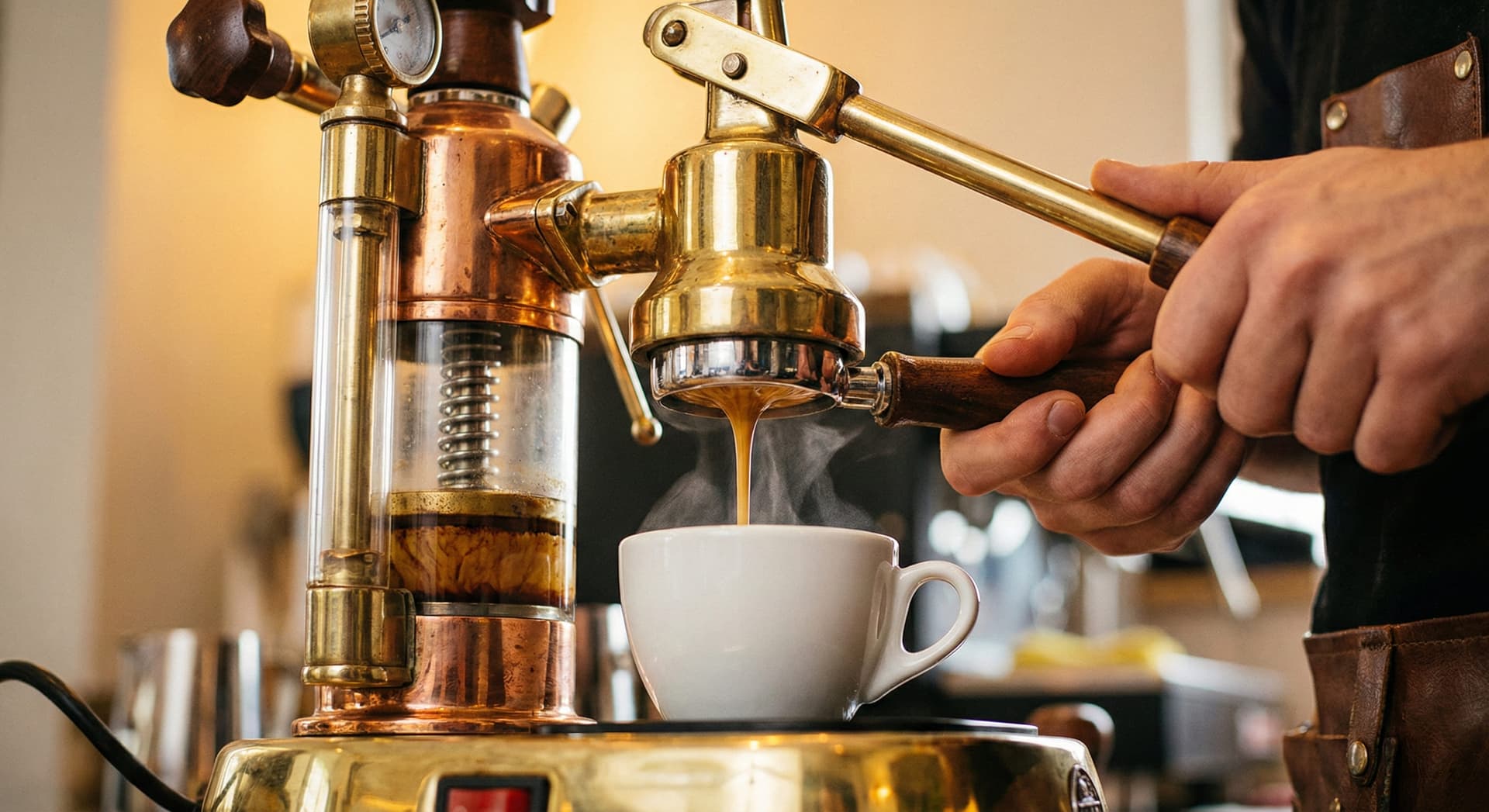
Manual lever espresso machines represent the oldest and most hands-on espresso preparation method, dating back to Achille Gaggia's revolutionary 1948 invention that first achieved espresso's signature crema through mechanical pressure rather than steam. These machines eliminate electric pumps entirely—the barista manually pulls a spring-loaded or direct-lever mechanism to generate extraction pressure, offering complete control over pressure profiling, flow rate, and extraction timing.
How Manual Lever Machines Work
Manual machines come in two primary designs: spring-lever machines where pulling the lever compresses a powerful spring that gradually releases to push water through coffee (declining pressure profile), and direct-lever machines where the operator's arm strength directly controls water pressure throughout extraction (customizable pressure profile).
Spring-lever models (La Pavoni Europiccola, Elektra Micro Casa) create a natural pressure curve—starting high to saturate grounds, then gradually declining as the spring relaxes—mimicking modern programmable pressure profiling automatically. Direct-lever machines (Cafelat Robot, Flair espresso makers) offer even more control but demand precise technique and consistent strength to maintain stable pressure.
Both designs require manual heating (electric heating element or stovetop), manual grinding, precise dosing and distribution, perfect tamping technique, and careful timing. The barista controls every extraction variable, making manual machines the ultimate learning tool for understanding espresso fundamentals. If you're new to this, our espresso extraction guide explains each of those variables and how they interact.
Advantages and Disadvantages
Advantages
- ✓Complete pressure control: Manually adjustable pressure profiling achieves extraction nuances impossible with fixed-pump machines
- ✓Mechanical simplicity: Fewer electronic components mean superior longevity (30-50+ years) and easier repairs
- ✓Exceptional build quality: Most use brass boilers, chrome-plated brass groups, and stainless components—commercial-grade materials
- ✓Zero pump noise: Silent extraction process ideal for noise-sensitive environments
- ✓Hands-on learning: Develops deep understanding of extraction variables and espresso fundamentals
- ✓Gorgeous aesthetics: Classic Italian designs become kitchen centerpieces and conversation starters
Disadvantages
- ✗Steep learning curve: Achieving consistency requires months of practice mastering lever technique
- ✗Physical demand: Pulling levers requires strength and stamina, especially for multiple consecutive shots
- ✗Temperature surfing: Single boilers require careful timing between heating cycles to hit optimal brew temperature
- ✗Time investment: Each shot takes 5-8 minutes including heating, pulling, and milk steaming workflow
- ✗Limited steam power: Small boilers and manual heating limit milk frothing capability and speed
- ✗Not guest-friendly: Inconsistent results and lengthy process frustrate multiple-drink scenarios
Expert Recommendation:
Manual lever machines suit dedicated espresso purists who value the meditative ritual of hands-on preparation, enjoy developing technical skills, and prioritize shot customization over convenience. They're perfect as secondary machines for experienced home baristas exploring pressure profiling, or as primary machines for patient beginners committed to mastering espresso craft. However, those wanting quick morning shots, consistent results without practice, or regular milk drink preparation should consider semi-automatic or automatic machines instead.
Semi-Automatic Espresso Machines: The Perfect Balance of Control and Convenience
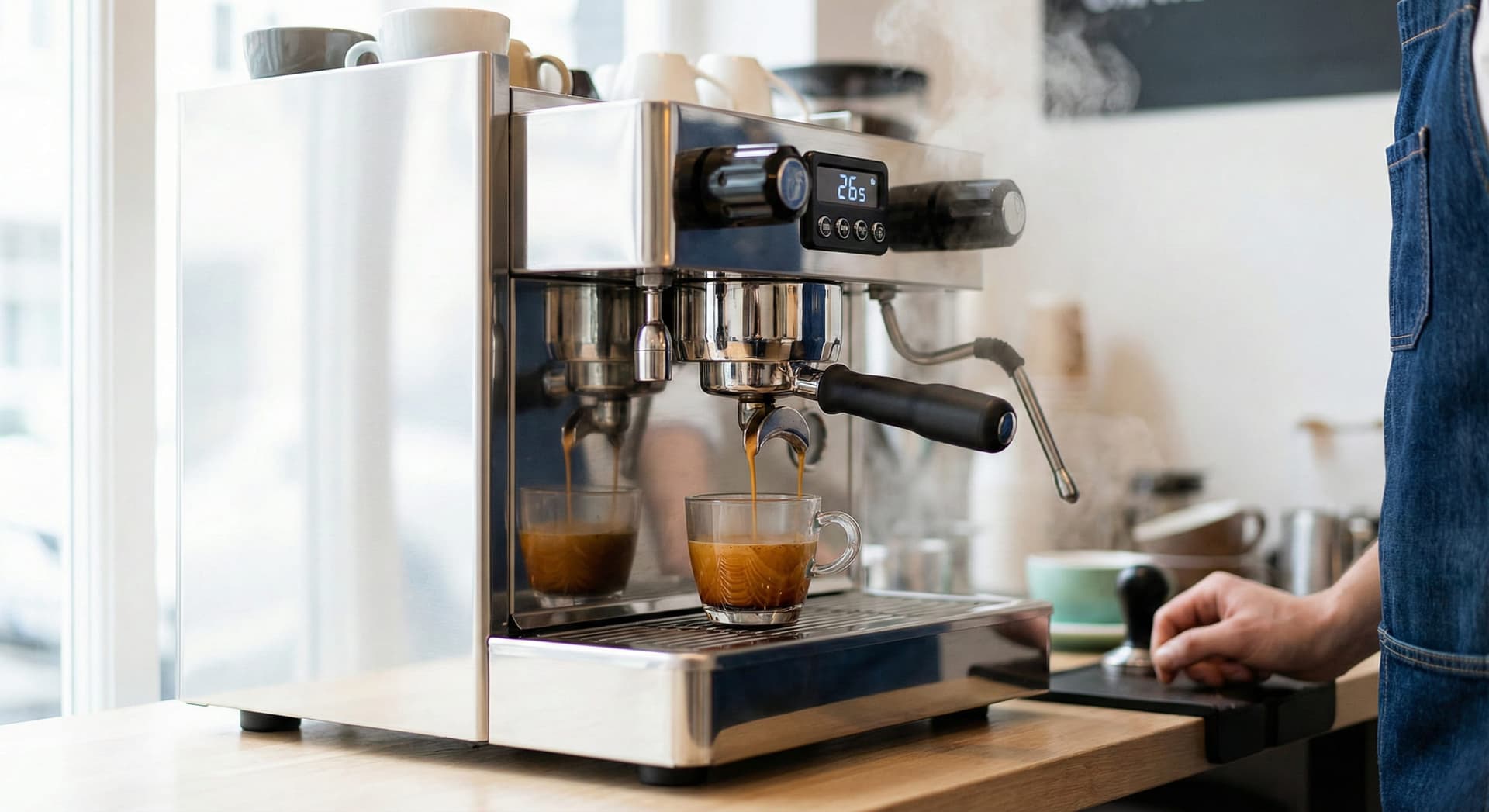
Semi-automatic espresso machines represent the gold standard for serious home baristas and commercial cafés worldwide. These machines automate water pressure and temperature regulation while preserving manual control over the most critical variables: grind size, dose amount, distribution and tamping technique, and shot timing. This balance makes semi-automatics the overwhelming choice for coffee enthusiasts seeking café-quality espresso without manual lever complexity.
How Semi-Automatic Machines Work
Semi-automatic machines feature electric pumps (vibratory in budget models, rotary in premium machines) maintaining consistent 9-bar extraction pressure, thermostats or PID controllers holding water temperature at precise brewing ranges (198-204°F), and user-activated switches controlling shot start and stop timing.
The barista's workflow: grind fresh beans to precise fineness, dose 18-20 grams into the portafilter basket, distribute grounds evenly, tamp with consistent 30-pound pressure, lock portafilter into group head, activate brew switch to start extraction, monitor shot flow and volume, then manually stop extraction at desired yield (typically 36-40 grams output for double shots in 25-30 seconds).
This hands-on process teaches espresso fundamentals while the machine handles the technical challenges of maintaining stable pressure and temperature—variables that manual machines leave to operator skill. Semi-automatics deliver remarkable shot-to-shot consistency once proper technique develops, typically within 2-4 weeks of daily practice.
Advantages and Disadvantages
Advantages
- ✓Optimal control-convenience balance: Automates pressure/temperature while preserving creative shot customization
- ✓Superior shot quality: Achieves café-level espresso matching commercial machines when paired with quality grinders
- ✓Skill development: Teaches fundamental barista techniques without overwhelming manual machine complexity
- ✓Excellent value: Wide price range ($200-2,000+) offers quality options at every budget level
- ✓Commercial-style steam wands: Professional milk frothing capability enabling latte art and microfoam texture
- ✓Extensive aftermarket support: Abundant accessories, modifications, and upgrade paths for enthusiast customization
- ✓Proven longevity: Quality models last 10-15+ years with proper maintenance and occasional part replacement
Disadvantages
- ✗Learning requirement: Achieving consistent results demands practice with grinding, dosing, distribution, and tamping
- ✗Time per shot: Workflow takes 3-5 minutes including grinding, preparation, extraction, and cleanup
- ✗Manual cleanup: Requires knocking out spent pucks, backflushing group heads, and purging steam wands after each session
- ✗Temperature wait times: Single-boiler models require 30-60 seconds switching between brewing and steaming temperatures
- ✗Grinder dependency: Shot quality relies equally on separate grinder investment ($300-800 for espresso-capable models)
- ✗Inconsistency during learning: Initial weeks produce variable results while technique develops
Expert Recommendation:
Semi-automatic machines are ideal for home enthusiasts who enjoy the craft of espresso making, want café-quality results, and appreciate hands-on involvement in their coffee preparation. They suit anyone willing to invest 2-4 weeks learning fundamental techniques in exchange for superior shot quality, creative control, and deeper understanding of espresso extraction. Popular models include Gaggia Classic Pro ($449-$499), Breville Bambino Plus ($350-400), Rancilio Silvia ($750-850), and Profitec Pro 500 ($1,600-1,800).
Automatic Espresso Machines: Convenience Meets Quality
Automatic espresso machines automate shot volume control by stopping water flow after a pre-programmed amount dispenses—typically 1 ounce for single shots, 2 ounces for doubles. Beyond this volumetric control feature, automatics function identically to semi-automatic machines, requiring manual grinding, dosing, distribution, tamping, and milk steaming. This single automation step improves consistency while maintaining the hands-on espresso preparation experience.
How Automatic Machines Work
Automatic machines incorporate flow meters or timers measuring water volume passing through the coffee puck. Users program desired shot volumes during initial setup—often with separate buttons for single and double shots—and the machine automatically terminates extraction when the programmed amount dispenses. This eliminates the need to manually stop shots while watching output volume or using scales.
The workflow mirrors semi-automatic preparation: grind beans, dose portafilter, distribute and tamp, lock into group head, then press the programmed shot button. The machine handles extraction termination automatically, freeing the barista to steam milk simultaneously (on dual-boiler or heat exchanger models) or attend to other tasks.
Professional cafés often prefer automatic machines for their consistency across different baristas and busy service periods. Home users appreciate the convenience during rushed mornings or when making multiple drinks. However, the distinction between "automatic" and "semi-automatic" has blurred in recent years—many modern semi-automatics include programmable shot buttons, making the categories nearly identical.
Advantages and Disadvantages
Advantages
- ✓Improved consistency: Programmed volumes eliminate shot-to-shot variation from manual timing errors
- ✓Multitasking capability: Automated shut-off allows steaming milk or preparing cups while extraction completes
- ✓Beginner-friendly: One less variable to monitor during the learning process
- ✓Café workflow efficiency: Perfect for commercial environments with multiple baristas maintaining consistency standards
- ✓Same shot quality: Identical extraction quality to semi-automatic machines when properly dialed in
Disadvantages
- ✗Less flexibility: Changing shot volumes requires reprogramming rather than simply stopping extraction
- ✗Price premium: Volumetric controls add $100-300 to comparable semi-automatic models
- ✗Extraction adjustments: Grind changes affect shot timing; may require volume reprogramming when switching beans
- ✗Same learning curve: Still requires mastering grinding, dosing, distribution, and tamping techniques
Expert Recommendation:
Automatic machines suit home baristas who value consistency and appreciate one less variable to monitor, especially during busy mornings or when making multiple drinks. They're also excellent for households where multiple people prepare espresso with varying skill levels. However, the price premium and reduced flexibility make pure semi-automatic machines more appealing for budget-conscious buyers or those who enjoy complete manual control. Many modern semi-automatics include programmable buttons anyway, essentially offering both functionalities.
Super-Automatic Espresso Machines: One-Touch Excellence
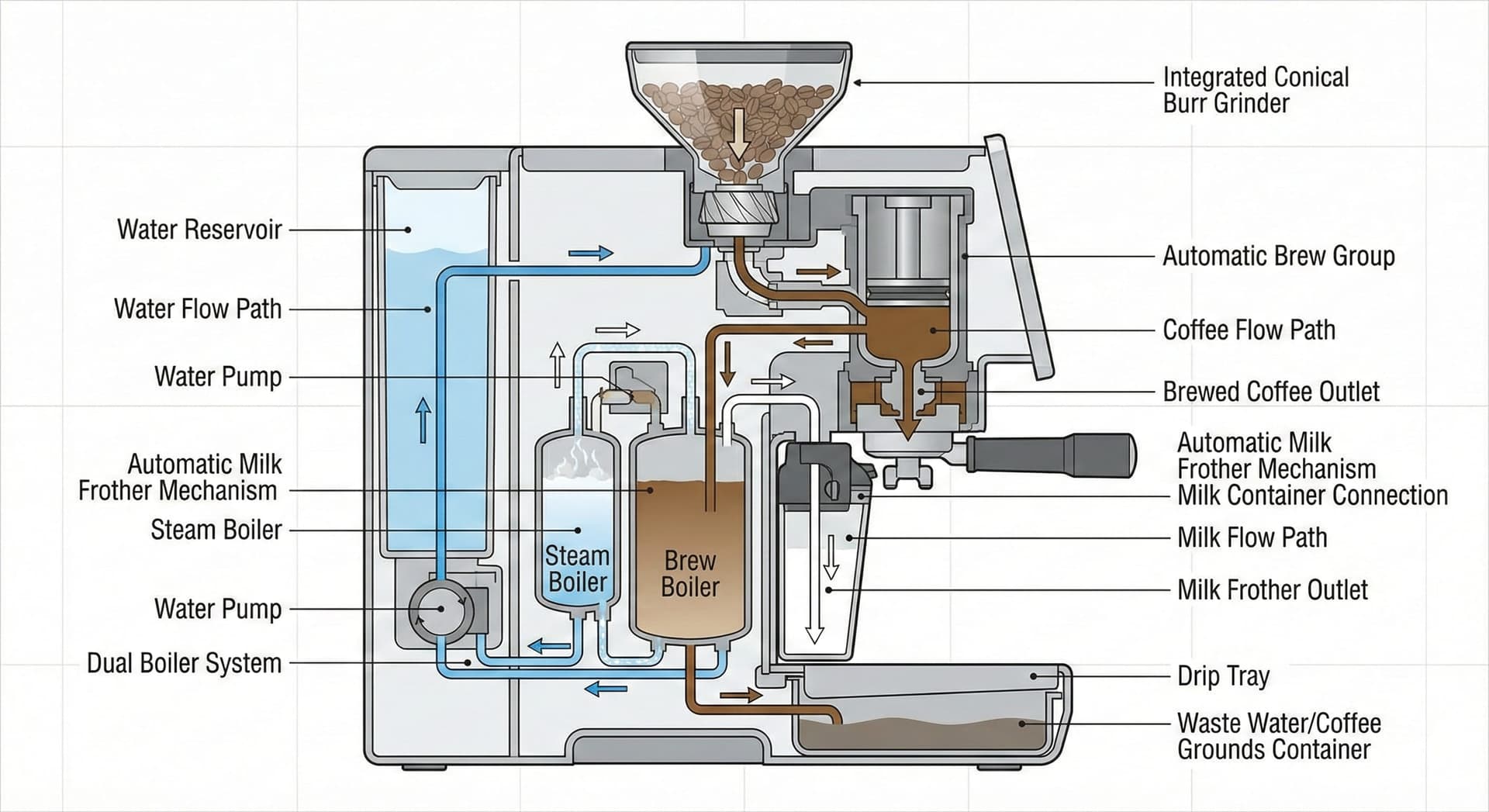
Super-automatic espresso machines automate the entire bean-to-cup process—incorporating built-in burr grinders, automatic dosing, self-tamping, programmable extraction, and automated milk frothing systems. Users simply add whole beans and water, press a button for their desired drink (espresso, cappuccino, latte, macchiato), and the machine handles every step automatically. This represents the ultimate convenience for those prioritizing speed and consistency over hands-on involvement.
How Super-Automatic Machines Work
Super-automatics feature integrated burr grinders (typically ceramic burrs) grinding fresh beans on-demand, automated dosing chambers measuring precise amounts, mechanical tamping mechanisms compressing grounds at consistent pressure, brew units moving portafilters through extraction cycles, and either automatic milk frothers (integrated tubes drawing from milk containers) or manual steam wands.
The workflow simplifies dramatically: fill the water reservoir and bean hopper, select your drink from the control panel or touchscreen, and press start. The machine grinds beans, doses into the brewing chamber, tamps, extracts espresso, froths and adds milk (if selected), then dispenses directly into your cup. Total time: 45-90 seconds from button press to finished drink.
Premium super-automatics offer extensive customization—grind fineness adjustment, dose amount control, extraction temperature settings, milk texture preferences, and drink ratio programming. Many include user profiles storing individual preferences, allowing households to save personalized recipes. Modern models feature smartphone connectivity, remote brewing activation, and maintenance alerts.
After each brewing cycle, most super-automatics automatically knock out spent pucks into internal waste containers and rinse brew units. Many include automatic descaling cycles, milk system cleaning programs, and self-diagnosis features alerting users to maintenance needs.
Advantages and Disadvantages
Advantages
- ✓Ultimate convenience: One-button operation from whole beans to finished drink in under 2 minutes
- ✓Zero learning curve: Excellent results immediately without developing barista skills
- ✓Remarkable consistency: Automated dosing, tamping, and extraction eliminate human error variables
- ✓No separate grinder needed: Built-in burr grinders save counter space and additional investment
- ✓Multiple drink options: Espresso, Americano, cappuccino, latte, macchiato all pre-programmed
- ✓User profiles: Save individual preferences for households with different taste preferences
- ✓Minimal cleanup: Automatic puck disposal and rinse cycles reduce daily maintenance
- ✓Guest-friendly: Anyone can make drinks without training or supervision
Disadvantages
- ✗High initial cost: Quality models start $800-1,200, premium machines cost $2,000-5,000+
- ✗Limited shot control: Minimal ability to adjust pressure profiles, pre-infusion, or flow rate during extraction
- ✗Integrated grinder limitations: Built-in grinders rarely match quality of dedicated espresso grinders
- ✗Complex maintenance: More components mean more potential failure points and expensive repairs
- ✗Milk system cleaning: Daily milk circuit rinsing essential to prevent bacterial growth and clogging
- ✗Latte art impossible: Automated milk frothers produce acceptable microfoam but lack manual steam wand precision
- ✗Large footprint: Integrated systems require significant counter space (12-18 inches wide)
- ✗Repair costs: Service requires specialized technicians and expensive proprietary parts
Expert Recommendation:
Super-automatic machines excel for convenience-focused users who drink multiple espresso beverages daily, households with varying coffee preferences, office environments, and anyone unwilling to develop barista skills but wanting better quality than pod machines. They're worth the investment if you'll use them 3+ times daily and value time savings over shot customization. However, espresso purists and hands-on enthusiasts find super-automatics unsatisfying. Popular models include De'Longhi Magnifica series ($800-1,200), Jura E8 ($2,600-2,800), Philips 3200 LatteGo ($699-799, best-value LatteGo entry), Philips 5500 Series ($799-849, with LatteGo and 12 drink programs), and Miele CM6 ($1,800-2,200).
Pod and Capsule Espresso Machines: Quick and Consistent
Pod and capsule espresso machines use pre-packaged, single-serve coffee portions—eliminating grinding, dosing, and tamping entirely. Users insert a sealed pod or capsule (Nespresso, Keurig, E.S.E., Lavazza, Illy), press a button, and extract coffee in 20-40 seconds. While these machines sacrifice customization and cost-effectiveness, they deliver unmatched convenience and consistency—perfect for casual coffee drinkers or ultra-convenient backup systems.
How Pod Machines Work and Pod Type Differences
Pod machines feature proprietary or standardized pod holders accepting pre-packaged coffee. The machine pierces the sealed pod, forces hot water through at moderate pressure (varies by system—Nespresso achieves 19 bars, others operate 8-15 bars), and dispenses brewed coffee directly into cups. Pods contain pre-ground, pre-dosed, and often pre-tamped coffee optimized for their specific machine systems.
Nespresso capsules: The market leader featuring aluminum or plastic capsules with 20-30 coffee varieties. Nespresso OriginalLine machines produce concentrated coffee resembling espresso with decent crema. VertuoLine uses centrifugal brewing (not true espresso) for larger cup sizes. Pods cost $0.70-1.40 each. If you are deciding between the two Nespresso platforms, our Nespresso Vertuo vs Original comparison covers the brewing technology difference, capsule lock-in, and which system suits different drinking habits.
E.S.E. (Easy Serving Espresso) pods: Standardized paper pods containing 7 grams of coffee, compatible across many brands (Illy, Lavazza). These produce more authentic espresso than capsule systems. Pods cost $0.60-1.00 each.
Keurig and compatible K-Cup systems: Primarily for drip-style coffee, not true espresso. Some models claim "espresso-style" shots but lack sufficient pressure for authentic espresso extraction. Pods cost $0.40-0.80 each.
Advantages and Disadvantages
Advantages
- ✓Extreme convenience: Insert pod, press button, receive coffee—no grinding, dosing, or cleanup
- ✓Perfect consistency: Every shot identical—zero variables or technique requirements
- ✓Low entry cost: Machines start $100-200, making espresso accessible to budget-conscious buyers
- ✓Compact footprint: Small machines ideal for limited counter space, offices, dorms, RVs
- ✓Variety exploration: Easy to try different roasts, origins, and flavors without buying full bags
- ✓No learning curve: Anyone can make drinks immediately without training
- ✓Extended freshness: Sealed pods preserve coffee longer than whole beans
Disadvantages
- ✗High per-cup cost: $0.60-1.40 per shot versus $0.20-0.40 with whole beans—annual costs add $400-800+
- ✗Environmental impact: Aluminum and plastic pods create significant waste unless recycled
- ✗Limited coffee selection: Restricted to pod manufacturer offerings—no access to specialty roasters
- ✗Inferior shot quality: Pre-ground coffee lacks freshness; extraction quality doesn't match fresh-ground espresso
- ✗Zero customization: Cannot adjust grind size, dose amount, or extraction parameters
- ✗Proprietary lock-in: Machines only accept specific pod brands, limiting options and pricing competition
- ✗Questionable "espresso": Many systems produce concentrated coffee but lack true espresso characteristics
Expert Recommendation:
Pod machines suit casual coffee drinkers consuming 1-2 cups daily who prioritize convenience over coffee quality, budget-conscious buyers wanting espresso-style drinks without grinder investment, office environments with varying user preferences, or backup systems for guests and rushed mornings. However, anyone drinking 3+ cups daily should calculate annual pod costs—often $600-1,200 yearly—versus a $500-800 semi-automatic machine investment with $0.25 per-cup bean costs. Popular models include Nespresso Vertuo ($150-200), Breville Nespresso Creatista ($400-700), and Illy E.S.E. compatible machines ($100-300).
Key Features to Consider When Buying an Espresso Machine
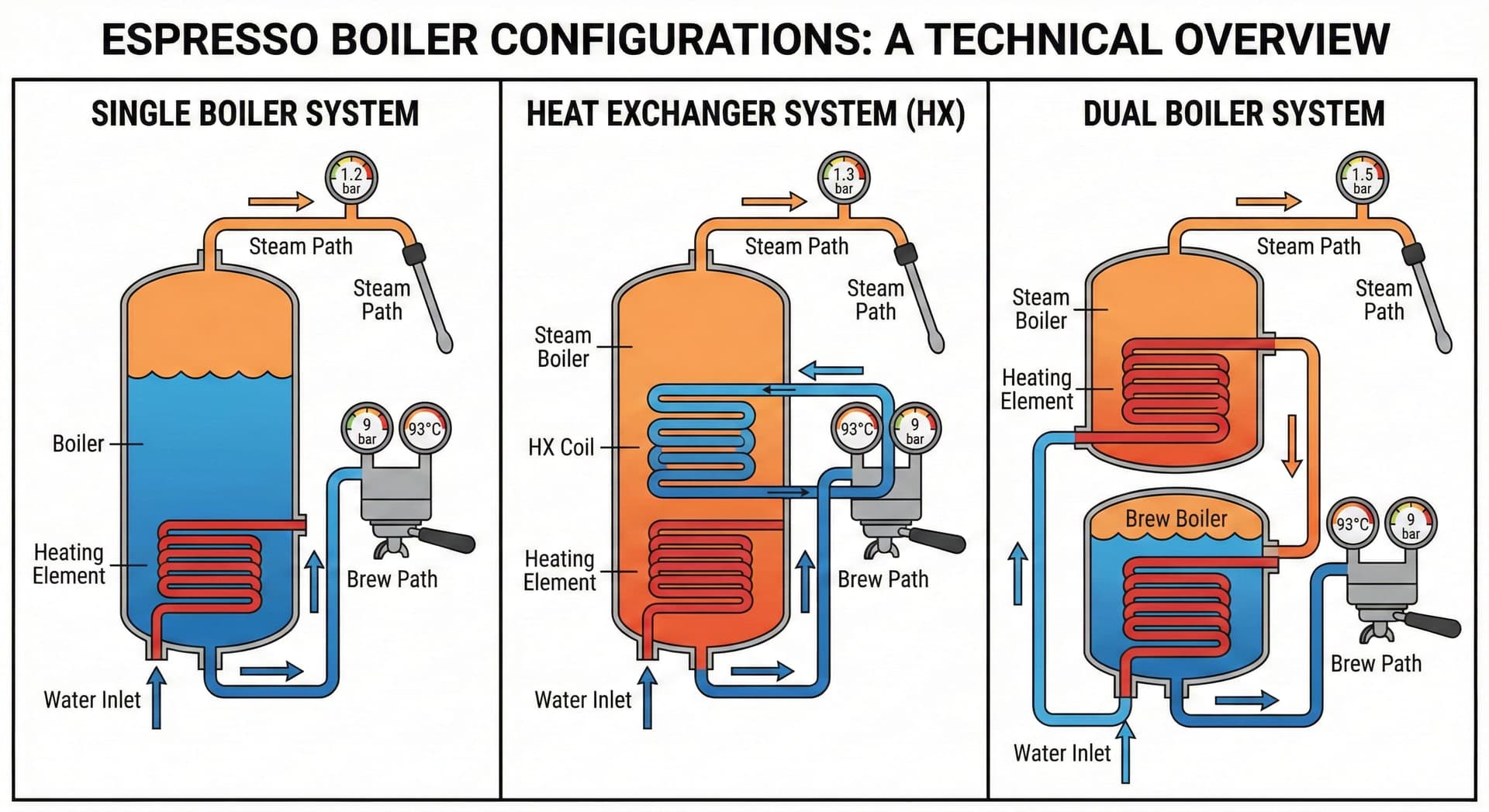
Boiler Type: Single, Dual, and Heat Exchanger Systems
Boiler configuration fundamentally affects workflow, especially for milk-based drinks. Single boiler machines use one boiler for both brewing (200°F) and steaming (270°F), requiring 30-60 seconds to switch between modes. This workflow interruption—brew espresso, wait for temperature increase, steam milk—frustrates users making multiple cappuccinos or lattes.
Heat exchanger (HX) machines maintain a large steam boiler with a water tube running through it. Fresh brewing water flows through this tube, heating to espresso temperature via heat transfer. This allows simultaneous brewing and steaming but requires temperature surfing (flushing water to achieve optimal brew temperature) and careful management.
Dual boiler systems represent the premium standard—separate boilers maintain independent optimal temperatures for brewing and steaming simultaneously. No waiting, no temperature surfing, just consistent shot quality and immediate milk steaming capability. Essential for serious home baristas making multiple milk drinks, but adds $500-1,500 to machine costs.
| Boiler Type | Brew + Steam Simultaneously? | Warm-Up Time | Ideal User |
|---|---|---|---|
| Single Boiler | No (30–60 sec switch) | 10–20 min | Solo espresso drinkers, beginners |
| Heat Exchanger | Yes (temperature surfing needed) | 15–25 min | Milk drink enthusiasts, intermediate users |
| Dual Boiler | Yes (seamless) | 15–30 min | Serious home baristas, high-volume households |
Pressure System: The 9-Bar Standard
Authentic espresso extraction requires 9 bars of pressure at the coffee puck. Most machines advertise 15-bar pumps but use over-pressure valves (OPV) to regulate actual extraction pressure to 9 bars. Vibratory pumps (budget and mid-range machines) create pulsating pressure, operate louder, but cost less and work fine for home use. Rotary pumps (commercial and premium machines) deliver smooth, consistent pressure with quieter operation and better longevity.
Beware machines advertising pressure below 15 bars or lacking OPV regulation—they cannot achieve authentic espresso extraction. Quality machines clearly specify pressure specifications and often allow OPV adjustment for advanced users experimenting with lower-pressure extractions.
Portafilter Type: Commercial vs. Pressurized Baskets
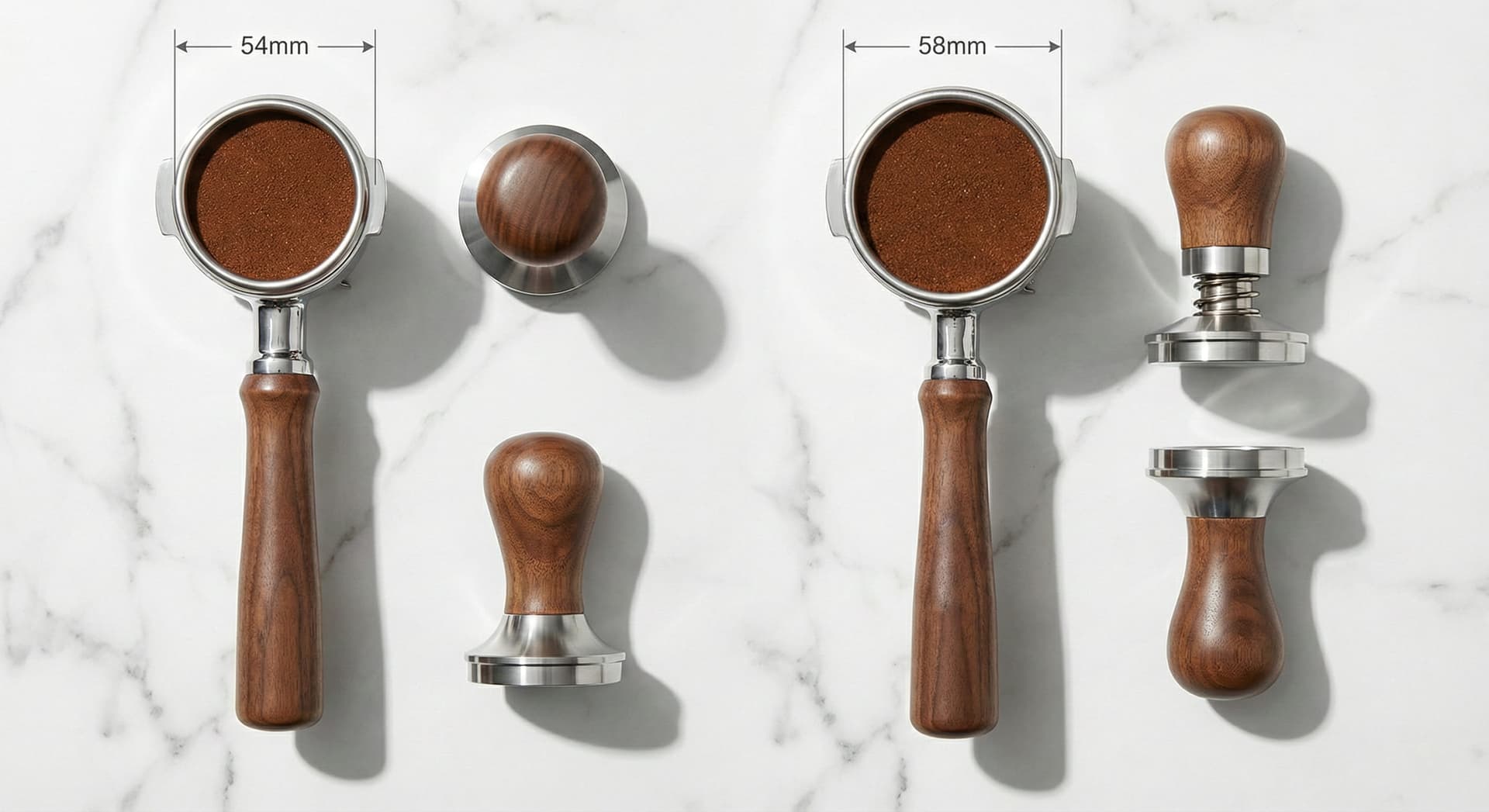
Commercial portafilters (bottomless or spouted) use standard filter baskets requiring proper grinding, dosing, distribution, and tamping. They demand quality grinders but deliver authentic espresso and allow technique development. Pressurized baskets (dual-wall, crema-enhancing) use built-in resistance to generate pressure, producing acceptable crema even with inconsistent grinding or pre-ground coffee.
Beginners often benefit from pressurized baskets while learning or using inferior grinders, but serious enthusiasts should prioritize machines accepting standard commercial baskets. Many machines include both types, letting users progress as skills develop.
PID Temperature Control: Consistency Through Precision
PID (Proportional-Integral-Derivative) controllers maintain brewing temperature within ±1°F by constantly monitoring and adjusting heating elements. Without PID, thermostats allow ±5-10°F temperature swings—enough to cause shot-to-shot variation from sour under-extraction to bitter over-extraction.
Entry-level machines typically use simple thermostats. Mid-range machines ($500+) increasingly include PID as standard. Premium machines offer dual PIDs controlling both boilers independently. For consistency-focused enthusiasts, PID proves essential. Casual users may not notice the difference, especially when using darker roasts that forgive temperature variation better than light roasts.
Steam Wand: Commercial vs. Panarello Frothers
Commercial-style steam wands (single or multi-hole tips) deliver powerful, dry steam allowing precise microfoam creation and latte art. They require technique but offer complete control over milk texture. Panarello frothers (plastic sleeve attachments) inject air automatically, making milk frothing easier but producing less refined foam unsuitable for latte art.
Serious milk drink enthusiasts should prioritize machines with commercial steam wands and adequate steam pressure (requiring proper boiler sizing). Budget machines often include panarello attachments, which many users remove to access the commercial tip underneath. Super-automatics use automated frothing systems eliminating manual technique entirely.
Espresso Machine Price Ranges: What to Expect at Every Budget Level
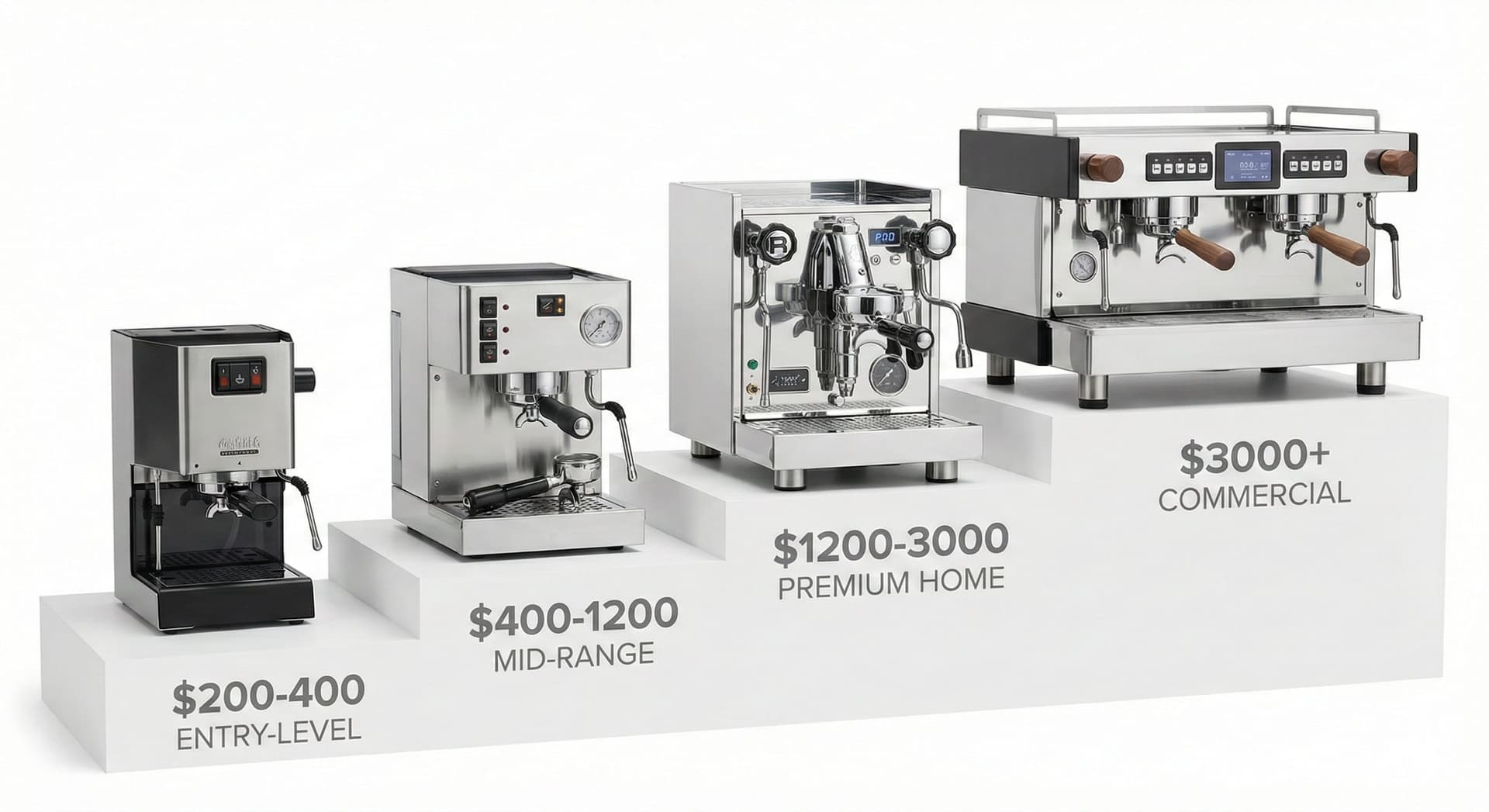
Understanding espresso machine pricing prevents unrealistic expectations and helps identify genuine value versus marketing hype. The market segments into distinct tiers, each delivering specific performance characteristics, build quality standards, and feature sets. Unlike coffee grinders where $300 buys exceptional quality, espresso machines require higher investment for café-level performance due to complex engineering, precision manufacturing, and thermodynamic demands.
Entry-Level Espresso Machines ($100-$400)
Entry-level machines feature single boilers with thermostat temperature control, vibratory pumps, plastic housing components, pressurized portafilter baskets, and panarello steam wands. Construction emphasizes affordability over longevity, with expected lifespans of 3-5 years under normal home use.
Performance expectations: These machines produce acceptable espresso-style drinks, especially when using pressurized baskets that forgive inferior grinder quality. However, temperature stability varies ±5-10°F, requiring shot-to-shot adjustment. Steam power limits milk frothing speed—expect 60-90 seconds to froth milk for cappuccinos.
Popular models: De'Longhi EC155 ($249-349, dual-function filter holder accepts ESE pods), Mr. Coffee Café Barista ($130-180), Krups XP444C50 ($99-129, 34 oz tank, pressurized basket), Capresso EC100 ($175-230, 15-bar pump, 40 oz tank, twin frother — good step up from pod machines), Breville Bambino ($250-300), De'Longhi Dedica ($300-350), Gaggia Carezza ($250-300). Pod machines (Nespresso OriginalLine $100-200) also fit this category.
Best For: Budget-conscious beginners exploring espresso, casual users drinking 1-2 cups weekly, those testing whether espresso justifies further investment before upgrading equipment
💡 Explore Top Budget Options: Our best espresso machines under $500 guide provides comprehensive reviews and comparisons of the top-rated entry-level and mid-range machines, helping you find the perfect value option for your needs.
Mid-Range Machines ($400-$1,200): Quality Meets Value
Mid-range machines incorporate better temperature stability (many include PID controllers), larger brass boilers, commercial-style 58mm portafilters accepting standard baskets, improved steam wand performance, and significantly better build quality. Stainless steel housing, precision-machined components, and quality control standards support 8-12 year lifespans with proper maintenance.
Performance characteristics: These machines achieve café-quality espresso when paired with quality grinders ($300-800 range). PID temperature control delivers consistency matching commercial equipment. Steam power supports proper microfoam creation and latte art. Most operate as single-boiler or thermoblock systems, requiring brief waits between brewing and steaming.
Category leaders: Gaggia Classic Pro ($449-$499), Breville Bambino Plus ($350-400), Breville Barista Express ($600-700, includes grinder), Rancilio Silvia ($750-850), Breville Infuser ($500-600), Lelit Anna ($450-550), Breville Barista Pro ($750-900).
This tier represents the sweet spot for home enthusiasts—delivering professional results at accessible prices. The difference in shot quality compared to entry-level machines is immediately apparent: superior flavor clarity, better crema consistency, and enhanced control over extraction variables.
Best For: Serious home baristas committed to daily espresso, anyone wanting café-quality results, enthusiasts willing to develop proper technique, households brewing multiple drinks daily
💡 See Our Complete Rankings: For detailed reviews, testing results, and comparisons across all price ranges, visit our comprehensive best espresso machines guide with expert picks from budget to premium models.
Premium and Prosumer Machines ($1,200-$3,000+): Café-Grade Performance
Premium espresso machines feature dual boiler systems or sophisticated heat exchangers, PID temperature control on all boilers, rotary pumps for quiet operation and plumbed-in capability, commercial E61 group heads with thermosyphon circulation, programmable pre-infusion, and professional-grade steam systems. Construction uses commercial components designed for café duty cycles—stainless steel throughout, brass boilers, chrome-plated brass groups.
Performance expectations: Shot quality matches high-end commercial machines. Dual boilers eliminate all waiting between brewing and steaming—pull shots while simultaneously steaming milk. Rotary pumps provide smoother pressure delivery and near-silent operation. Build quality supports 15-20+ years of daily use, with some machines operating in cafés for decades.
Advanced features include smartphone connectivity, custom pressure profiling, flow rate control, shot timers with pressure/temperature monitoring, and extensive programmability. Many support plumbed-in water connections eliminating reservoir refilling.
Premium model examples: Profitec Pro 500 ($1,600-1,800), ECM Classika ($1,400-1,600), Rocket Appartamento ($1,500-1,700), Lelit Bianca ($2,400-2,800), Profitec Pro 700 ($2,200-2,500), ECM Synchronika ($2,800-3,200), Decent Espresso DE1+ ($3,500-4,000).
Best For: Espresso perfectionists pursuing ultimate shot quality, high-volume home users, experienced baristas building home setups, small café operations, anyone wanting commercial-grade equipment longevity
Commercial Machines ($3,000-$15,000+): Professional Equipment
Commercial espresso machines designed for café duty cycles feature multi-group heads (2-4 groups for simultaneous extractions), massive boiler capacity (5-20+ liters), commercial-grade rotary pumps, volumetric dosing systems, automatic backflushing, and industrial construction supporting hundreds of shots daily. These machines require dedicated electrical circuits (220V-240V) and often plumbed water connections with professional filtration systems.
Popular commercial brands: La Marzocco Linea ($8,000-15,000+), Slayer Steam ($15,000-20,000), Victoria Arduino Black Eagle ($15,000-25,000), Nuova Simonelli Aurelia ($7,000-12,000), Synesso MVP Hydra ($15,000-20,000).
Some enthusiasts install commercial single-group machines at home (La Marzocco GS3 $7,500-9,000, Slayer Single Group $9,000-12,000), but these require professional installation, dedicated circuits, and represent extreme investments for residential use.
Best For: Café owners, commercial operations, mobile coffee carts, extreme enthusiasts with unlimited budgets and dedicated coffee spaces
Budget Allocation Strategy:
Professional baristas recommend the 1:1 or 2:1 machine-to-grinder ratio for optimal results. If buying a $1,000 espresso machine, invest $500-1,000 in your grinder. Grinder quality affects shot quality equally or more than machine quality—a $500 grinder with $800 machine outperforms a $200 grinder with $1,100 machine. Factor grinder costs into your espresso setup budget from the beginning to avoid disappointment. See our best coffee grinders guide for expert-tested picks at every budget.
If you already know your budget, explore our top-tested espresso machines by price range:
Choosing an Espresso Machine Based on Your Needs
Skill Level and Learning Commitment
Complete beginners: Semi-automatic machines with PID control and both pressurized and commercial baskets offer the best learning progression (Breville Bambino Plus $350-400, Gaggia Classic Pro $449-$499). Start with pressurized baskets while developing technique, then switch to commercial baskets as skills improve. Avoid manual lever machines—their steep learning curve frustrates newcomers.
Convenience-focused users: Super-automatic machines eliminate all learning curves, delivering consistent results immediately (De'Longhi Magnifica $800-1,200, Jura E8 $2,600-2,800). Perfect for those wanting café-style drinks without developing barista skills or investing time in technique.
Experienced home baristas: Prosumer dual boiler machines with advanced features support exploration of pressure profiling, flow control, and shot experimentation (Lelit Bianca $2,400-2,800, Decent DE1+ $3,500+).
Daily Consumption Volume
1-2 cups daily (solo users): Single boiler semi-automatic machines provide excellent value. Temperature switching delays between brewing and steaming matter less when making individual drinks (Rancilio Silvia $750-850, Lelit Anna $450-550).
3-5 cups daily (couples, small households): Heat exchanger or dual boiler machines eliminate waiting between shots and offer simultaneous brewing/steaming capability (Profitec Pro 500 $1,600-1,800, ECM Classika $1,400-1,600).
6+ cups daily (large households, offices): Super-automatic machines with high-capacity boilers and waste containers handle volume efficiently (Jura Z10 $3,000-3,500), or commercial-grade machines designed for continuous use.
Counter Space and Kitchen Layout
Limited counter space (apartments, small kitchens): Compact machines under 10 inches wide fit tight spaces (Breville Bambino $250-300, De'Longhi Dedica $300-350). Pod machines offer the smallest footprints (Nespresso OriginalLine 5-8 inches wide).
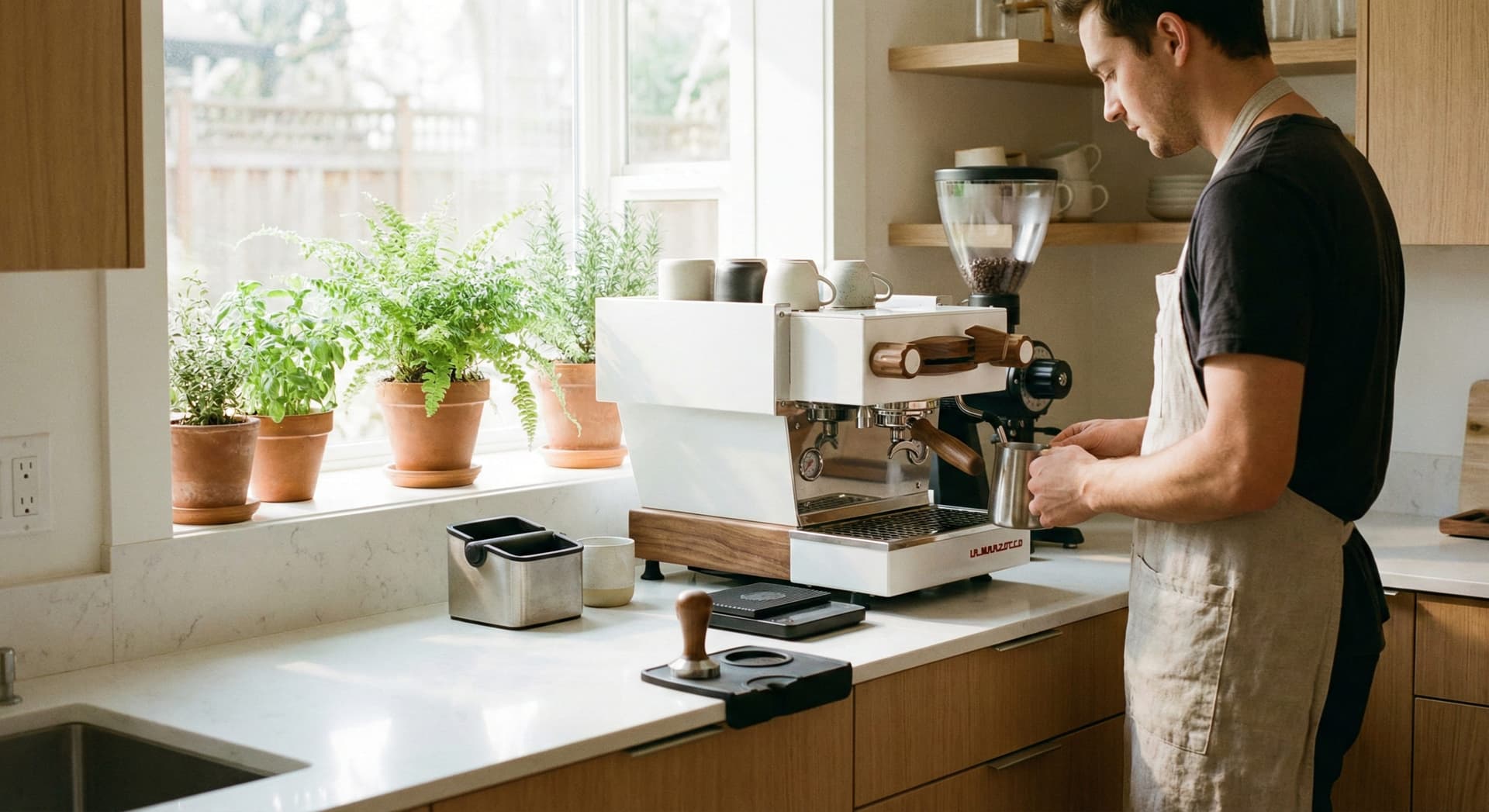
Dedicated coffee stations: Larger prosumer machines (12-16 inches wide) require permanent placement but offer superior performance and aesthetics (Rocket Appartamento, ECM Synchronika).
Consider height clearances for refilling water tanks (many machines require 12-16 inches overhead clearance) and access for maintenance. Heat exchanger and dual boiler machines need adequate ventilation for heat dissipation.
Milk Drink Preferences
Primarily straight espresso: Single boiler machines work perfectly—steam capability matters less (Gaggia Classic Pro $449-$499, Rancilio Silvia $750-850).
50/50 espresso and milk drinks: Heat exchanger machines offer good value, providing adequate steam power without dual boiler costs (Profitec Pro 400 $1,200-1,400).
Primarily cappuccinos/lattes: Dual boiler machines with powerful steam systems make workflow efficient, especially when preparing multiple drinks (Profitec Pro 500 $1,600-1,800). Super-automatics with automatic milk frothers eliminate manual steaming entirely.
Latte art focus: Machines with commercial-style steam wands and adequate steam pressure are essential. Avoid panarello frothers and automatic milk systems—they cannot create microfoam fine enough for detailed latte art.
Morning Workflow and Time Constraints
Rushed mornings (5-10 minutes available): Super-automatic machines or pod systems deliver drinks fastest—45-90 seconds from button press to finished beverage.
Leisurely routines (15-20 minutes): Semi-automatic machines fit comfortably into relaxed morning rituals, with grinding, preparation, and cleanup becoming meditative routines rather than rushed chores.
Pre-heating consideration: Most machines require 10-25 minutes warm-up time for thermal stability. Users on tight schedules benefit from programmable timers switching machines on automatically before waking, or thermocoil machines offering faster heat-up (Breville Bambino 3-minute warm-up).
Maintenance and Long-Term Costs: Keeping Your Machine Running
Daily Maintenance Requirements
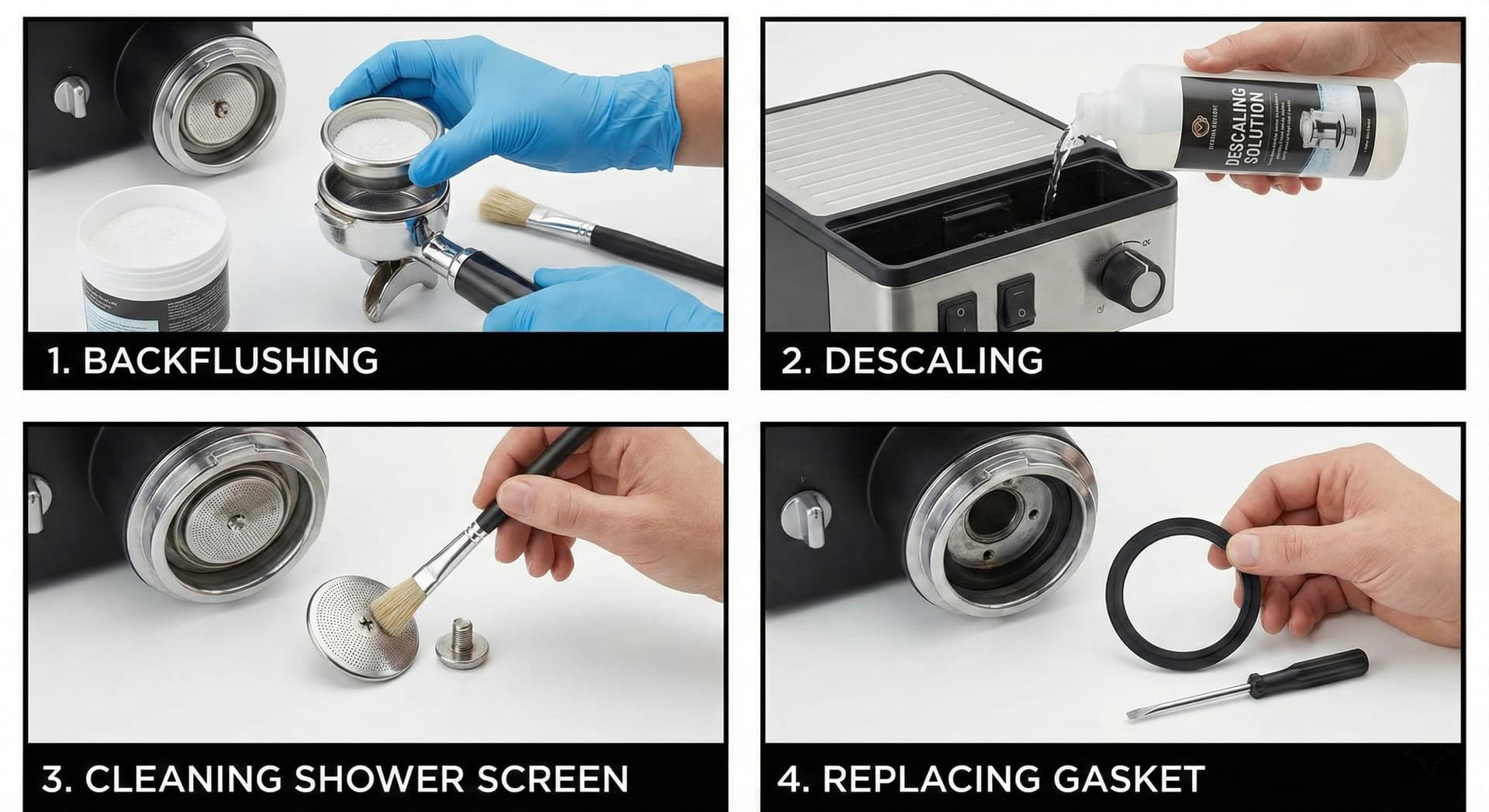
After each use: Knock out spent coffee pucks immediately to prevent oil buildup, purge group head to flush residual coffee, backflush with water (no detergent) using blind basket, wipe steam wand exterior and purge accumulated milk, wipe portafilter and basket clean, empty drip tray if needed. Total time: 2-3 minutes.
Weekly cleaning: Deep-clean portafilter baskets and group screen by soaking in espresso machine cleaner solution (Cafiza, Puly Caff), scrub steam wand tip to remove milk residue, wipe machine exterior and drip tray. Total time: 10-15 minutes. For a complete step-by-step routine covering daily, weekly, and monthly tasks, see our dedicated espresso machine cleaning guide.
Descaling and Water Quality
Water hardness directly affects descaling frequency and machine longevity. Hard water creates mineral scale deposits in boilers and water lines, restricting flow and reducing heating efficiency. Descaling frequency: Every 1-3 months depending on water hardness and usage volume.
Use manufacturer-approved descaling solutions (never vinegar—it damages seals and leaves odors). The descaling process takes 30-45 minutes, involving running descaler solution through the machine, letting it soak, then flushing thoroughly with fresh water.
Water filtration investment: Installing water softeners or using filtered water extends machine lifespan dramatically. Third Wave Water packets or Brita filtration pitchers provide affordable solutions. Prosumer users often install whole-house water softeners or dedicated espresso machine filtration systems.
Long-Term Parts Replacement
Group head gaskets: Replace every 6-12 months ($5-15 parts, 15-minute DIY installation). Signs: leaking around portafilter, difficulty locking portafilter, hissing during extraction.
Shower screens: Replace every 1-2 years or when flow becomes restricted ($10-20 parts).
Pump replacement: Vibratory pumps last 5-10 years ($40-80 parts, professional installation recommended). Rotary pumps last 15-20+ years.
Boiler and heating element: Quality machines rarely require boiler replacement. Heating elements last 10-15 years with proper descaling ($50-150 parts, professional installation recommended).
Annual Cost of Ownership
Budget machines ($100-400): Annual maintenance costs $20-40 (descaler, cleaning products, occasional gasket replacement). Lifespan 3-5 years before requiring replacement.
Mid-range machines ($400-1,200): Annual costs $40-80 (cleaning supplies, gaskets, occasional professional service). Lifespan 8-12 years with proper care.
Premium machines ($1,200+): Annual costs $60-150 (quality cleaning products, scheduled professional maintenance, replacement parts). Lifespan 15-20+ years, often exceeding 25 years with excellent care.
Common Mistakes to Avoid When Buying an Espresso Machine
Buying Based on Features Instead of Machine Type
Don't be swayed by fancy features on the wrong machine type. A super-automatic with pressure profiling doesn't help if you want hands-on control. A semi-automatic with extensive programmability frustrates users wanting one-touch convenience. Choose machine type first based on your workflow preferences, then evaluate features within that category.
Ignoring Grinder Investment
A $1,000 espresso machine paired with a $50 blade grinder produces terrible espresso. Budget at least 40-50% of your machine cost for a quality grinder—preferably 100% for optimal results. The grinder affects shot quality equally or more than the machine. Don't compromise here.
Essential reading: Complete burr grinder buying guide →
Overlooking Physical Space Requirements
Measure your available counter space before falling in love with a machine. Consider width, depth, and critical height clearance for refilling water tanks. Many prosumer machines require 18+ inches of total height including clearance. Verify the machine fits your space AND allows comfortable workflow.
Underestimating Learning Commitment
Semi-automatic and manual machines require genuine learning investment—2-4 weeks of daily practice to achieve consistency. Don't buy a semi-automatic expecting immediate café-quality results without technique development. If this doesn't appeal to you, choose super-automatic or pod machines instead.
Focusing Solely on Initial Purchase Price
Calculate total cost of ownership including grinder, accessories (tamper, distribution tool, milk pitcher, scale), ongoing maintenance, and consumables. Pod machines seem affordable ($150) but cost $600-1,200 annually in pods. A $700 semi-automatic with $400 grinder costs less over 2+ years while delivering superior quality.
Choosing Single Boiler for Milk Drink Lovers
If you primarily drink cappuccinos and lattes, single boiler machines frustrate with their 30-60 second wait between brewing and steaming. The workflow interruption becomes annoying quickly. Invest in dual boiler or heat exchanger machines if milk drinks dominate your consumption—the price premium justifies the convenience.
Neglecting Water Quality Impact
Hard water destroys espresso machines through mineral scale buildup, reducing lifespan by 50-70%. Invest in water filtration from the beginning—either filtered pitcher water, bottled water, or water softening systems. The $30-100 investment prevents thousands in premature machine replacement.
Buying Machines Without PID for Temperature-Sensitive Beans
Light-roasted specialty coffee demands precise temperature control (±1-2°F) to extract properly. Simple thermostats vary ±8-10°F, making consistency impossible with delicate beans. If you're investing in specialty single-origin coffees, prioritize machines with PID temperature control to showcase their nuanced flavors properly.
Making Your Final Decision: A Framework for Choosing the Right Machine
Step-by-Step Decision Framework
- 1.Determine your automation preference: Do you want hands-on involvement (manual/semi-automatic), partial automation (automatic), or complete automation (super-automatic/pod)? This fundamental choice narrows your options by 70%.
- 2.Establish total budget including grinder: Allocate funds for machine ($X), grinder (40-100% of machine cost), and accessories ($100-200 for scale, tamper, pitcher, distribution tool). Don't forget cleaning supplies and water filtration.
- 3.Assess milk drink consumption: If you make milk drinks 70%+ of the time, prioritize dual boiler or heat exchanger machines. Straight espresso drinkers save money with single boiler machines.
- 4.Measure your available space: Width, depth, and critically height clearance (for tank refills). Verify ventilation for heat dissipation. Consider workflow ergonomics and comfort.
- 5.Research specific models within your category: Read professional reviews from specialty coffee publications, watch video reviews showing machines in action, study user reviews for reliability insights (focus on 6-month+ ownership reviews).
- 6.Verify parts availability and service support: Check manufacturer warranty terms (1-2 years standard, 3-5 years premium), research local service options, confirm replacement parts availability, and investigate online community support for troubleshooting.
- 7.Visit showrooms if possible: Specialty coffee retailers and high-end appliance stores often display espresso machines. Seeing machines in person, hearing operation noise levels, and feeling build quality helps enormously.
Testing and Trial Periods:
Many retailers offer 30-day return policies. Use this trial period actively—pull 20-30 shots during the first week to evaluate whether the machine suits your workflow and preferences. Don't wait until day 29 to discover issues.
Join online espresso communities (r/espresso on Reddit, Home-Barista forums, Coffee Geek forums) where experienced users share insights, troubleshooting advice, and honest assessments of specific machines. These communities help tremendously during the learning process.
Research Resources and Expert Reviews
Prioritize reviews from established specialty coffee sources: James Hoffmann (YouTube), Lance Hedrick (YouTube), Whole Latte Love, Seattle Coffee Gear, Clive Coffee, and Home-Barista forums. These sources test machines extensively, understand espresso fundamentals, and provide honest assessments rather than affiliate-driven marketing.
Be skeptical of Amazon reviews for espresso machines—many reviewers lack experience with quality espresso, comparing machines against blade grinders and drip coffee rather than café standards. Look for reviews from users with 6-12+ months of ownership discussing long-term reliability and performance consistency.
Ready to Find Your Perfect Espresso Machine?
Explore our expert-reviewed espresso machines across all types and price ranges
Read Recommended Espresso Machine ReviewsFrequently Asked Questions
Semi-automatic machines offer the best balance for beginners.
They automate water pressure and temperature control while letting you control shot timing, making them easier than manual machines while still teaching espresso fundamentals.
Budget options like the Breville Bambino Plus ($350-400) or Gaggia Classic Pro ($449-$499) are excellent starting points.
Conclusion: Your Espresso Journey Begins Here
Choosing the right espresso machine type represents the single most important decision in your espresso journey—more impactful than brand selection, feature lists, or price points. Understanding the fundamental differences between manual lever machines, semi-automatic workhorses, convenient automatics, ultra-automated super-automatics, and pod systems ensures your investment aligns perfectly with your lifestyle, skill level, and coffee preferences.
Remember that exceptional espresso requires three critical elements working in harmony: a quality espresso machine matched to your needs, an equally capable grinder producing consistent particle distribution, and your developing technique and understanding. Skimping on any element compromises the entire system. The $500 you save buying a cheaper grinder or lower-tier machine translates directly into mediocre shots and long-term dissatisfaction.
Whether you invest $300 in an entry-level semi-automatic for your first espresso exploration, $1,500 in a prosumer dual boiler pursuing café-quality home shots, or $2,500 in a premium super-automatic for ultimate convenience, choose deliberately. Consider your actual daily workflow, honest assessment of learning commitment, realistic space constraints, and long-term coffee goals. The perfect espresso machine exists for every enthusiast—from patient purists cherishing manual lever artistry to busy professionals wanting one-touch excellence. Take your time researching, trust reputable sources, and remember that great espresso starts with choosing the right machine type for you.
Get Coffee Tips
Join our newsletter for expert reviews and brewing guides.
Affiliate Disclosure: We may earn a commission when you purchase through links on our site. This comes at no extra cost to you and helps us continue providing expert coffee guidance and comprehensive buying guides.