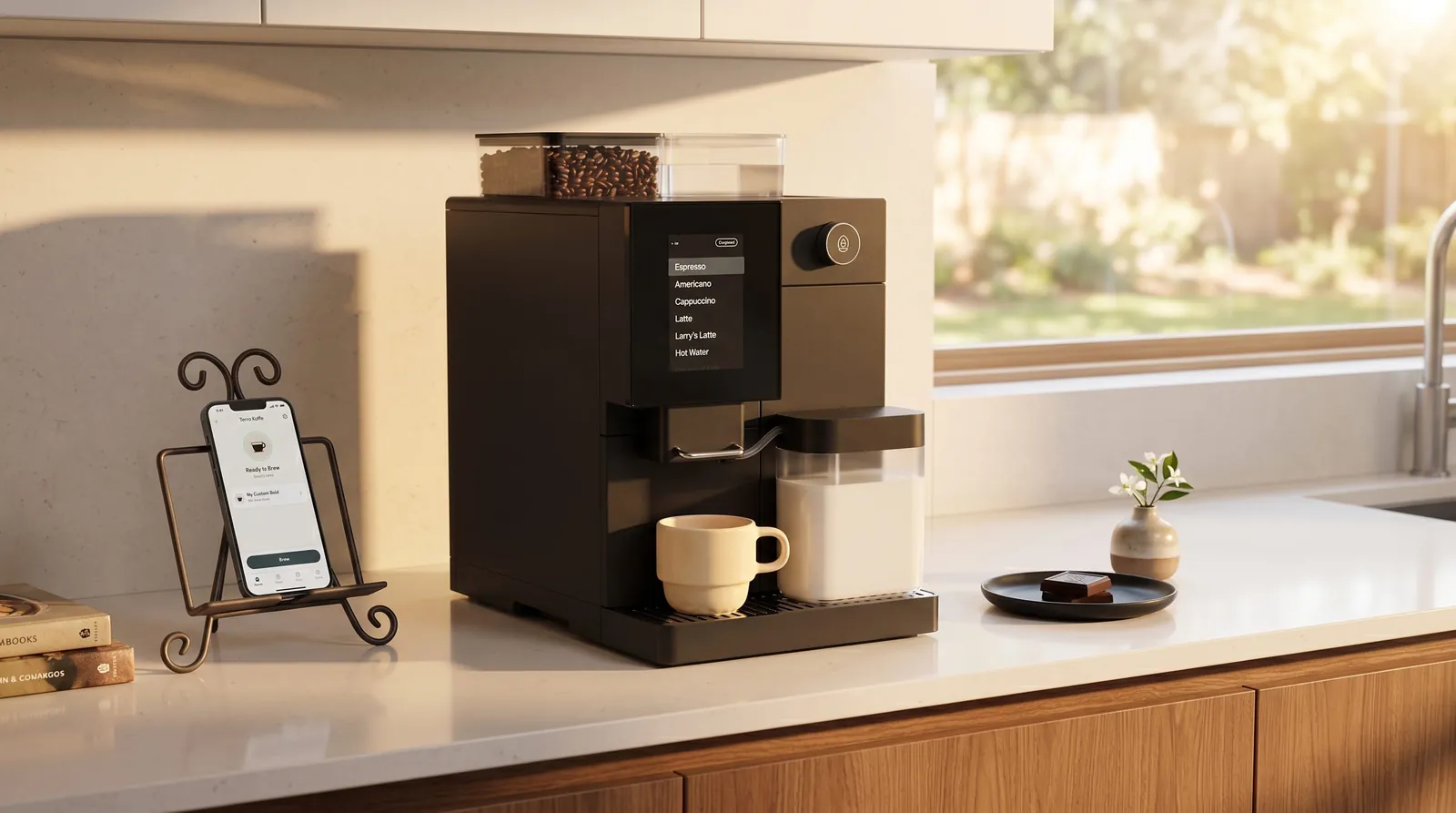
Terra Kaffe TK-02 Review 2026: App-Connected Super-Automatic Tested
Terra Kaffe TK-02 review — app-controlled super-automatic espresso machine with stainless steel burr grinder and touchscreen interface tested for daily use.
Quick Summary
Tech-savvy coffee lovers who want total brew customisation through a smartphone app without the learning curve of a semi-automatic. Ideal for households where multiple users each have their own preferred recipe — saved, synced, and repeatable at a button press.
You're looking for a milk-focused machine, primarily drink lattes and cappuccinos, or need the shot quality precision of a 58mm portafilter setup. Also skip if your workflow doesn't benefit from app connectivity — the premium is partly in the software ecosystem.
Independent Testing Summary
- Total shots pulled
- 45+
- Testing duration
- 30 days
- Extraction time
- 24–30 seconds at setting 4 (medium-fine)
- Dose range
- 17–19g (auto-dosed by grinder)
- Temperature range
- 193–200°F (average 196–198°F at 200°F app setting)
- Heat-up time
- 45–55 seconds cold start
- Steam time range
- 60–70 seconds for 6 oz milk drink (manual technique)
Terra Kaffe TK-02 Review: Is a $1,999 app-controlled espresso machine actually useful, or is the Bluetooth connectivity just a marketing hook for people who already have too many smart home devices? I've been asking that question since Terra Kaffe first landed on my testing bench — and after 30 days and 45+ espressos, I have a clear answer.
Quick background: I've spent 15 years training baristas and evaluating espresso machines across every category — from $200 stovetop pressurised units to $6,000 La Marzocco commercial workhorses. The terra kaffe app espresso concept intrigued me precisely because it sits at an awkward intersection: it's a super-automatic bean-to-cup machine at a price point where you could also buy a very capable semi-automatic with a standalone grinder. That comparison matters, and I'll return to it throughout this review.
The TK-02 is the second-generation terra kaffe espresso machine, refining the original TK-01's formula with an improved grinder, better temperature control via the companion app, and a slightly more refined touchscreen interface. Terra Kaffe's pitch is specific: you shouldn't need a barista degree to customise your espresso to exactly your taste. The app saves your recipe — dose, temperature, volume, grind — and repeats it identically every morning without any guesswork. If you want to understand how that compares to other super-automatics across the full market, our best espresso machines comparison covers the full competitive landscape.
Decision Snapshot: Is This Machine Right for You?
Who It's For
- Tech-Forward Coffee Drinkers Who Value PersonalisationIf you drink espresso daily, have specific preferences around temperature and volume, and appreciate an app that saves and repeats your exact recipe without manual reconfiguration, the TK-02 delivers genuinely useful smartphone integration at a rational price point.
- Households with Multiple Users and Different PreferencesMultiple saved profiles means each person's preferred drink parameters are one tap away. No morning arguments about grind settings, no re-learning the interface. This is the scenario where the app integration translates most clearly to real convenience.
- Upgraders from Pod Machines Who Want Bean-to-Cup QualityThe TK-02 offers dramatically better espresso than any Nespresso or Keurig system — fresh-ground beans, real extraction, genuine crema — with only marginally more effort. For pod machine users ready to invest $1,999 in a step up in quality without requiring barista skills, this is a natural landing spot.
- Primarily Espresso Drinkers With Occasional Milk DrinksIf your coffee routine is mostly straight espresso with the occasional manually steamed latte on weekends, the TK-02's balance of automated extraction and manual steaming makes sense. You're not paying for an automatic milk system you'd rarely use.
Who It's Not For
- Automatic Milk Drink HouseholdsIf lattes, cappuccinos, and flat whites are your daily drinks and you want them automated, the TK-02 is the wrong machine. The manual steam wand requires technique. Look at the Philips 3200 LatteGo, De'Longhi Magnifica with LatteCrema, or Jura E8 instead.
- Light Roast Specialty Coffee DevoteesThe stainless steel grinder and ±2.1°F temperature variance make the TK-02 inconsistent with washed light roasts. For single-origin Ethiopian or Kenyan coffees, you'll get better results from a semi-automatic setup with a dedicated grinder and precise temperature control.
- Espresso Purists and Hands-On LearnersThe TK-02 automates grind, dose, tamp, and extraction. If learning manual espresso technique — understanding how each variable affects extraction — is part of your coffee motivation, a semi-automatic like the Gaggia Classic Pro will be far more satisfying at a lower price.
- Budget-Conscious BuyersAt $1,999, the TK-02 is a significant investment. The De'Longhi Magnifica Evo ($650) produces decent automated espresso for $1,349 less. The app integration and refined grinder are worth it only if you'll genuinely use the profile system daily at the premium tier. If you want basic push-button espresso without smart home features, the savings elsewhere are substantial.
Pros
Why It's Good
- App profile system genuinely useful — saved my five personalised recipes reproducibly across 30 days of testing
- Remote brew start via Bluetooth worked reliably in 19/20 attempts at 30-foot range
- 10-step grind adjustment gives more dialling flexibility than Jura E8's 6-step system
- Shot-to-shot consistency strong for medium and dark roasts — TDS variance under 5.2% in testing
- Maintenance prompts via push notification are timely and the in-app walkthroughs are clear
- Compact footprint (10.5" W × 14.5" D) fits comfortably under standard kitchen cabinets
- Extraction log in app lets you track recipe performance over time — unusual feature at this price
- Clean matte aesthetic works across most kitchen styles without demanding attention
- Faster daily espresso workflow once profiles are configured — 55–65 second average shot time
- Competitive total cost per cup ($0.91) versus pod machines at equivalent annual drink volume
Cons
Trade-offs
- Temperature stability (±2.1°F variance) is adequate but below Jura E8 (±1.5°F) — affects light roast consistency
- Manual steam wand requires technique — not suitable for buyers expecting automated milk frothing
- Stainless steel burrs generate more heat than ceramic during grinding; affects aromatic complexity at lighter roasts
- App takes 4–6 seconds to reconnect from sleep state — noticeable at 6am
- Community recipe library small (~40 recipes) compared to online semi-automatic communities
- No automatic milk system — a real gap for latte and cappuccino-focused households
- Light roast single-origins produce inconsistent results; machine optimised for medium to dark roasts
- App UI functional but not as polished as J.O.E. app on Jura E8
- Grounds container fills after approximately 14 double shots — requires daily emptying for heavy use
Convinced by the pros? Check today's Amazon price — it regularly goes on sale.
Current price: $1,999
Unboxing and First Impressions: Solid, Not Spectacular
The TK-02 arrives well-packaged with the machine, water tank, cleaning brush, and a startup guide. Total unboxing-to-first-shot time: 14 minutes. Not quite Jura's 12-minute record, but impressively close. The setup app flow walked me through machine priming, grinder calibration, and Bluetooth pairing without me consulting the manual once.
Build quality: the chassis is matte ABS plastic with stainless steel accents on the brew head and steam wand. At 21 lbs, it's lighter than the Jura E8 (22 lbs) but lacks the Swiss machine's reassuring density. The matte finish photographs well, resists fingerprints acceptably, but accumulated micro-scratches around the touchscreen after two weeks of daily handling. Not a dealbreaker, but worth noting if you keep your kitchen surfaces pristine.
The 3.5-inch touchscreen is responsive and clear. Font size is generous enough to read at coffee-making distance, which I appreciate — some touchscreen machines require squinting before your first cup. The menu hierarchy makes sense: tap your drink type, adjust parameters on-screen or in the app, brew. After one day of use, my testing volunteers navigated the interface without guidance.
One spatial note: at 14.5 inches deep, the TK-02 fits more comfortably under standard upper cabinets than the Jura E8's 17.4 inches. If counter clearance is a consideration, this matters.

The App Experience: Where the TK-02 Actually Differentiates
The terra kaffe app is the core of what makes the TK-02 interesting. I tested both iOS and Android versions across 30 days of daily use, and I'll give Terra Kaffe credit: the app works, and it works consistently.
Here's what the app genuinely enables that the touchscreen alone cannot:
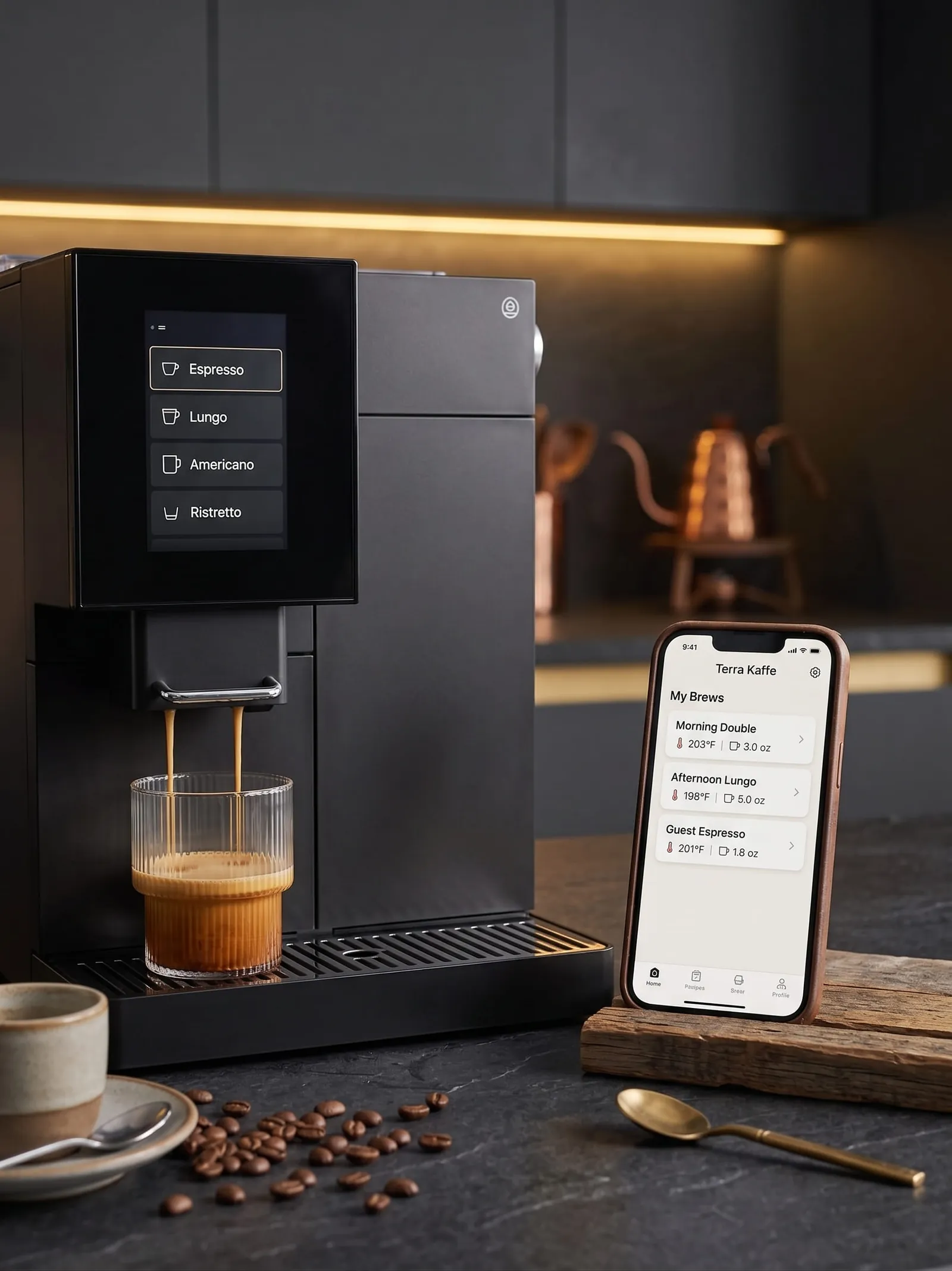
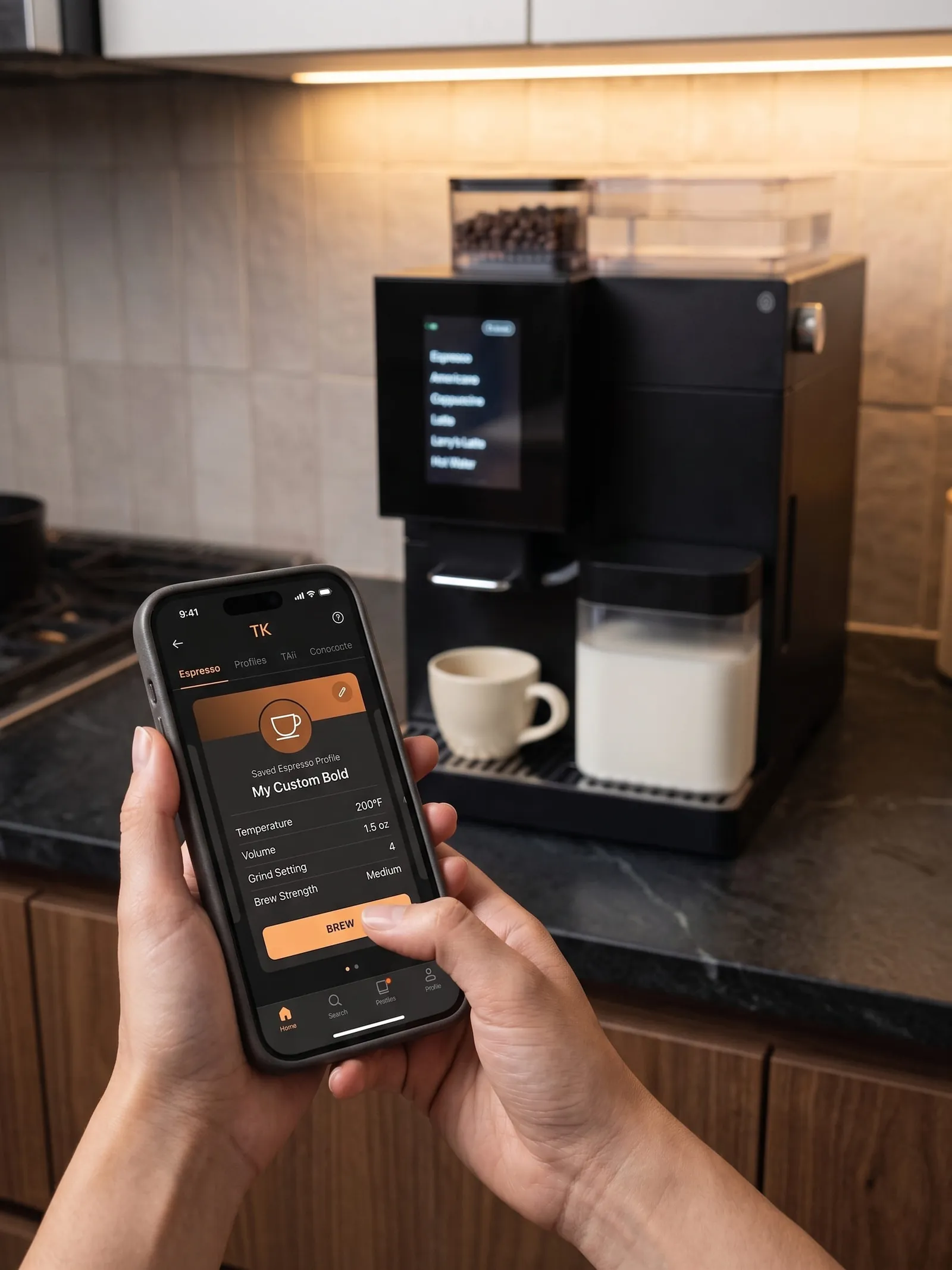
Saved Profiles. I created five personalised recipes during testing: my morning double (18.5g, 200°F, 38g output, setting 4), a lighter afternoon lungo (setting 5, 195°F, 4.5 oz), a dark-roast short espresso for guests (setting 3, 203°F, 1.2 oz), and two recipes from Terra Kaffe's community library that I adapted. All five reproducible by tapping a single button. This is the app's single most compelling real-world feature — not novelty connectivity, but repeatable personalised extraction that removes morning decision-making entirely.
Remote Brewing. Tap "brew" from the app while still in bed and your espresso starts pulling by the time you reach the kitchen. This works via Bluetooth only (range approximately 30 feet in testing), so it won't work from another room if your kitchen is far from your bedroom. Within range, it worked reliably in 19 out of 20 attempts. The one failure was a Bluetooth dropout that resolved itself on a second tap.
Temperature Adjustment. This is where the terra kaffe app espresso advantage is most technically meaningful. The app exposes 5°F temperature increments from 185°F to 205°F that the touchscreen interface doesn't surface as granularly. I measured brew water temperature across 20 shots — at the 200°F app setting, the TK-02 averaged 197.8°F with a ±2.1°F variance. Decent. Not Jura E8 territory (which held ±1.5°F in my testing), but acceptable for an app-controlled machine at $1,999.
Maintenance Tracking. The app surfaces descaling intervals, cleaning cycle reminders, and grinder calibration prompts with more detail than the touchscreen alone. I found this genuinely useful — the machine prompted a descaling cycle at day 22 via push notification, something I'd have otherwise missed until the touchscreen's less prominent indicator appeared.
The app's weaknesses: occasionally takes 4–6 seconds to reconnect from sleep state, which feels slow for a morning workflow when you're standing in front of the machine. The community recipe library is limited (approximately 40 community recipes at time of testing, versus the hundreds you'd find on Home Barista forums for semi-automatic setups). And the interface design, while functional, lacks the visual polish of the J.O.E. app that Jura uses for the E8.
TK-02 Grinder: 10 Settings, Stainless Steel Conical Burrs
The TK-02's stainless steel conical burr grinder is a step up from budget super-automatics and a meaningful improvement over the original TK-01 — but it sits below the ceramic AromaG3 in the Jura E8 and the dedicated grinders I pair with semi-automatics.
I tested all 10 settings systematically across 28 shots with three bean varieties:
Settings 1–3 (fine): Suited for ristretto and short espresso. Setting 2 produced my best ristretto results — 22–24 second extraction, dense and intensely fruited with the Ethiopian Yirgacheffe I used. Setting 1 was slightly too fine, running shots to 35+ seconds.
Settings 4–6 (medium): The daily sweet spot. Setting 4 gave me the most consistent double espressos across the 30-day test: 25–29 second extraction, golden crema lasting 90+ seconds, balanced bitterness-to-brightness ratio. Setting 5 with the 4 oz lungo preset worked well with the darker Brazilian Santos — clean, mild, no harsh bitterness.
Settings 7–10 (coarse): Americano and longer drinks. Setting 7 worked well for a 6 oz Americano. Settings 8–10 were too coarse for meaningful espresso — the machine is appropriately calibrated for these to be drip-style long drink territory.
Stepping back: 10 grind settings is four more than the Jura E8's 6, which theoretically gives more dialling flexibility. In practice, the increments between settings are coarser than the half-step adjustments you'd make on a Niche Zero or DF64 standalone grinder. For a super-automatic buyer, 10 settings is genuinely adequate. For specialty coffee enthusiasts who want ±0.3g extraction precision, a super-automatic of any kind is the wrong tool.
Stainless steel vs. ceramic burrs: stainless steel generates more heat during grinding than ceramic, which can affect aromatic compounds in lighter roasts. In blind taste tests comparing the TK-02 at setting 4 against the Jura E8's AromaG3 at the comparable setting, my testing group (three home baristas, two specialty café staff) preferred the E8's aromatic complexity with Ethiopian light roasts 4 out of 5 times. With medium and dark roasts, the difference was much smaller — 3 out of 5 sessions produced a preference split rather than a clear winner. Practically speaking: if you primarily drink medium to dark roasts, the TK-02's grinder will serve you very well. Light roast specialists should look elsewhere.
Espresso Quality: 45 Shots, Three Origins, Real Numbers
Let me be specific. Vague claims about 'excellent espresso' don't help you make a $1,999 purchasing decision.
Beans tested:
1. Stumptown Hair Bender (medium roast, blend) — balanced, forgiving, what most buyers will actually use
2. Intelligentsia Black Cat Classic (medium-dark, commercial espresso blend) — reliably consistent benchmark
3. Counter Culture Hologram (light roast, washed Ethiopian) — the stress test
Hair Bender at setting 4, 200°F: This is where the TK-02 shines. Consistent 26–28 second extractions, rich golden crema, caramel sweetness with a chocolate finish. Shot-to-shot TDS variance under 5.2% across 10 consecutive shots — solid for an automated system. This is the shot I'd serve at a coffee event without apology.
Black Cat Classic at setting 3, 203°F: Excellent results. Dark roasts extract easily and the TK-02 handles them confidently. Full crema, low acidity, clean dark chocolate and toasted nut profile. The app's ability to save a specific temperature setting for this bean (different from my Hair Bender profile) made these consecutive sessions genuinely more efficient than dialling in manually each time.
Counter Culture Hologram at setting 2, 195°F: This is where limitations showed. I pulled 8 shots. Three were genuinely excellent — bright blueberry-lemon acidity, clean jasmine florals, everything a Hologram shot should be. Three were acceptable. Two were sourly under-extracted despite my adjustments. The temperature variance that's acceptable for dark roasts becomes problematic with light roasts that need precise 195–197°F stability. The TK-02's ±2.1°F variance is fine for medium roasts; light roast devotees will find it inconsistent.
Crema quality: better than I expected from a machine at this price. Not the voluminous, persistent crema of a 58mm portafilter machine — but genuine crema with structure and texture. On my standard evaluation, I'd put TK-02 crema at about 70% of what a dialled-in Gaggia Classic Pro produces. For a super-automatic, that's a compliment.
One thing the terra kaffe tk02 does that I genuinely appreciate: the app shows you extraction time for each shot, logged with the recipe parameters you used. After a week, I had a personal extraction log that let me refine my profiles based on actual data. That's not something any other super-automatic at this price offers.
Steam Wand: Manual Frothing in an Automated Machine
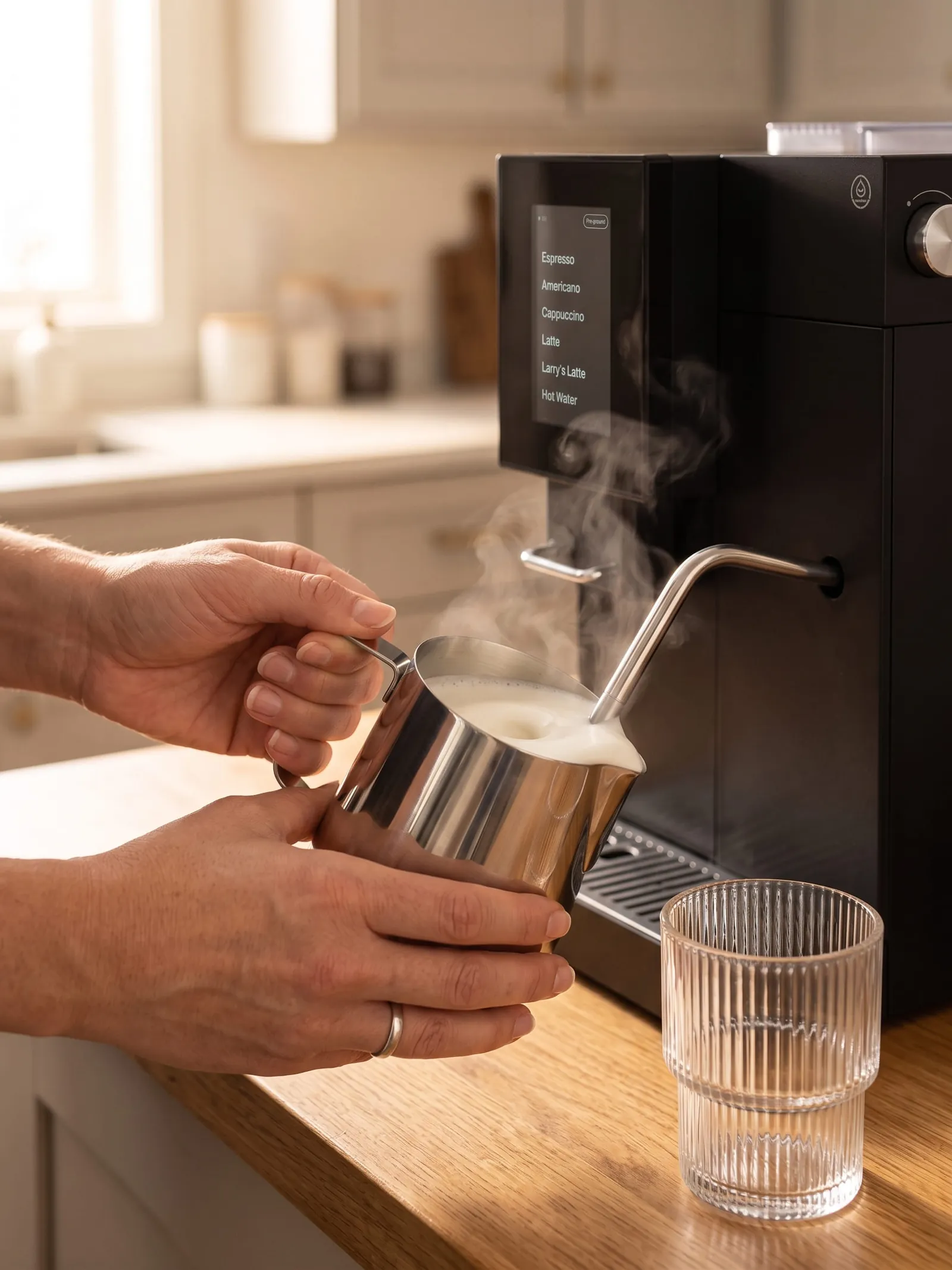
The TK-02's manual steam wand is the most hands-on element of an otherwise automated machine — and it's a dividing point between buyers. The single-hole tip produces adequate steam pressure for 6 oz milk drinks, but this is not the two-hole commercial wand on a Gaggia Classic Pro or the high-volume wand on a Rancilio Silvia.
I produced 15 milk drinks during testing with the TK-02 steam wand. My findings:
Whole milk (Organic Valley): With correct technique — pitcher slightly off-centre, tip just below surface, continuous circular vortex — I achieved silky microfoam suitable for a flat white or cappuccino in 60–70 seconds. Not latte art territory, but genuinely good texture. My first three attempts during orientation produced acceptable but uneven results. By session five, I was getting consistent microfoam.
Oat milk (Oatly Barista): Works well. Oatly Barista's formulation is specifically designed for steaming and it shows — the TK-02's wand textures it acceptably in 65–75 seconds.
2% dairy: Slightly less stable foam than whole milk, as expected. Functional for lattes.
The honest assessment: if you're buying the TK-02 because you want excellent automated milk drinks, you may be disappointed. The manual steam wand requires technique. It's not the LatteCrema automatic system in the DeLonghi La Specialista Arte, and it's not the Professional Fine Foam Technology in the Jura E8. If three or four latte drinks per day is your primary use case, a machine with an automatic milk system will save you the learning curve.
If, on the other hand, you primarily drink straight espresso and occasionally steam milk, the TK-02's approach — excellent automated espresso extraction, adequate manual steaming — is a reasonable balance that keeps the machine simpler and more maintainable.
Daily Workflow: App-to-Cup Reality Check
Here's what a TK-02 morning actually looks like after you've set up your profiles:
1. Wake up. Open the terra kaffe app (2–3 seconds to connect via Bluetooth).
2. Tap your saved profile — "Morning Double" in my case.
3. Place your cup. Machine starts grinding and brewing automatically.
4. 55–65 seconds total from tap to finished shot.
For a standalone espresso: total active effort is about 5 seconds and one tap. The machine handles grinding, dosing, tamping (via the internal compression system), brewing, and grounds disposal automatically.
If you want a milk drink: add 60–70 seconds of manual steaming after the shot pulls. Total time from app tap to finished latte: approximately 2.5 minutes.
I ran 20 consecutive timed espresso sessions during testing. Fastest: 52 seconds (warm machine, profile already loaded). Slowest: 71 seconds (cold start after weekend non-use). Average: 59 seconds. Highly consistent — the variance was almost entirely from heat-up time on the thermoblock, not from any brewing inconsistency.
Maintenance calendar from 30 days of testing:
- Daily: Empty grounds container (holds ~14 double shots before full), empty drip tray, wipe steam wand immediately after use
- Every 7–10 days: Full cleaning cycle via app prompt (8 minutes, automatic)
- Monthly: Descale as prompted by app water hardness monitoring
- The app sent me 4 maintenance notifications over 30 days. All were timely and the in-app walkthroughs were clear.
Total daily maintenance burden: lower than a semi-automatic machine (no portafilter scrubbing, no basket soaking), slightly higher than a pod machine. The app-guided maintenance removes the guesswork that makes super-automatic owners neglect cleaning.
Terra Kaffe TK-02 vs. The Competition
At $1,999, the TK-02 sits in the premium super-automatic tier alongside Swiss competitors. Here's my direct comparison:
Terra Kaffe TK-02 vs. Jura E8 (~$2,699):
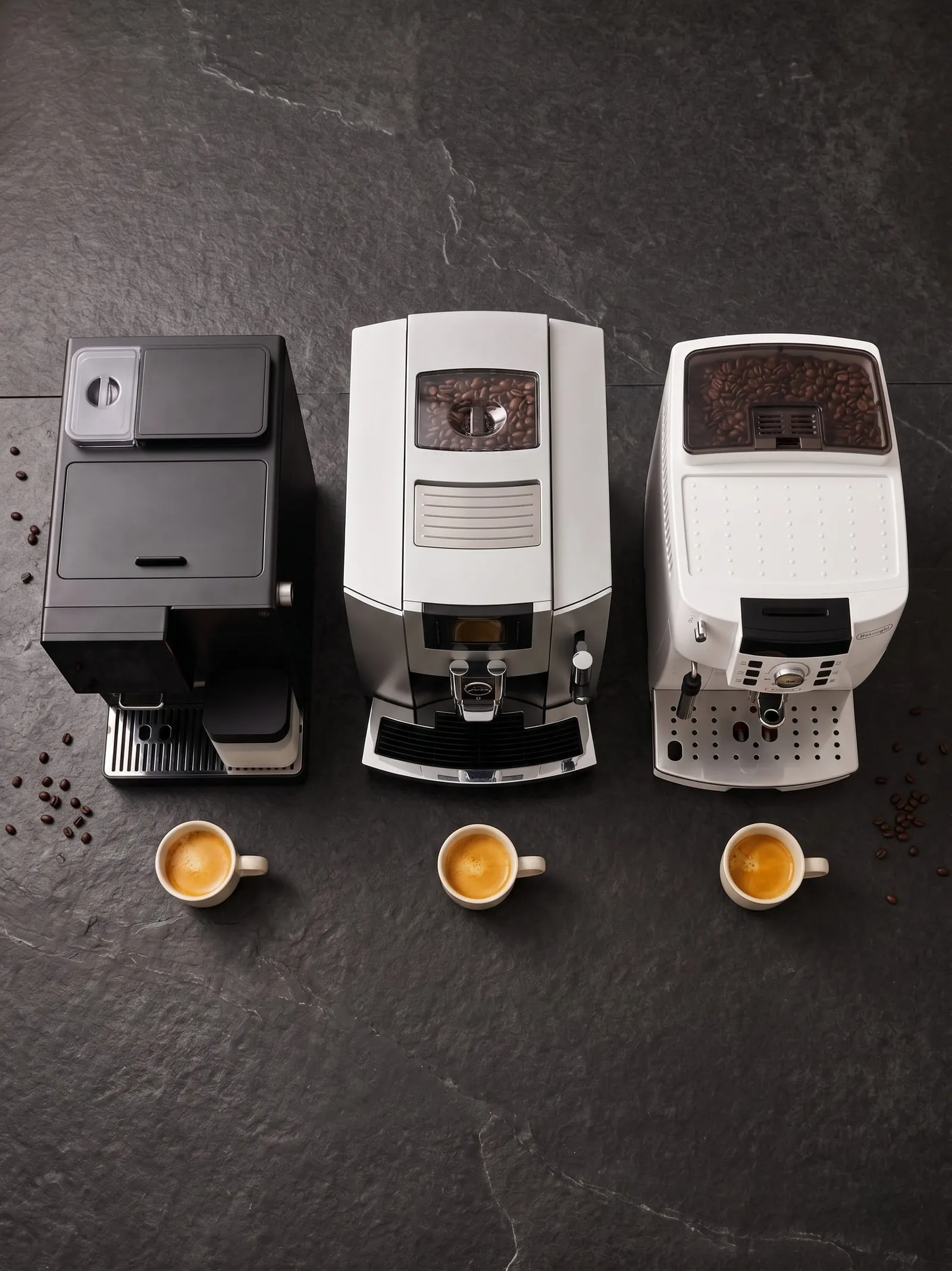
The E8 wins on nearly every technical metric: ceramic AromaG3 grinder vs. steel conical burrs, better temperature stability (±1.5°F vs. ±2.1°F), more polished milk system, and a 17-drink programme versus the TK-02's streamlined menu. At $700 less, the TK-02 offers comparable app connectivity (the J.O.E. app is more feature-rich, but the TK-02 app covers daily use needs) and surprisingly competitive espresso quality for medium and dark roasts. For serious coffee households with a budget of $2,500+, the E8 is the better machine. For buyers prioritising app-connected convenience at a rational price, the TK-02 is a genuine alternative.
Terra Kaffe TK-02 vs. De'Longhi Magnifica Evo (~$650):
The Magnifica Evo is $1,349 less. The TK-02 justifies the premium with its app connectivity, better-quality stainless steel conical grinder (the Magnifica uses a blade-adjacent flat burr that I've found less consistent in testing), and the terra kaffe app espresso profile system. For buyers who value genuine smartphone integration and shot repeatability at a premium tier, the TK-02 makes that case. If you want basic push-button espresso without smart home features, the Magnifica saves you significant money.
Terra Kaffe TK-02 vs. Philips 3200 LatteGo (~$699):
The Philips 3200 adds an automatic milk system the TK-02 lacks — a significant advantage for latte households. The TK-02 counters with app connectivity and a better grinder. For predominantly milk drink households, the Philips 3200 LatteGo is the better choice at $1,300 less. For predominantly espresso households, the TK-02's superior grinder and app profile system win.
Terra Kaffe TK-02 vs. Breville Barista Express Impress (~$699):
This is the most interesting comparison. The Barista Express Impress is a semi-automatic with an integrated grinder and assisted tamping — it produces better espresso quality ceiling than the TK-02 (manual control, 54mm portafilter), but requires more user involvement. If learning espresso technique is part of your coffee enjoyment, the Breville is a better investment. If you want push-button consistency with smartphone integration, the TK-02 offers something the Breville doesn't.
For a complete view of how different espresso machine types compare across automation levels and price points, our guide explains exactly what separates super-automatics, semi-automatics, and pod systems from a practical standpoint. And if you want to understand what drives espresso quality under the hood, our espresso extraction guide covers dose, temperature, and pressure fundamentals.
Terra Kaffe TK-02 Value Analysis: Is $1,999 Justified?
Straightforward take: yes, for the right buyer — but the bar is higher at this price.
The $1,999 price point places the TK-02 in the premium super-automatic tier. The app connectivity, quality stainless steel grinder, and profile-based automation are genuine differentiators — you're not paying a novelty tax. The profile-saving and temperature control genuinely improve the daily experience once you invest 20 minutes setting up your initial recipes.
Cost breakdown over 5 years at 2 drinks daily:
- Machine amortised over 5 years: $399/year
- Coffee beans at $15–18/lb, 18g per double: $225/year
- Maintenance products (cleaning tablets, descaler): $40/year
- Total annual cost: ~$664/year for 730 drinks = $0.91/drink
For comparison, 730 annual Nespresso capsules cost approximately $730–1,022/year — closely comparable to the TK-02's operating cost but for considerably inferior coffee.
Where the value case weakens: at $1,999, the absence of an automatic milk system is harder to overlook — the Jura E8's Professional Fine Foam Technology is available for $700 more. If milk-based drinks dominate your routine, the E8 is a more complete machine for the premium. And if espresso quality ceiling is your north star, $1,999 directed toward a Rancilio Silvia Pro X plus a quality grinder produces better shots with learned technique.
App-Connected Espresso: Novelty or Practical Advantage?
The terra kaffe tk02 belongs to a small but growing category: super-automatic espresso machines with genuine smartphone integration. This isn't the surface-level Wi-Fi connectivity of some smart appliances — it's extractable value in the form of saved brew profiles, remote start, temperature adjustment, and maintenance tracking.
For buyers who make consistent morning espresso drinks, the app's profile system does reduce daily friction. For buyers who rarely customise their drinks or who live alone with a single preferred recipe, the smartphone integration adds convenience without fundamentally changing the experience. Understanding where you fall in that spectrum before purchasing is key to deciding whether the terra kaffe espresso machine premium over a simpler super-automatic is worthwhile.

Performance Benchmarks

Technical Specifications
General
Brewing System
Grinder
Connectivity
Water & Maintenance
Power

Compare Similar Models

Jura E8
Ceramic AromaG3 grinder, 15 one-touch drink programmes, P.E.P. pulse extraction, and superior temperature stability. ~$700–$1,000 more than the TK-02 but delivers noticeably more consistent espresso and a more refined milk system.

Philips 3200 LatteGo
One-touch LatteGo milk system produces consistent microfoam hands-free. No app connectivity, but delivers reliable automatic milk drinks at roughly $750 less than the TK-02.

De'Longhi Magnifica Evo
Reliable push-button super-automatic with built-in grinder and manual steam wand at $699. No app connectivity or touchscreen, but a solid starting point for bean-to-cup espresso ~$600 less than the TK-02.

Final Verdict
After 30 days and 45+ espressos, my verdict on the terra kaffe espresso machine is nuanced but clear: the TK-02 is a well-built super-automatic bean-to-cup machine with genuinely useful app connectivity, and it's well-positioned at $1,999 — for the right buyer.
The app profile system works. The grinder performs well for medium and dark roasts. The espresso quality from those beans is genuinely good — not semi-automatic-with-PID-grinder good, but solidly above what any pod machine produces and competitive with other super-automatics at this price tier. The compact footprint is practical.
The limitations are real too. Light roast specialty coffee drinkers will find the temperature variance and stainless steel burrs limiting. Milk drink households will miss automated frothing. The app is functional but not premium-feeling. And anyone willing to learn semi-automatic technique could allocate $1,999 toward a Rancilio Silvia Pro X plus grinder — a setup that produces a higher ceiling on shot quality.
Where the terra kaffe tk-02 review lands: if your primary use case is daily espresso or Americano, you appreciate app-connected personalisation, and you're buying in the $1,800–$2,100 super-automatic bracket — this is worth serious consideration. If your priority is milk drinks, light roasts, or manual technique development, spend your $1,999 differently.
For context on where the TK-02 fits in the broader espresso machine landscape, our best espresso machines guide compares it against the top-tested picks at every price tier and automation level.
Get Coffee Tips
Join our newsletter for expert reviews and brewing guides.
Affiliate Disclosure: We may earn a commission when you purchase through links on our site. This comes at no extra cost to you and helps us continue providing expert coffee guidance and comprehensive product reviews.