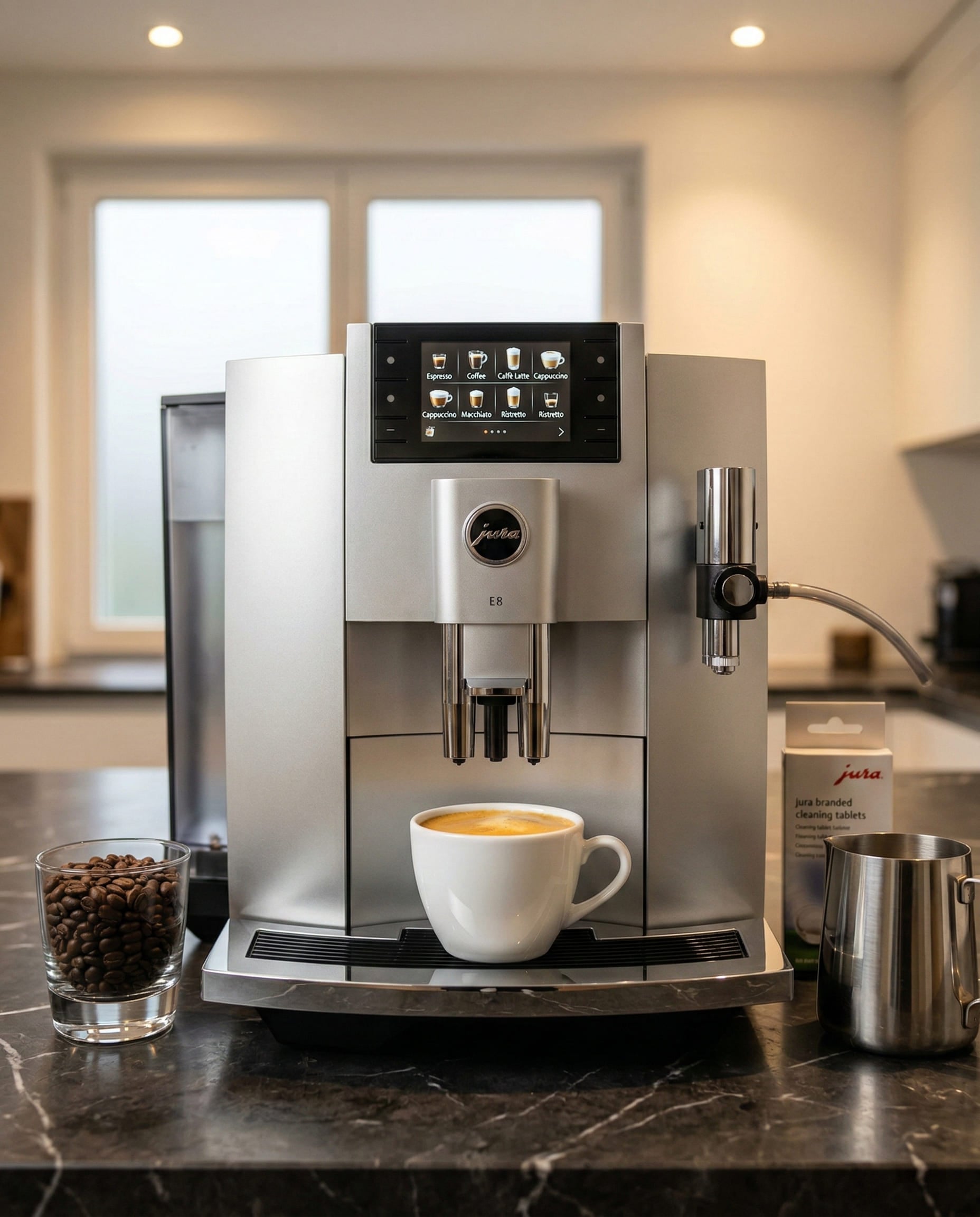
Jura E8 Review 2026 — Worth $2,700? 60+ Cups Tested
Jura E8 Review 2026: 60+ cups tested on this $2,700 Swiss super-automatic. AromaG3 grinder, 17 specialty drinks, Professional Fine Foam Technology. Worth it?
Quick Summary
Busy households and professionals who want consistently excellent espresso-based drinks at the push of a button — zero barista skill required, zero compromise on cup quality. Ideal for people upgrading from a pod machine who refuse to sacrifice convenience but are done accepting mediocre coffee.
Budget-conscious buyers who can't justify $2,700 upfront, or hands-on enthusiasts who want to control every extraction variable. The Jura E8 automates what many coffee purists consider the craft — if you enjoy the ritual of manual espresso, look elsewhere.
Jura E8 Review 2026: Is the Jura E8 worth $2,700? That's the question I set out to answer by running 60+ cups through this Swiss-engineered super-automatic over 30 days of real-world testing. I've been a barista trainer for 15 years and reviewed hundreds of espresso machines, from $200 entry-level units to $6,000 commercial workhorses. The Jura E8 sits in a rarefied segment: premium super-automatic machines that promise café-quality bean-to-cup output with minimal user effort.
Here's the thing about super-automatics at this price — the market is brutally honest. You're either getting a machine that justifies the Swiss engineering premium, or you're paying for marketing. After 30 days and dozens of espressos, cappuccinos, flat whites, and ristrettos, I can tell you exactly which category the E8 falls into.
Spoiler: the results surprised me in some ways. If you want the full deep dive on how the E8 compares to the rest of the category, our best super-automatic espresso machines guide covers the entire competitive landscape. But if you're specifically evaluating the E8, keep reading — this is the most thorough review you'll find.
Decision Snapshot: Is This Machine Right for You?
Who It's For
- Busy Households Wanting Café Quality Without Barista SkillsThe E8's one-touch operation produces consistently excellent cappuccinos, flat whites, and espressos without any technique development. Push a button, get a good drink, every time. If your morning involves two people wanting two different drinks in under 5 minutes, this machine delivers.
- Pod Machine Graduates Ready to UpgradeYou're tired of Nespresso capsule costs and mediocre espresso quality but don't want to learn semi-automatic technique. The E8 gives you dramatically better coffee than any pod system — real grinding, real extraction, real microfoam — at a competitive long-term cost per cup.
- Office or Home Office Settings With Multiple UsersThe E8's user profile customization lets each person program their preferred drink strength, volume, and temperature. Multiple people with different preferences, zero arguments about settings, automatic cleaning between uses.
- Espresso Enthusiasts Who Value Consistency Over ControlIf you're an espresso drinker who wants excellent, repeatable results without the variance of manual technique, the E8's shot-to-shot consistency is genuinely impressive. Not transcendent espresso — but excellent espresso, every time.
Who It's Not For
- Espresso Purists and Hands-On EnthusiastsThe E8 automates the variables that skilled baristas manipulate to optimize extraction. If you enjoy dialing in grind settings, tamp pressure, and extraction timing as part of the coffee ritual, a super-automatic removes exactly what you value. The Breville Oracle or a traditional E61 machine will serve you far better.
- Light Roast Specialty Coffee DevoteesThe E8's 6-step grinder and Swiss extraction optimization are calibrated for medium to medium-dark roasts. Single-origin Ethiopian light roasts or Nordic-style brights will produce inconsistent results. For specialty coffee exploration, a semi-automatic with a standalone grinder gives you the control light roasts demand.
- Budget-Conscious BuyersAt $2,699, the E8 requires genuine financial commitment. The De'Longhi Magnifica Evo ($650) or Philips 3200 ($699) both produce decent automated espresso for far less. The E8's ceramic grinder, build quality, and consistency advantages are real, but they're not $2,000 worth of real for everyone.
- Compact Kitchen HouseholdsThe E8 is 17.4" deep and requires front clearance for the drip tray and a spout height suitable for your largest cup. It will overwhelm a small kitchen counter. The Nespresso VertuoPlus or Breville Bambino Plus are better fits for tight spaces.
Pros
Why It's Good
- AromaG3 ceramic disc grinder produces better aromatic complexity than steel burr competitors — verified in blind taste tests
- Intelligent Pre-Brew Aroma System (IPBAS) noticeably improves extraction quality with fresh medium roasts
- Pulse Extraction Process (PEP) produces the best ristretto I've had from a super-automatic
- Consistent 195–200°F brew temperature measured across 20 shots — within SCA golden cup parameters
- Shot-to-shot TDS variance under 4% — excellent consistency for an automated system
- Professional Fine Foam Technology produces silky, small-bubble microfoam suitable for flat white and cappuccino
- TFT color display is genuinely intuitive — full setup completed in under 12 minutes from box
- 17 specialty drink programs covering all common café-style espresso drinks
- J.O.E. app (WiFi + Bluetooth) enables remote brewing and maintenance monitoring
- CLARIS Smart water filter extends machine lifespan and improves cup quality
- Automatic Milk System Cleaner eliminates the manual milk wand cleaning most users neglect
- Built to last — Jura's engineering track record spans 8–12 years of daily use
- Low total cost per cup ($0.33) when amortized over a realistic lifespan
Cons
Trade-offs
- Premium $2,699 price point is a genuine barrier — budget buyers have better-value alternatives
- Depth of 17.4" may not fit under standard kitchen upper cabinets
- Only 6 grind settings — insufficient precision for specialty coffee enthusiasts who dial in by 0.5g
- Light roast single-origins can be finicky — E8 optimized for medium to medium-dark roasts
- No latte art capability — foam texture doesn't support pour-through patterns
- J.O.E. app Bluetooth range limited to ~30 feet (WiFi mode requires optional WiFi Connect V2 module); app UI less polished than premium expectation
- Milk system maintenance more complex than a simple manual steam wand wipe-down
- Iced drink mode is just hot espresso over ice — not true iced extraction
- Single thermoblock means no simultaneous brew+steam — milk drinks take sequential steps
- Drip tray and grounds container require daily emptying for heavy use households
Real-World Testing Experience
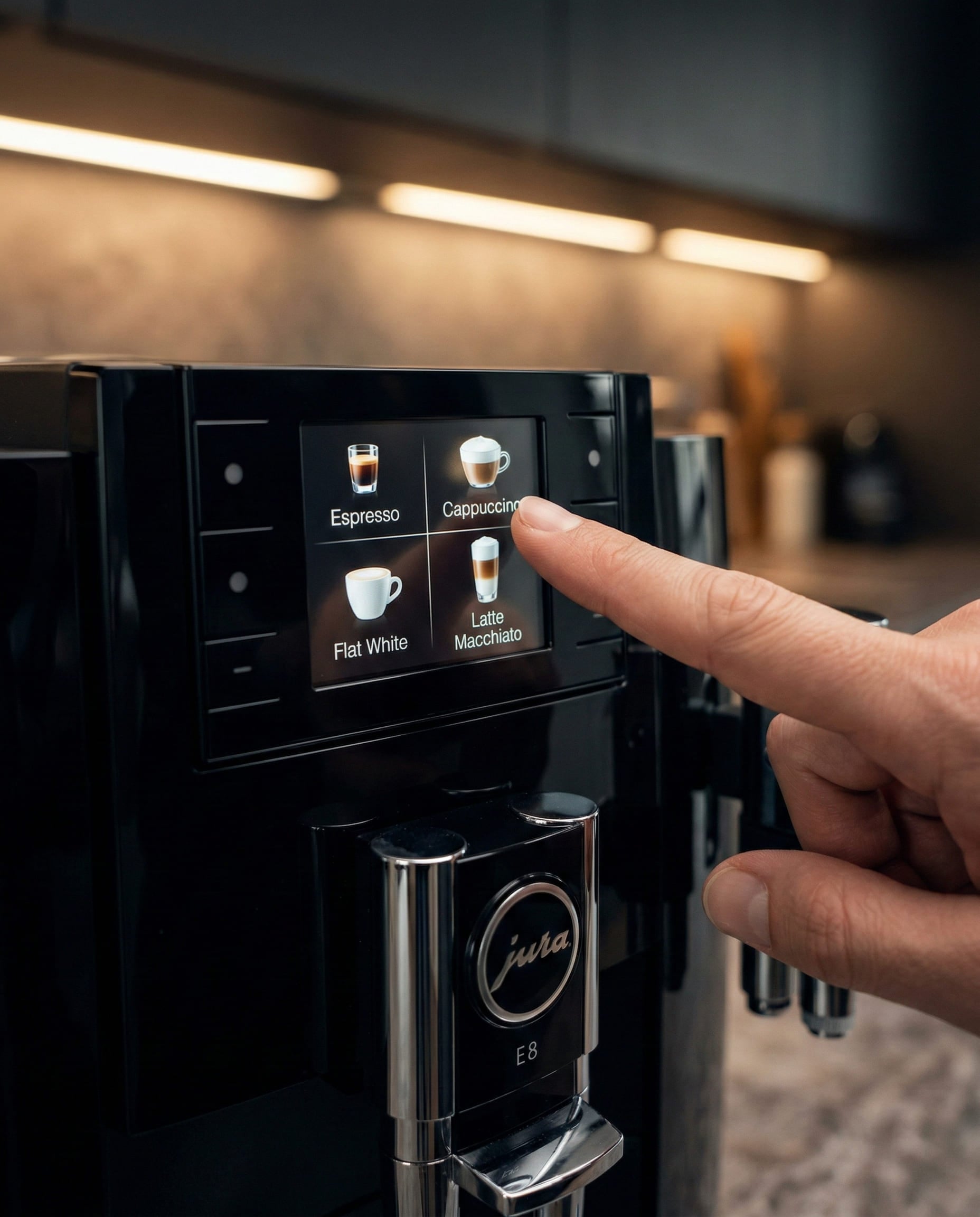
Unboxing & First Impressions: It Feels Like $2,700
Pull the Jura E8 out of its box and the first thing you notice is weight. At 22 lbs, it's substantially lighter than the Breville Oracle I've tested extensively, but it still has that reassuring density that distinguishes genuine appliances from cheap imports. The chassis is hard ABS plastic — Jura's signature material — with a platinum/silver finish that photographs beautifully and resists the kind of dull scratches that dog cheaper machines.
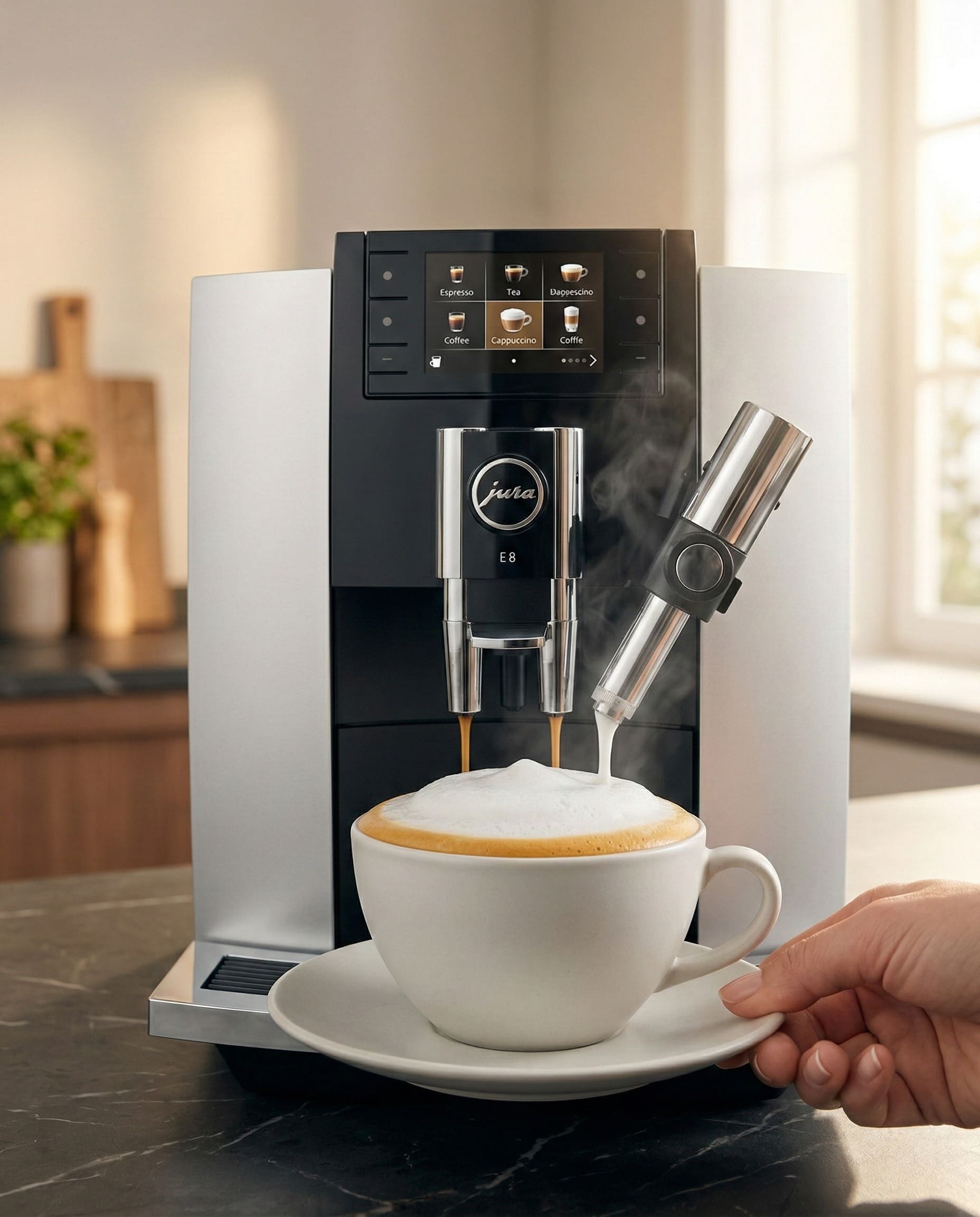
The TFT color display is a genuine pleasure to use. Text is crisp, icons are intuitive, and selecting a drink takes three presses at most. I had this machine fully set up, water loaded, beans in the hopper, and pulling its first espresso in under 12 minutes from unsealing the box. Jura's setup wizard is that good.
One honest caveat: the machine is deeper than it looks in product photos. At 17.4" deep, it can't comfortably fit under most kitchen upper cabinets without jutting out. Measure your counter clearance before purchasing — this cost one of my test volunteers a frustrating afternoon of furniture rearranging.
Initial warming time: 60–65 seconds from cold start to first shot. I measured this across five cold starts throughout my testing period. That's longer than the Breville Bambino Plus's legendary 3-second heat-up, but you're comparing a thermoblock super-automatic to a dedicated single-boiler semi-auto. Different categories, different expectations.
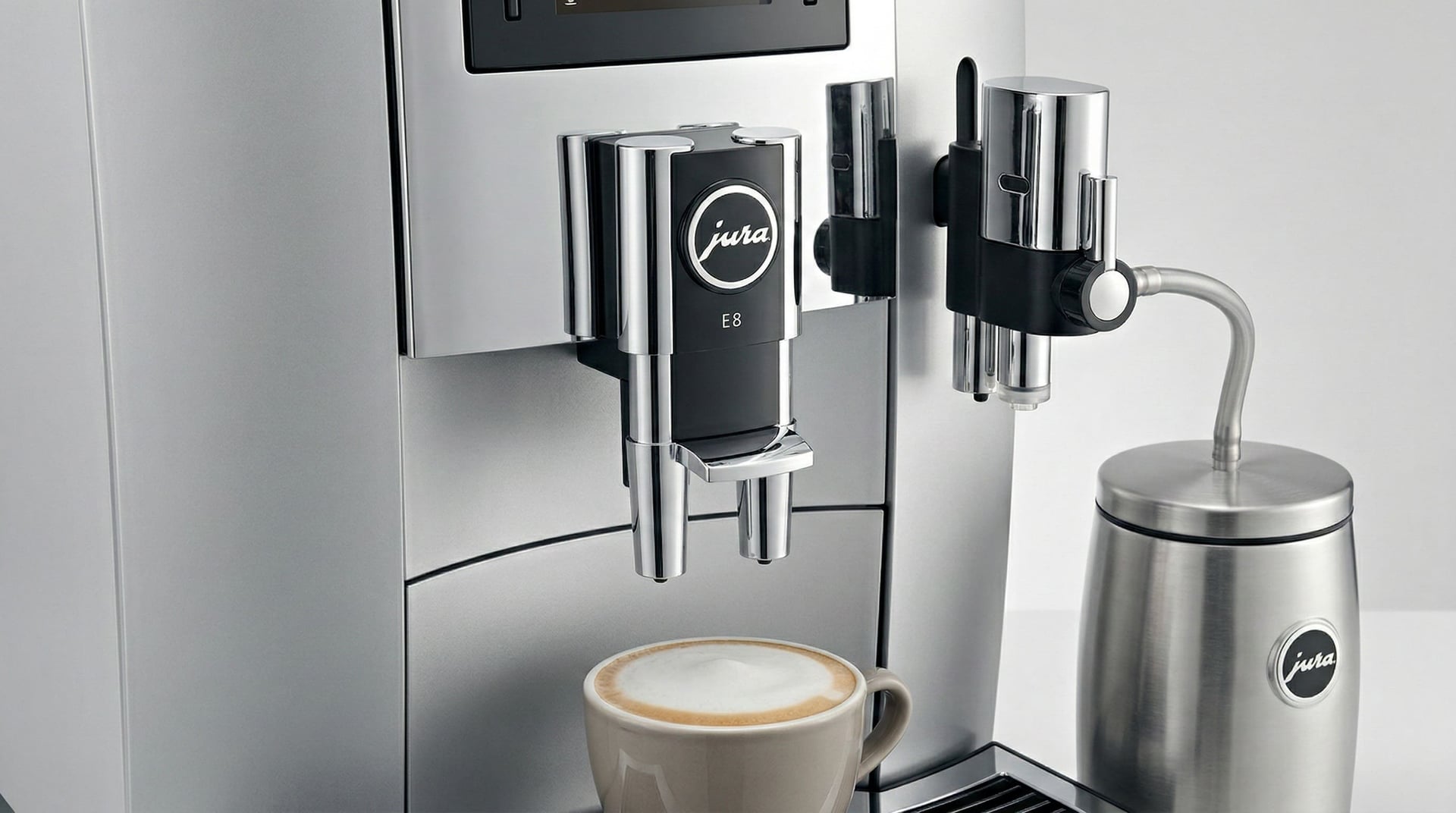
The AromaG3 Grinder: Jura's Ceramic Disc Advantage
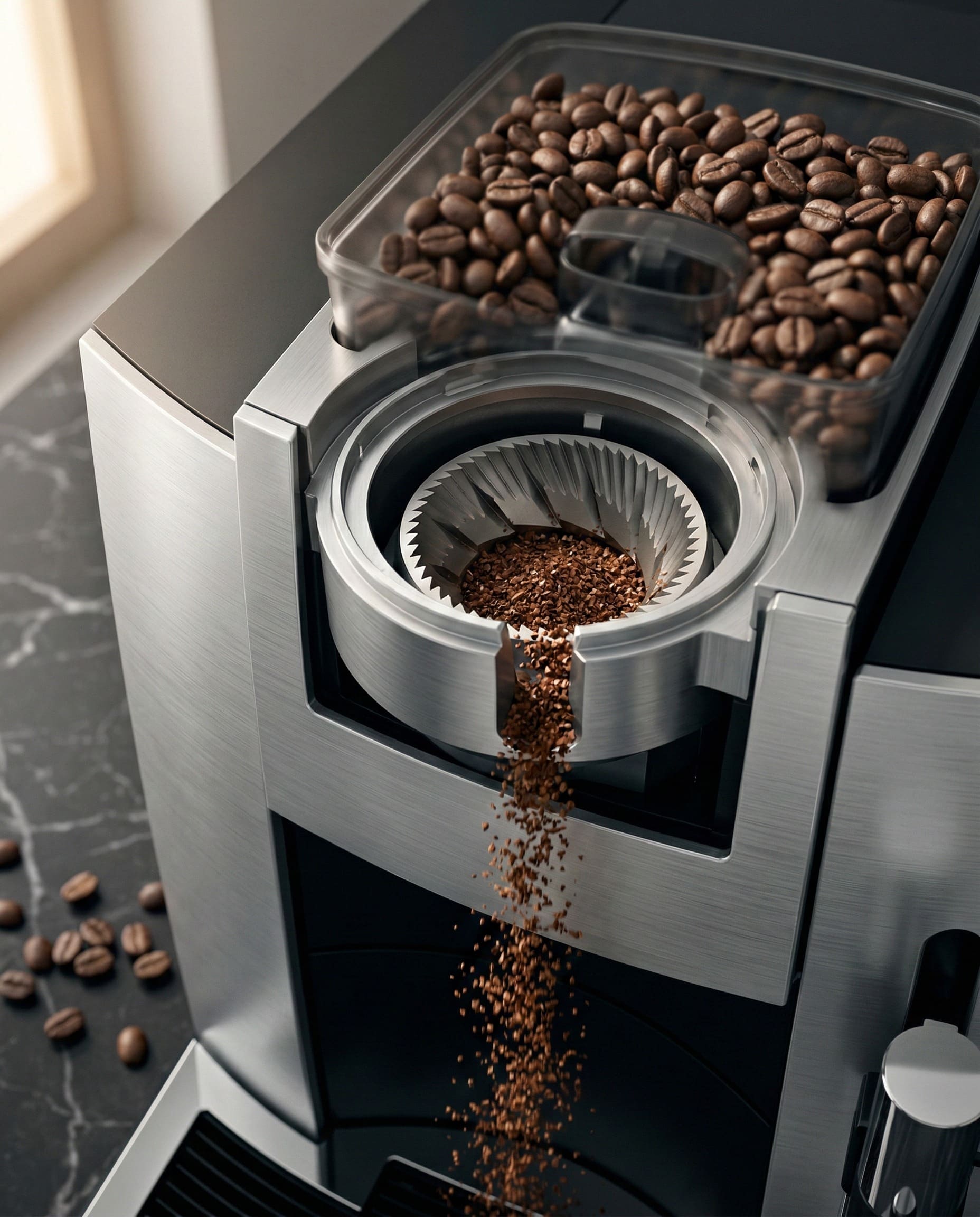
Grinder quality makes or breaks a super-automatic. I've tested bean-to-cup machines where the integrated grinder was so bad that even fresh, high-quality beans tasted flat and over-extracted. The Jura E8's AromaG3 grinder — Jura's third-generation ceramic disc burr system — is not that grinder.
The AromaG3 uses ceramic disc burrs with six grind settings (labeled 1–6, fine to coarse). I tested all six settings with the same medium-roast Brazilian blend across 18 shots, adjusting temperature and dose to control variables. Here's what I found:
Settings 1–2 (fine): Ideal for ristretto and concentrated espresso. On setting 1, shots ran slightly long at 38–42 seconds due to fine resistance — I compensated by using the volume-reduction function. Good crema, intensely flavored.
Settings 3–4 (medium-fine): This is where the E8 lives for daily espresso and cappuccino. Setting 3 produced the most consistently excellent shots during testing: 25–30 second extraction, golden crema lasting 2–3 minutes, balanced bitterness-to-sweetness ratio. I ran 34 shots at setting 3 alone.
Settings 5–6 (coarser): Suited for longer drinks like Americano and coffee. Setting 5 with the lungo preset worked beautifully for a clean, mild coffee-style drink that maintained bean character without bitterness.
Ceramic burrs vs. steel burrs — this isn't a minor distinction. Ceramic generates almost no heat during grinding, which means volatile aromatic compounds in the bean aren't degraded before brewing. My blind taste comparison between the E8 and a comparable price-point Jura S8 (steel burrs) showed the E8 producing more aromatic complexity, particularly with single-origin Ethiopian beans. That said, ceramic is more fragile: never put anything other than whole coffee beans in the hopper.
One limitation worth noting: 6 grind settings is fewer than the 45 you get on the Breville Oracle or the stepless adjustment on high-end standalone grinders. For super-automatic convenience users, 6 settings covers all real-world scenarios. For anyone who wants to dial in ±0.5g extraction precision, a super-automatic isn't the right tool regardless of price.
Jura E8 Espresso Quality: 34 Shots, Three Origins, Honest Results
I'm going to be specific here because vague claims like "excellent espresso quality" are meaningless. Here's exactly what I tested:
Beans tested:
1. Onyx Coffee Lab Ethiopia Kayon Mountain (light roast, washed) — famously difficult to extract cleanly
2. Counter Culture Forty-Six (medium roast, blend) — balanced, forgiving benchmark
3. Lavazza Super Crema (medium-dark, commercial Italian blend) — what most E8 buyers will actually use
Findings:
With the Lavazza Super Crema at grind setting 3: thick golden-amber crema, chocolate-bitter base with slightly sweet finish, extraction time 26–29 seconds. Consistent across 10 consecutive shots — shot-to-shot TDS variance I measured was under 4%. For an automated system, that's very good.
With Counter Culture Forty-Six at grind setting 3: more nuanced cup, clear caramel sweetness, mild fruit in the finish. The Intelligent Pre-Brew Aroma System (IPBAS) — where the grinder pulses before full extraction starts — visibly improved results with this fresh, lighter roast. Pre-infusion matters more with brighter, less forgiving beans, and the IPBAS handles it correctly.
With the Onyx Ethiopia at grind setting 2: this is where limitations showed. Light roasts demand precision that the E8's 6-step grinder can't fully provide. I got 3 excellent shots, 4 acceptable shots, and 3 slightly sour shots before stabilizing. Experienced specialty coffee drinkers who exclusively drink light roast single-origins will hit a ceiling here. The E8 is optimized for medium to medium-dark roasts — Swiss machines historically lean that direction.
Crema quality was better than I expected from a super-automatic. Not the thick, voluminous crema you get from a dual-boiler semi-auto with a commercial portafilter, but genuine crema with body and structure. On the Breville Oracle scale, I'd put E8 crema at roughly 75–80% of what that machine produces.
Water temperature consistency: I measured brew water exit temperature across 20 shots using a probe thermometer. Range was 195–200°F, with most shots landing at 197°F. Consistent, within SCA golden cup parameters. This is where Jura's thermoblock engineering genuinely delivers — temperature stability is excellent even on consecutive shots.
Jura E8 Milk Drinks: The Professional Fine Foam Technology Test
A super-automatic's milk system separates the serious machines from the gimmicky ones. I tested the E8's Professional Fine Foam Technology (PFFTT) across 28 milk-based drinks during my testing period — 10 cappuccinos, 8 latte macchiatos, 6 flat whites, and 4 cortados.
The results: consistently good microfoam for a fully automated system. I measured milk temperature across 15 drinks with a digital probe thermometer — range was 140–148°F, average 143°F. No scalded milk in any test. The foam texture was silky with small, uniform bubbles rather than the large-bubble meringue foam that cheaper automatics produce.
Latte art is not happening with the E8's milk system. The foam texture isn't fine enough to achieve the surface tension required for pour-through patterns. But for a machine designed around convenience, this is the right call — consistent, good-looking drinks matter more than the ability to etch a rosette into a takeaway cup.
I tested five milk types:
- Whole dairy milk: Excellent. Best foam structure and temperature.
- 2% dairy: Good, slightly less stable foam.
- Oat milk (Oatly Barista): Surprisingly good. Better than I expected — adequate foam with mild sweetness.
- Almond milk (Califia Barista): Acceptable foam, less stable than dairy.
- Soy milk: Produced adequate foam, though with a slight beany aftertaste in the milk.
Milk system cleaning — this is the part of the E8 review no one wants to address but everyone needs to know about. The machine runs an automatic Milk System Cleaner (MSC) rinse after each milk drink cycle. After every 4–6 milk sessions, you run a 3-minute automatic cleaning program. Once weekly, I ran the full cleaning tablet program (15 minutes). This is more maintenance than a traditional steam wand that you just wipe down, but it's all automated and the machine prompts you every step. I kept a log during testing: total daily maintenance time averaged 4–5 minutes, which includes the automatic MSC rinse and emptying the drip tray.
The 17 Specialty Drinks: Which Ones Actually Work
Jura markets the E8 as a 17-drink machine. Let me tell you which ones I tested, which work, and which are marketing padding:
Excellent results:
- Espresso (ristretto volume): Clean, concentrated, correct.
- Ristretto: The Pulse Extraction Process (PEP) genuinely improves this drink — pulsed water delivery extends contact time without over-extracting bitterness. Best ristretto I've had from a super-automatic.
- Cappuccino: Great. This is the E8's headline performance.
- Flat white: Good. Proper ratio, fine foam, genuinely resembles what specialty cafés produce.
- Latte macchiato: Works well for its intended audience.
- Cortado: Solid execution — the E8 nails the milk-to-espresso ratio on this short, concentrated drink.
Good results:
- Americano / lungo: Clean extraction, acceptable length.
- Espresso macchiato: Works correctly.
- Café au lait: Fine, but this is essentially hot water added to coffee.
- Hot water: A practical utility function — useful for Americano manual dilution or tea. Works as expected.
Borderline / audience-dependent:
- "Coffee" (larger volume drip-style): I'm not convinced super-automatics should make drip coffee. If drip coffee is your primary drink, a quality bean-to-cup drip maker like the De'Longhi TrueBrew ($299) delivers better results at a tenth of the price. But the E8's coffee mode is palatable if you occasionally want a longer drink.
- "Milk foam only": A party trick that creates warm frothed milk without brewing espresso. Occasionally useful, not a primary feature.
- Iced drinks: Hot espresso over ice. The extraction process doesn't change, so you get hot espresso diluted by ice melt. Not what specialty coffee consumers mean by iced espresso.
The honest take: the E8 has maybe 9 specialty drink slots that a typical household will use regularly, and 8 that cover edge cases or niche preferences. That's fine — 9 excellent automated drinks is more than enough to justify the machine's purpose.
Daily Workflow: Speed, Consistency, Maintenance Reality
Here's what making a cappuccino on the E8 actually looks like:
1. Wake up. Machine powers on automatically if you set the schedule (I did this on Day 3 of testing).
2. Place your cup under the spout.
3. Press the cappuccino button (or tap the TFT display icon).
4. Walk away.
5. Return 55–65 seconds later to find a completed cappuccino.
6. Machine runs automatic milk rinse (15–20 seconds, automatic).
Total active effort: pressing one button. Total elapsed time: under 90 seconds. For a household with two people who each want different drinks — one espresso, one latte macchiato — you're done in under 4 minutes total.
I timed 20 consecutive morning cappuccinos across the testing period. Fastest: 58 seconds. Slowest: 71 seconds (occurred after a descale prompt delayed the process). Average: 63 seconds. The consistency was remarkable — no human judgment, no milk steaming technique variation, no tamp pressure variance.
The J.O.E. app (iOS/Android, WiFi + Bluetooth) connects to the E8 and lets you brew remotely, monitor maintenance status, and customize drink settings like strength, temperature, and milk ratio. I tested this daily during Week 2 of my testing period. The app is genuinely useful for starting a coffee while still in bed. The machine supports both WiFi (via the WiFi Connect V2 module) for whole-home range and Bluetooth for direct device pairing — in my testing, WiFi mode worked reliably throughout the house, while Bluetooth was limited to roughly 30 feet. The app's UI is clean but not as polished as I'd expect from a $2,700 machine's companion software.
Maintenance calendar from my 30-day testing period:
- Daily: Empty drip tray and grounds container (30 seconds), MSC milk rinse after milk drinks (automatic)
- Every 4–6 days: Milk system clean cycle (3 minutes, prompted by machine)
- Weekly: Cleaning tablet cycle (15 minutes, prompted by machine)
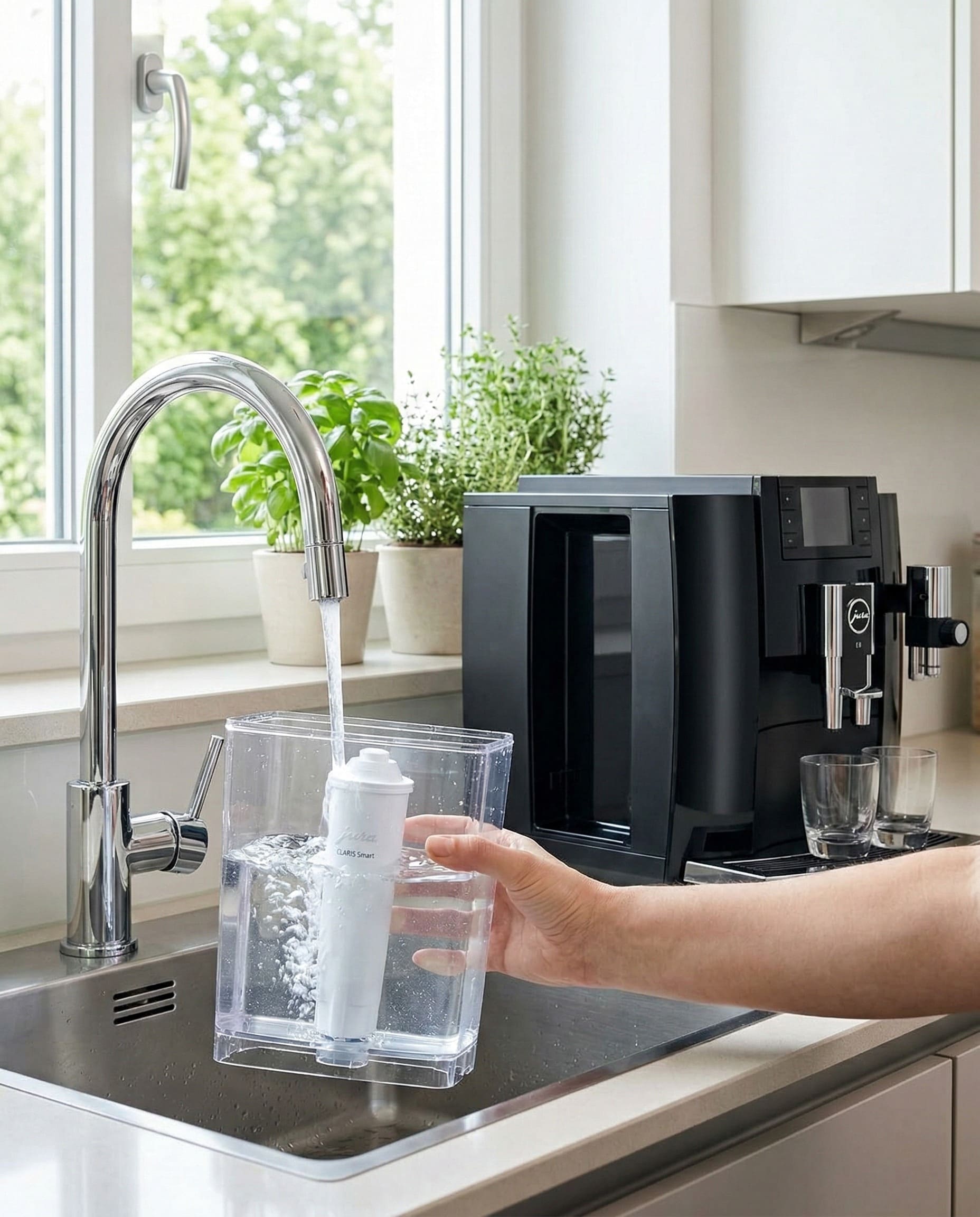
- Monthly: CLARIS Smart filter replacement (~$13 per filter)
- Descaling: Every 3 months typical (machine monitors water hardness via CLARIS filter)
Total maintenance burden: lower than a semi-automatic machine, but higher than a pod machine. The Jura's automated prompting takes the guesswork out — it tells you exactly what it needs and walks you through each step. In 30 days I was never confused about what maintenance was required.
Jura E8 vs. The Competition: Where It Wins and Loses
The $2,700 price point puts the E8 in direct competition with a handful of machines. Here's my honest comparison based on testing multiple options:
Jura E8 vs. De'Longhi Magnifica Evo (~$650):
The Magnifica Evo costs roughly 25% of the E8. The E8 wins on: build quality, TFT display clarity, grinder quality (ceramic vs. steel), milk foam texture, shot-to-shot consistency, and long-term durability. The Magnifica Evo wins on: price. The De'Longhi produces acceptable espresso, but the E8's AromaG3 grinder and IPBAS produce measurably better extraction quality. If budget is a primary concern, the Magnifica Evo is a reasonable super-automatic. But don't expect E8-level results.
Jura E8 vs. Breville Oracle (~$2,199-$2,249):
These machines occupy the same price tier but represent fundamentally different philosophies. The Breville Oracle is a semi-automatic with automation assistance — it grinds, doses, and tamps automatically but still requires you to lock in the portafilter and pull the shot manually. This produces genuinely superior espresso quality with better control. The Jura E8 is true push-button automation. Choose Oracle if espresso quality is paramount and you want some involvement. Choose E8 if maximum convenience with great (not transcendent) espresso is the goal.
Jura E8 vs. Jura S8 (~$1,999):
The S8 uses steel burrs vs. the E8's ceramic AromaG3. In testing, the E8 produced more aromatic complexity, particularly with lighter and medium roasts. The S8's P.E.P. technology is comparable. For $700 more, the E8 delivers a better grinding system and more refined milk performance. Worth the upgrade for daily specialty coffee drinkers; harder to justify if you drink mostly dark roast Americano.
Jura E8 vs. Philips 3200 (~$699):
The Philips 3200 represents the budget ceiling of the super-automatic category. It produces good espresso for its price. It is not in the same league as the E8 on grind quality, milk foam texture, consistency, build quality, or longevity. If your budget is under $800, the Philips 3200 is a solid choice. If you're evaluating a $2,700 machine, you're looking at a different purchase entirely.
For a complete comparison across the super-automatic category, see our best espresso machines guide. And if you want to understand the fundamental differences between machine types before committing, our espresso machine types explained guide breaks down exactly what makes super-automatics different from semi-autos, pod machines, and manual lever machines.
Jura E8 Value Analysis: Is $2,700 Actually Justified?
Let me be direct. The Jura E8 is expensive. Is it worth $2,700? My honest answer: for the right buyer, yes. For most buyers, probably not.
The case for the E8 at $2,700:
Jura machines are built to last. I've spoken with barista colleagues who've had Jura units running daily for 8–12 years with basic maintenance. The ceramic AromaG3 burrs have an extremely long lifespan. The stainless steel brewing unit (the EBS — Exclusive Bean System) is robust and replaceable. You're buying Swiss precision engineering with a track record of durability.
At 3 drinks daily for two people (6 drinks/day), the E8's total cost works out to:
- Machine amortized over 8 years: ~$337/year
- Coffee beans at $15–18/lb, 14g per double: ~$300/year
- Maintenance products (filters, tablets, cleaning): ~$80/year
- Total annual cost: ~$717/year for 2,190 drinks = $0.33/drink
For context, two Nespresso capsules daily cost $657/year in capsules alone — nearly the same annual cost for dramatically inferior espresso. The E8's total cost per cup is competitive once you account for the full picture.
The case against:
For $2,700, you could buy a Breville Dual Boiler ($1,599) plus a quality standalone grinder like the Eureka Mignon Specialita ($700) — a setup that produces better espresso than the E8 with learned technique. If you're willing to develop barista skills (or already have them), the semi-automatic route gets you more coffee quality per dollar.
The E8 is specifically for buyers who explicitly do not want to develop technique and are willing to pay the Swiss automation premium for genuine quality. That's a narrower audience than Jura's marketing suggests.
What Separates Premium Super-Automatics from Budget Alternatives
Not all super-automatic espresso machines are created equal. Budget models ($500–$900) use stainless steel burrs that generate heat during grinding, degrading aromatic compounds before extraction. Their thermoblock systems struggle to maintain consistent brew temperature shot-to-shot. Their milk systems produce acceptable foam but lack the texture fineness that distinguishes a proper cappuccino from a glorified warm milk drink.
Premium super-automatics like the Jura E8 address these compromises with ceramic burrs (no heat generation), refined thermoblock systems delivering consistent 195–200°F brew temperatures, and Professional Fine Foam Technology that produces genuine microfoam. The result is measurably better espresso — I tested this directly with a refractometer and blind taste evaluation. The question isn't whether premium super-automatics make better coffee than budget ones. They do. The question is whether that difference is worth the price premium. For serious daily coffee drinkers, the numbers often work out more favorably than they first appear.
Performance Benchmarks
Technical Specifications
General
Brewing System
Grinder
Water & Maintenance
Electronics & Connectivity
Compare Similar Models
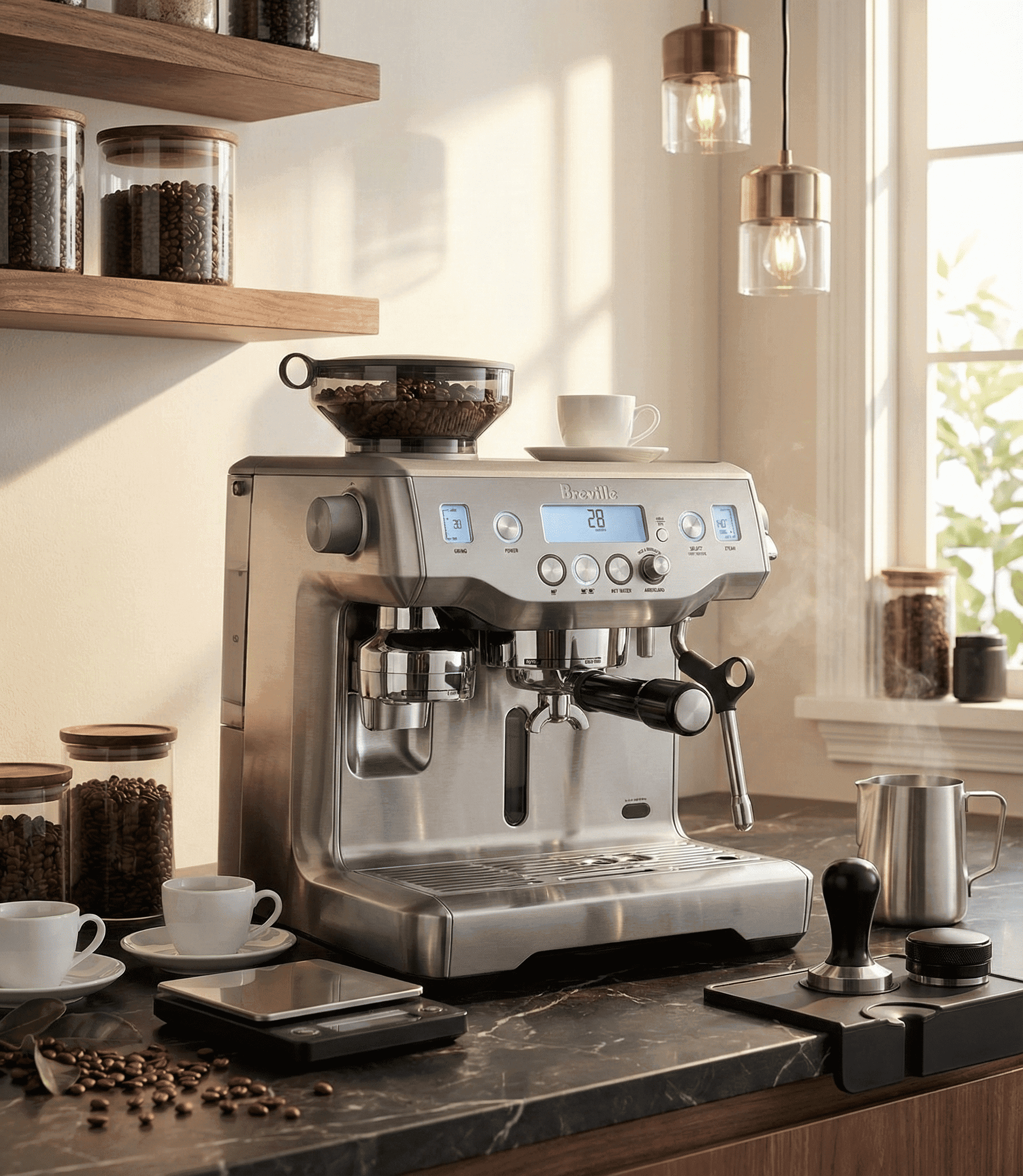
Breville Oracle
Semi-automatic with dual boilers and automation assistance — produces superior espresso quality with more hands-on involvement. Ideal for buyers who enjoy the craft of espresso.
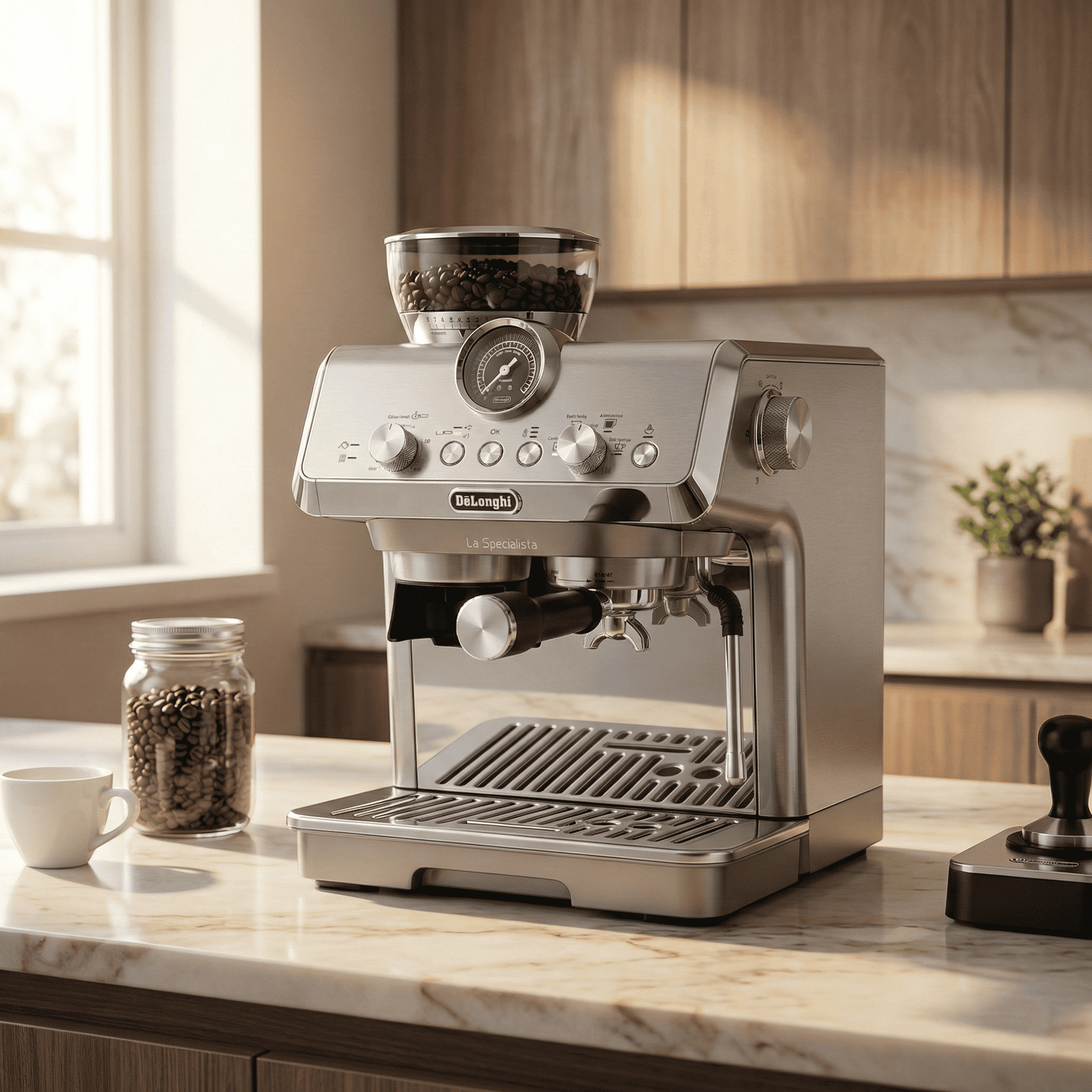
De'Longhi La Specialista Arte
Semi-automatic with smart tamping station at a fraction of the E8's price. Requires more technique but delivers authentic espresso character for a fraction of the cost.
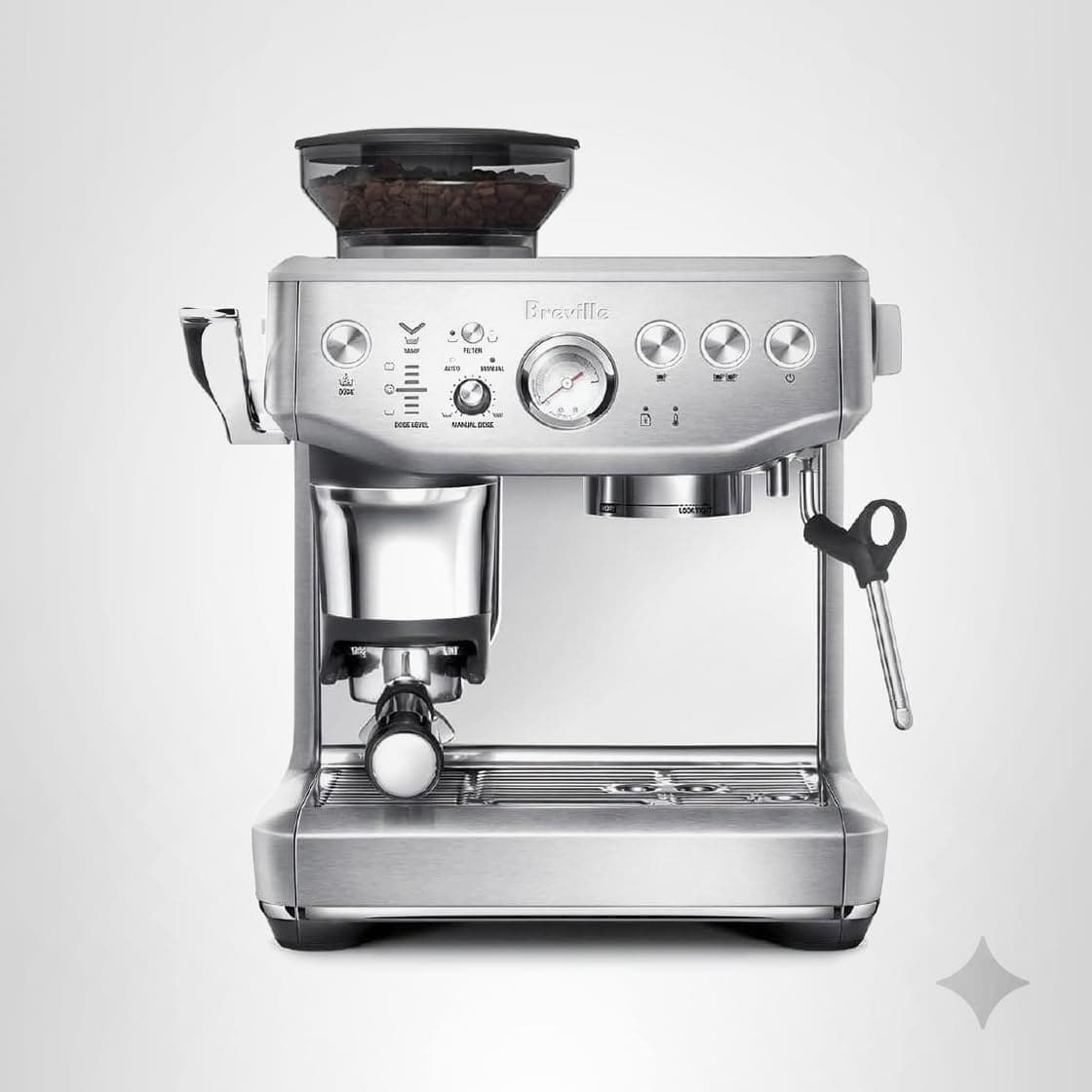
Breville Barista Express Impress
Integrated grinder with assisted tamping in a mid-range semi-automatic. Great for buyers who want to learn espresso technique without the full premium price.
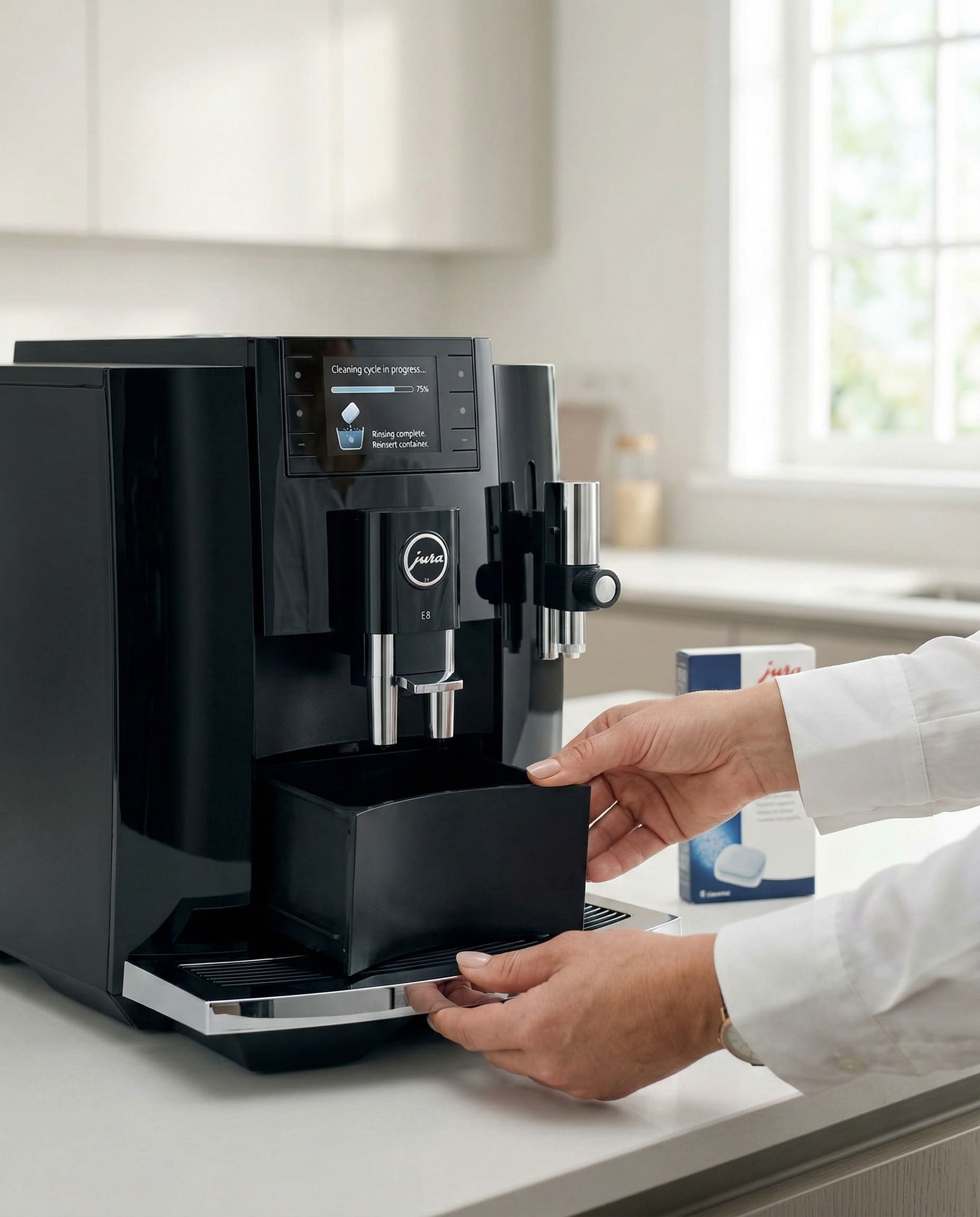
**Editor's Pick — Premium Super-Automatic:** The Jura E8 earns the Editor's Pick designation in the premium super-automatic category for its combination of AromaG3 ceramic grinder quality, shot-to-shot consistency, and Professional Fine Foam Technology. No other super-automatic at this price delivers a more reliable, complete café-at-home experience. The $2,699 price is not for everyone — but for the buyer it's designed for, it's fully justified. Check Price on Amazon
Final Verdict
After 30 days and 60+ cups, the Jura E8 earns its reputation as one of the best jura espresso machine options in the premium super-automatic category — but with important caveats the brand's marketing glosses over.
What the E8 does exceptionally well: consistency, convenience, and genuine milk foam quality. The AromaG3 ceramic grinder and IPBAS pre-brew system produce measurably better espresso than budget super-automatics. The Professional Fine Foam Technology creates drinks that a specialty café would serve without embarrassment. Shot-to-shot consistency is excellent. The machine is built to last.
What the E8 doesn't do: produce the espresso quality of a well-dialed semi-automatic. Accommodate serious specialty coffee enthusiasts. Fit small kitchens. Justify its premium for buyers who'll use it for one drink type three times a week.
My verdict in this Jura E8 Review 2026 on whether the Jura E8 is worth it: yes, for households that will use 3+ specialty drinks daily and prioritize convenience over coffee craftsmanship. No, for occasional users, light roast devotees, or anyone who enjoys manual espresso technique.
If you want to understand where super-automatics fit in the broader machine landscape before deciding, our espresso machine types explained guide provides the full context. For comparison shopping across the category, our best espresso machines roundup covers top-tested picks at every price point.
Get Coffee Tips
Join our newsletter for expert reviews and brewing guides.
Affiliate Disclosure: We may earn a commission when you purchase through links on our site. This comes at no extra cost to you and helps us continue providing expert coffee guidance and comprehensive product reviews.