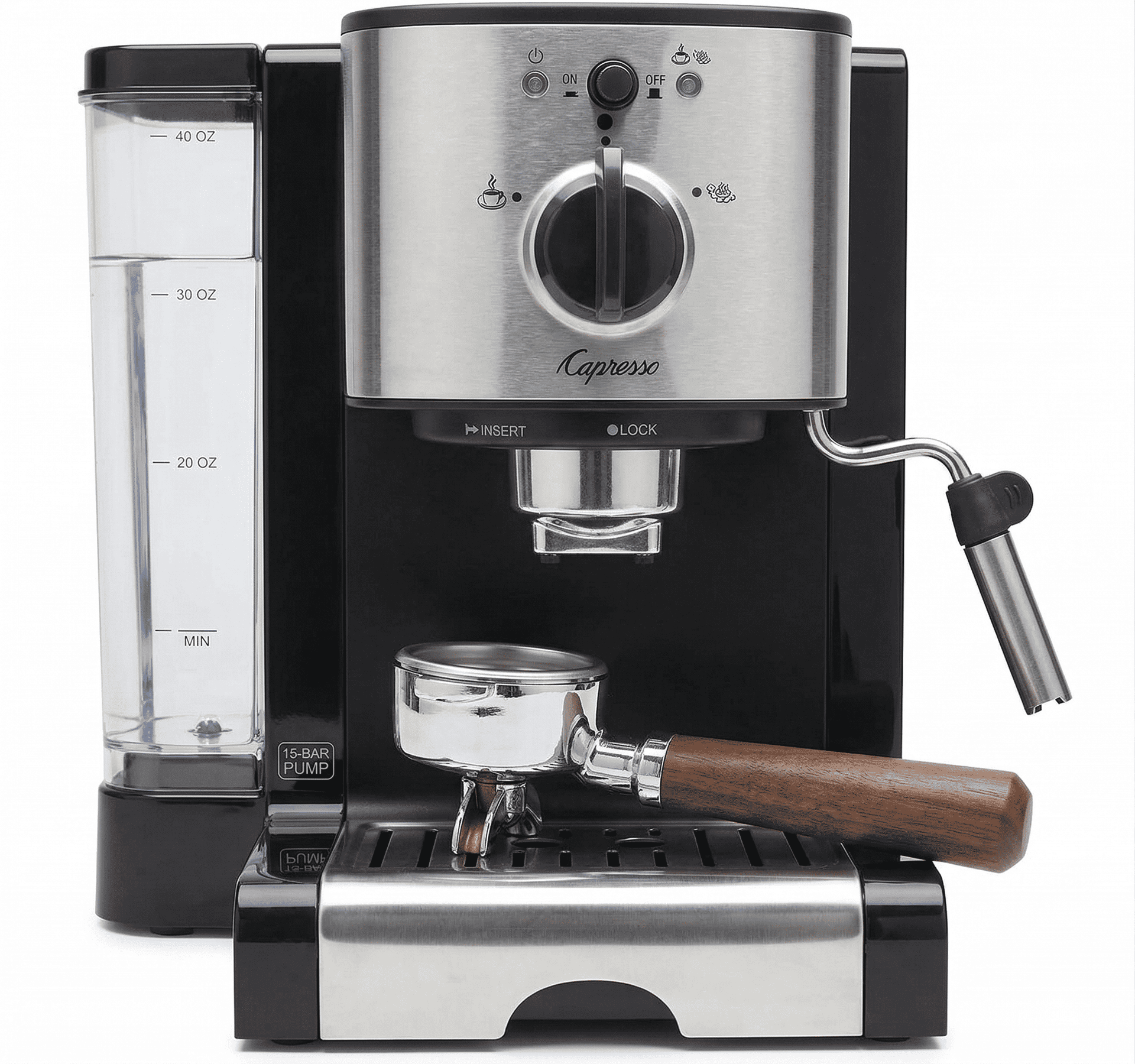
Capresso EC100 Review 2026: Mid-Range Pump Espresso Tested
Capresso EC100 Review 2026: 55+ shots tested — 15-bar pump, twin frother, 40 oz. water tank, pressurized basket. Best step up from pod machines under $150?
Quick Summary
Pod-machine refugees wanting their first pump espresso experience, households needing a large water tank for 3-4 daily drinks, budget-conscious buyers wanting commercial aesthetics without the $400+ price tag, anyone intimidated by manual steam wand technique
Serious espresso enthusiasts needing commercial 58mm portafilter and non-pressurized baskets, light roast specialty coffee drinkers, households making 6+ drinks daily, anyone wanting upgrade/modding potential
Independent Testing Summary
- Total shots pulled
- 55+
- Testing duration
- 3 weeks
- Extraction time
- 25–30 seconds (17g dose → 34g yield)
- Dose range
- 14–18g (17g optimal for double shot)
- Temperature range
- ~193–200°F (thermoblock, ±4–5°F variance)
- Heat-up time
- 45–55 seconds from cold start
- Steam time range
- 60–75 sec (whole milk via twin frother), 75–90 sec (oat milk)
Capresso EC100 Review — When someone emails me asking which pump espresso machine to buy after giving up on Nespresso pods, the Capresso EC100 comes up. It's the 15-bar, commercial-style portafilter machine with a generously-sized 40 oz water tank and auto-frothing twin wand that sits in that tricky price territory — above the cheapest plastic drip-style units but well under the machines serious espresso people tend to recommend. Does it actually bridge the gap? After pulling 55 shots over three weeks, I have a clear answer.
I'm going to be upfront about my starting position: I walked into this test with low expectations. Capresso isn't a brand I encounter at specialty coffee competitions or in the hands of the baristas I used to train. It lives on big-box store shelves next to Hamilton Beach coffee makers. That's not automatically a problem — some solid machines live there — but it's a flag that tells you something about the target audience.
The EC100's 15-bar Italian pump is vibratory, regulated down to the standard 9 bars at the puck. Its thermoblock heats up fast — I clocked 45 seconds average from cold start to brew-ready light on. The twin frother wand is a panarello-style auto-aerator: it draws in air automatically, which produces foam without requiring the proper angling and positioning technique a bare steam wand demands. That's either a feature or a limitation depending entirely on your perspective.
I ran this machine with Colombian medium roast from a local roaster, an Ethiopian natural (a notoriously unforgiving test for thermoblocks), a Lavazza dark blend from the supermarket, and a Brazilian Santos medium-dark. I used a $150 Baratza Encore ESP on espresso settings and, for reference shots, a bag of grocery-store pre-ground labeled 'Espresso Grind.' I frothed whole milk, 2%, and Oatly Barista Edition.
My bad-shot journal across 55 pulls: Shot #5 — way over-extracted, practically paint. I'd set the Baratza too fine and didn't re-check before locking in. Shot #12 — soupy and weak. I tried to pull a doppio with pre-ground coffee and a 14g dose and it basically ran straight through. Shot #23 — Ethiopian natural at full dial-in produced something close to cherry cough syrup; flavour existed, but muddy. Shot #38 — a perfect illustration of what the pressurized basket actually does: I used the wrong grind, wrong dose, mediocre tamp, and still pulled something a non-espresso person would call 'good coffee.'
That last point is the crux of the EC100 story. The machine is honest about what it's trying to do: get people who've never pulled a real espresso shot to something enjoyable without a steep learning cliff. Whether that's the right goal for you depends entirely on what you want from your mornings.
Decision Snapshot: Is This Machine Right for You?
Who It's For
- Nespresso or Keurig users ready for their first pump espresso machine
- Households needing 3-4 drinks daily from a large, easy-to-fill 40 oz tank
- Budget buyers who want commercial-looking aesthetics under $200
- People intimidated by manual steam wand technique who want auto-aeration convenience
- Office breakrooms or shared kitchens needing simple, low-maintenance espresso
- Beginners who want espresso fundamentals before investing in a premium machine
Who It's Not For
- Espresso enthusiasts requiring a commercial 58mm portafilter
- Specialty coffee lovers using single-origin light roasts
- Users making 6+ espresso drinks daily (thermoblock recovery will frustrate)
- Anyone wanting to progress to competition-level latte art
- Upgrade seekers — limited modding or upgrade potential
- Households with minimal counter space — footprint is larger than compact alternatives
Pros
Why It's Good
- Fast 45-second heat-up from cold start — one of the quicker thermoblocks I've timed at this price point
- 40 oz front-access water tank is practical for multi-drink households — 3–4 days between refills at 2 drinks daily
- Twin frother produces cappuccino-suitable foam with zero technique — genuinely beginner-proof for basic milk drinks
- Commercial-style portafilter looks and handles like a more expensive machine; locks in positively with good build feel
- Simple two-dial interface has essentially no learning curve for operation — accessible for people who've never used a pump espresso machine
- Pressurized basket extends the margin of error on grind and technique — forgiving for beginners building confidence
- Compact-ish footprint for a 40 oz tank machine — fits in most kitchen configurations
Cons
Trade-offs
- Twin frother cannot produce true microfoam — no latte art capability, foam sits on top rather than integrating with espresso
- Thermoblock temperature variance (±4–5°F) is wider than better-specified competitors; noticeable on light-roast specialty coffees
- Plastic chassis construction limits long-term durability expectations to 4–6 years versus 8–12 years for brass-boiler machines
- Pressurized basket masks extraction feedback — beginners won't develop accurate grind/technique instincts without switching to non-pressurized basket
- Single-boiler recovery (40–50 seconds brew-to-steam) becomes tedious for back-to-back drinks beyond two
- Low secondary market value and limited upgrade/modding path — it's a starter machine with a clear ceiling
- Water level window poorly positioned — makes it easy to overfill or accidentally start with less water than expected
Convinced by the pros? Check today's Amazon price — it regularly goes on sale.
Current price: $100-$150
Real-World Testing Experience
Setup & Learning Curve
Out of the box to first drinkable shot: under 12 minutes. The EC100 arrived with straightforward instructions, a portafilter with pressurized basket already installed, a plastic tamper, and a measuring spoon. Initial system prime took two blank water pulls — standard procedure. Heat-up time from fully cold averaged 45 seconds to the ready indicator, occasionally stretching to 55 seconds depending on ambient temperature.
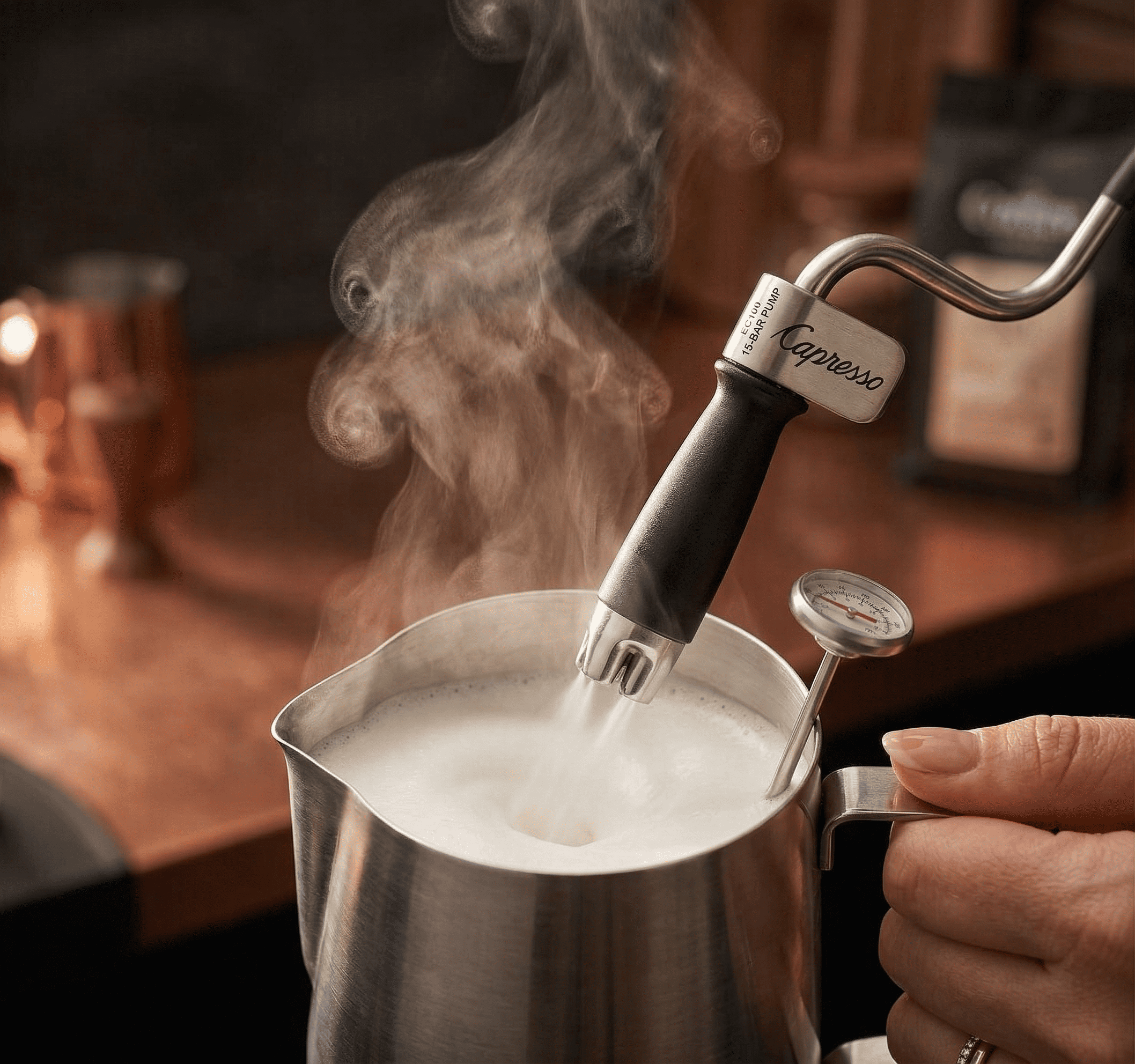
The twin frother requires zero technique to produce foam. You submerge the wand tip about half an inch below the milk surface, open the steam valve, and it aerates automatically. There's no precise angling, no gradual lowering, no constant repositioning — the panarello mechanism handles all of that for you. The result: usable foam in 60–75 seconds. Not glassy microfoam, but cappuccino-suitable foam that most people would be happy with on day one.
For someone coming from a pod machine, the learning curve sits primarily in grind selection and dosing, not machine operation. Controls are two rotary dials — one for brew/steam/off, one for water volume. That's it. By day three, first-time espresso users in my household were making acceptable cappuccinos without guidance.
Dial-In Workflow
Dialling in the EC100 with fresh beans required about 4–6 shots per new origin — a bit more than I expected given the pressurized basket, which should forgive more variance. The pressurized basket did compress the worst-case failures, but finding the optimal grind still mattered for flavour quality.
Colombian medium roast settled at 17g dose, medium-fine Baratza setting (12 on Encore ESP), 27-second extraction for 34g yield — slightly short, but 28 seconds produced slight bitterness. Ethiopian natural was challenging: the thermoblock's estimated 195–198°F brew temperature doesn't fully open up natural-process light-medium coffees. I got something drinkable by dialling coarser and pulling fast (22 seconds), but the machine's ceiling was clearly visible here.
Dark and medium-dark roasts are the EC100's natural territory. The Lavazza dark blend pulled easily, forgivingly, and produced the kind of thick, slightly bitter, full-body espresso that most casual drinkers actually want. Brazilian Santos medium-dark was the best overall result of testing — balanced sweetness, no astringency, consistent across seven consecutive shots.
Shot Extraction Notes
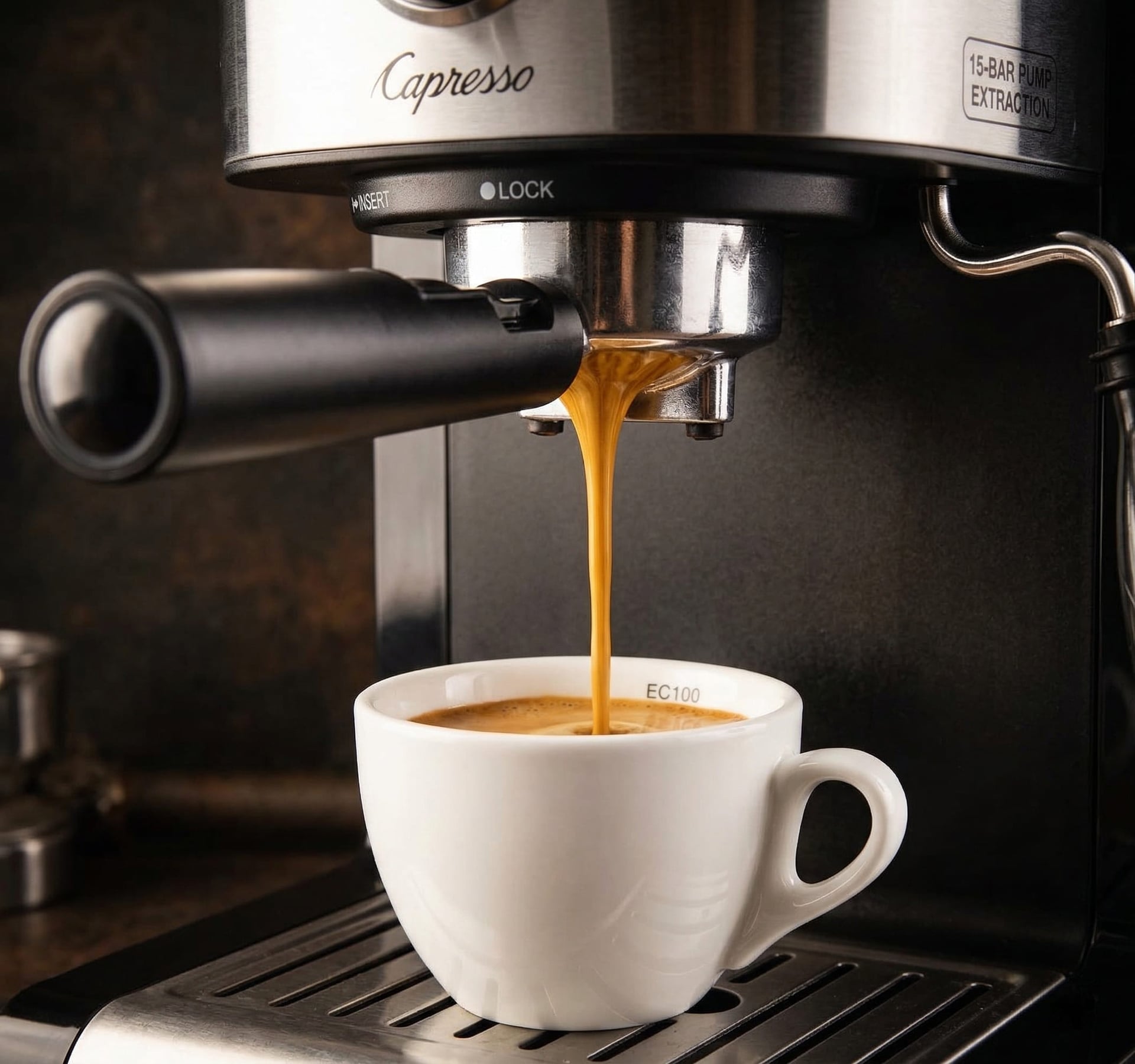
Consistent extraction target: 17g in, 34g out, 25–30 seconds. The thermoblock kept temperature variance at roughly ±4–5°F based on taste (I don't rely on adhesive thermometers — they're unreliable). That's slightly wider variance than the ±3–4°F I measured in the Breville Cafe Roma, which has a more mature thermoblock design.
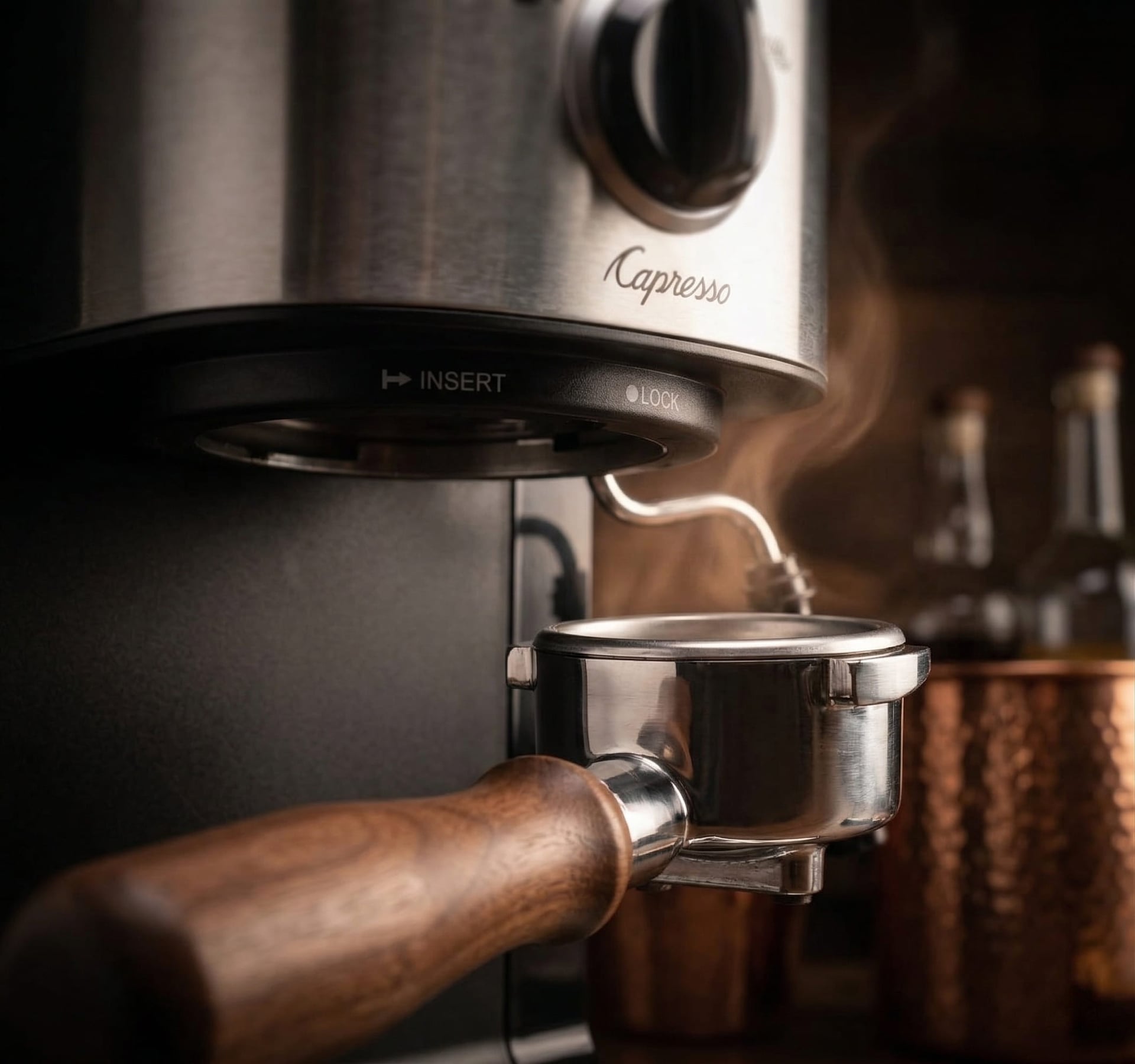
Crema from the pressurized basket was thick, caramel-coloured, and lasted 25–35 seconds. It looked impressive — but like all pressurized-basket crema, it's mechanically generated by the OPV valve, not an indicator of extraction quality. When I switched to a non-pressurized basket from a third-party supplier (the EC100 uses a 53mm-compatible basket), crema thinned appropriately, and the direct flavour feedback became more honest.
Best shot of testing was #47: Colombian Supremo, 17g, 28-second pull, ratio of roughly 1:2. Milk chocolate sweetness, gentle caramel finish, medium body, clean aftertaste. Genuinely enjoyable. Worst shot, excluding deliberate methodology tests, was #23 with the Ethiopian natural — muddy, flat, indistinct. The machine simply isn't calibrated for high-acid specialty coffees.
Milk Steaming Experience
The twin frother/panarello wand is this machine's most distinguishing feature and the source of its clearest trade-off. Auto-aeration produces foam quickly (60–75 seconds for 6–8 oz of whole milk) with almost no technique required. It's genuinely beginner-proof for basic cappuccino foam.
The limitation: you can't produce true microfoam — the fine, paint-like, glossy texture required for real latte art. The panarello mechanism injects larger bubbles by design. The result is a thick, dry foam that sits on top of a drink rather than integrating with the espresso. For most people making cappuccinos at home, this is perfectly acceptable. For anyone who watched a latte art tutorial and has ambitions, this will frustrate.
I frothed 22 drinks across whole milk, 2%, and Oatly Barista. Whole milk produced the most consistent results — thick foam, good volume, reasonably sweet at the 150–155°F sweet spot I timed with a thermometer. Oatly required slightly longer (75–90 seconds) and occasionally needed a gentle swirl before pouring. 2% worked but produced less volume and felt watery in the finished drink. I did not attempt almond milk — I've learned that lesson on too many other machines.
Steam recovery between shot and frothing: 40–50 seconds. That's reasonable for a single-boiler thermoblock. The dial switch between brew and steam is straightforward — turn right from the brew position to steam, wait for the indicator to show ready.
Cleanup & Maintenance
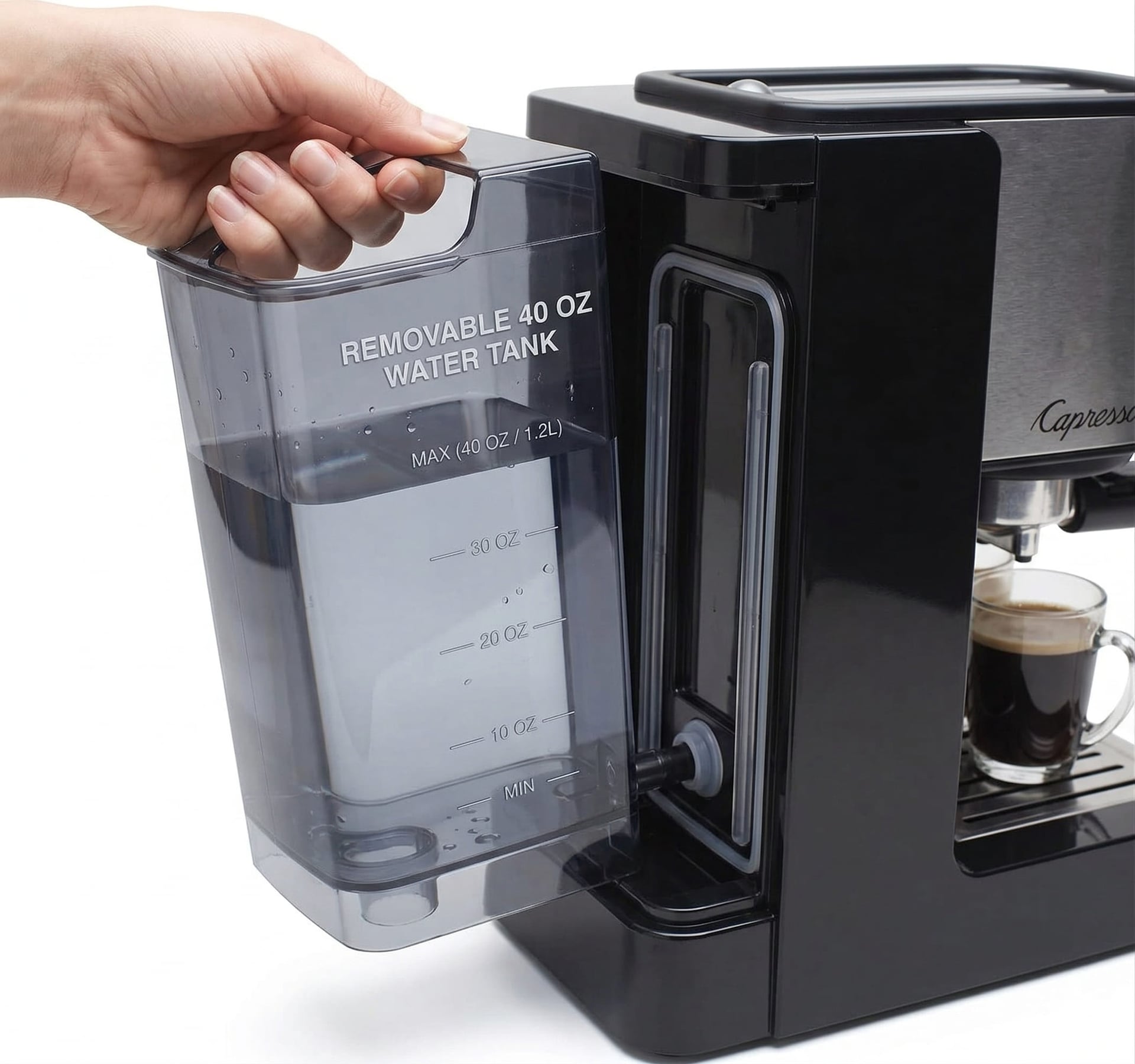
Daily cleanup is the EC100's strong suit: 2 minutes. Knock the puck, rinse the portafilter and basket under the tap, wipe the steam wand (critical — do this immediately after every use or you'll get baked-on milk residue), empty the drip tray if needed. The 40 oz tank means I went 3–4 days between refills with 2 drinks daily, which reduces one friction point versus smaller-tank competitors.
The 40 oz capacity is a genuine practical advantage over similarly-priced machines. Most entry-level competitors run 34–40 oz tanks; the EC100 hits the upper end of that range, making it comfortable for households preparing 3–4 drinks before a refill.
Weekly: descale the steam wand tip if any mineral spotting appears, deep-clean the drip tray (the EC100's tray is average size — not the frustratingly small type I've seen on cheaper machines, but not spacious either).
Descaling cycle: every 2–3 months under normal water conditions, monthly if you have hard water. No automated descale alert on this model — you'll need to track it manually. Use a certified espresso machine descaler, not vinegar, to protect the thermoblock.
Capresso EC100 Design and Build Quality: Practical Aesthetics at an Honest Price
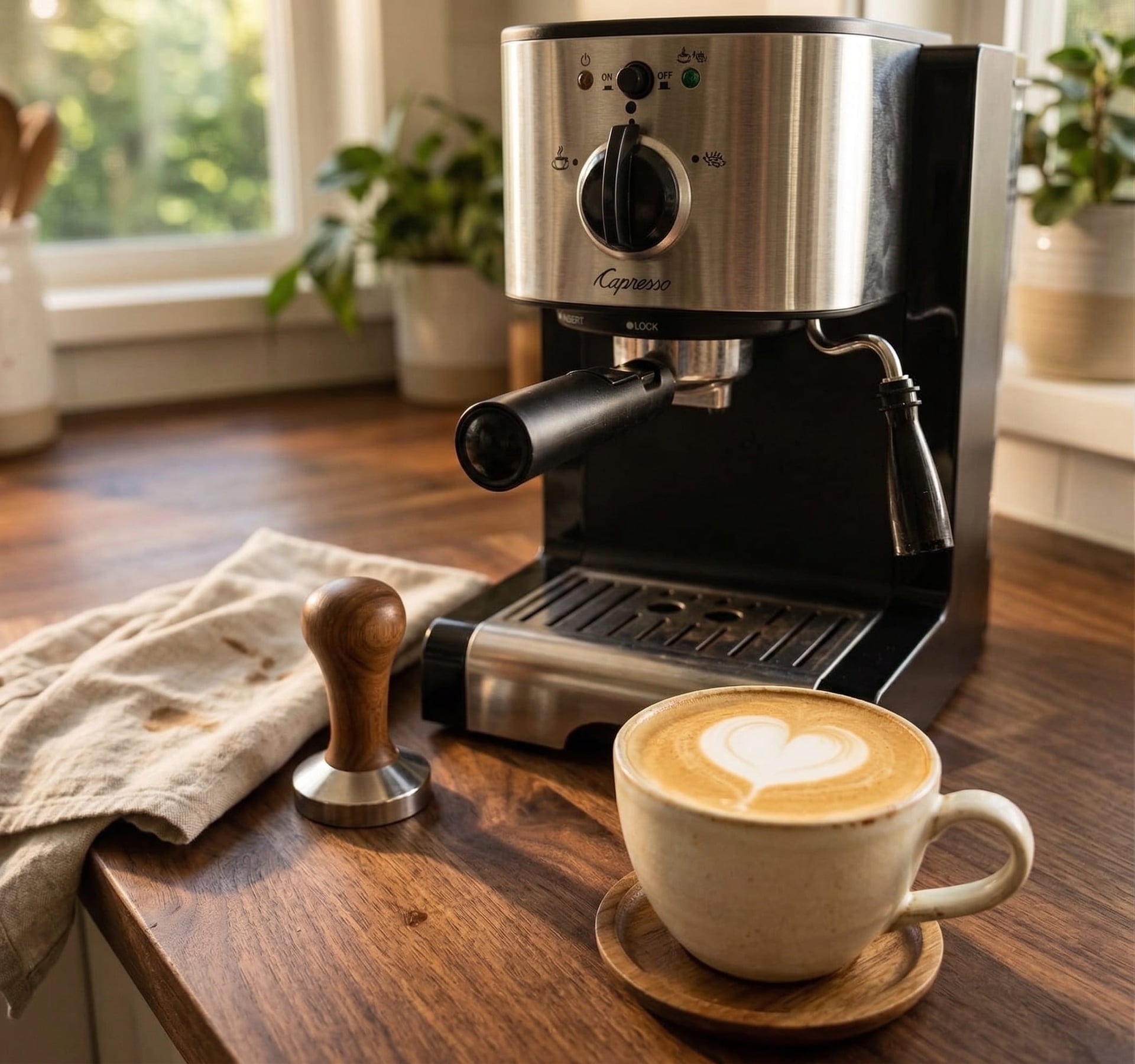
Picking up the EC100 the first time, the weight immediately tells you something: this is a 7.5-lb machine, noticeably lighter than the 10-lb Breville Cafe Roma or the 13-lb Gaggia Classic Pro. The chassis is primarily plastic with stainless steel accents on the front panel and portafilter housing. It doesn't pretend otherwise — Capresso hasn't tried to dress this up as a commercial machine. The stainless elements are decorative rather than structural, and the plastic housing, while smooth and well-finished, makes no claims about 20-year durability.
What the design does well: it's compact-ish for a machine with a 40 oz tank (roughly 8" wide, 10" deep, 11.5" tall), the dial controls are smooth and intuitive, and the front-access water tank is genuinely convenient. Front-access means you don't need to pull the machine away from the wall to refill — a practical detail that sounds minor until you're doing it before your first coffee of the morning.
The commercial-style portafilter handles with enough weight to feel substantial, even if the metal is thinner gauge than what you'd find on a Gaggia or Rancilio. It locks into the group head positively with a satisfying quarter-turn. The drip tray is medium-sized — adequate for normal use, needs emptying after 3–4 shots depending on pre-infusion drip.
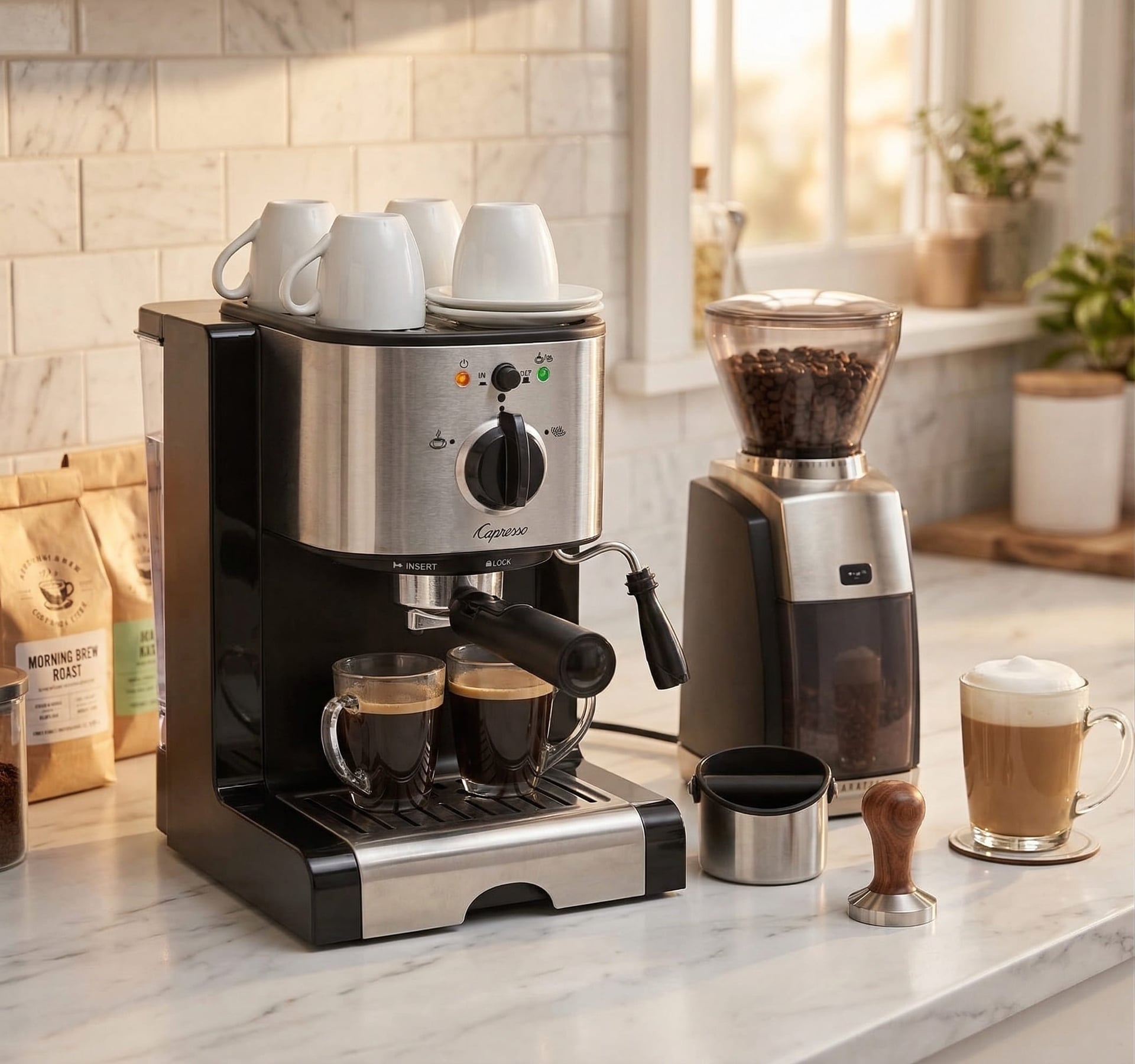
Passive cup warming tray on top measured between 95–105°F after 10 minutes of machine warm-up — adequate for keeping ceramic espresso cups from pulling heat out of your shot. Not as effective as the active warmers on premium machines, but functional.
One design frustration: the water level window is small and positioned awkwardly, making it slightly difficult to read from normal counter height. A clear marking system would help. This is a minor complaint, but worth noting because under-filling the tank enough to interrupt extraction mid-shot is a beginner pitfall.
Capresso EC100 Espresso Quality: Honest Performance With Clear Limits
Here's what 55 shots across four coffee origins told me: the EC100 is a capable everyday espresso machine for medium and dark roasts. It is not a specialty coffee machine, and it doesn't try to be.
With the included pressurized basket and a properly-dialled burr grinder:
- Colombian Supremo medium roast (best result): milk chocolate, caramel finish, medium body, no harsh aftertaste — genuinely enjoyable
- Brazilian Santos medium-dark: full body, dark chocolate, slight sweetness, highly consistent across repeated shots
- Lavazza dark blend: exactly what you'd expect — intense, bitter-sweet, full extraction, works well for milk-based drinks
- Ethiopian natural light-medium: muddy, indistinct, occasionally sour. The thermoblock's ~195–198°F ceiling doesn't extract delicate light roast profiles well
The pressurized basket is doing significant work here. By mechanically generating pressure via an OPV valve in the basket bottom, it produces crema and drinkable espresso from grounds that a non-pressurized basket would choke or channel on. That's the right call for this price point — it extends the margin of error and protects the machine's reputation with beginners.
Shot-to-shot consistency across the same bean/grind combination was good: I pulled seven consecutive shots of the Brazilian Santos on day 12 using the same 17g dose and Baratza setting, and five of seven were essentially identical. The two outliers were related to portafilter temperature drop after the first shot — pre-heating the portafilter under the group head for 20 seconds closed that gap.
Bottom line on espresso quality: if you drink medium or dark roast espresso and make cappuccinos and lattes, this machine delivers results you'll be genuinely happy with. If you're chasing single-origin pour-over-grade clarity in espresso form, this is not your machine.
The Twin Frother: Speed vs. Microfoam Quality
The twin frother is the EC100's headline differentiation versus its competitors. I want to be precise about what it does and doesn't do, because the marketing language around panarello wands tends toward vagueness.
What it does: auto-aerates milk by drawing in ambient air through a small tube alongside the steam path, producing foam without any technique requirement. You submerge it, open the steam valve, and it foams. Full stop. No positioning, no gradual lowering, no thermometer required for basic results (though I always recommend a thermometer regardless).
What it doesn't do: produce true microfoam — the fine, integrated, silky texture that allows latte art and creates the glossy, paint-like consistency you see in specialty coffee shops. The auto-aeration produces larger bubbles that sit on top of the drink rather than incorporating fully into the espresso. For a standard cappuccino — a shot with foam piled on top — this is perfectly functional. For a flat white or a textured latte requiring the milk to be woven into the shot, it falls short.
Milk type performance across 22 steamed drinks: Whole milk — best results, thick foam, naturally sweet at 150–155°F, good volume. 2% — lighter foam, less sweet, drinkable but underwhelming. Oat milk (Oatly Barista Edition) — required patience, 75–90 seconds, adequate foam but less integrated than dairy. I'd recommend Oatly Barista specifically for oat milk; standard oat milks don't behave well with this type of wand.
If you've never used a manual steam wand and the idea of learning that technique feels like too much, the EC100's twin frother removes that barrier. If you already know how to use a manual wand and value microfoam texture, this wand will feel like a step backward.
Capresso EC100 Daily Workflow: The Machine You'll Actually Use Every Morning
I timed my morning routine with this machine across 15 consecutive weekday mornings. Cold start to cappuccino in hand: 3.5 to 4 minutes consistently. That's faster than most machines in this class because the 45-second heat-up is genuinely quick for a thermoblock.
Morning workflow that became automatic by week two: Power on while grinding (45 seconds heat-up, typically 30 seconds grinding by hand with my Timemore C3). Dose and lock portafilter during final heat-up seconds. Extraction: 27 seconds average. Turn dial to steam, wait 40 seconds. Froth milk: 65 seconds. Wipe wand immediately. Pour and drink.
Total active time: under 3 minutes once warmed up. That's the right kind of machine for mornings — low cognitive load, predictable sequence, quick result.
For back-to-back drinks (two people, two cappuccinos), the single-boiler recovery adds 40–50 seconds between steam cycles. For a two-drink household, this is manageable. For three or more drinks in quick succession, you'll feel the wait.
The 40 oz tank genuinely earns its keep in multi-person households. At two drinks daily with flushing between shots, I refilled every 3–4 days. That's appreciably better than 34 oz competitors. It's the kind of detail that sounds minor in a spec sheet but accumulates positive points over months of use.
Where the Capresso EC100 Fits in the Entry-Level Pump Espresso Market
The entry-level pump espresso market is crowded, and the EC100 occupies a specific and understandable niche: it's the machine for people who want more than a pod machine but aren't ready — financially or in terms of commitment — for a $350+ machine with a learning curve.
The competition at this price ($175–$230) includes the De'Longhi Stilosa EC260 ($79–$149), which is cheaper but more plasticky; the Mr. Coffee Café Barista ($130–$180), which adds an automatic milk frother but feels less substantial; and the De'Longhi EC155 ($149–$199), which has a smaller tank and older design. The EC100's 40 oz tank and commercial-style portafilter give it a practical edge for multi-drink households.
One tier up, the Breville Bambino Plus ($399–$449) offers significantly better espresso quality, PID temperature control, and thermojet heating — but it's twice the price. If your budget stretches there, I'd tell you to stretch. If it doesn't, the EC100 is a reasonable choice in its tier.
For a broader view of what's available at every price point, see our espresso machine reviews hub. If your budget allows, our best espresso machines under $500 guide covers the next tier up in detail, and our complete espresso machine types guide explains the technical differences that affect everyday use.
Performance Benchmarks
Technical Specifications
General
Performance
Physical
Compare Similar Models
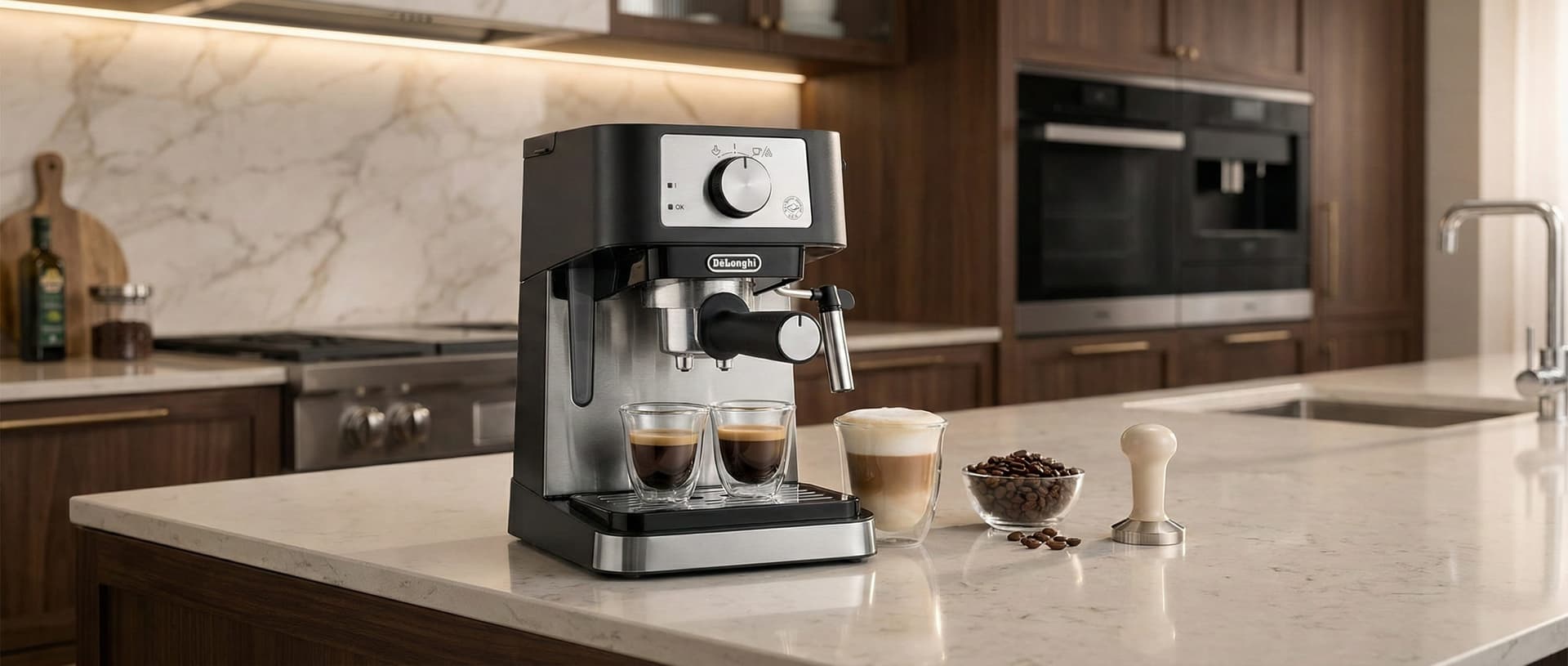
De'Longhi Stilosa EC260
True entry-level budget option with manual steam wand. Less tank capacity but lower price.
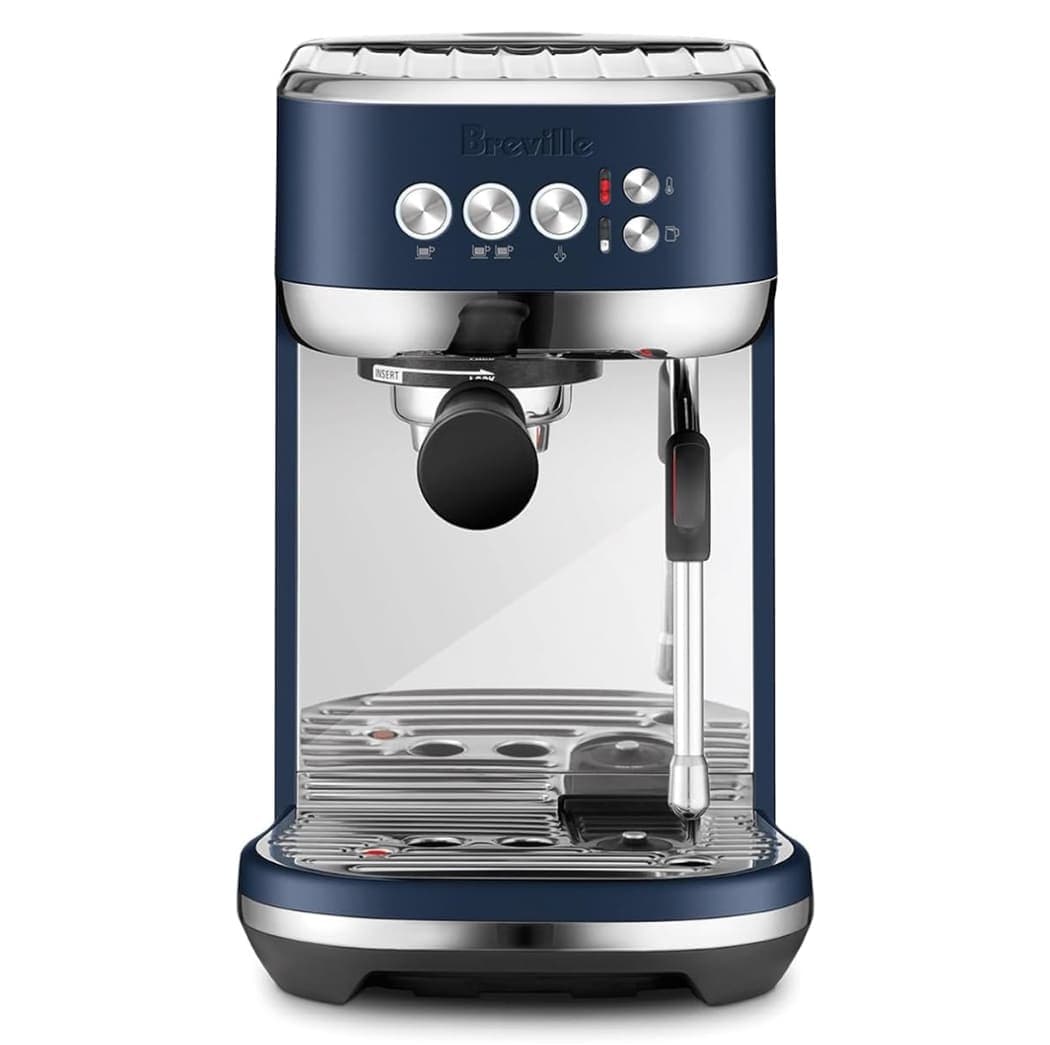
Breville Bambino Plus
PID temperature control, ThermoJet 3-second heat-up, automatic microfoam. The next tier up.
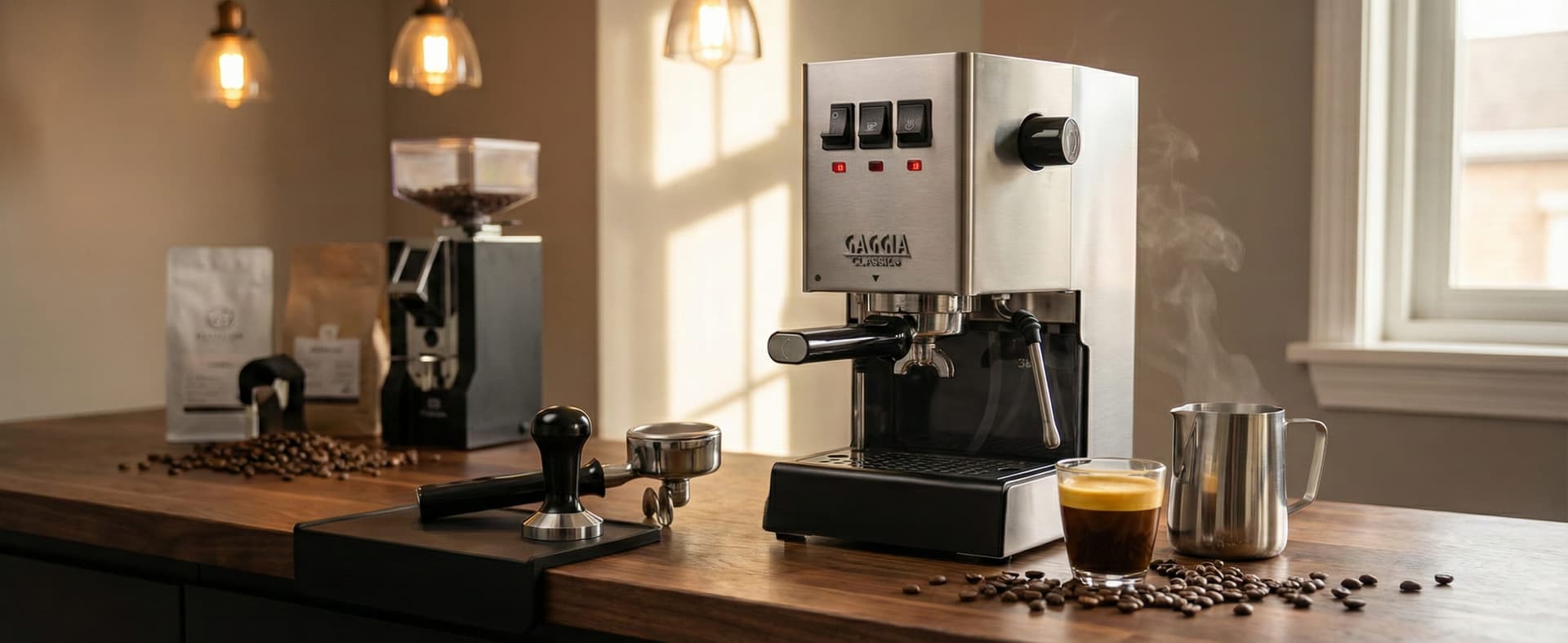
Gaggia Classic Pro
Commercial 58mm portafilter, brass boiler, legendary durability. The enthusiast choice.
Long-Term Ownership Considerations
Durability & Build Quality
Mixed-material construction — stainless steel accents over a plastic chassis. Thermoblock heating is standard for this price class and proven in long-term use. Expected lifespan: 4–6 years with proper maintenance and regular descaling. Components are consumer-grade; not designed for the 10-year durability of brass-boiler machines like the Gaggia Classic Pro.
Reliability & Common Issues
Common issues in this product class: thermoblock scale buildup (prevented with regular descaling every 2–3 months), steam wand blocked tip from dried milk (prevented by immediate post-use wiping), portafilter seal wear (gasket replacement every 12–18 months). Capresso customer service has generally good community reviews for responsiveness.
Parts Availability
Moderate — Capresso maintains parts for 3–5 years. Portafilter baskets, gaskets available through Capresso directly and major retailers. Third-party 53mm basket compatibility broadens options compared to fully proprietary designs.
Maintenance Cost
Annual: $20–$30 (descaling solution, occasional basket or gasket). 5-year total: $100–$150 with typical maintenance frequency.
Warranty Coverage
1-year limited warranty. Standard for this category. Register on Capresso's website to activate.
Resale Value
Low secondary market for Capresso EC100 — brand recognition is limited among espresso enthusiasts. Expect 25–35% of purchase price after 2 years ($50–$75 resale on a $199 machine).
This machine was purchased independently and was not provided by Capresso.
Final Verdict
After three weeks and 55 shots across four coffee origins with the Capresso EC100, my honest assessment is: this machine is competent at exactly what it's designed to do, and that's a narrower brief than its marketing suggests.
For someone stepping up from a pod machine who wants pump espresso without a steep learning curve, the EC100 delivers. The 45-second heat-up is fast, the 40 oz tank is practical for households making multiple drinks, the twin frother removes the steaming technique barrier, and medium-to-dark roast espresso is genuinely enjoyable — especially in milk-based drinks where any small flavour imperfections get smoothed over.
The machine's ceiling, though, is clear. The pressurized basket masks extraction feedback, slowing skill development. The twin frother can't produce real microfoam. The thermoblock's ±4–5°F variance limits single-origin specialty coffee work. These aren't flaws exactly — they're accurate design choices for the target user — but they mean this machine has a natural shelf life. Most espresso-curious people who buy it will outgrow it within 18–24 months and start looking at the Bambino Plus or Gaggia Classic Pro tier.
If you know you're buying a starter machine and are comfortable with that, the EC100 is a reasonable choice at its price. If you suspect you're going to get serious about espresso, spend the extra money now. The upgrade path is well-worn and you'll end up there anyway.
A capable starter pump espresso machine for medium-to-dark roast daily drinkers transitioning from pod systems. The 40 oz tank, fast heat-up, and beginner-proof twin frother are genuine practical advantages. The pressurized basket and auto-frother ceiling are real limitations for anyone wanting to develop serious espresso skills. Buy this if you want enjoyable espresso drinks now with minimal learning curve; plan to upgrade in 1–2 years if you catch the espresso bug.
Get Coffee Tips
Join our newsletter for expert reviews and brewing guides.
Affiliate Disclosure: We may earn a commission when you purchase through links on our site. This comes at no extra cost to you and helps us continue providing expert coffee guidance and comprehensive product reviews.