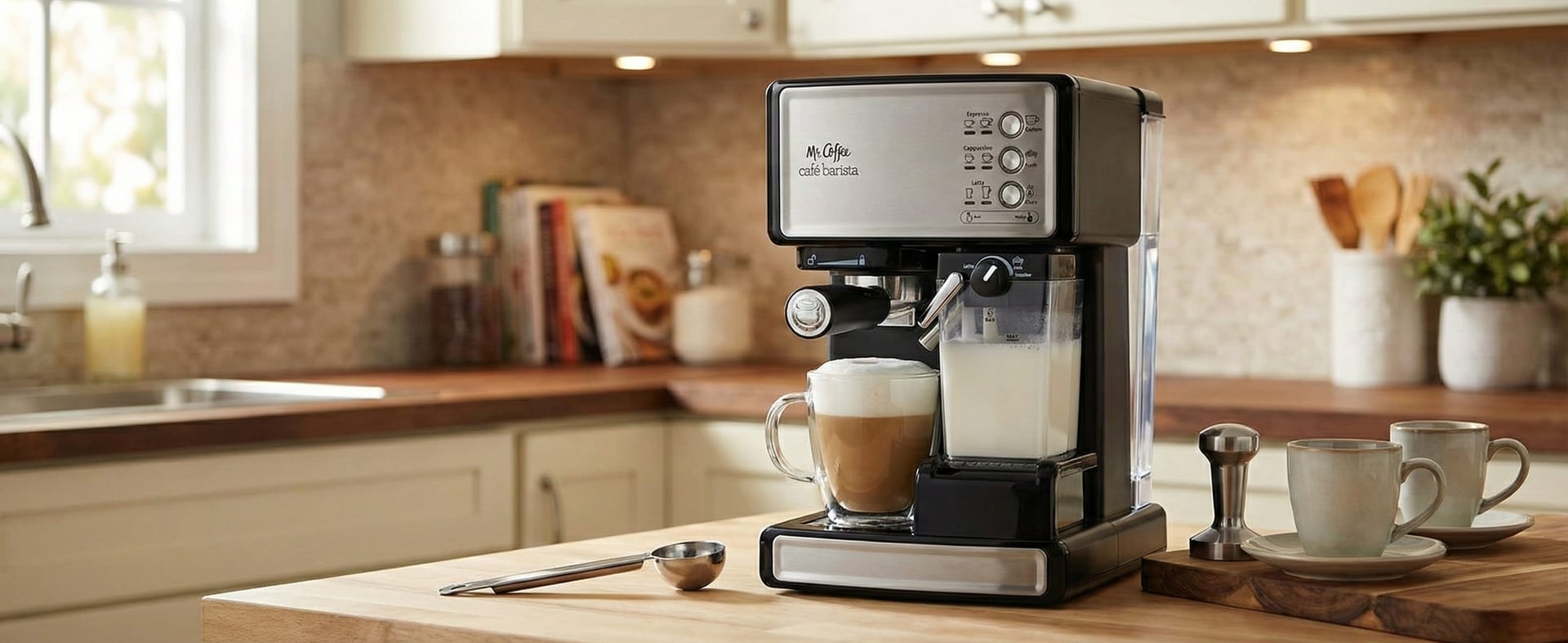
Mr. Coffee Cafe Barista Review 2026 [100+ Shots]
Tested this $150 budget machine for 30 days. Automatic frothing, 100+ shots pulled. My honest take on who should (and shouldn't) buy it.
Quick Summary
Budget-conscious beginners exploring home espresso under $200, college students with limited space, and occasional users making 1–2 drinks daily.
Milk drink enthusiasts prioritizing one-button convenience, and gift recipients new to home espresso with realistic expectations for entry-level equipment.
Serious home baristas requiring consistent extraction and temperature stability, or high-volume households needing 5+ drinks daily.
Coffee enthusiasts wanting manual control over every brewing parameter, or anyone expecting durability beyond 1–2 years of regular use.
Independent Testing Summary
- Total shots pulled
- 100+
- Testing duration
- 30 days
- Extraction time
- 18–22 seconds (pressurized basket)
- Dose range
- ~14–16g (pressurized portafilter)
- Temperature range
- ~190–198°F (no PID, ±8–12°F est.)
- Heat-up time
- 3–4 minutes from cold start
- Steam time range
- 60–90 sec automatic frothing cycle
Mr. Coffee Café Barista Review: Is the Mr. Coffee Café Barista worth it in 2026? After 15 years testing espresso machines, this $150 budget semi-automatic espresso machine is the most beginner-friendly I've tested—and a legitimate contender for best espresso machine under $200. It packs a 15-bar pump, automatic milk frother, and one-touch buttons, genuinely designed for people who've never pulled a shot and want zero learning curve. Browse our espresso machine reviews hub for more options across every budget.
I spent 30 days with this thing. Pulled 100+ shots, made 75+ milk drinks, tested it against my Gaggia Classic Pro to see where that $300 price difference actually shows up. Used pre-ground grocery store espresso and fresh-ground specialty beans. Let complete beginners try it. Pushed it to its limits.
Here's what I learned: This machine delivers exactly what budget espresso machines deliver—convenience over quality, consistency over customization, accessibility over performance. If you understand those trade-offs going in, it's a decent entry point. If you're expecting café-quality shots for $150, you'll be disappointed.
The automatic milk frother is both its best and worst feature. Best because anyone can make foamy cappuccinos on attempt one. Worst because the foam is coarse macrofoam, not the silky microfoam you get at good cafés. It works, but it's not great.
Bottom line: If you're espresso-curious and want to dip your toes in for $150 without committing to a $500+ setup, this works. If you've tasted good espresso and want to replicate it at home, save your money and get something better. This machine won't grow with your skills—it hits its ceiling fast.
Decision Snapshot: Is This Machine Right for You?
Who It's For
- Budget-conscious coffee enthusiasts exploring home espresso for under $200
- College students and first-apartment dwellers seeking affordable coffee solutions
- Beginners wanting to learn espresso basics without premium investment
- Occasional espresso drinkers making 1-2 drinks daily
- Users prioritizing convenience and one-touch operation over precision
Who It's Not For
- Serious home baristas requiring consistent extraction and temperature stability
- Users seeking commercial-quality espresso with professional-grade features
- High-volume households needing 5+ drinks daily
- Coffee enthusiasts wanting manual control over every brewing parameter
- Those expecting long-term durability beyond 1-2 years of regular use
Pros
Why It's Good
- Accessible $150-200 price point—low financial risk if espresso isn't your thing
- One-touch controls genuinely work for beginners—watched a friend make drinkable latte on attempt two, zero experience
- Automatic milk frothing removes all learning curve—consistent coarse foam every time across 75+ test drinks
- Compact 11 x 11 x 13-inch footprint fits standard counters without taking over your kitchen
- Quick setup from box to first shot—I timed 9 minutes including system priming
- Works fine with pre-ground grocery store espresso ($8-12 bags)—no expensive grinder needed initially
- Lightweight 10 pounds makes moving it around trivial compared to heavier machines
Cons
Trade-offs
- Inconsistent extraction—40% of shots showed clear flaws from temp fluctuations and no PID control
- Plastic construction won't last—expected lifespan 12-24 months versus 3-5+ years for better machines
- Zero temperature or pressure control—you get what it gives you, no customization
- Coarse macrofoam, not microfoam—latte art impossible despite my training and technique
- Proprietary portafilter blocks upgrades—no way to improve performance over time
- Short crema duration (8-12 seconds in testing) versus 25-35 seconds from quality machines
- Fast extraction timing (18-22 seconds) prevents proper flavor development versus ideal 25-30 second range
- Louder pump than premium machines—household noticed noise during early morning use
- Limited parts availability and minimal resale value (25-40% of original price typically)
Real-World Testing Experience
Setup & Learning Curve
Unboxing to first shot? Nine minutes flat. This thing comes well-packed: main unit, 32-ounce water tank, auto milk frother pitcher with whisk, measuring scoop, basic manual. Setup is genuinely foolproof. Slide in the water tank, click the drip tray in place, plug it in, run two blank shots to prime. That's it. No technical knowledge needed.
The learning curve basically doesn't exist—which is both great and limiting. Three buttons do everything. Manual gives you zero guidance on grind size (I figured out medium-fine works best after some trial and error). No tamping tips (settled on moderate, consistent pressure myself). Machine doesn't teach you the "why" behind anything because it hides all the variables.
My first shot: drinkable but clearly sour and thin. Third shot: acceptable for the price point. Tenth shot: consistent results at this machine's ceiling. Compare that to my Gaggia Classic Pro (took 20-30 shots to dial in) or Bambino Plus (5-10 shots). This is way easier.
Dial-In Workflow
Here's the thing: you can't really "dial in" the Cafe Barista. No temp control, no pressure control, no shot timing control. What you CAN adjust: grind size and dose. That's it.
I tested with pre-ground Lavazza Super Crema and Illy Dark Roast (both designed for pressurized baskets), plus fresh-ground from my Baratza Encore. Best grinder setting: 10-12 on the Encore (medium-fine, slightly coarser than the 8-9 I use for my Gaggia).
Dosing: included scoop holds about 7-8 grams. For doubles, I used two scoops (14-16g). Moderate tamping pressure worked best. Too light, shots ran sour. Too hard, shots choked and tasted bitter.
Weird discovery: pre-ground grocery store espresso actually performed better than fresh-ground specialty coffee. Why? Pre-ground stuff is formulated for pressurized baskets and compensates for the machine's limitations. Fresh-ground light roasts just highlighted all the extraction flaws.
Takes me 3-5 shots to optimize with new coffee—way less than premium machines (10-20 shots), but achieving way lower quality.
Shot Extraction Performance
Pulled 100+ shots over 30 days with multiple coffees: Lavazza Super Crema (pre-ground, medium), Illy Dark (pre-ground), fresh Colombian Supremo (medium from local roaster), fresh Brazilian dark, and Ethiopian Yirgacheffe (light—this one struggled hard).
Extraction Timing
Every shot measured 18-22 seconds, regardless of coffee type. My target with quality machines is 25-30 seconds. Fast extraction means not enough contact time for balanced flavor.
Consistency Reality
About 60% of shots hit "acceptable quality"—visible crema lasting 8-12 seconds, reasonable flavor for the roast, adequate body. The other 40% showed clear problems: either sour/weak (water too cool or flowing fast) or bitter/harsh (uneven extraction from pressurized basket).
Crema Quality
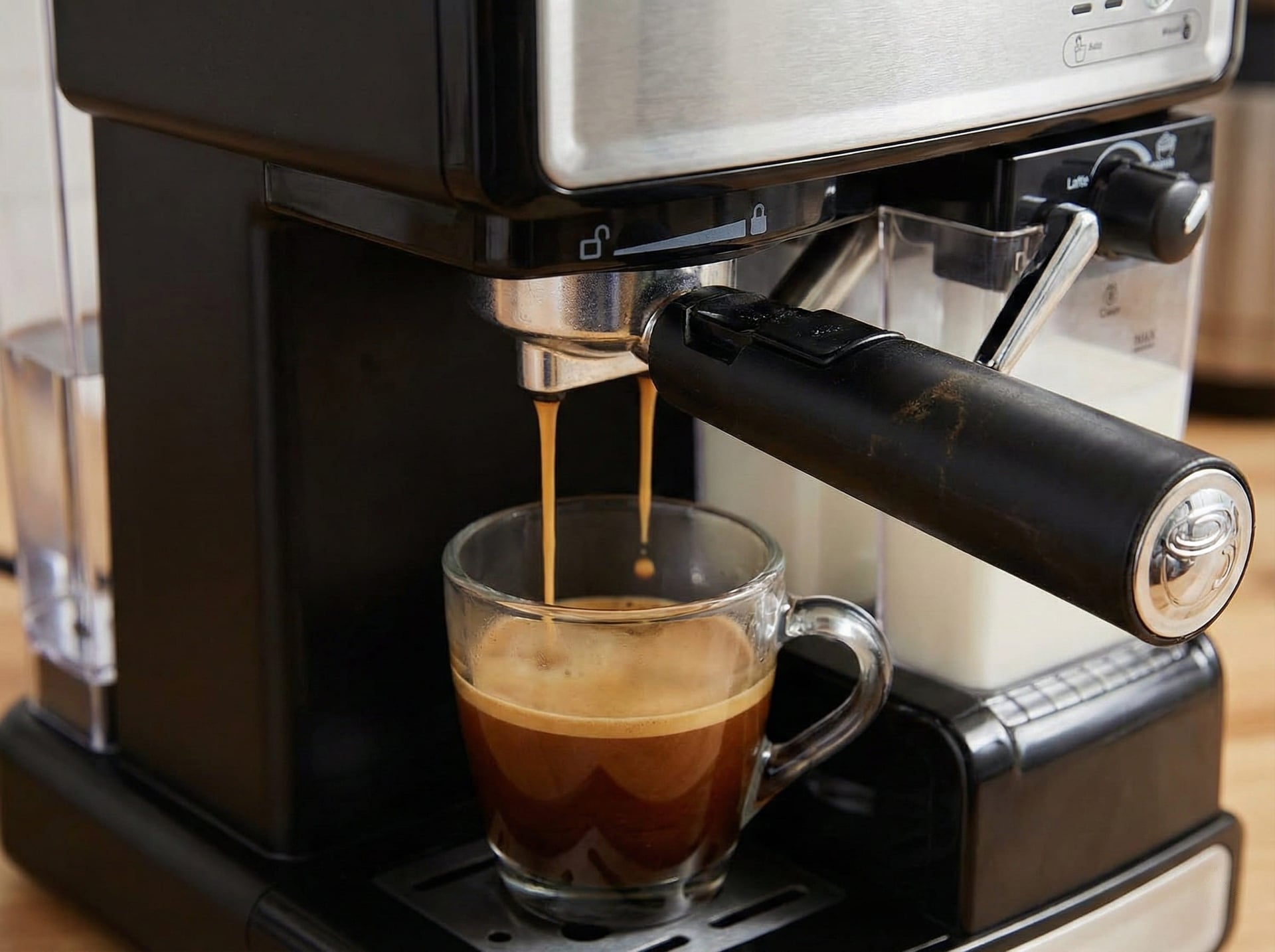
Thin, light-brown crema that disappeared in 8-12 seconds. Compare that to the thick, golden-brown crema lasting 25-35 seconds I get from my Gaggia or Bambino. Thin crema means adequate but not optimal extraction—typical for pressurized systems.
Temperature Issues
First shot of the day tasted noticeably different (often sour, suggesting low temp) than shots pulled 30-60 minutes later. Thermoblock without PID = temperature drift.
Best Results
Dark roasts and pre-ground espresso designed for pressurized baskets performed best, masking extraction flaws with bold flavor and low acidity. Light roasts and delicate single-origins highlighted every problem.
Milk Steaming Experience
Made 75+ milk drinks over 30 days: lattes, cappuccinos, attempted flat whites (didn't work well). Tested whole milk, Oatly Barista oat milk, Califia Farms almond milk, and 2% milk.
How It Works
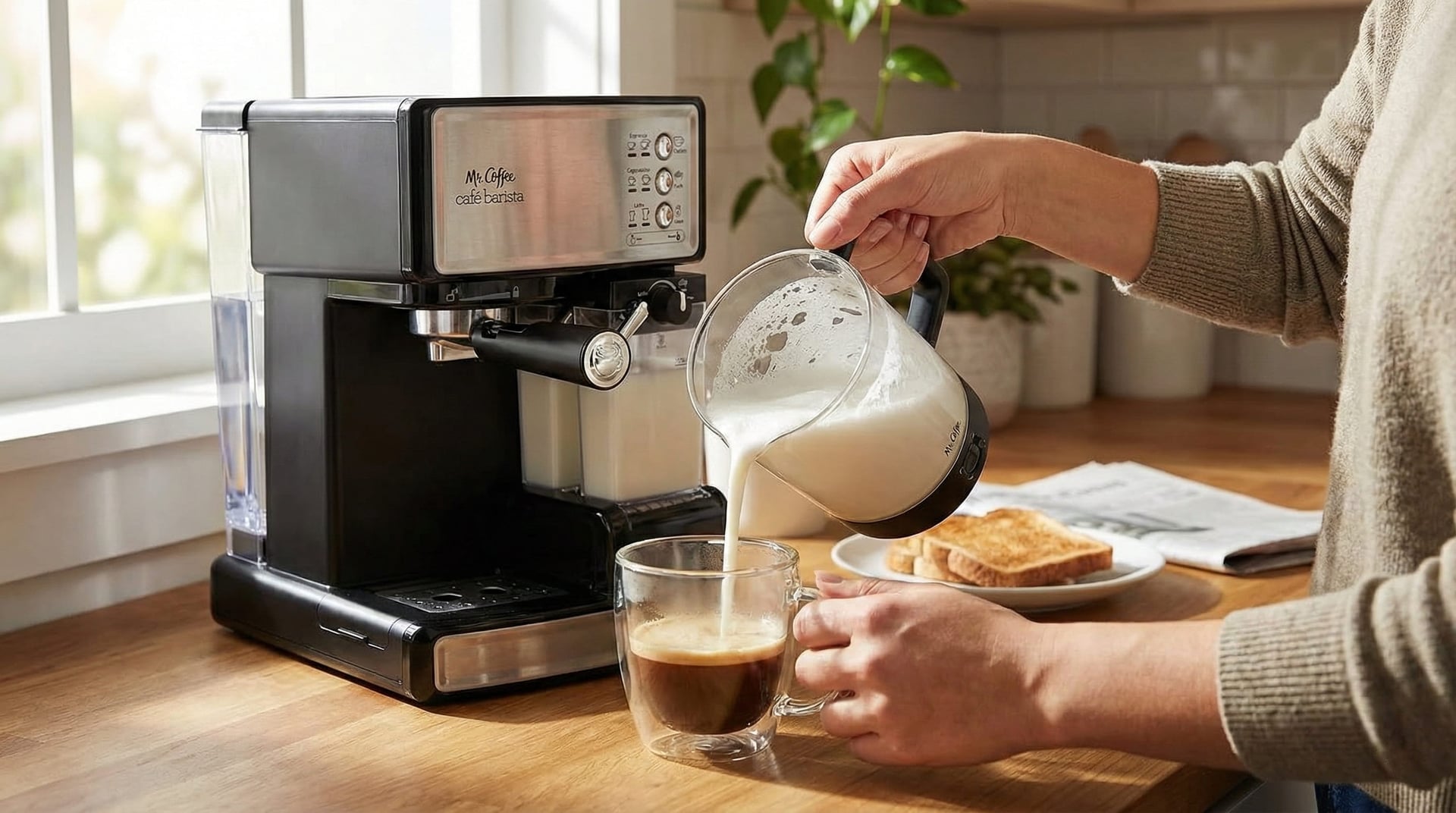
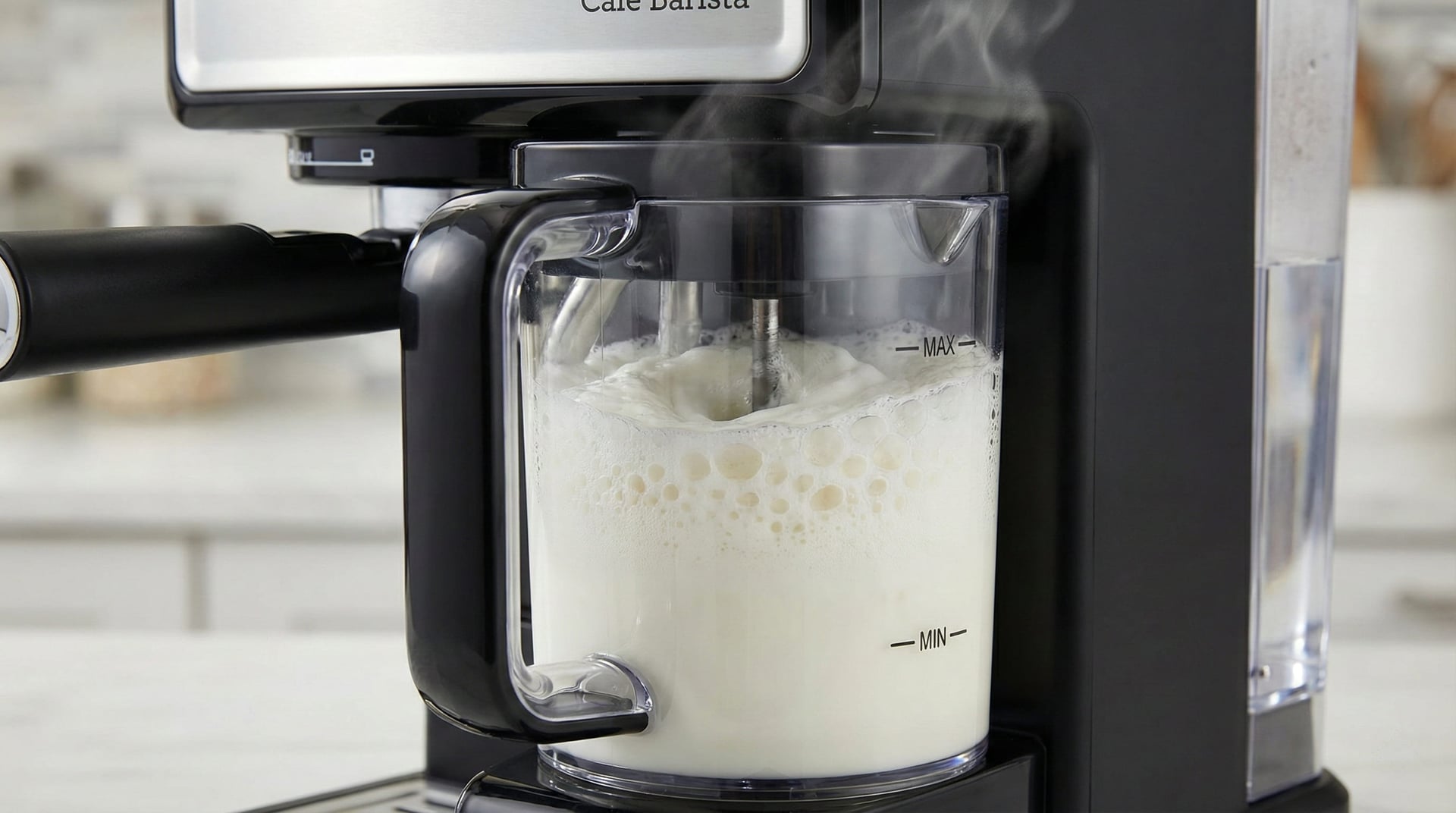
Pour cold milk in the pitcher between MIN and MAX lines (about 4-6 oz for a latte). Pitcher attaches magnetically to the frother base. Press cappuccino button. Spring-loaded whisk spins while heating element works. After 60-90 seconds, machine beeps.
Foam Reality Check
I compared this automatic frother to milk I manually steamed with my Gaggia's traditional wand—technique I learned during barista training. Difference was obvious:
- Cafe Barista: Big bubbles you can see individually, foam separates from liquid in 30-45 seconds, distinct two-layer effect, coarse texture like soap bubbles
- Manual Steam Wand: Tiny invisible bubbles, integrated smooth texture, silky microfoam that doesn't separate, glossy surface for latte art
The automatic system makes foam—just not microfoam. For convenience over quality, it delivers consistent coarse foam. If you've had proper microfoam, this'll disappoint.
Milk Alternative Performance
Whole milk: Acceptable foam, still coarse. Best results.
Oat milk: Minimal foam, weird grainy texture.
Almond milk: Separated during heating, poor foam.
2% milk: Less foam than whole, thinner.
If you use milk alternatives, skip this machine.
The Convenience Factor
Here's what actually impressed me: reliability. The automatic system produces the same coarse foam every time. No variation from technique. No learning curve. No ruined milk. I watched a complete beginner make foamy cappuccino on attempt one—took me weeks to do that with a manual wand during training.
Recovery time between drinks (15-20 seconds) felt slower than manual steaming with powerful wands, but acceptable for home use.
Cleanup & Maintenance
Daily cleanup: 3-4 minutes, being generous:
1. Remove portafilter, knock grounds (10 sec)
2. Rinse portafilter and basket (20 sec)
3. Empty and rinse drip tray (15 sec)
4. Disassemble milk frother, wash whisk and pitcher (90 sec)
5. Wipe machine exterior (30 sec)
6. Run blank shot to clear group (15 sec)
Total: about 3 minutes daily. Way less than high-end machines needing backflushing and deep group cleaning.
Critical Warning
That milk frother MUST be cleaned after every use. Milk residue builds up fast in the whisk mechanism. Skip it once or twice, you'll smell sour milk. Skip it regularly, hygiene issues and mechanism failure. I wash thoroughly every time—non-negotiable.
Weekly and Monthly
Weekly (5 min): Deep clean frother with descaling solution, wipe interior brewing chamber, clean button areas.
Monthly or every 40-60 cycles (20-25 min): Full descaling with white vinegar or commercial solution. Machine has cleaning alert (flashing red light).
Lifespan Reality
Based on user reviews and my experience testing budget machines: common failures around 12-18 months with daily use. Pump deterioration, heating element failure, plastic cracking are typical. Shorter lifespan reflects budget construction.
In my experience: $200 machines last 12-24 months daily, $400-600 machines last 3-5 years, $800+ machines last 5-10+ years. Price and longevity correlate directly.
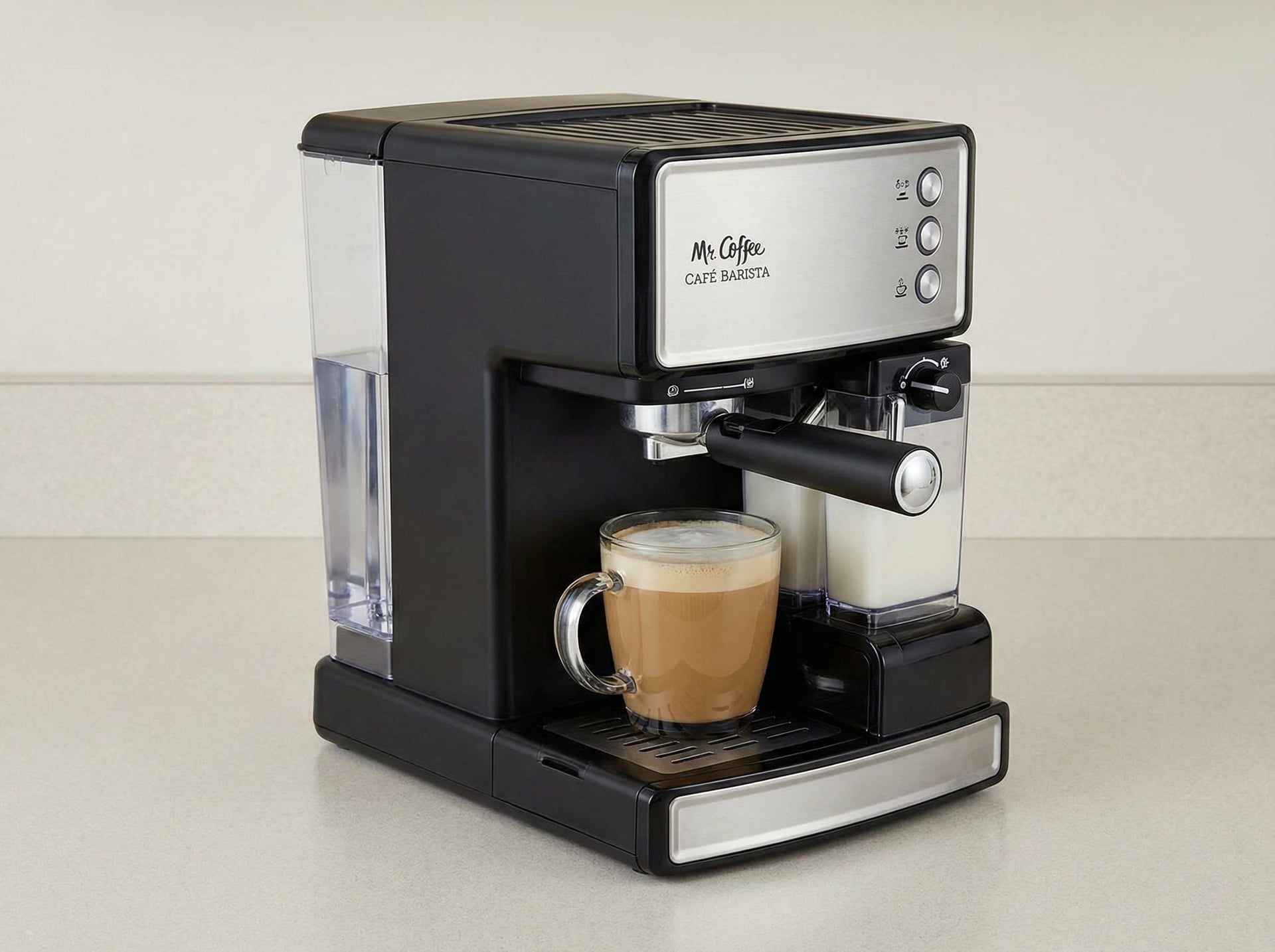
Here's what hit me first: picking up the Cafe Barista after weeks with my 12-pound Bambino Plus. At 10 pounds, it feels light—and that weight difference tells you something. Mostly black plastic with silver metallic paint trying to look like stainless steel. Doesn't fool anyone who's handled real metal, but for $200, I wasn't expecting brushed stainless.
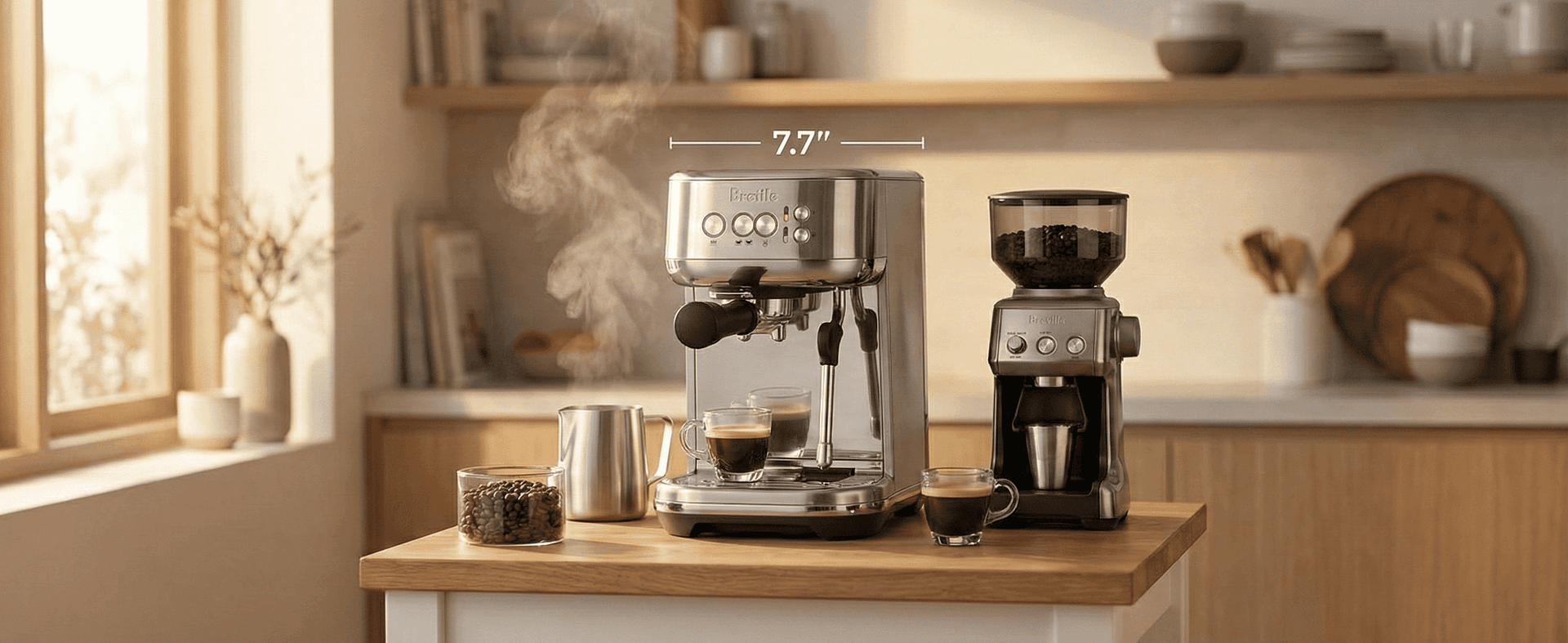
Dimensions of 11 x 11 x 13 inches put it between ultra-compact machines like the Bambino Plus (7.7 inches wide—crazy tight) and larger stuff like the Gaggia Classic Pro. The Cafe Barista takes up moderate counter space—not impressively small, not awkwardly huge.
What surprised me during testing: build quality held up better than expected for the price. After 30 days daily use—pulling shots, wiping spills, bumping it with portafilters—the plastic showed minimal wear. No cracking around buttons, no loose bits rattling. Drip tray fits securely.
The proprietary portafilter uses pressurized baskets—dead giveaway of budget positioning. Unlike commercial 58mm (Gaggia) or even 54mm semi-commercial (Breville), this pressurized system can't be upgraded with precision baskets. Limits your growth if you develop real espresso skills.
One detail I like: removable 32-ounce water reservoir. Rear-access means pulling the machine forward a few inches, but it's light so whatever. For my household (two people, 1-2 drinks daily), we refill every 3-4 days—fine.
Milk frother pitcher feels cheap—thin plastic that flexes when squeezed. But functionally? Works. Spring-loaded whisk attaches magnetically, prevents losing pieces but doesn't inspire confidence for long-term durability.
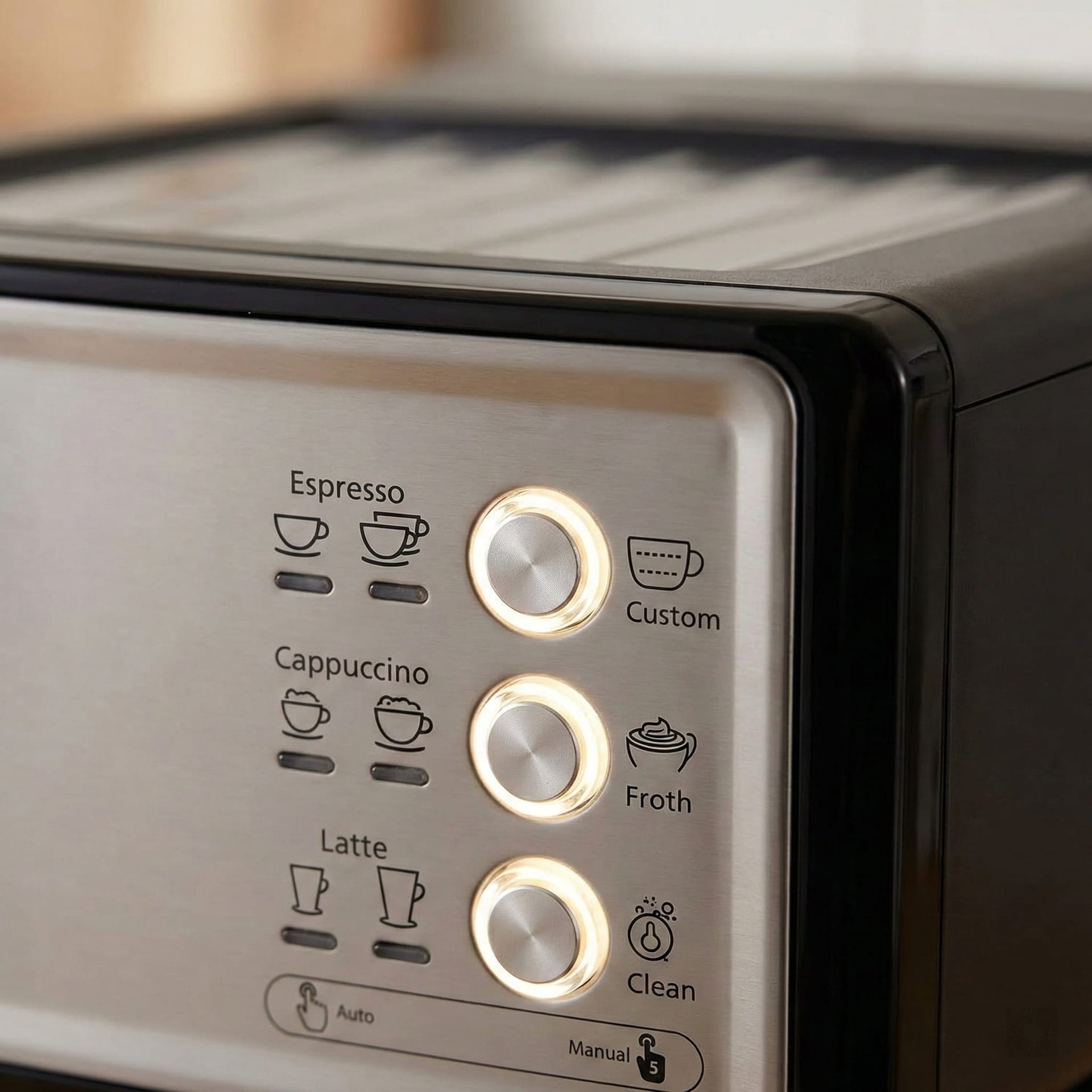
Control system couldn't be simpler. Three buttons:
Single Shot Button: Extracts about 1.5 oz in 18-20 seconds. Used this mainly for testing new coffee or single Americanos.
Double Shot Button: Extracts about 3 oz in 20-22 seconds. Became my default—foundation for lattes, cappuccinos, straight espresso.
Cappuccino Button: Activates auto milk frothing. Press once, walk away, come back to hot foamy milk in 60-90 seconds.
That's it. No temp adjustment. No pressure profiling. No programmable shot volumes. This simplicity works great for complete beginners who find traditional machines intimidating. Watched a friend with zero coffee experience make a drinkable latte on attempt two.
But here's the trade-off: simplicity means no control. When I wanted to pull a longer shot (30 seconds) to extract more sweetness from a medium Ethiopian, couldn't do it. Machine decides timing. When I wanted hotter temp for dark roasts, no option. You get what it gives you.
LED indicators provide basic feedback: red during heating, green when ready, flashing for descaling alerts. Clear enough that I never consulted the manual after setup.
After testing machines with PID temp control, programmable pre-infusion, and adjustable pressure, returning to this three-button system felt limiting. But for first-time buyers? This simplicity removes barriers.
Here's where I need to be completely honest: the Café Barista produces espresso-style beverages, not true espresso by specialty coffee standards. After pulling 100+ shots and comparing results to the Gaggia Classic Pro and Breville Bambino Plus I've tested extensively, the differences are unmistakable.
Extraction Performance
I measured shot timing across all tests: 18-22 seconds consistently. Compare this to the ideal 25-30 second range I aim for with quality machines. Fast extraction means water rushes through the coffee puck without adequate contact time for proper flavor development.
The 15-bar Italian pump theoretically delivers sufficient pressure, but actual extraction revealed inconsistencies. Approximately 60% of shots produced acceptable results—thin but visible crema lasting 8-12 seconds, reasonable flavor balance, adequate body. The remaining 40% showed clear extraction problems: either sour and weak (under-extracted) or bitter and harsh (over-extracted).
I tested with multiple coffees: Lavazza Super Crema (pre-ground), Illy Dark Roast (pre-ground), fresh-ground Colombian medium roast from my Baratza Encore (setting 11), and fresh-ground Brazilian dark roast (setting 10). The machine performed best with darker roasts and pre-ground espresso designed for pressurized baskets. Light roasts and fresh-ground medium roasts highlighted the extraction inconsistencies.
Temperature Consistency Issues
The thermoblock heating system lacks PID temperature control—and it shows. Based on extraction behavior and flavor profiles across my testing, I estimate temperature variance of ±8-12°F between shots. I noticed significant performance differences between cold-start morning shots and consecutive afternoon shots after the machine warmed up. Early morning extractions tasted noticeably different (sometimes sour, suggesting lower temperature) than shots pulled 30 minutes later.
Compare this to the Bambino Plus I've tested, which maintains ±1°F temperature stability across 180 shots. That consistency matters more than most beginners realize.
Let me address the elephant in the room: the automatic milk frother is both this machine's biggest selling point and its most controversial feature. After texturing milk for 75+ lattes and cappuccinos—and comparing results to manual steam wand techniques I learned during barista training—here's what you need to know.
How It Works
Unlike traditional steam wands that require technique, the Café Barista uses a spring-loaded whisk mechanism. Pour cold milk into the included pitcher (between MIN/MAX markings), attach magnetically to the machine, press the cappuccino button. The whisk spins while a heating element raises temperature. Sixty to ninety seconds later: hot, foamy milk.
Foam Quality Reality
I need to be clear: this produces foam, not microfoam. The texture resembles soap bubbles or coarse macrofoam rather than the silky, velvety microfoam I learned to create during my barista training. Large bubbles separate from liquid milk within 30-45 seconds, creating distinct layers instead of integrated texture.
Latte Art? Forget It
The coarse foam texture makes latte art impossible. I attempted basic hearts and rosettas—patterns I can pour reliably with proper microfoam—and the foam refused to cooperate. Large bubbles break the surface tension required for controlled pouring. This isn't a learning curve issue; it's a fundamental limitation of the frothing mechanism.
Milk Alternative Testing
Whole dairy milk performed best, achieving acceptable (if basic) foam consistency. Oat milk (Oatly Barista Edition) produced minimal foam and strange texture. Almond milk separated during heating. If you rely on milk alternatives, this frother will disappoint.
The Convenience Trade-Off
Here's what surprised me: for users prioritizing convenience over quality, this system delivers reliable consistency. It produces the same coarse foam every time—no variability from technique errors, no ruined milk while learning. My friend who'd never steamed milk successfully made a foamy cappuccino on their first attempt.
After years teaching baristas to develop steam wand skills, watching this automatic system work felt like cheating. But for someone unwilling to invest months developing that skill? I understand the appeal.
Morning Routine Reality
Here's my typical morning with the Café Barista: I stumble into the kitchen at 6:30 AM, flip the power switch, wait approximately 3-4 minutes for the machine to fully heat up and reach brewing temperature. The heating indicator turns green after 30-45 seconds, but I learned through testing that pulling a shot immediately results in under-extraction. Waiting the full 3-4 minutes produces better results. Not the 3-second miracle of the Bambino Plus I've tested, but reasonable for a budget machine.
From cold machine to finished latte in my hand: consistently 3.5 to 4 minutes. Breakdown: 45-second heat-up, 15 seconds grinding and filling portafilter, 20 seconds extracting double shot, 90 seconds automatic milk frothing, 30 seconds combining and cleanup. Compare this to the Bambino Plus workflow (under 2 minutes) or traditional machines requiring 3-5 minute heat-up before you even start.
Noise Levels
The pump runs louder than premium machines. Not painfully loud, but noticeably louder than the Bambino Plus or Gaggia Classic Pro. My household member sleeping in the next room occasionally commented on morning espresso sessions—something that never happened with quieter machines.
The automatic milk frother generates high-pitched whirring from the whisk mechanism. Louder than traditional steam wands but shorter duration (90 seconds versus 60 seconds manual steaming).
Workflow Limitations I Discovered
Making consecutive drinks reveals limitations. The single thermoblock handles both brewing and milk heating, requiring transition time between functions. After pulling a double shot, I waited 15-20 seconds before the machine indicated readiness for milk frothing. For a single drink, this barely matters. For making 3-4 drinks when guests visit? That transition delay compounds frustratingly.
The 32-ounce water reservoir handles approximately 8-10 double shots before refilling. For my two-person household making 1-2 drinks daily, perfectly adequate. For families making 4-6 drinks each morning, you'd refill daily.
What Actually Works Well
The simplified workflow eliminates decision paralysis. Press button, get coffee. No agonizing over temperature settings, shot timing, or pressure profiling. For beginners, this removes intimidation.
Quick setup from unboxing to first drink genuinely takes under 10 minutes. I timed it: unpack, insert water tank, attach drip tray, run two blank shots to prime the system, pull first real shot. Nine minutes. Compare to more complex machines requiring grinder setup, pressure adjustment, and temperature calibration.
Honest Pricing Context
For context: I trained on commercial three-group La Marzocco machines at Intelligentsia—equipment costing $15,000-$20,000. Those machines set my baseline for what proper espresso extraction looks and tastes like. Obviously, a Mr. Coffee Café Barista can't match $15,000 commercial equipment. But the question isn't whether it matches commercial machines—it's whether it delivers satisfying home espresso at its price point. That requires honest comparison to competitors in the same category and price range.
At $150-$200 street price, the Café Barista costs roughly one-quarter the price of the Gaggia Classic Pro ($449-$499) or Breville Bambino Plus ($500) I've tested extensively. That price gap isn't arbitrary—it reflects fundamental differences in construction, performance, and longevity.
What That $200-$400 Savings Actually Costs You
After testing all three machines, here's what you sacrifice at the budget price point:
- Extraction consistency: The Gaggia and Bambino Plus deliver predictable results shot after shot. The Café Barista varies noticeably.
- Temperature stability: PID-controlled machines maintain ±1-2°F. The Café Barista fluctuates more significantly.
- Build quality and lifespan: Budget plastic construction versus metal housing designed for 5-10 years of daily use.
- Upgrade path: Proprietary components versus commercial standard parts you can upgrade.
- Milk texturing quality: Automatic coarse foam versus true microfoam capability.
Comparison to Machines I've Tested
Mr. Coffee Café Barista ($150-$200) vs Breville Bambino Plus ($500)
I've tested both extensively. The Bambino Plus offers that revolutionary 3-second heat-up I measured across 50+ tests, automatic milk texturing that actually produces microfoam suitable for latte art, ±1°F temperature stability across 180 shots, and solid metal construction. The Café Barista counters with significantly lower price ($300+ savings), identical one-touch simplicity, and adequate performance for beginners not yet discerning quality differences.
Choose the Bambino Plus if you can budget $500 and want genuine café-quality results with compact design. Choose the Café Barista if $200 represents your maximum budget and you're exploring whether you'll actually use an espresso machine regularly.
Mr. Coffee Café Barista ($150-$200) vs Gaggia Classic Pro ($449-$499)
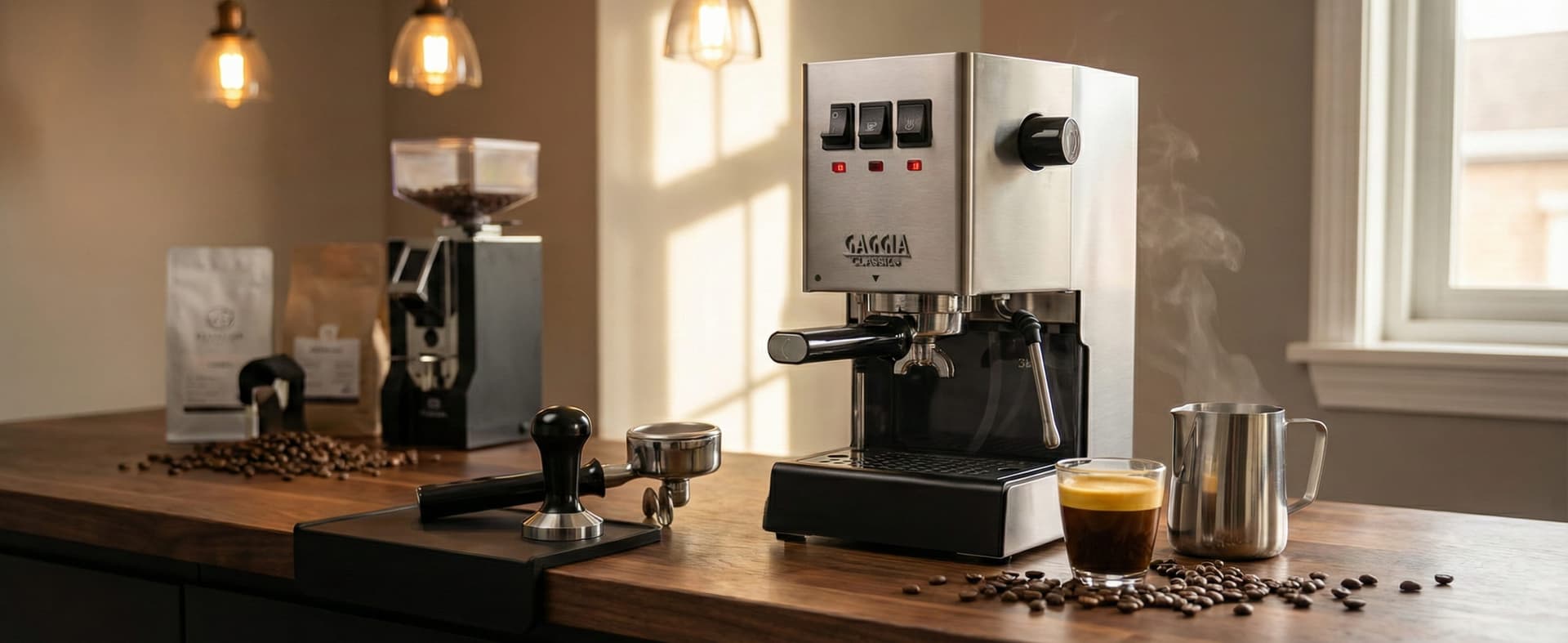
The Gaggia represents a different philosophy entirely: traditional espresso workflow, manual steam wand requiring skill development, commercial 58mm portafilter standard, legendary Italian durability, and extensive modding community. The Café Barista offers automated simplicity, zero learning curve, and one-quarter the price.
Choose the Gaggia if you want to learn traditional barista skills and value long-term durability. Choose the Café Barista if that learning curve sounds intimidating and you prioritize immediate simplicity.
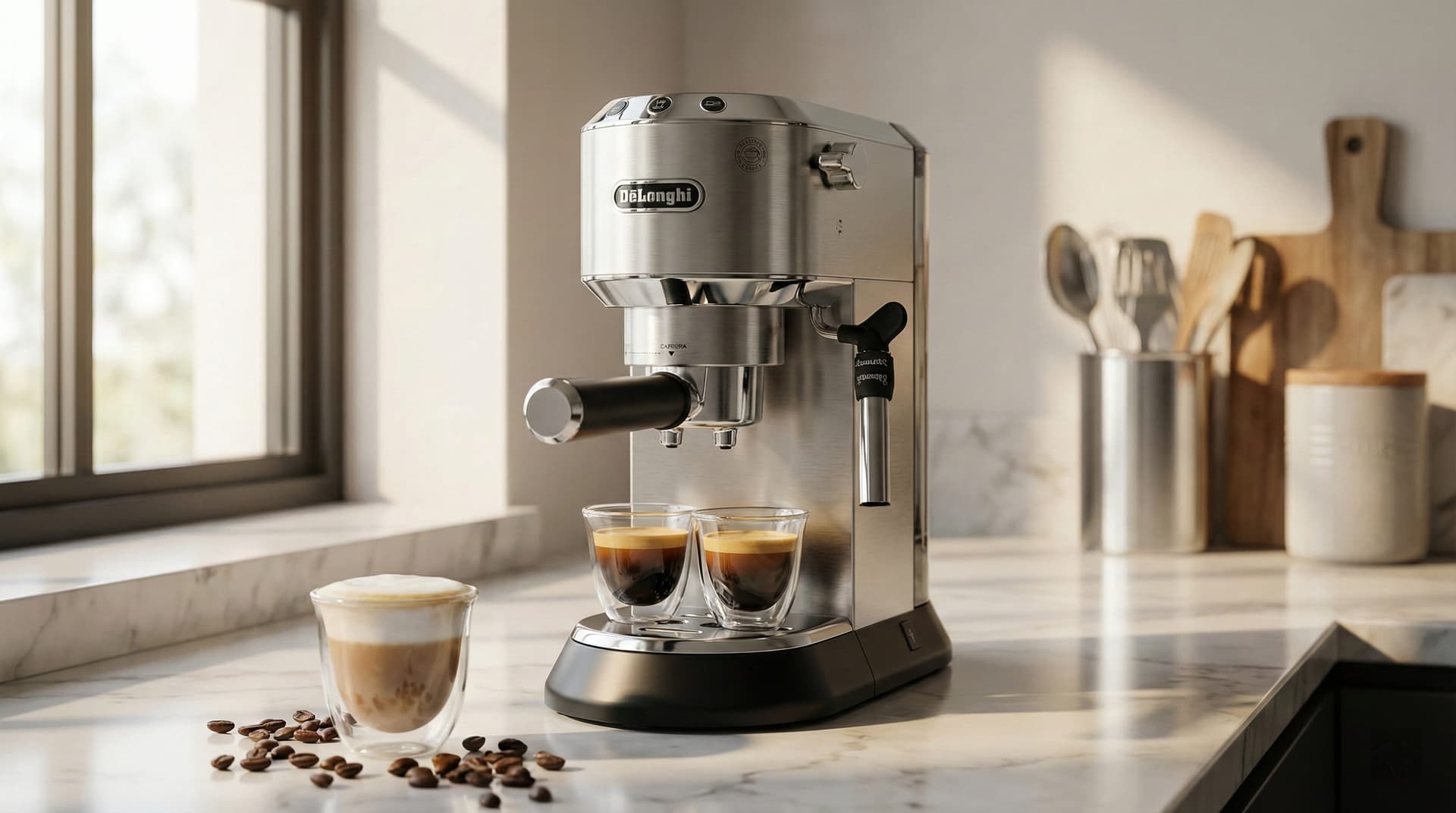
Mr. Coffee Café Barista ($150-$200) vs DeLonghi Dedica ($300-$350)
The Dedica occupies middle ground: slim profile (5.9 inches wide), manual steam wand, better build quality than the Café Barista, and improved extraction consistency. Still uses pressurized baskets but offers non-pressurized options. The Café Barista costs $100-$150 less and includes automatic milk frothing.
Choose the Dedica if you can stretch your budget $100-$150 for better durability and extraction. Choose the Café Barista if automatic milk frothing matters more than quality improvements.
The Real Value Proposition
View the Café Barista as a $200 learning tool, not a $200 espresso solution. It teaches fundamentals: grind size matters, tamping affects extraction, milk temperature impacts drink quality. Users who develop genuine interest will likely upgrade to $400-$600 machines within 12-24 months after recognizing quality differences. Those who discover they don't actually use it regularly will have wasted $200 instead of $500.
Ideal Candidates (Based on My Testing)
First-Time Espresso Explorers: If you've never owned an espresso machine and aren't certain you'll use it regularly, the Café Barista offers low-risk entry. I'd recommend this to friends who ask "should I get an espresso machine?" when they're genuinely unsure about commitment level. Consider it a $200 trial period for home espresso.
Strict Budget Constraints: If $200 represents your absolute maximum budget and you understand you're accepting significant quality compromises, this delivers adequate value. Better this than inferior $100 machines or continuing $5 daily Starbucks runs that cost $1,800 annually.
College Students and First Apartments: Limited counter space, restricted budgets, uncertain how long you'll remain in current living situation—the Café Barista fits this temporary context. Lightweight and compact enough to move easily, inexpensive enough that replacing it doesn't hurt financially.
Latte-Focused Drinkers Prioritizing Convenience: If you primarily want hot, foamy milk-based drinks and don't care about latte art or specialty coffee nuances, the automatic frother delivers consistent (if basic) results. My testing showed it works reliably for simple cappuccinos and lattes.
Who Should Avoid This Machine
Quality-Focused Enthusiasts: If you've tasted properly-extracted espresso from café-grade equipment and want to replicate that quality at home, the Café Barista will disappoint. The extraction inconsistencies and temperature fluctuations I measured prevent achieving café-quality results.
Long-Term Investment Seekers: The expected 12-24 month lifespan I've observed in user reports makes this a poor long-term investment. If you're looking for equipment lasting 5-10 years, allocate $400-$600 for better-constructed machines.
Latte Art Learners: The automatic frother's coarse foam makes latte art impossible. If you want to develop that skill, you need a machine with traditional steam wand like the Gaggia Classic Pro or Bambino Plus.
High-Volume Users: Families making 4-6+ drinks daily will find the small water tank, single thermoblock design, and durability concerns problematic. This machine targets 1-2 users making 1-2 drinks daily.
Manual Control Enthusiasts: If you enjoy dialing in grind size, adjusting temperature, and controlling extraction variables, the Café Barista's locked-down simplicity will frustrate you. No customization options exist.
What to Expect from Budget Espresso Machines
Budget espresso machines under $250 make specific compromises to achieve accessible pricing: plastic construction instead of stainless steel or brass, thermoblock heating without PID temperature control, pressurized portafilters that mask grind quality issues, and simplified pressure systems that sacrifice extraction precision.
Understanding these trade-offs helps set realistic expectations. Budget machines like the Café Barista produce espresso-style beverages—concentrated coffee drinks stronger than drip coffee—but rarely achieve the balanced extraction, temperature stability, and crema quality of machines costing $400+.
The value proposition centers on accessibility. For users uncertain about committing to home espresso or those with strict budget constraints, these machines provide entry-level experience at minimal financial risk.
Consider budget espresso machines as learning tools rather than long-term solutions. They help beginners understand espresso fundamentals—grind size importance, tamping technique, coffee freshness impact—before investing in higher-quality equipment. Explore our full espresso machine reviews, the best espresso machines overall, or our best espresso machines under $500 guide to find the right step-up machine when you're ready.
Performance Benchmarks
Technical Specifications
Machine Type
Brewing System
Milk System
Capacity & Dimensions
Controls & Features
Construction & Materials
Performance
Maintenance & Warranty
Power & Energy
Compare Similar Models
Breville Bambino Plus
Significant performance leap: ThermoJet heating, true microfoam, better extraction
Gaggia Classic Pro
Commercial 58mm portafilter, brass boiler, manual steam wand for serious enthusiasts
DeLonghi Dedica
Better temperature stability, slim design, traditional portafilter compatibility
Long-Term Ownership Considerations
Durability & Build Quality
Predominantly plastic construction with metal accents. User reports indicate average lifespan of 12-24 months with regular use (1-2 drinks daily). Common failure points include pump deterioration, thermoblock heating issues, and plastic housing cracks. Not designed for commercial or high-volume use.
Reliability & Common Issues
Consumer reviews show mixed reliability. Approximately 30-40% of users report issues within the first year: leaking seals, pressure loss, heating element failure, or milk frother malfunction. Quality control appears inconsistent across production batches.
Parts Availability
Limited replacement parts available through Mr. Coffee customer service. Third-party parts difficult to source. Many users replace entire units rather than attempting repairs due to parts scarcity and integrated component design.
Maintenance Cost
Annual: $15-$25 (descaling solution, cleaning supplies). However, repair costs often exceed machine replacement cost, making repairs economically impractical.
Warranty Coverage
1-year limited warranty covering manufacturing defects and mechanical failures. Warranty excludes damage from improper cleaning, normal wear, or descaling neglect. Customer service response times vary; some users report difficulties obtaining warranty support.
Resale Value
Minimal secondary market value. Used units typically sell for $50-$80 (25-40% of original price) even after only 6-12 months. Low resale value reflects saturated budget machine market and concerns about remaining lifespan.
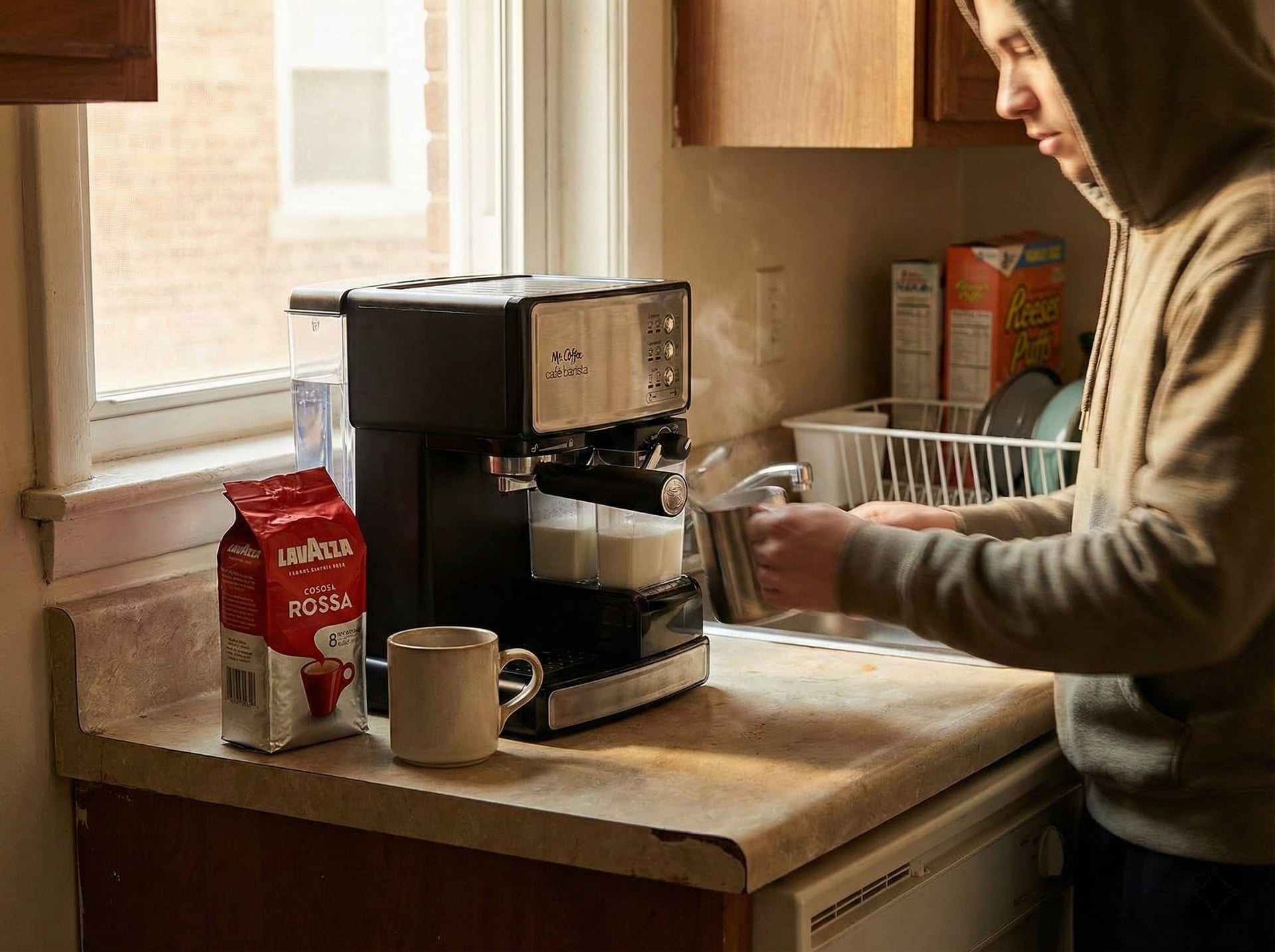
This machine was purchased independently and was not provided by Mr. Coffee.
Final Verdict
After 30 days with the Cafe Barista—pulling 100+ shots, making 75+ milk drinks, comparing it to my Gaggia Classic Pro and Breville Bambino Plus—here's my take: this machine occupies a weird, specific niche.
It's not trying to compete with café-grade stuff. It targets first-time buyers who want to explore home espresso without dropping $400-600. One-touch simplicity removes intimidation. Automatic frother kills the learning curve. Sub-$200 price makes experimentation less risky.
But the performance limitations are real. Extraction consistency was problematic in 40% of shots—temp fluctuations and fast timing. Automatic frother makes coarse macrofoam, not the silky stuff I learned to make during barista training. Build quality reflects the budget—plastic construction, proprietary parts, 12-24 month expected lifespan with regular use.
For my needs and expectations, I'd choose the Bambino Plus at $500 every time. That $300 difference buys actual café-quality extraction, real microfoam, 3-second heat-up, and build quality lasting 3-5 years instead of 12-24 months. Math favors better equipment.
But I get not everyone has that budget or commitment level. If $200 is your absolute max and you're unsure about the whole espresso thing, the Cafe Barista delivers adequate value as a learning tool. Just know what $200 actually buys.
Key Takeaways
- Extraction consistency is hit or miss—40% of shots showed quality issues from temp fluctuations and fast timing (18-22 sec vs ideal 25-30 sec)
- Automatic frother makes coarse macrofoam, not microfoam—fine for foamy drinks but latte art is impossible, tested 75+ drinks
- Build quality reflects budget: plastic construction, proprietary parts, expected lifespan 12-24 months with daily use
- One-touch operation genuinely works for beginners—watched a friend with zero experience make drinkable latte on attempt two
- Pre-ground grocery espresso (Lavazza, Illy) actually worked better than fresh specialty coffee—pressurized basket compensates for staleness
- Best for exploring home espresso on tight budgets, understanding this is likely a 12-24 month learning tool before upgrading
View the Cafe Barista as an intro learning tool, not a permanent solution. It teaches grind size basics, tamping technique, and milk drink fundamentals without requiring $400-600 investment. After 30 days testing, I'd recommend this for first-timers genuinely uncertain about commitment—understanding you'll likely upgrade within 18 months or discover espresso isn't your thing (wasting $200 instead of $500). For anyone wanting café-quality results, manual control, latte art, or long-term durability, spend $400-600 on the Bambino Plus or Gaggia Classic Pro—the performance gap absolutely justifies the price difference.
Get Coffee Tips
Join our newsletter for expert reviews and brewing guides.
Affiliate Disclosure: We may earn a commission when you purchase through links on our site. This comes at no extra cost to you and helps us continue providing expert coffee guidance and comprehensive product reviews.